
Fractions
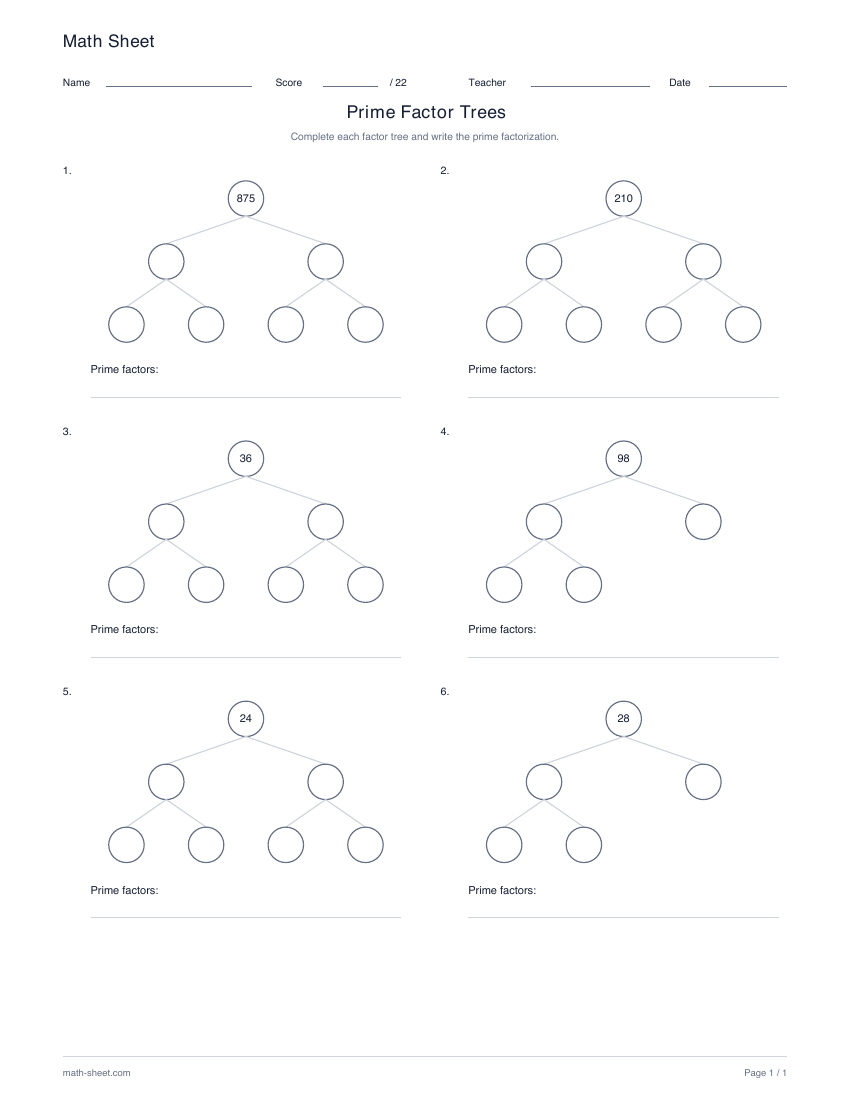
Prime factor trees
Break composite numbers into factor pairs until every branch ends in a prime, retaining repeated factors.
Preview and downloadBuild understanding, then fluency
Strengthen fraction operations and explain why they work. Use factors and multiples to simplify calculations, then apply the same reasoning to measurement problems.
This is a selected skill collection using familiar English grade labels. Grade expectations vary between schools and countries; it is not a full curriculum or a standards-alignment claim.
The learner should be comfortable with multiplication facts, equivalent fractions and converting mixed numbers. Teach the meaning of fractional division before relying on the reciprocal rule.
Discuss together
Two and one quarter is 9/4. Dividing 9/4 by 3/4 asks how many groups of three quarters are in nine quarters: 3 groups. The written calculation 9/4 × 4/3 = 3 agrees with that interpretation.
Step 1
Explain the difference between a factor and a multiple before finding one common to two values.
Fractions
Break composite numbers into factor pairs until every branch ends in a prime, retaining repeated factors.
Preview and download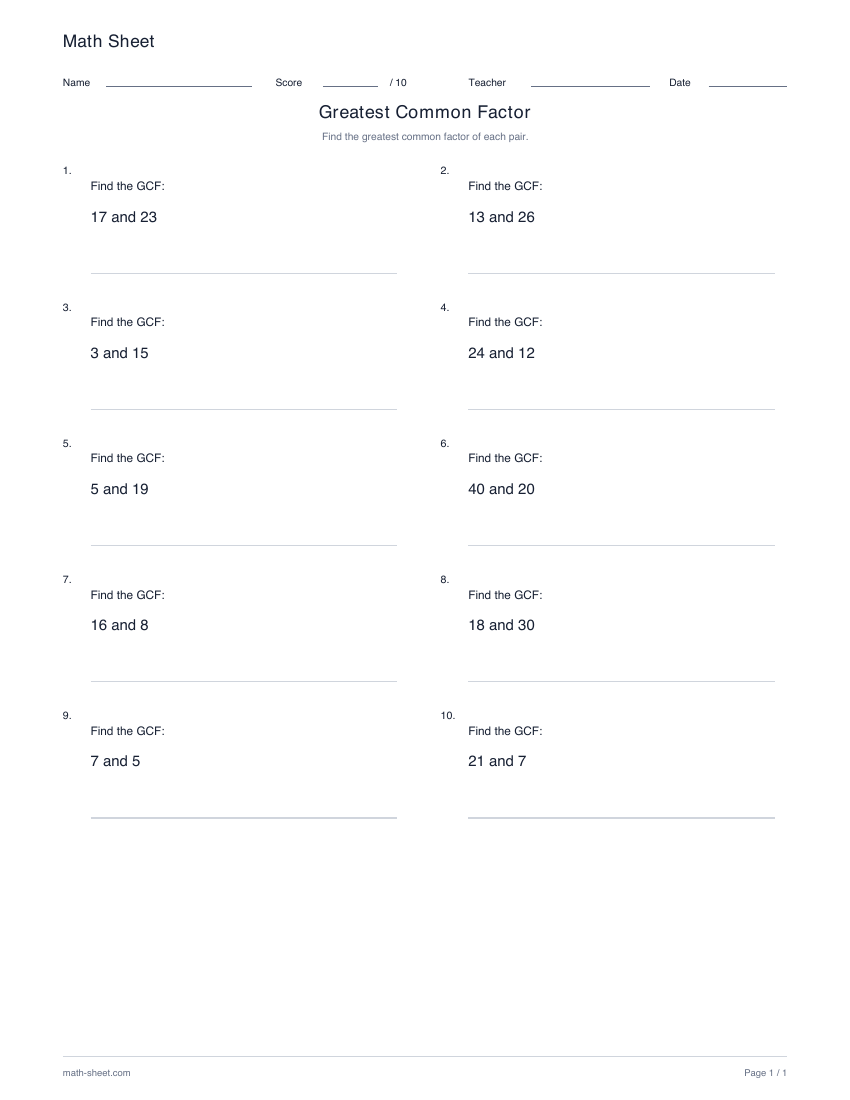
Fractions
Find the greatest common factor of positive integer pairs. Choose a maximum of 24, 40, 60 or 120 and 10, 15 or 20 questions, with a separate answer key.
Preview and download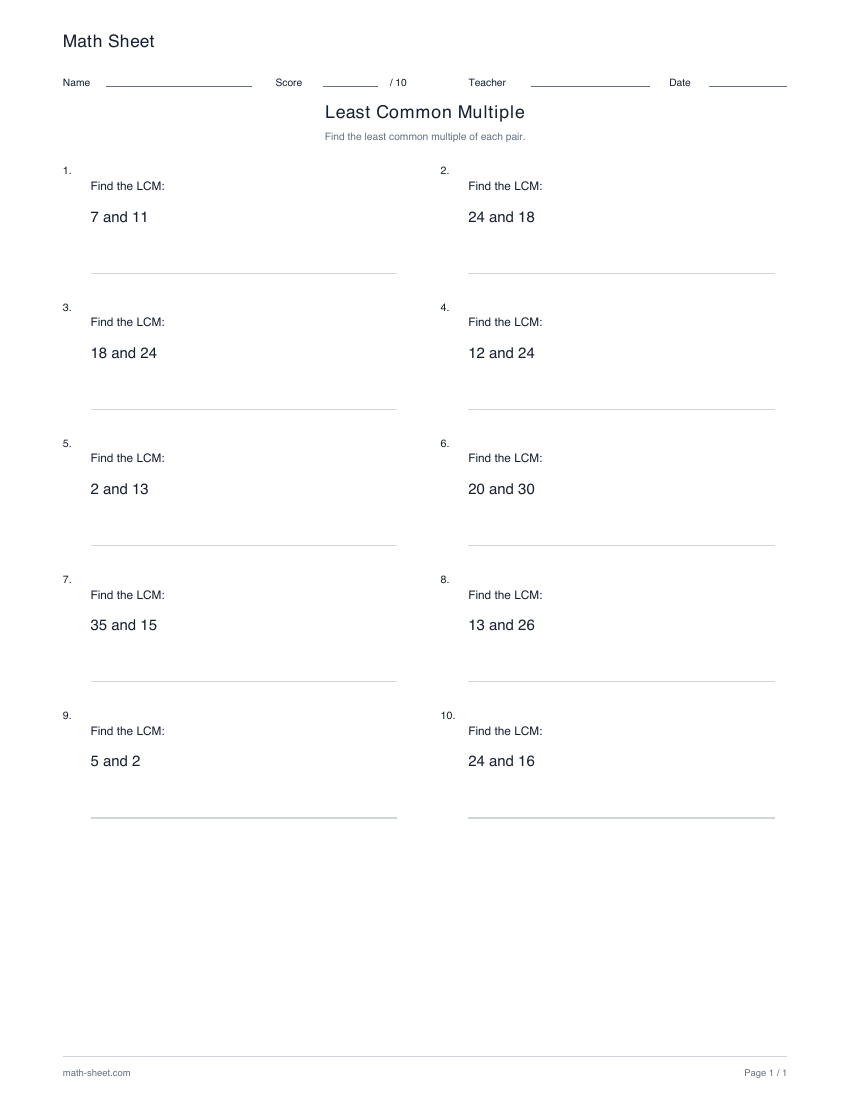
Fractions
Find the smallest positive multiple shared by two numbers and use it to plan common-denominator work.
Preview and download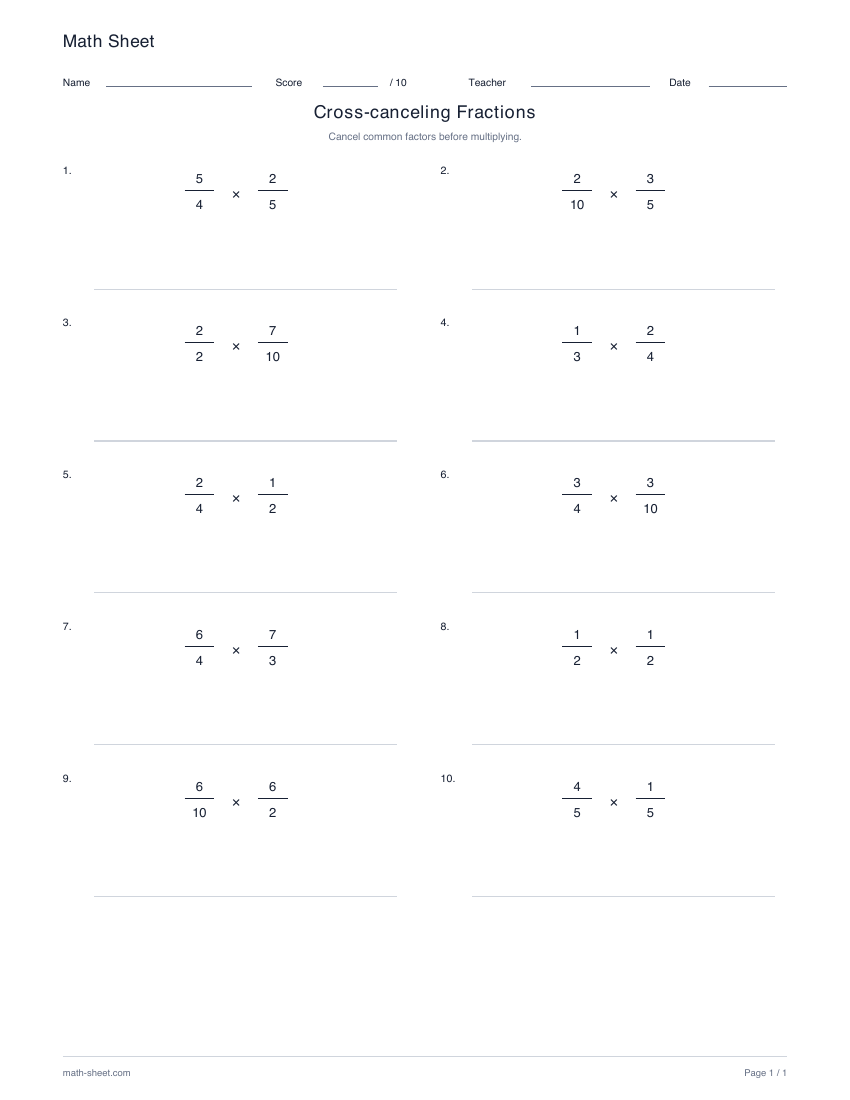
Fractions
Reduce common numerator and denominator factors before multiplication to keep the product calculation manageable.
Preview and downloadStep 2
Estimate whether the quotient should be larger or smaller than the dividend. Check by multiplying it by the divisor.
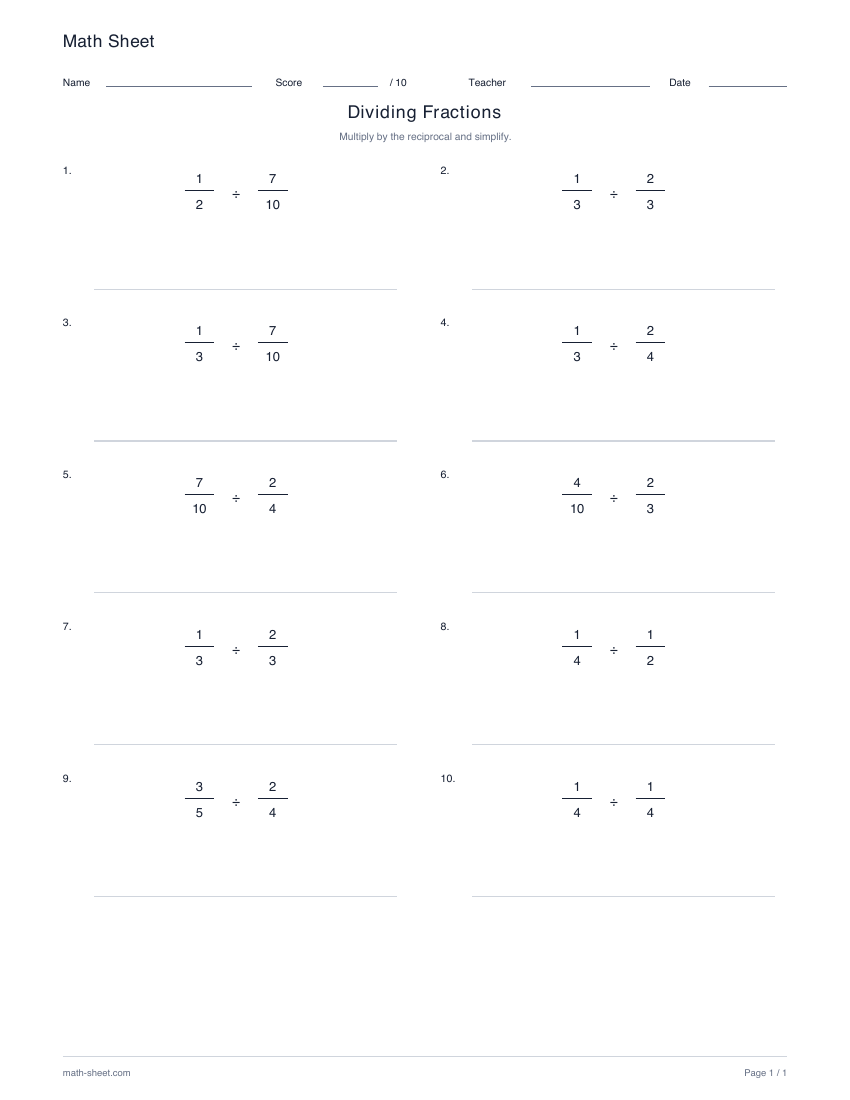
Fractions
Create a dividing fractions worksheet with 10 or 15 proper-fraction problems, three difficulty ranges, exact reduced answers, and a separate answer key.
Preview and download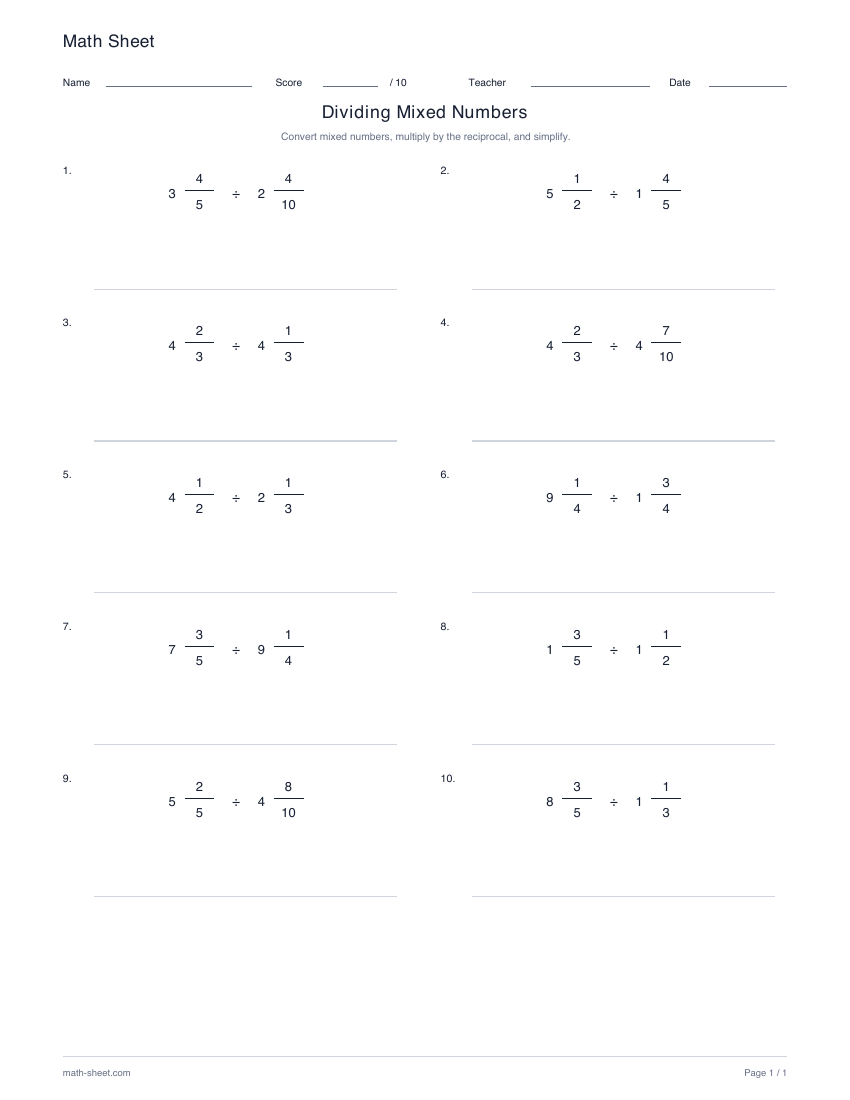
Fractions
Convert mixed quantities to improper fractions, divide them exactly and interpret the resulting quotient.
Preview and download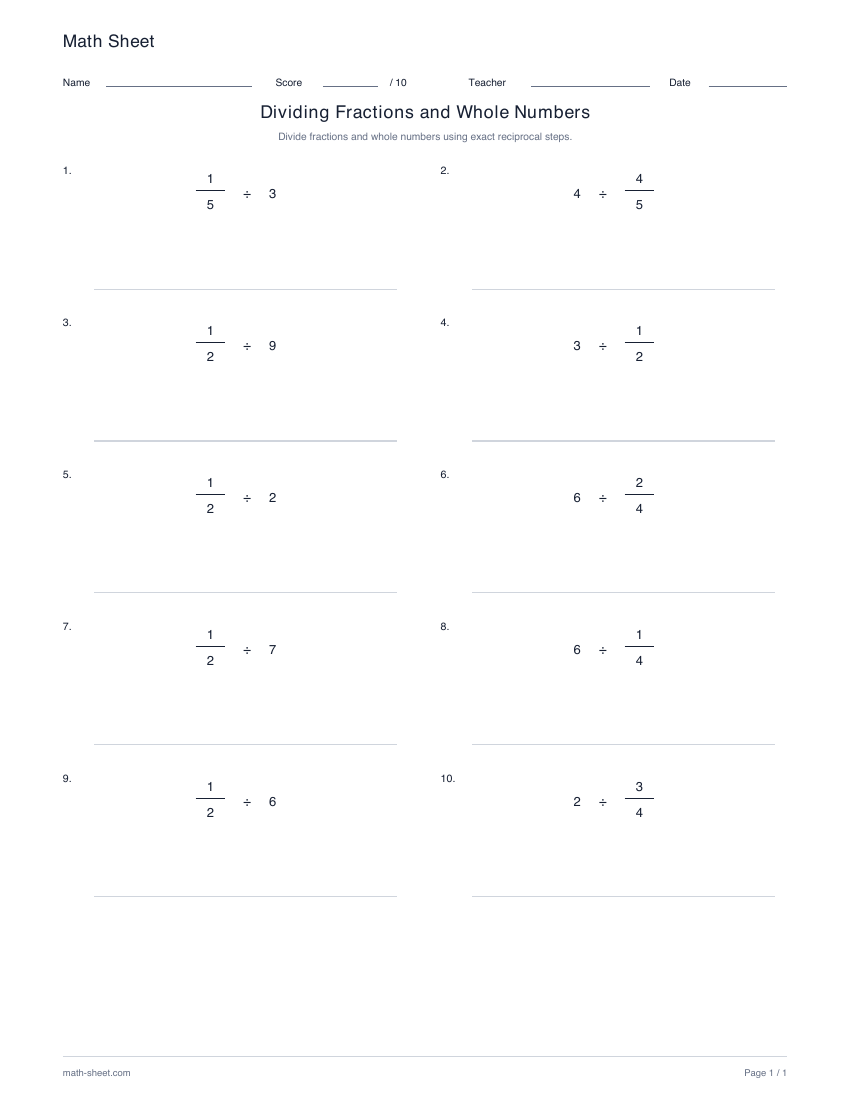
Fractions
Practice both a fraction divided by a whole number and a whole number divided by a fraction, preserving their different meanings.
Preview and download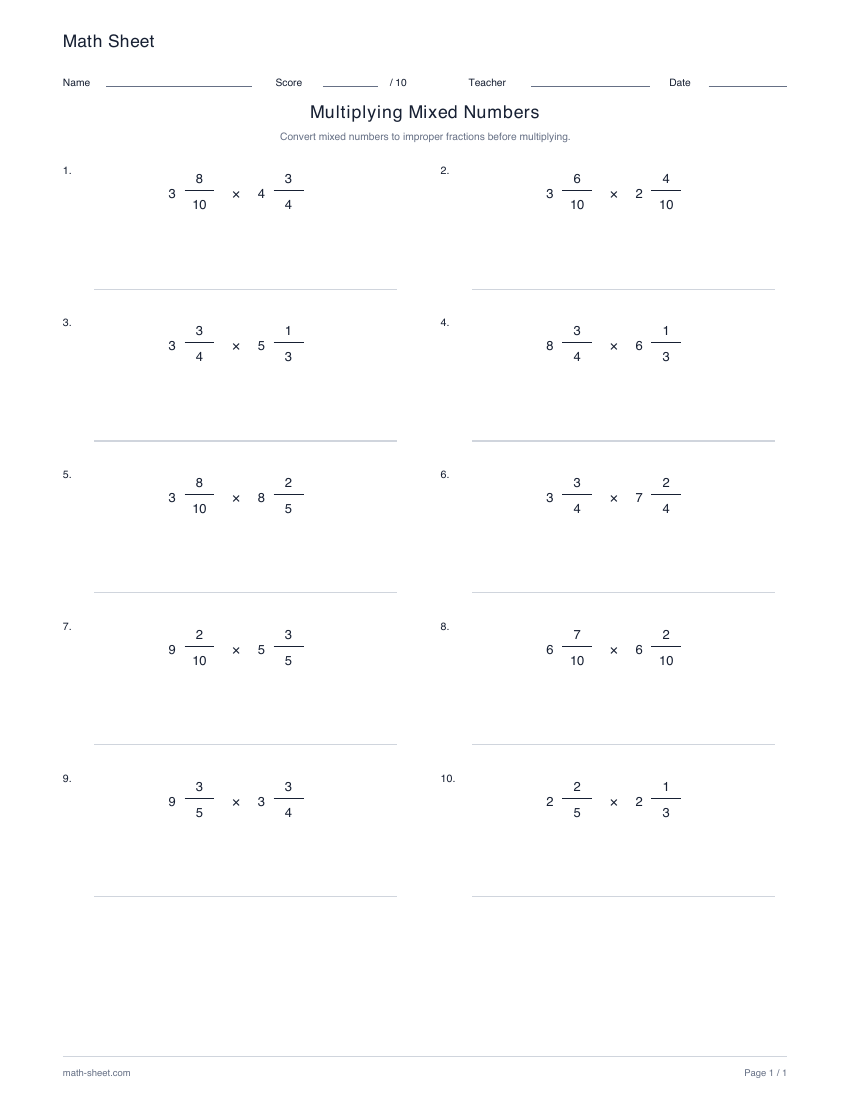
Fractions
Convert mixed numbers into single fractions before multiplying and expressing the product clearly.
Preview and downloadStep 3
Distinguish an exact finite decimal from an approximation. Exchange feet and inches before subtracting when needed.
Fractions
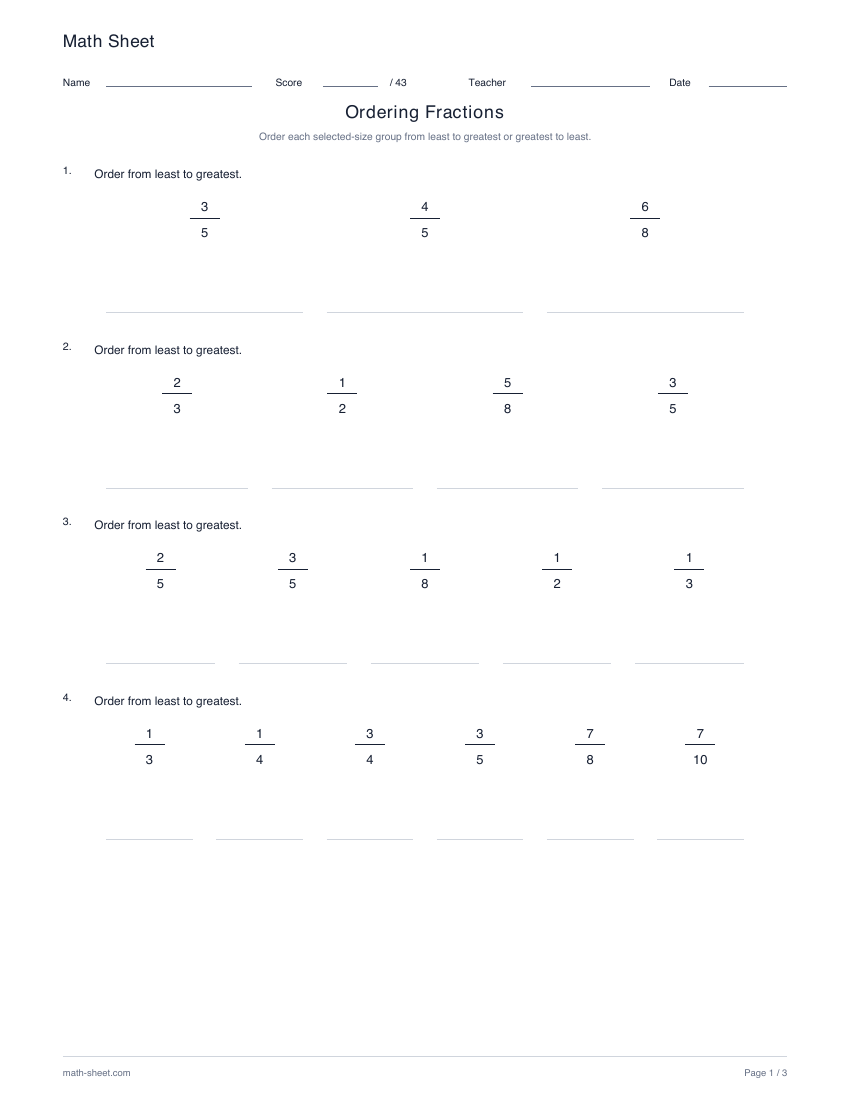
Arrange a group of fractions in the requested direction using exact comparisons and a consistent common unit.
Preview and download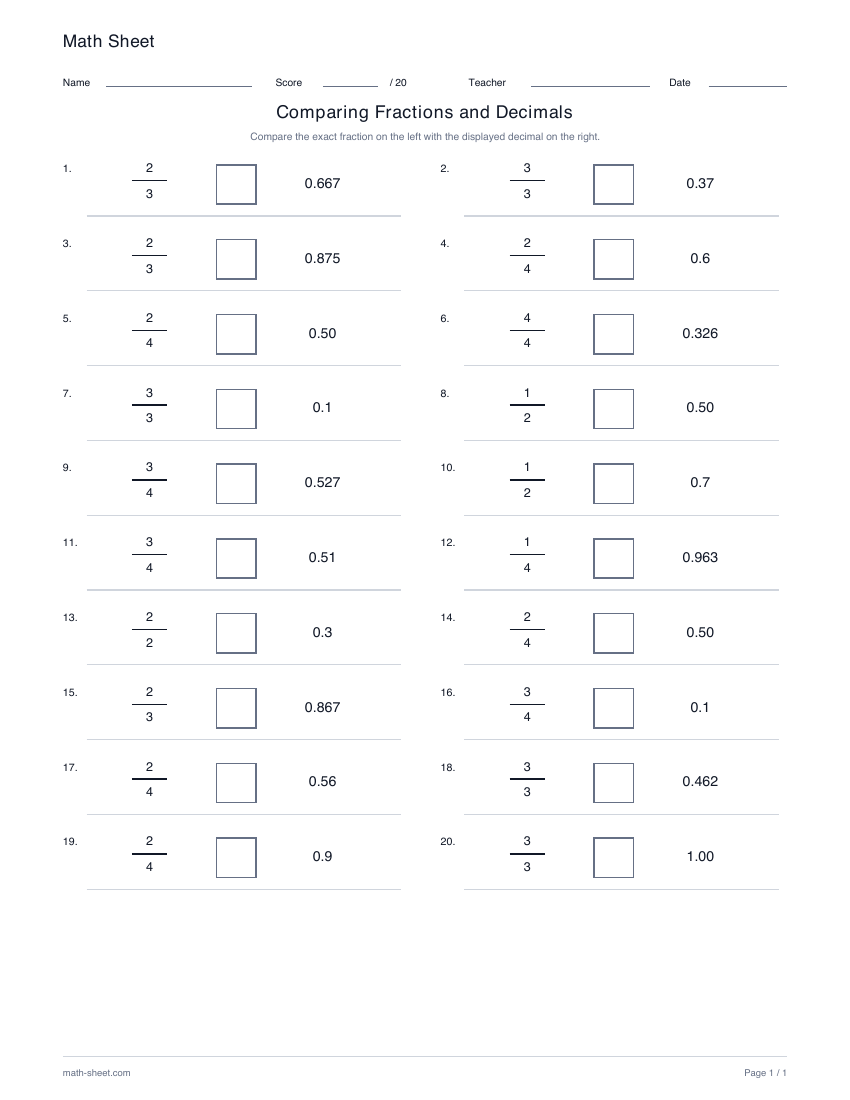
Comparing numbers
Compare a displayed fraction with a finite decimal, preserving exact values even when the fraction has a recurring decimal expansion.
Preview and download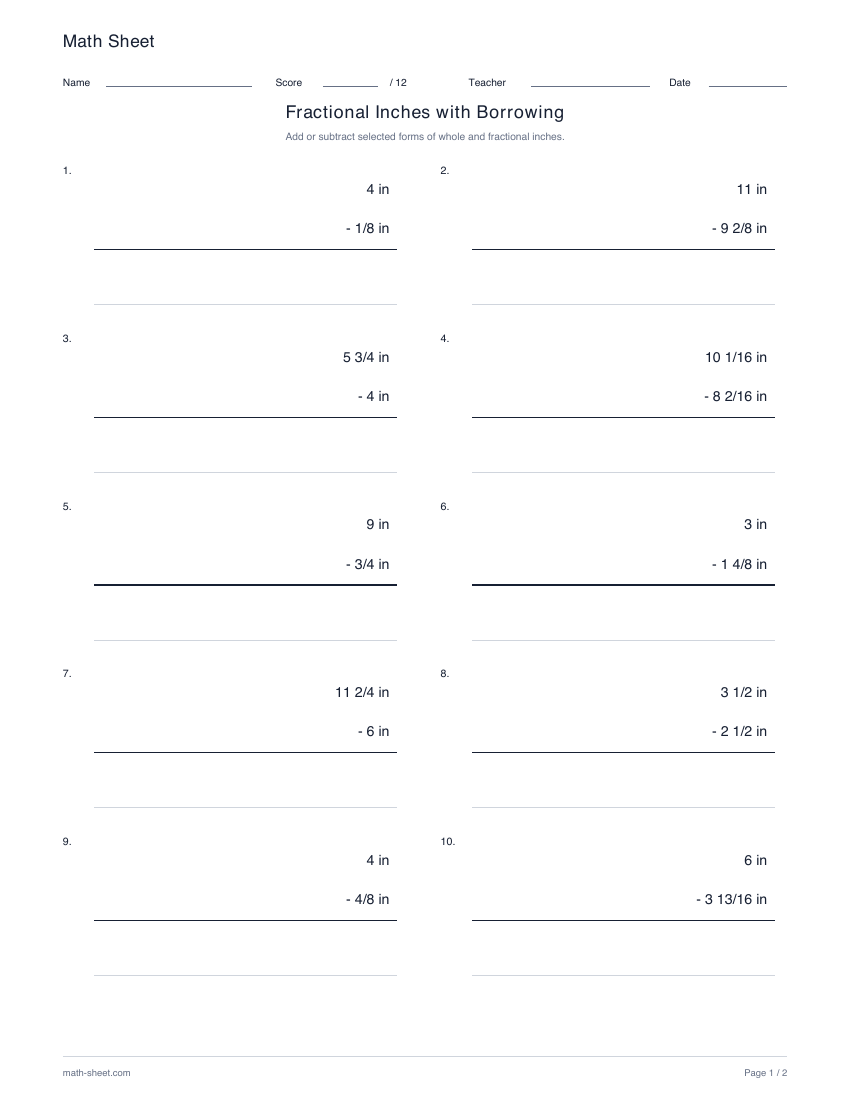
Fractions
Add or subtract whole, proper-fraction and mixed-inch quantities, with targeted practice in exchanging a whole inch.
Preview and download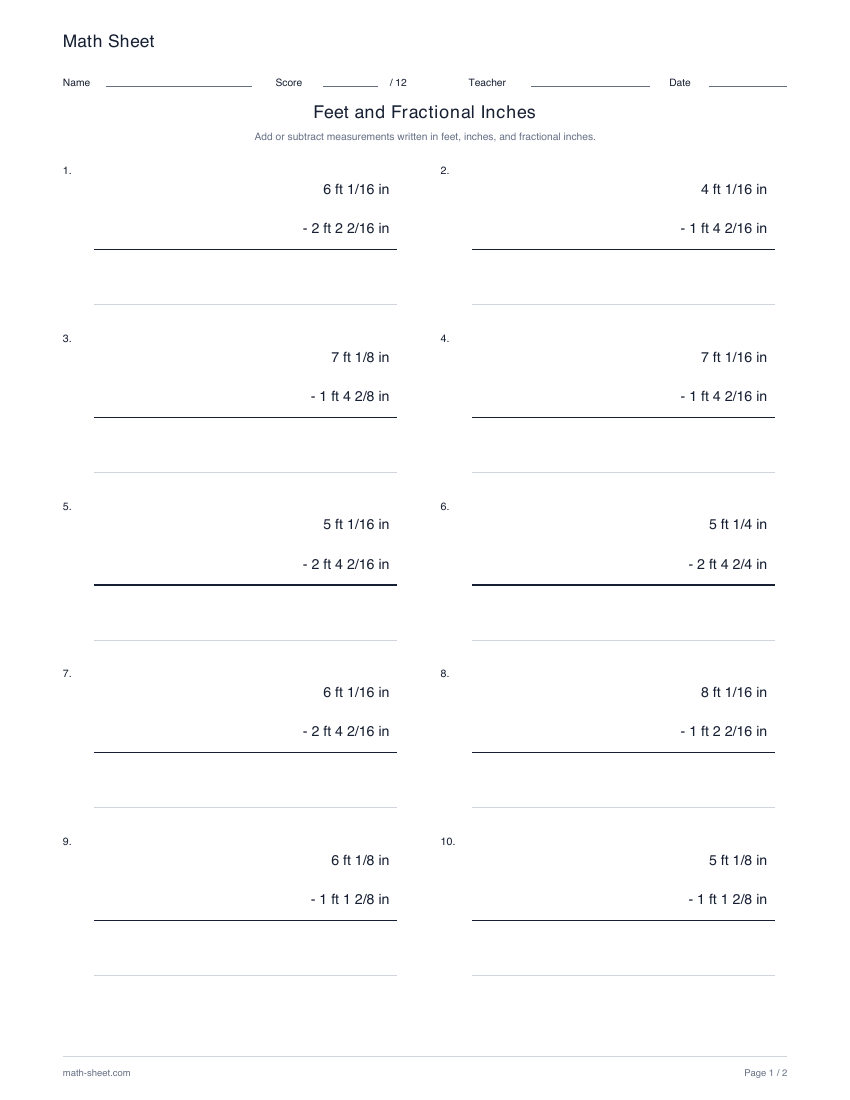
Fractions
Add and subtract compound lengths with feet, whole inches and fractional inches, preserving both unit exchanges.
Preview and downloadUse these skills as prerequisites for ratios and algebra. This collection does not yet cover a complete Grade 6 curriculum.
Begin with a short set, review the learner's explanation, and adjust the settings for the next lesson. Advanced options on an activity page may extend beyond this stage.
Choose after the relevant decimal places are familiar. Signed subtraction is an optional later step; these settings describe readiness, not a required curriculum.
Use after signed numbers are secure. Decide which operand is greater, then calculate the exact difference.
Open this decimal practice →Mix all three multipliers and explain why the key may retain trailing decimal zeros.
Open this decimal practice →Start after equivalent fractions and decimals are familiar. These settings are readiness suggestions; local curricula may introduce percentages at a different stage.
Practice both directions, simplify fractions and retain every decimal place needed for an exact answer.
Open this percent practice →Read ten word prompts, identify part, whole or rate, and round the final result to two decimal places.
Open this percent practice →Begin after array counting, common factors and equivalent fractions are familiar. Grade 5 options are teacher-led introductions; use rates and applications when the learner can explain the required division and unit conversions.
Count the same picture twice for different comparisons. Name the quantities before simplifying each ratio.
Open this ratio practice →Gaps and shuffled positions require learners to derive each missing value from the complete anchor.
Open this ratio practice →Compare all four rows in each of three contextual tables and justify the matching pair.
Open this ratio practice →Use after unit rates and time conversions are familiar. Keep exact intermediate values and answer every part.
Open this ratio practice →Choose by the learner's arithmetic readiness. Begin with familiar facts and one grouping level; signed inputs and powers are later options, not a claim of curriculum alignment.
Use after exponent notation and grouped calculations are secure. Work from the innermost group outward.
Open this order-of-operations resource →Use after negative-number arithmetic is familiar. Choose the next operation and check its sign before continuing.
Open this order-of-operations resource →Read, rewrite and evaluate
Begin with familiar operations and short verbal phrases. Add signed coefficients, grouping and two-variable inputs when the prerequisites are secure. These entry points are readiness suggestions, not country or curriculum requirements.
Use the phrase guide to discuss operation order and the meaning of grouped quantities.
Open this resource →Use whole-number inputs in short expressions; signed coefficients still require careful arithmetic.
Open this resource →Combine like terms with smaller coefficient magnitudes before adding more terms and groups.
Open this resource →Practice one distribution at a time, including negative factors.
Open this resource →Match each variable with its own value, then calculate with positive and negative integers.
Open this resource →Practice a variable as the dividend or divisor, with whole-number inputs chosen for exact division.
Open this resource →Keep track of both inputs, negative divisors and the other terms in the expression.
Open this resource →Beyond one equation
These are extension activities for learners already comfortable with signed arithmetic, linear equations and coordinate graphs. Choose by readiness and local expectations; the grade label does not claim curriculum alignment.
Compare substitution with the point where two lines meet. Use the worked reference after single equations and coordinate graphs are familiar.
Open this starting point →Pair a general equation with a simpler equation and use substitution. A simpler form can still lead to an exact fractional answer.
Open this starting point →Work with two standard-form equations. Scale complete equations, eliminate one variable, then check both coordinates.
Open this starting point →Graph a slope-intercept equation with a horizontal or vertical line. Find the shared point and verify its coordinates.
Open this starting point →Expressions with powers
These are extension starting points for learners ready for variables, signed arithmetic and exponents. Choose by readiness and local expectations; a grade label does not claim curriculum alignment.
Start when variables and powers are familiar. Compare one, two and three complete terms, keeping multiplication within each term.
Open this starting point →Start with coefficients from 4 to 20 and one or two unpowered variables. Write every prime factor before using exponent notation.
Open this starting point →Combine two groups with four or five input terms. Use signed arithmetic to remove parentheses without losing a sign.
Open this starting point →Keep the first factor monic while learning to form all four products. Then vary the second factor’s leading coefficient.
Open this starting point →Coordinate relationships
These are extension starting points for learners ready for signed coordinates, fractions and variables. Choose by readiness and local expectations; a grade label does not claim curriculum alignment.
Begin after coordinate plotting and signed subtraction are secure. Compare vertical and horizontal changes between two points.
Open this starting point →Start with y already isolated so the learner can connect its coefficient and constant with a graph.
Open this starting point →Write the equation and graph it from supplied properties, keeping each representation connected.
Open this starting point →Mix standard and slope-intercept forms after equivalent transformations and fractions are familiar.
Open this starting point →Describe a set of solutions
Choose by readiness: reading number lines comes before signed transformations and distribution. These starting points are general guidance, not alignment with a national curriculum.
Read the complete handout together, moving from open and filled endpoints to equivalent transformations.
Open this starting point →Draw twenty rays on a nonnegative number line, with positive variables and all four comparison symbols.
Open this starting point →Alternate ten graphing tasks with ten graph-reading tasks, including negative boundaries and half units.
Open this starting point →Compare positive and negative multipliers or divisors before moving to two-step inequalities.
Open this starting point →Mix three addition, three subtraction, two multiplication and two division questions in one ten-question review.
Open this starting point →Use additive and multiplicative inverse steps, then check the endpoint and ray in the original inequality.
Open this starting point →Keep both sides equal
Choose by readiness: signed arithmetic, inverse operations, fractions and distribution are separate prerequisites. These grade entry points do not claim alignment to a national curriculum.
Use a short equation to explain how one operation can be undone on both sides. Signed-number knowledge is needed.
Open this starting point →Use familiar inverse operations with decimal operands and terminating solutions.
Open this starting point →Interpret mixed numbers and reciprocals, then distinguish an exact fraction from a rounded decimal.
Open this starting point →Balance integer, decimal and fraction equations while keeping every solution and check exact.
Open this starting point →Practice two-step equations, including fractional coefficients and a whole numerator divided by a constant.
Open this starting point →Move from expanding expressions to simplifying both sides of a complete equation.
Open this starting point →Keep the visible inputs simpler while practicing variables on both sides. The resulting solution may still be negative.
Open this starting point →Compare missing quantities, groups, shared totals and costs before writing a one-step equation.
Try the expanded story set →Count outcomes. Explain the chance.
Choose by readiness with fractions, factors and compound events. These starting points are suggestions based on prerequisites, not claims of country or curriculum alignment.
Compare sums and absolute differences using two distinguishable dice.
Open this resource →Replace and shuffle after the first draw, then multiply the event probabilities.
Open this resource →Use the introductory sections first; explore conditional probability and trees when ready.
Open this resource →Explain why a method works
Choose by readiness for the operations and notation shown. Equality rules with variables are enrichment options; these suggestions do not claim alignment with a country or curriculum.
Move from noticing a change to identifying the mathematical property behind it.
Open this resource →Seven enrichment questions introduce equality rules and the restriction on dividing by zero.
Open this resource →Connect areas and lengths
These are readiness suggestions for practice, not claims of country or standards alignment.
Begin with the illustrated explanation after learners know square area and right angles.
Open this resource →An enrichment starting point for learners who can square numbers and recognize a positive square root.
Open this resource →Mix hypotenuse and leg questions after learners can rearrange the squared-length relation.
Open this resource →Connect coordinate differences to the two legs of a right triangle; introduce signed grids later.
Open this resource →Describe shape and direction
These are readiness suggestions for practice, not claims of country or standards alignment.
Begin after learners recognize a right angle and can compare degree measures with 90 and 180.
Customize this geometry task →Use clear rotated examples to decide whether the extended supporting lines will ever meet.
Customize this geometry task →Move from the parts of one angle to equivalent names and complete lists in multi-ray figures.
Customize this geometry task →Compare perpendicular examples with parallel and oblique pairs, including rotated configurations.
Customize this geometry task →An enrichment choice for learners ready to combine position, opposite rays and exact measures.
Customize this geometry task →Distinguish parallel, perpendicular and ordinary oblique intersections in one balanced set.
Customize this geometry task →Use endpoint names and right-angle marks to classify ten pairs drawn in a shared six-line figure.
Customize this geometry task →Align a protractor with the requested left or right starting ray and measure eight angles to the nearest degree.
Customize this geometry task →Use a stated degree and starting ray to draw and label eight new rays above the baseline.
Customize this geometry task →Subtract one stated region measure from 90, with whole-number, tenths or hundredths precision.
Customize this geometry task →Use opposite outer rays to justify a 180-degree total and calculate the missing region.
Customize this geometry task →Transfer two adjacent givens to their opposite regions and check each straight-line sum.
Customize this geometry task →Use a fixed two-page reference to connect side classes, angle classes and the 180-degree interior sum.
Customize this geometry task →Use equal-side ticks and exact right-angle marks to sort twelve rotated triangles into seven named classes.
Customize this geometry task →Use three numbered angle values, including interior, adjacent exterior and vertical proxy cases, to solve exactly for x.
Customize this geometry task →Use one adjacent exterior angle and its two remote interior angles to solve exactly for x.
Customize this geometry task →Read exact shape markings, then calculate area and perimeter with linear and squared units.
Customize this geometry task →Classify real triangles, use visible side lengths, and work with supplied or derived perpendicular heights.
Customize this geometry task →Start from a radius or diameter, then find all four measurements using pi = 3.14 and correct units.
Customize this geometry task →Find base area, multiply by the distance between bases, and round final irrational volumes to the nearest hundredth.
Customize this geometry task →Decompose nine shaded figures into rectangles, triangles, circles and semicircles, then round only the final signed total.
Customize this geometry task →Apply horizontal, vertical and two-axis movements to every vertex on a four-quadrant coordinate grid.
Customize this geometry task →Use axes, diagonals and offset horizontal or vertical mirror lines to draw exact images.
Customize this geometry task →Plane geometry reference
Keep labelled diagrams, formula conditions, symbol meanings and unit reminders together while solving plane-figure problems.
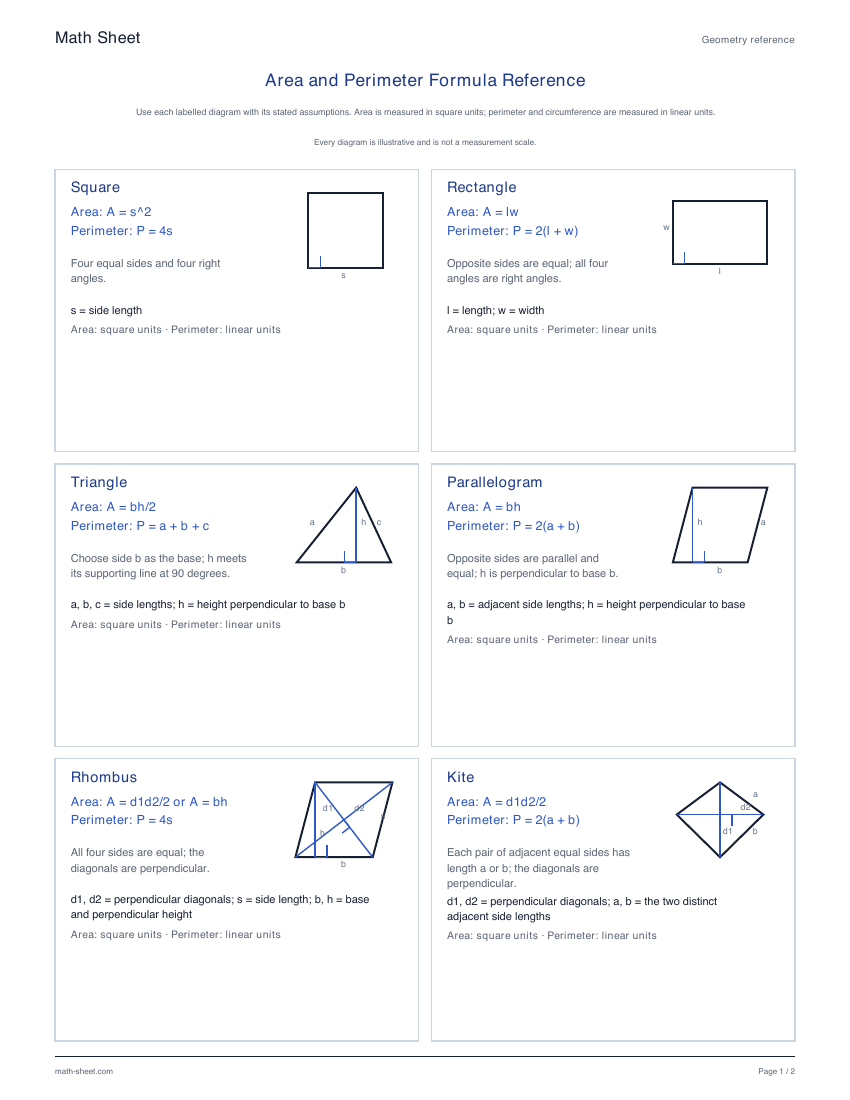
Geometry
Print nine labelled area and perimeter formula cards for common plane figures, with exact assumptions, symbol definitions and unit reminders.
Preview and downloadLocate, plot and connect
Use the signs of x and y to locate points, including positions on the axes.
Customize this graphing task →Start with one sequence and check the completed shape before trying multiple paths.
Customize this graphing task →Draw, plot and explain
Use four −5 to 5 grids after signed coordinates are familiar. These are blank plotting templates, without a preset exercise or answer key.
Customize this paper →Describe a dataset
Practice after negative-number arithmetic is familiar. Check the order of signed values and the average of two central observations.
Customize this practice →Choose familiar arithmetic so the learner can focus on the story. These starting points describe readiness; expectations differ between schools and curricula.
Model how many portions fit in the available amount before using the reciprocal algorithm.
Open this story practice →Label the three related quantities and calculate from the given values.
Open this story practice →