
Geometry
Identifying parallel lines worksheets
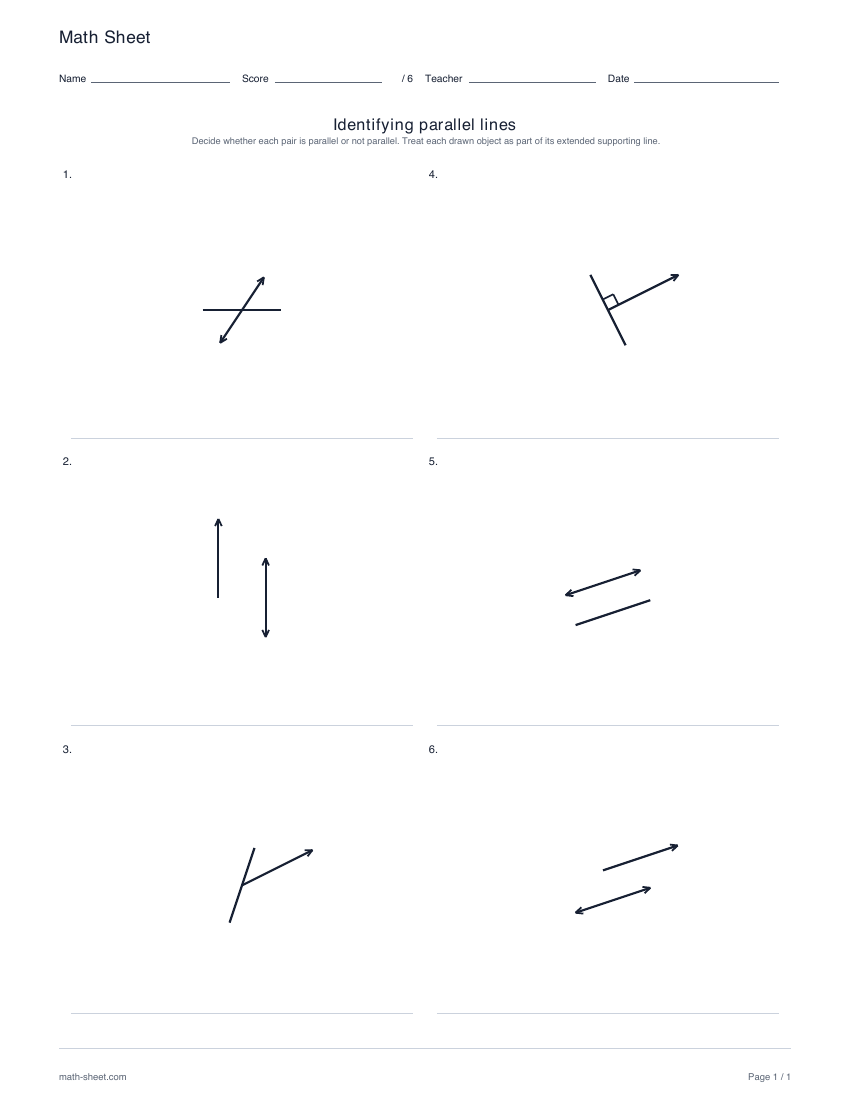
Decide whether six pairs of extended supporting lines are parallel. The balanced set includes parallel, perpendicular and oblique examples in varied orientations.
Preview and downloadGeometry practice
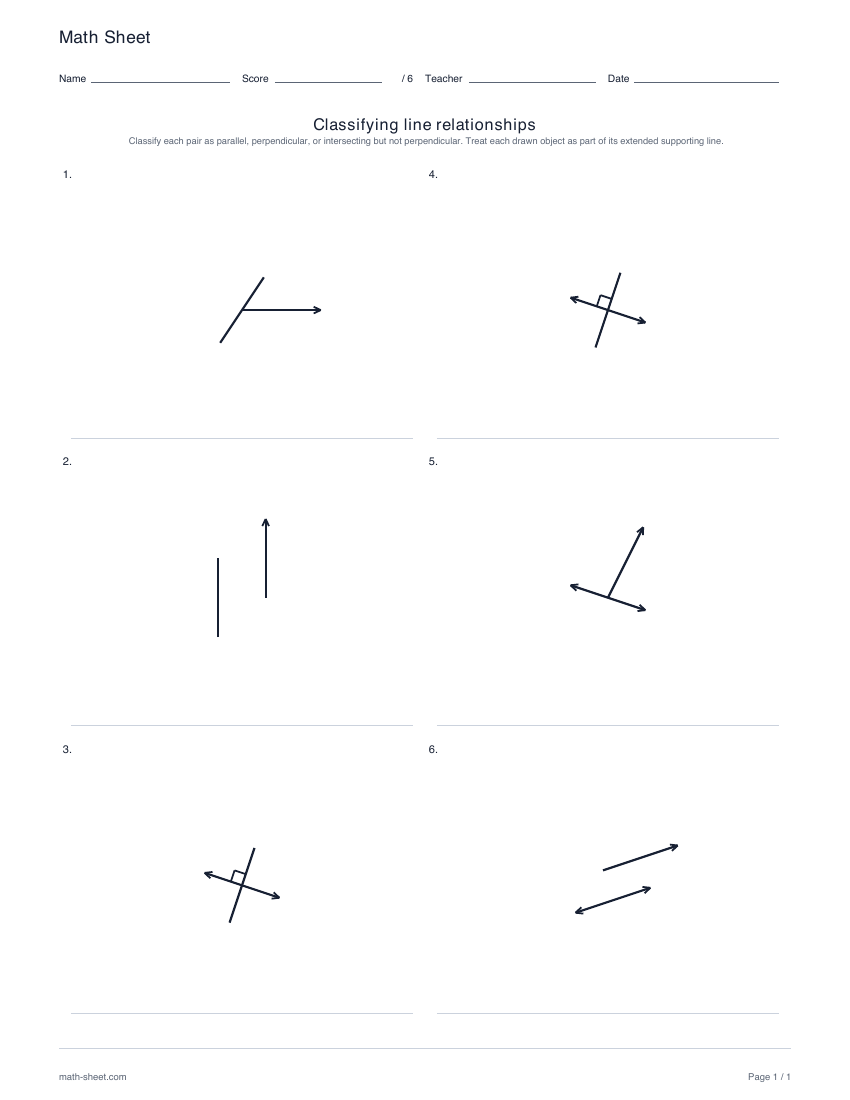
Classify six pairs of extended supporting lines as parallel, perpendicular or intersecting but not perpendicular. Each worksheet balances two examples of every relationship.
Ready-made English PDF · fixed settings
Customization below makes a separate PDF.
Fixed English ready-made files. Custom settings below apply only to the configured PDF.
Ready to print
Classify the extended supporting lines as parallel, perpendicular, or intersecting but not perpendicular. Extend every drawn line, ray or segment mentally in both directions.
Download the practice pages alone, or include a separate answer key or teacher model. Longer activities may use more than one page.
Customize this worksheetEach line, ray or segment represents part of a complete supporting line. Extend both straight paths mentally before deciding their relationship. Short pieces that do not touch on the page can still have supporting lines that intersect.
Parallel lines remain distinct and keep the same direction. Perpendicular lines intersect at exactly 90 degrees. A different crossing is labelled intersecting, not perpendicular.
Learning objective
Use a complete three-way classification that keeps ordinary oblique intersections distinct from right-angle intersections.
Worked example
Intersecting, not perpendicular.
The lines meet, so they are not parallel. Their angle is 60 degrees rather than 90 degrees, so perpendicular is also incorrect.
Teaching notes
Make it yours
Choose your options, update the preview, then download the exact same pages.
A useful next step
Geometry
Decide whether six pairs of extended supporting lines are parallel. The balanced set includes parallel, perpendicular and oblique examples in varied orientations.
Preview and download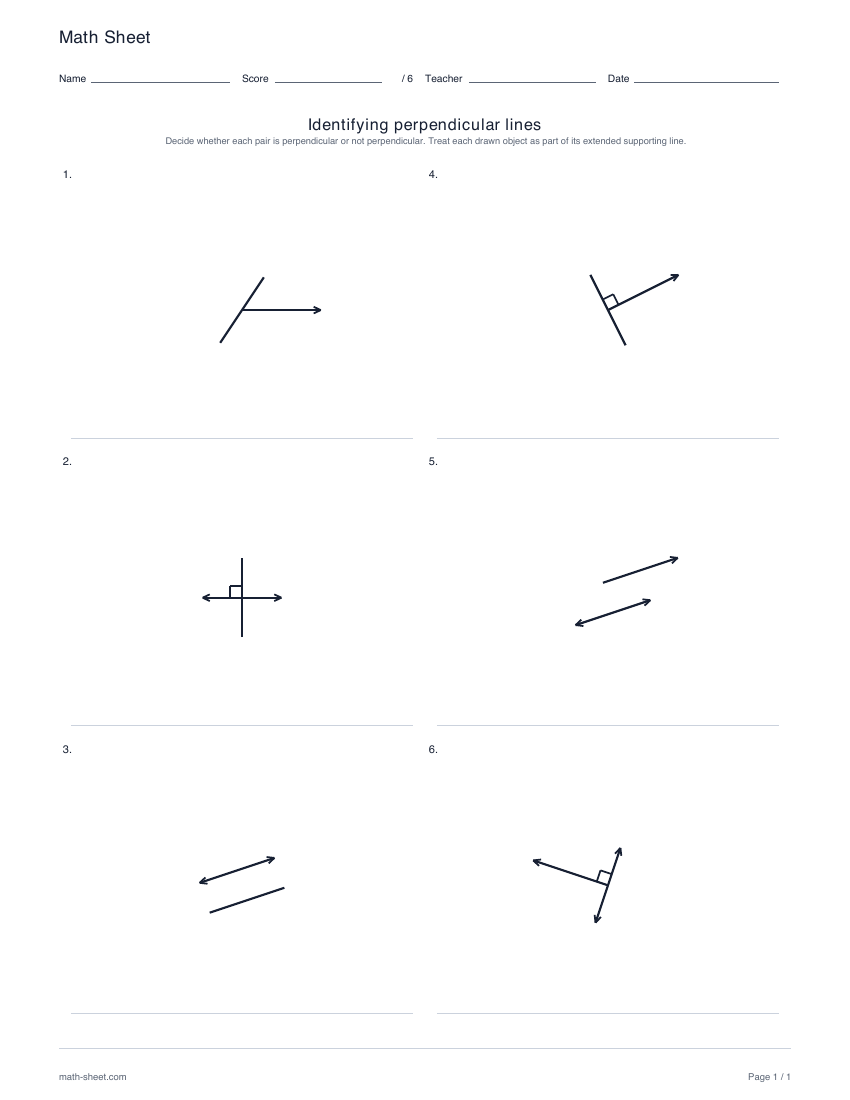
Geometry
Decide whether six pairs of extended supporting lines are perpendicular. True examples include a right-angle mark; counterexamples include parallel and oblique pairs.
Preview and download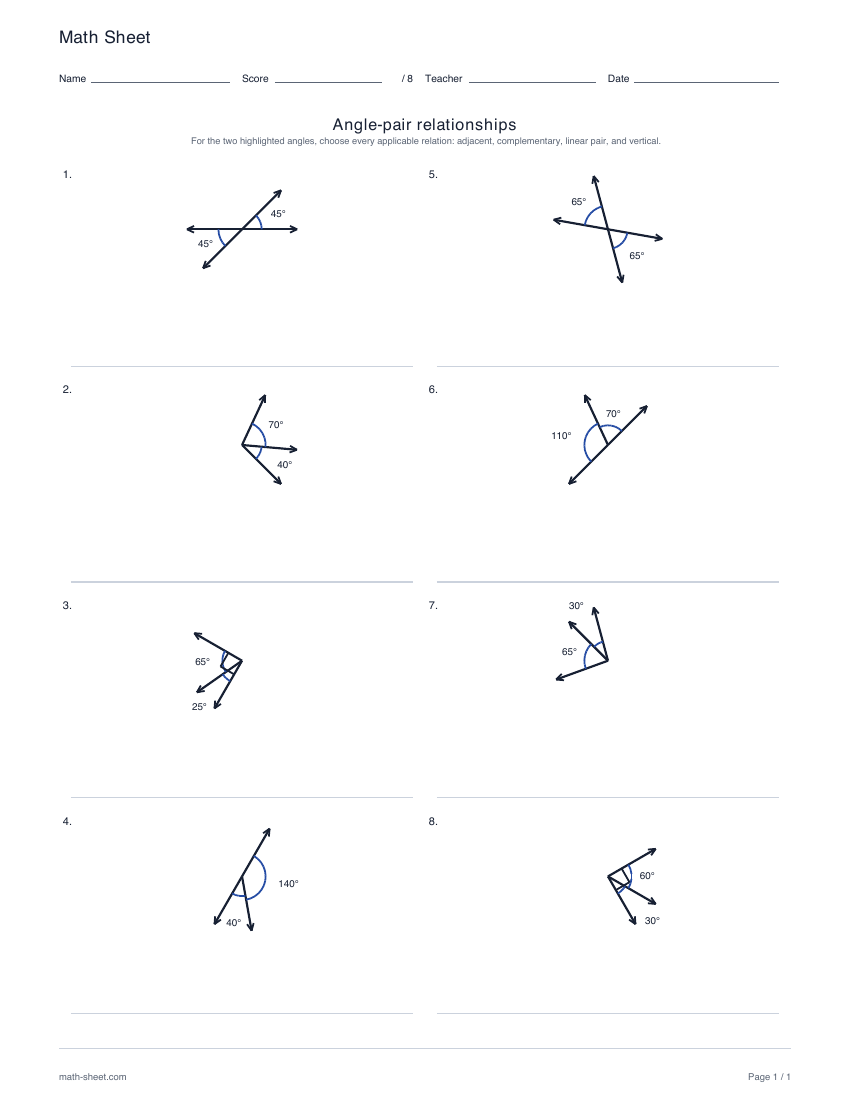
Geometry
Identify every relationship that applies to two marked angles: adjacent, complementary, a linear pair or vertical. Eight diagrams show both exact measures and a separate checked answer key.
Preview and download