Make sense of the story before doing the calculation. Start with familiar numbers, then explore missing quantities, measured amounts and several linked steps.
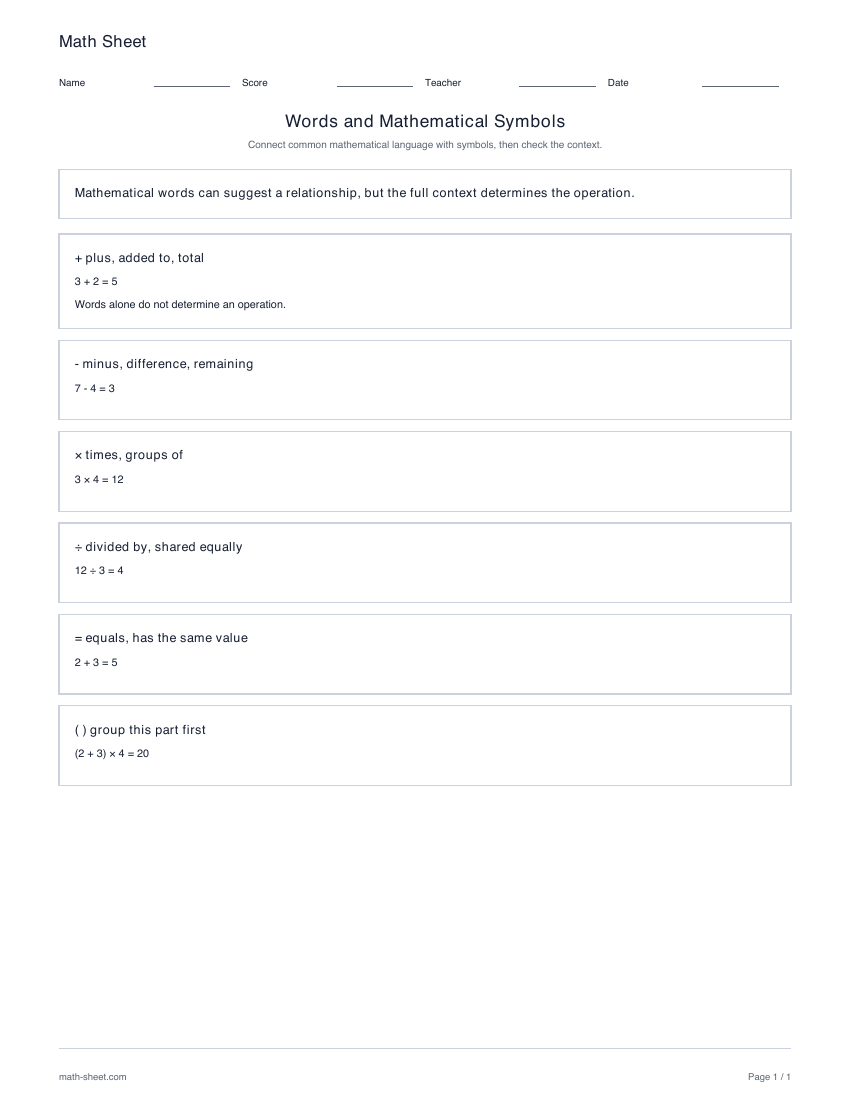
Connect mathematical language with addition, subtraction, multiplication, division, equality and grouping. Print a reference with contextual examples that goes beyond memorizing keywords.
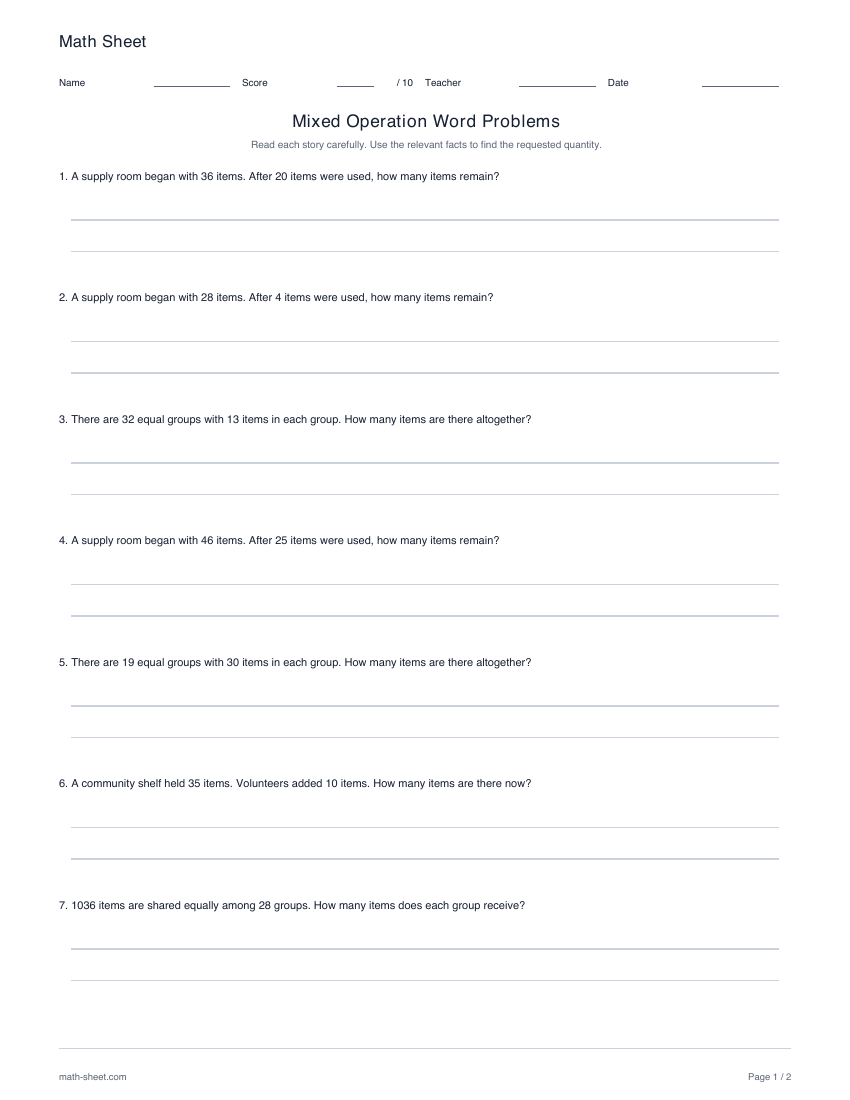
Practice reading mathematical language in ten mixed-operation stories. Select the operation pool, number wording and extra information while checking the meaning of each question.
Choose addition/subtraction, addition/multiplication, multiplication/division or all four operations. Set the digit range, number wording and extra information for ten stories.
Preview and download →
Explain the relationship
Addition and subtraction stories
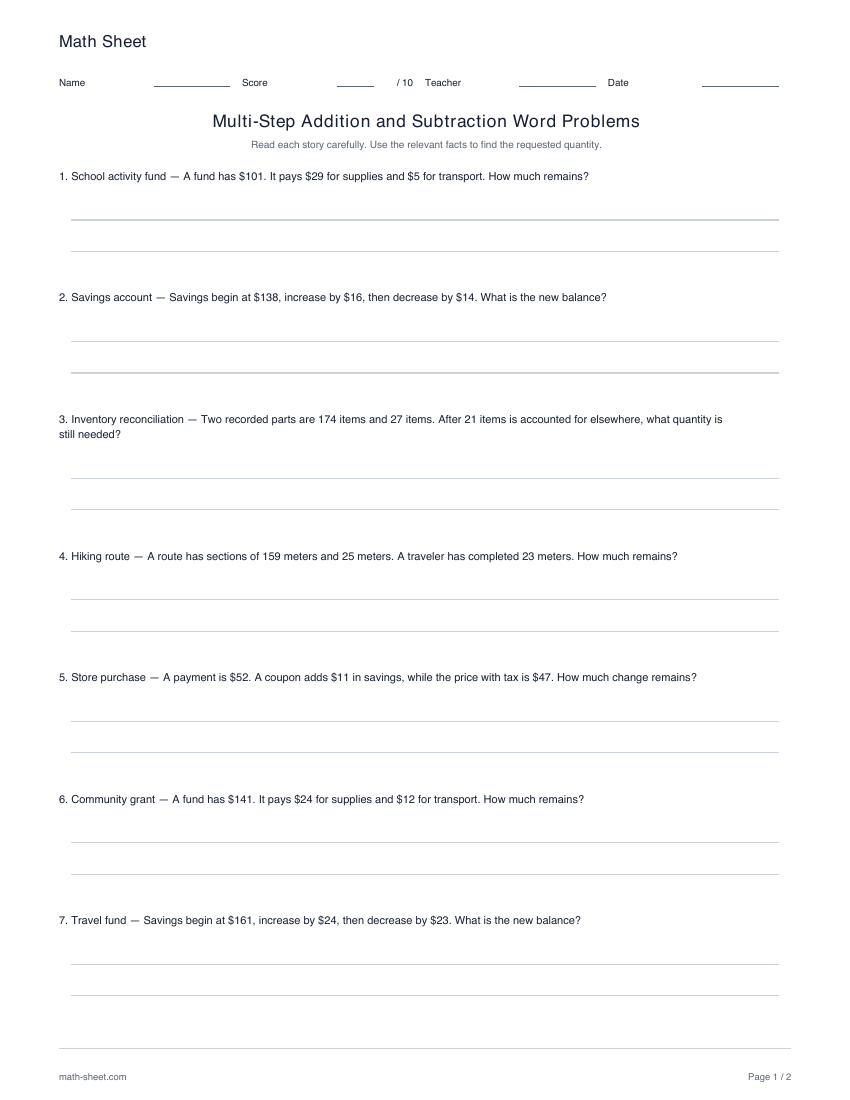
Combine parts, find what remains, compare quantities and recover a missing amount. Choose a number range that leaves room to focus on reading.
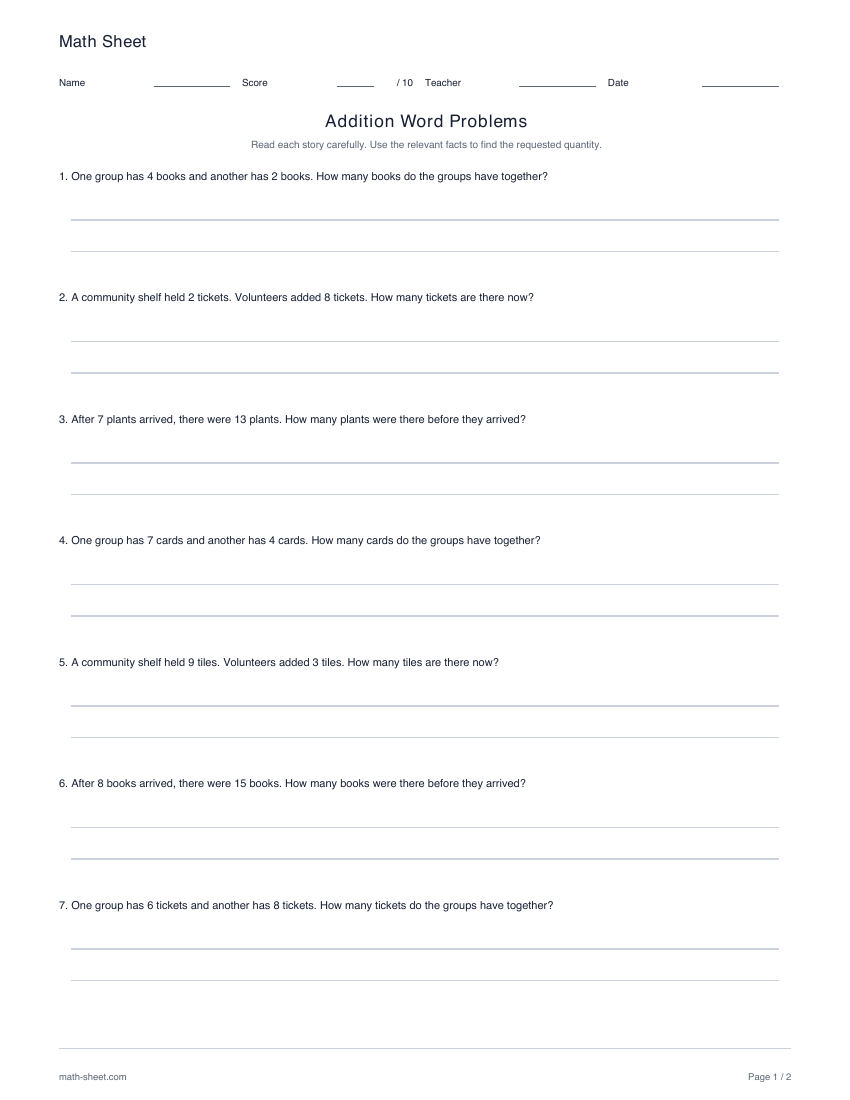
Print ten addition stories with two or three addends. Choose one- or two-digit numbers, digits or number words, and optional extra information, with a separate answer key.
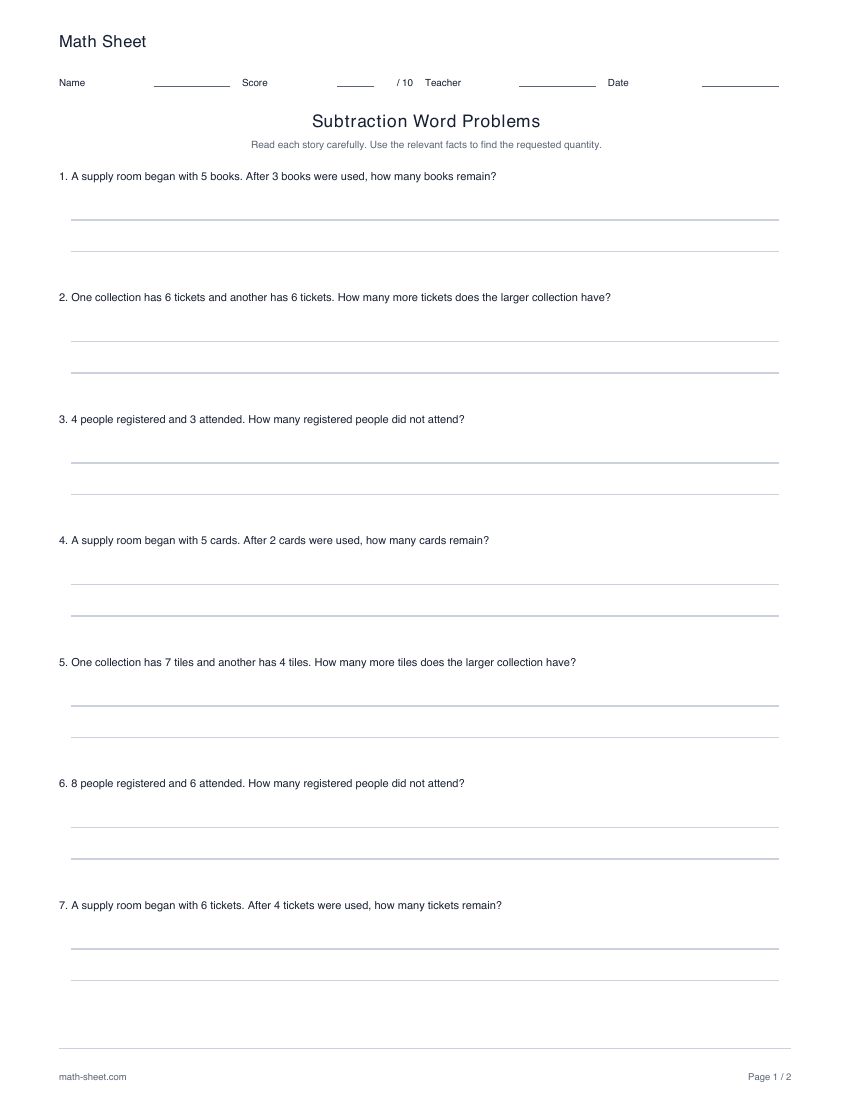
Practice remaining amounts, differences and missing quantities with ten subtraction stories. Choose one- or two-digit values, number wording and irrelevant-information options.
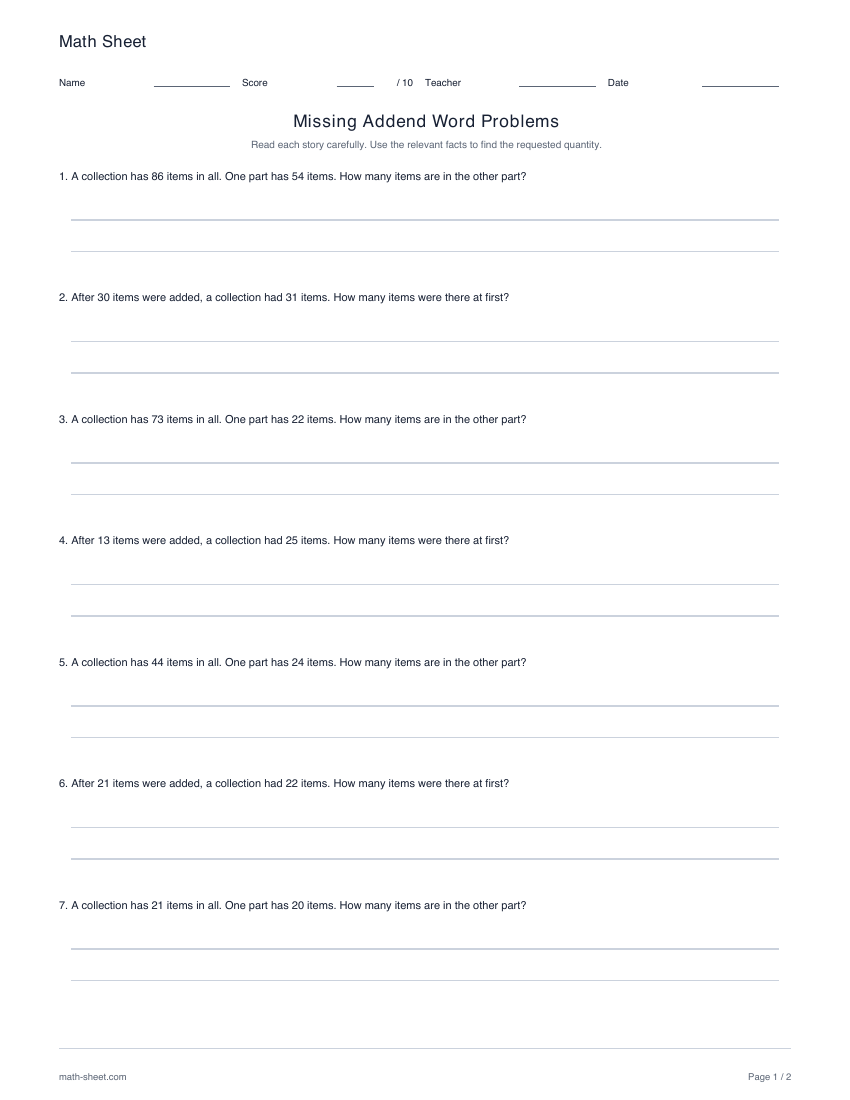
Find an unknown part or starting quantity in ten stories. Select practice with or without regrouping, number wording and extra information, then print questions and answers.
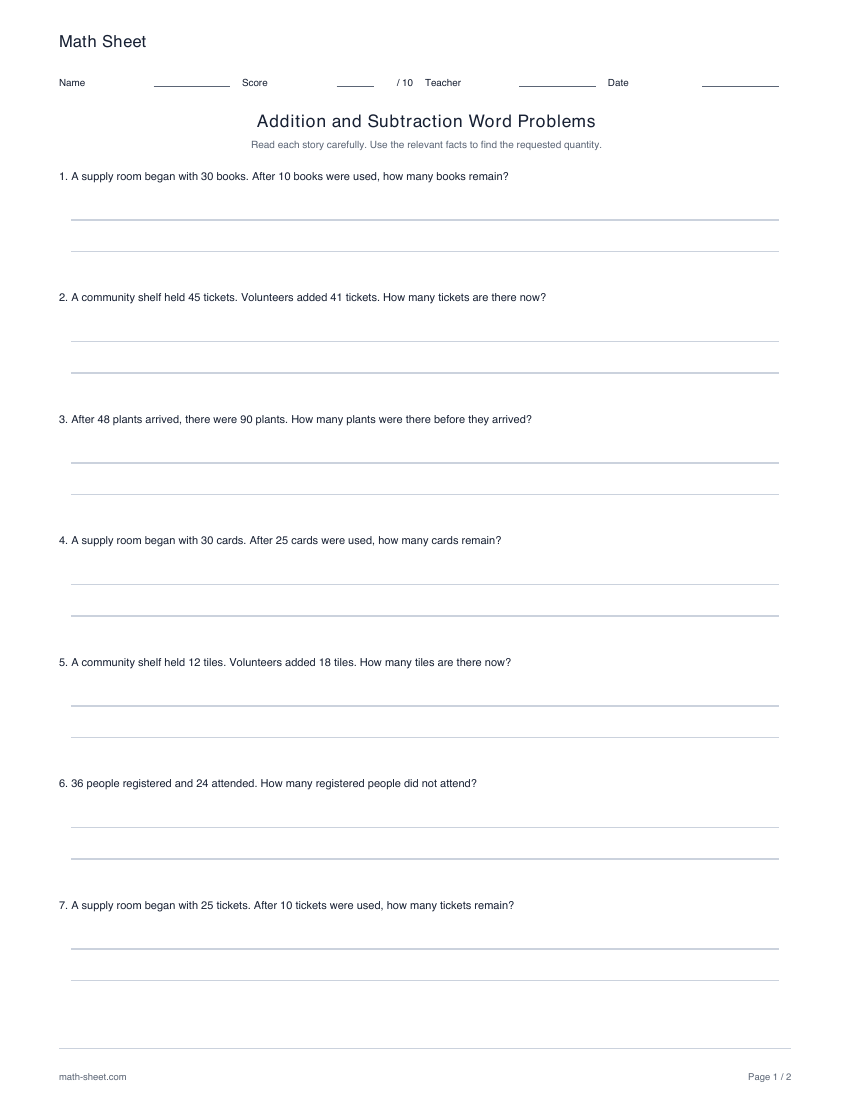
Choose the operation in a balanced set of five addition and five subtraction stories. Use one-, two- or three-digit quantities and optional practice without regrouping.
Preview and download →
Explain the relationship
Groups, rates and dozens
Work with equal groups, sharing and multiplicative comparisons. Dozen problems also require keeping group counts and individual items distinct.
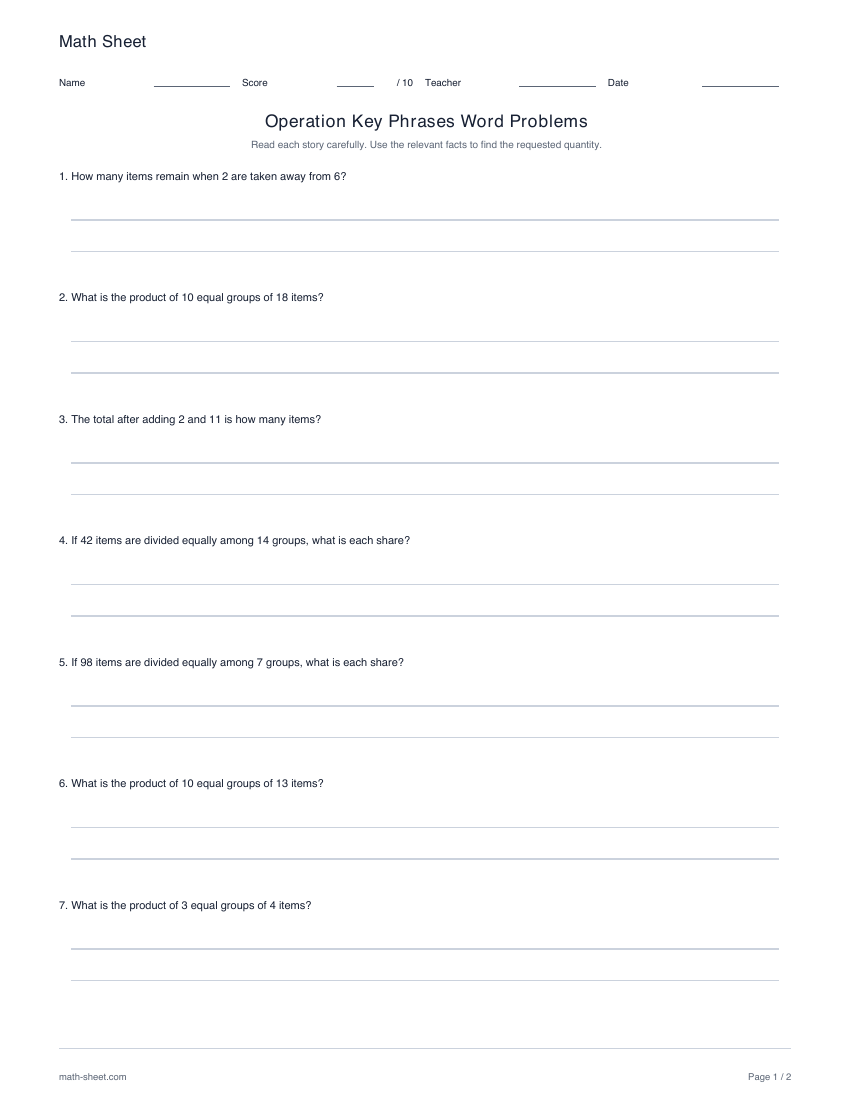
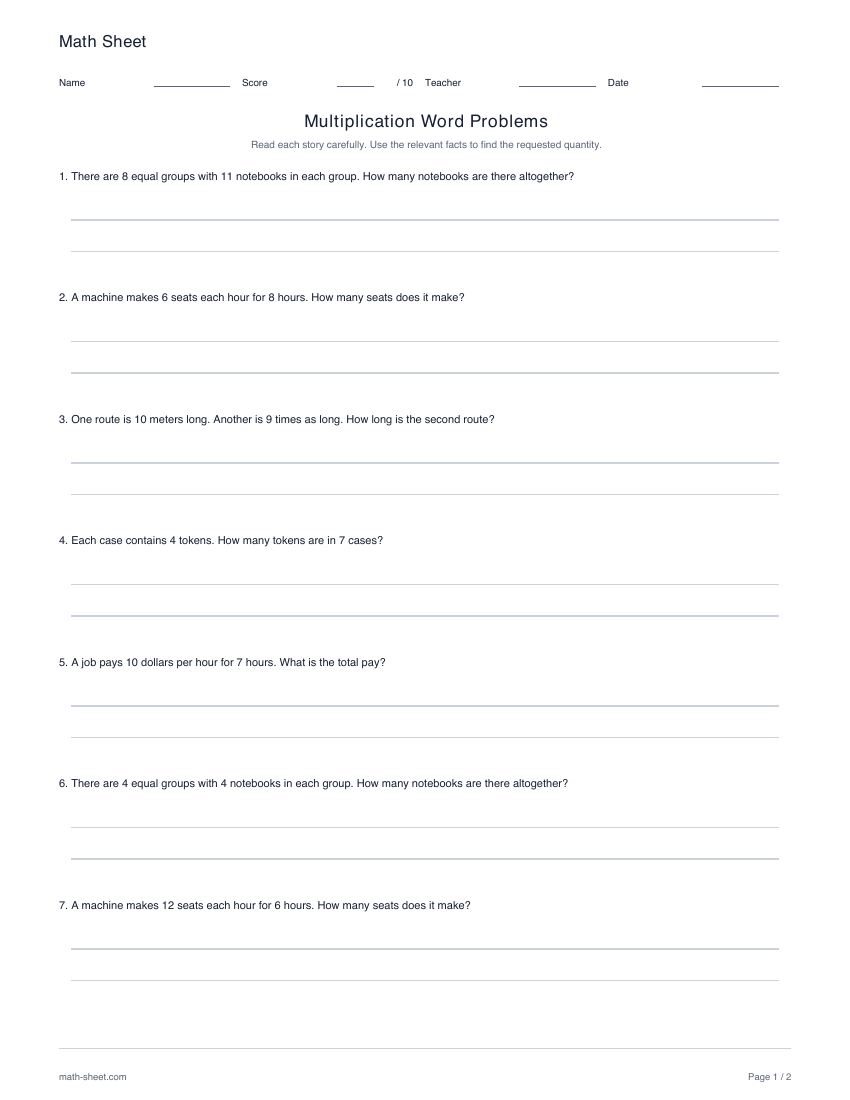
Use equal groups, rates and comparisons to solve ten multiplication stories. Choose one- or two-digit practice, number wording and optional extra details.
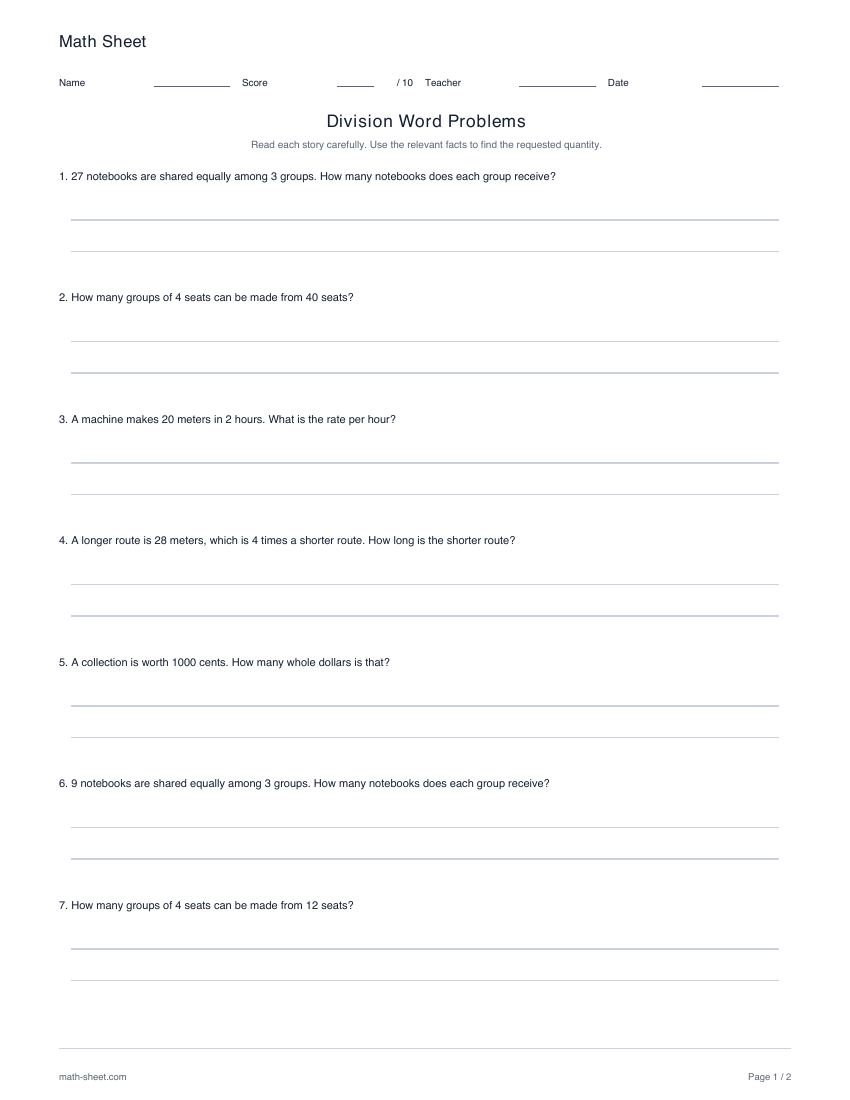
Solve ten whole-answer sharing, grouping and rate stories. Select one- or two-digit divisor practice, digits or words, and optional irrelevant information.
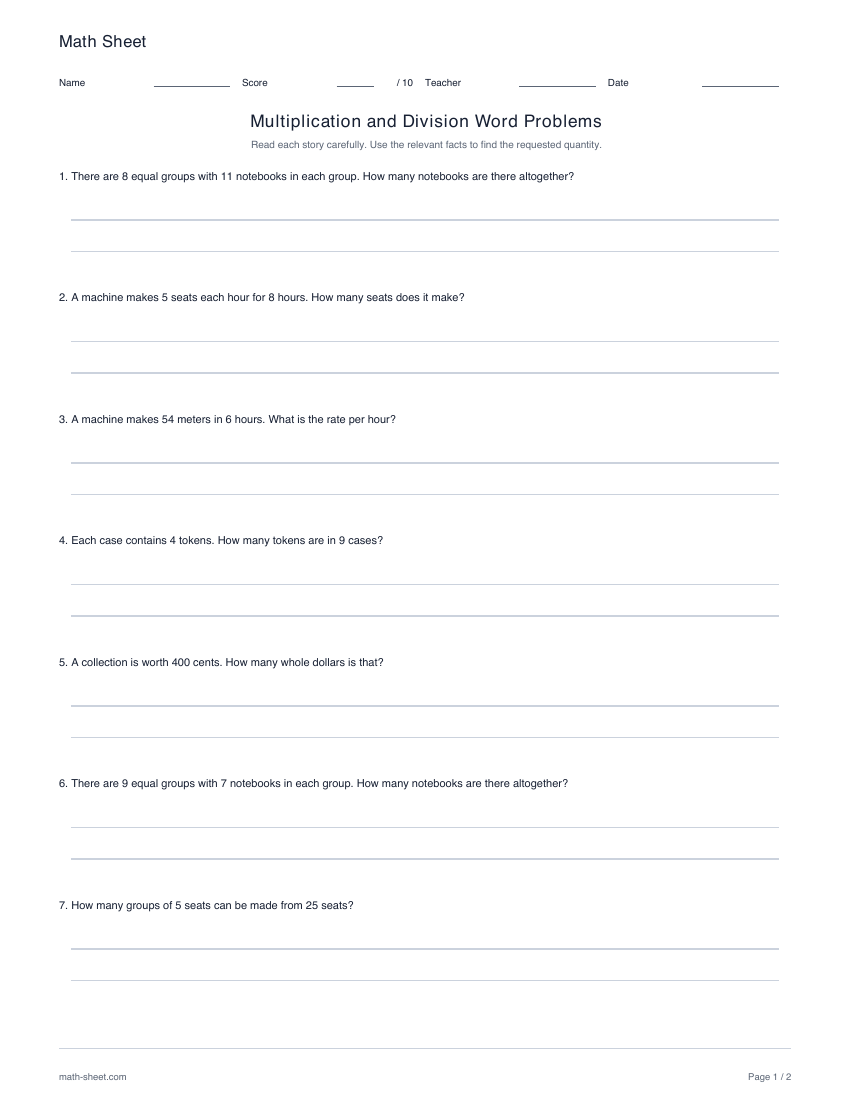
Decide between multiplication and division in ten equal-group, sharing and rate stories. Each set includes five of each operation, with wording and extra-data options.
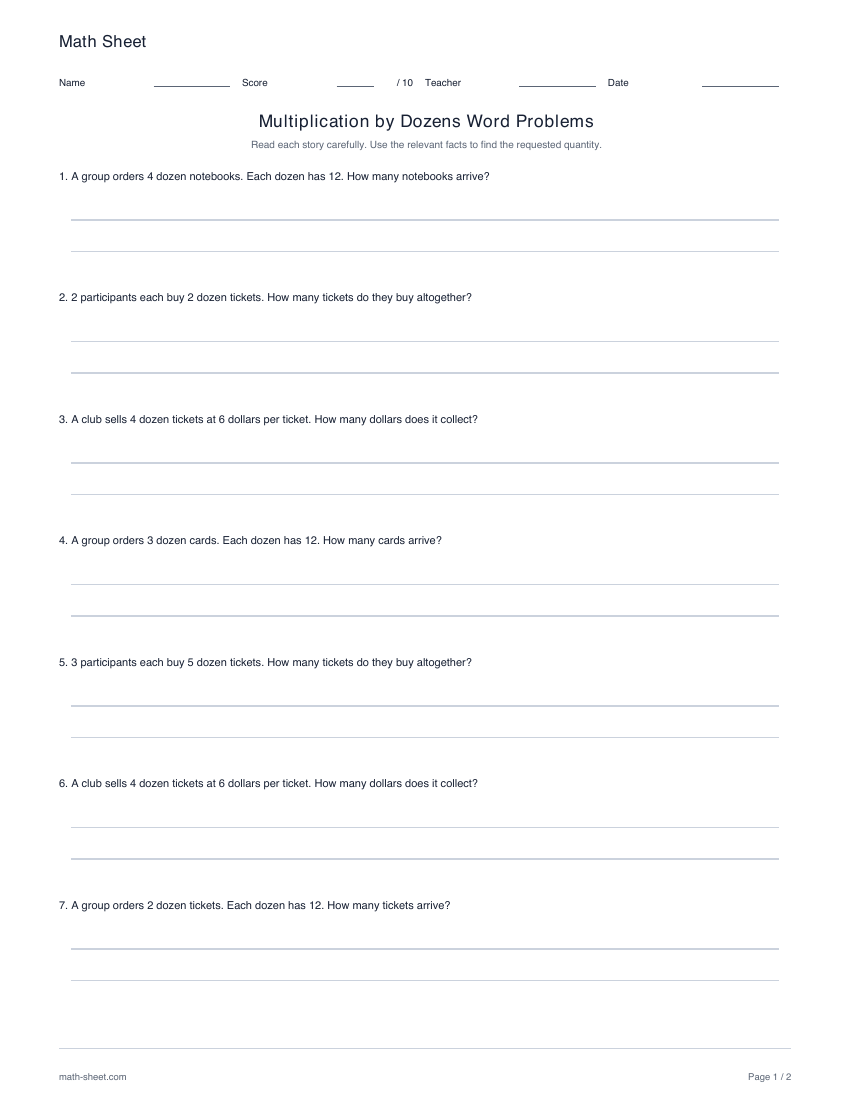
Convert dozens to individual items and combine group or value calculations. Print ten original stories with number-wording and extra-information options.
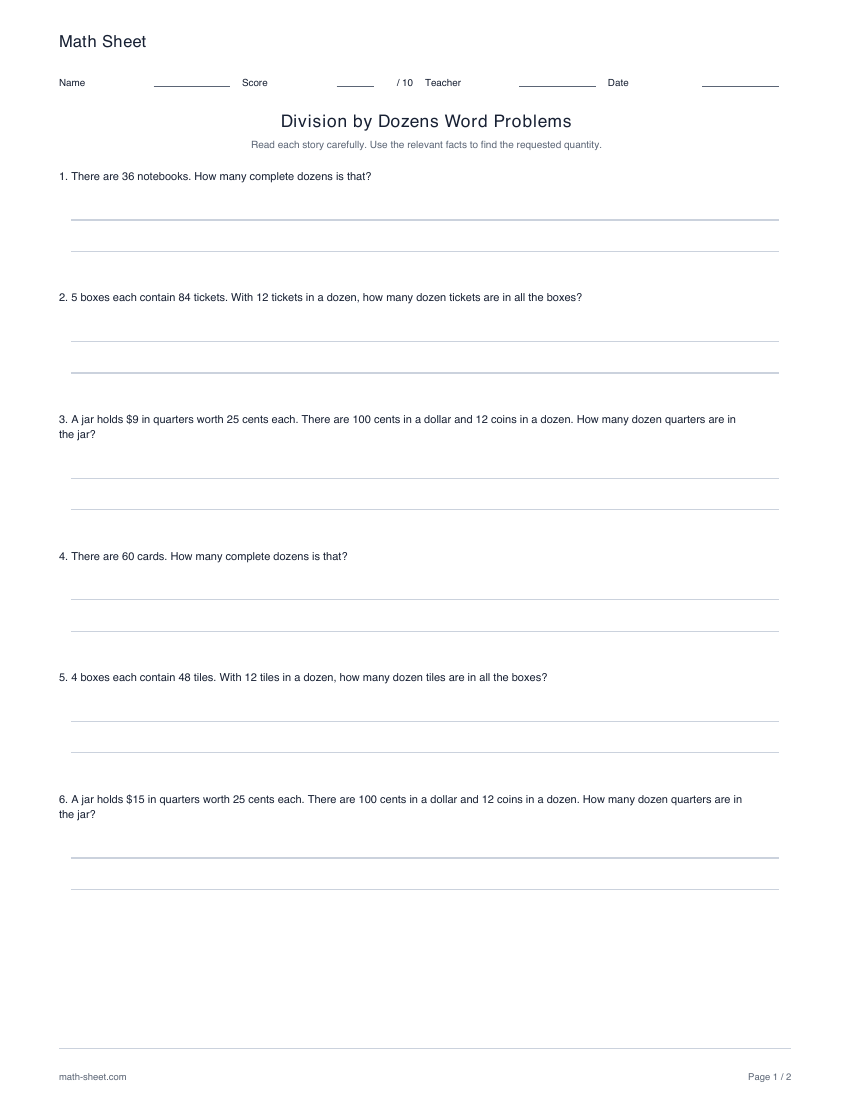
Find quantities measured in dozens after grouping or unit conversion. Practice ten stories, including money-value relationships, with a separate answer key.
Preview and download →
Explain the relationship
Multi-step stories and equations
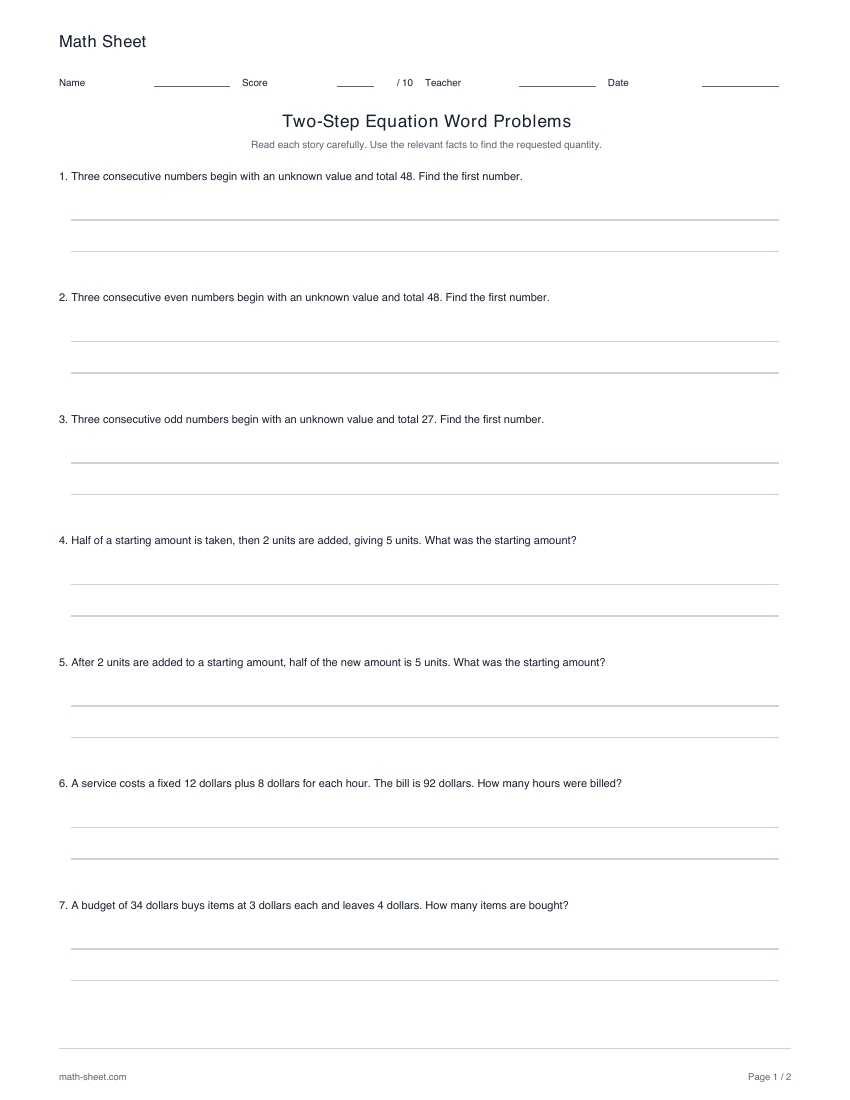
Track several changes, recover unknown quantities and reverse a number process. Later options include fixed fees, signed values, decimals, and coupled distance-rate-time relationships and additive work rates.
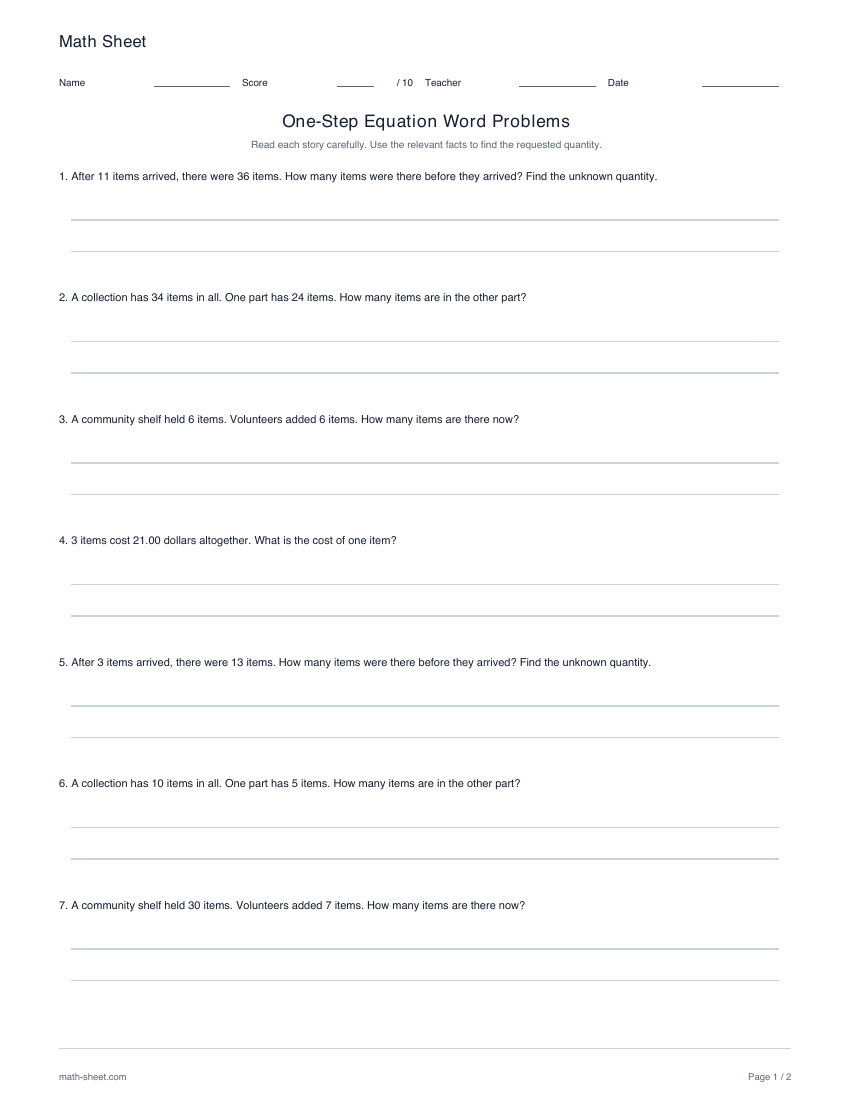
Work through ten stories with several changes or an unknown total. Choose whole-number practice or a set including decimals and money, with space to show intermediate steps.
Find a missing starting amount, part, total or unit cost in ten short stories. Choose digits, number words or a mixture, and optional irrelevant information.
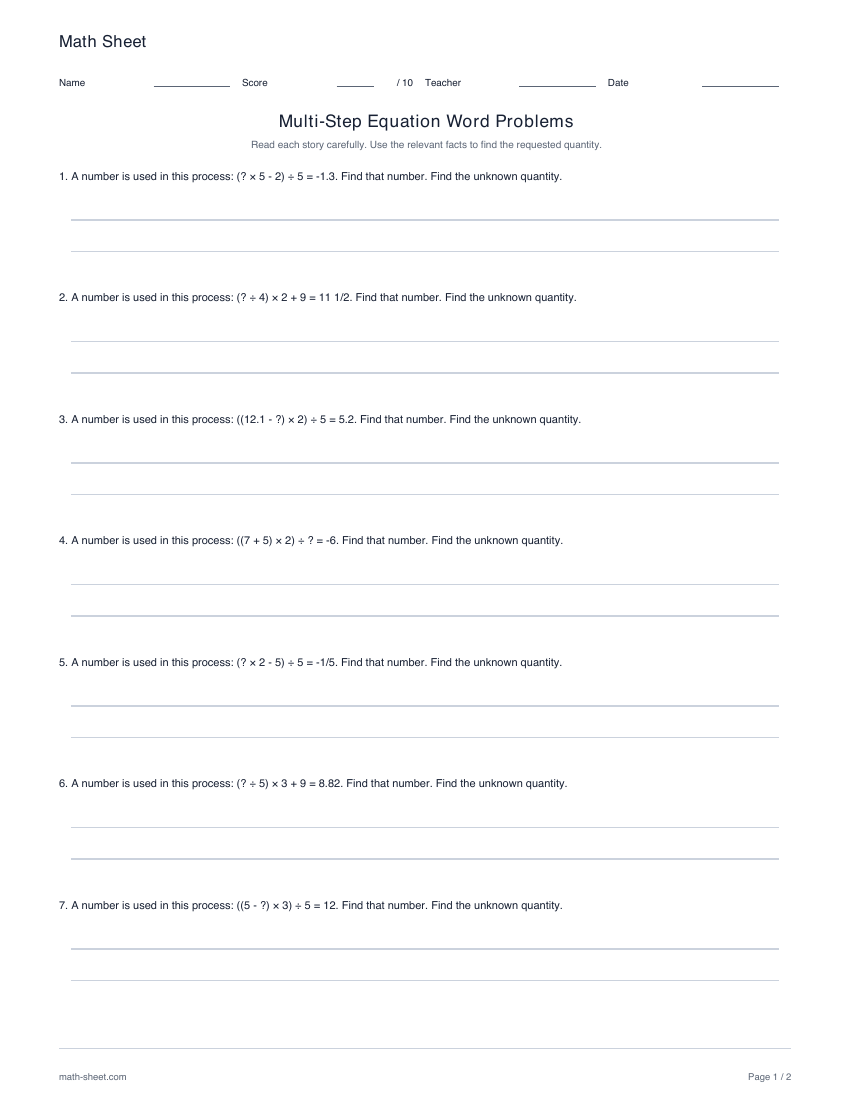
Reverse three-operation number processes, including unknown divisors and starting quantities. Choose positive or negative whole-number or decimal answers.
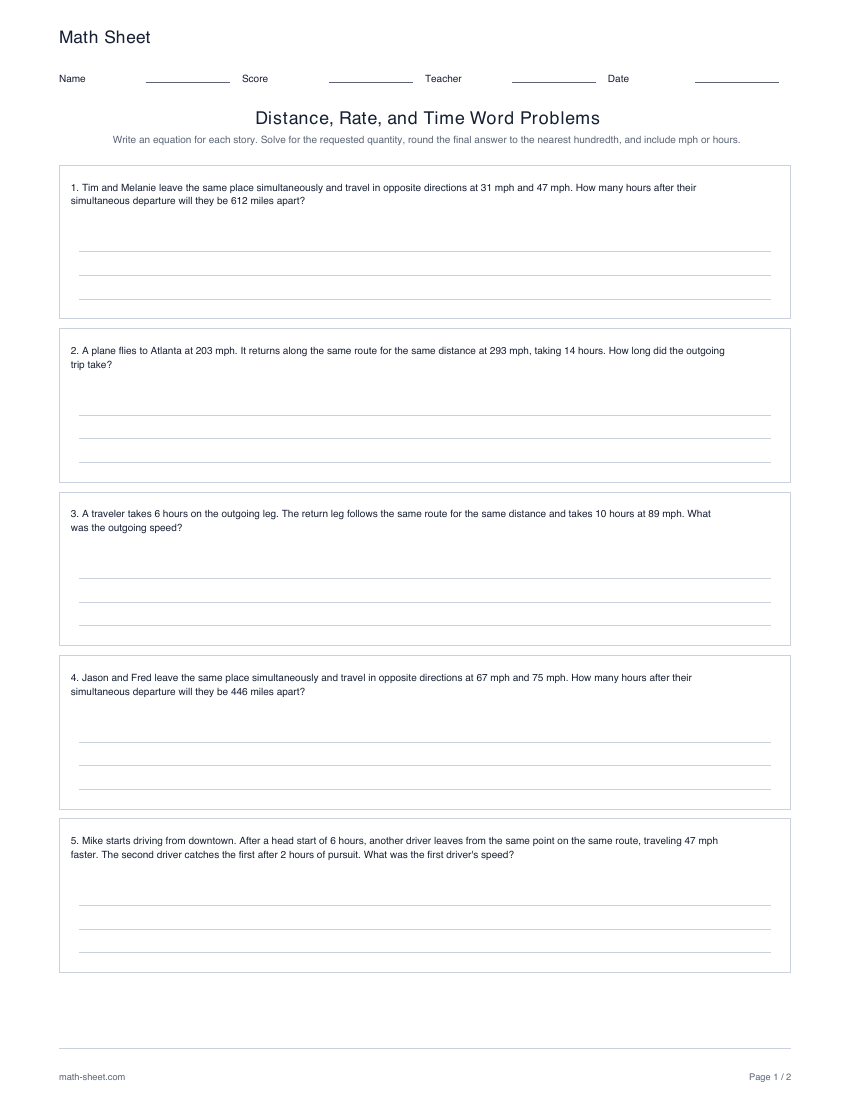
Model ten pursuit, opposite-direction, and equal-distance travel stories with exact linear equations. Choose digits, number words, or a mixed set and use worked answer keys with exact checks.
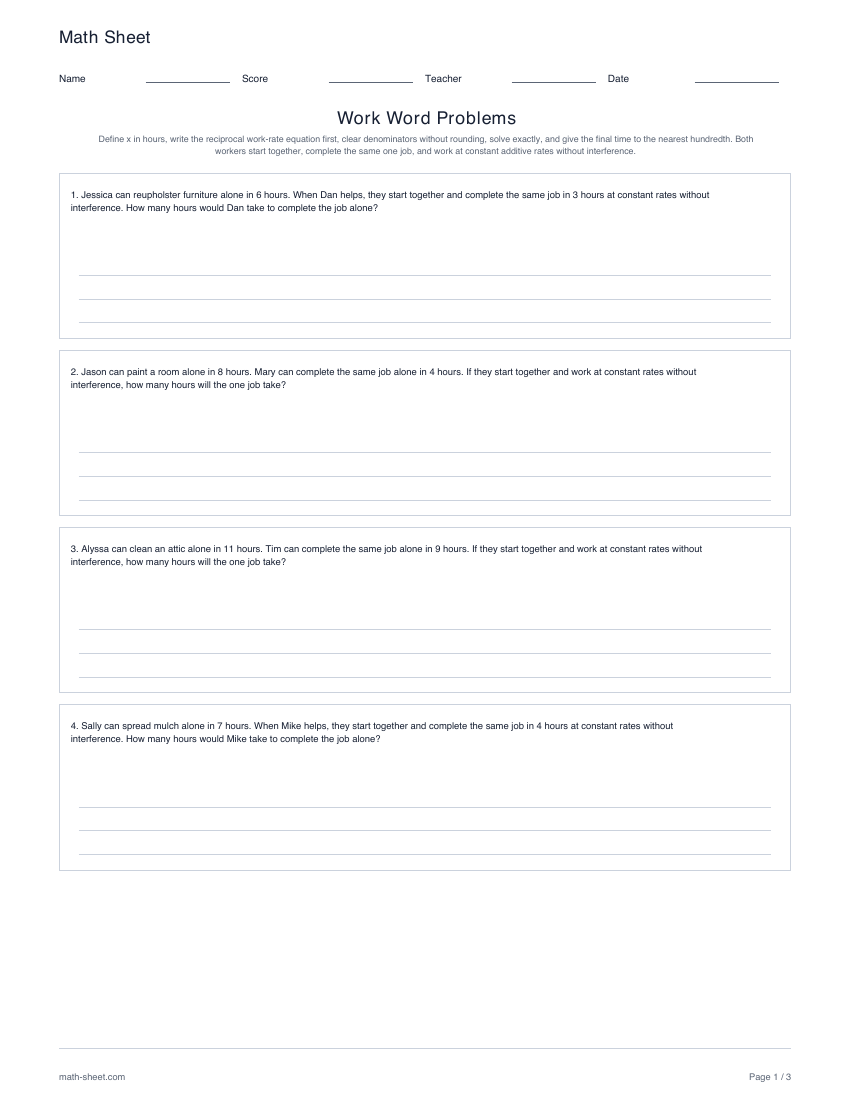
Model ten two-worker job stories with reciprocal work rates, exact equations, and worked checks. Every sheet balances five combined-time and five unknown-solo-time problems.
Preview and download →
Explain the relationship
Fractions in measured quantities
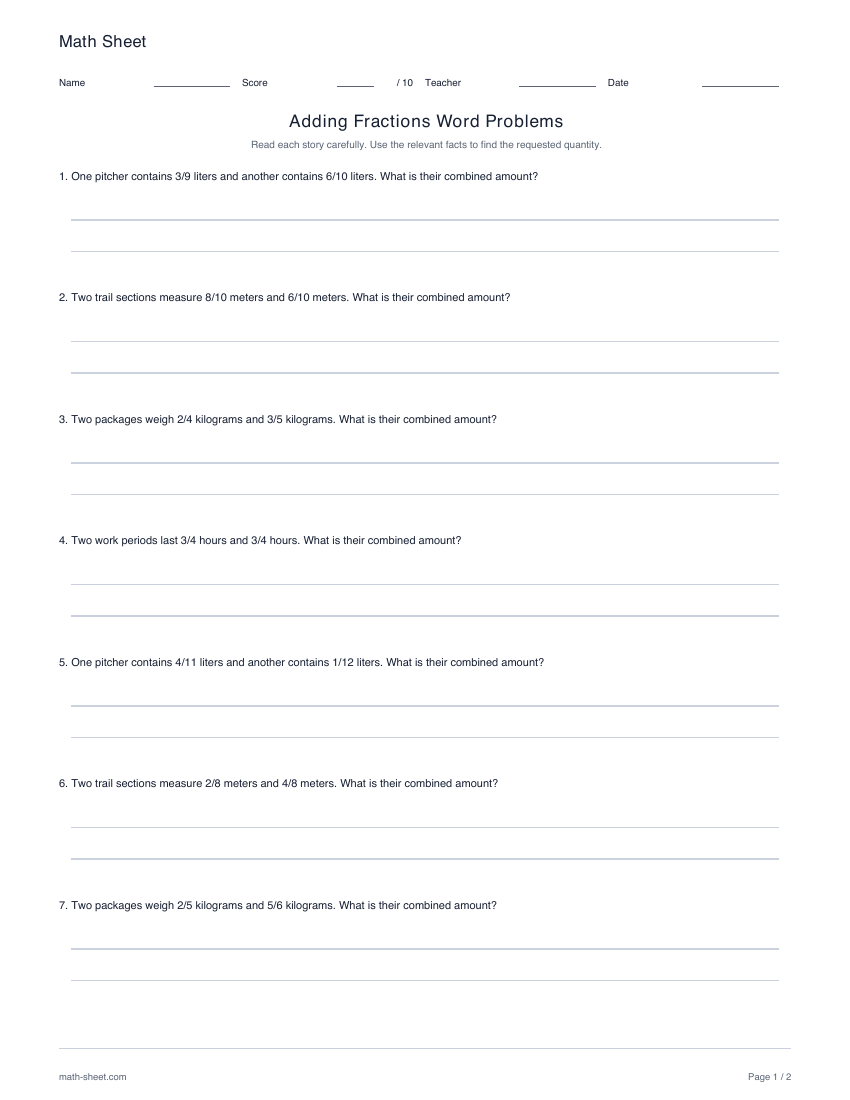
Add, subtract and divide fractional amounts with a clearly stated unit. Choose denominator relationships and portion types to match the intended lesson.
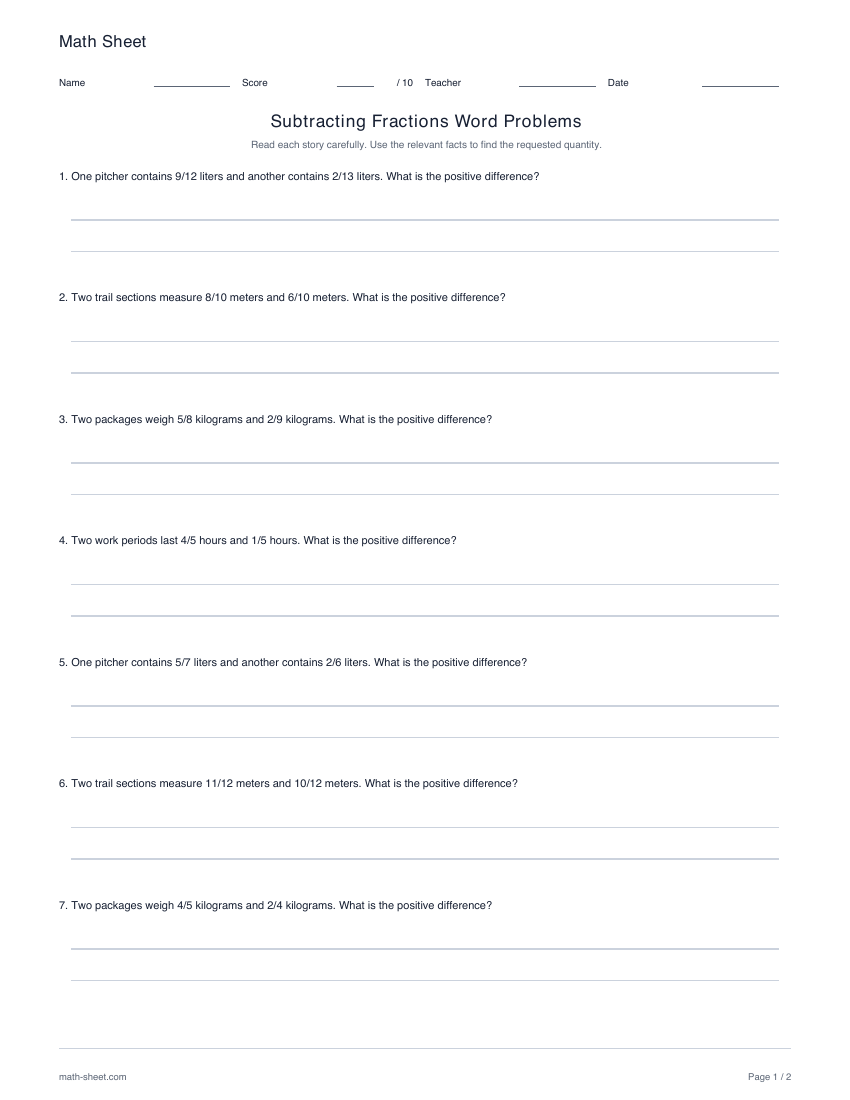
Compare fractional measurements and find what remains. Choose common, different or mixed denominators and irrelevant-information options for ten questions.
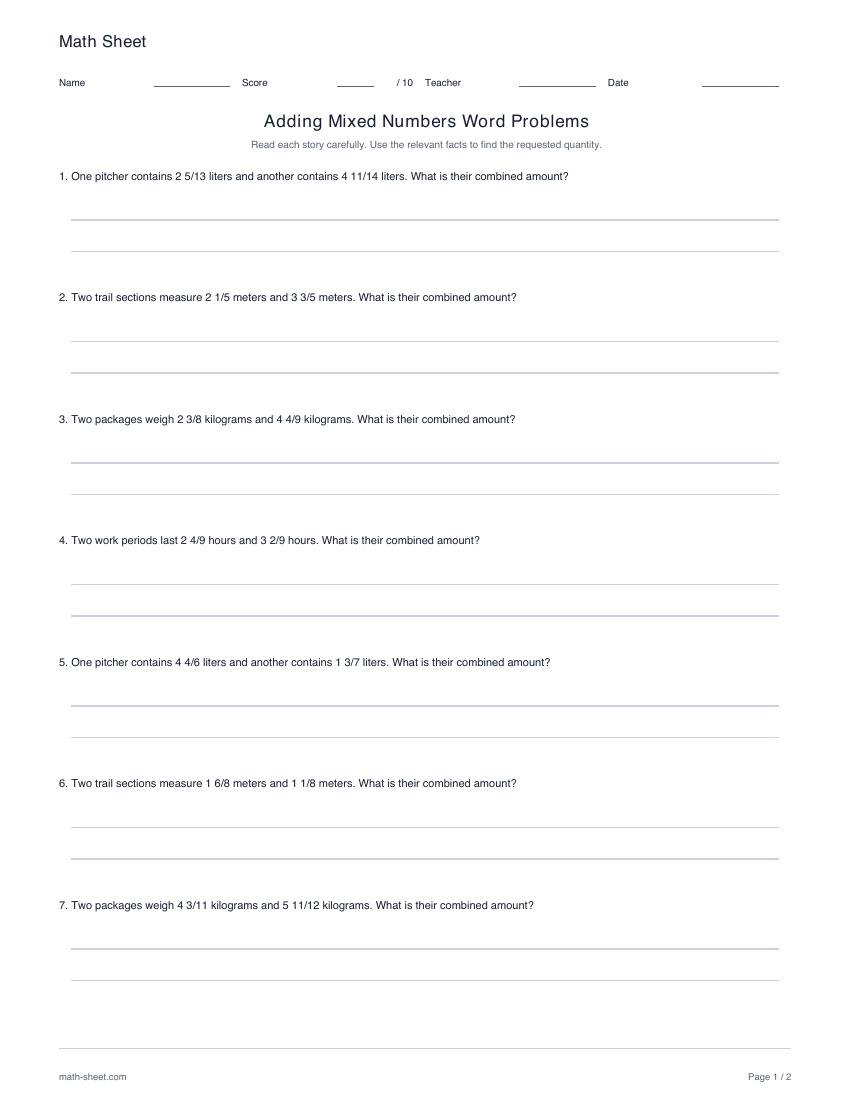
Combine whole and fractional measurements in ten contextual problems. Choose denominator relationships, add optional extra data and print an answer key.
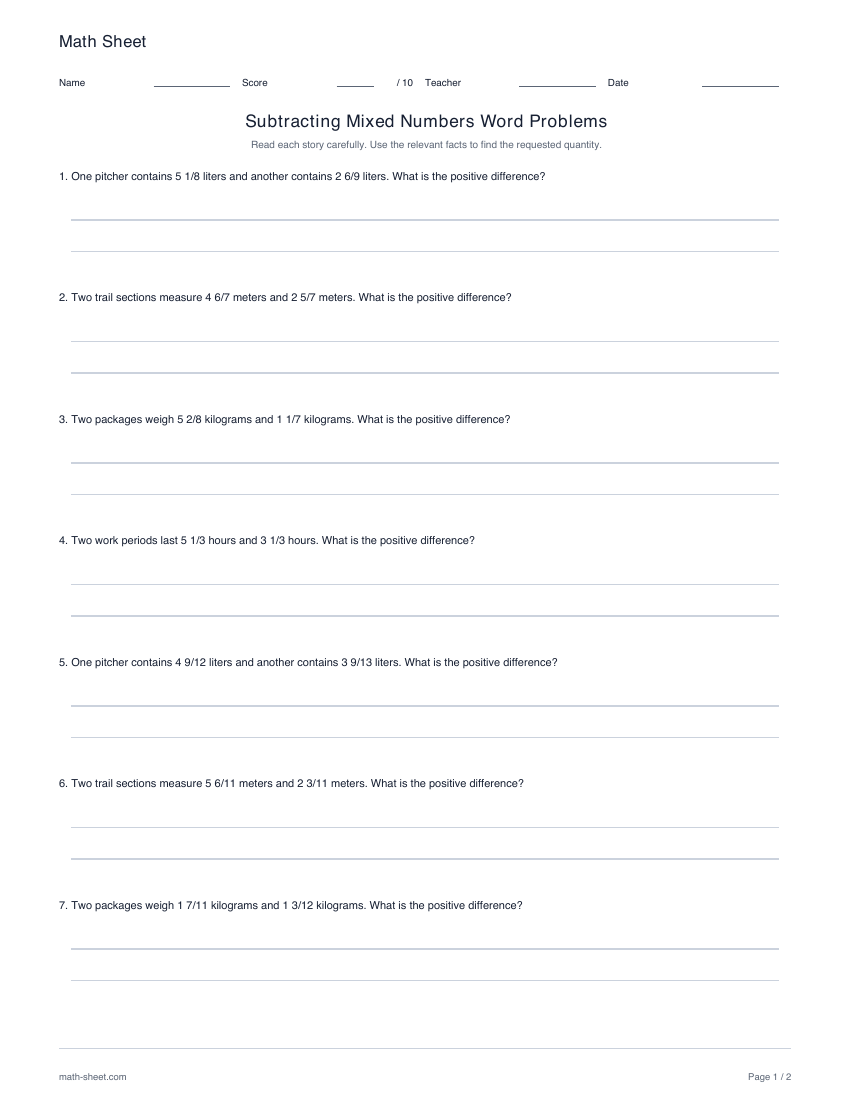
Find differences between mixed-number measurements, including regrouping across a whole. Select denominator relationships and optional irrelevant information.
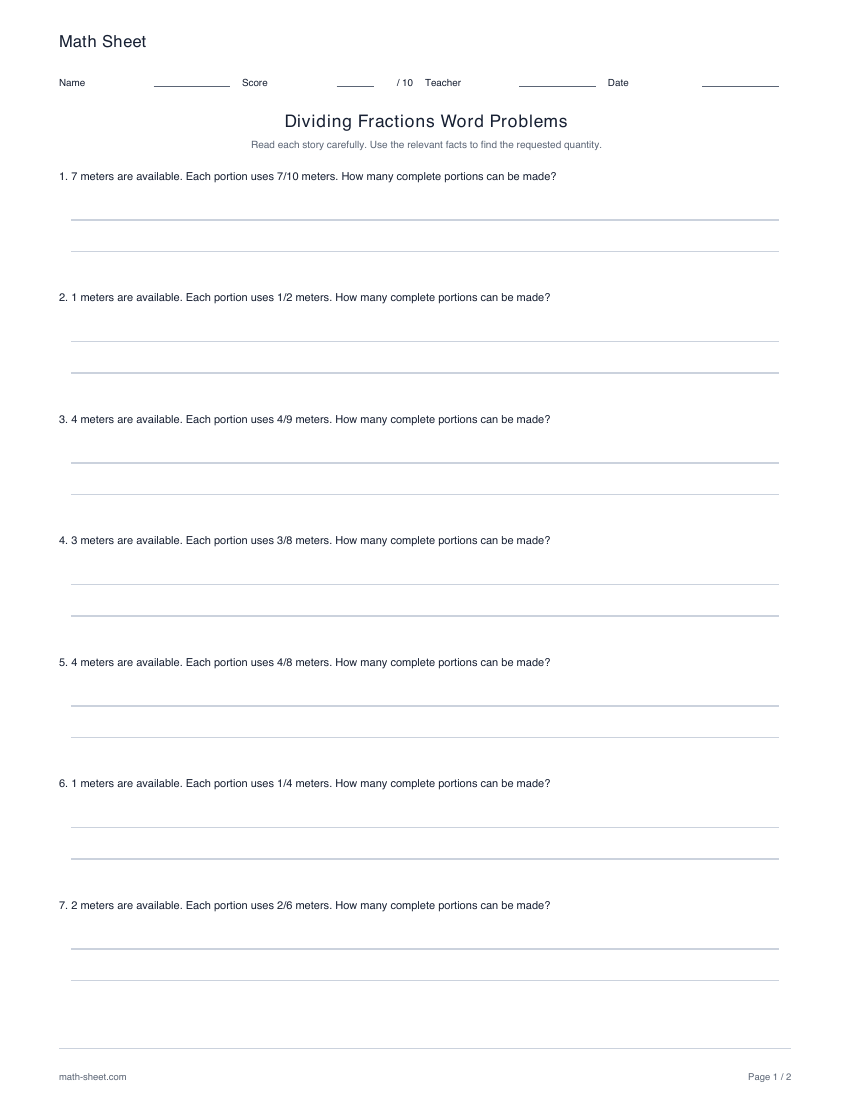
Find how many fractional-sized portions fit in a whole available quantity. Choose proper, improper or mixed-number portion sizes and denominator ranges.
Preview and download →
Explain the relationship
Coins, purchases and change
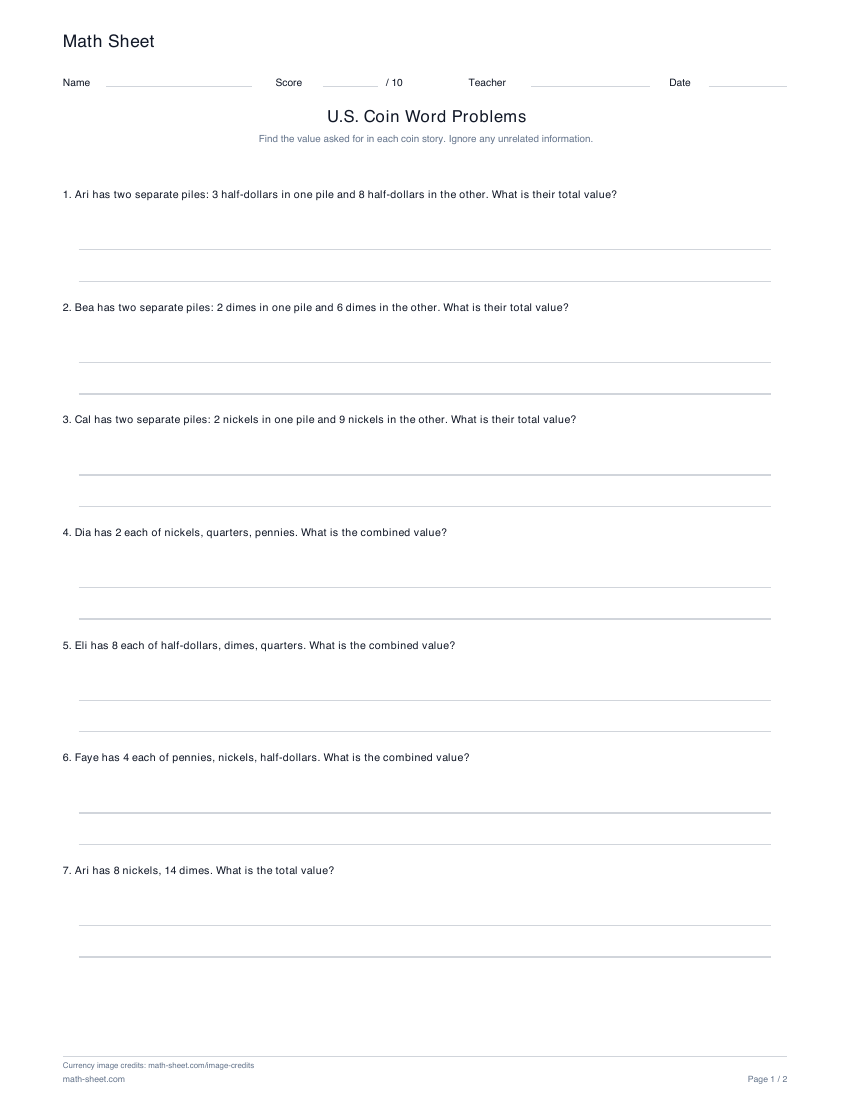
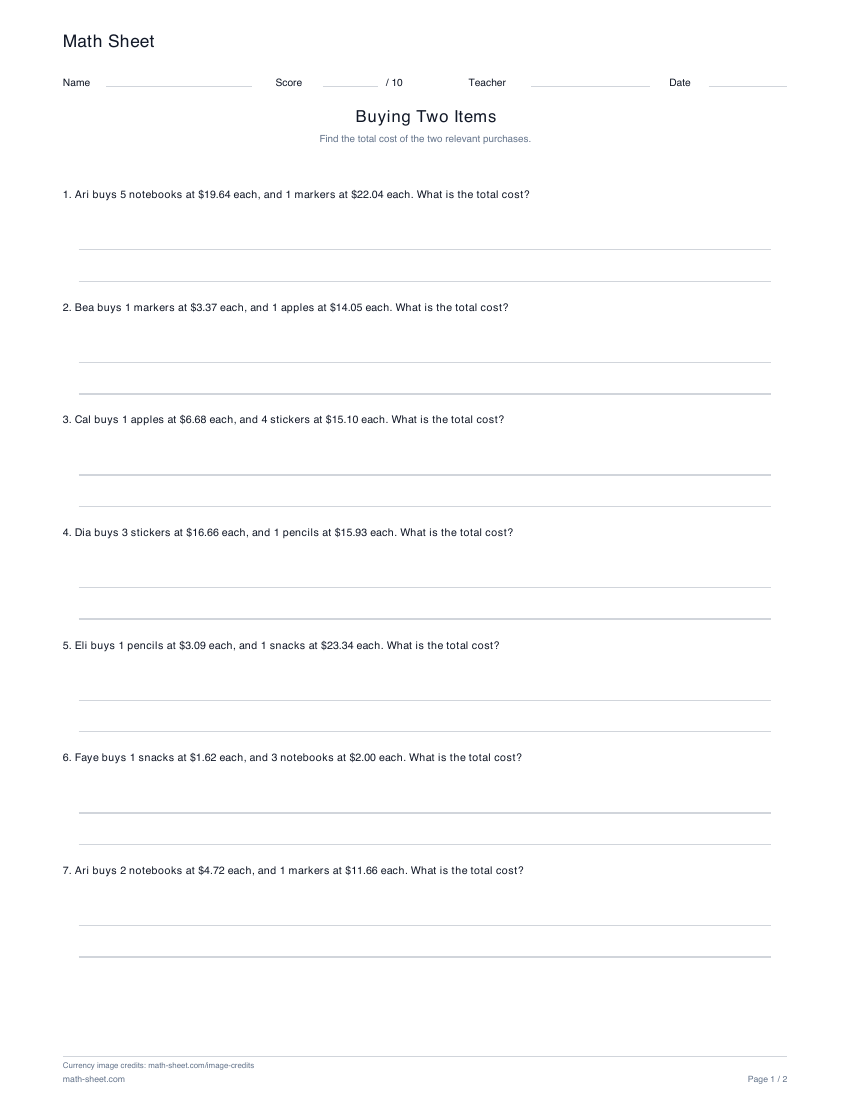
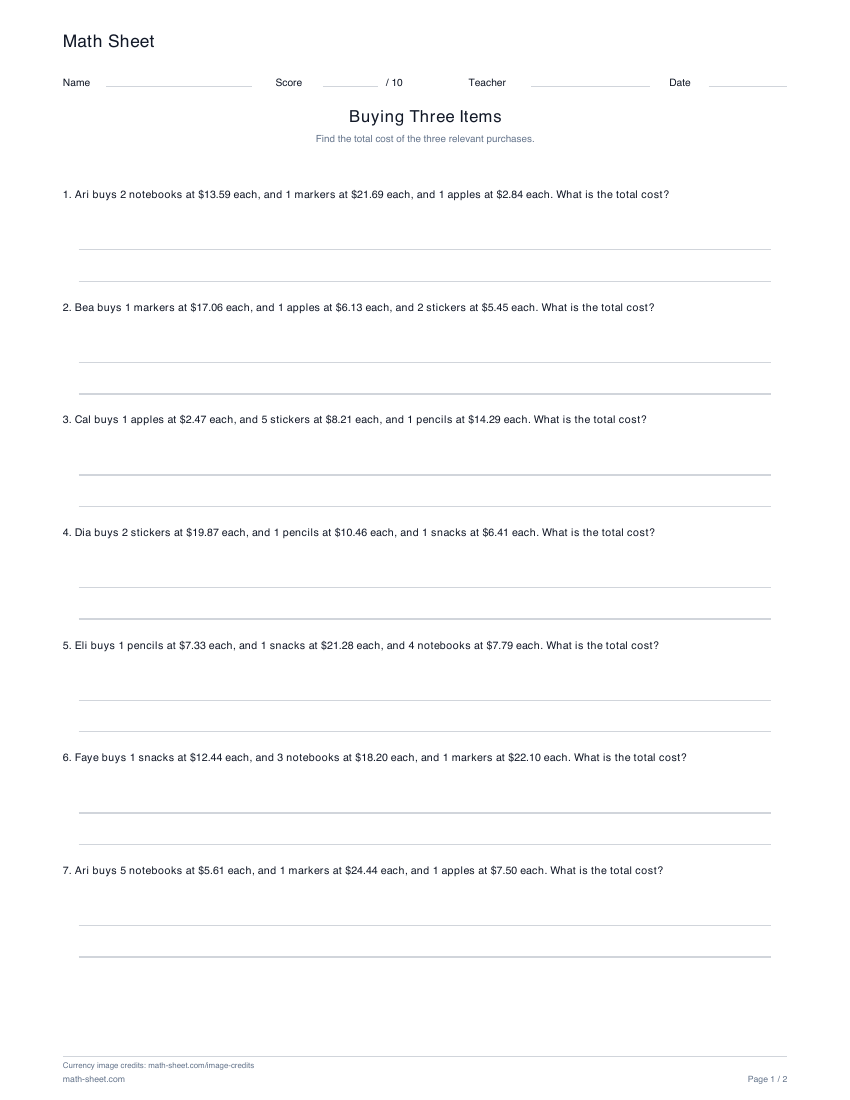
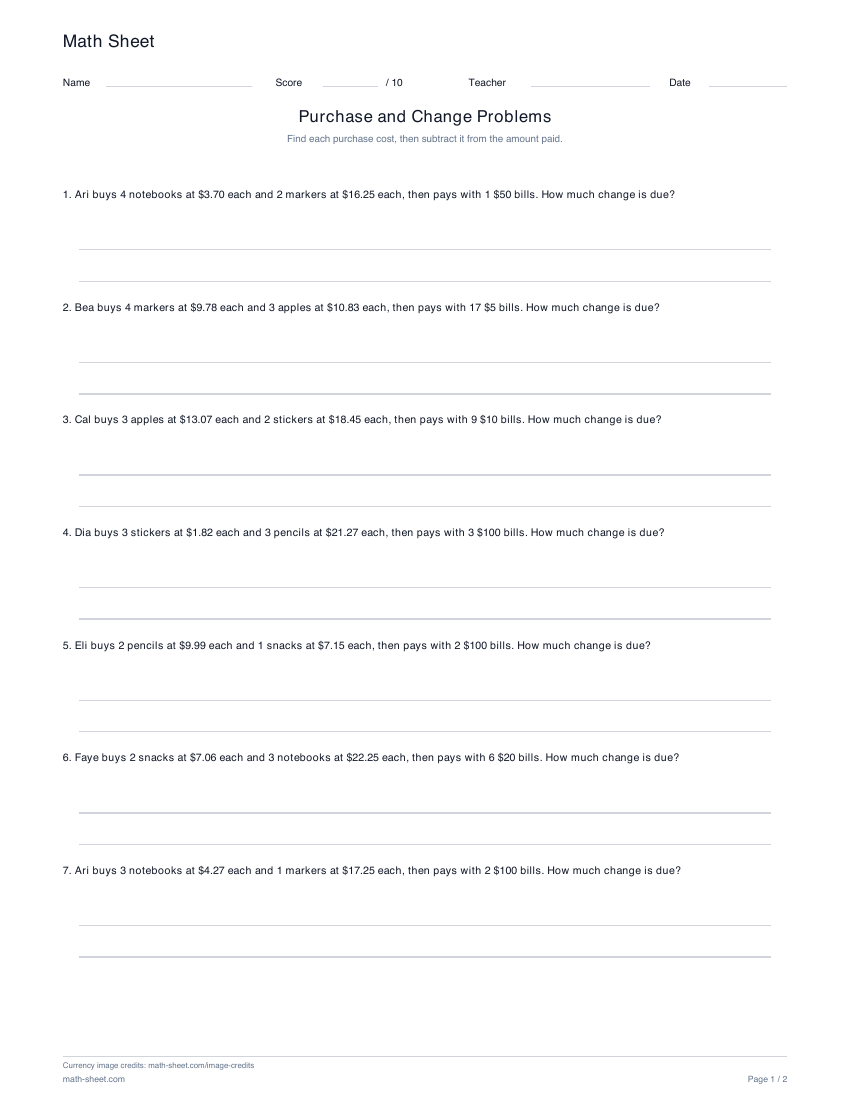
Use the existing U.S. Money activities to count value, total purchases and calculate change. Keep currency units consistent throughout the story.
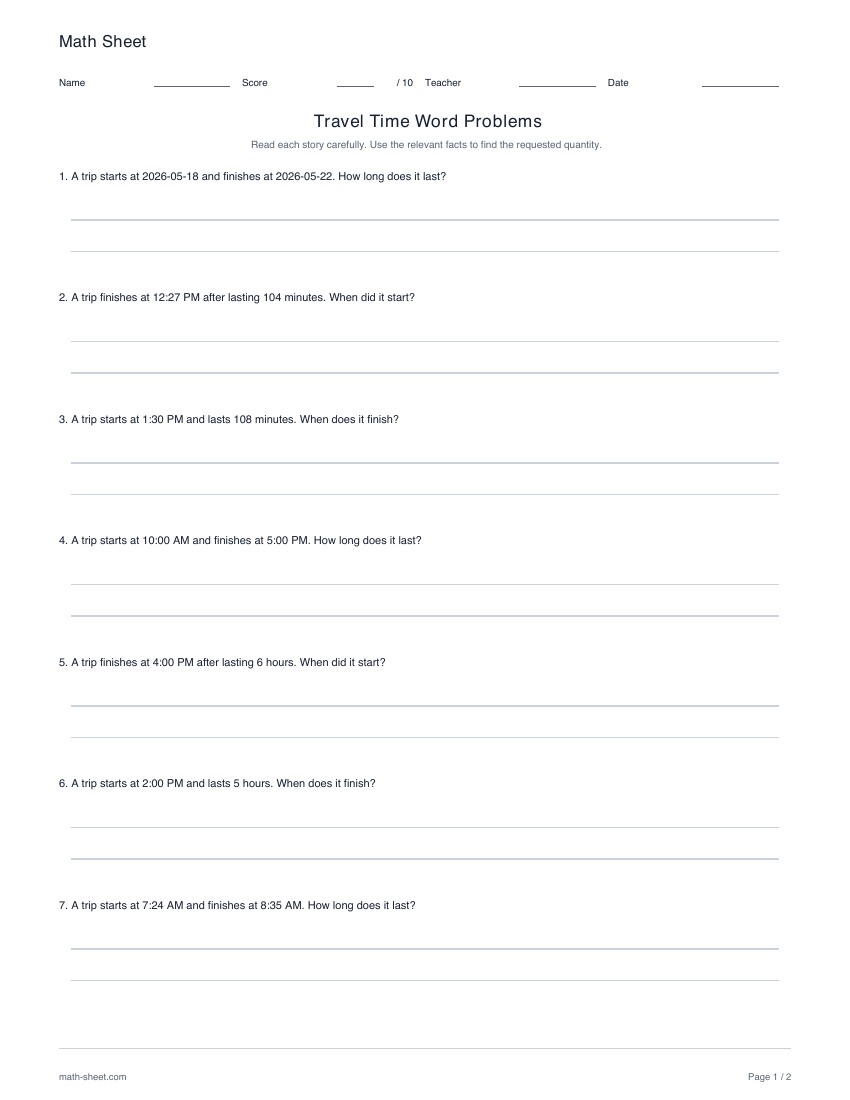
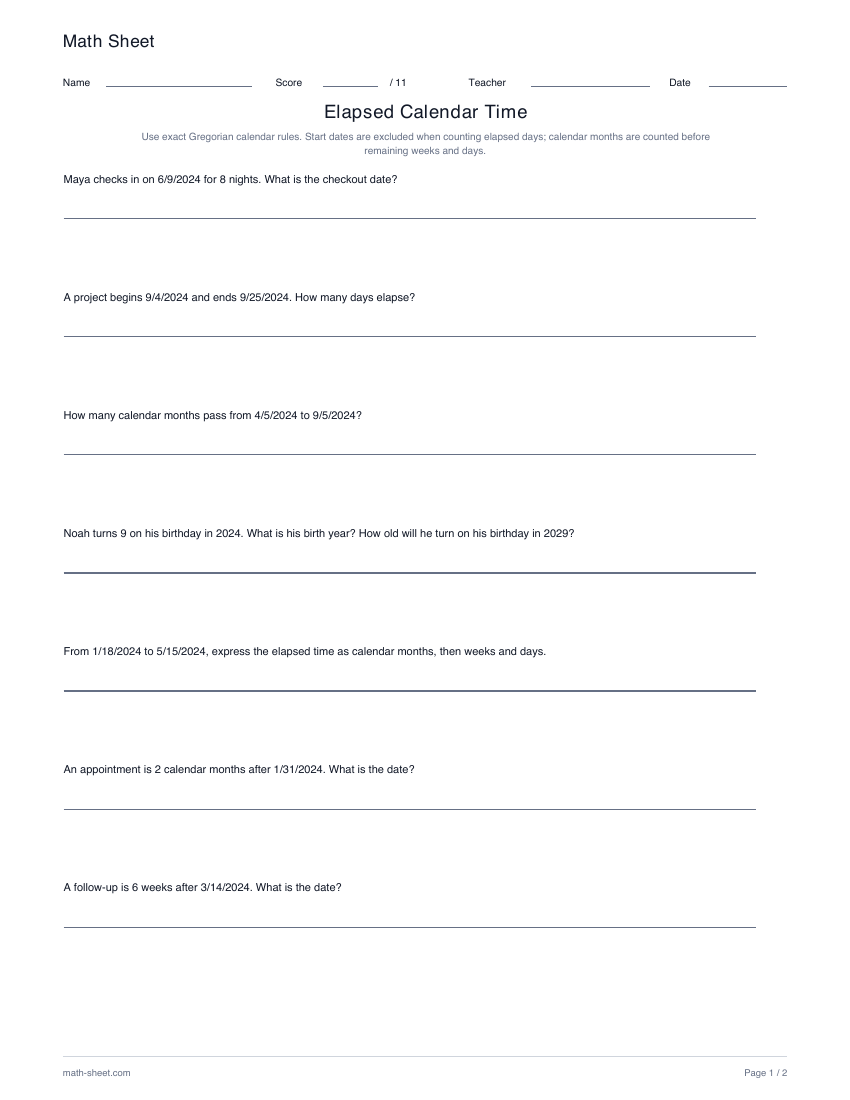
Find a journey duration, departure or arrival in ten travel stories. Select minutes, hours or days, with optional extra information and separate answers.
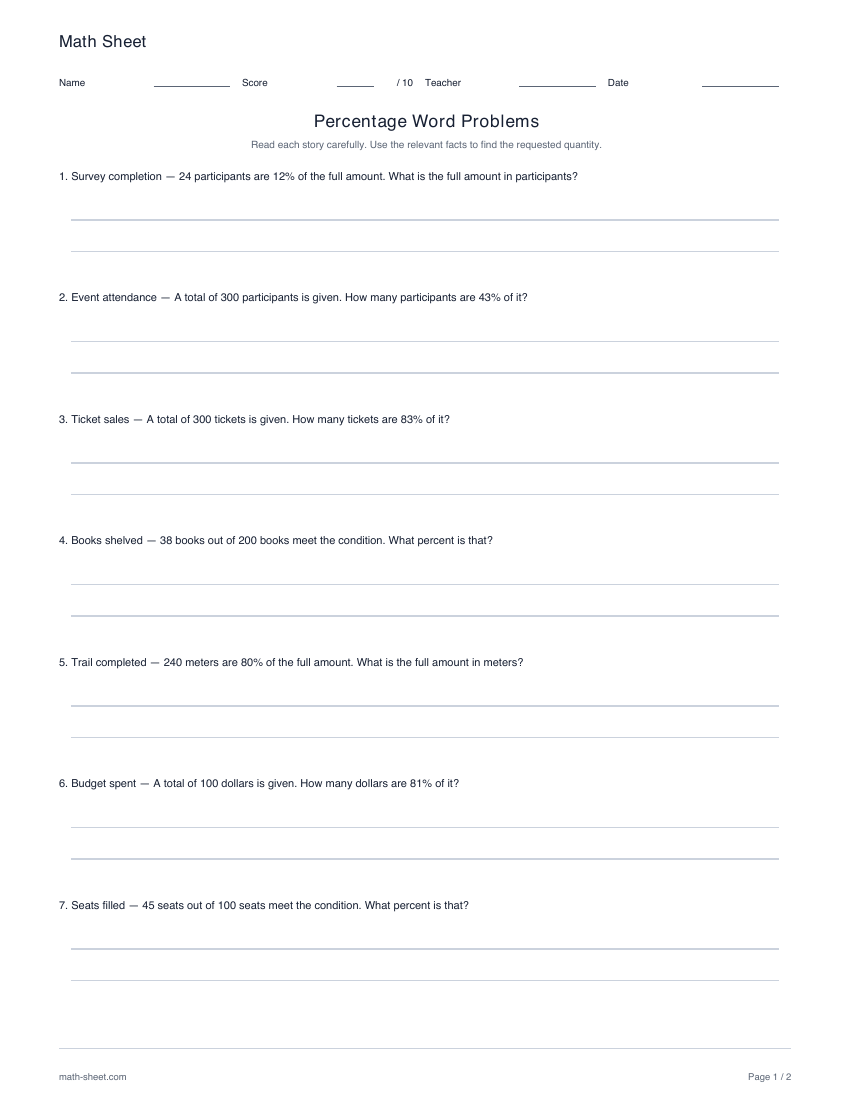
Find a percent, whole or part in ten contextual questions. Choose percentage precision and the question types, with answers calculated from the displayed values.
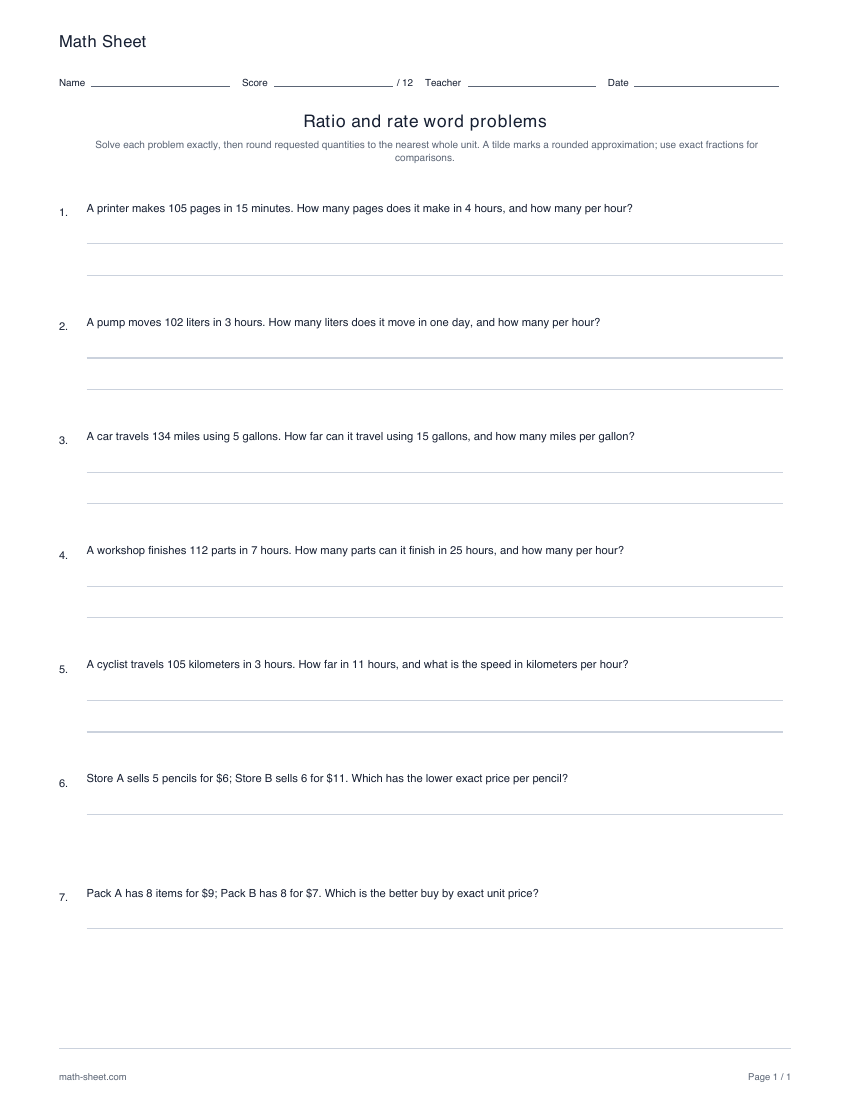
Solve seven contextual problems using constant rates, time conversions, fuel use and better-buy comparisons. Answer linked scaling and unit-rate questions with separate worked keys.
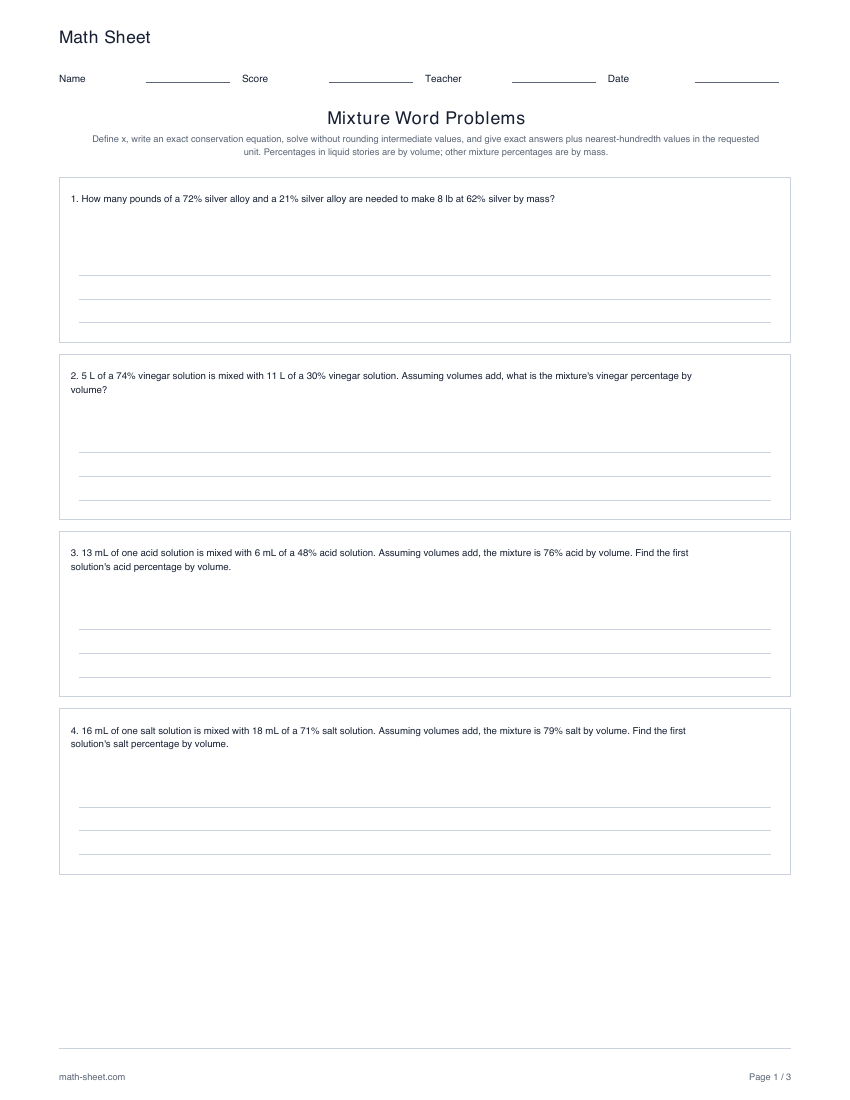
Model ten concentration, alloy, food-mixture, and unit-cost stories with exact linear equations. Every sheet covers five equation families and reports both ingredient amounts when two quantities are unknown.
Preview and download →
A useful next step
Match the reading and the arithmetic
A learner can understand a mathematical relationship before being fluent with large numbers. Begin with quantities they can calculate confidently, then increase the arithmetic demand. Grade labels are broad starting points, not a claim of alignment with a particular national curriculum.
Grade 1
Read together and draw the two relevant parts. Keep number wording and extra information simple.
Read the question. Name the quantity you need to find and its unit.
Organize what is known. Draw groups, a bar, a timeline or a simple table. Set unrelated information aside.
Write the relationship. Choose an equation that represents the situation, including any intermediate step.
Calculate and check. Put the answer back into the story. Check its unit, size and meaning.
Use extra information deliberately
Many activities let you choose no extra information, occasional extra information or an unrelated detail in every question. Start without distractions when introducing a mathematical idea. Add them when the lesson is about selecting relevant evidence.
Ask learners to explain why a number is unnecessary. Crossing out a detail without understanding its role can hide a lucky guess. Changing digits to number words adds a reading demand, so adjust it separately from the arithmetic.
Keep units and wholes consistent
Three quarters of a litre and two thirds of a litre can be added because they measure the same unit. Fractions of two different-sized containers cannot be treated as fractions of one combined whole without more information.
Money stories distinguish dollars, cents and coin counts. Dozen stories distinguish groups of twelve from individual objects. Time questions distinguish a clock reading from an elapsed duration. A correctly calculated number still needs to answer the actual question.
Build toward equations through meaning
For a fixed $8 rental fee plus $5 per hour, a $33 total means the hourly part costs $25. Removing the fee and dividing by the rate gives 5 hours. The equation 8 + 5h = 33 records the same reasoning.
Later problems reverse a sequence of operations or describe consecutive numbers. Preserve the original order and check the solution by substitution. If the unknown is a divisor, name it explicitly rather than confusing it with the starting dividend.
Print a short set, review it, then adjust
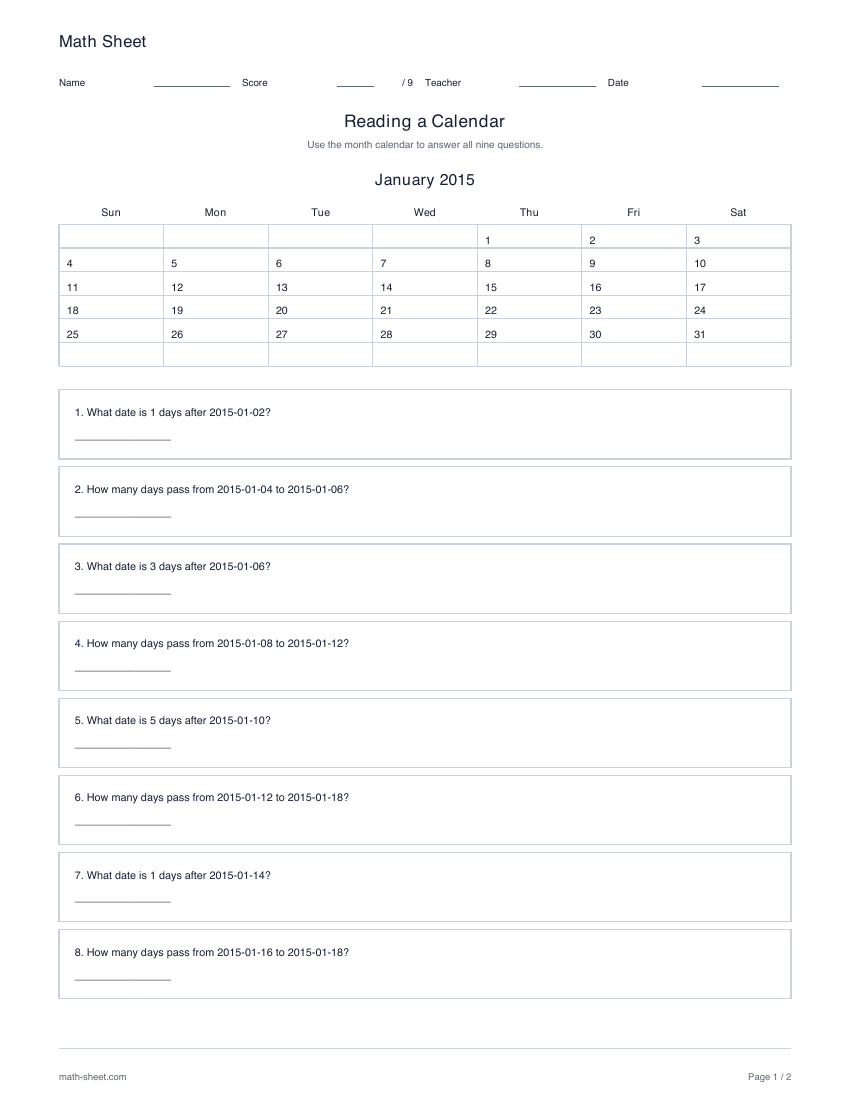
New practice activities contain ten questions, while the selected-month calendar has nine. The words-to-symbols handout is an unscored reference. The existing ratio-and-rate activity has seven longer contextual questions.
Choose Letter or A4 and preview the page count before printing. Practice downloads can include a separate answer key. Longer stories continue onto another page so the prompt and writing space stay readable.
The core Word Problems generators offer eight printed languages. Distance, rate, and time, Mixture, and Work rate generators are currently English only. Existing Money and elapsed-date resources keep their current English output; the reused ratio-and-rate activity supports eight languages. Ready-made downloads are English.