
Fractions
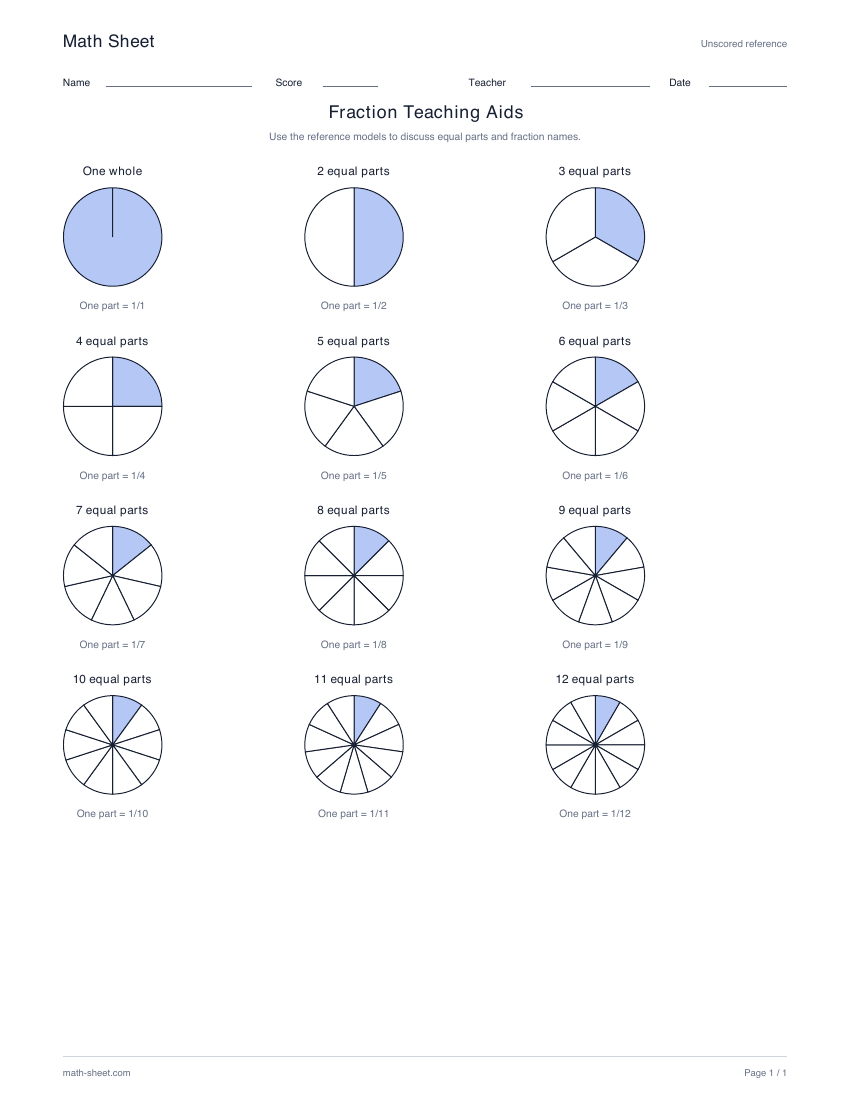
Fraction teaching aids
Use fraction circles or bars to discuss equal parts, unit fractions and different names for the same amount.
Preview and downloadBuild understanding, then fluency
Connect fraction pictures to equivalent names before moving into calculations. These selected activities develop one part of the Grade 4 learning journey.
This is a selected skill collection using familiar English grade labels. Grade expectations vary between schools and countries; it is not a full curriculum or a standards-alignment claim.
Begin when the learner can identify the whole, name a unit fraction and explain why the parts must be equal. If that is uncertain, start with the visual models.
Discuss together
One half is the same amount as two quarters. Naming both amounts in quarters makes the sum 2/4 + 1/4 = 3/4. The denominator stays 4 because the pieces are still quarters.
Step 1
Draw a model before using the scaling rule. Keep one whole the same size in every comparison.
Fractions
Use fraction circles or bars to discuss equal parts, unit fractions and different names for the same amount.
Preview and download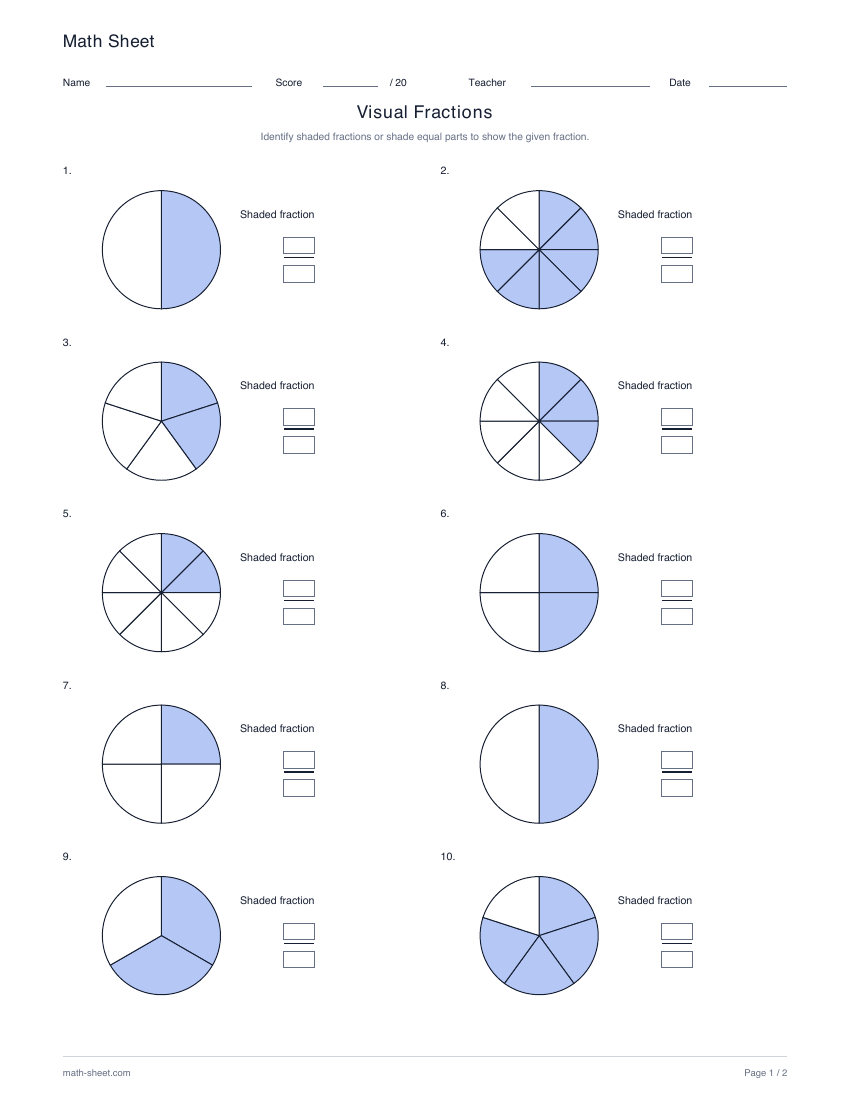
Fractions
Read a fraction from a partitioned shape or shade equal parts to represent a stated fraction.
Preview and download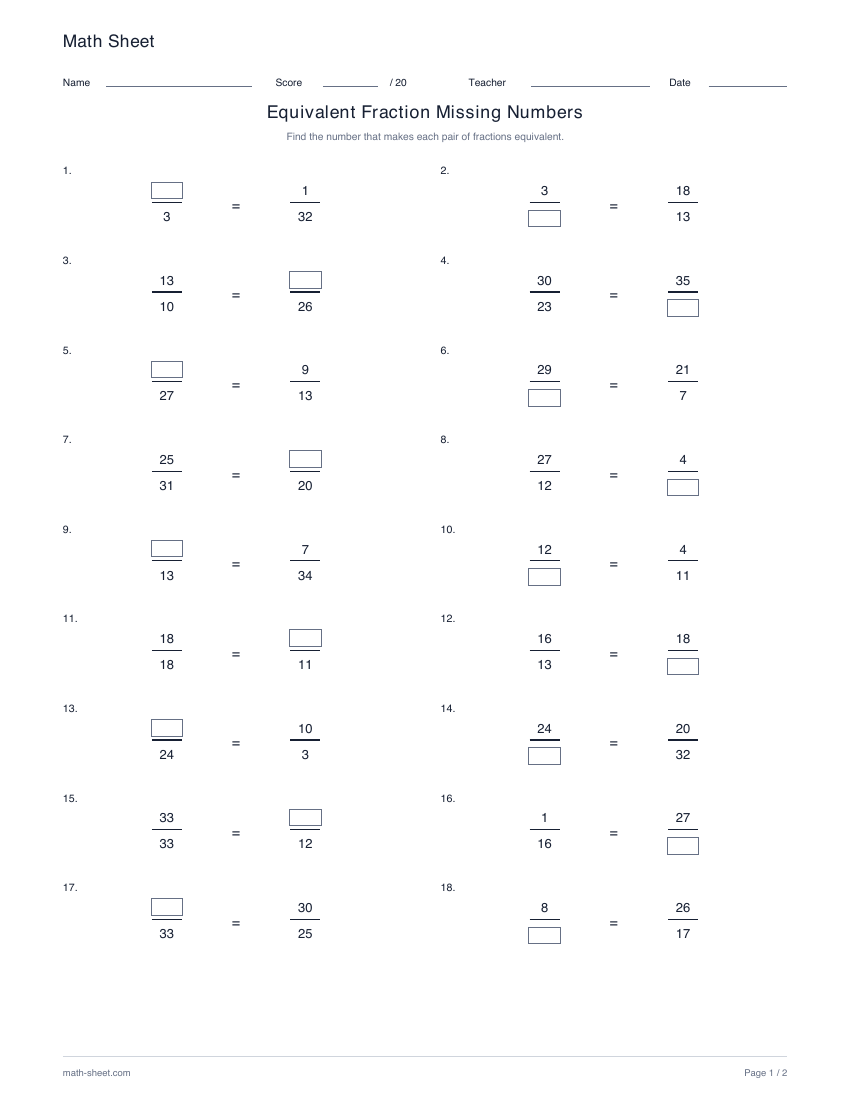
Fractions
Find a missing numerator or denominator that makes two fraction values equal, including blanks whose exact value is fractional.
Preview and download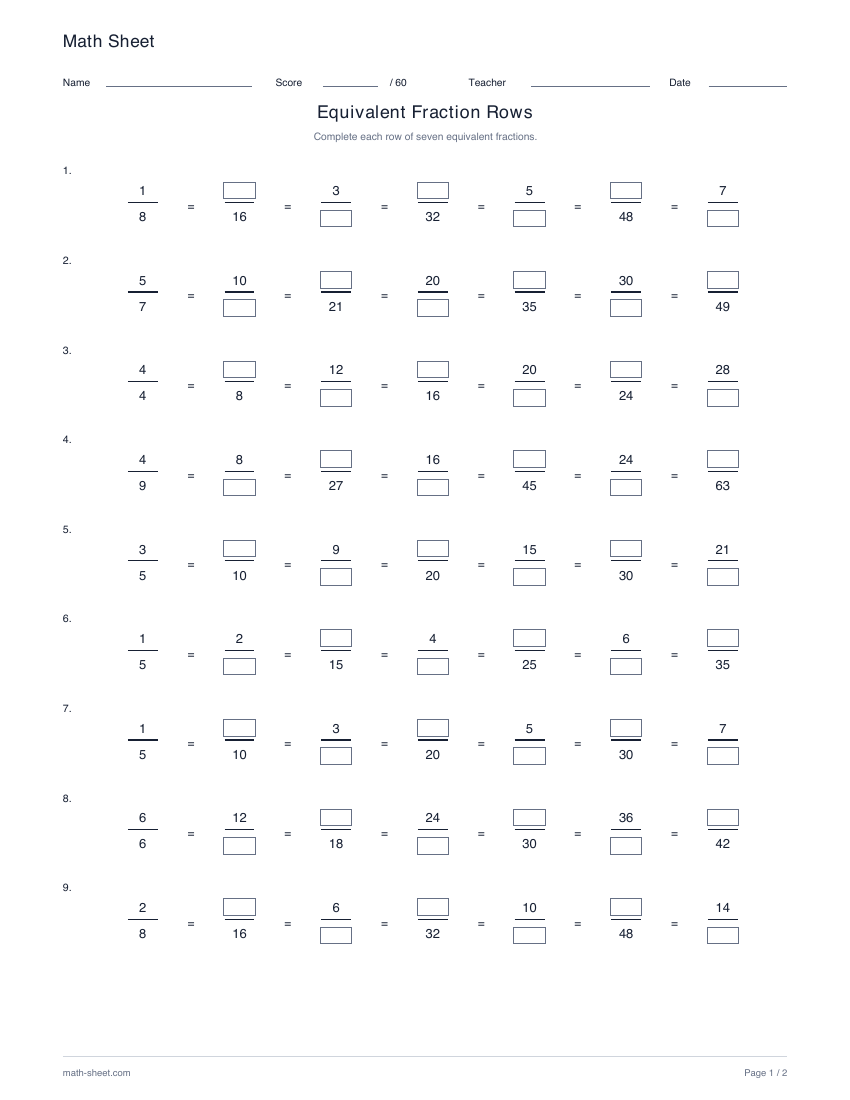
Fractions
Print an equivalent fractions worksheet with 10 rows of seven equal fractions, six one-part blanks per row, four denominator sets, and a separate answer key.
Preview and downloadStep 2
Use the meaning of numerator and denominator. Explain why a larger denominator makes smaller unit fractions.
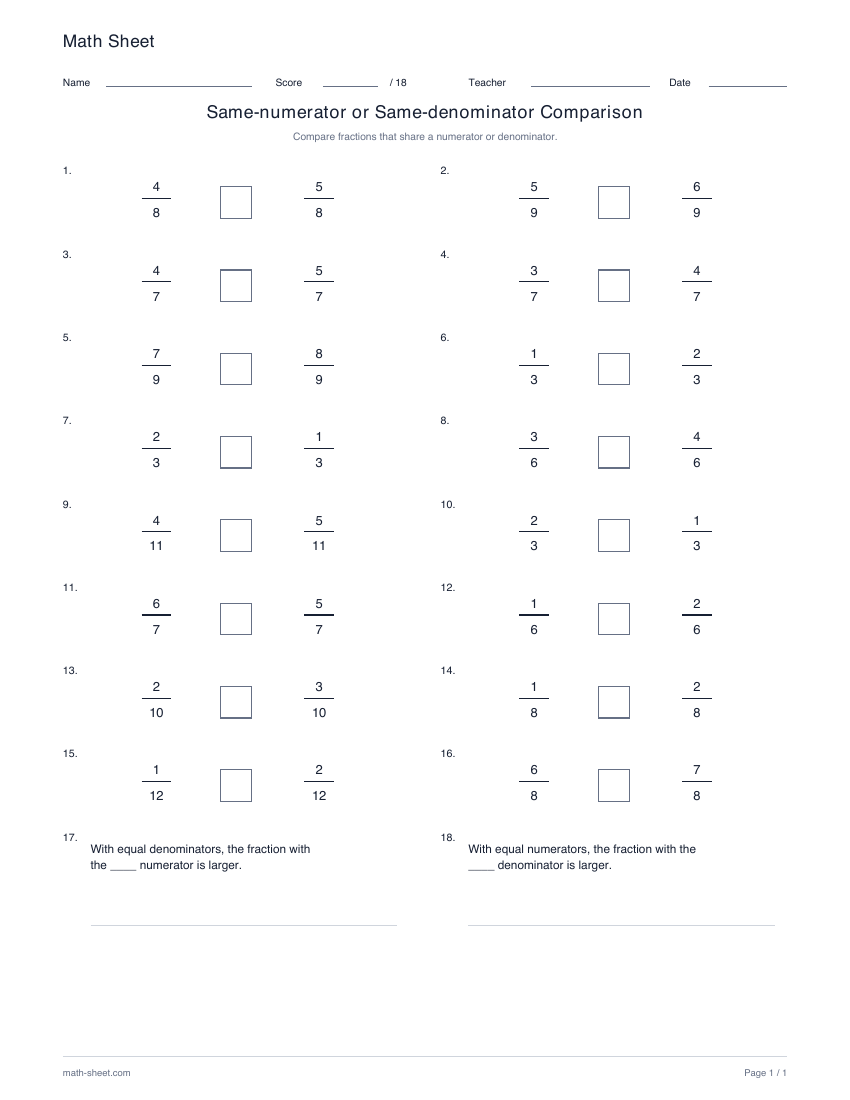
Fractions
Compare positive fractions by separating the number of parts from the size of each part, then explain the comparison rule.
Preview and download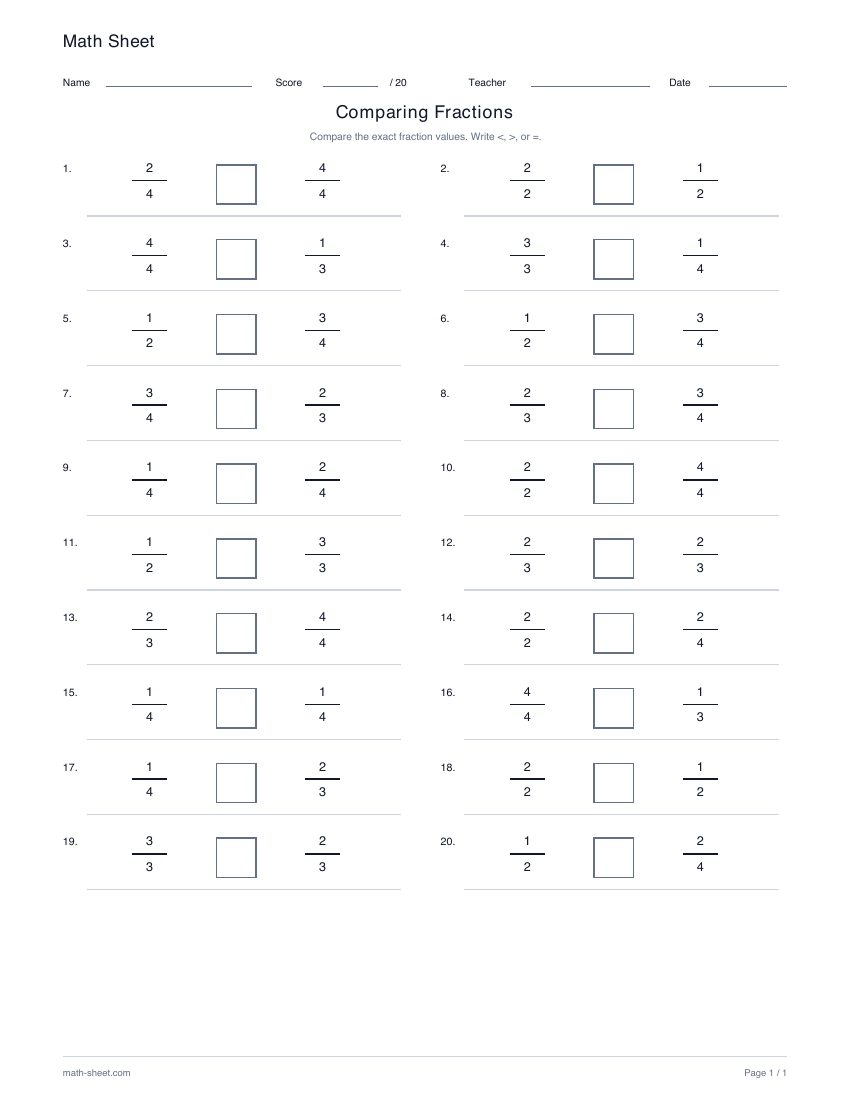
Comparing numbers
Print a 20-question comparing fractions worksheet with exact <, > and = problems. Choose positive, mixed-sign or negative values and optional denominators through 12.
Preview and download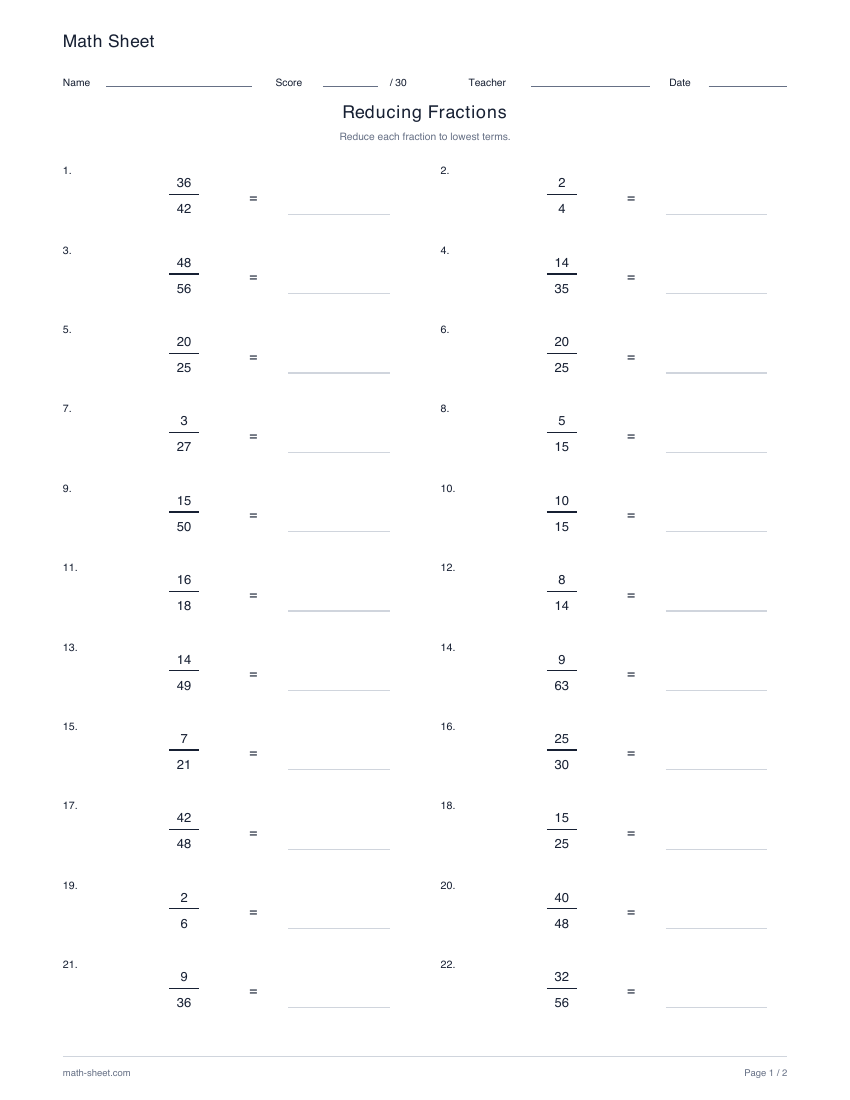
Fractions
Print simplifying fractions worksheets for positive proper fractions, with a separate key. Choose answer denominators, 10, 20 or 30 questions and optional no-repeat practice.
Preview and downloadStep 3
Start with visual addition and subtraction, then try the numerical version. Work that produces an improper fraction may need extra support.
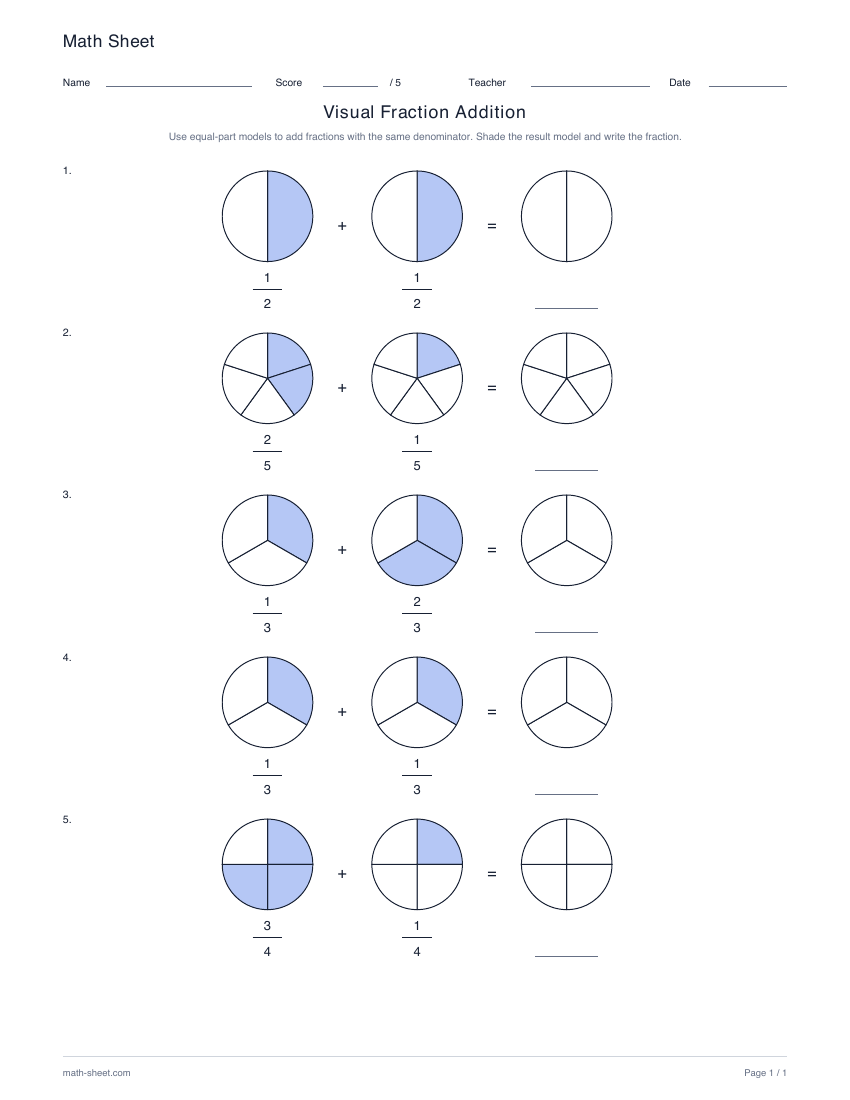
Fractions
Use equal-part models to see why adding fractions with a shared denominator combines their numerators.
Preview and download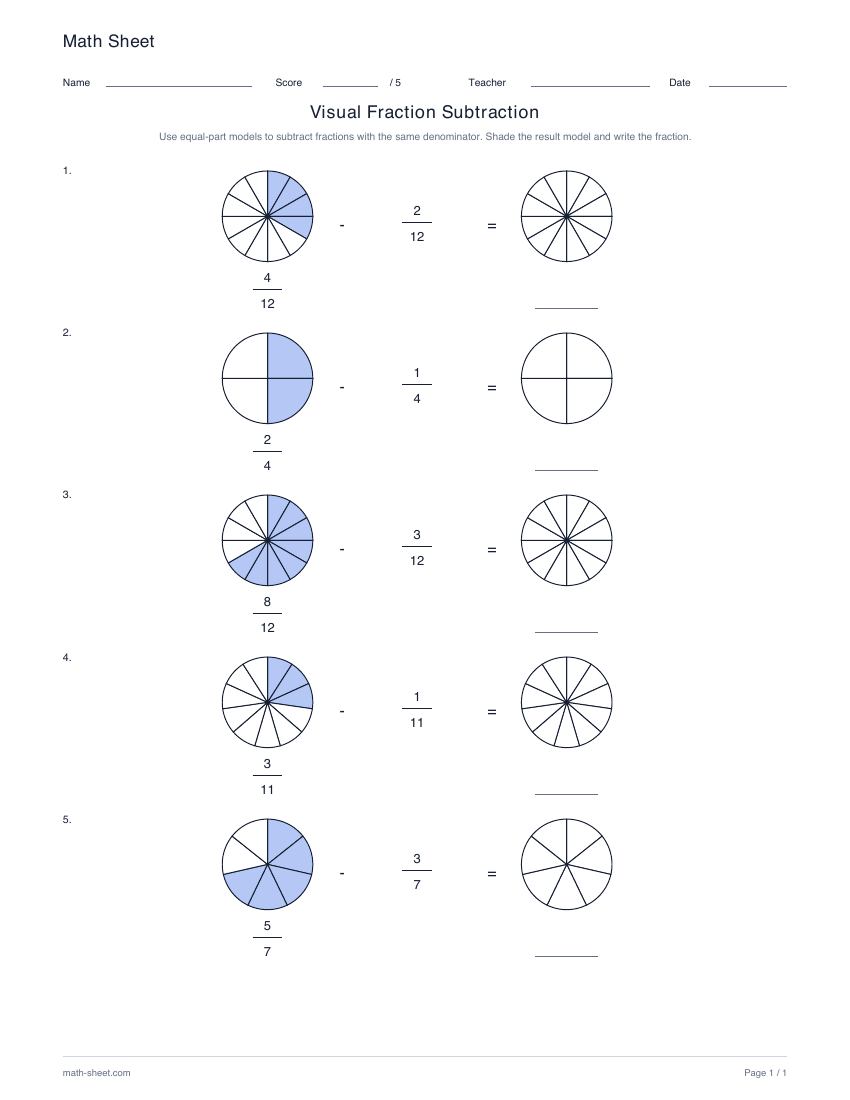
Fractions
Use equal-part models to remove a fractional amount and connect the remaining parts to a subtraction equation.
Preview and download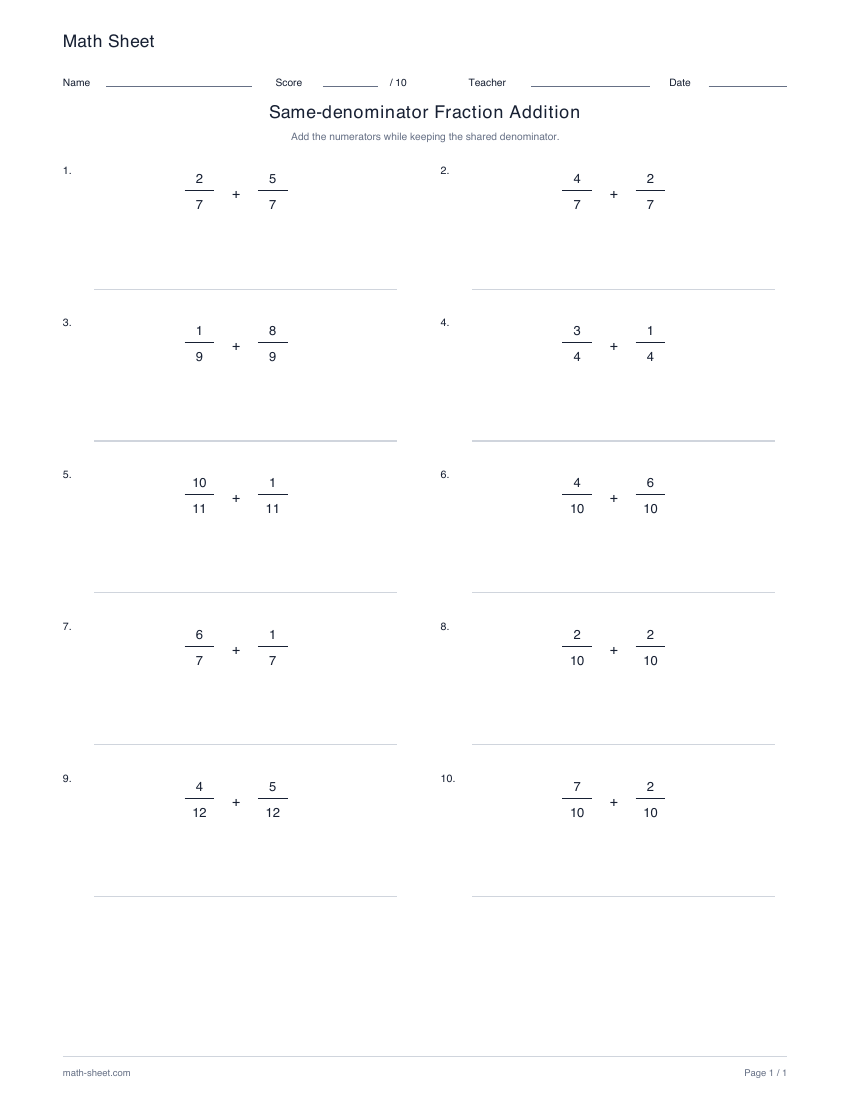
Fractions
Add like fractional units within one whole, simplify the total and recognize when the sum makes exactly one.
Preview and download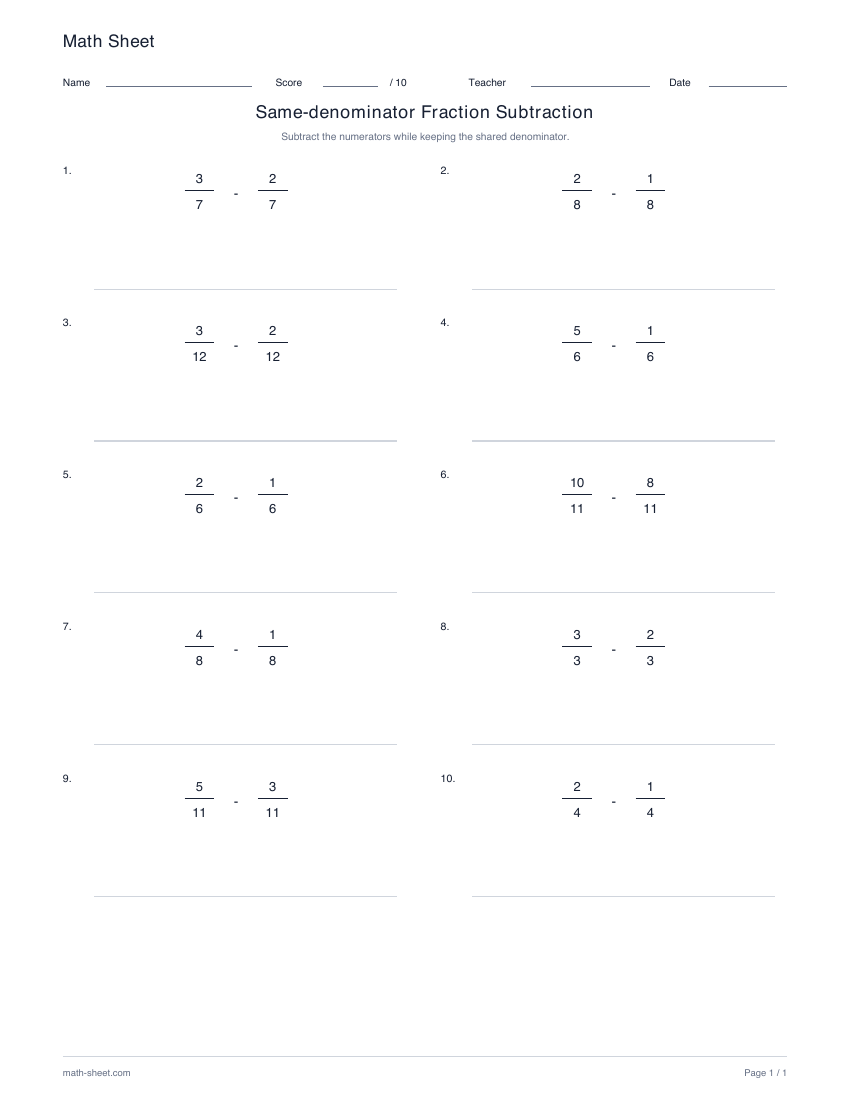
Fractions
Subtract amounts expressed in the same fractional unit, then simplify the difference without changing its value.
Preview and downloadAfter equal-part reasoning and like-denominator operations are secure, move to unlike denominators and explain every renaming step.
Begin with a short set, review the learner's explanation, and adjust the settings for the next lesson. Advanced options on an activity page may extend beyond this stage.
Choose after the relevant decimal places are familiar. Signed subtraction is an optional later step; these settings describe readiness, not a required curriculum.
Use after decimal place value is familiar. Compare three values below one and explain equivalent trailing zeros.
Open this decimal practice →Begin with printed decimal zeros and positive answers. Explain why 5 and 5.0 have the same value.
Open this decimal practice →Choose by the learner's arithmetic readiness. Begin with familiar facts and one grouping level; signed inputs and powers are later options, not a claim of curriculum alignment.
A teacher-led introduction after multiplication facts and addition/subtraction are secure. Begin with base operations and explain the order aloud.
Open this order-of-operations resource →Count outcomes. Explain the chance.
Choose by readiness with fractions, factors and compound events. These starting points are suggestions based on prerequisites, not claims of country or curriculum alignment.
Use familiar numbers and six equally likely outcomes as a first probability model.
Open this resource →Compare repeated labels by counting sectors in two printed diagrams.
Open this resource →Use the introductory sections first; explore conditional probability and trees when ready.
Open this resource →Explain why a method works
Choose by readiness for the operations and notation shown. Equality rules with variables are enrichment options; these suggestions do not claim alignment with a country or curriculum.
Eight questions compare the commutative and associative laws using familiar operations.
Open this resource →Use the definitions beside practice, including the two names for addition with zero.
Open this resource →Describe shape and direction
These are readiness suggestions for practice, not claims of country or standards alignment.
Begin after learners recognize a right angle and can compare degree measures with 90 and 180.
Customize this geometry task →Use clear rotated examples to decide whether the extended supporting lines will ever meet.
Customize this geometry task →Compare perpendicular examples with parallel and oblique pairs, including rotated configurations.
Customize this geometry task →Distinguish parallel, perpendicular and ordinary oblique intersections in one balanced set.
Customize this geometry task →Use endpoint names and right-angle marks to classify ten pairs drawn in a shared six-line figure.
Customize this geometry task →Align a protractor with the requested left or right starting ray and measure eight angles to the nearest degree.
Customize this geometry task →Use a stated degree and starting ray to draw and label eight new rays above the baseline.
Customize this geometry task →Use a fixed two-page reference to connect side classes, angle classes and the 180-degree interior sum.
Customize this geometry task →Draw, plot and explain
Join dots to make rectangles and compare their side lengths. Count intervals between dots, not the dots themselves.
Customize this paper →Describe a dataset
A readiness-based starting point with positive values from 1 to 10. Count repeated observations, then compare the greatest and least.
Customize this practice →Choose familiar arithmetic so the learner can focus on the story. These starting points describe readiness; expectations differ between schools and curricula.
Keep arithmetic familiar while choosing an operation and setting aside unrelated details.
Open this story practice →Label each intermediate quantity before moving to the next part of a story.
Open this story practice →