Read the data. Explain the measure.

Mean, median, mode and range worksheets

Four ways to describe a dataset. Learn what each measure tells you, then practice with familiar values, larger datasets or signed numbers.

Choose your practice
One dataset. Four questions.

7 3 5 5

In order: 3, 5, 5, 7

Mean
5
Median
5
Mode
5
Range
4

The same number can answer different questions. Explain the calculation.

Understand, calculate, explain

Understand the four measures

Use definitions and worked examples to distinguish a fair-share value, the middle, the most frequent observations and the spread from least to greatest.

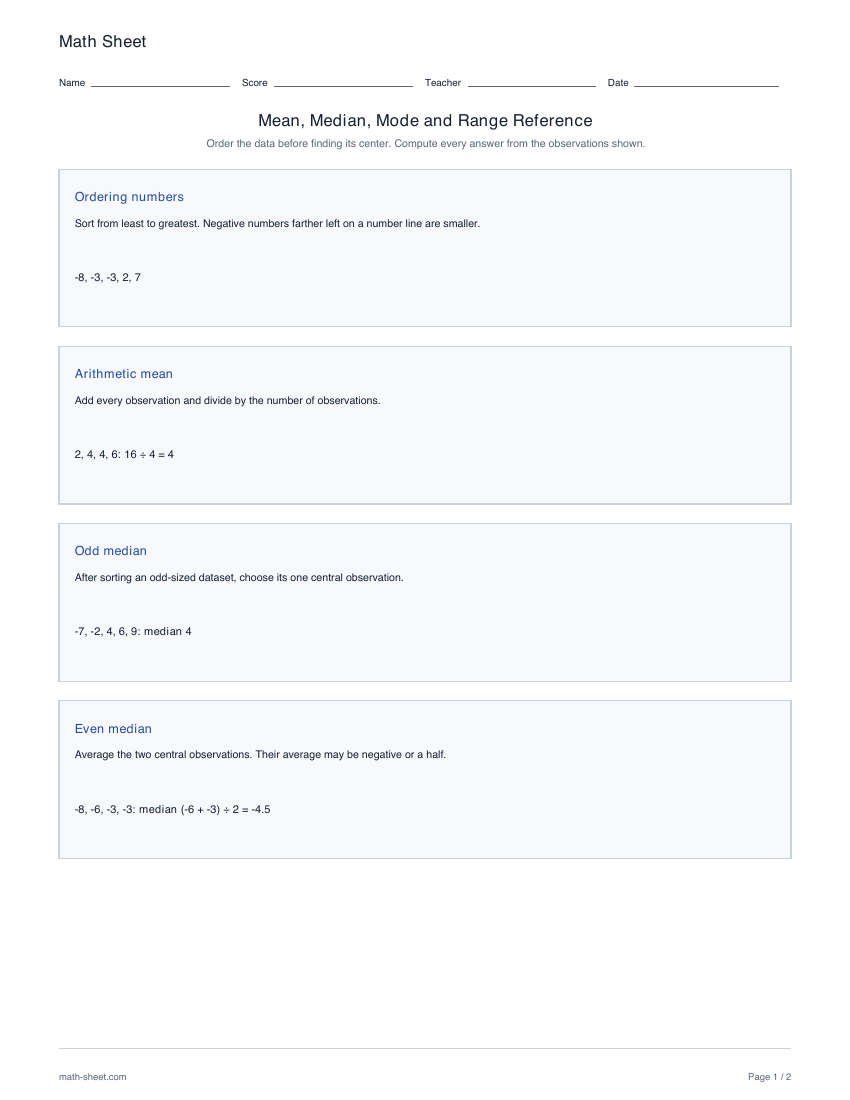
Printable mean, median, mode and range reference worksheet preview

Mean, median, mode & range

Mean, median, mode and range reference

Print a reference that explains mean, median, mode and range with worked examples. Compare odd and even datasets, negative values, tied modes and data with no mode.

Preview and download
Understand, calculate, explain

Work from the observations

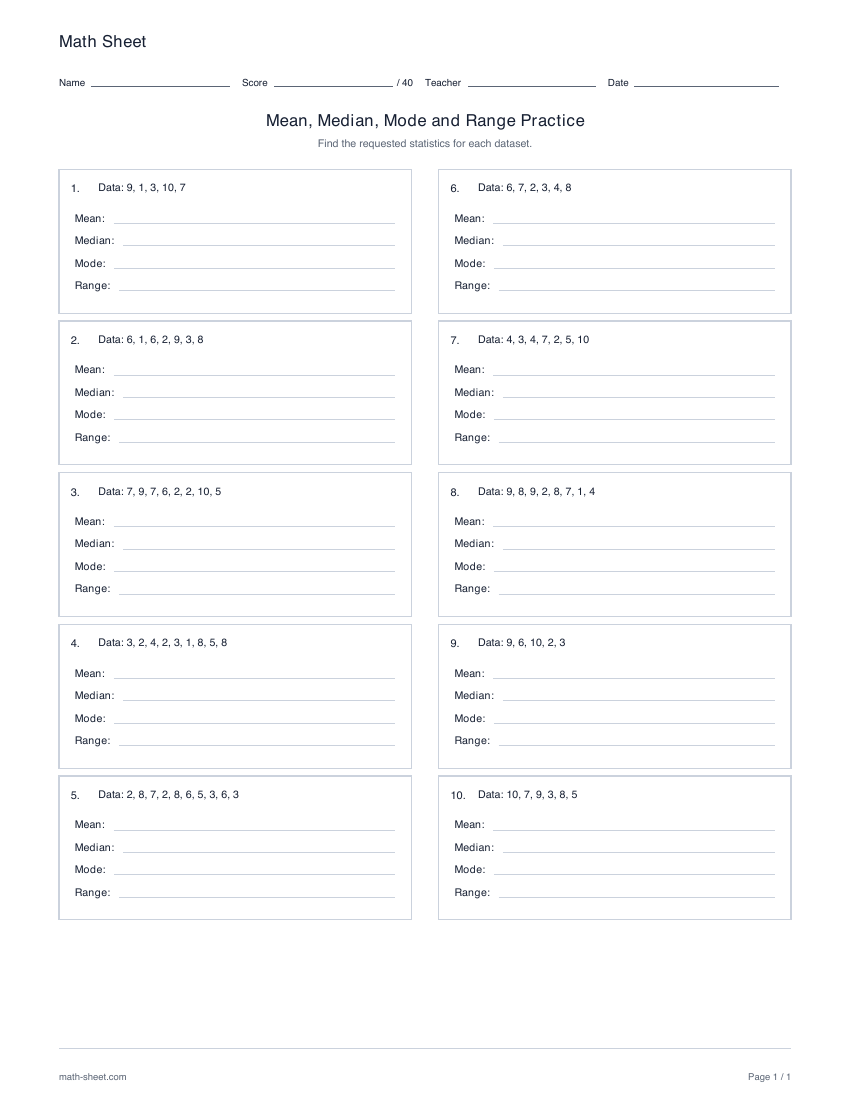
Practice with ten raw datasets. Start with selected measures, then vary the number of observations, magnitude range and signs.

Printable mean, median, mode and range practice worksheet preview

Mean, median, mode & range

Mean, median, mode and range practice

Generate ten datasets for mean, median, mode and range practice. Choose the requested statistics, observations per dataset, number range and signs, with separate answer pages.

Preview and download

Choose by readiness

Build the calculation on familiar numbers

Start with the measures the learner can explain. Introduce mean and even-sized medians after addition and division are secure; choose signed datasets after negative-number arithmetic is familiar. These grade entry points are suggestions, not a claim of curriculum alignment.

Find the mode and range

A readiness-based starting point with positive values from 1 to 10. Count repeated observations, then compare the greatest and least.

Open this focused practice →

Compare all four statistics

Use after addition, division and numerical ordering are secure. Work with odd and even dataset lengths and explain each calculation.

Open this focused practice →

Summarize signed data

Practice after negative-number arithmetic is familiar. Check the order of signed values and the average of two central observations.

Open this focused practice →

What does each measure tell you?

  • Mean: add every observation, then divide by the number of observations.
  • Median: put the observations in order and find the middle. For an even count, average the two central values.
  • Mode: find the most frequent repeated value or values. If every observation occurs once, use no mode.
  • Range: subtract the least value from the greatest to describe the distance between the extremes.

For 7, 3, 5, 5, the mean is 20 ÷ 4 = 5. The sorted middle pair is 5 and 5, the most frequent value is 5, and the range is 7 − 3 = 4.

A dataset can have more than one mode

In 2, 2, 4, 4, 7, both 2 and 4 occur twice. Each belongs in the mode answer. In 1, 3, 5, 7, every value occurs once, so there is no mode under the convention used here.

Count the frequency of every value before choosing an answer. A value being numerically larger does not make it more frequent. Repeated observations also continue to count individually when you calculate the mean.

Negative values still have a numerical order

For −8, −6, −3, −3, the mean is −20 ÷ 4 = −5. The median is the average of −6 and −3, which is −4.5. The mode is −3 and the range is −3 − (−8) = 5.

Generated practice uses integer observations and integral means. An even-sized median may end in .5. The positive, negative and mixed settings describe the observations; mixed allows either sign and does not promise both signs in every dataset.

Print exactly the practice you chose

Every practice sheet contains ten datasets. Choose a fixed set of statistics, or use random two to ask for two distinct statistics on each question. The dataset-size setting changes the number of observations inside a question, not the number of questions.

Preview US Letter or A4 before downloading. Separate answer pages show the original data, sorted data and the requested results. The two-page English reference includes its worked examples without a separate key. Eight printed languages are available in the generator; ready-made downloads are English.