
Ratios
Ratios from pictures
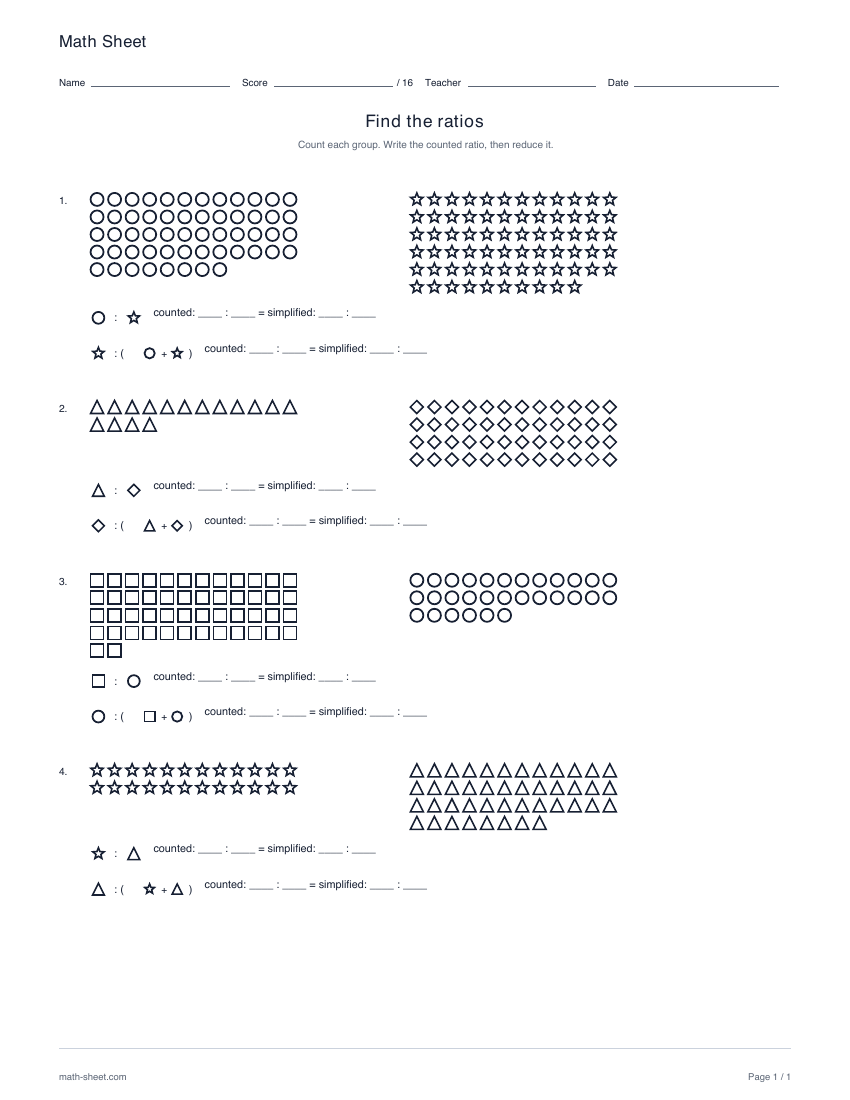
Count two kinds of shapes in four picture arrays. Write and simplify part-to-part ratios, with an optional second question comparing one group with the whole.
Preview and downloadPractice by skill
Compare quantities, keep their order, and explain the relationship. Start with pictures, build equivalent ratios, then put unit rates to work.
Choose a ratio skillBlue circles : amber circles
Compare, scale, explain
Connect counted shapes and verbal comparisons with an ordered ratio. Distinguish a part from the whole before simplifying.
Ratios
Count two kinds of shapes in four picture arrays. Write and simplify part-to-part ratios, with an optional second question comparing one group with the whole.
Preview and download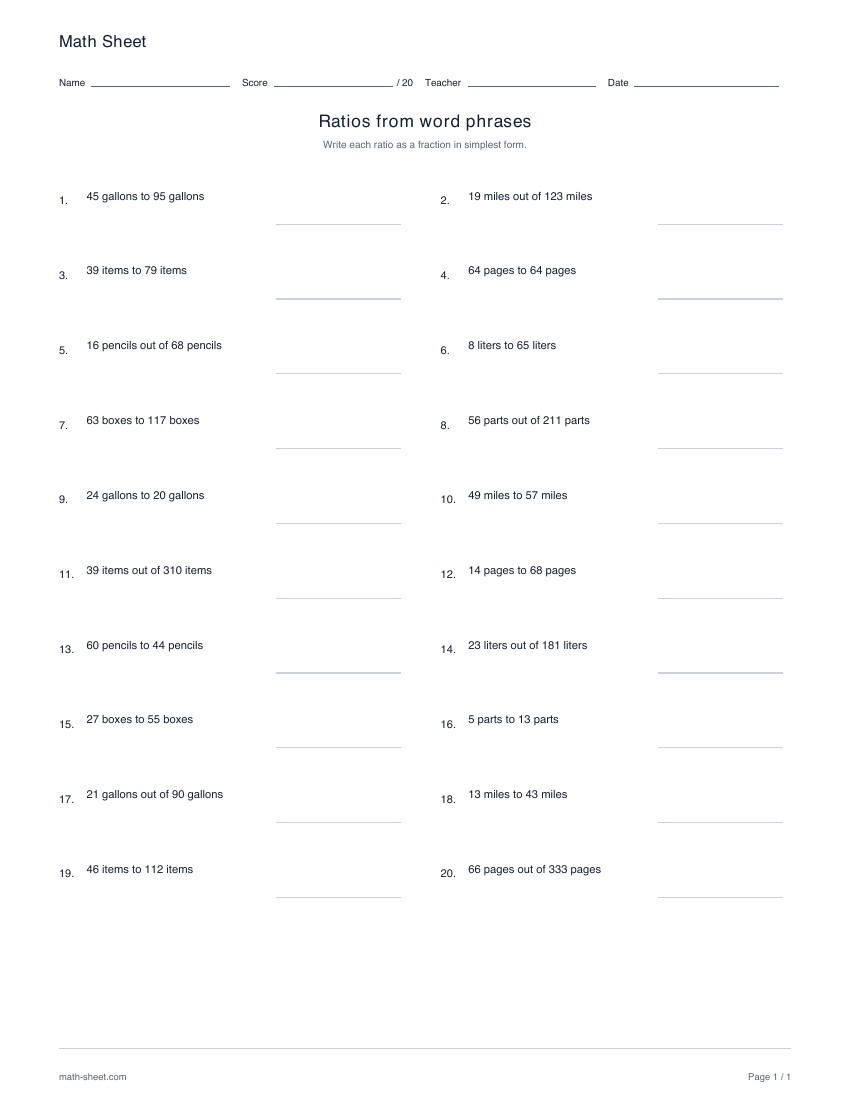
Ratios
Turn twenty word phrases into fractions in simplest form. Practice ordered comparisons and distinguish “to” from “out of” a stated total.
Preview and downloadCompare, scale, explain
Scale both quantities together, complete missing terms and identify matching ratios in contextual tables.
Ratios
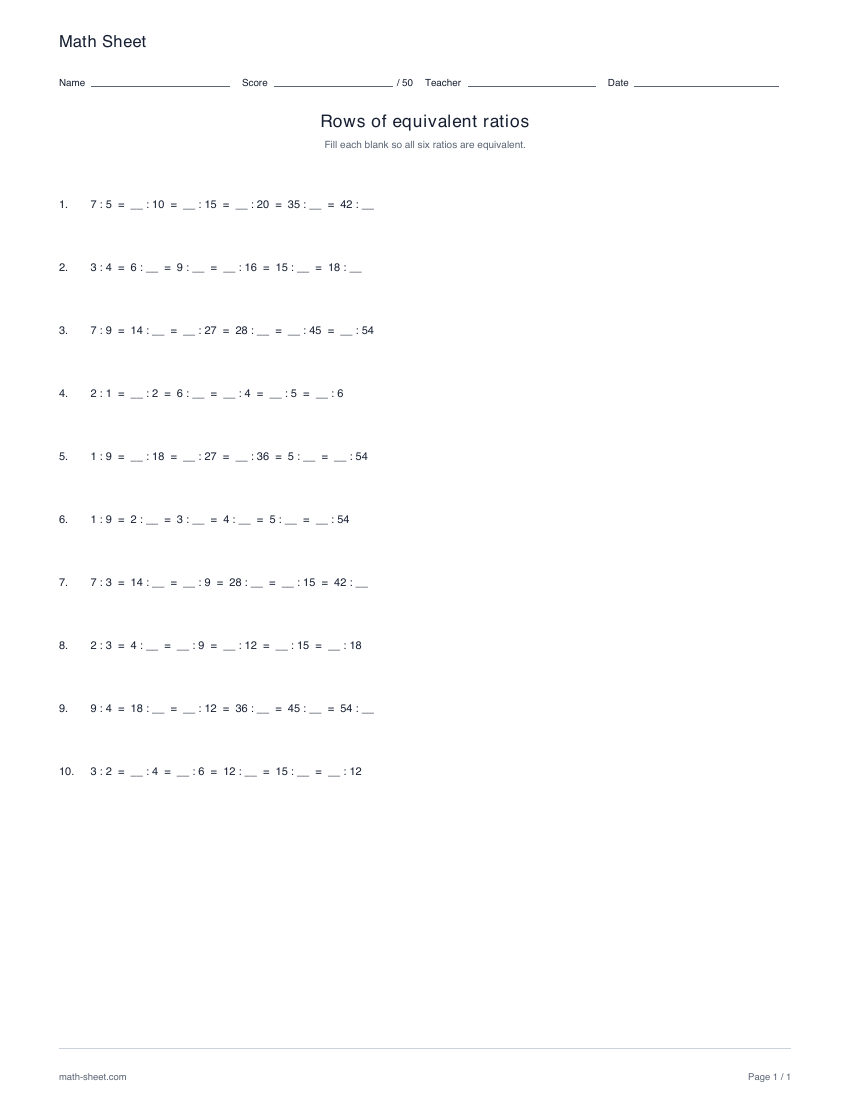
Fill missing terms in ten rows of six equivalent ratios. Choose consecutive or gapped scale factors and ordered or shuffled practice, with printable answer keys.
Preview and download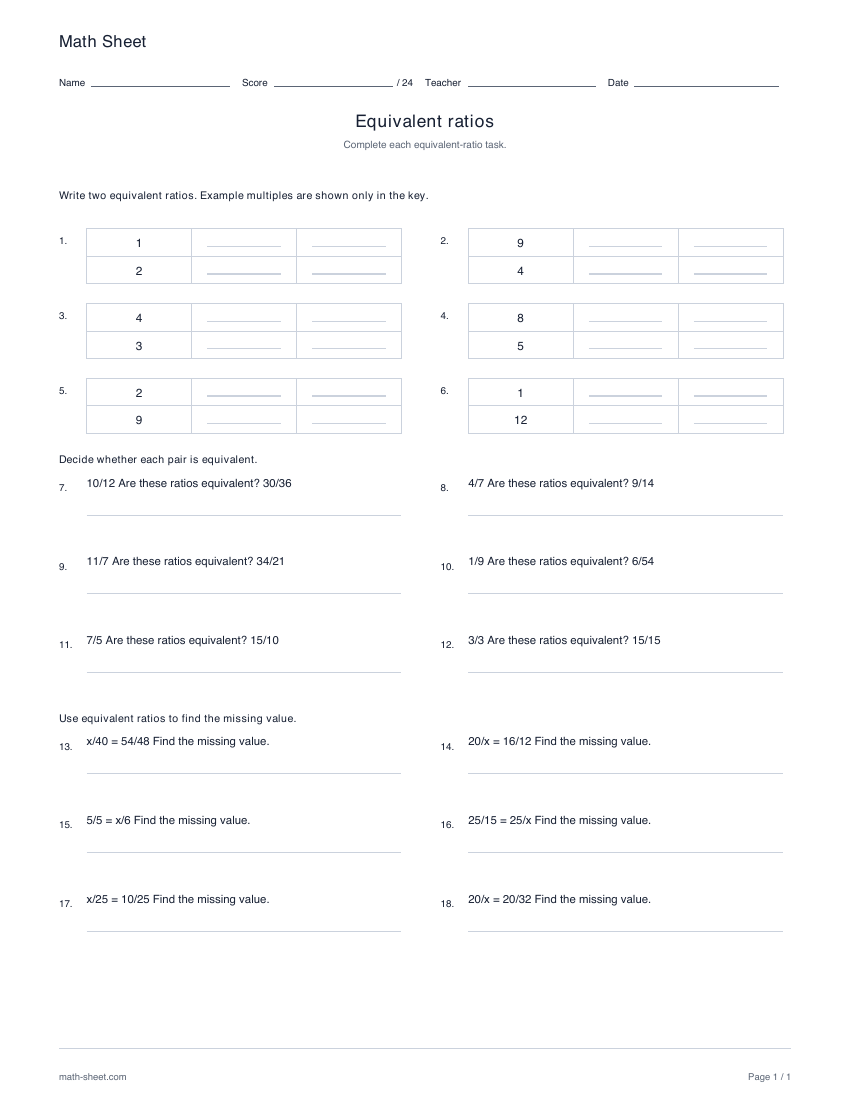
Ratios
Practice eighteen equivalent-ratio questions in three formats: complete ratio tables, decide whether pairs are equivalent, and solve missing-value proportions.
Preview and download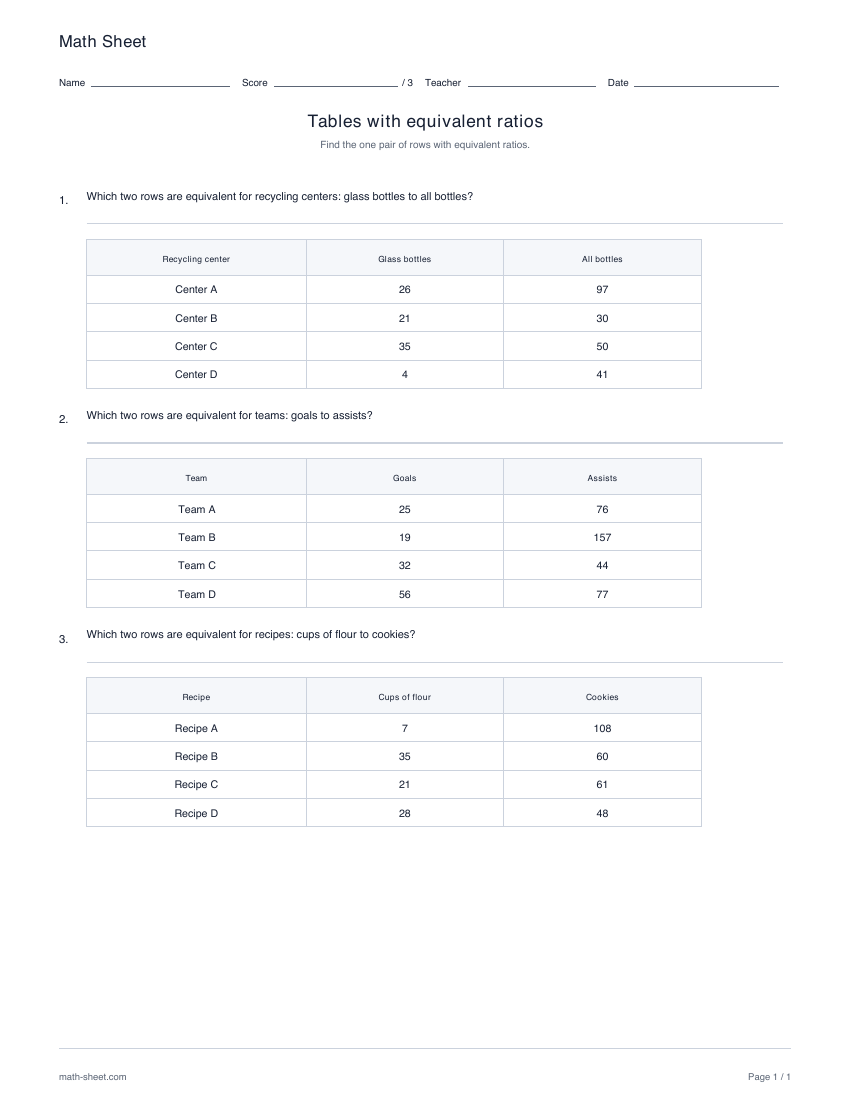
Ratios
Compare four named rows of data and identify the two with equivalent ratios. Choose three contextual problems or a six-problem set, with separate answer pages.
Preview and downloadCompare, scale, explain
Express a quantity per one unit, compare offers and use constant rates to scale a result.
Ratios
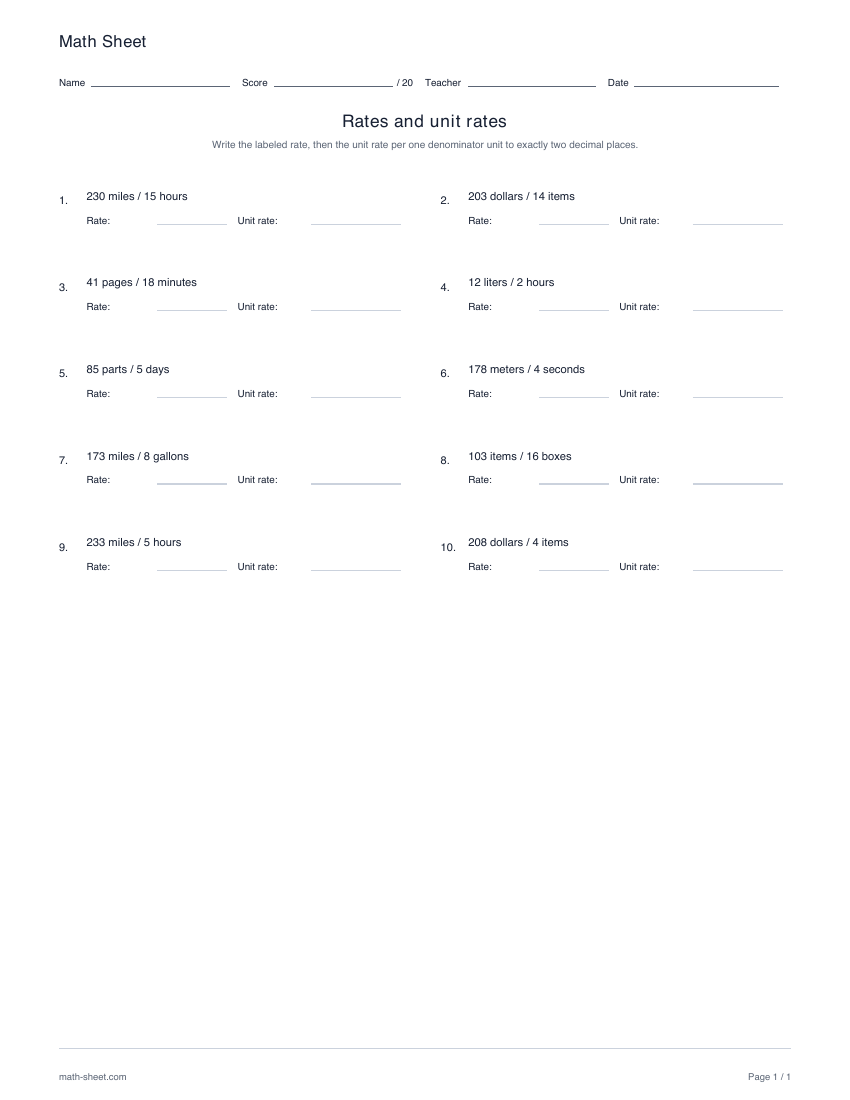
Write a labeled rate and calculate a unit rate for ten word phrases. Keep the units in order and round the final unit rate to two decimal places.
Preview and download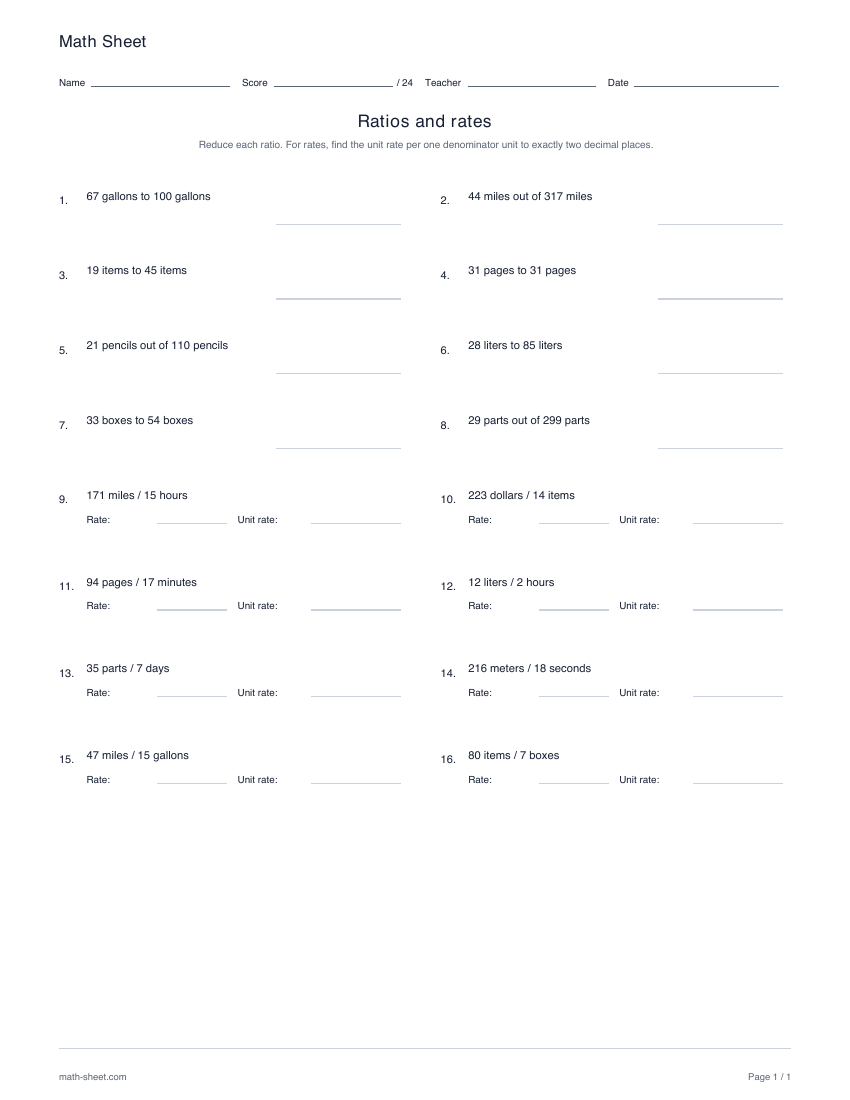
Ratios
Combine eight simplest-form ratio questions with eight rate and unit-rate questions. Practice choosing the correct representation and keeping units with every answer.
Preview and download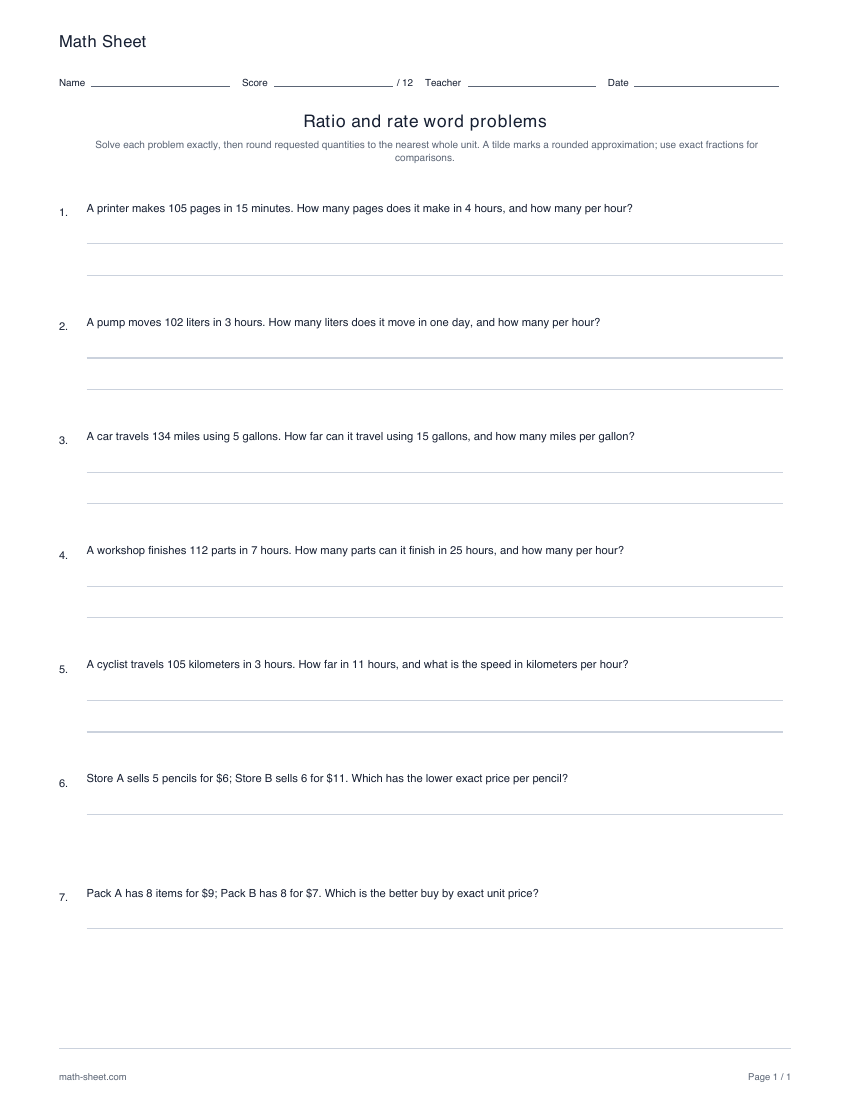
Ratios
Solve seven contextual problems using constant rates, time conversions, fuel use and better-buy comparisons. Answer linked scaling and unit-rate questions with separate worked keys.
Preview and downloadChoose by readiness
Picture comparisons work well after array counting and common factors are familiar. Move to rates and proportions when learners can explain equivalent fractions and division. These starting points describe readiness, not alignment with a particular country's curriculum.
A teacher-led introduction after array counting and common factors are secure. Begin with the part-to-part comparison only.
Open this focused practice →Gaps and shuffled positions require learners to derive each missing value from the complete anchor.
Open this focused practice →Use after unit rates and time conversions are familiar. Keep exact intermediate values and answer every part.
Open this focused practice →If a box contains 6 blue counters and 9 amber counters, blue to amber is 6:9, or 2:3. Amber to blue is 9:6, or 3:2. Those are different comparisons.
Amber to all counters is 9:15, or 3:5, because there are 15 counters altogether. Naming both quantities before calculating helps prevent part-to-part and part-to-whole confusion.
2:5 becomes 4:10 when both quantities double. Tripling both gives 6:15.
3:4 and 9:12 are equivalent: both terms have been multiplied by 3. Their cross-products also match.
For 3:4 = 15:x, the first quantity is multiplied by 5. The second must be 4 × 5, so x = 20.
Ordered rows reveal a pattern. Gaps and shuffling test whether students understand the relationship independently of the order in which the ratios appear.
If a cyclist travels 42 kilometres in 3 hours at a constant rate, the rate is 42 kilometres per 3 hours. Dividing gives a unit rate of 14 kilometres per hour.
Reversing the division answers a different question: 3/42 hours per kilometre. Keep the units beside the quantities so the answer matches what was asked.
The unit-rate sheets request two decimal places. Keep the exact quotient until the final rounding step, and include the unit phrase with the result.
A problem can ask both for a scaled amount and for the unit rate. For a machine that handles 45 items in 15 minutes, first convert to a common time unit: that is 180 items per hour. At the same rate, two hours gives 360 items.
Use exact values for intermediate work. Rounding a rate before multiplying can change the final answer. When comparing prices, compare exact unit costs so a rounded tie does not hide the cheaper offer.
All eight activities include free English PDFs, image previews and answer keys. Choose Letter or A4. The table activity offers three problems or six across two student pages; longer notes or translated text may require extra space.
Use the online generator to make a fresh set or save the configured link for the same questions later. Changing paper or printed language preserves the mathematics.