
Flash cards
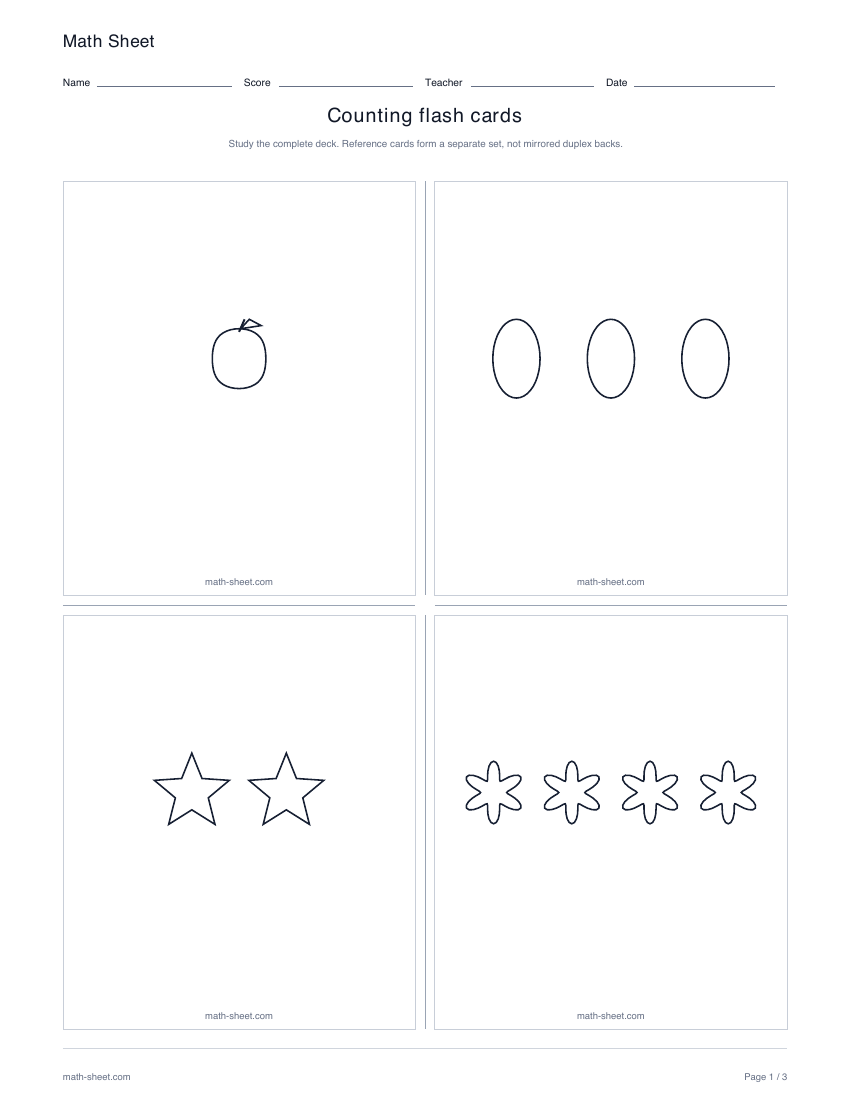
Counting picture flash cards
Count original picture groups from one to twelve, with no numeral revealing the answer on the prompt card.
Preview and downloadPractice by skill
Count a picture group, explain a fact or name a familiar symbol. Choose a deck, review every page, then print cards for a short lesson or repeated practice.
Explore the decksChoose a deck
Begin with small picture groups, familiar numerals, shape attributes or paired basic Latin letters.
Flash cards
Count original picture groups from one to twelve, with no numeral revealing the answer on the prompt card.
Preview and download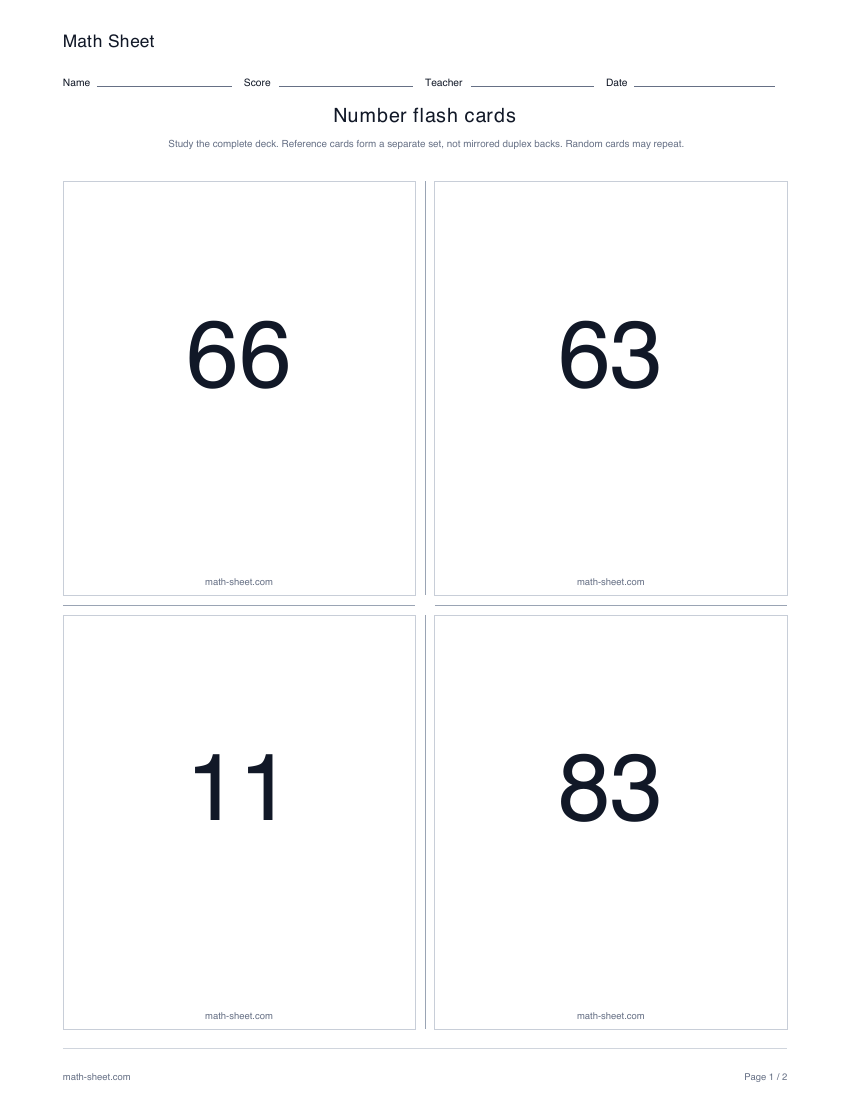
Flash cards
Read random one-, two-, three- or four-digit whole numbers. Choose page count and 4, 8 or 10 cards per sheet.
Preview and download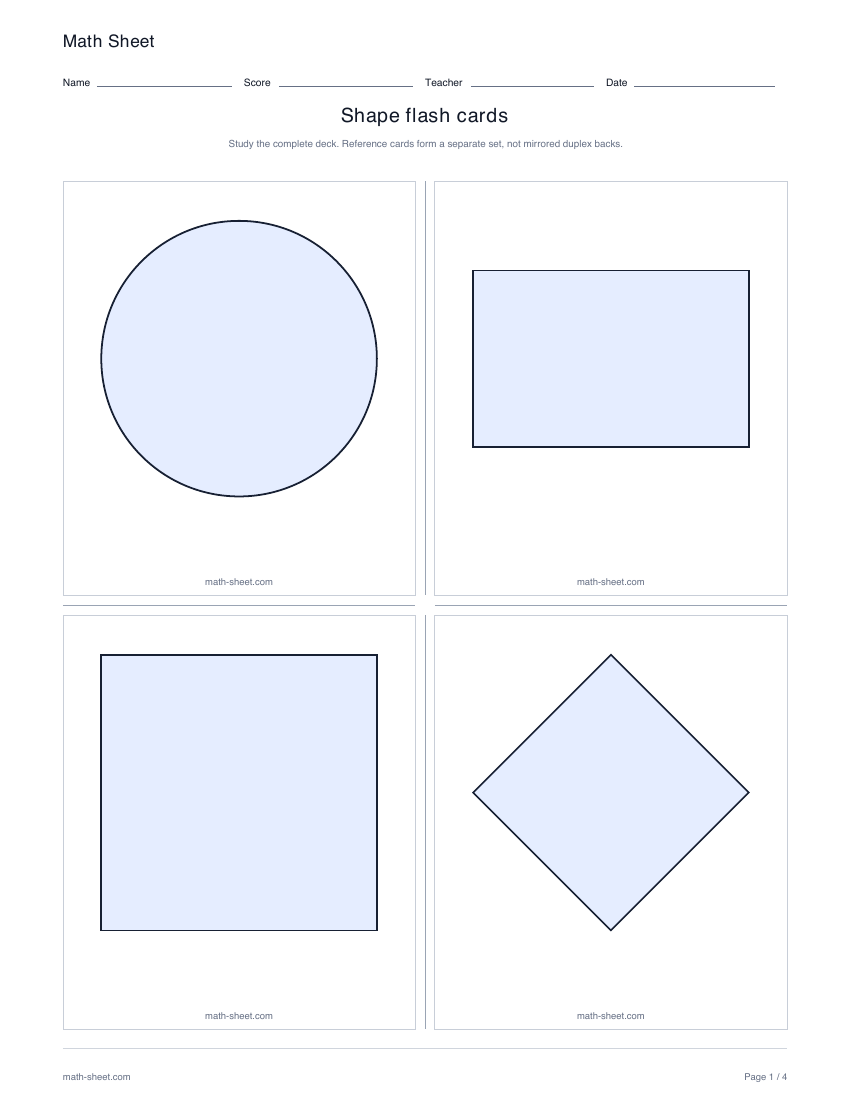
Flash cards
Name thirteen original shapes and discuss sides, corners and curves. Choose color or monochrome cards.
Preview and download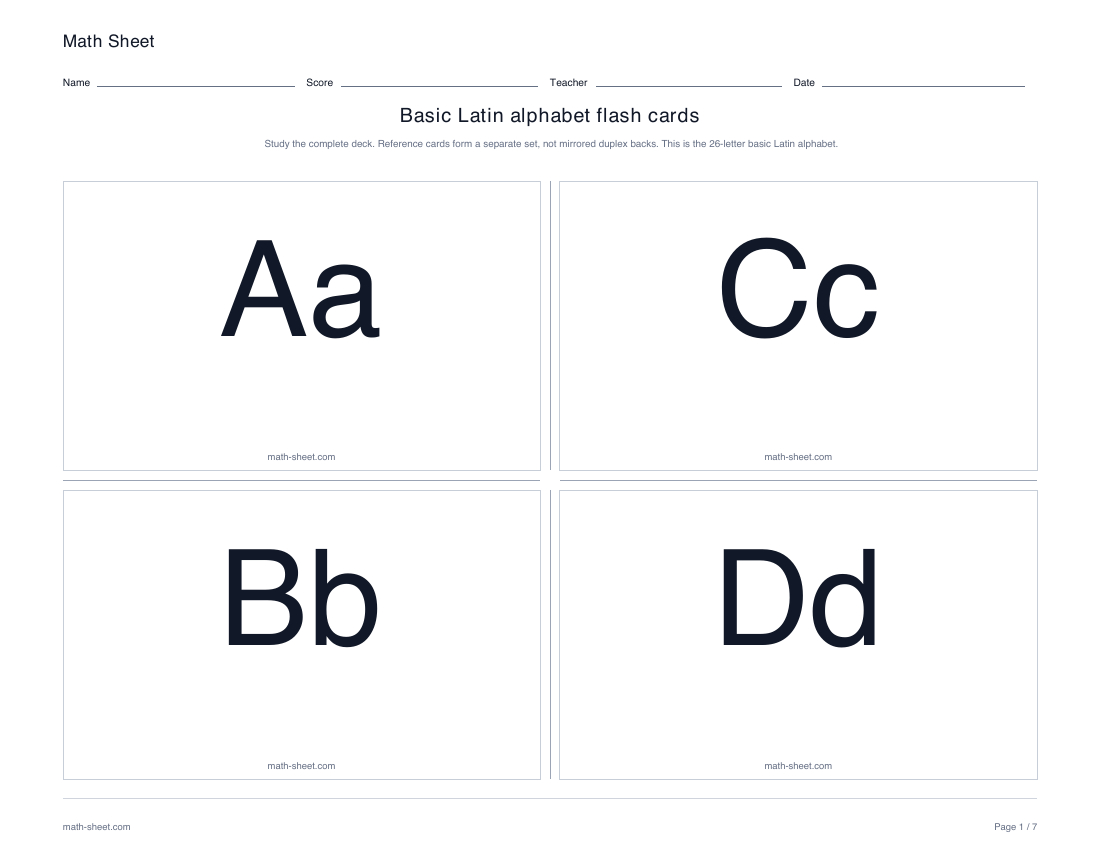
Flash cards
Recognize the 26 basic Latin uppercase and lowercase pairs, Aa through Zz, on landscape cards.
Preview and downloadChoose a deck
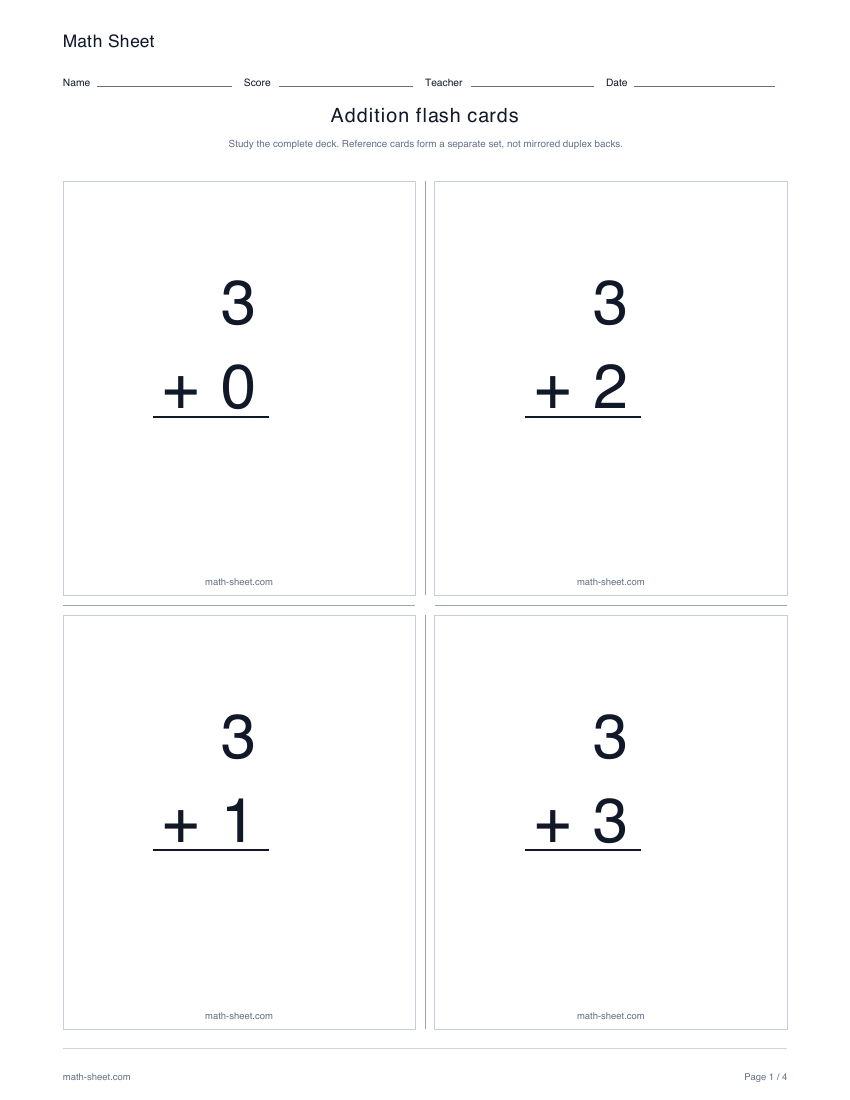
Choose one fixed operand and print its complete addition, subtraction, multiplication or exact-division set.
Flash cards
Practice one fixed addend with every partner from zero through 9 or 12. Print the complete fact set with optional separate reference cards.
Preview and download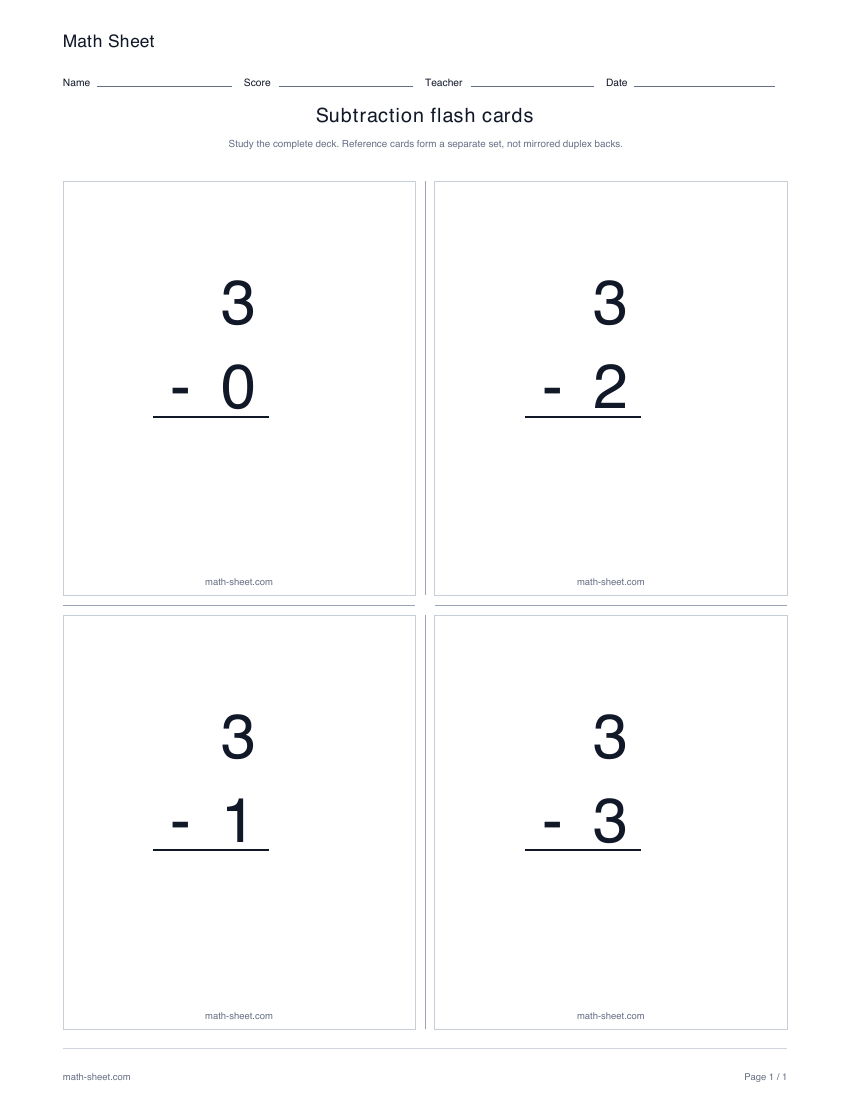
Flash cards
Take away zero up to the chosen starting number, with no negative answers. Practice a complete fixed-number subtraction deck.
Preview and download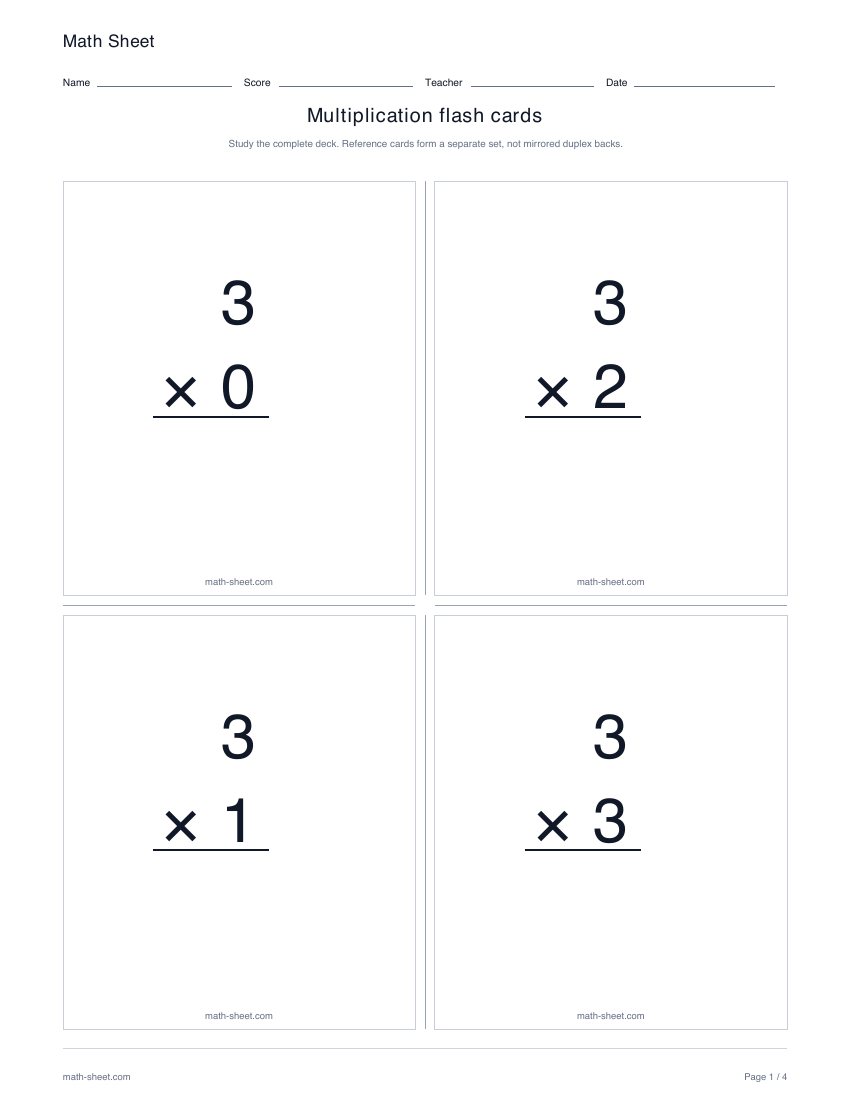
Flash cards
Choose a fixed factor from 1–12 and practice its products with every factor from zero through 9 or 12.
Preview and download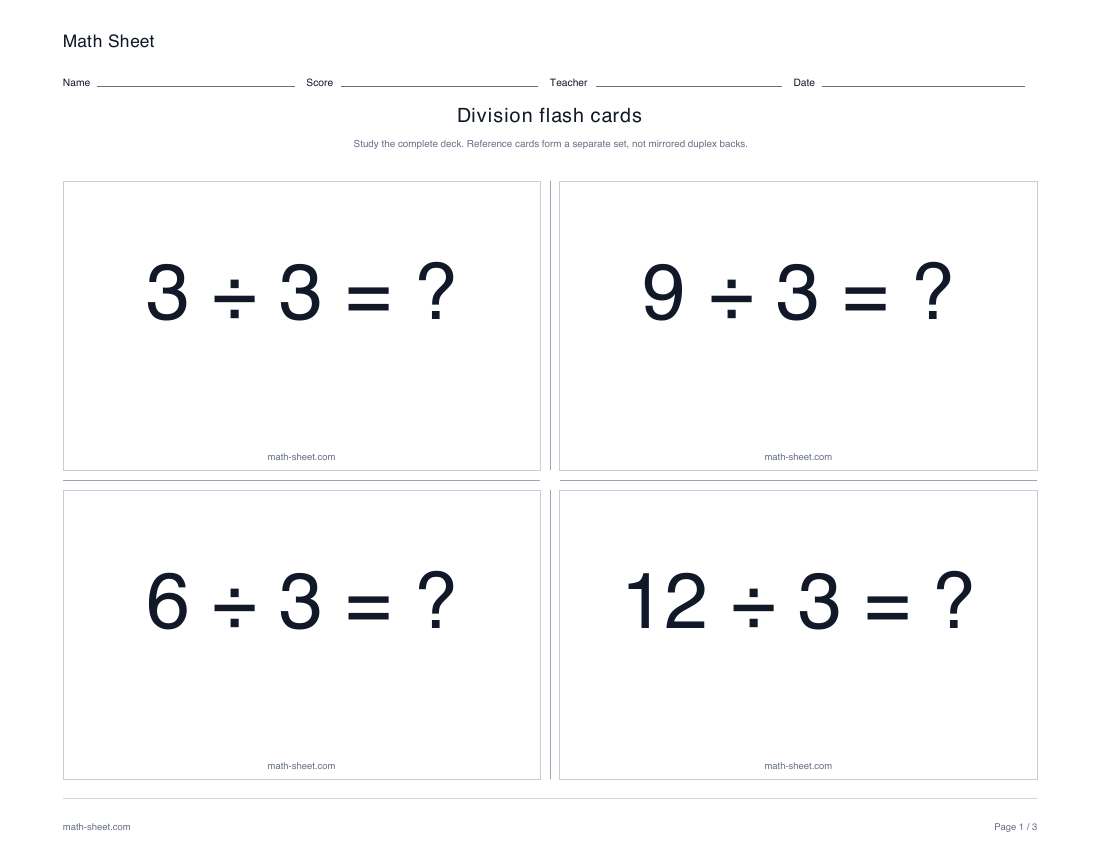
Flash cards
Practice exact divisions by one fixed divisor from 1–12. Quotients cover every value from 1 through 9 or 12.
Preview and downloadChoose a deck
Read triangle givens and explain four related equations. These complete decks are distinct from the six-family writing worksheets.
Flash cards
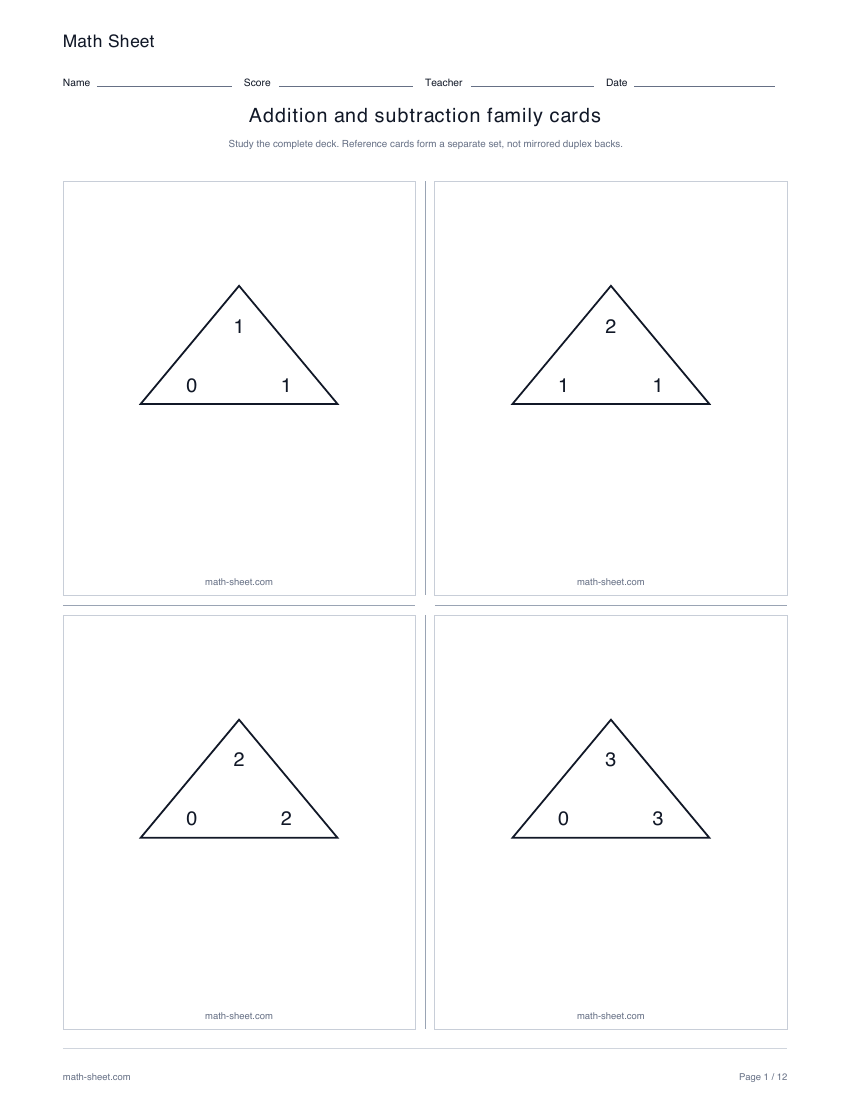
Use complete sets of part–whole triangles, including zero and doubles. Choose wholes through 9, 12 or 18.
Preview and download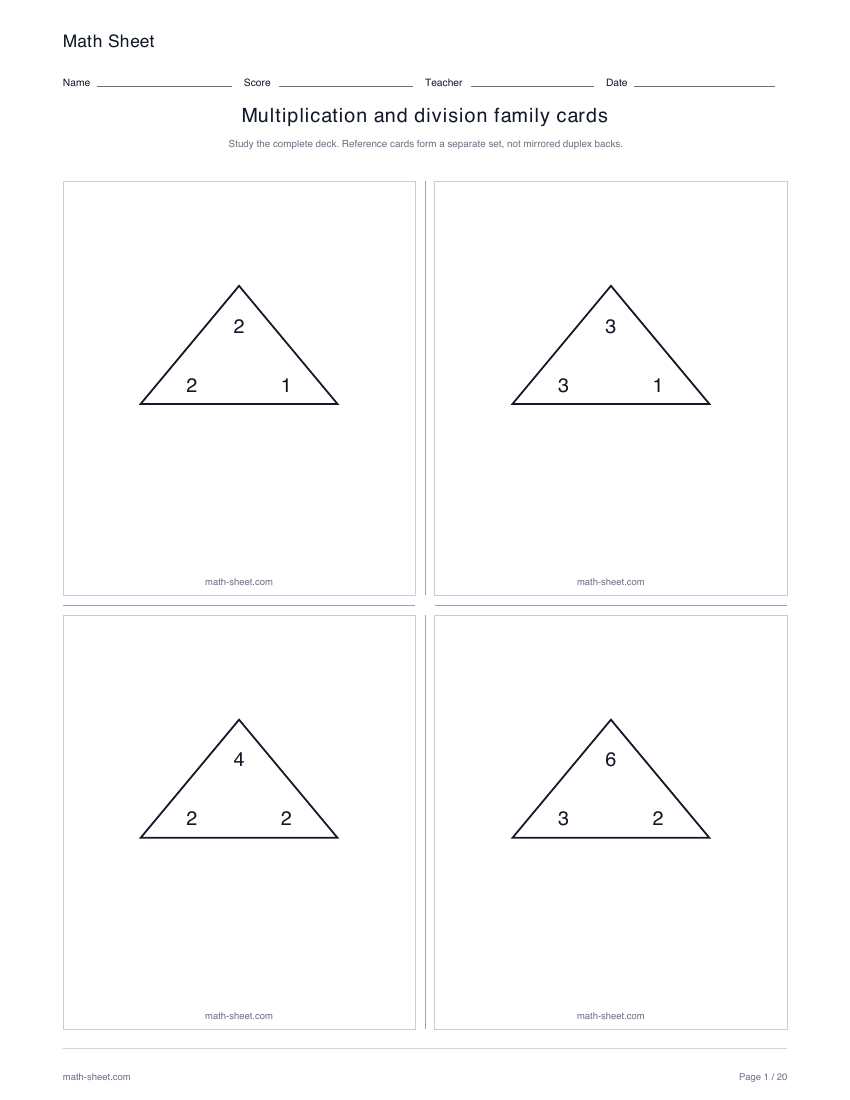
Flash cards
Connect factors, products and exact divisions in complete triangle decks through a larger factor of 9 or 12.
Preview and downloadChoose a deck
Choose clock patterns, identify U.S. currency fronts or read numerical amounts with explicit currency codes.
Flash cards
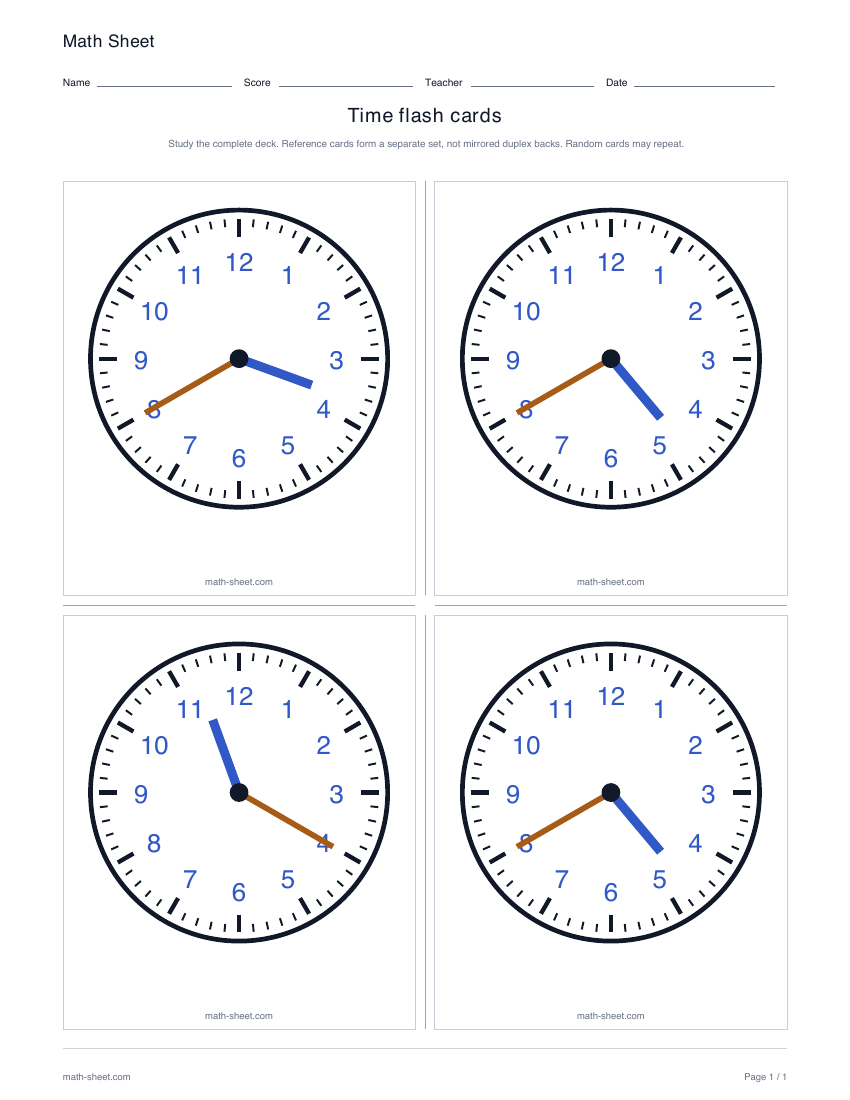
Read clocks using whole hours, selected minute patterns or positions on either half of the dial. Choose one to eight pages.
Preview and download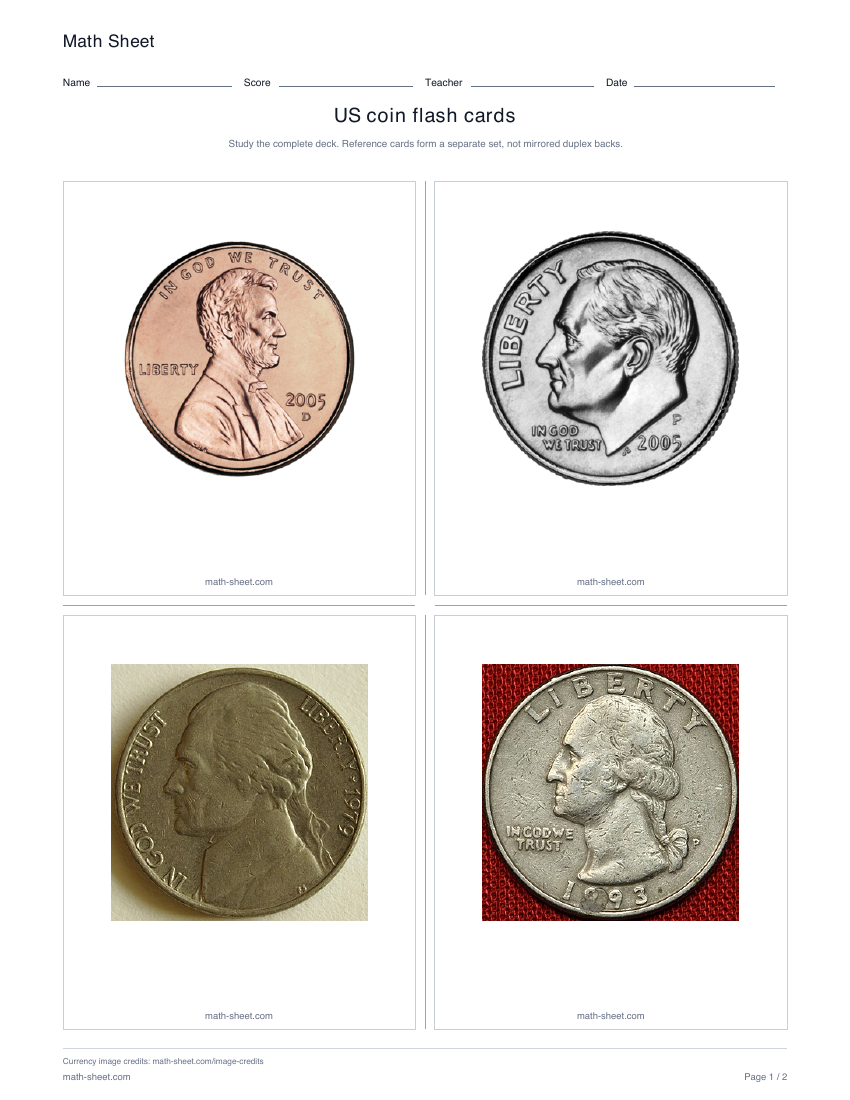
Flash cards
Recognize five U.S. coin fronts and connect their designs with values of 1, 5, 10, 25 and 50 cents.
Preview and download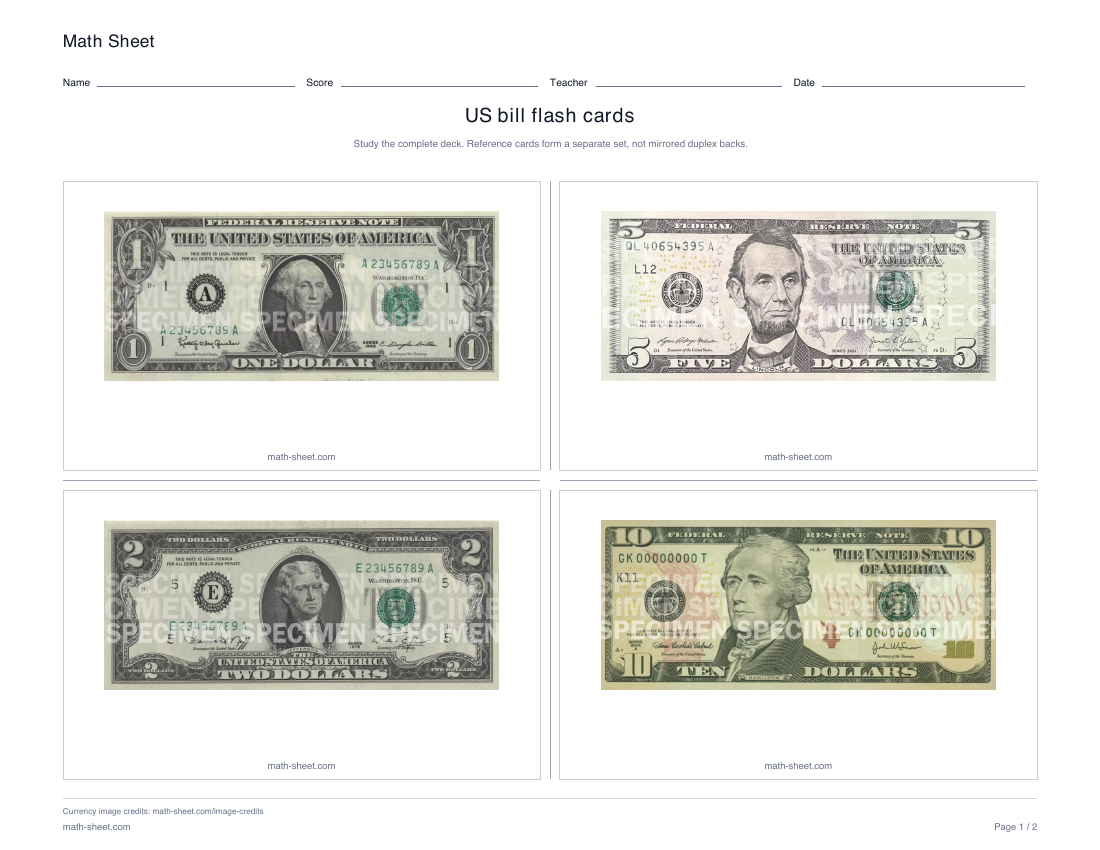
Flash cards
Identify specimen fronts for seven U.S. banknotes, from one dollar to one hundred dollars.
Preview and download
Flash cards
Read numerical amounts in selected USD, GBP, EUR or JPY currencies, with zero or two decimal places and one to four whole-part digits.
Preview and downloadChoose a deck
Read fractions from equal-area circles or match a fixed set of Roman numerals with their values.
Flash cards
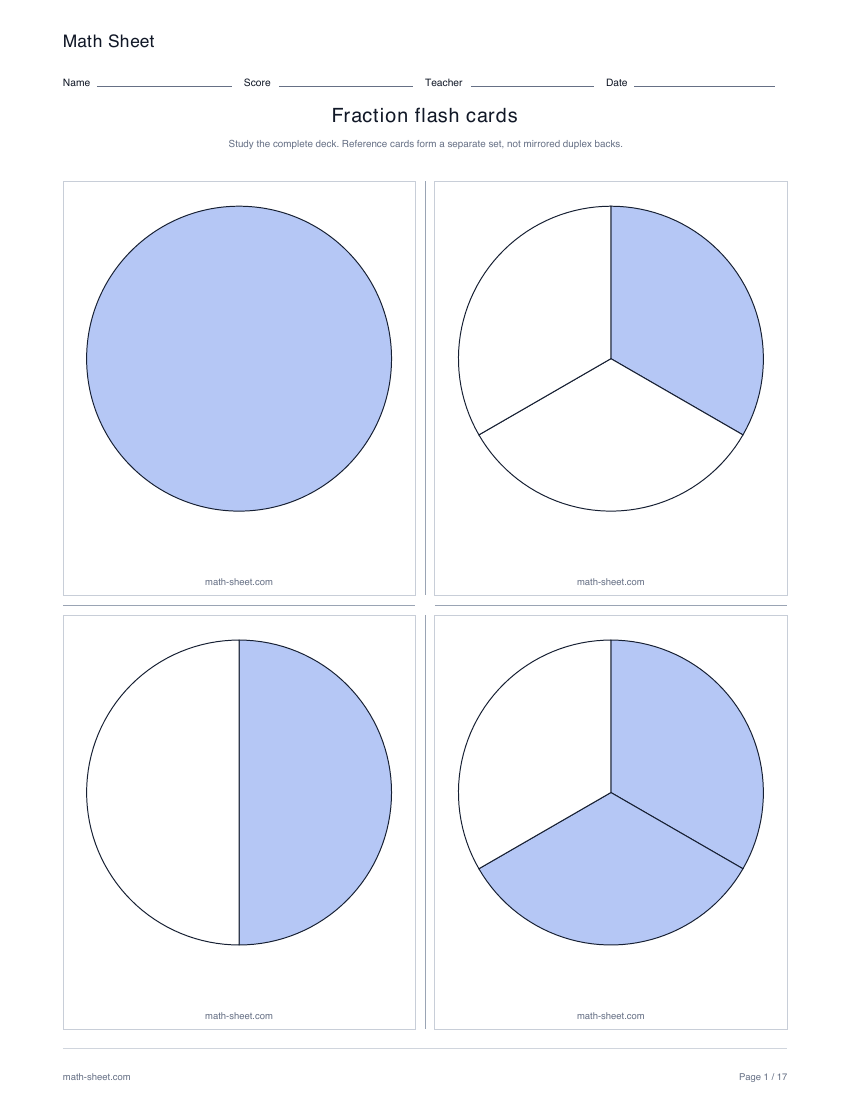
Read equal-area fraction circles from selected denominator groups. Optionally label each equal part; reference cards identify the total shaded fraction.
Preview and download
Flash cards
Read a fixed set of 56 Roman numerals: 1–31 and selected landmarks through 2000.
Preview and downloadChoose by readiness
Print a complete deck, then choose a few suitable cards for the learner. Start with one-to-one counting, familiar numerals or shape features. Introduce the addition and subtraction presets only after joining and taking away make sense with objects. Basic Latin letter cards are a separate recognition activity.
Use the smallest groups first and point to each object once. The full deck contains quantities 1–12.
Open this starter deck →Match each numeral with counters, including an empty group for zero. Random values can repeat.
Open this starter deck →Choose a few familiar cards from the thirteen-shape deck and discuss their sides and curves.
Open this starter deck →Recognize paired uppercase and lowercase forms. This set is Aa–Zz, not every language’s full alphabet.
Open this starter deck →After joining groups is familiar, use counters for 1 plus each value from 0 to 9.
Open this starter deck →After taking away is familiar, model the four facts from 3 − 0 through 3 − 3.
Open this starter deck →Fixed decks keep every card when density changes. Ordered fixed decks ignore the seed; choose Shuffled to use the seed for a different order. Time, number and money-amount decks generate a count from pages × density and can contain repeats.
Each activity states its ready-made card and page counts. The studio shows all pages, including the final partly filled sheet. Two-card sheets are landscape; division, bill, Roman numeral and alphabet decks stay landscape at every supported density.
Another way to show the idea
Use a number bond to explain a sum, an array to explain a product, or a clock worksheet to draw what the hands mean. These activities keep their own formats and practice goals.
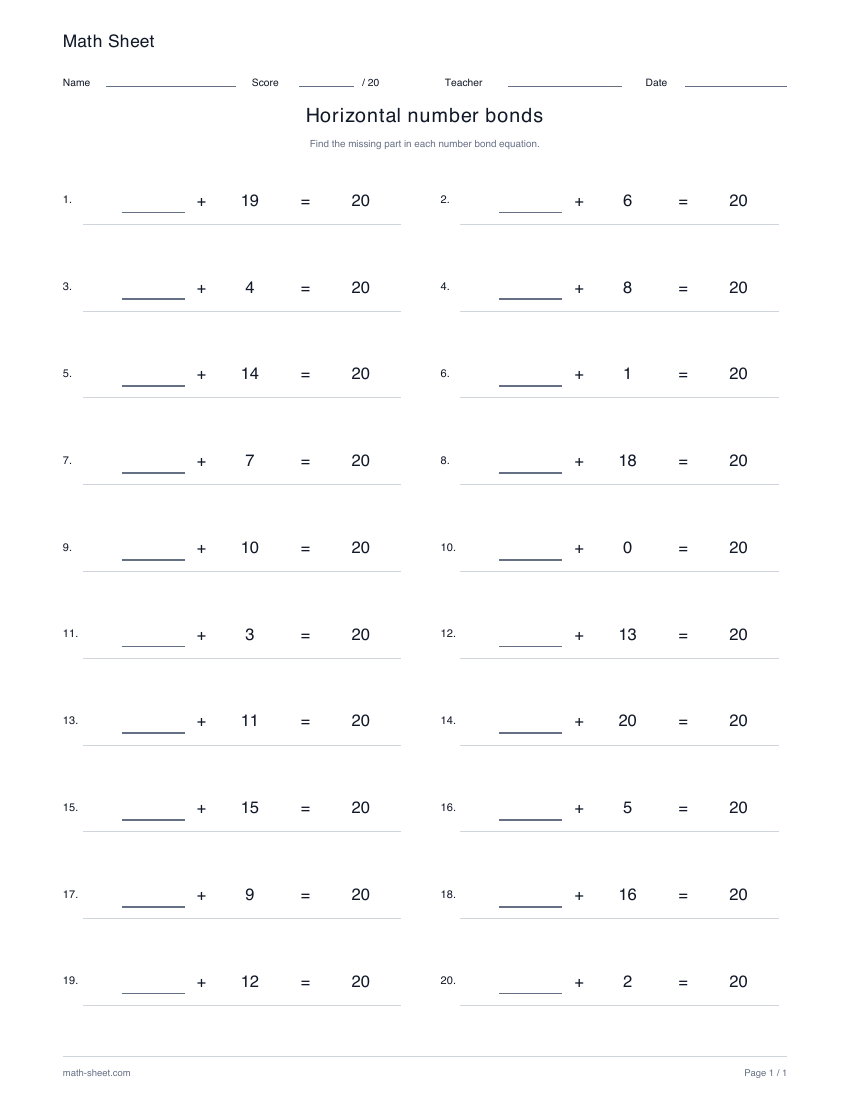
Number bonds
Find one missing part in two-part equations with a fixed whole from 5 to 100, six equation layouts and up to 30 problems.
Preview and download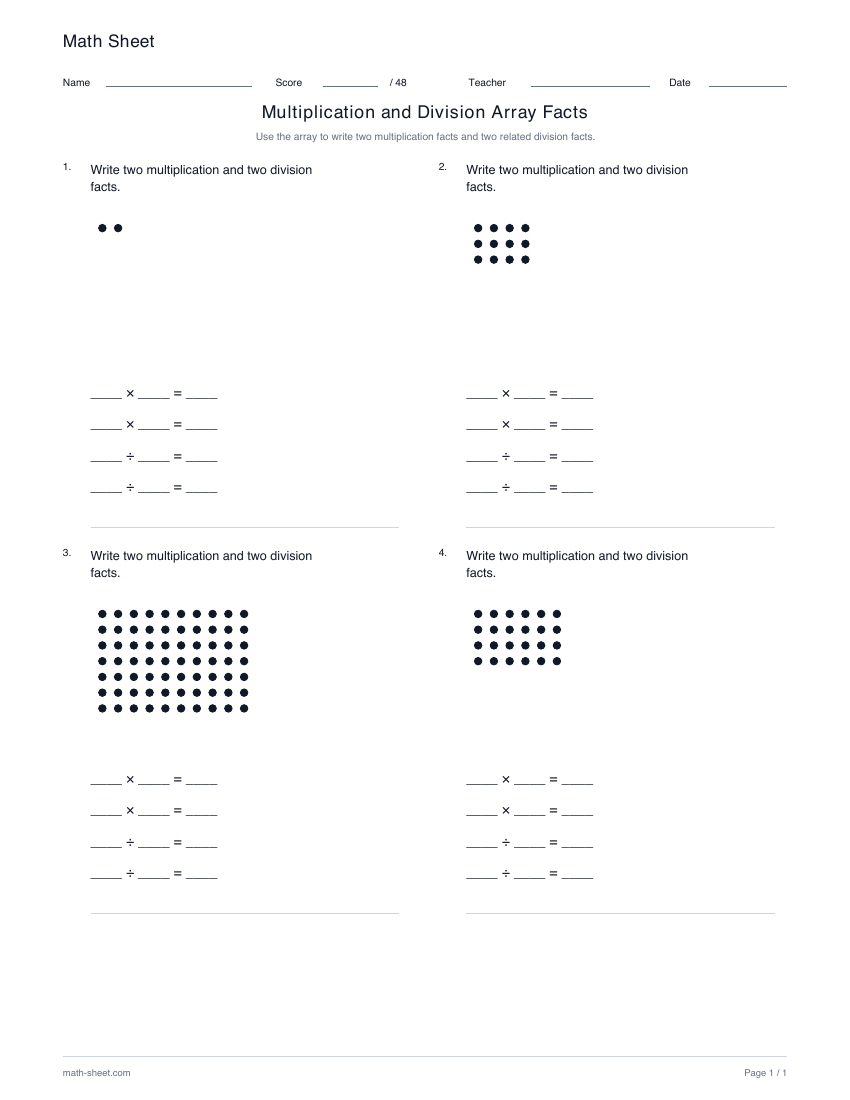
Multiplication
Use one rectangular array to write two multiplication equations and two related division equations.
Preview and download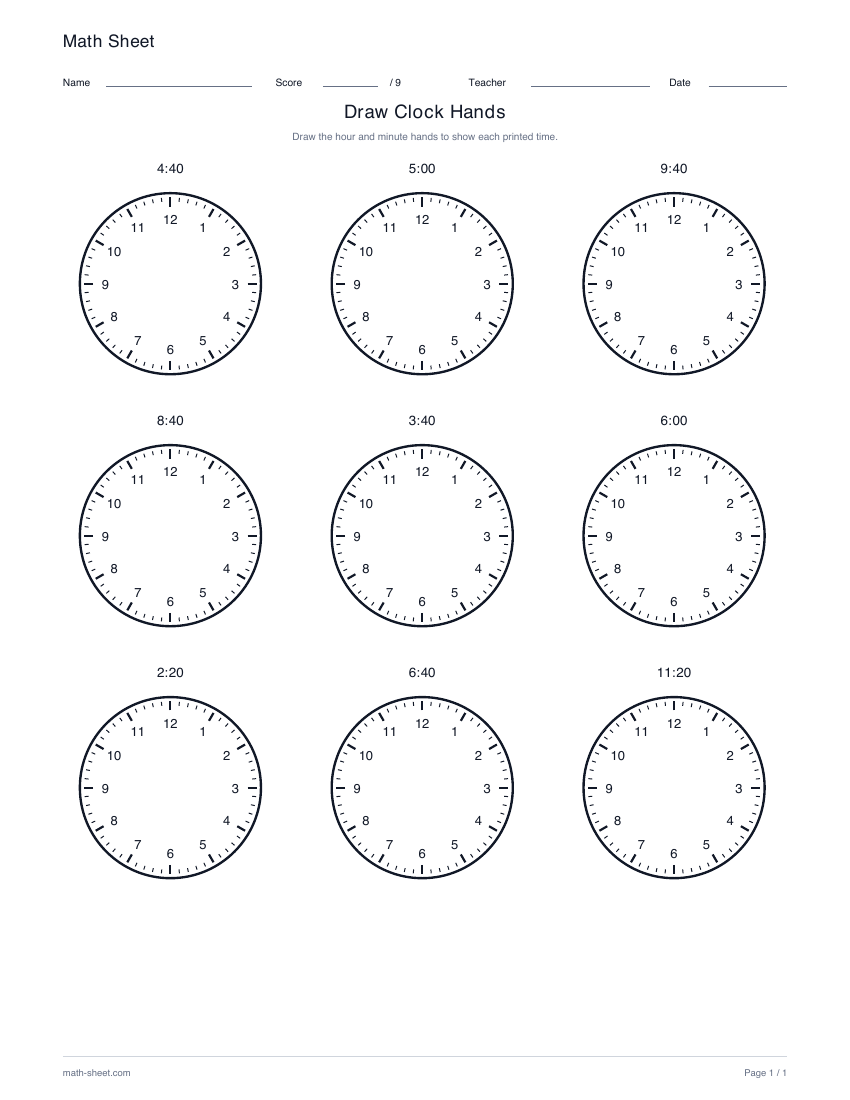
Time
Translate a written time into two correctly positioned clock hands, using generated practice or an ordered custom set of times.
Preview and downloadlook · say · explain
A correct answer is useful; an explanation reveals the learner’s understanding. Keep the first session brief, use an object or picture model when a card is uncertain, and return to that card later.