
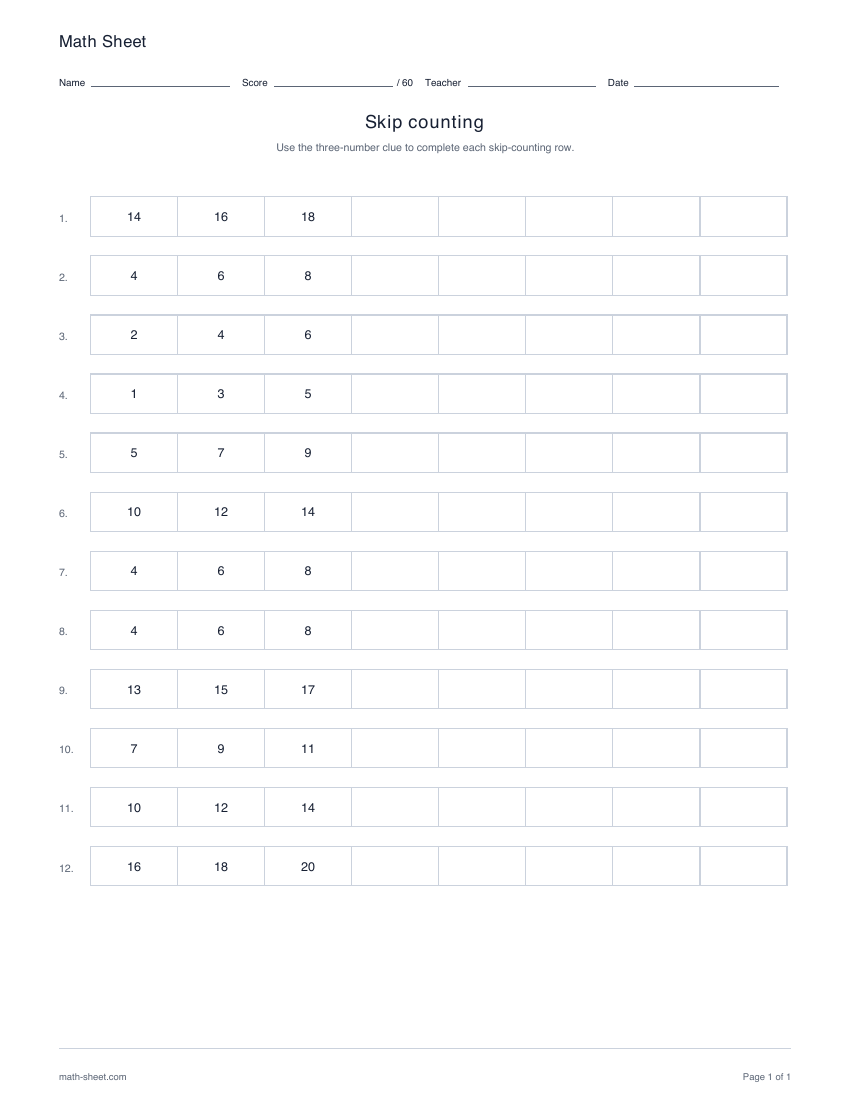
Skip counting
Skip counting with starting bands
Use the expanded twelve-row profile with eight terms per row. Select a starting band and steps from 2 through 12, with three clues in each row.
Preview and downloadEqual jumps, connected numbers
Keep one step constant as a row continues. Choose familiar small jumps, control the start and direction of each row, or connect equal jumps with the first twelve multiples of a times table.
Choose a sequenceThe starting-band and custom cards open expanded twelve-row profiles on the existing activity pages. The original ten-row formats and their printable editions remain available there.
Skip counting
Use the expanded twelve-row profile with eight terms per row. Select a starting band and steps from 2 through 12, with three clues in each row.
Preview and download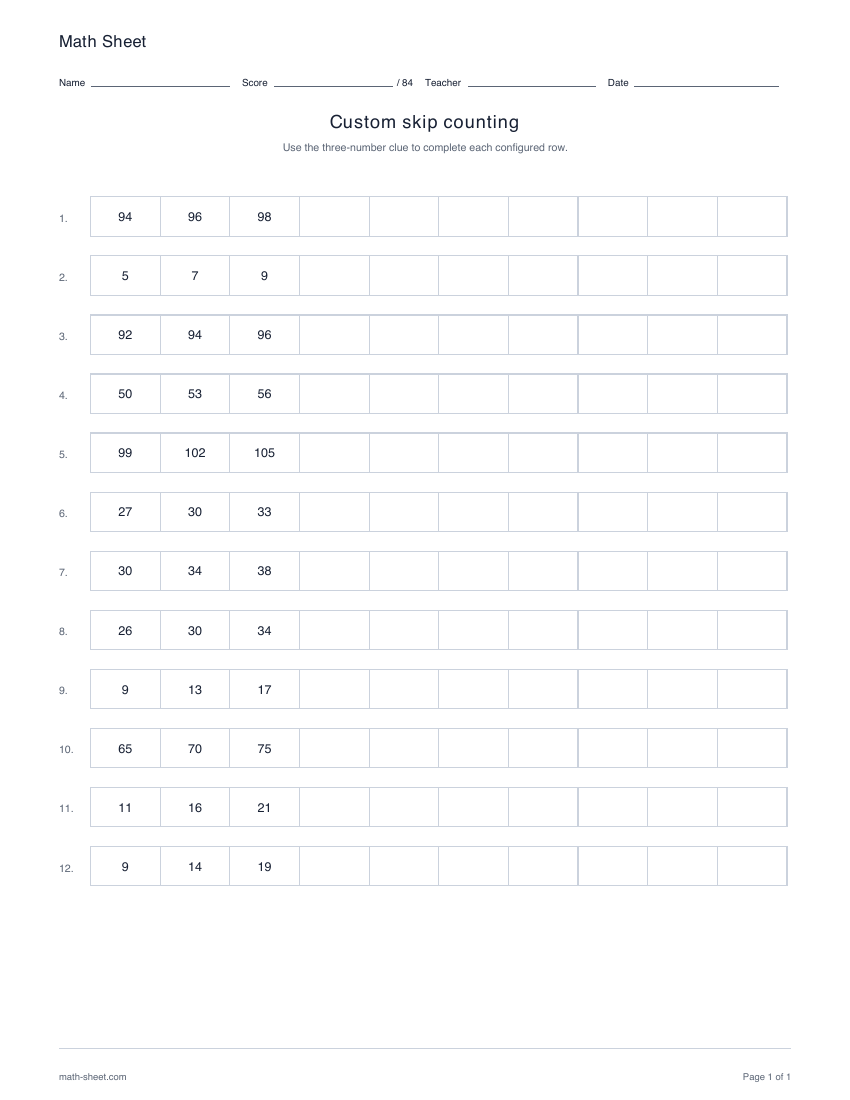
Skip counting
Set twelve independent starts and steps, including descending sequences. Leave a start blank for a reproducible nonnegative start, or enter zero explicitly.
Preview and download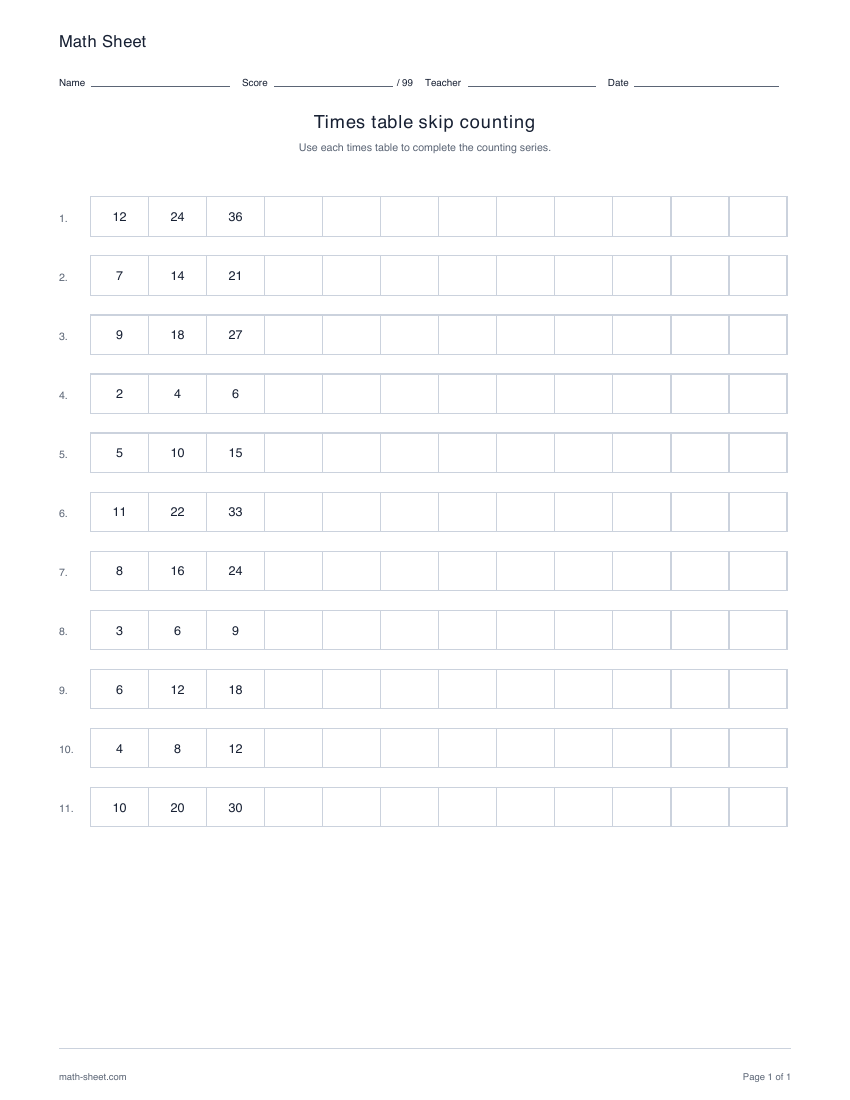
Skip counting
Complete twelve multiples for each selected table from 2 through 12. Keep the first three clues together, or scatter the three clues across the row.
Preview and downloadGroup counters or make equal hops on a number line. After the learner can add the step, use clues at the beginning of a row. Mixed clue positions add the challenge of working backward and checking a gap between known values.
The original ten-row worksheet leaves three blanks per row in its standard setting. Choose step two and end blanks for a supported lesson.
Open original skip counting →The expanded profile has eight terms per row and three clues. The selected band limits the first term; later numbers can exceed the band or 99.
Try twelve rows counting by two →Use twos, fives and tens after equal groups are familiar. Each table gets one row of twelve multiples.
Open familiar times tables →The start tells where a row begins. The step tells how much changes each time. In the twelve-row custom profile, a blank start chooses a reproducible number from zero through 99; entering zero fixes the start at zero. A negative step makes the row decrease and can take it below zero.
Each row keeps its entered settings and its position. Choose signed values only after negative numbers are understood. Starting limits do not limit later terms.
Check every pair of neighboring terms. A times-table sequence always advances by the table number, while alternating numerical rules can change the operation at each gap. Use the Patterns collection when finding a repeating operation rule is the intended skill.
Explore visual and numerical patterns → · Model equal hops on a number line →