
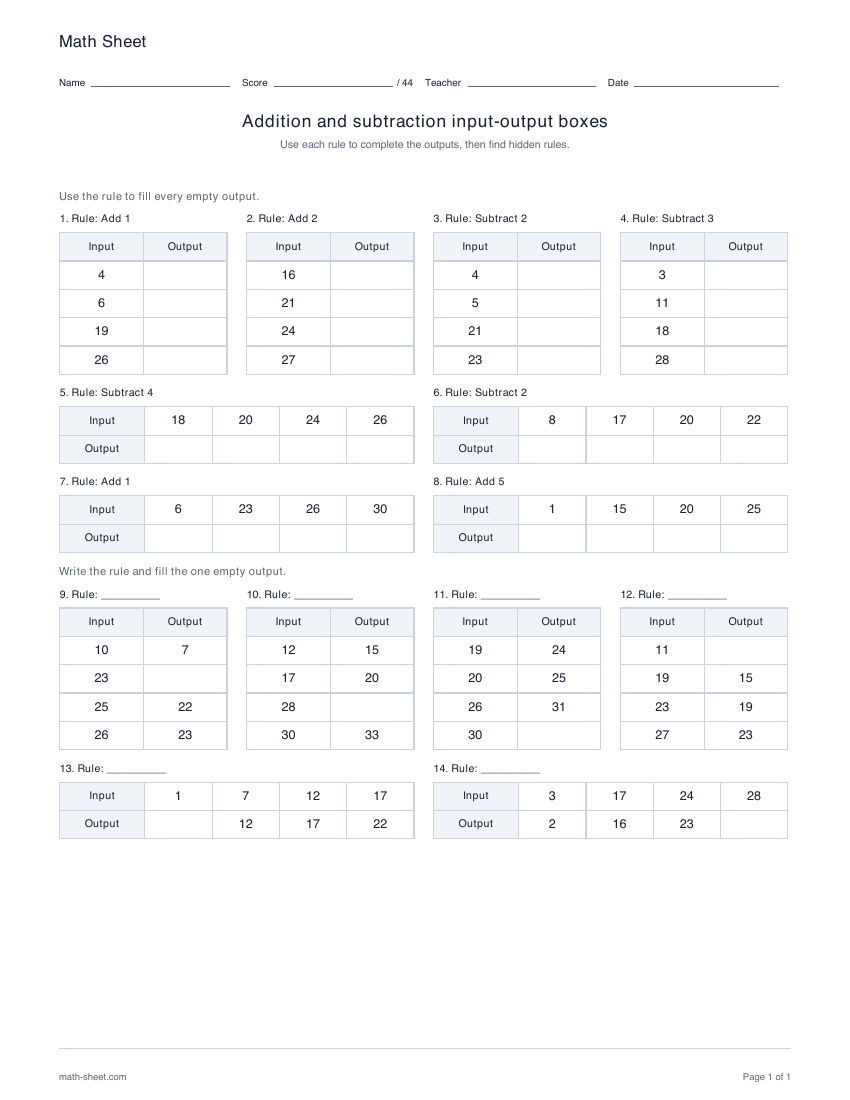
Function table
Addition and subtraction in-out boxes
Apply a given addition or subtraction rule, then infer a hidden rule from three complete pairs. Fourteen tables mix vertical and horizontal layouts.
Preview and downloadPractice by skill
One rule connects every input with its output. Follow a stated rule, recover a hidden change, or use a table to make sense of a situation.
Choose a table activityInput and output
Begin with familiar addition and subtraction. Match pairs in both table directions, then explain the change in a short situation.
Function table
Apply a given addition or subtraction rule, then infer a hidden rule from three complete pairs. Fourteen tables mix vertical and horizontal layouts.
Preview and download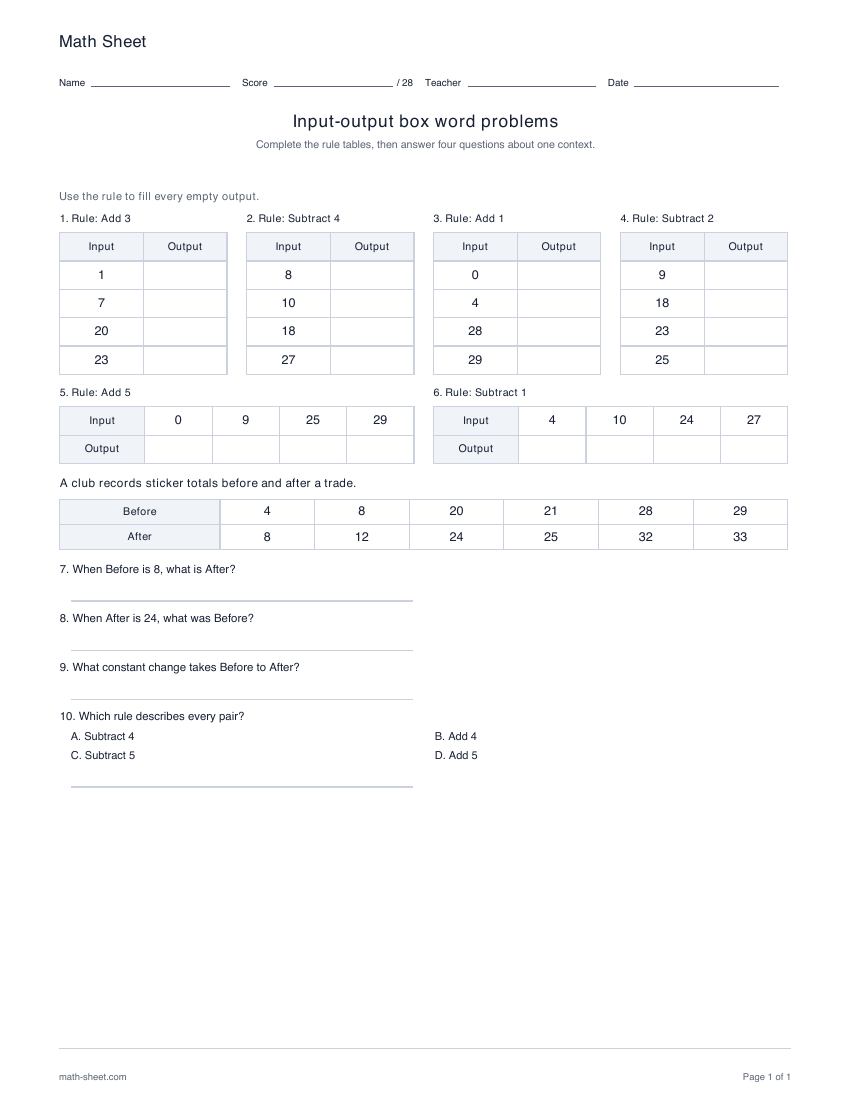
Function table
Start with six rule tables, then use one complete table from a school, sticker or ticket situation to answer four connected questions.
Preview and downloadInput and output
Keep the table relationship while moving to decimal place value or multiplicative rules.
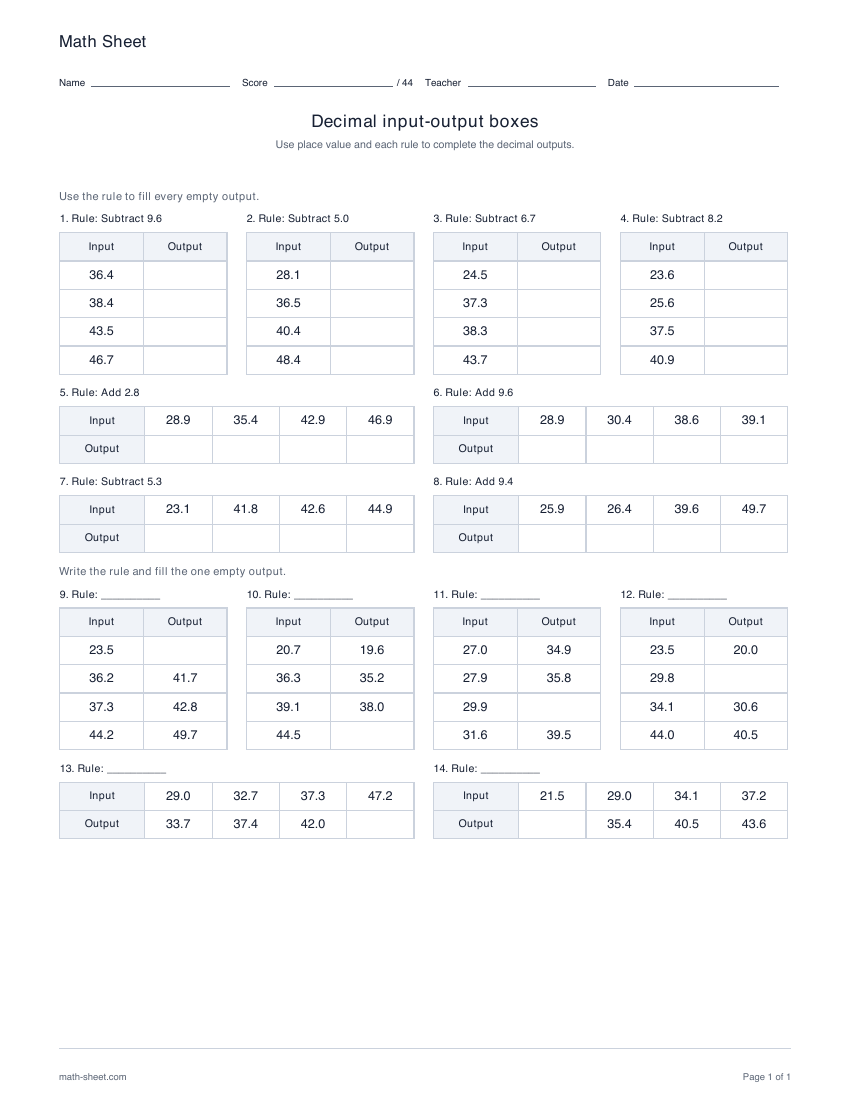
Function table
Track one constant change through fourteen decimal tables. Choose tenths or hundredths, apply visible rules and infer hidden rules from complete pairs.
Preview and download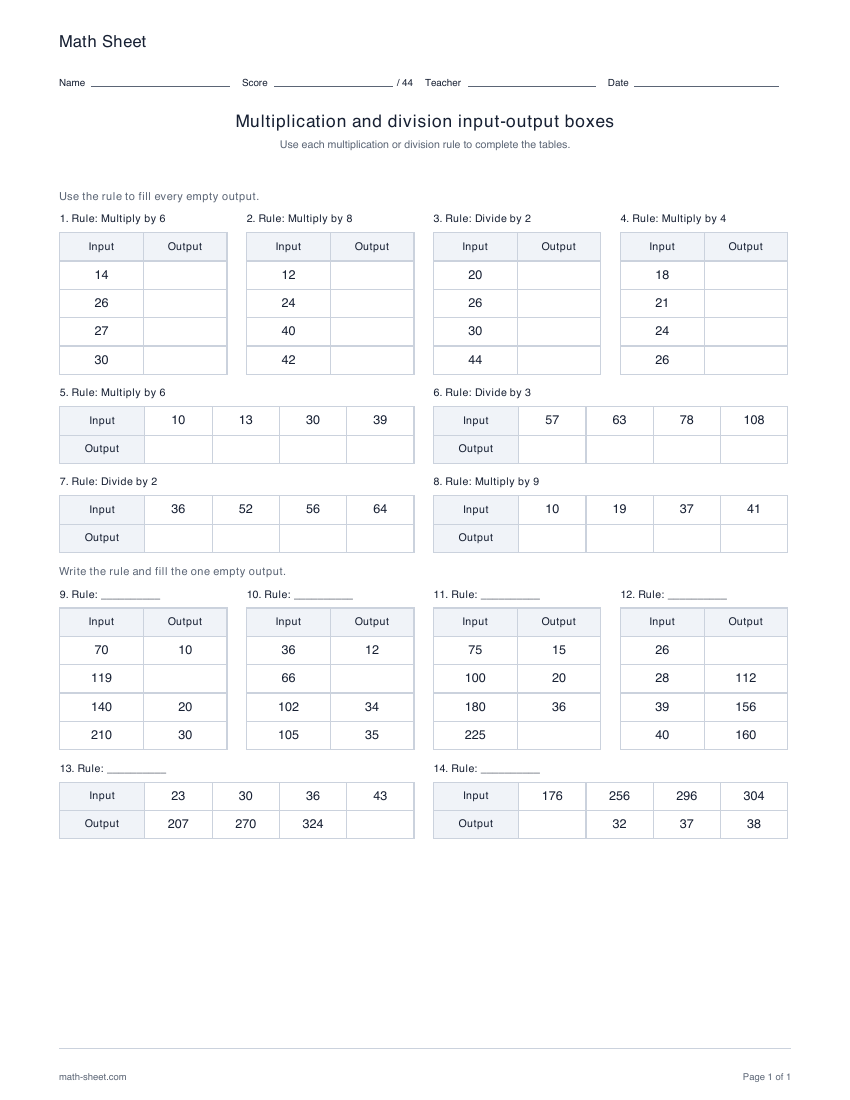
Function table
Apply and identify exact multiplication or division rules across fourteen tables. Choose factors and divisors from 2 through 12.
Preview and downloadInput and output
Connect a stated equation with five inputs. Prepare signed-number and fraction arithmetic before choosing the more demanding rule families.
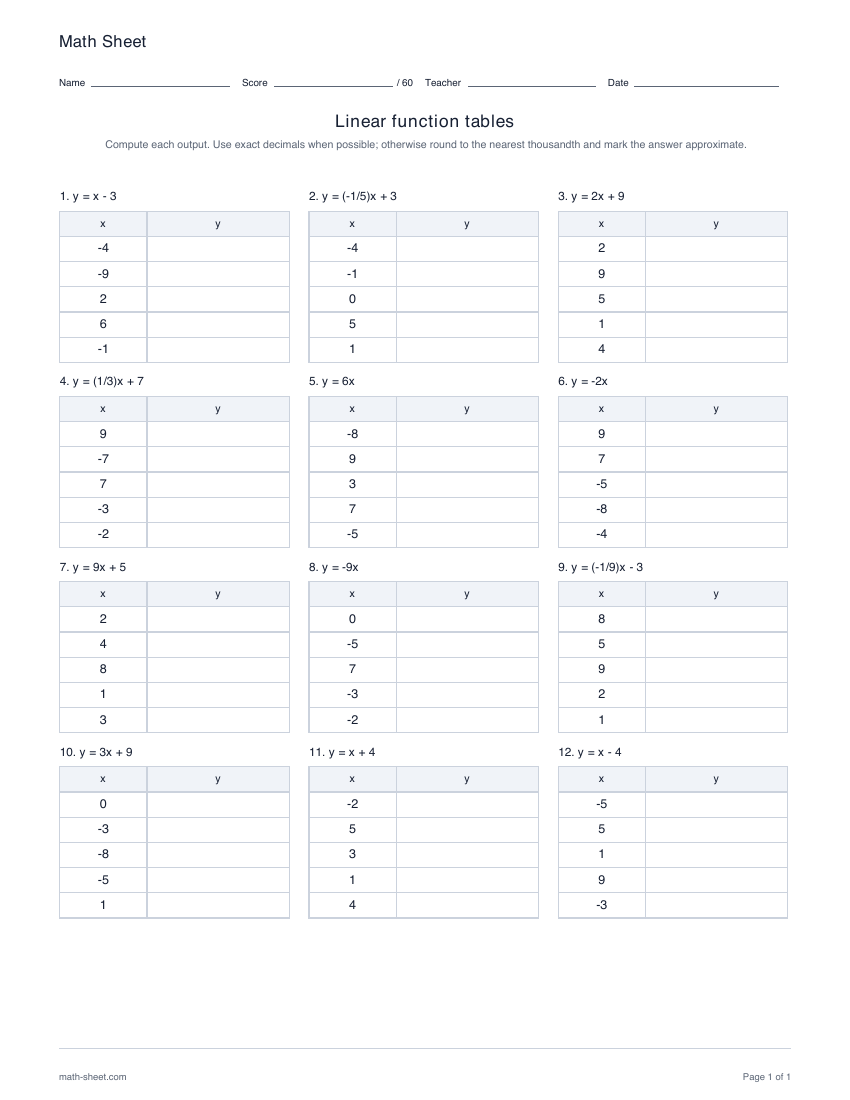
Function table
Substitute five inputs into each of twelve linear rules. Choose whole or fractional slopes, signed or nonnegative inputs, and decimal or exact fraction answers.
Preview and downloadChoose by readiness
Reading a table adds a new demand to familiar arithmetic. First check that the learner can match a pair and explain the direction from input to output. These settings are starting suggestions, not curriculum requirements.
Use after addition through 33 is comfortable. Inputs may reach 30; outputs can be three greater.
Open this focused preset →Base numbers stay within 0–10. Division inputs can reach 50, with whole-number quotients.
Open this focused preset →Use x values 0–9 with positive or negative intercepts. Prepare signed outputs; the first table is fully worked.
Open this focused preset →A visible rule asks for calculation: start with the input and perform the stated operation. A hidden rule asks for comparison: examine several complete pairs, propose an allowed operation, and check it against all the clues before filling the last box.
The arithmetic box sheets combine both tasks in fourteen tables. The word-problem sheet instead pairs six given-rule tables with one complete contextual table and four questions about it.
In a linear table, the equation supplies the rule. Substitute an input for x, multiply by the slope, then combine with the intercept. A negative slope or intercept can produce negative outputs even when every input is nonnegative.
Use exact fraction answers when the arithmetic is the focus. Decimal mode rounds values that need more than three decimal places to the nearest thousandth and identifies the rounded values as approximate.
Connect the ideas
Fact families help explain inverse operations. Skip counting and numerical series connect repeated changes across a sequence; compare that structure with the separate input-output pairs in a table.
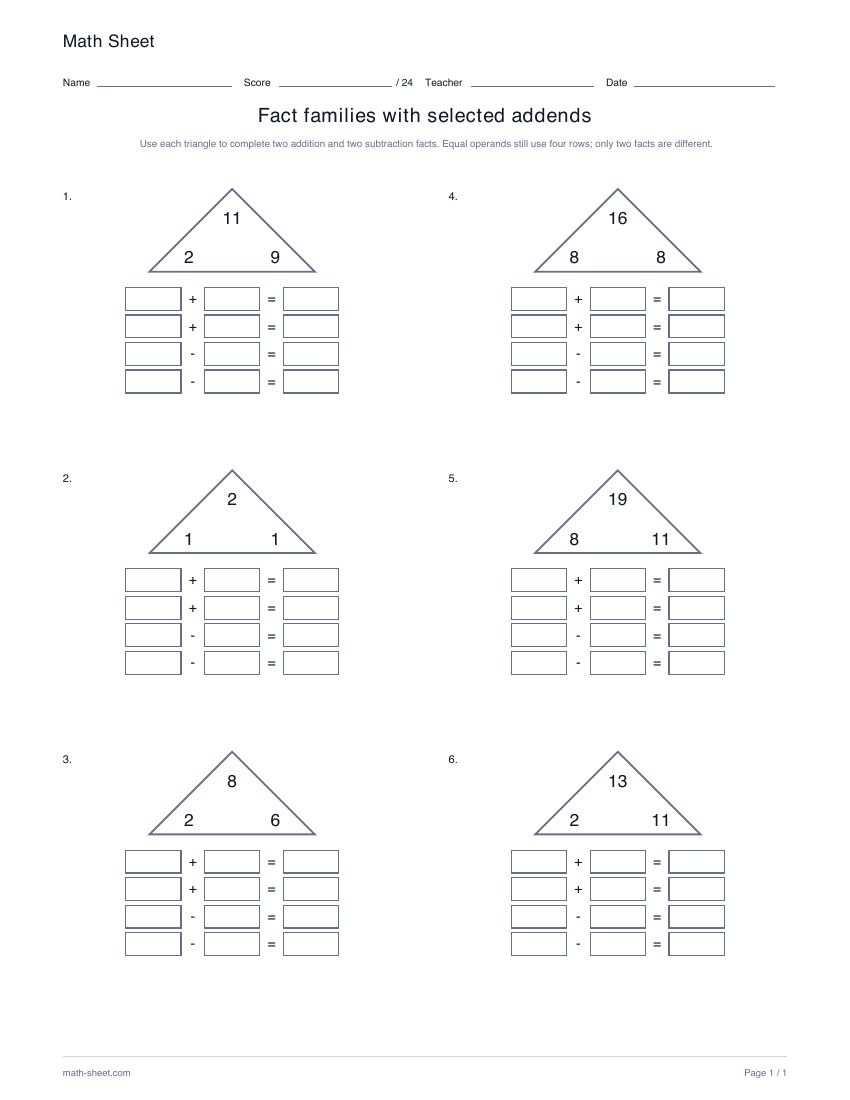
Fact family
Choose at least three addends from 1–12 and use only those choices for both parts of six addition and subtraction triangles.
Preview and download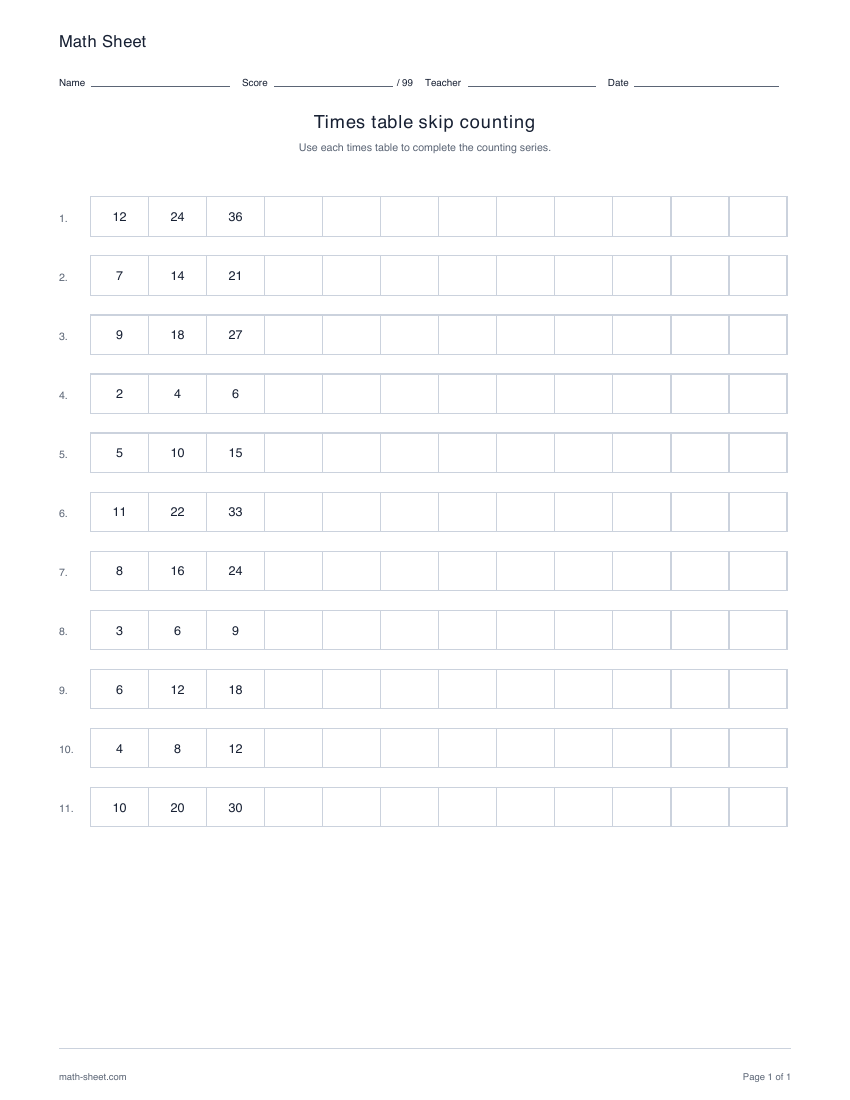
Skip counting
Complete twelve multiples for each selected table from 2 through 12. Keep the first three clues together, or scatter the three clues across the row.
Preview and download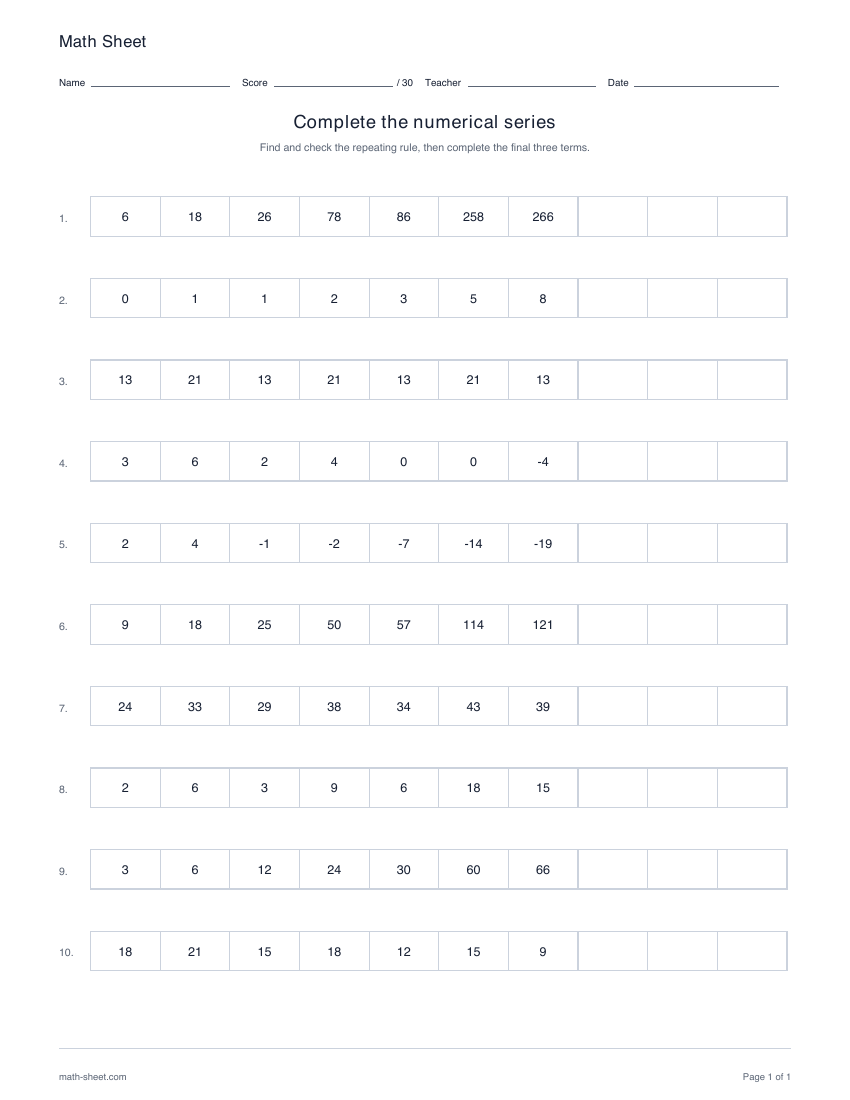
Numerical patterns
Find and check a repeating numerical rule, then complete the last three terms. Choose Fibonacci, alternating addition and subtraction, or alternating multiplication with addition or subtraction.
Preview and downloadcheck every pair
The preview shows the first student page. Downloads include every practice page; the version with answers adds a separate key with the same table positions. Longer notes or translated instructions may add pages.