A useful starting point
Begin when signed-number arithmetic, fraction operations and one- or two-step equations are reasonably secure. If calculation errors hide the algebra, revisit the Grade 7 rational-number group before adding more symbolic steps.
Discuss together
Solve 3(x − 2) + 5 = 14.
x = 5Distribute first: 3x − 6 + 5 = 14. Combine constants to get 3x − 1 = 14, add 1 to both sides, then divide by 3. Substitution checks the result: 3(5 − 2) + 5 = 14.
Five-resource starter
Open an editable Grade 9 packet
Load five existing worksheets in the packet builder. Reorder them, add or remove resources, choose a student or teacher packet, then download the version you need.
- Multi-step integer equations
- Evaluating functions
- Finding slope from two points
- Solving systems by graphing
- Solving quadratics by factoring
Load the Grade 9 starter →Step 1
Equations and inequalities
Preserve equality while simplifying each side. For a two-variable inequality, test a point and use the boundary style to distinguish included from excluded solutions.
Equations
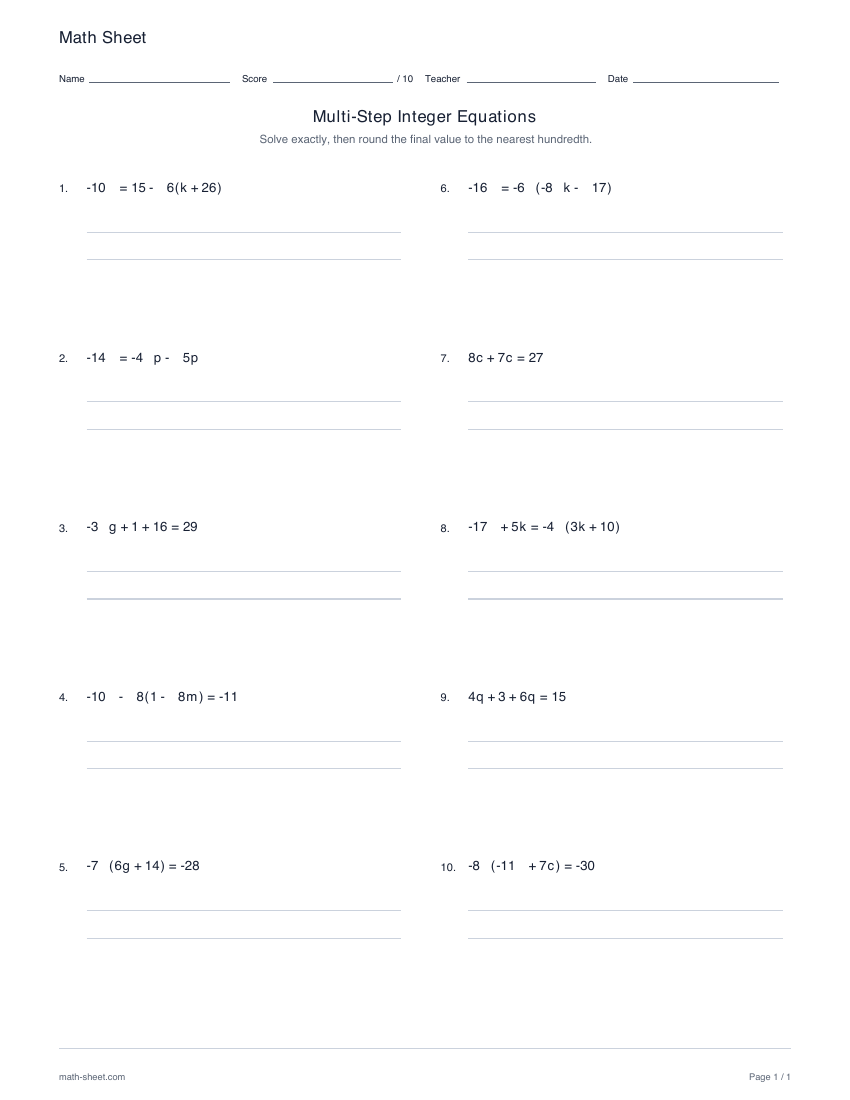
Choose from eleven equation structures for ten questions with integer operands. Practice like terms, grouped expressions and variables on either side, with exact worked solutions and separately rounded answers.
Preview and download →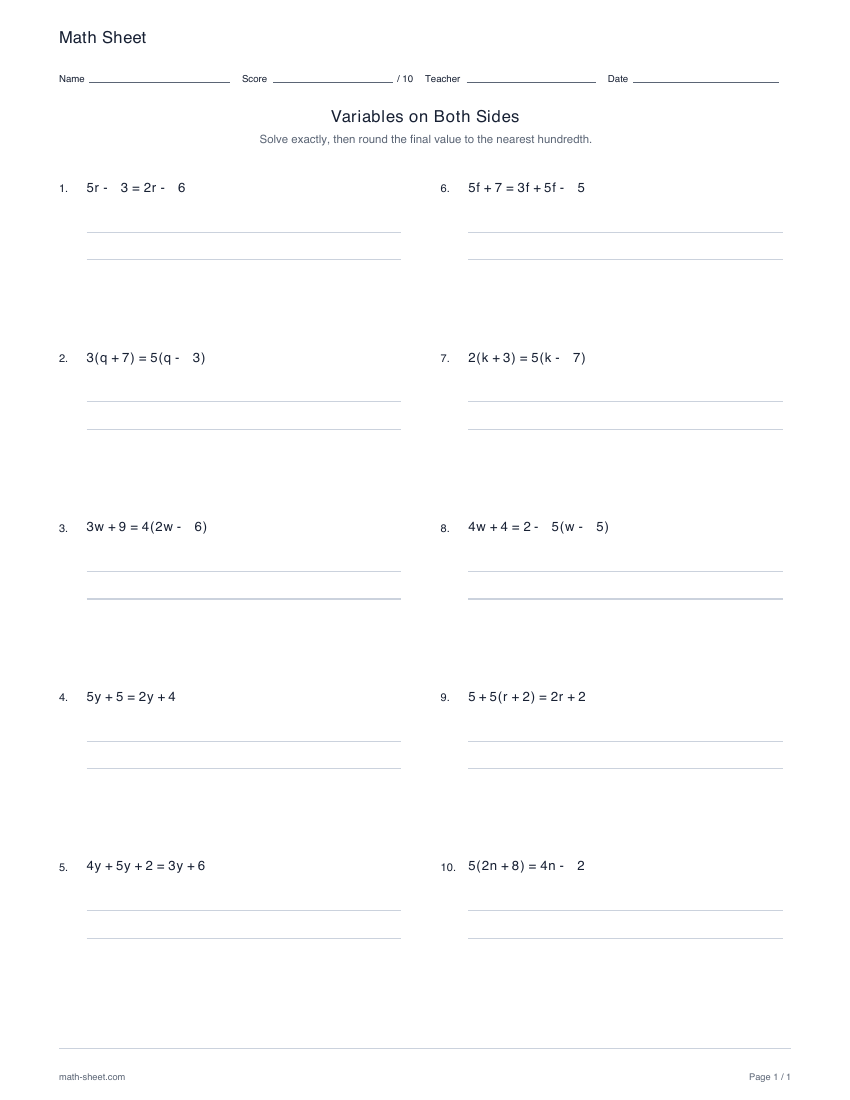
Equations
Solve ten equations with the same variable on both sides. Choose the letter policy, constant and coefficient ranges, and signed or positive-only operands, with full worked solutions.
Preview and download →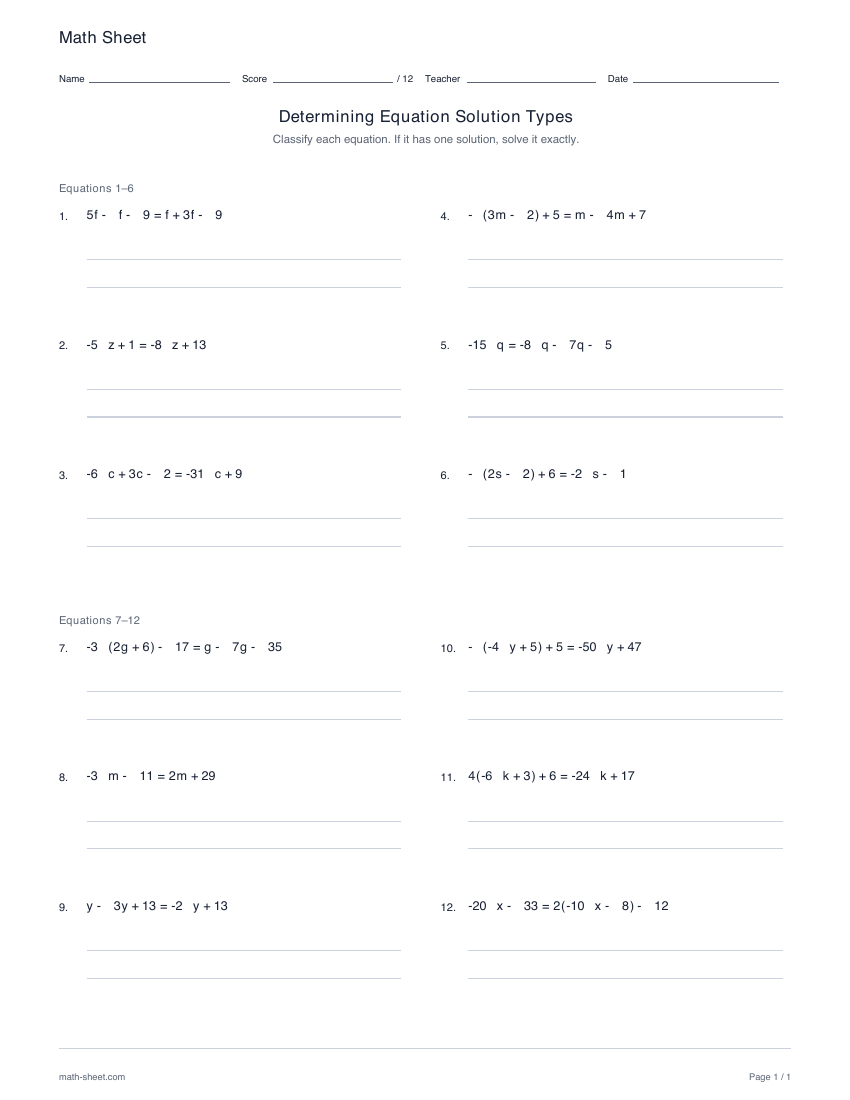
Equations
Classify twelve linear equations as having no solutions, one solution or infinitely many solutions. Choose any nonempty combination, with exact rational roots on separate keys.
Preview and download →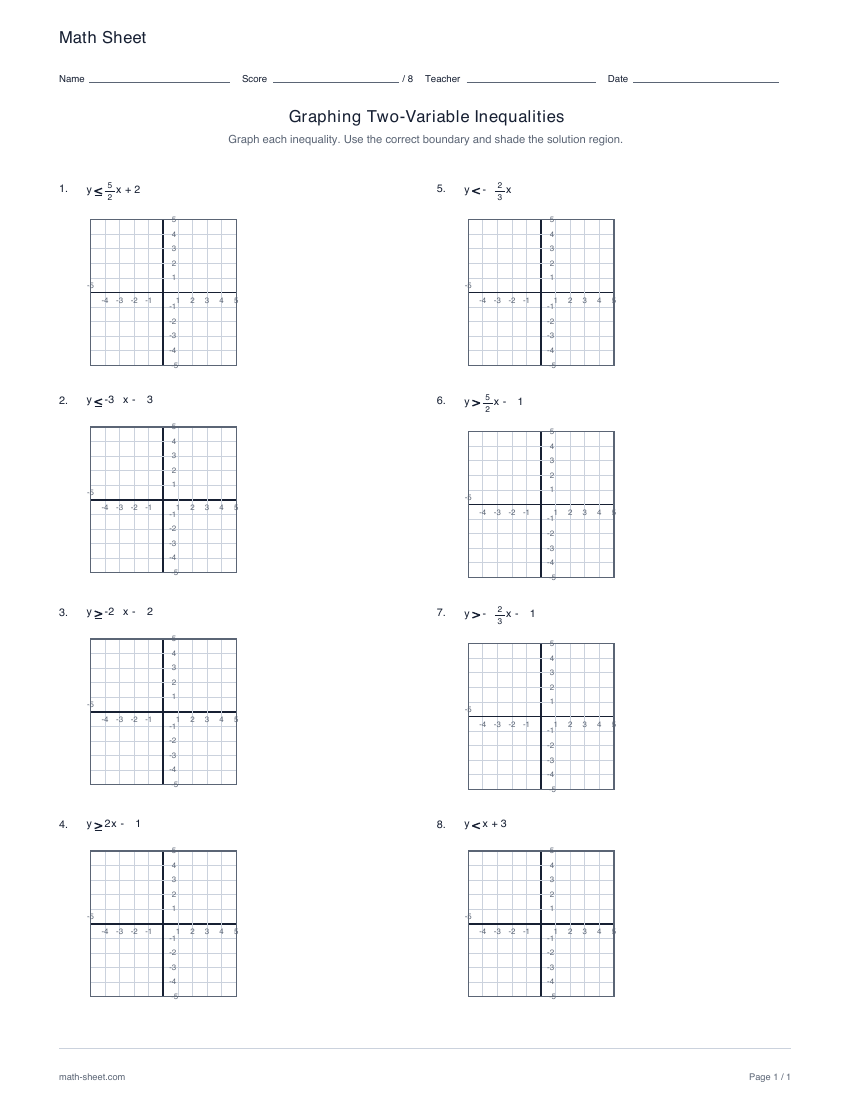
Linear functions
Graph eight linear inequalities on coordinate planes. Select any nonempty combination of <, ≤, > and ≥, then draw the boundaries and shade the solution regions with a separate graphical key.
Preview and download →Step 2
Functions and linear models
Decide whether each input has one output, then connect ordered pairs, graphs, rate of change and intercepts without losing the meaning of the quantities.
General functions
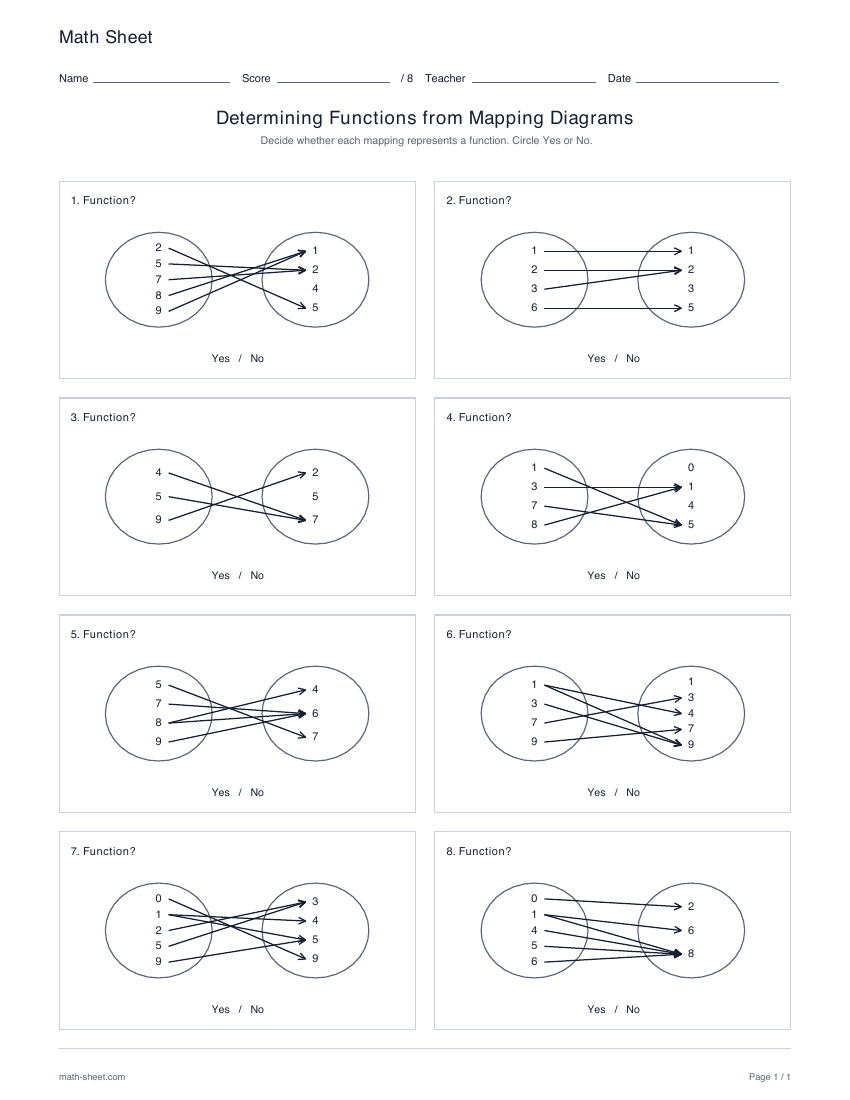
Classify eight mapping diagrams as functions or nonfunctions. Choose two to five numeric or letter values on each side, with four of each classification and a separate answer key.
Preview and download →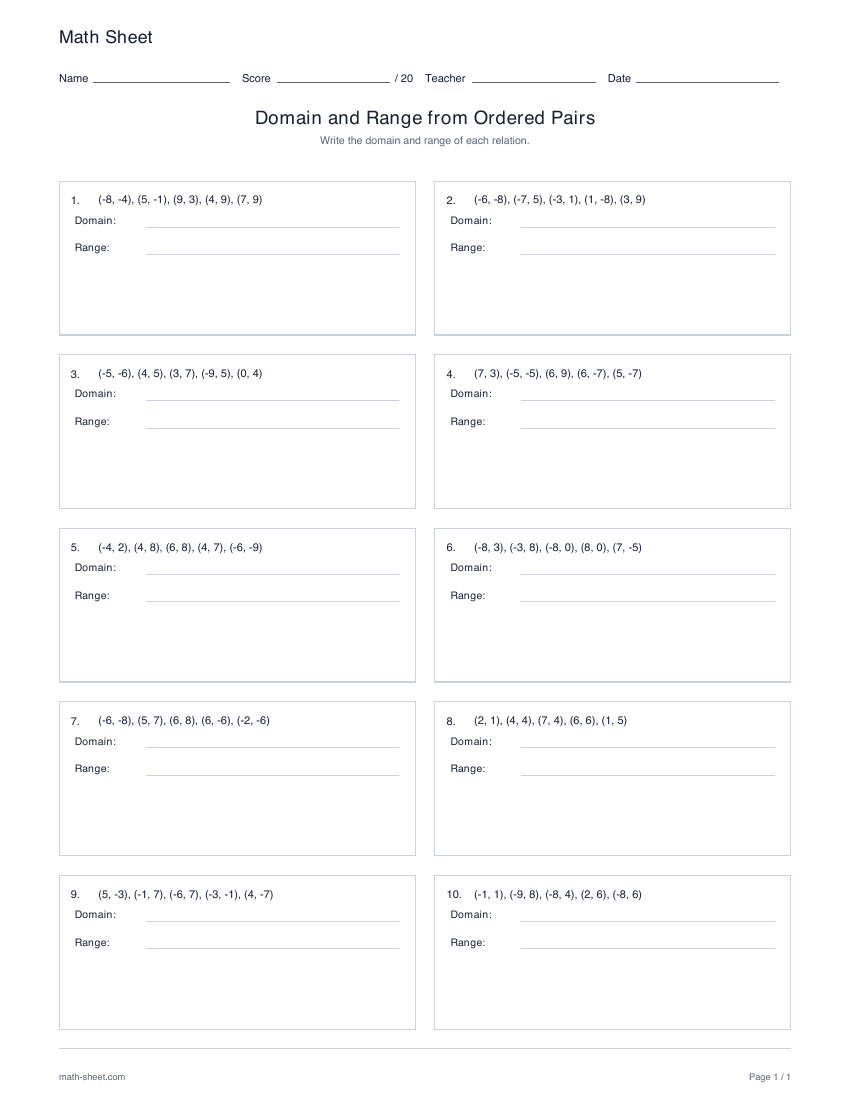
General functions
Find the domain and range of ten five-pair relations. Choose negative or nonnegative coordinates, control repeats independently and optionally classify each relation as a function.
Preview and download →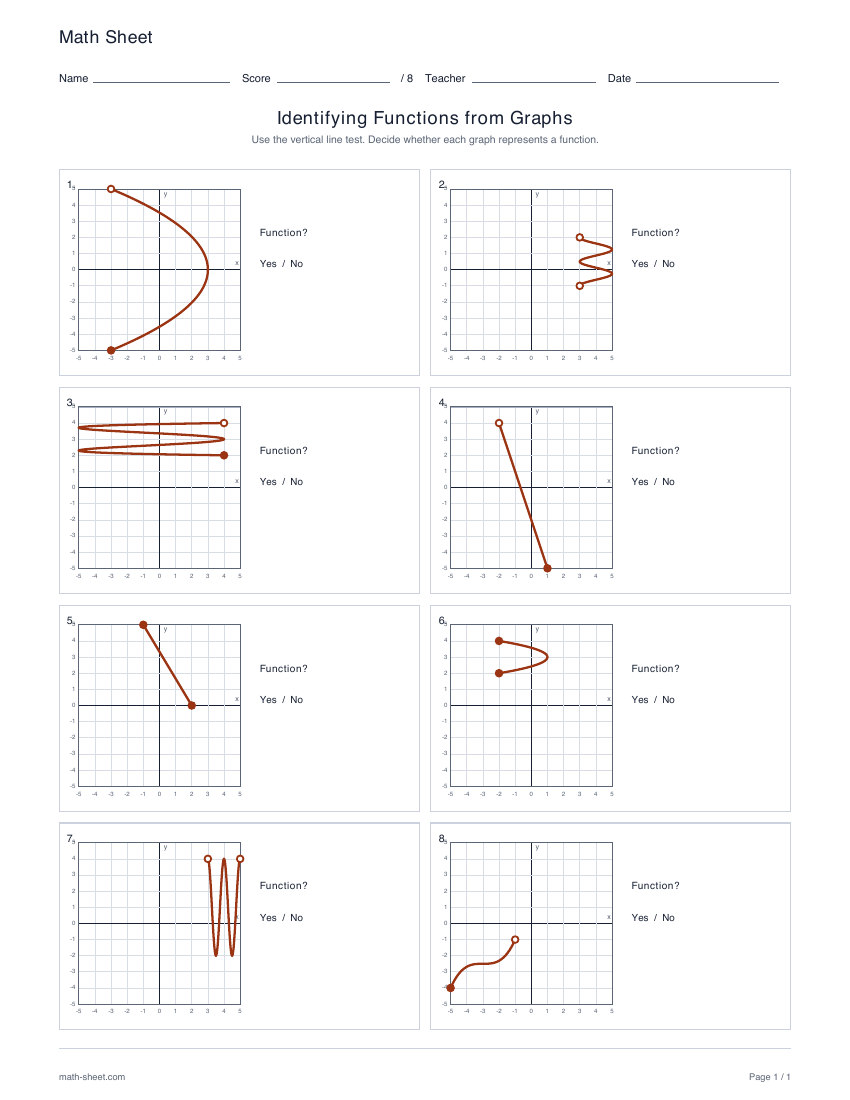
General functions
Apply the vertical line test to eight finite graph relations. Choose lines, polynomials, special curves, horizontal parabolas or rotated curves, with balanced endpoints and a separate key.
Preview and download →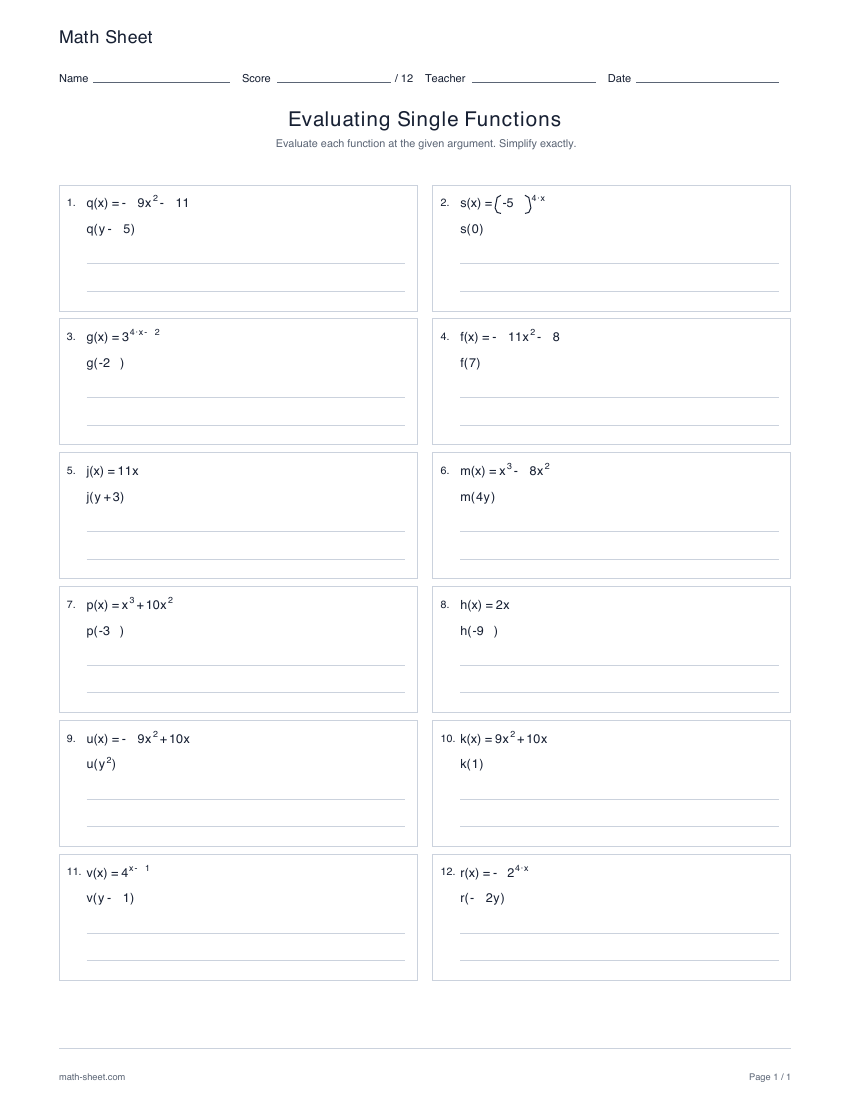
General functions
Evaluate twelve polynomial and exponential functions. Choose numbers, variable expressions or a mixture, with exact answers and substitution steps.
Preview and download →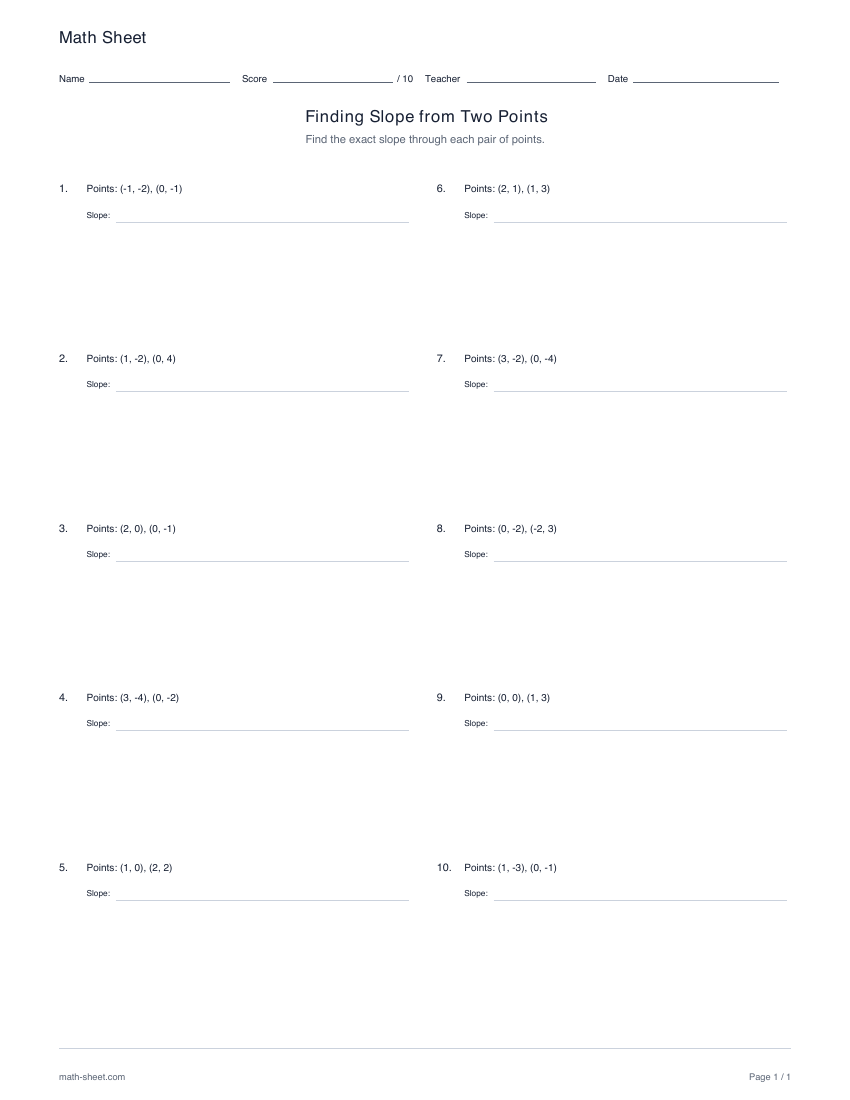
Linear functions
Calculate exact slopes from ten pairs of integer-coordinate points. Practice signed differences and reduced fractions, with a separate key that explains the slope calculation.
Preview and download →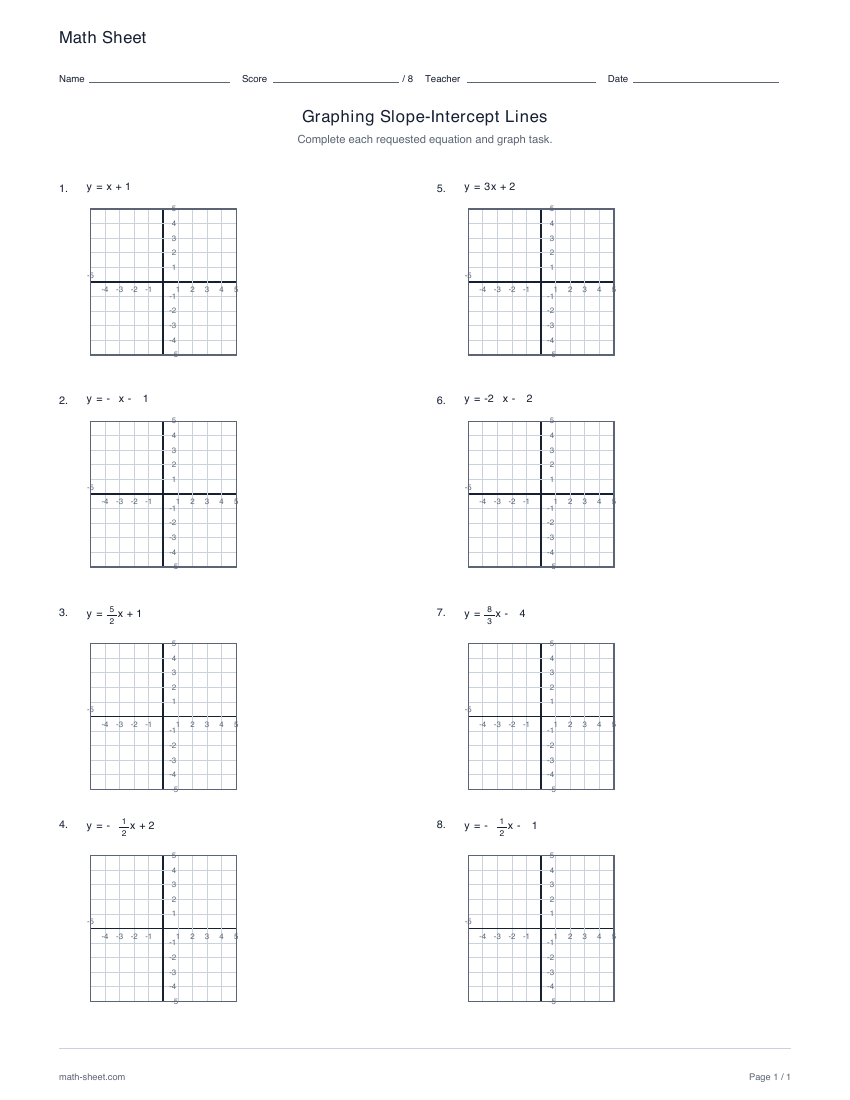
Linear functions
Graph eight lines in slope-intercept form. Choose graphing alone, graphing with slope and intercept questions, or writing an equation and graph from supplied properties.
Preview and download →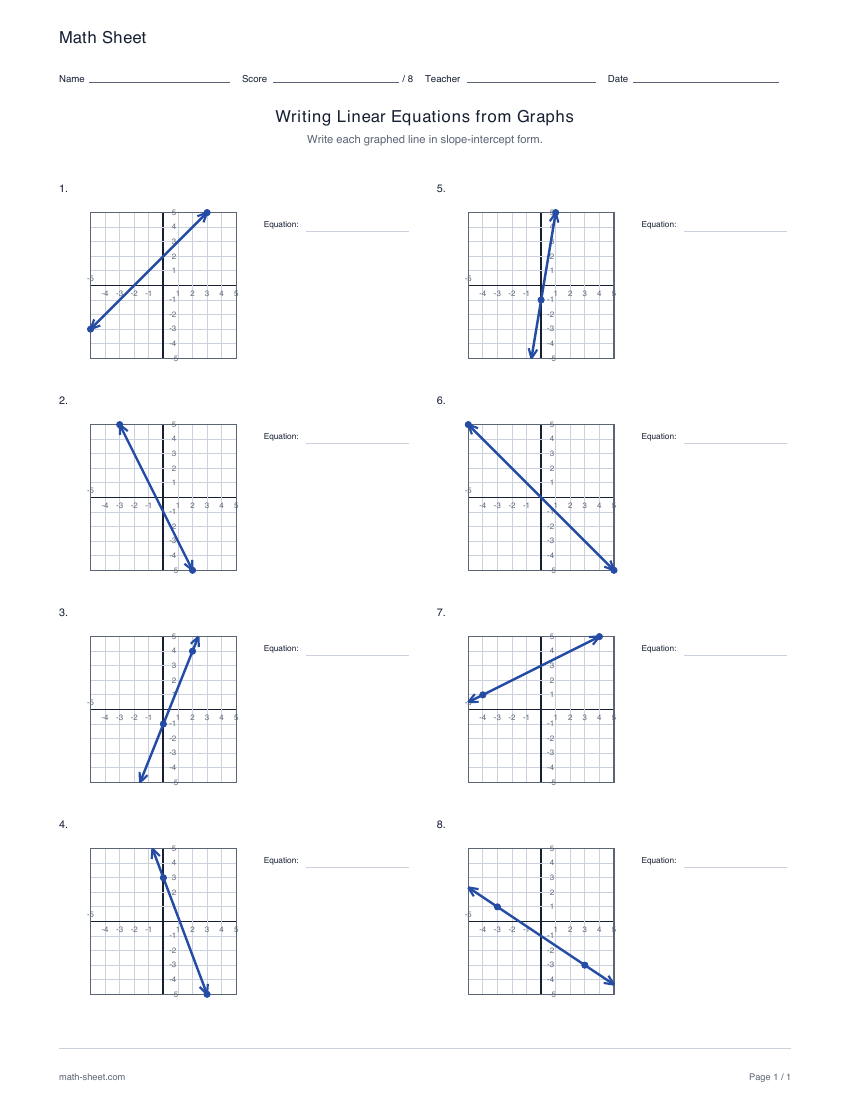
Linear functions
Write slope-intercept equations for eight graphed lines. Read the y-intercept, calculate an exact slope and check the equation against visible points with a separate worked key.
Preview and download →Step 3
Systems of equations
A system solution must satisfy both equations. Compare an algebraic solution with the intersection on a graph and check the ordered pair in both originals.
Systems of equations
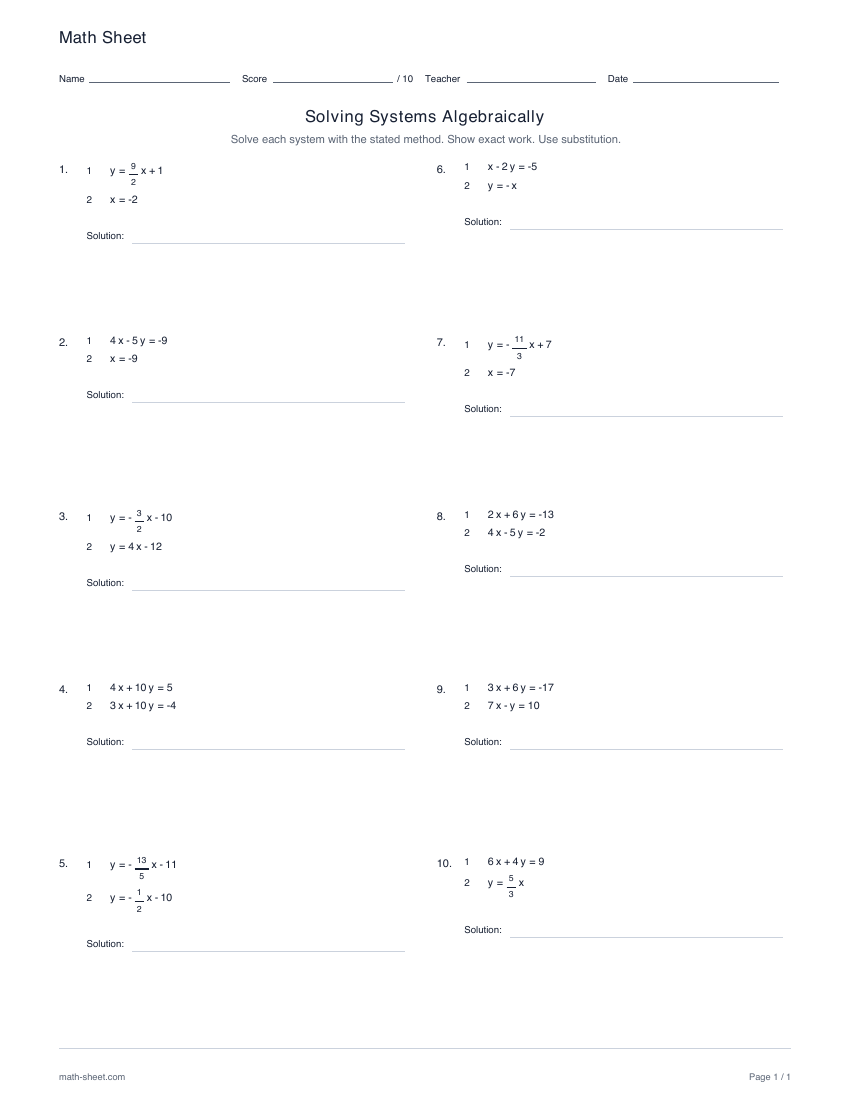
Solve ten two-variable systems using substitution, elimination or any method. Choose four equation-pair structures and download exact, step-by-step answer keys.
Preview and download →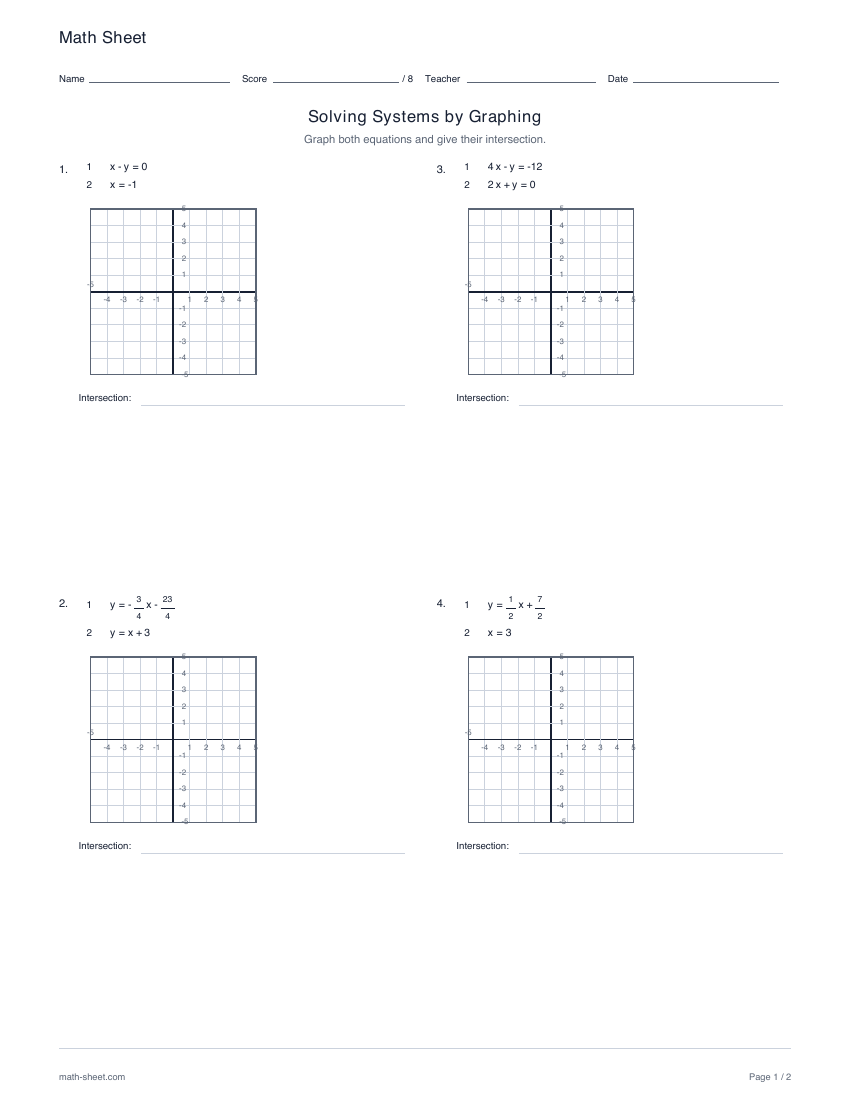
Systems of equations
Graph eight pairs of linear equations on blank coordinate grids. Choose equation forms, locate each intersection and check a separate key with both lines and the exact solution.
Preview and download →Step 4
Quadratic expressions, equations and graphs
Connect factors, zeros and x-intercepts. Choose a solving method that fits the equation, and use the discriminant or graph to check how many real solutions are reasonable.
Polynomials
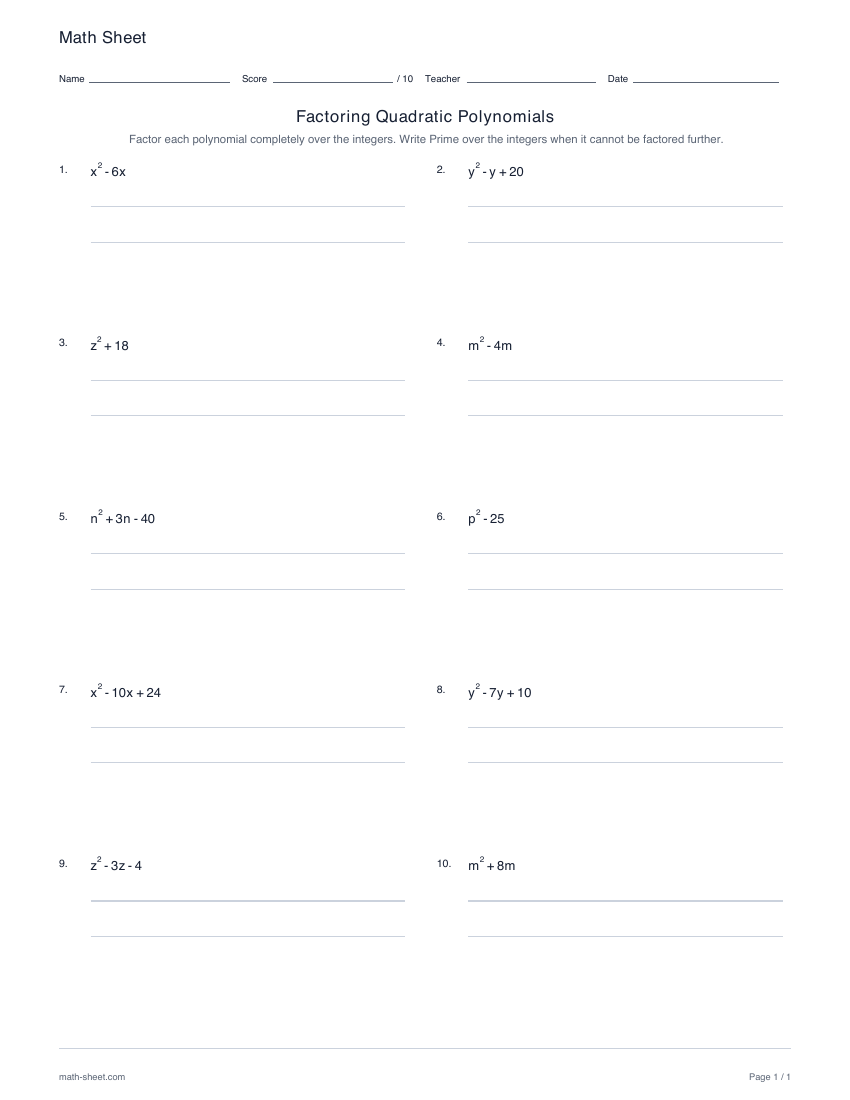
Factor ten quadratic binomials and trinomials completely over the integers. Choose factorable-only practice or include two prime quadratics, and vary monic and nonmonic leading coefficients.
Preview and download →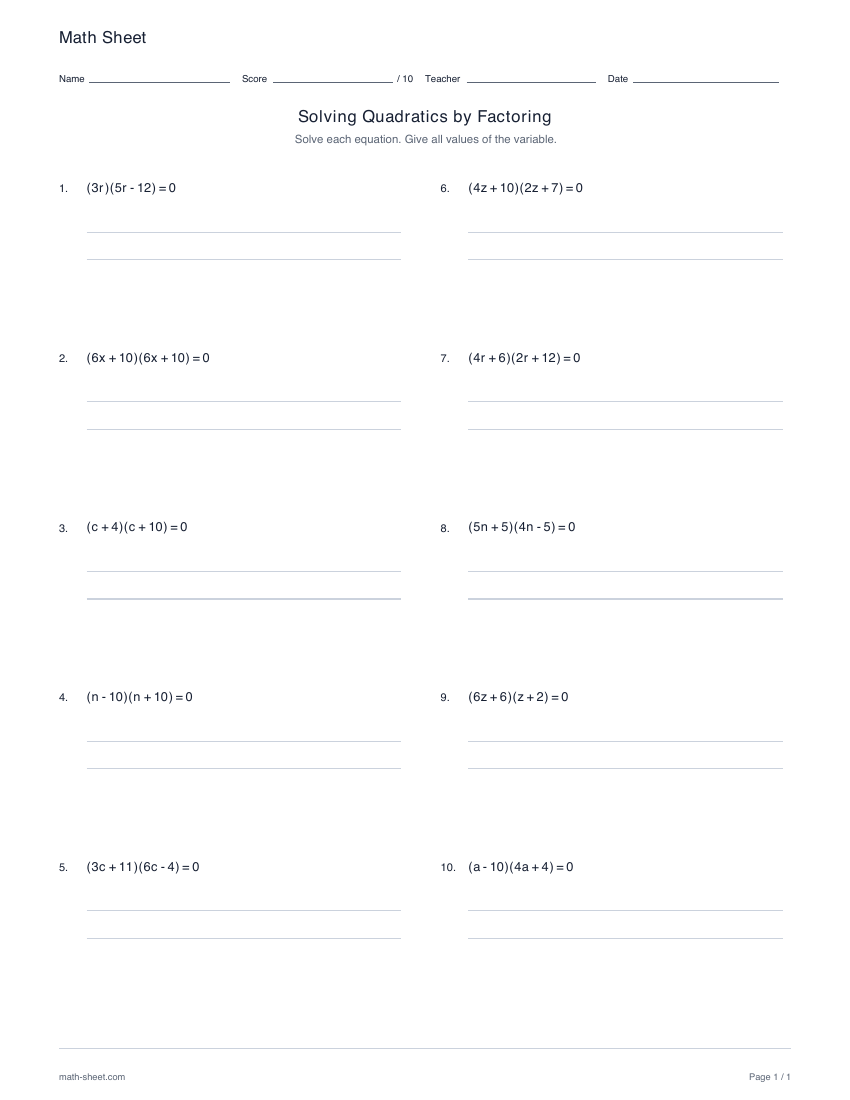
Equations
Solve ten factorable quadratic equations with complete exact root sets. Choose factored form, expanded form, rearrangement practice or a balanced mixed sheet.
Preview and download →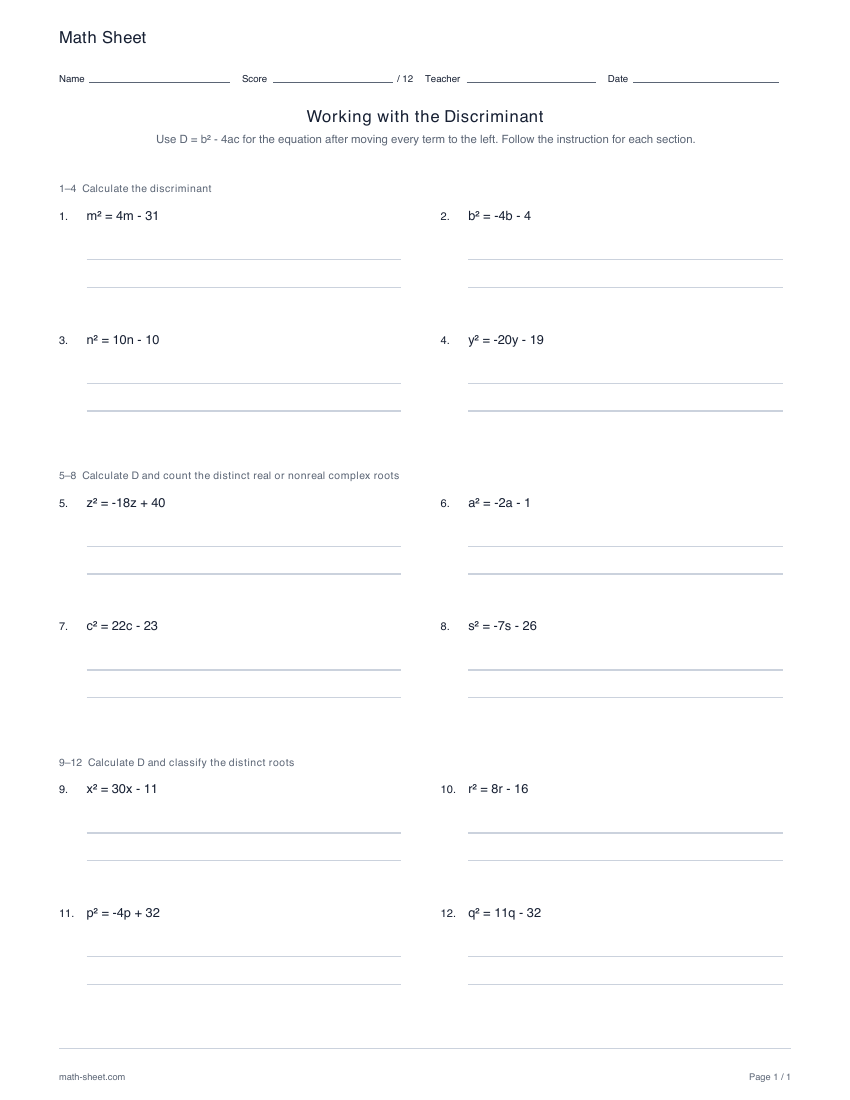
Equations
Calculate the discriminant for twelve quadratic equations, then use its sign and square status to count and classify distinct roots. Choose monic, signed nonmonic or mixed leading coefficients.
Preview and download →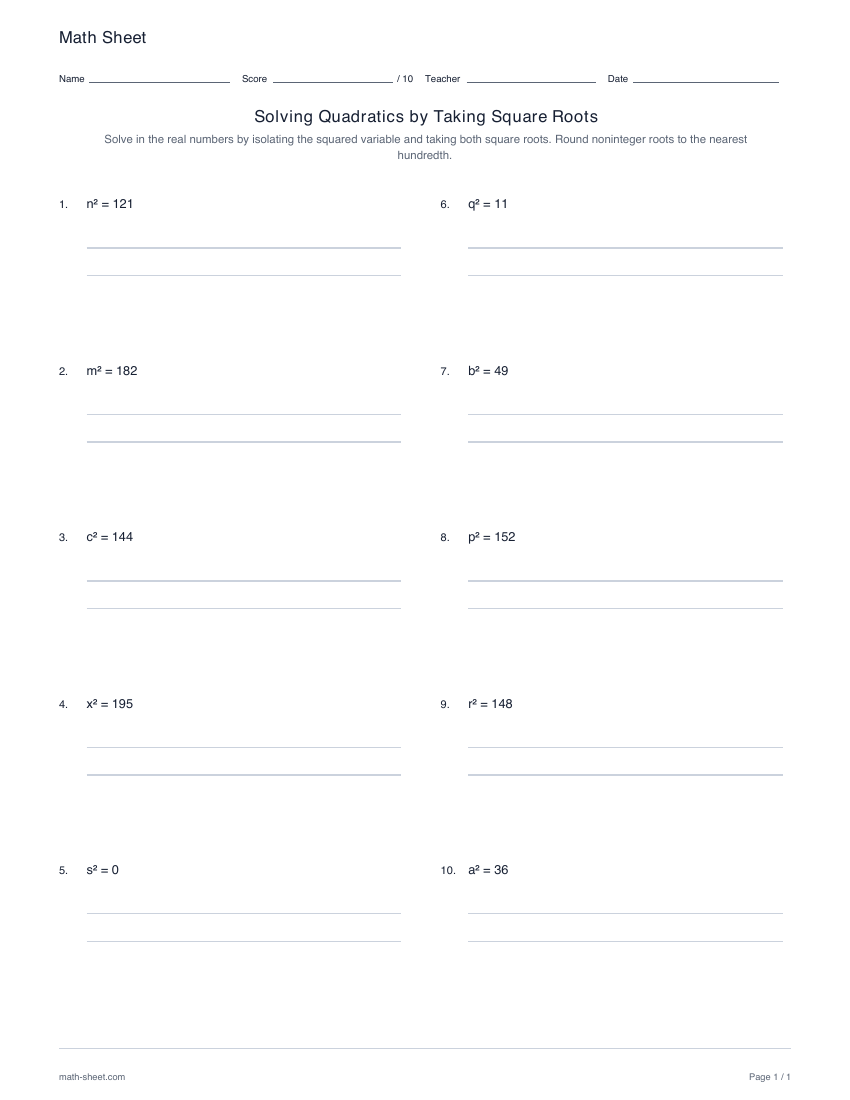
Equations
Solve ten quadratic equations by isolating a squared variable and taking both square roots. Choose direct, offset, scaled, multi-step or mixed equations with rounded real, exact real, no-real or imaginary results.
Preview and download →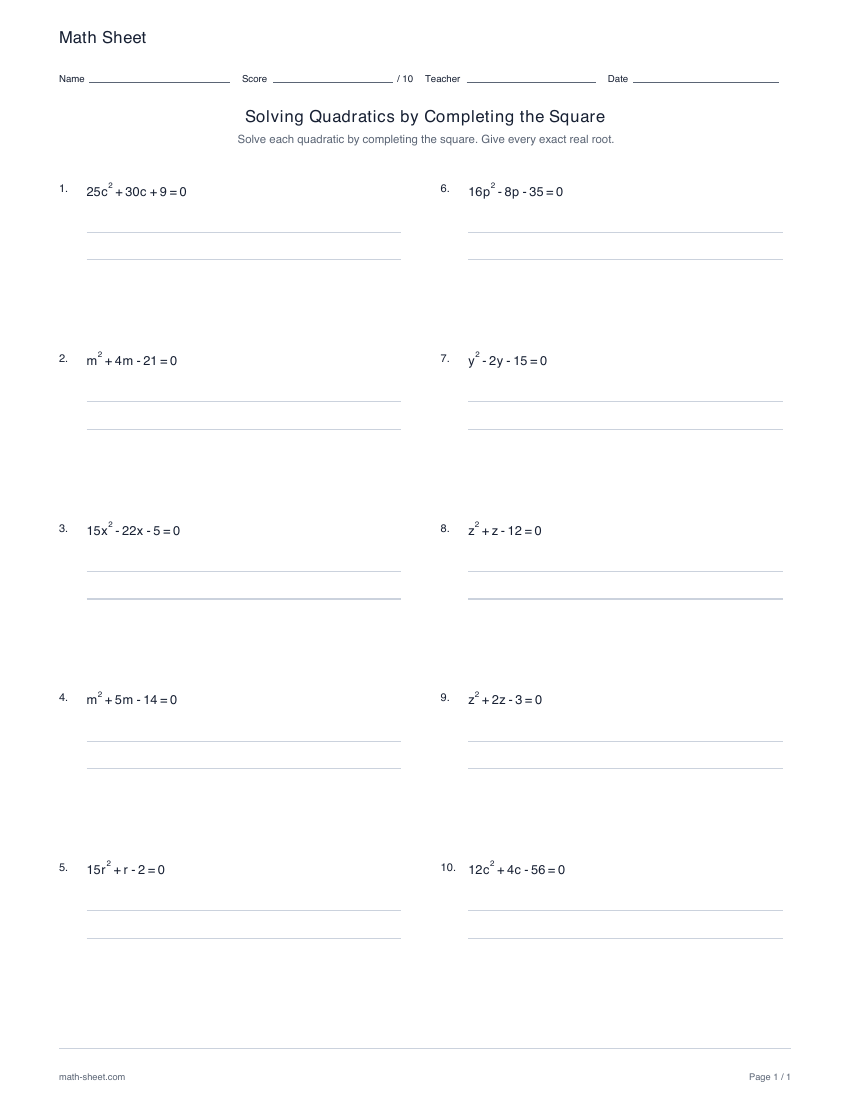
Equations
Solve ten quadratic equations by completing the square. Choose easy, hard or mixed equations and rational-only answers or exact radical roots.
Preview and download →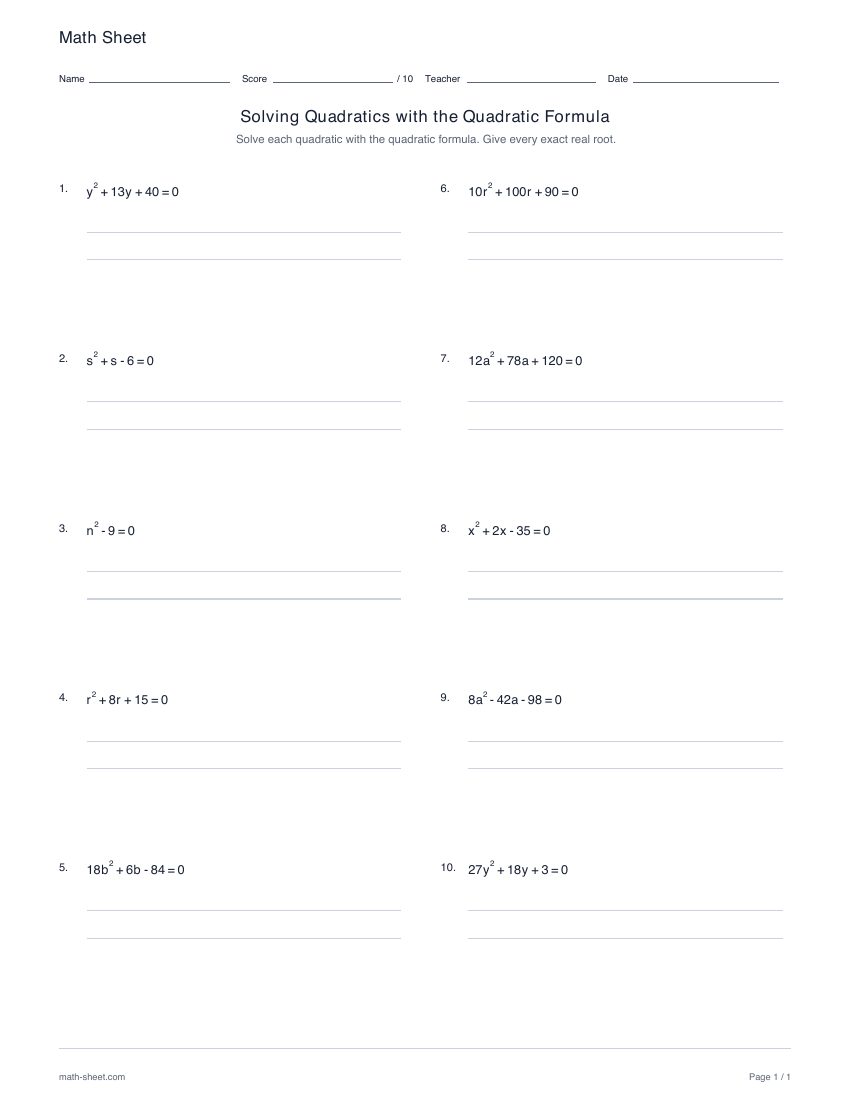
Equations
Solve ten quadratic equations with the quadratic formula. Practice original monic and nonmonic equations with rational and exact radical answers.
Preview and download →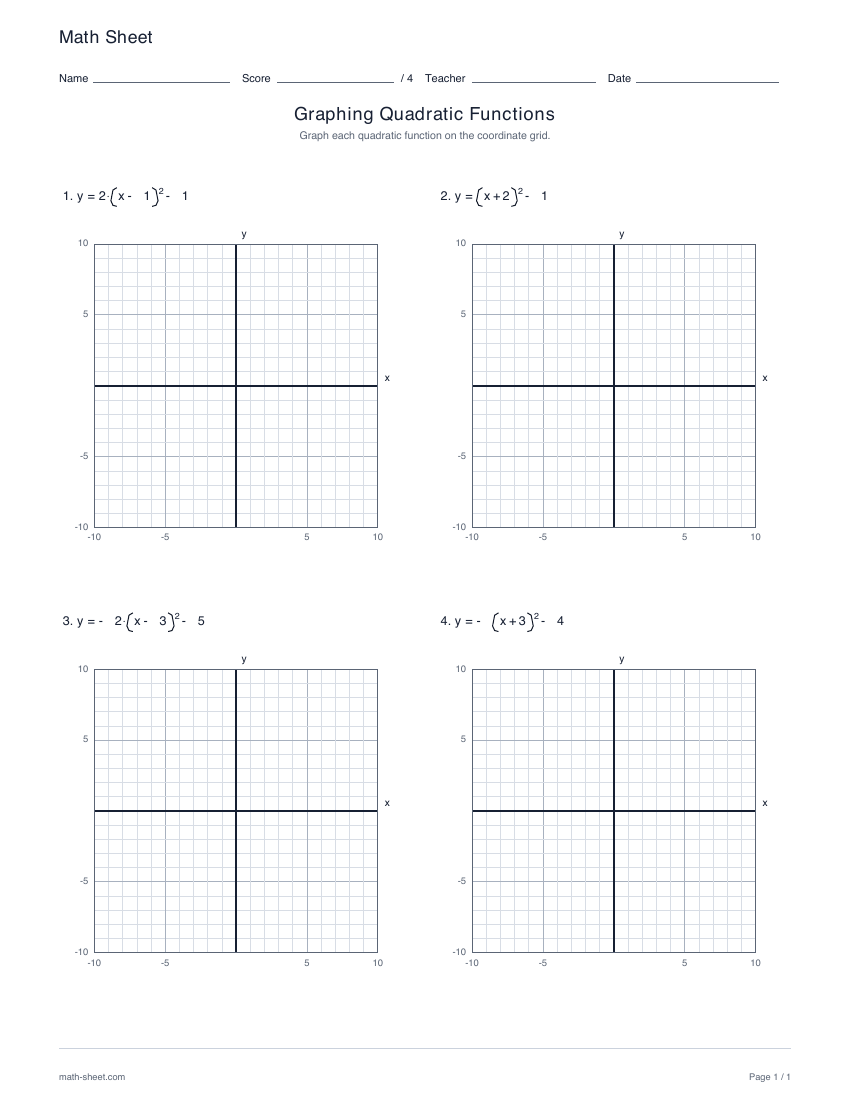
General functions
Graph four quadratic functions in vertex form on blank coordinate grids. Each sheet includes every leading coefficient from −2, −1, 1 and 2, with a separate completed graph key.
Preview and download →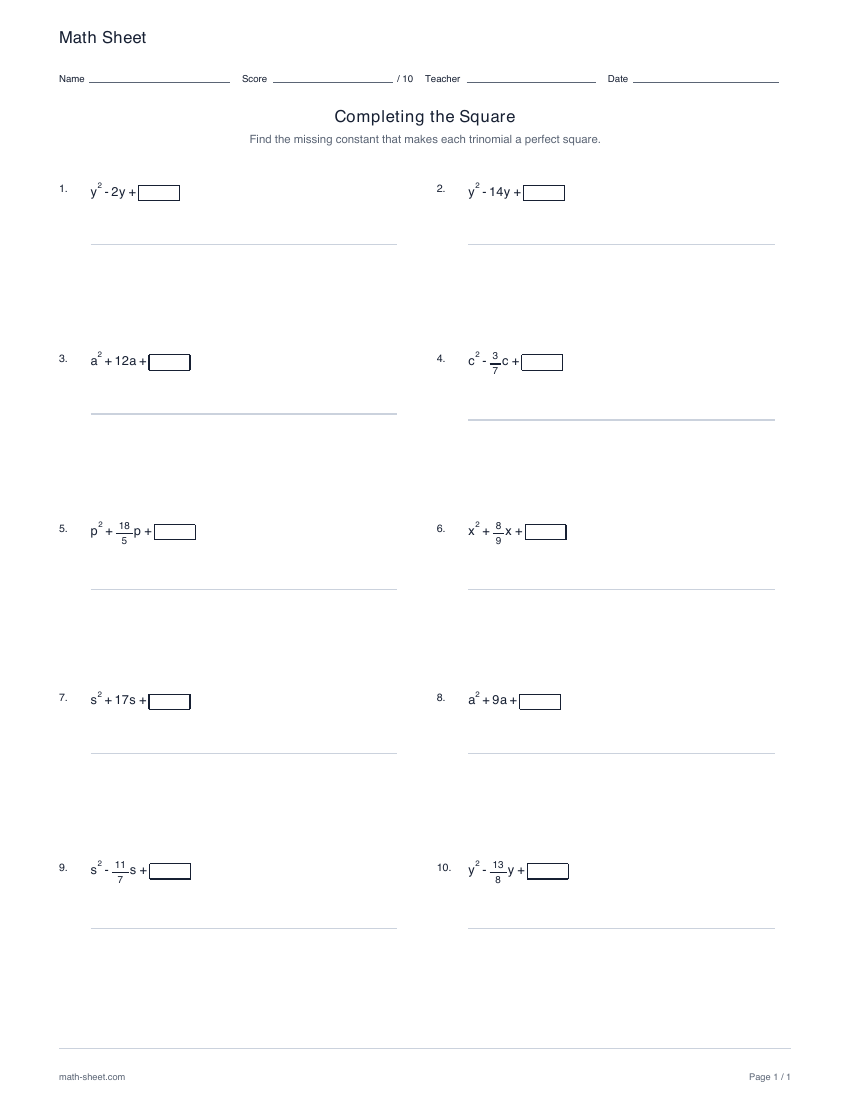
Polynomials
Find the missing constant in ten monic quadratic trinomials. Choose whole, fractional or mixed linear coefficients and check exact reduced answers.
Preview and download →Choose what to practice next
Begin with one short resource, review the learner's written reasoning and adjust the difficulty on the activity page. Revisit an earlier group when arithmetic errors obscure the new idea.
Browse the complete worksheet library →
