
Beginner: no division
Ten expressions using addition, subtraction and multiplication. Start with easy base operations, then add grouping; the separate key shows each reduction step.
Start without division →Practice by skill
Create printable order of operations practice with separate answer keys. Choose basic arithmetic, signed-number challenges or algebraic simplification; rule charts help explain each step.
Choose a worksheetMultiplication and division share a level.
Ten expressions using addition, subtraction and multiplication. Start with easy base operations, then add grouping; the separate key shows each reduction step.
Start without division →Ten expressions with four operations. Choose easy or hard practice and grouping or exponent formats.
Basic order of operations worksheets →Twelve expressions with positive, negative or mixed inputs, grouping and powers.
Advanced order of operations worksheets →Twelve expressions containing x. Simplify variable terms without substituting a numerical value.
Algebraic order of operations worksheets →Read, calculate, explain
Use a concise reference to connect grouping, powers and equal-precedence operations. Both handouts include explanations and worked examples.
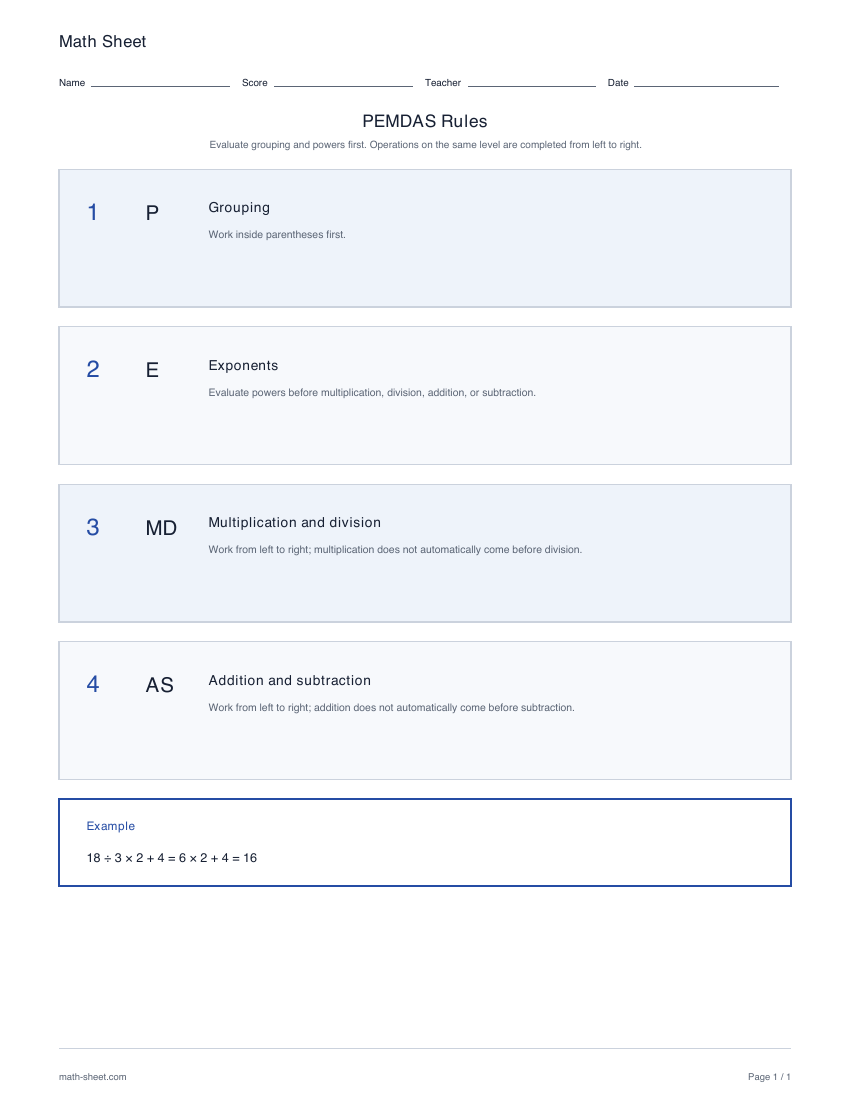
Order of operations
Print a clear order-of-operations reference with grouping, powers, multiplication and division, then addition and subtraction. Worked examples explain equal precedence and left-to-right calculation.
Preview and download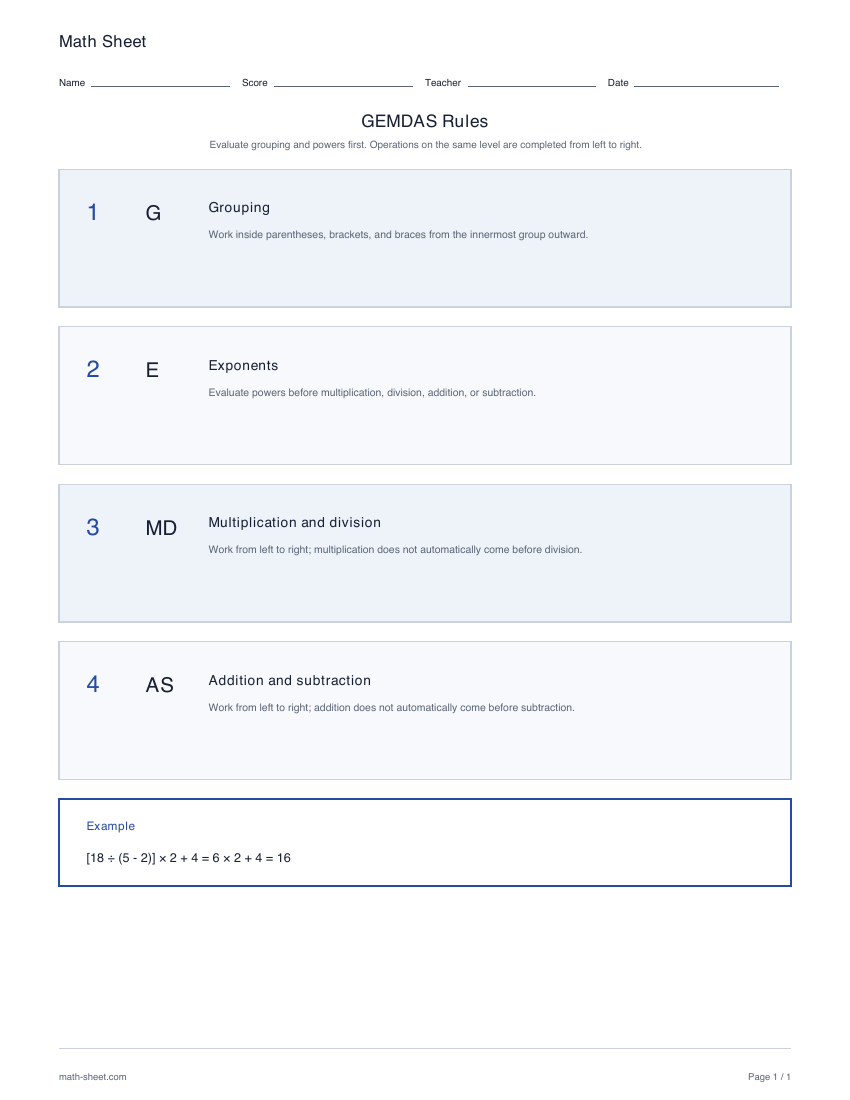
Order of operations
Use an order-of-operations handout that treats parentheses, brackets and braces as grouping symbols. Follow a nested example from the innermost group outward.
Preview and downloadRead, calculate, explain
Start without division, then combine all four operations. Add parentheses, nested groups and powers when the learner is ready.
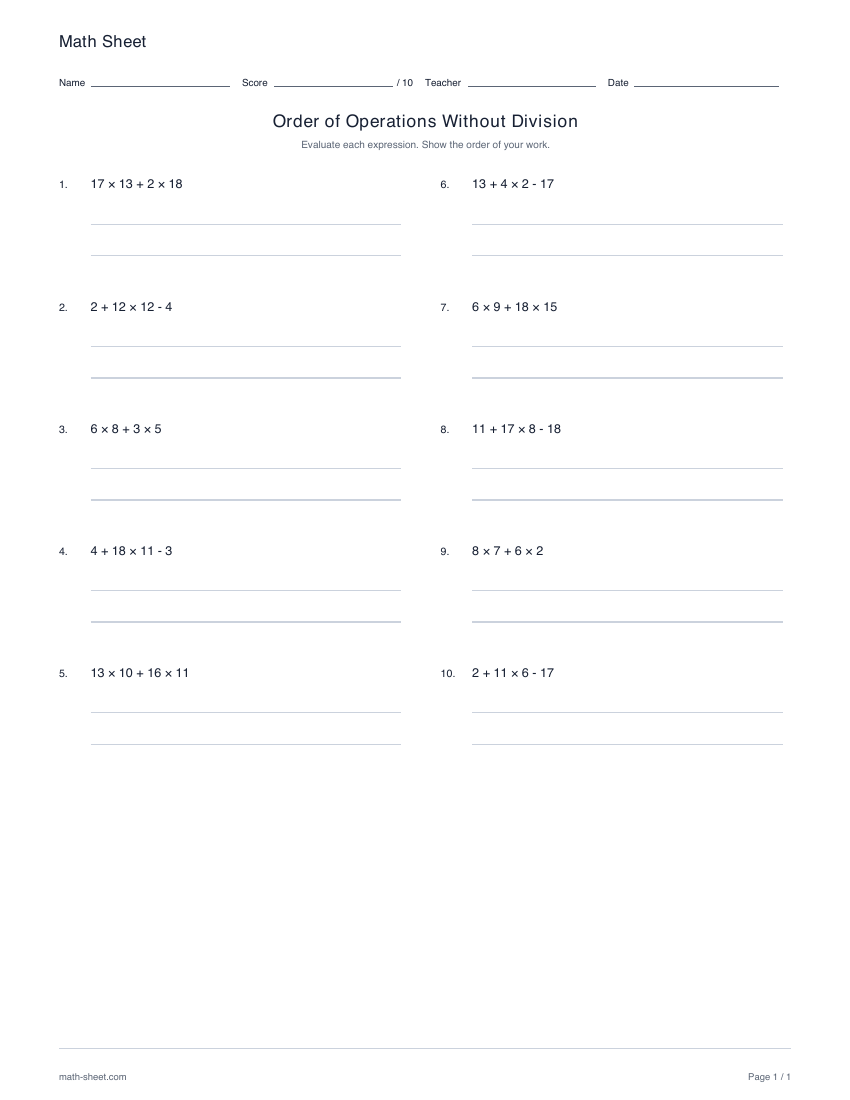
Order of operations
Practice ten expressions using addition, subtraction and multiplication. Choose easy or hard practice, with optional parentheses, nested groups and exponents, plus separate worked answer pages.
Preview and download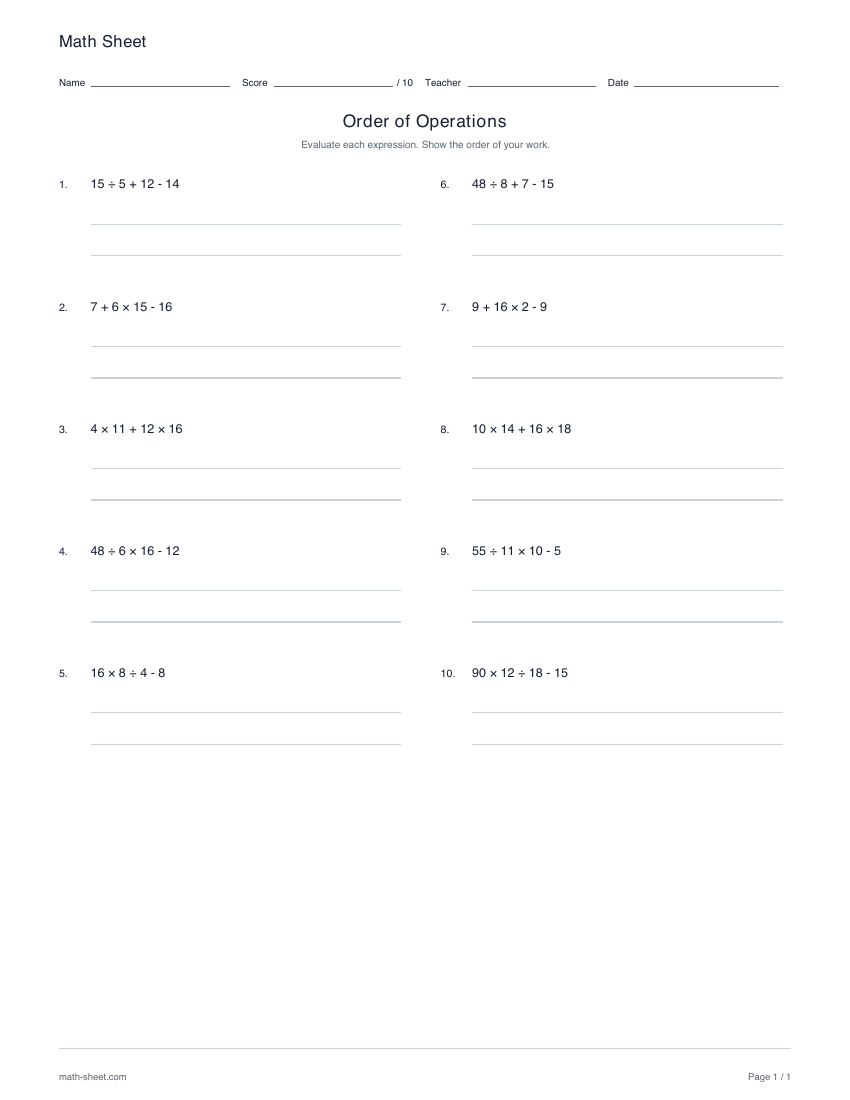
Order of operations
Evaluate ten expressions with all four arithmetic operations. Select easy or hard practice and five grouping/exponent formats, then print the questions and a separate worked key.
Preview and downloadRead, calculate, explain
Separate sign rules from precedence, then simplify expressions containing a variable. Algebraic forms require confidence with powers and like terms.
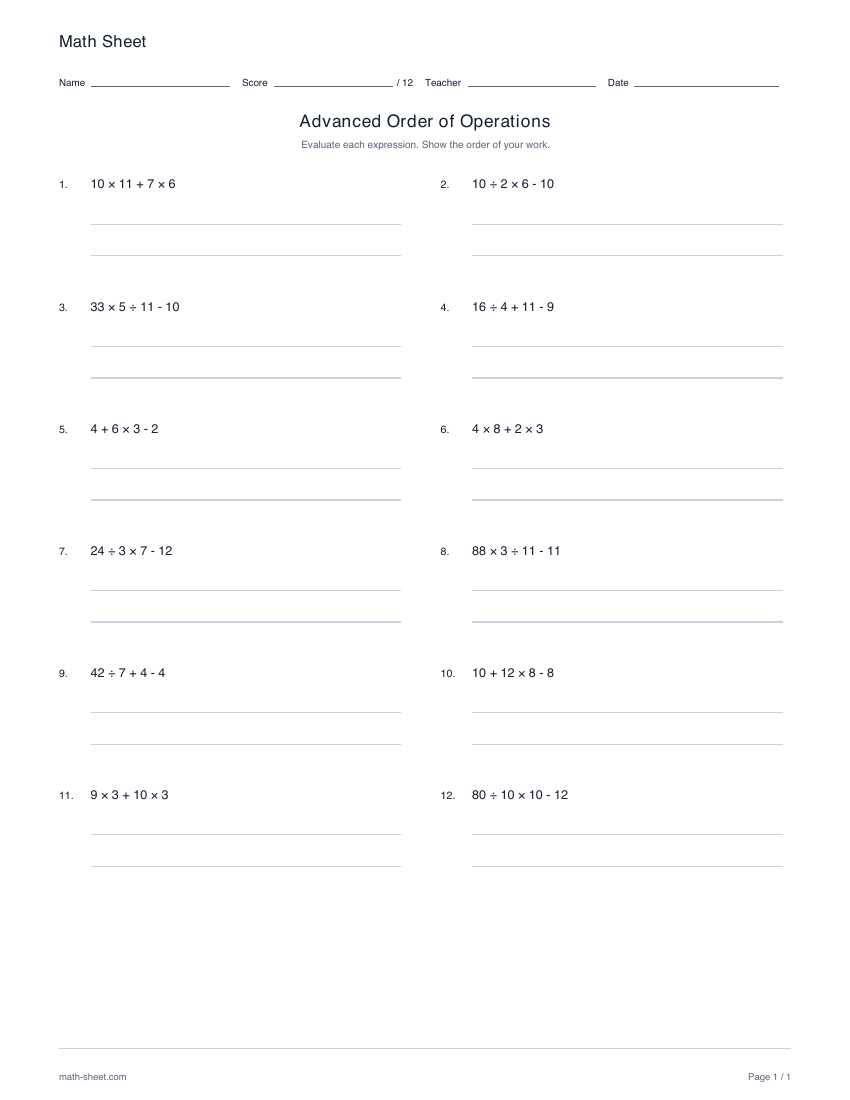
Order of operations
Work through twelve expressions with positive, negative or mixed inputs. Combine easy or hard practice with grouping, nested groups and exponents, and check a separate answer key.
Preview and download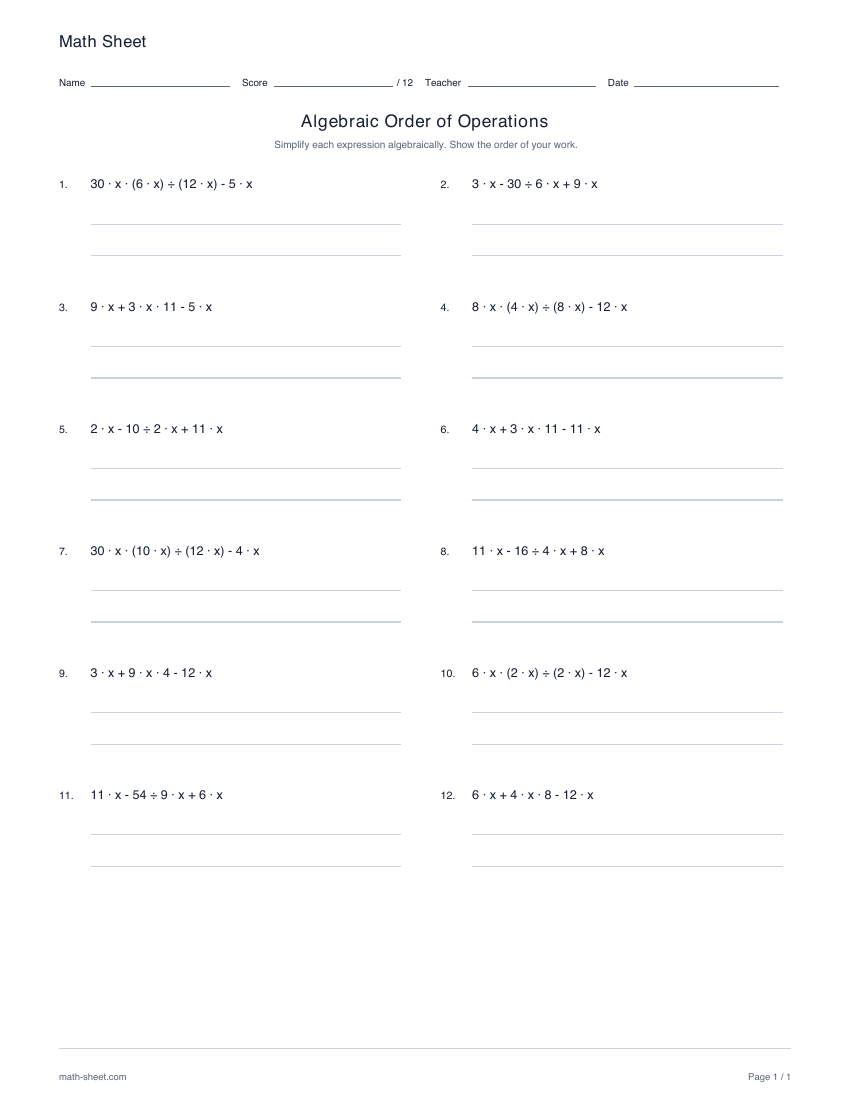
Order of operations
Simplify twelve expressions containing x, with configurable signs, grouping and powers. Practice combining like terms and simplifying products and quotients without substituting a number for x.
Preview and downloadChoose by readiness
If a learner is just meeting precedence, begin with familiar multiplication facts and no division. Add grouping before nesting. Introduce signed inputs and algebra only after their underlying rules are secure. Grade labels are starting points and do not claim alignment with a particular curriculum.
A teacher-led introduction after multiplication facts and addition/subtraction are secure. Begin with base operations and explain the order aloud.
Open this focused resource →Work with a single grouping level and familiar arithmetic. Keep every unused term when rewriting the expression.
Open this focused resource →Use after exponent notation and grouped calculations are secure. Work from the innermost group outward.
Open this focused resource →Apply the same rules inside a group before returning to the surrounding expression. Finishing one calculation does not remove the other terms: rewrite them as you go.
Compare 5 + 2 × 3 with (5 + 2) × 3. In the first expression, multiplication comes first: 5 + 6 = 11. In the second, the parentheses make 5 + 2 a single group: 7 × 3 = 21.
For 2 × [3 + (8 − 5)], start inside the parentheses. The expression becomes 2 × [3 + 3], then 2 × 6, then 12. The innermost group comes first, regardless of whether its symbols are parentheses, brackets or braces.
A negative base needs clear grouping. (−3)2 means (−3) × (−3), which is 9. The expression −(32) means the negative of 9, which is −9.
On advanced sheets, the positive, negative and mixed settings describe the inputs. A subtraction using positive inputs can still produce a negative result. Choose these settings based on the sign rules the learner can already explain.
The algebraic activity asks learners to simplify, without assigning a numerical value to x. For 3 × 4x − 2x + 5x, first find 12x, then combine the like terms to get 15x.
Power forms may require products, quotients and negative powers of x. If the original expression divides by x or uses x−1, x must be nonzero. Cancelling a variable does not erase that original restriction.
These sheets are a later step after like terms, signed arithmetic and exponent rules are familiar. They are available by skill without being presented as a requirement for every learner in a particular grade.
The two rule handouts include their explanations and examples together. The four practice activities provide separate student and answer PDFs. Choose US Letter or A4, with eight printed-language options in the generator.
The no-division and basic arithmetic families provide worked reduction steps in their separate keys. Advanced signed-number and algebraic keys provide the expression and final answer; they do not show every intermediate step.
The two basic practice families have ten questions; advanced and algebraic sheets have twelve. Use a new set for another lesson, or keep a configured link to reproduce the same questions. Preview the selected paper and language before printing.