
Percent
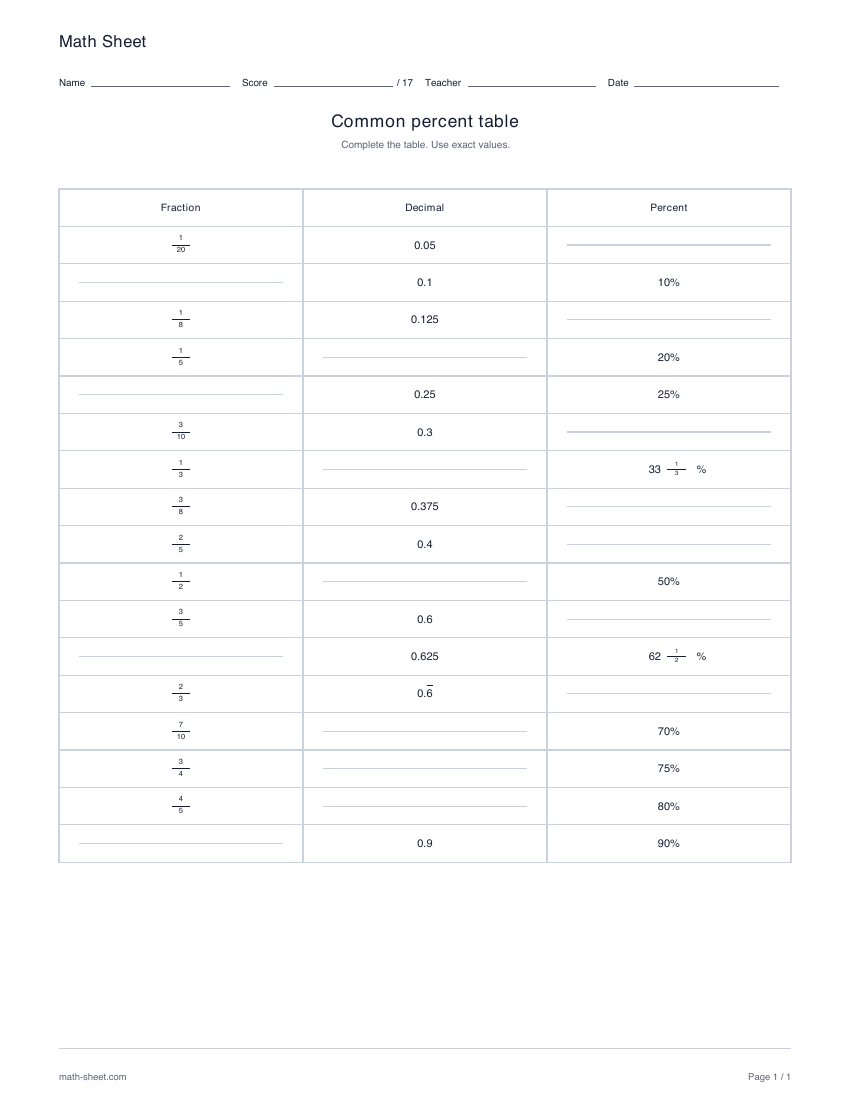
Common fraction, decimal and percent table
Print a common-percent reference chart or fill in missing fractions, decimals and percents. Include thirds and eighths, and choose exact, truncated or rounded values.
Preview and downloadPractice by skill
One value, three ways to write it. Connect fractions and decimals to percentages, then find the missing part, whole or rate.
Choose a percent skillTwenty-five out of every hundred.
Represent, calculate, explain
Use a common-value chart, then practice individual conversion directions. Keep exact values separate from rounded approximations.
Percent
Print a common-percent reference chart or fill in missing fractions, decimals and percents. Include thirds and eighths, and choose exact, truncated or rounded values.
Preview and download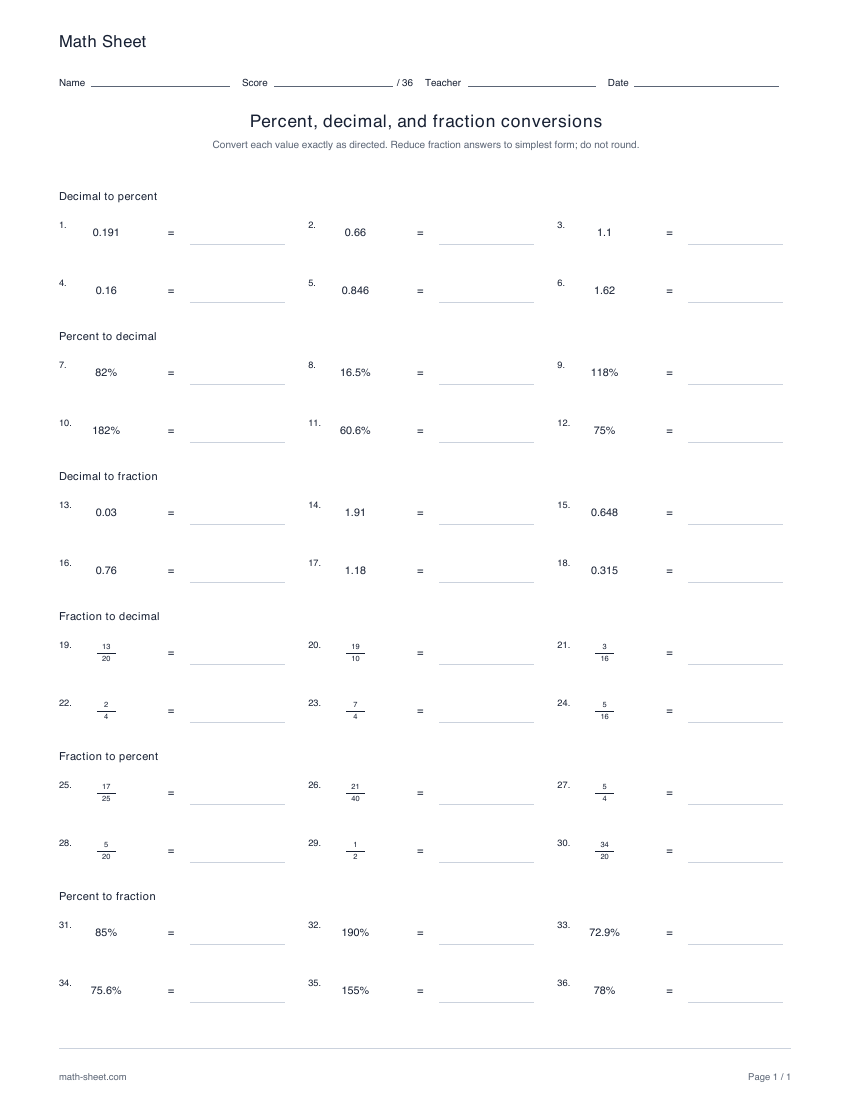
Percent
Practice all six conversion directions between percentages, decimals and fractions. Choose values below or above one, fractional percents, and printable simplified answer keys.
Preview and downloadRepresent, calculate, explain
Build intuition with powers-of-ten percentages before choosing the operation for different unknowns.
Percent
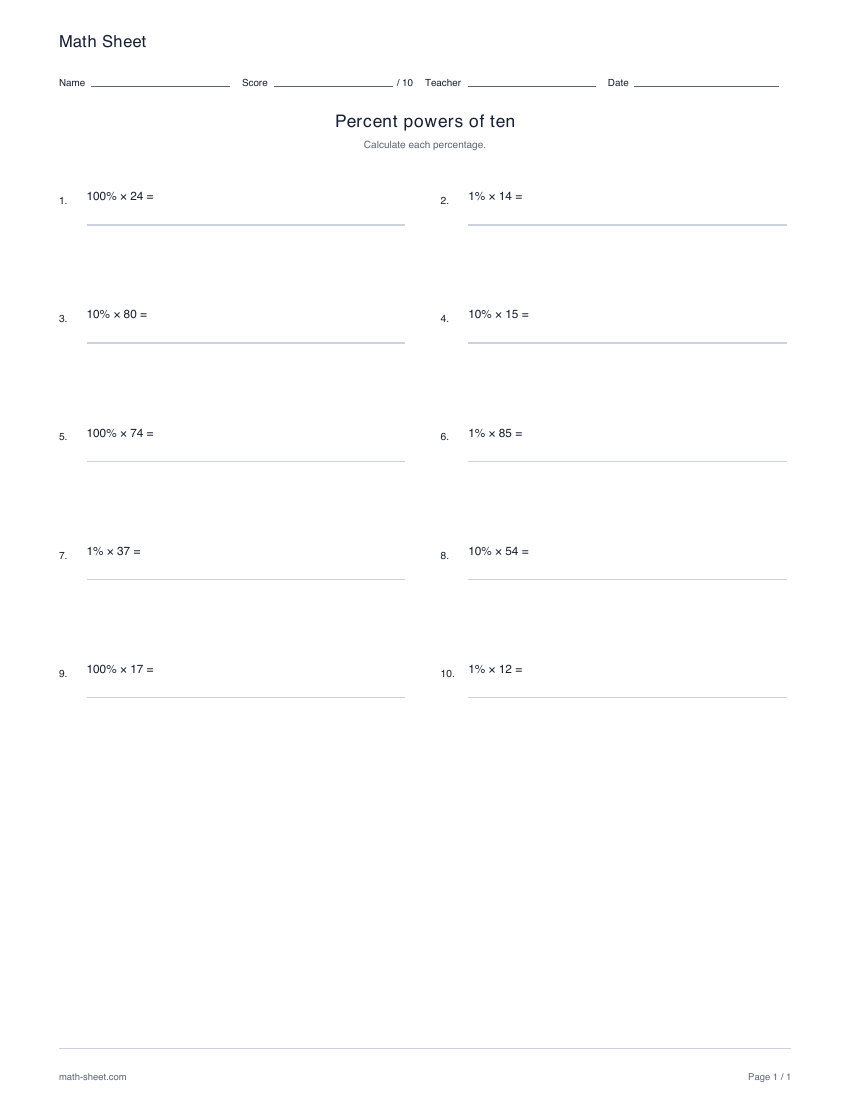
Find 0.1%, 1%, 10%, 100% or 1000% of whole numbers and decimals. Print ten focused questions with numeric or word prompts and exact answer keys.
Preview and download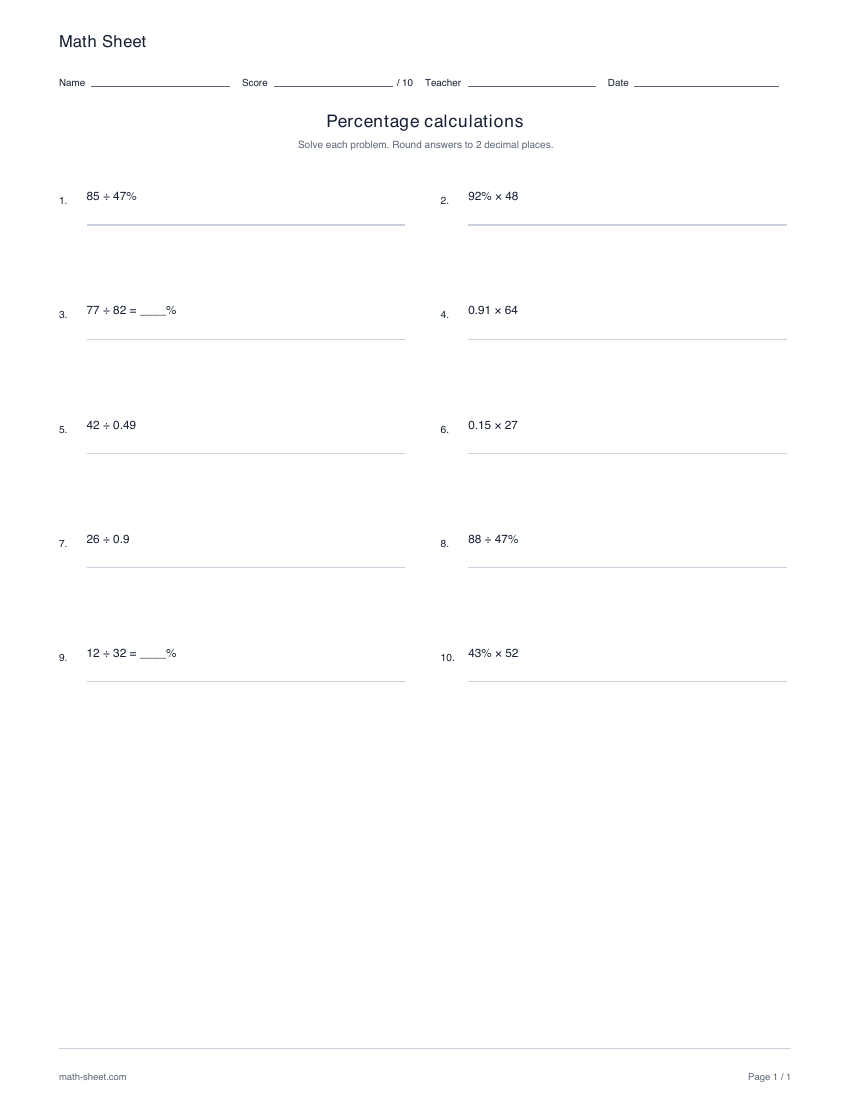
Percent
Find a part, a whole or a percentage in ten configurable problems. Choose five equation forms, whole or decimal operands, word prompts and 1–3 decimal places.
Preview and downloadChoose by readiness
Begin after equivalent fractions and decimal hundredths are familiar. These starting points use general English grade labels; countries and schools introduce percentages at different stages.
Use after equivalent fractions and hundredths are secure. Complete one missing representation in each of twelve rows.
Open this focused practice →Find one tenth and one whole of a quantity, then explain why the two multipliers differ.
Open this focused practice →Read ten word prompts, identify part, whole or rate, and round the final result to two decimal places.
Open this focused practice →25% is 25/100, which simplifies to 1/4 and equals 0.25. A percent describes a relationship to a whole; that whole does not need to contain exactly one hundred objects.
For example, 25% of a class of 24 students is 6 students. One quarter of 24 and 0.25 ×24 both express the same calculation.
The relationship is part = decimal rate × whole. Identify the missing quantity before choosing an operation.
What is 20% of 80?
0.20 ×80 =16.
16 is 20% of what number?
16 ÷0.20 =80.
16 is what percent of 80?
16 ÷80 ×100 =20%.
The calculation generator offers five numeric forms because parts and wholes can be practiced with either percent notation or decimal-rate notation. Word prompts help students choose a method from the meaning of the question.
One-third has a recurring decimal and an exact percent of 33 1/3%. Writing 33% gives an approximation. Truncating two-thirds to a whole percent gives 66%; rounding it gives 67%.
The common-percent chart offers both methods and labels approximations. When an approximate row has missing cells, its exact fraction remains visible so the task has a clear starting value.
Conversion practice uses terminating values and asks for exact answers. The calculation sheet instead specifies one, two or three decimal places. Read that instruction before rounding.
10% means multiply by 0.1, 1% means multiply by 0.01, and 0.1% means multiply by 0.001. By contrast, 100% keeps the original quantity and 1000% multiplies it by ten.
Use powers-of-ten practice to predict the size of an answer before calculating. A result for 0.1% should be much smaller than the starting positive amount.
All four activities have free English PDFs in Letter and A4, with a student-only option and a separate answer key. The image previews show the first page; the downloads contain every page.
Choose settings in the generator to change the practice. Percent multiplication and calculation each have ten questions. Conversion sheets have thirty or thirty-six, distributed evenly among the directions you select. Common-value tables have twelve to seventeen rows.