
Factors
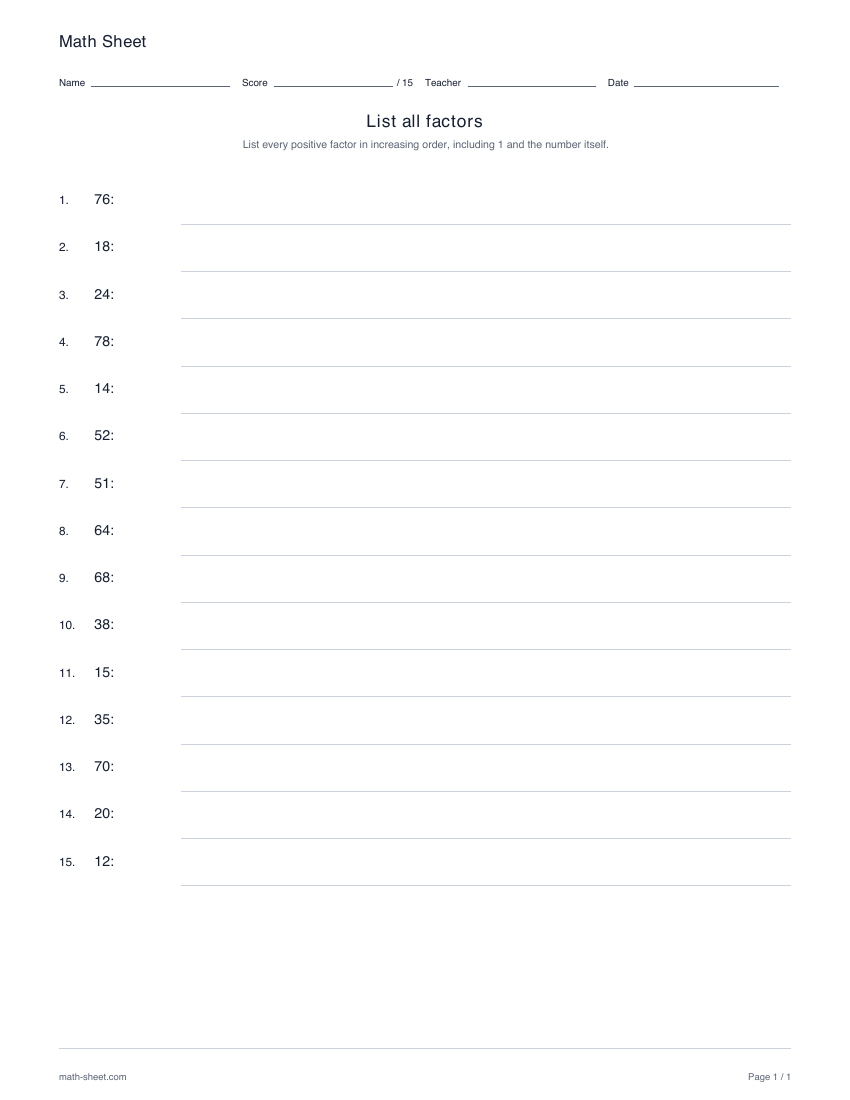
List all factors
Find every positive factor of a composite number. Choose numbers up to 50, 81, 144 or 200, with 10, 15 or 20 questions and a separate answer key.
Preview and downloadPractice by skill
Find the numbers that divide exactly. Build a prime factorization, then use it to compare what two or three numbers share.
Choose a factor skillUnderstand the structure
Begin with complete factor pairs, then distinguish different prime divisors from a product that retains repeated factors.
Factors
Find every positive factor of a composite number. Choose numbers up to 50, 81, 144 or 200, with 10, 15 or 20 questions and a separate answer key.
Preview and download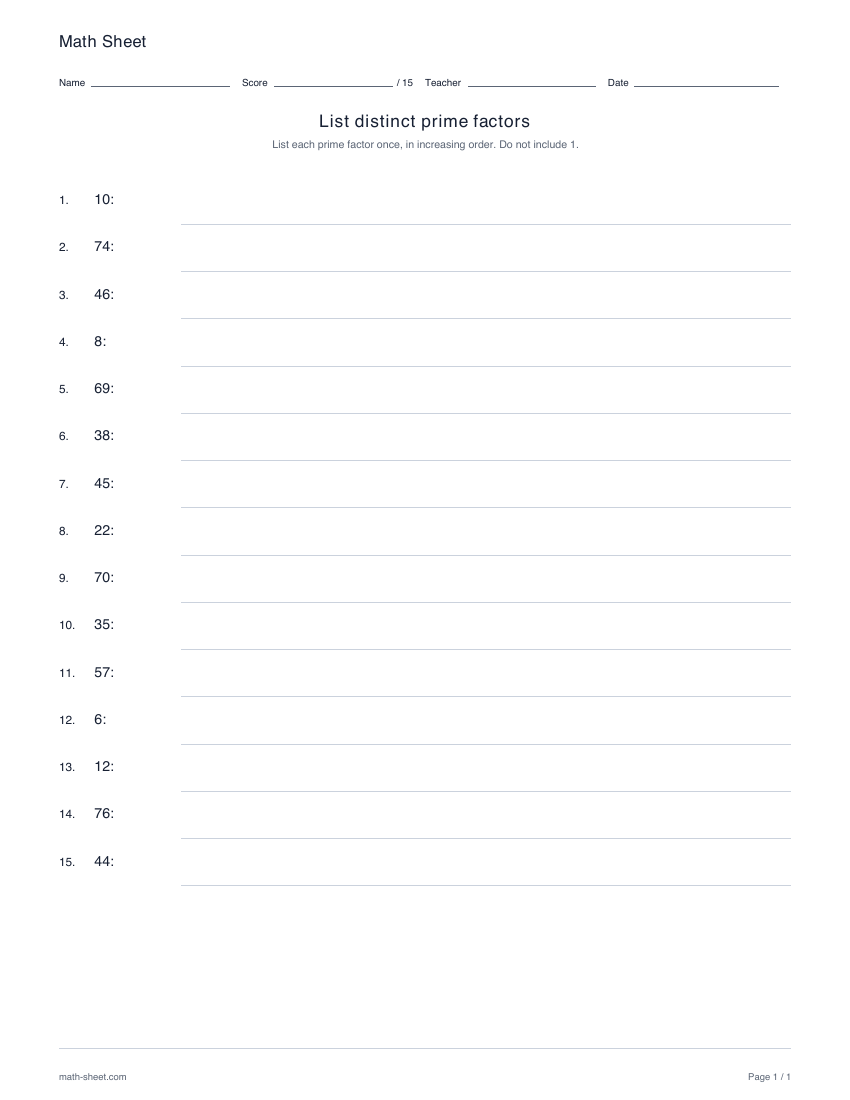
Factors
Identify the different prime divisors of each composite number. List each prime once, using selectable ranges through 200 and a separate key.
Preview and download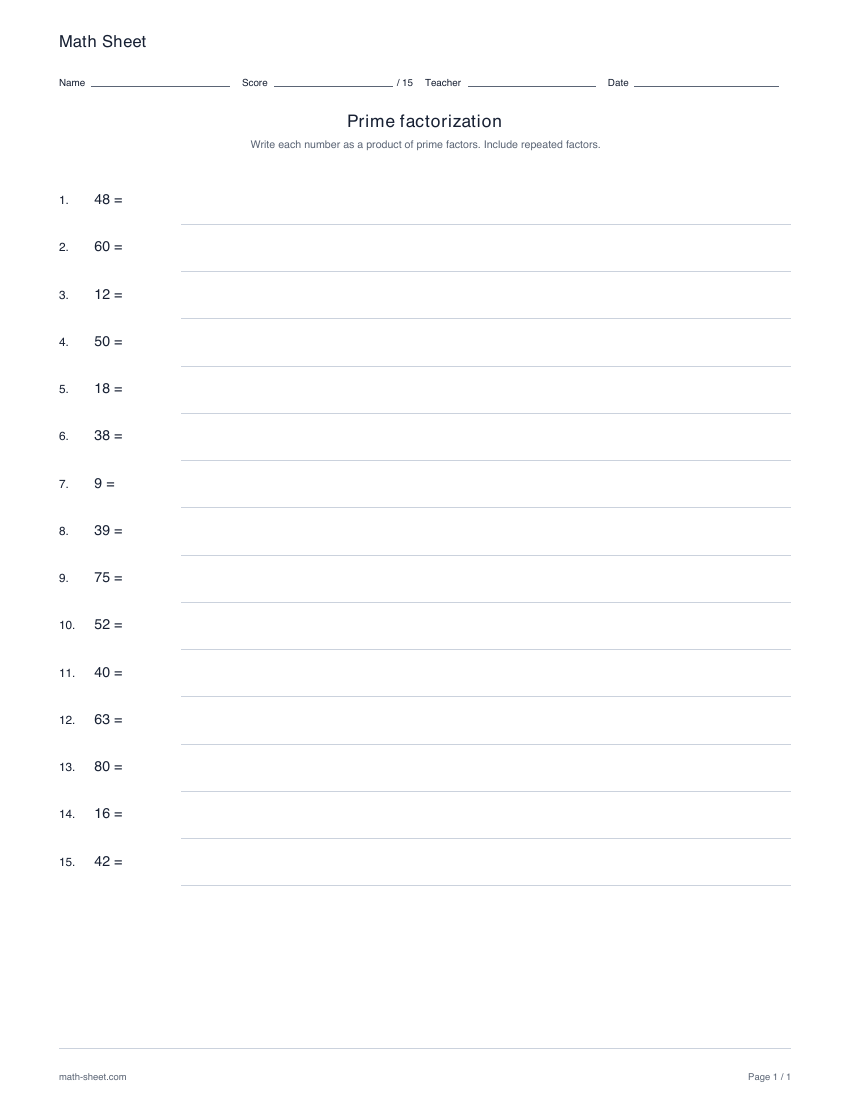
Factors
Express composite numbers as products of primes, retaining repeated factors. Print 10, 15 or 20 questions for ranges up to 50, 81, 144 or 200.
Preview and downloadUnderstand the structure
Use a visual factor tree, focus on one common-value task, or compare LCM and GCF for the same set of numbers.
Fractions
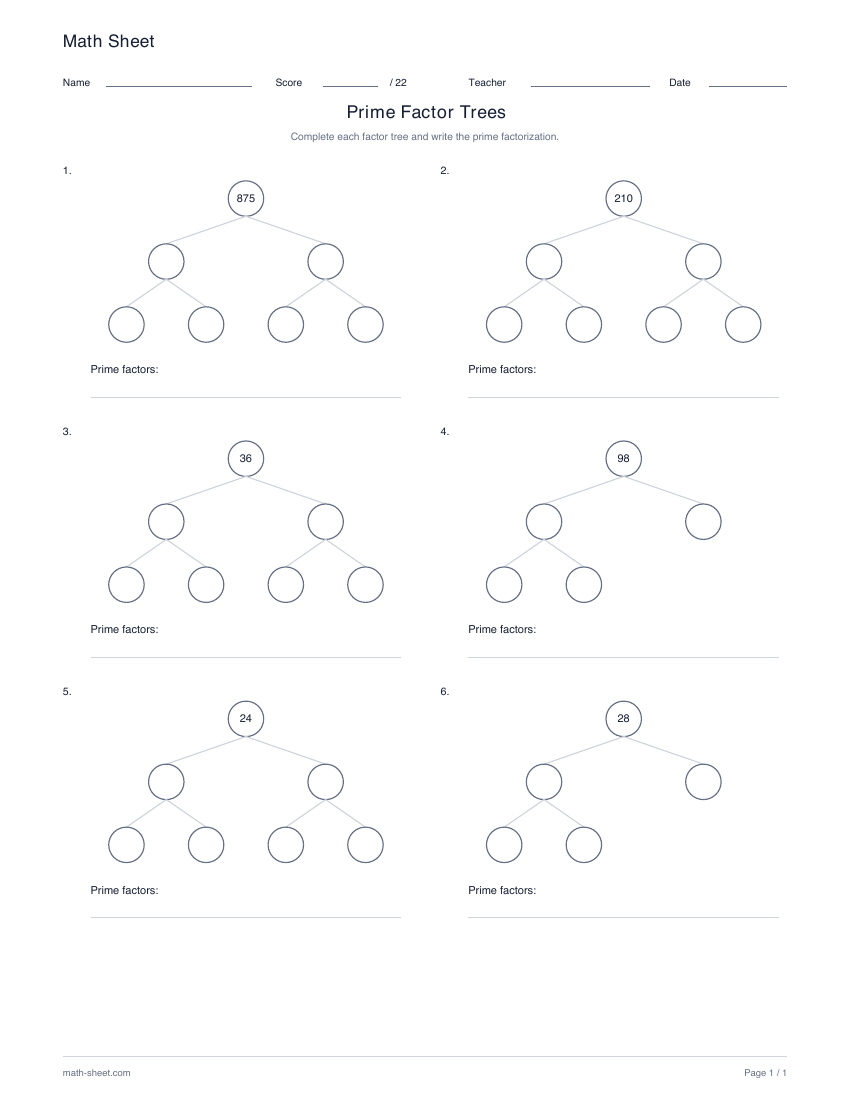
Break composite numbers into factor pairs until every branch ends in a prime, retaining repeated factors.
Preview and download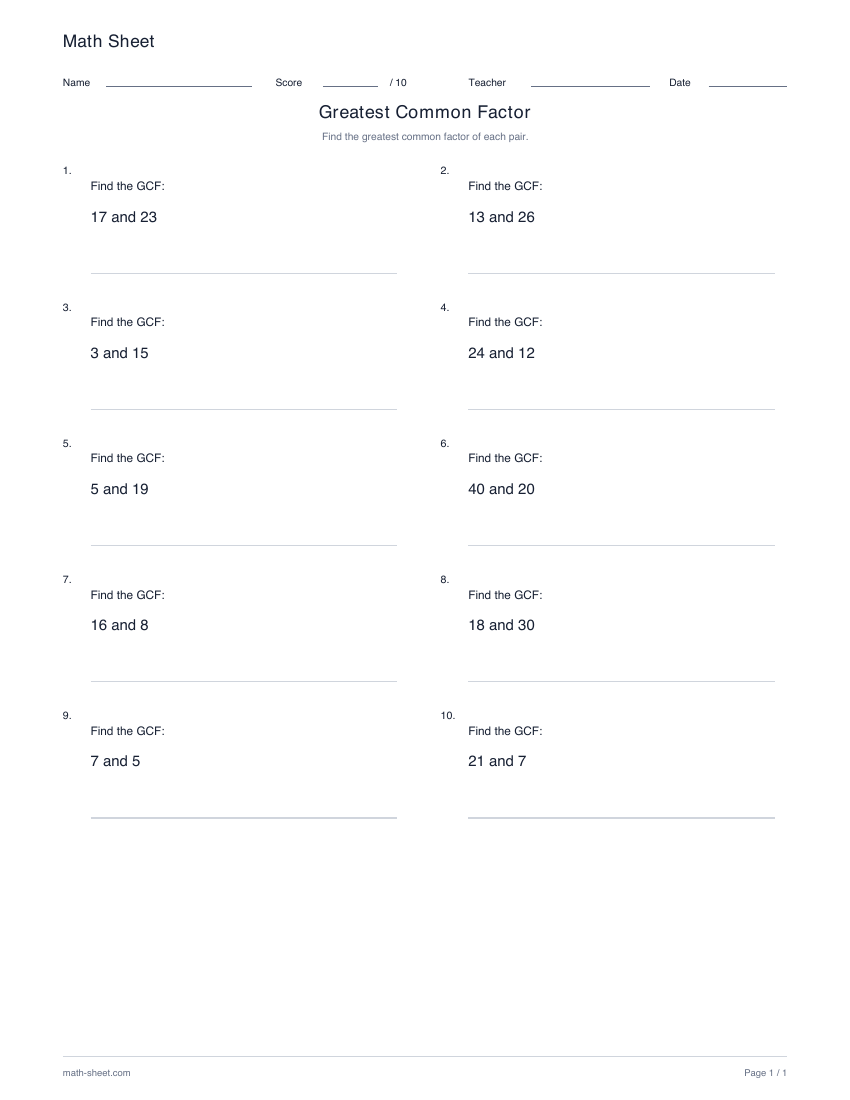
Fractions
Find the greatest common factor of positive integer pairs. Choose a maximum of 24, 40, 60 or 120 and 10, 15 or 20 questions, with a separate answer key.
Preview and download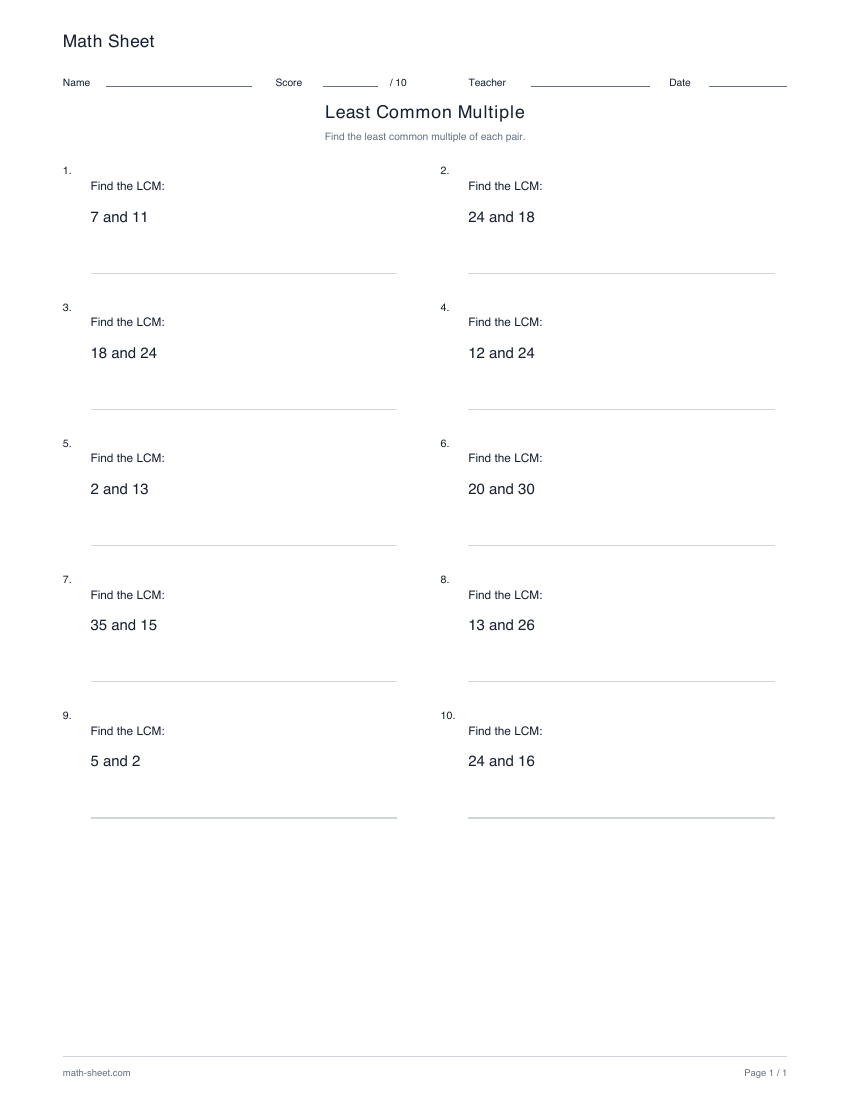
Fractions
Find the smallest positive multiple shared by two numbers and use it to plan common-denominator work.
Preview and download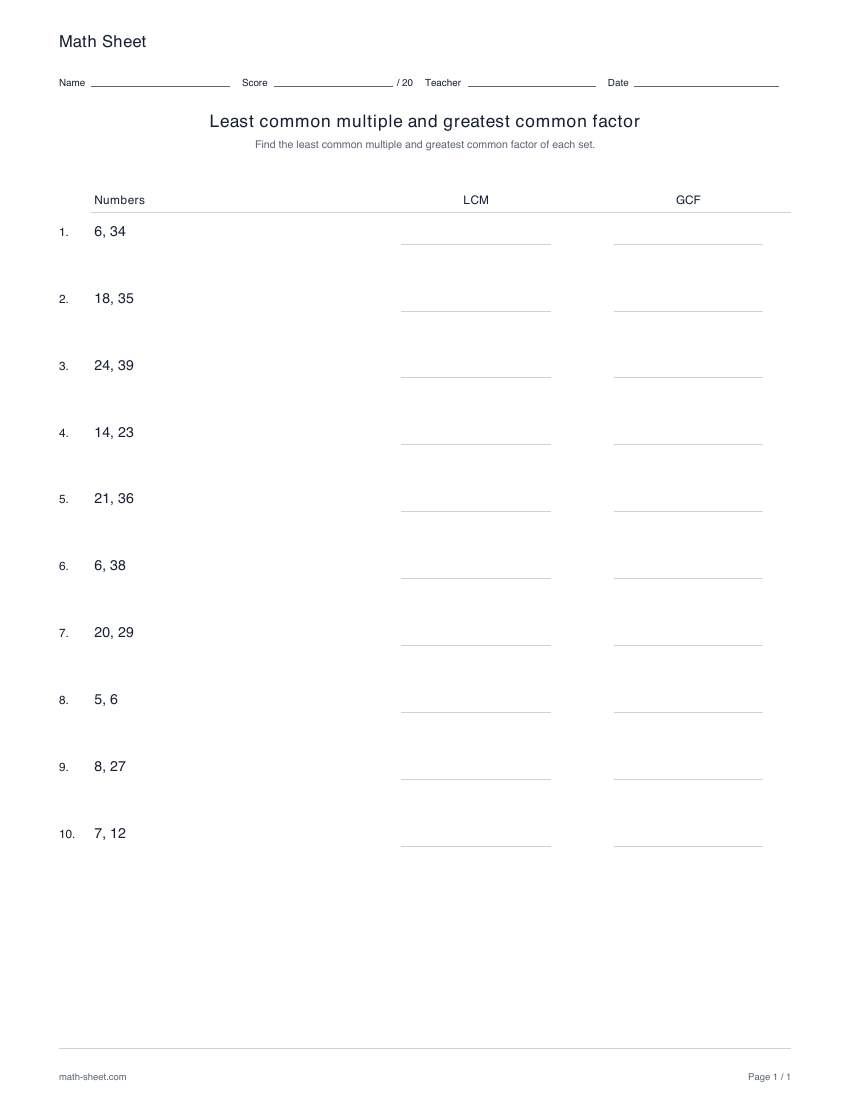
Factors
Find the least common multiple and greatest common factor side by side. Choose two or three numbers per set, ranges through 120, and 10 or 12 questions.
Preview and downloadChoose by readiness
Factor work builds on exact division, multiplication facts and the meaning of prime numbers. These suggested settings describe a starting point, not a required curriculum sequence.
Start after exact division and multiplication facts are familiar. Use pairs to explain why the list is complete.
Open this focused practice →Write and check full products before using prime powers to compare numbers.
Open this focused practice →Include every member of the set. Prepare for larger products and coprime sets.
Open this focused practice →A factor of 18 divides 18 without a remainder. Its positive factors are 1, 2, 3, 6, 9 and 18. A multiple of 18 comes from multiplying 18 by a whole number: 18, 36, 54 and so on.
Every positive factor of a number is at most that number. There is no largest positive multiple. This difference helps explain why a greatest common factor stays small while a least common multiple can exceed every input.
For 36, the different prime factors are 2 and 3. The full prime factorization is 2 × 2 × 3 × 3. Removing repeated factors changes the product, even though it leaves the distinct-prime list unchanged.
A factor tree records repeated splitting. Different valid first pairs can lead to different tree shapes, but the prime leaves produce the same final factorization.
For 12 and 18, the greatest common factor is 6 and the least common multiple is 36. The GCF keeps only prime copies that both numbers share. The LCM keeps enough copies to include each number as a factor.
For three numbers, compare every member of the set. A factor shared by the first two may fail to divide the third. Check a proposed LCM by dividing it by each input.
Every linked activity has printable Letter and A4 worksheets with a separate answer key. The three list activities offer 10, 15 or 20 questions. Combined GCF/LCM practice offers 10 or 12 sets of two or three numbers; the largest-number setting applies to inputs, not answers.
The new factor lists and combined practice support eight worksheet languages: English, German, Albanian, Spanish, Italian, French, Turkish and Norwegian Bokmål. Ready-made downloads use English. The linked factor trees and individual GCF and LCM activities currently print in English.