
Fractions
Add fractions with common denominators
Rename fractions as equivalent amounts with a common denominator before finding and simplifying their sum.
Preview and downloadBuild understanding, then fluency
Use equivalent fractions to make unlike units comparable. Build a reliable written method for mixed numbers, and connect fraction multiplication to finding part of a quantity.
This is a selected skill collection using familiar English grade labels. Grade expectations vary between schools and countries; it is not a full curriculum or a standards-alignment claim.
Check that the learner can generate an equivalent fraction, simplify a fraction and explain a mixed number. Revisit those skills before adding several new steps at once.
Discuss together
Rename the fractions in twelfths: 2 4/12 - 1 9/12. Exchange one whole for twelve twelfths to get 1 16/12 - 1 9/12. Subtracting gives 7/12. A model can explain why the exchange keeps the value unchanged.
Step 1
Begin with two terms and useful denominator choices. Add a third term only when the renaming process is understood.
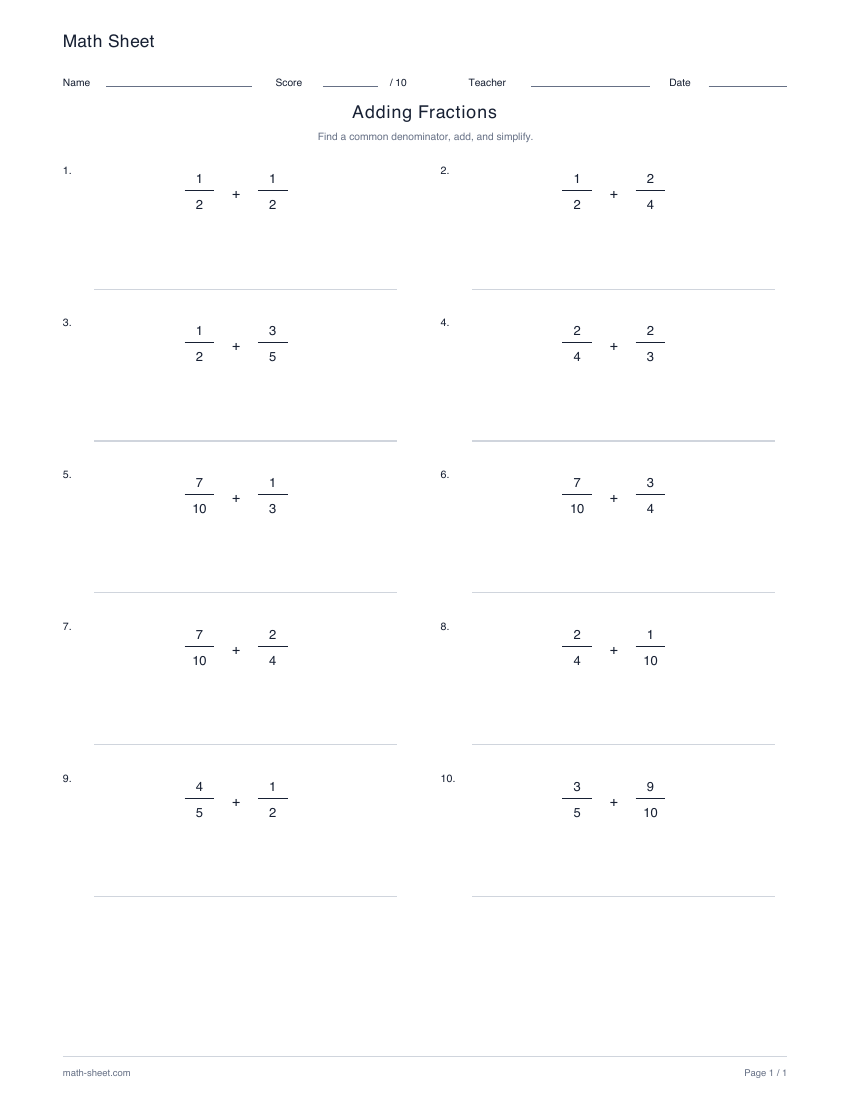
Fractions
Rename fractions as equivalent amounts with a common denominator before finding and simplifying their sum.
Preview and download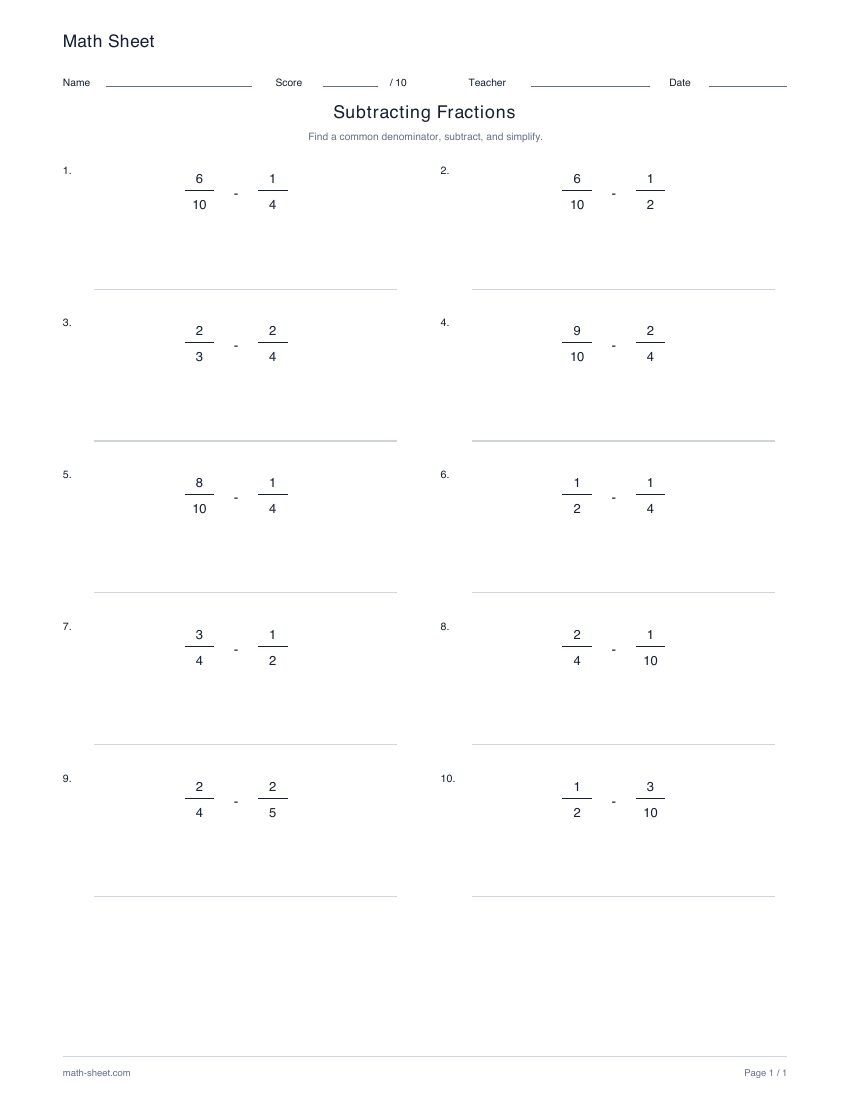
Fractions
Rename unlike fractions using a common unit before calculating and simplifying their difference.
Preview and download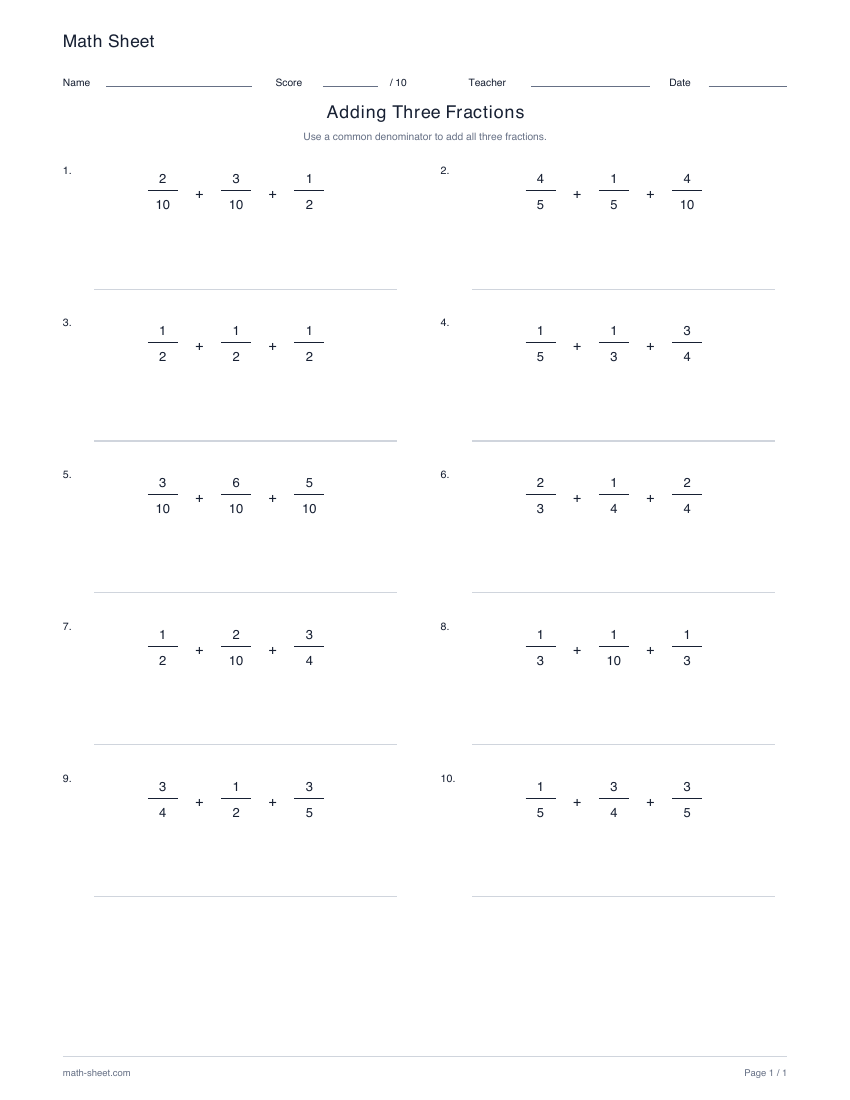
Fractions
Coordinate three equivalent-fraction conversions and combine all three addends using one common denominator.
Preview and download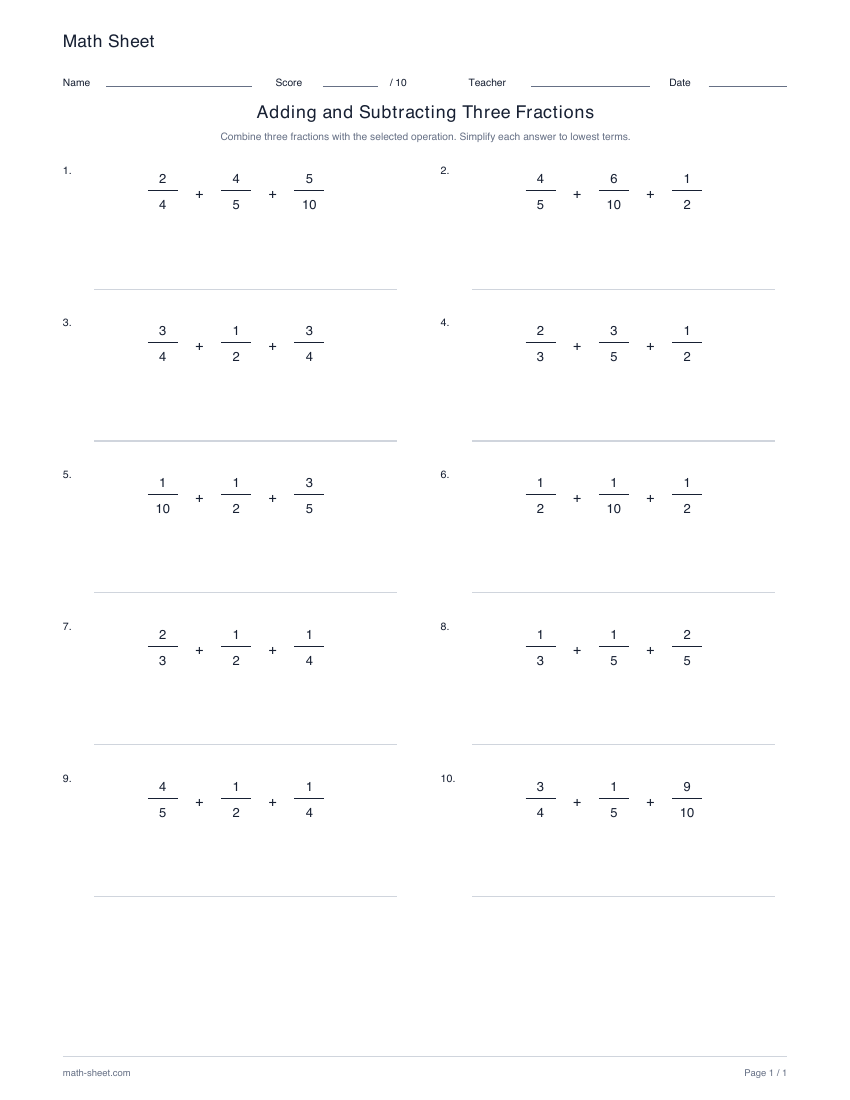
Fractions
Choose a three-term addition or subtraction lesson and keep the common-unit method consistent with the selected operation.
Preview and downloadStep 2
Connect improper fractions and mixed numbers, then explain regrouping as an exchange of one whole.
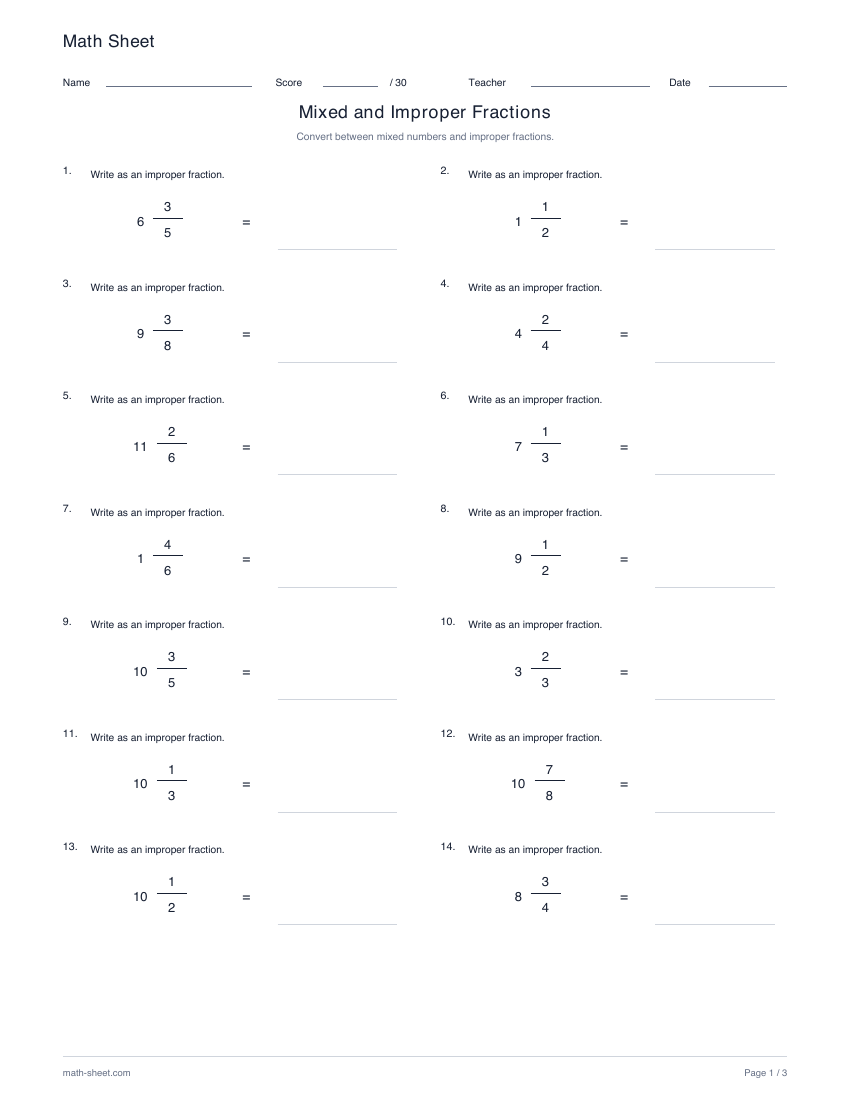
Fractions
Rename quantities greater than one as a mixed number or a single improper fraction without changing their value.
Preview and download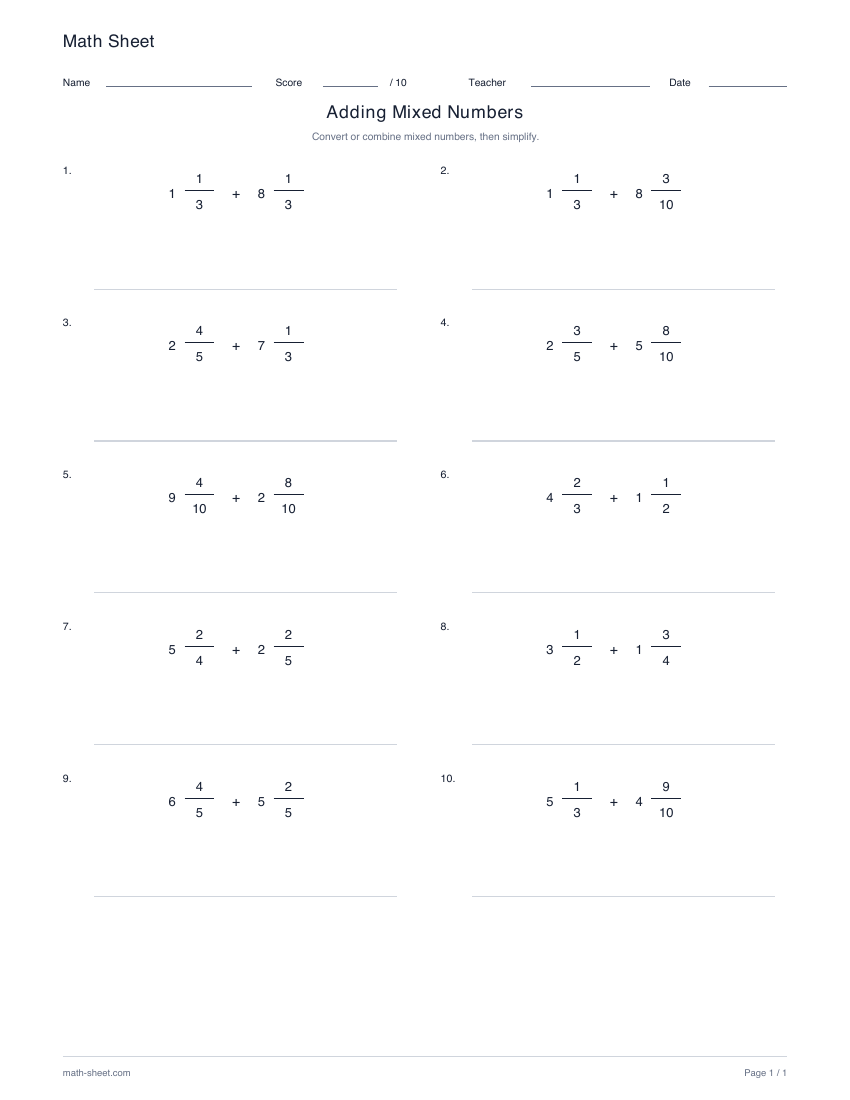
Fractions
Combine whole-number and fractional parts, renaming fractional totals that make an additional whole.
Preview and download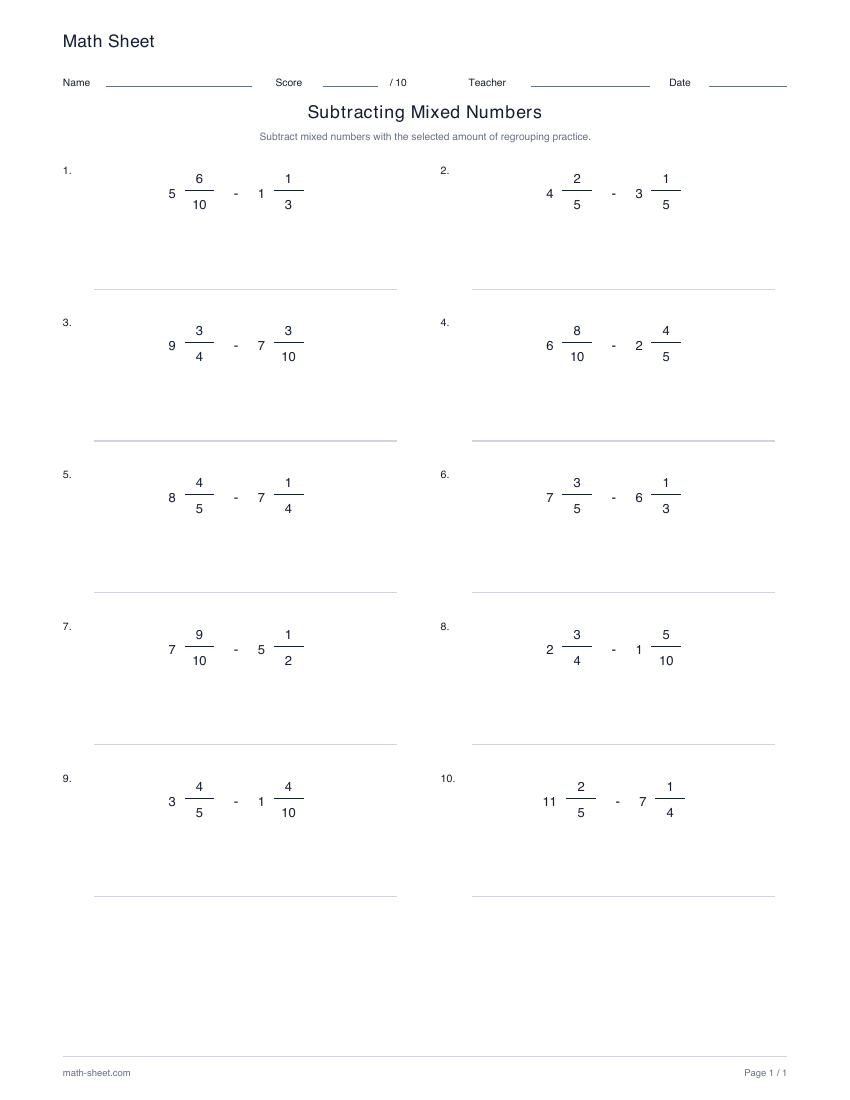
Fractions
Subtract whole and fractional parts, with focused practice that can include exchanging a whole when needed.
Preview and download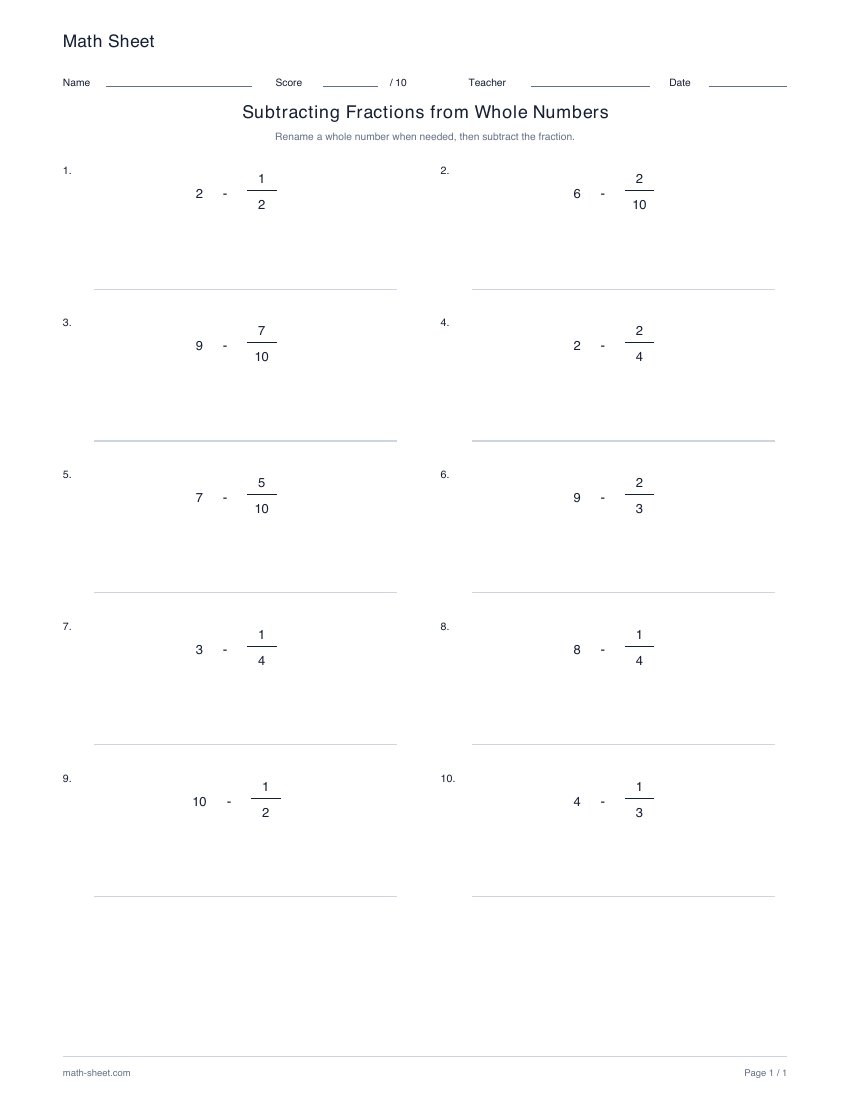
Fractions
Rename part of a whole number as fractional units to subtract a fraction accurately.
Preview and downloadStep 3
Read a fraction of a whole quantity as equal sharing followed by selection. Once decimal place value is secure, estimate decimal products before calculating them.
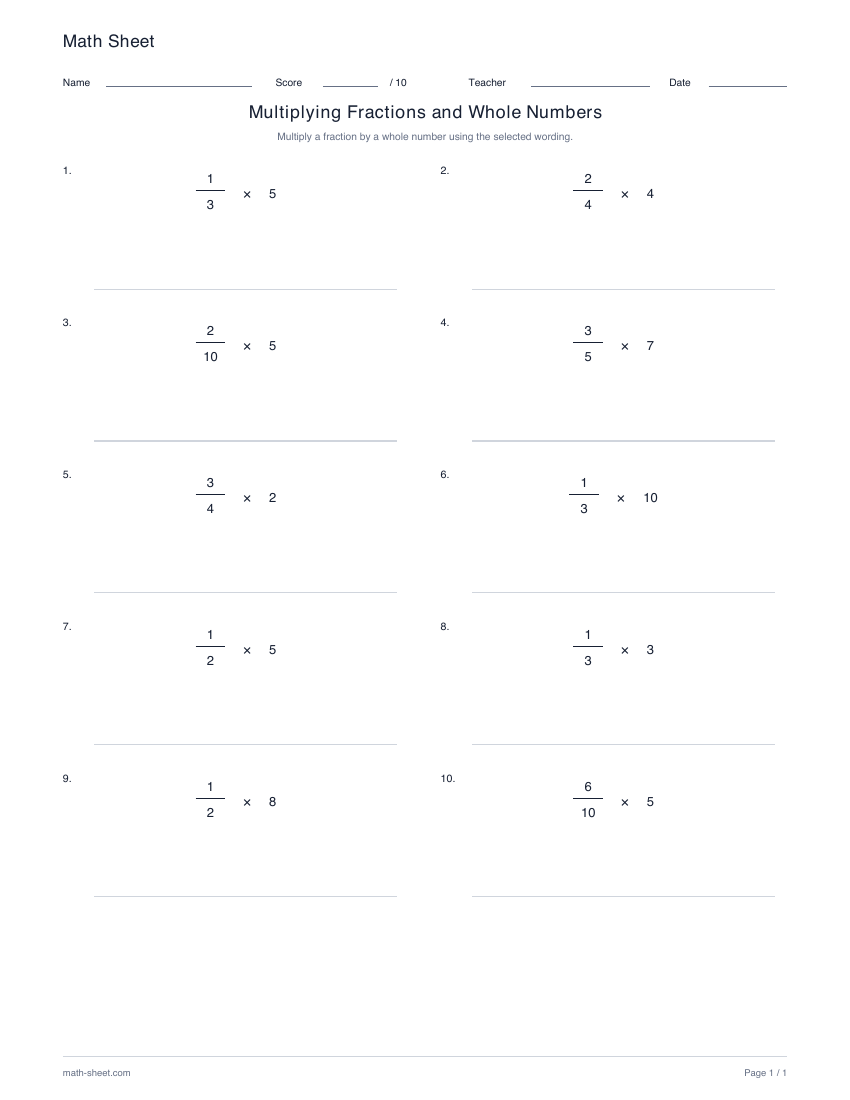
Fractions
Connect a fraction times a whole number with finding that fraction of an amount.
Preview and download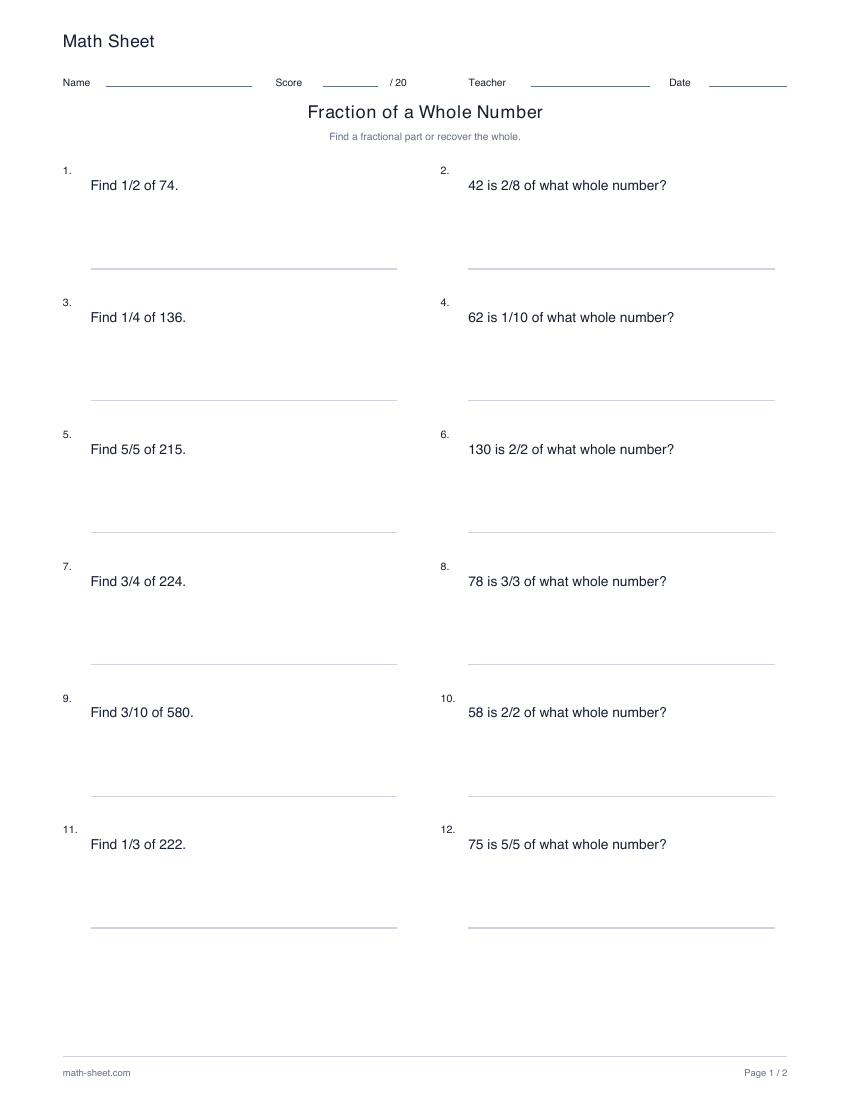
Fractions
Find a fraction of a known amount or recover an unknown whole from a given fractional part.
Preview and download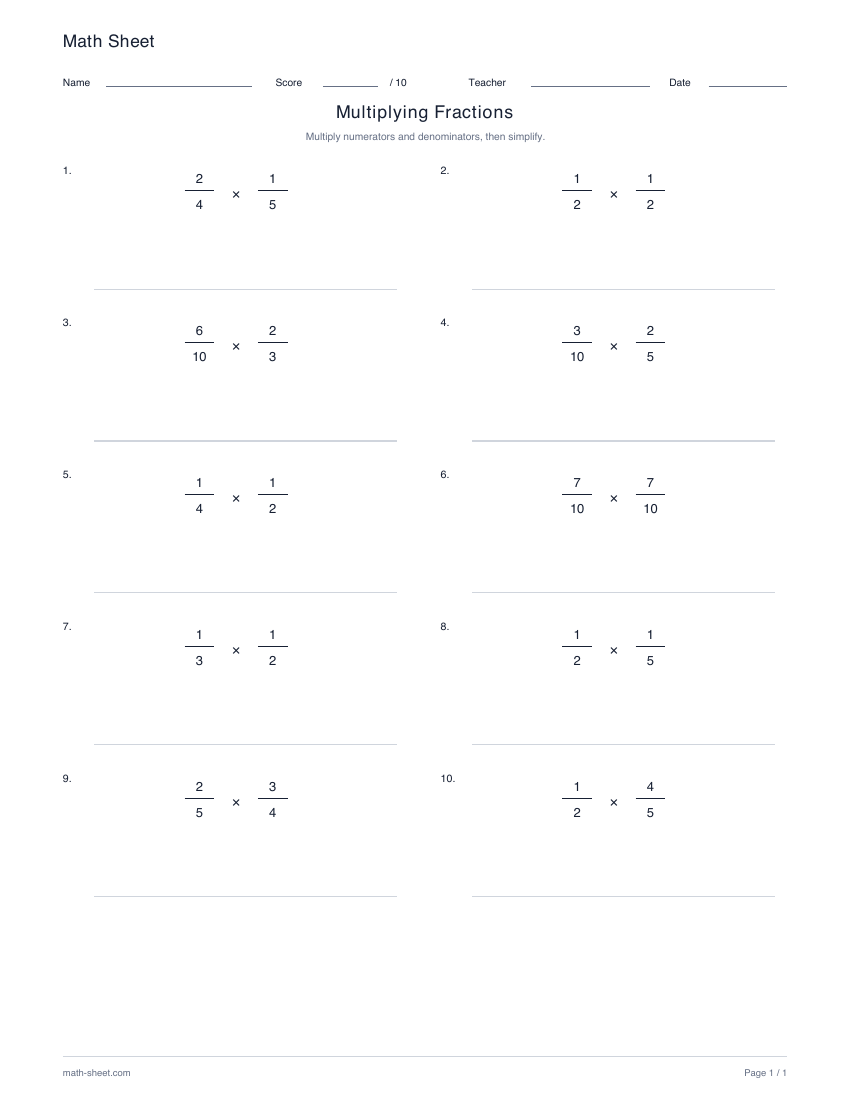
Fractions
Create a multiplying fractions worksheet with 10 or 15 proper-fraction problems, three denominator ranges, exact reduced products, and a separate answer key.
Preview and download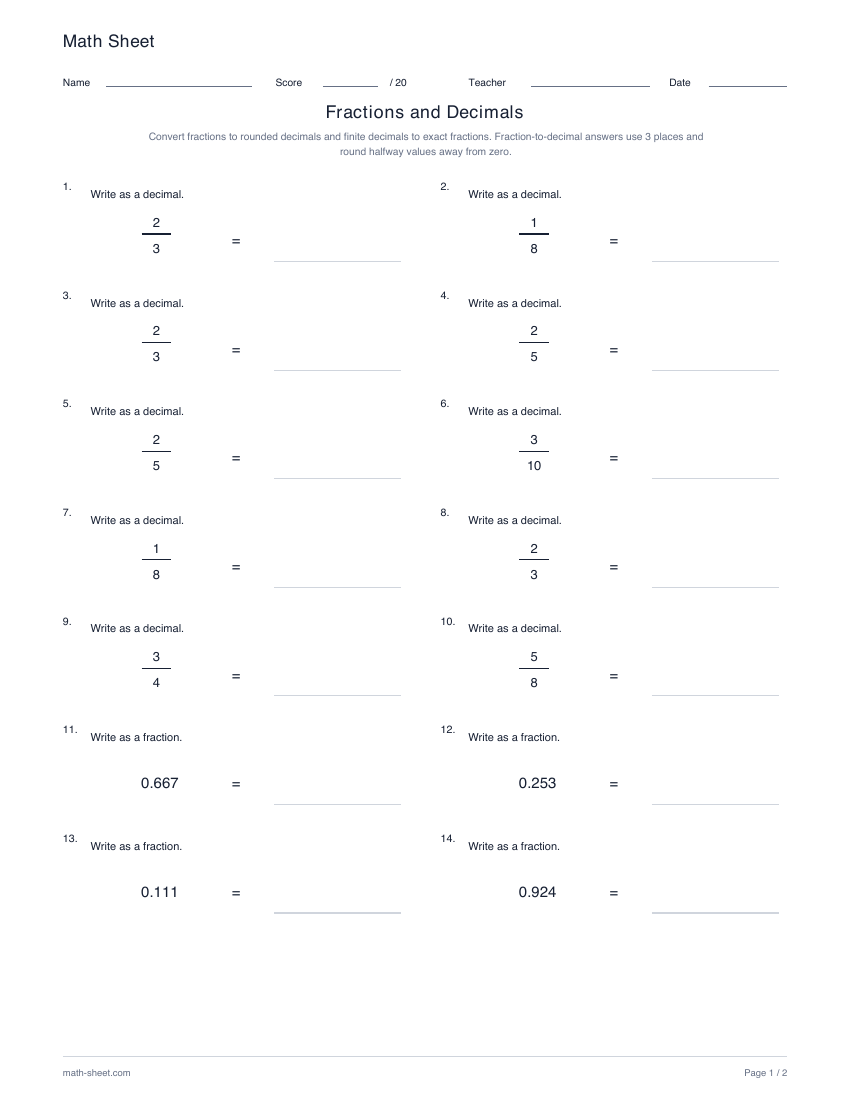
Fractions
Convert fractions to decimals with explicit rounding and convert finite written decimals back to exact fractions.
Preview and download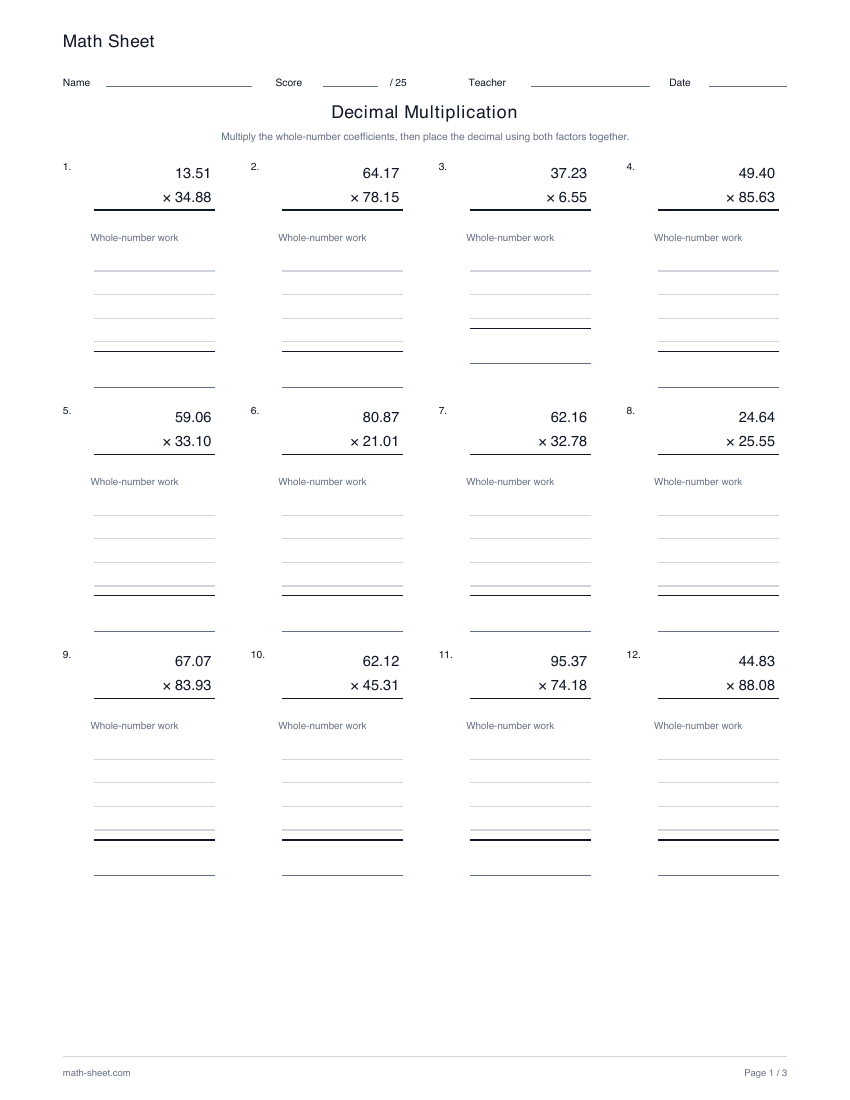
Multiplication
Create multiplying decimals worksheets with tenths or hundredths, adjustable whole-number width, 12–25 vertical problems, exact products, and answer keys.
Preview and downloadExtend the meaning of division to fractional group sizes, using multiplication to check the quotient.
Begin with a short set, review the learner's explanation, and adjust the settings for the next lesson. Advanced options on an activity page may extend beyond this stage.
Choose after the relevant decimal places are familiar. Signed subtraction is an optional later step; these settings describe readiness, not a required curriculum.
Track the value of every digit before introducing a third multiplier.
Open this decimal practice →Read the direction first, then compare four values with a shared integer part.
Open this decimal practice →Start after equivalent fractions and decimals are familiar. These settings are readiness suggestions; local curricula may introduce percentages at a different stage.
Use after equivalent fractions and hundredths are secure. Complete one missing representation in each of twelve rows.
Open this percent practice →Find one tenth and one whole of a quantity, then explain why the two multipliers differ.
Open this percent practice →Begin after array counting, common factors and equivalent fractions are familiar. Grade 5 options are teacher-led introductions; use rates and applications when the learner can explain the required division and unit conversions.
A teacher-led introduction after array counting and common factors are secure. Begin with the part-to-part comparison only.
Open this ratio practice →Connect equivalent-fraction reasoning with consecutive, ordered colon ratios. Explain how both terms change together.
Open this ratio practice →Choose by the learner's arithmetic readiness. Begin with familiar facts and one grouping level; signed inputs and powers are later options, not a claim of curriculum alignment.
Use the four-level reference to explain why multiplication/division and addition/subtraction each work from left to right.
Open this order-of-operations resource →Work with a single grouping level and familiar arithmetic. Keep every unused term when rewriting the expression.
Open this order-of-operations resource →Read, rewrite and evaluate
Begin with familiar operations and short verbal phrases. Add signed coefficients, grouping and two-variable inputs when the prerequisites are secure. These entry points are readiness suggestions, not country or curriculum requirements.
Use the phrase guide to discuss operation order and the meaning of grouped quantities.
Open this resource →Begin with short one-variable phrases after the four operations are familiar.
Open this resource →Use whole-number inputs in short expressions; signed coefficients still require careful arithmetic.
Open this resource →Describe a set of solutions
Choose by readiness: reading number lines comes before signed transformations and distribution. These starting points are general guidance, not alignment with a national curriculum.
Read the complete handout together, moving from open and filled endpoints to equivalent transformations.
Open this starting point →Draw twenty rays on a nonnegative number line, with positive variables and all four comparison symbols.
Open this starting point →Keep both sides equal
Choose by readiness: signed arithmetic, inverse operations, fractions and distribution are separate prerequisites. These grade entry points do not claim alignment to a national curriculum.
Use a short equation to explain how one operation can be undone on both sides. Signed-number knowledge is needed.
Open this starting point →Compare missing quantities, groups, shared totals and costs before writing a one-step equation.
Try the expanded story set →Count outcomes. Explain the chance.
Choose by readiness with fractions, factors and compound events. These starting points are suggestions based on prerequisites, not claims of country or curriculum alignment.
Compare repeated labels by counting sectors in two printed diagrams.
Open this resource →Work from the integers 1 through 10 and justify which satisfy each event.
Open this resource →Compare sums and absolute differences using two distinguishable dice.
Open this resource →Use the introductory sections first; explore conditional probability and trees when ready.
Open this resource →Explain why a method works
Choose by readiness for the operations and notation shown. Equality rules with variables are enrichment options; these suggestions do not claim alignment with a country or curriculum.
Use the definitions beside practice, including the two names for addition with zero.
Open this resource →Five questions connect multiplication across a sum with examples and symbolic expansion.
Open this resource →Move from noticing a change to identifying the mathematical property behind it.
Open this resource →Describe shape and direction
These are readiness suggestions for practice, not claims of country or standards alignment.
Begin after learners recognize a right angle and can compare degree measures with 90 and 180.
Customize this geometry task →Use clear rotated examples to decide whether the extended supporting lines will ever meet.
Customize this geometry task →Move from the parts of one angle to equivalent names and complete lists in multi-ray figures.
Customize this geometry task →Compare perpendicular examples with parallel and oblique pairs, including rotated configurations.
Customize this geometry task →Distinguish parallel, perpendicular and ordinary oblique intersections in one balanced set.
Customize this geometry task →Use endpoint names and right-angle marks to classify ten pairs drawn in a shared six-line figure.
Customize this geometry task →Align a protractor with the requested left or right starting ray and measure eight angles to the nearest degree.
Customize this geometry task →Use a stated degree and starting ray to draw and label eight new rays above the baseline.
Customize this geometry task →Subtract one stated region measure from 90, with whole-number, tenths or hundredths precision.
Customize this geometry task →Use a fixed two-page reference to connect side classes, angle classes and the 180-degree interior sum.
Customize this geometry task →Use equal-side ticks and exact right-angle marks to sort twelve rotated triangles into seven named classes.
Customize this geometry task →Read exact shape markings, then calculate area and perimeter with linear and squared units.
Customize this geometry task →Classify real triangles, use visible side lengths, and work with supplied or derived perpendicular heights.
Customize this geometry task →Decompose nine shaded figures into rectangles, triangles, circles and semicircles, then round only the final signed total.
Customize this geometry task →Plane geometry reference
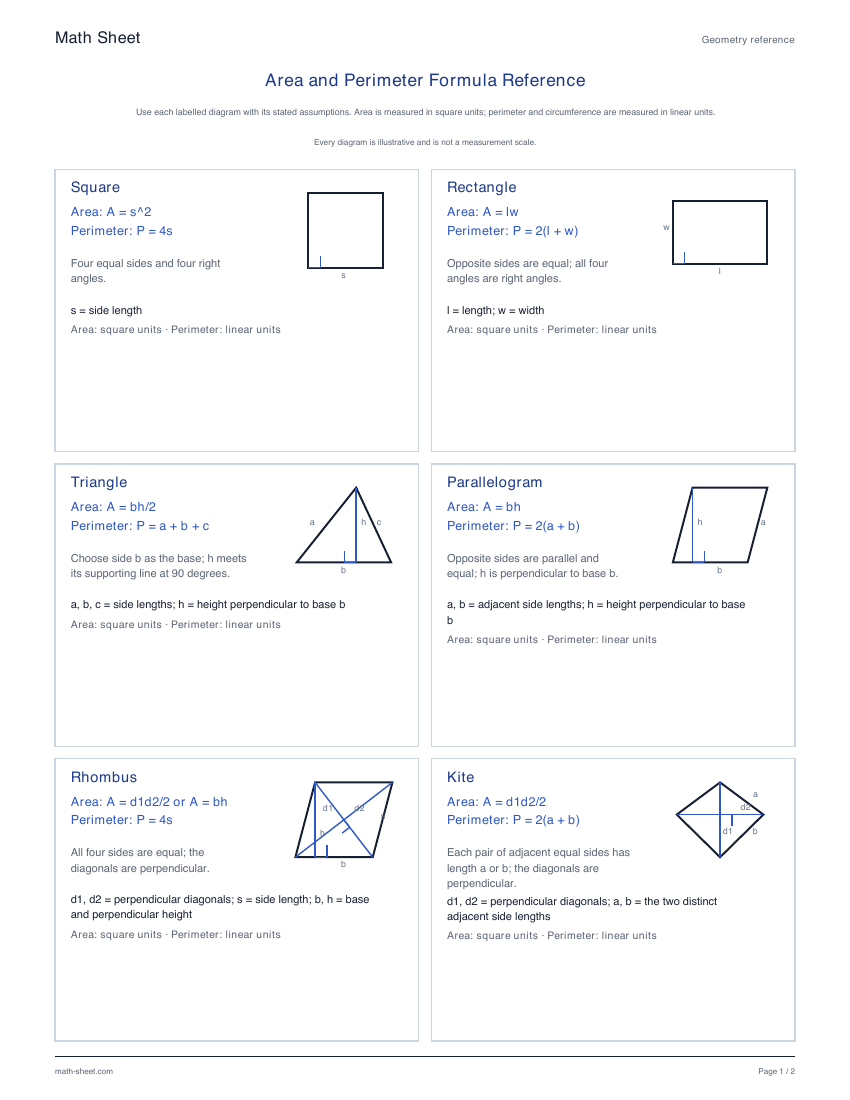
Keep labelled diagrams, formula conditions, symbol meanings and unit reminders together while solving plane-figure problems.
Geometry
Print nine labelled area and perimeter formula cards for common plane figures, with exact assumptions, symbol definitions and unit reminders.
Preview and downloadLocate, plot and connect
Connect horizontal and vertical positions with point labels before introducing negative coordinates.
Customize this graphing task →Work through separate paths after positive coordinates and half-unit positions are familiar.
Customize this graphing task →Draw, plot and explain
Four first-quadrant planes give space for separate plotting tasks after horizontal and vertical coordinates are understood.
Customize this paper →Describe a dataset
Use after addition, division and numerical ordering are secure. Work with odd and even dataset lengths and explain each calculation.
Customize this practice →Choose familiar arithmetic so the learner can focus on the story. These starting points describe readiness; expectations differ between schools and curricula.
Use a common unit and equivalent fractions to combine two measured amounts.
Open this story practice →Use after one-step inverse operations are secure. Draw or write how the known total was formed.
Open this story practice →