
Geometry
Identifying parallel lines worksheets
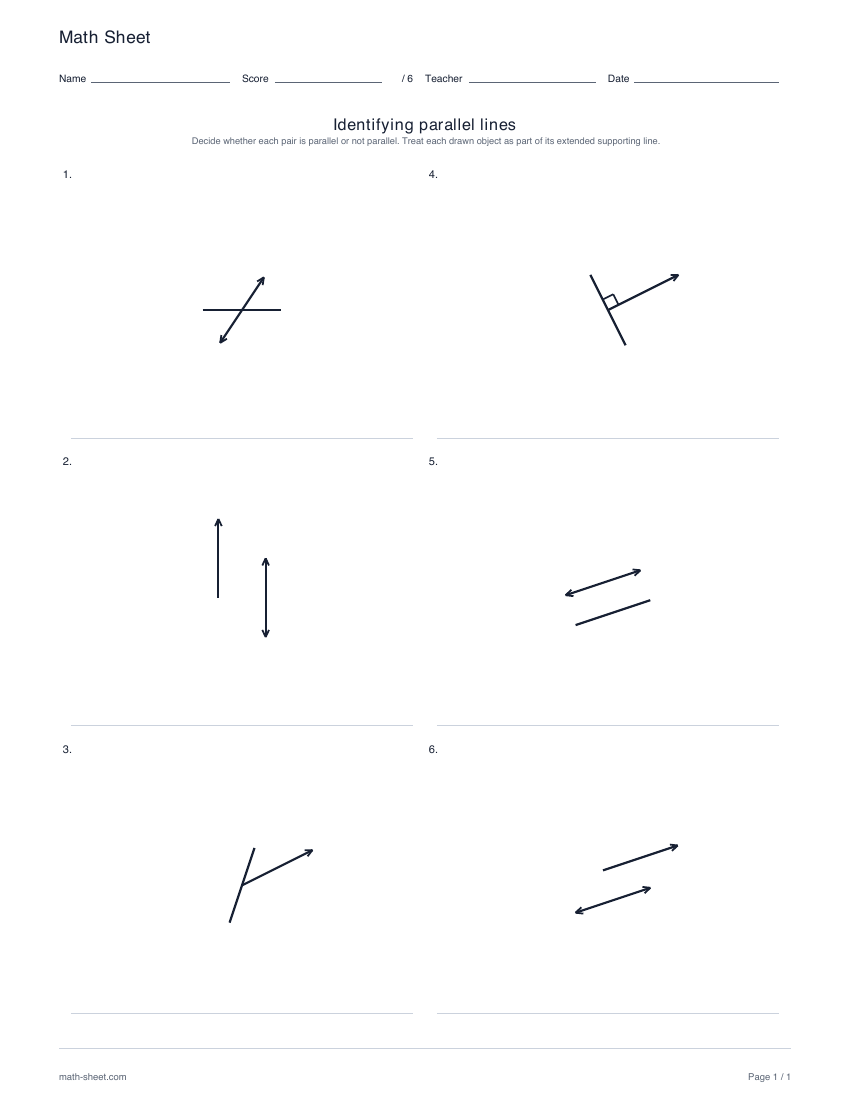
Decide whether six pairs of extended supporting lines are parallel. The balanced set includes parallel, perpendicular and oblique examples in varied orientations.
Preview and downloadGeometry practice
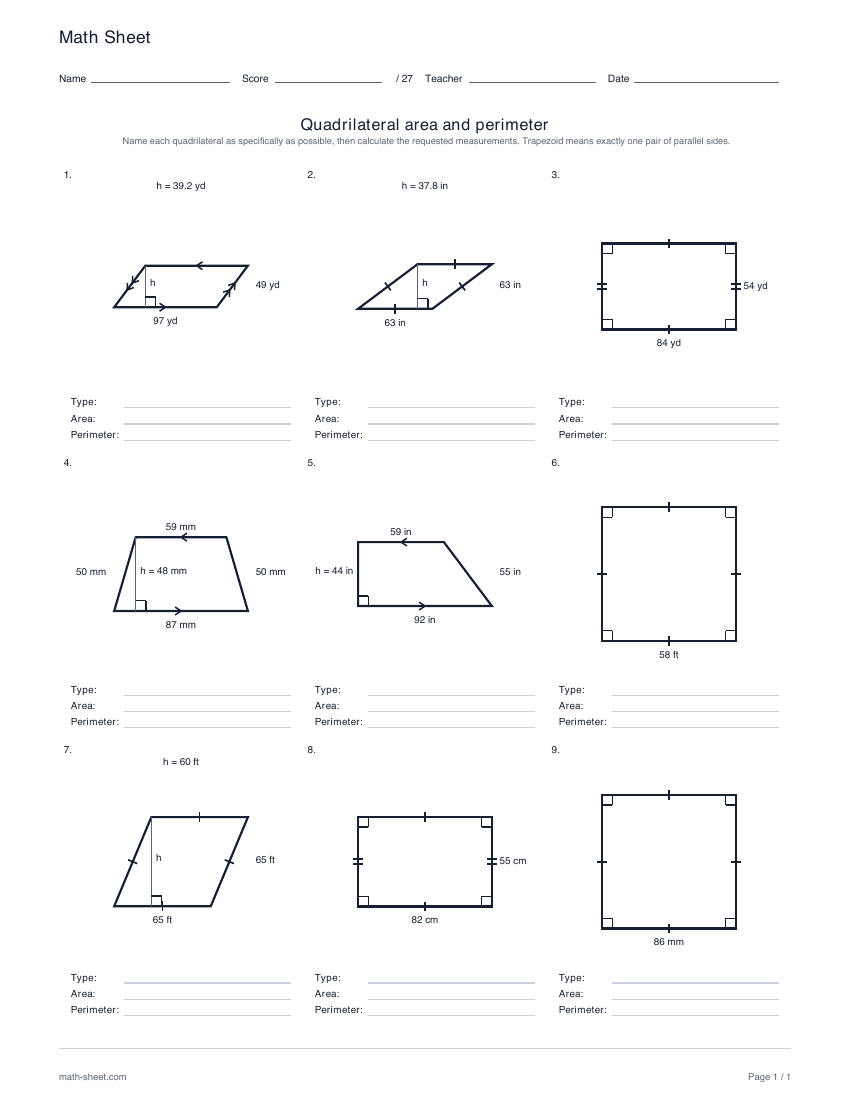
Name nine marked squares, rectangles, parallelograms, rhombi and trapezoids, then calculate area, perimeter or both with exact whole-number or decimal dimensions in five selectable units.
Ready-made English PDF · fixed settings
Customization below makes a separate PDF.
Fixed English ready-made files. Custom settings below apply only to the configured PDF.
Ready to print
Name each quadrilateral as specifically as possible, then calculate the requested measurements. Trapezoid means exactly one pair of parallel sides.
Download the practice pages alone, or include a separate answer key or teacher model. Longer activities may use more than one page.
Customize this worksheetEvery sheet has nine marked quadrilaterals. Equal-side ticks, parallel arrows and right-angle squares establish the most specific shape name; the drawing alone is not the evidence.
The perpendicular height is labelled separately from a sloping side. Use linear units for perimeter and squared units for area. On this activity, trapezoid means a quadrilateral with exactly one pair of parallel sides.
Learning objective
Use defining geometric markings to name each quadrilateral precisely and select the dimensions needed for exact area and perimeter formulas.
Worked example
Area = 32 cm²; perimeter = 26 cm.
Multiply the base by the perpendicular height for area: 8 × 4 = 32. Add both pairs of equal opposite sides for perimeter: 8 + 5 + 8 + 5 = 26.
Teaching notes
Make it yours
Choose your options, update the preview, then download the exact same pages.
A useful next step
Geometry
Decide whether six pairs of extended supporting lines are parallel. The balanced set includes parallel, perpendicular and oblique examples in varied orientations.
Preview and download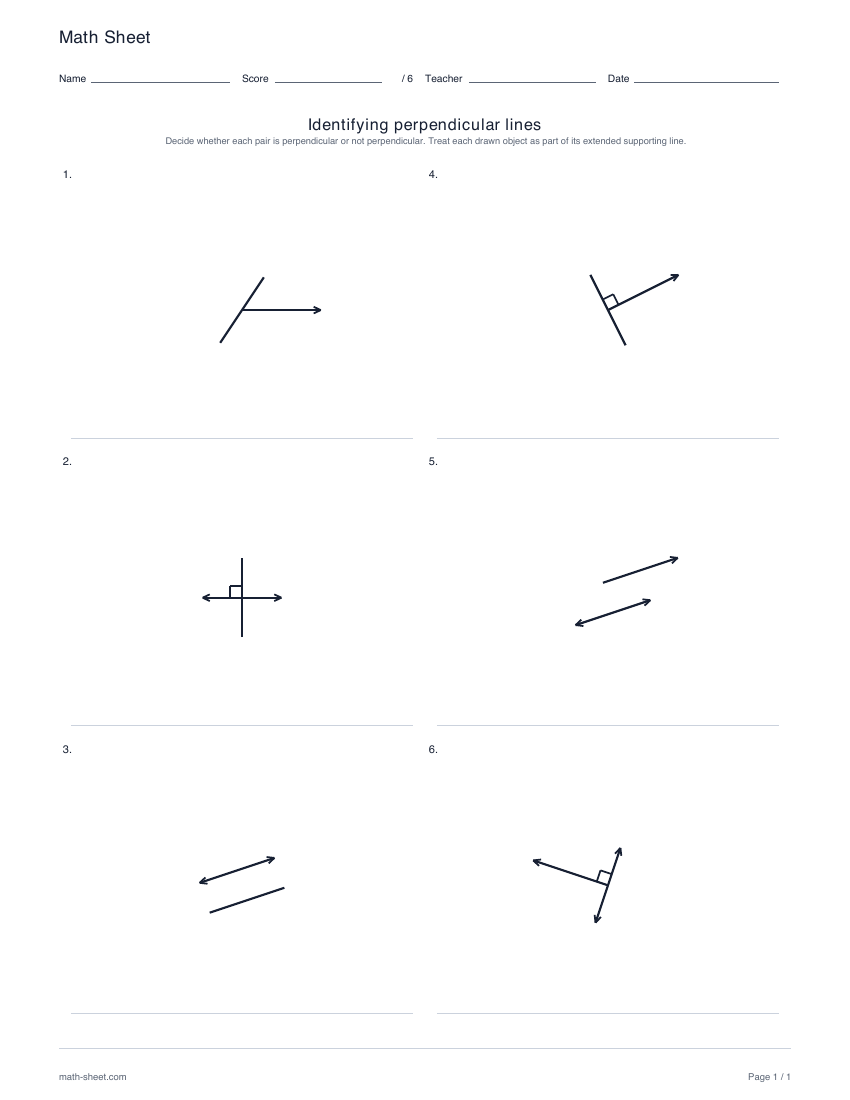
Geometry
Decide whether six pairs of extended supporting lines are perpendicular. True examples include a right-angle mark; counterexamples include parallel and oblique pairs.
Preview and download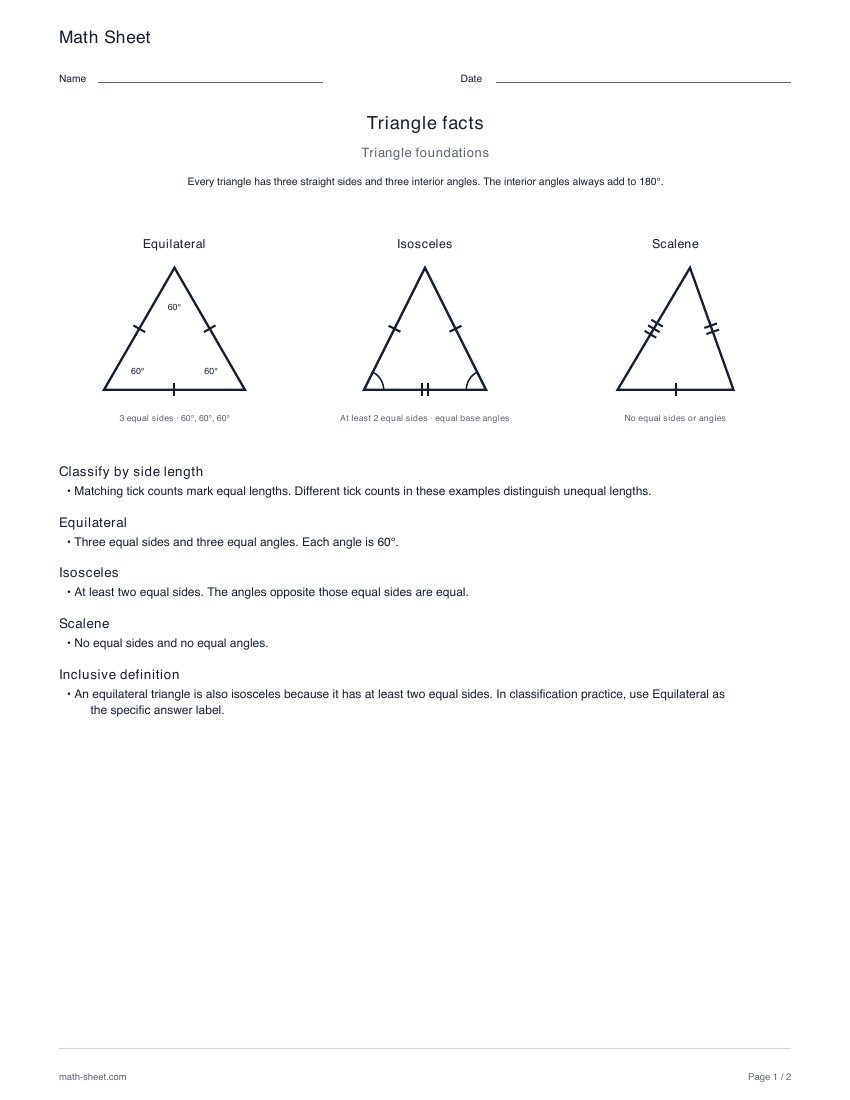
Geometry
Review triangle parts, the 180-degree interior-angle sum, side classifications and angle classifications in one fixed two-page handout with six exact diagrams for Letter or A4 paper.
Preview and download