A useful starting point
Begin when linear equations, function notation and basic quadratic factoring are secure. Learners should be ready to track excluded values and check solutions that arise after squaring or clearing denominators.
Discuss together
Solve log₂(x − 1) = 3.
x = 9The logarithm requires x − 1 > 0, so x > 1. Rewrite the equation in exponential form: x − 1 = 2³ = 8, then add 1 to get x = 9. The solution is in the domain, and log₂(9 − 1) = log₂(8) = 3.
Five-resource starter
Open an editable Grade 11 packet
Load five existing worksheets in the packet builder. Reorder them, add or remove resources, choose a student or teacher packet, then download the version you need.
- Basic polynomial operations
- Factoring quadratic polynomials
- Simplifying radical expressions
- Evaluating exponential functions
- Arithmetic sequences
Load the Grade 11 starter →Step 1
Polynomial structure and equations
Align like terms, preserve degree information and connect factors to zeros. Check division or remainder work by reconstructing the dividend.
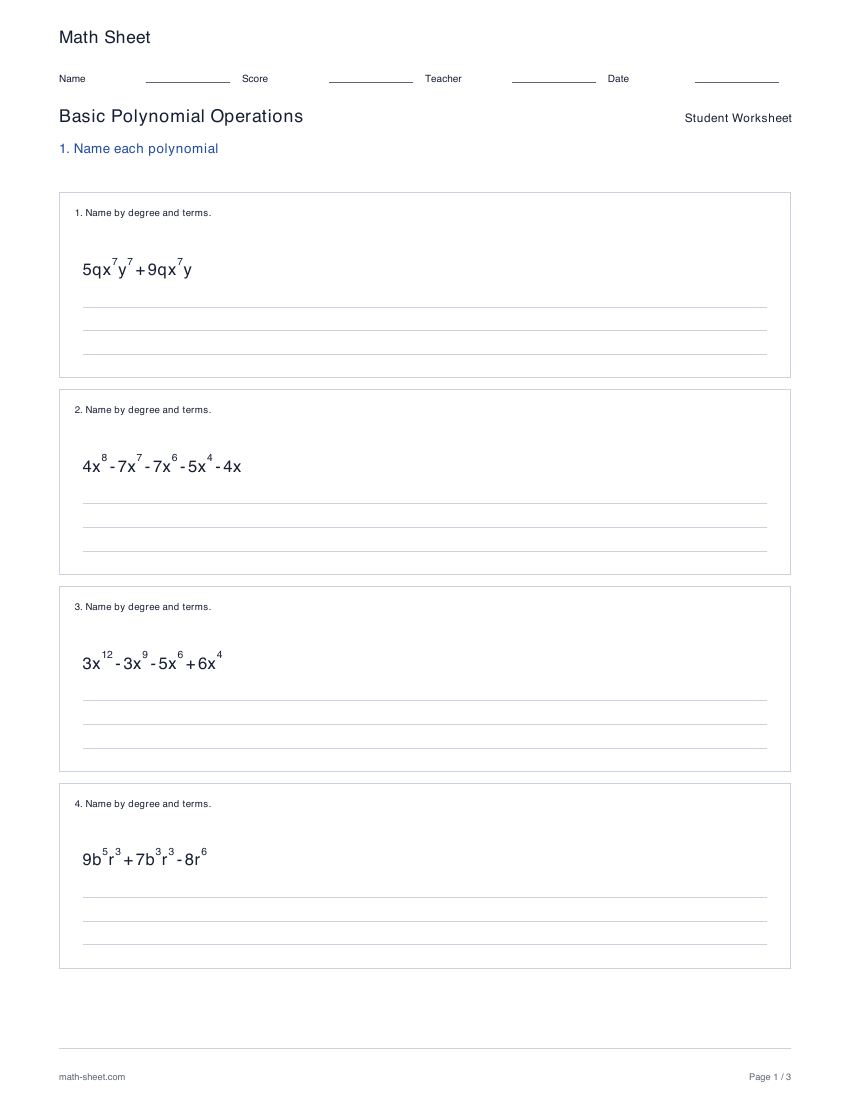
Polynomials
Practice twelve balanced polynomial problems: name four expressions by degree and term count, simplify four grouped sums or differences, and expand four products of quadratic binomials or trinomials.
Preview and download →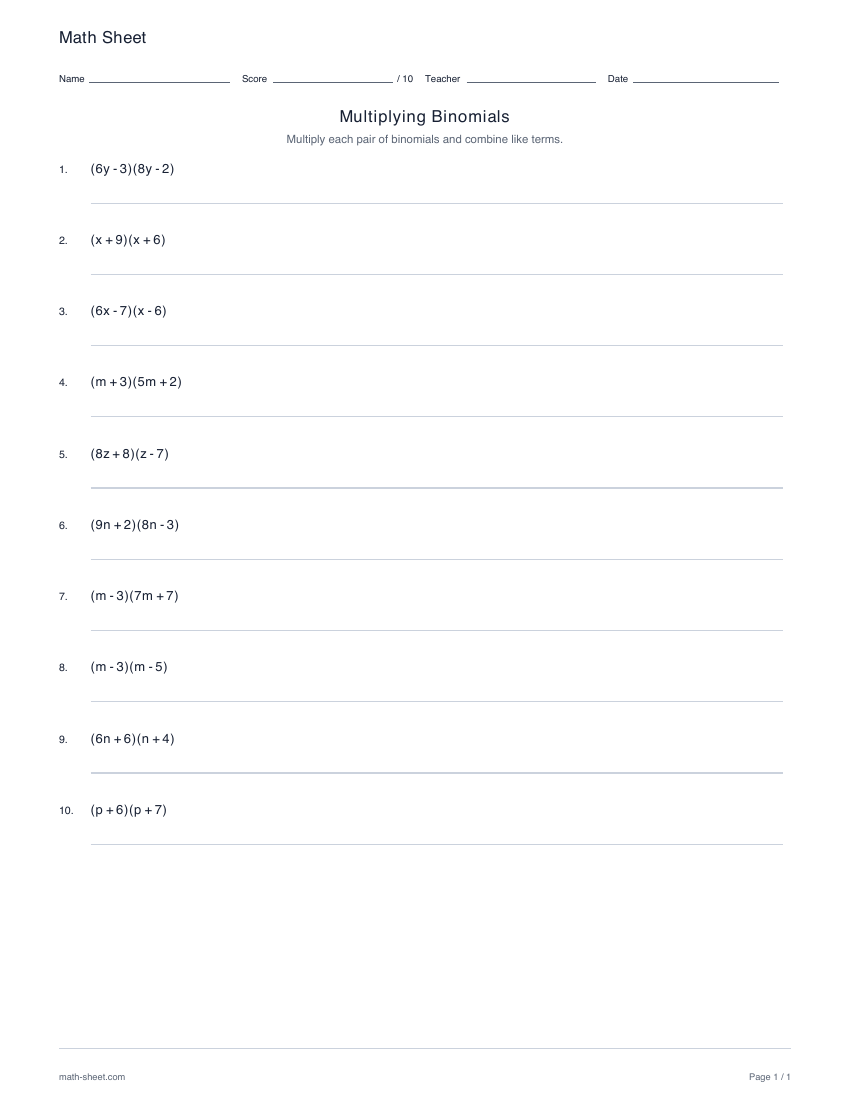
Polynomials
Expand ten products of two binomials. Choose among four expression structures, form every term pair and collect like terms with a separate worked key.
Preview and download →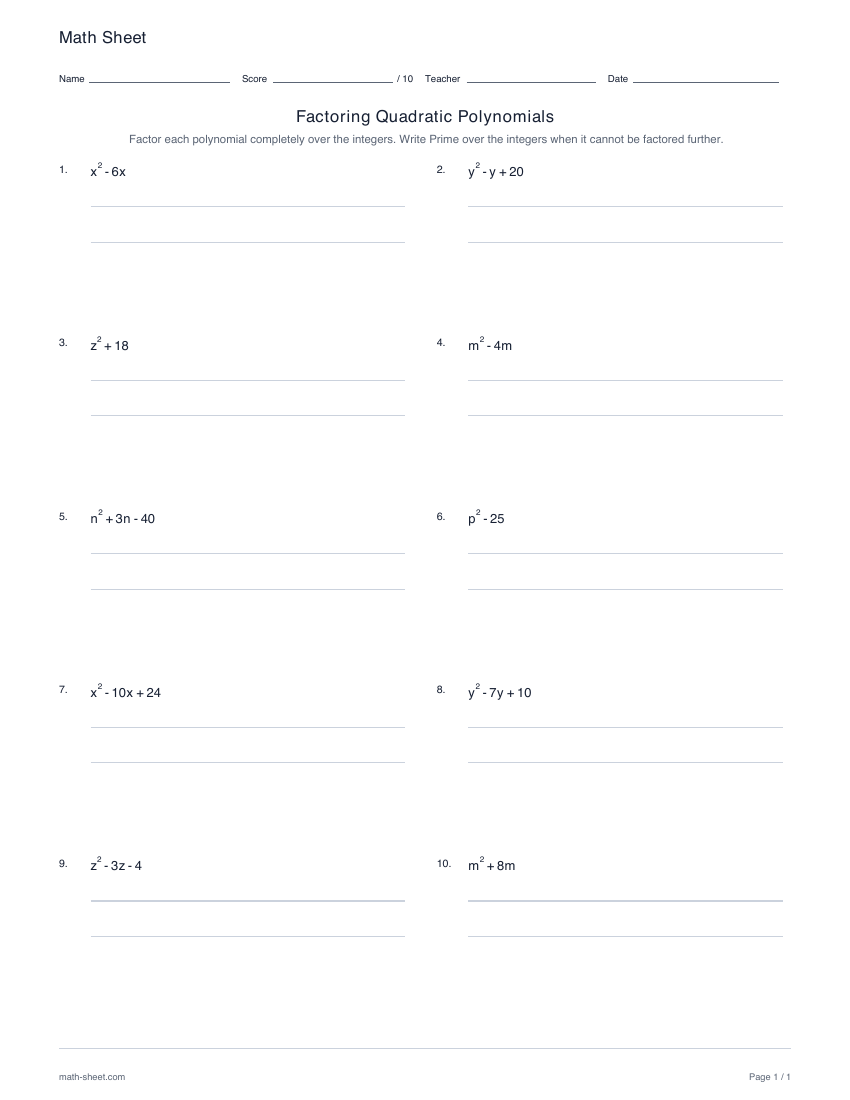
Polynomials
Factor ten quadratic binomials and trinomials completely over the integers. Choose factorable-only practice or include two prime quadratics, and vary monic and nonmonic leading coefficients.
Preview and download →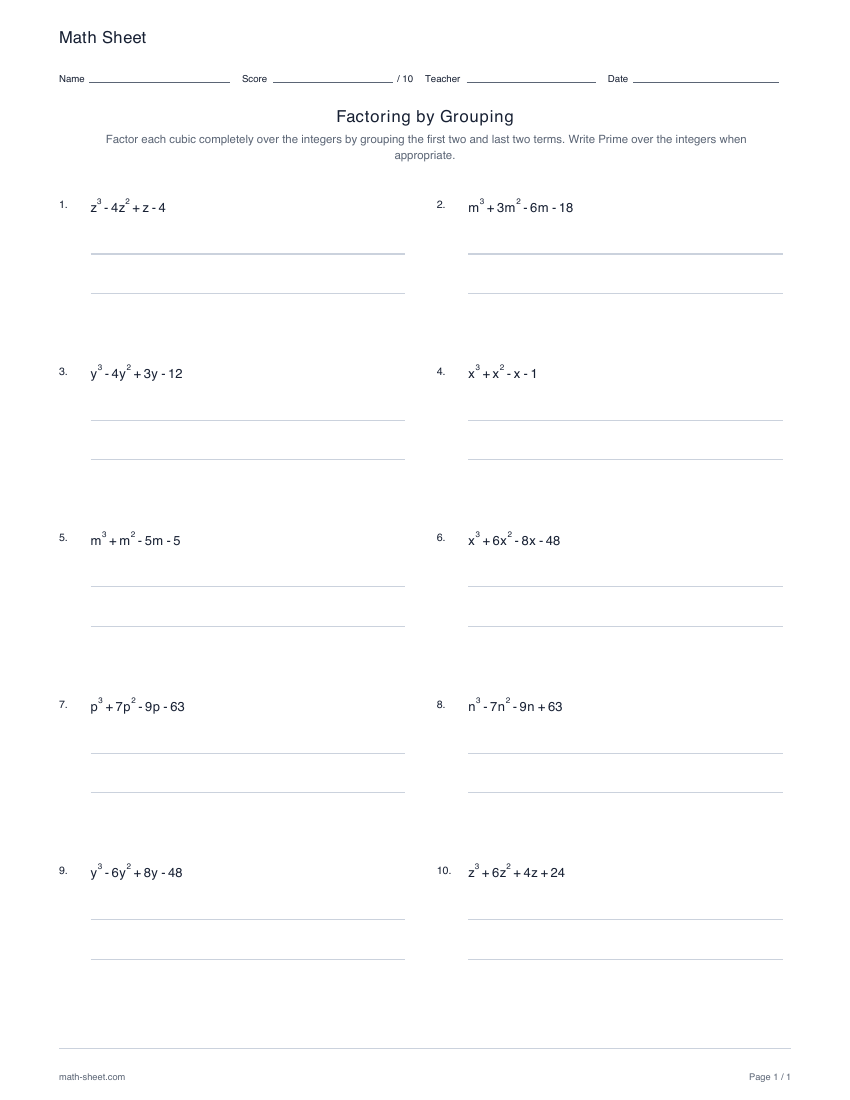
Polynomials
Factor ten four-term cubics completely over the integers. Choose displayed monic, nonmonic or mixed leading coefficients and factorable-only practice or a set with three primitive prime cubics.
Preview and download →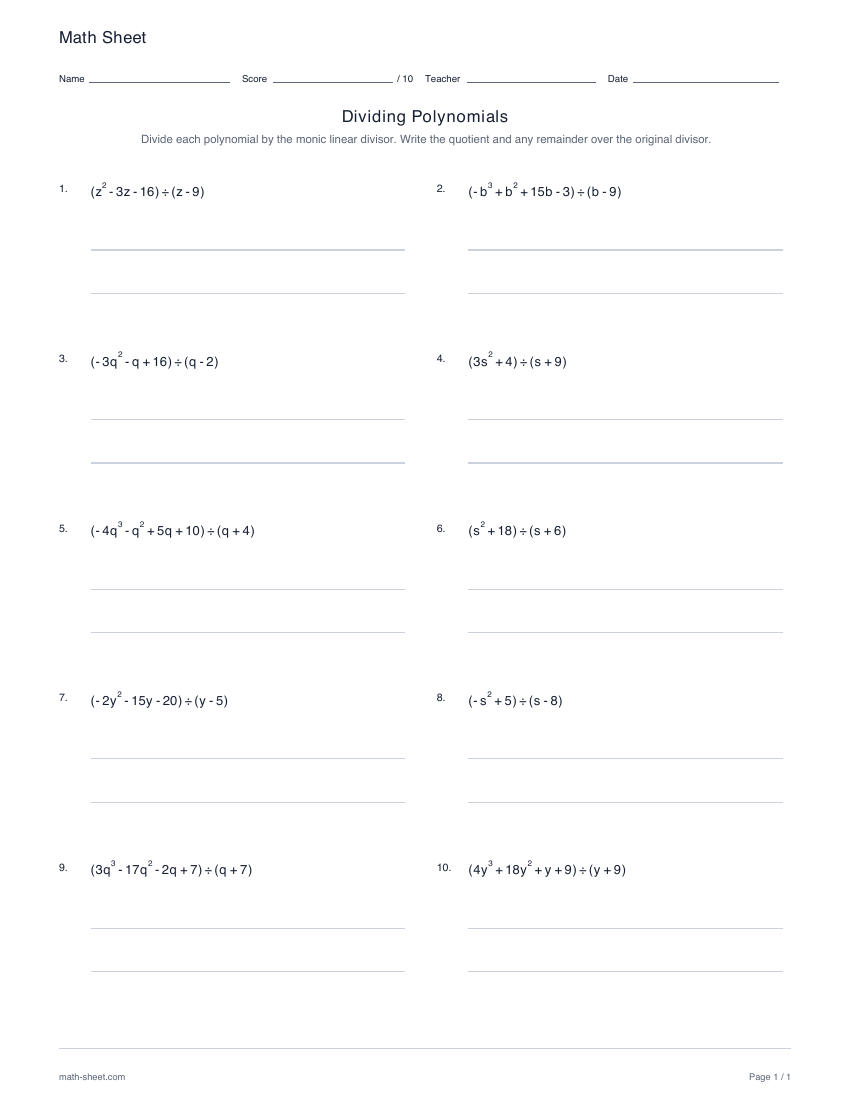
Polynomials
Divide polynomials by monic linear divisors in ten expression problems or six long-division problems. Choose binomial, trinomial, four-term or mixed dividends and check exact quotient-and-remainder keys.
Preview and download →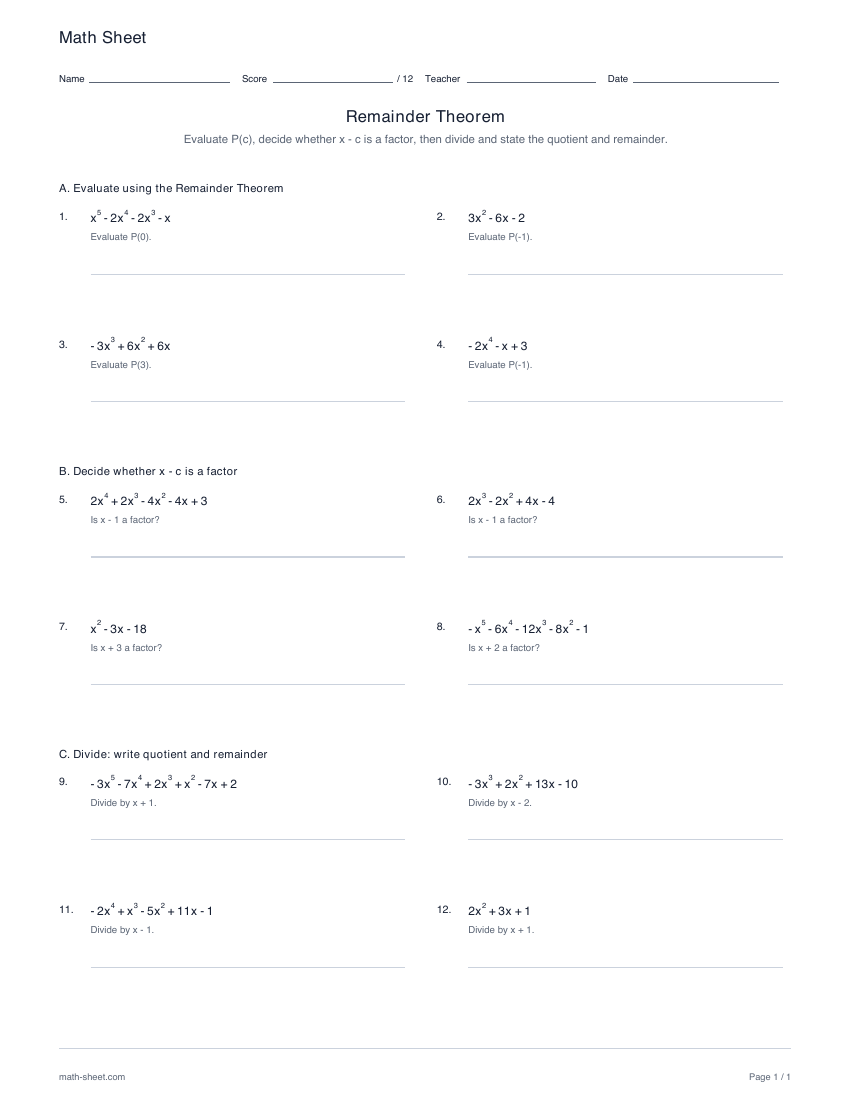
Polynomials
Use the Remainder Theorem in twelve structured problems: evaluate four polynomials at a point, make four factor decisions from zero remainders, and divide four polynomials by signed monic linear divisors with exact quotient-and-remainder answers.
Preview and download →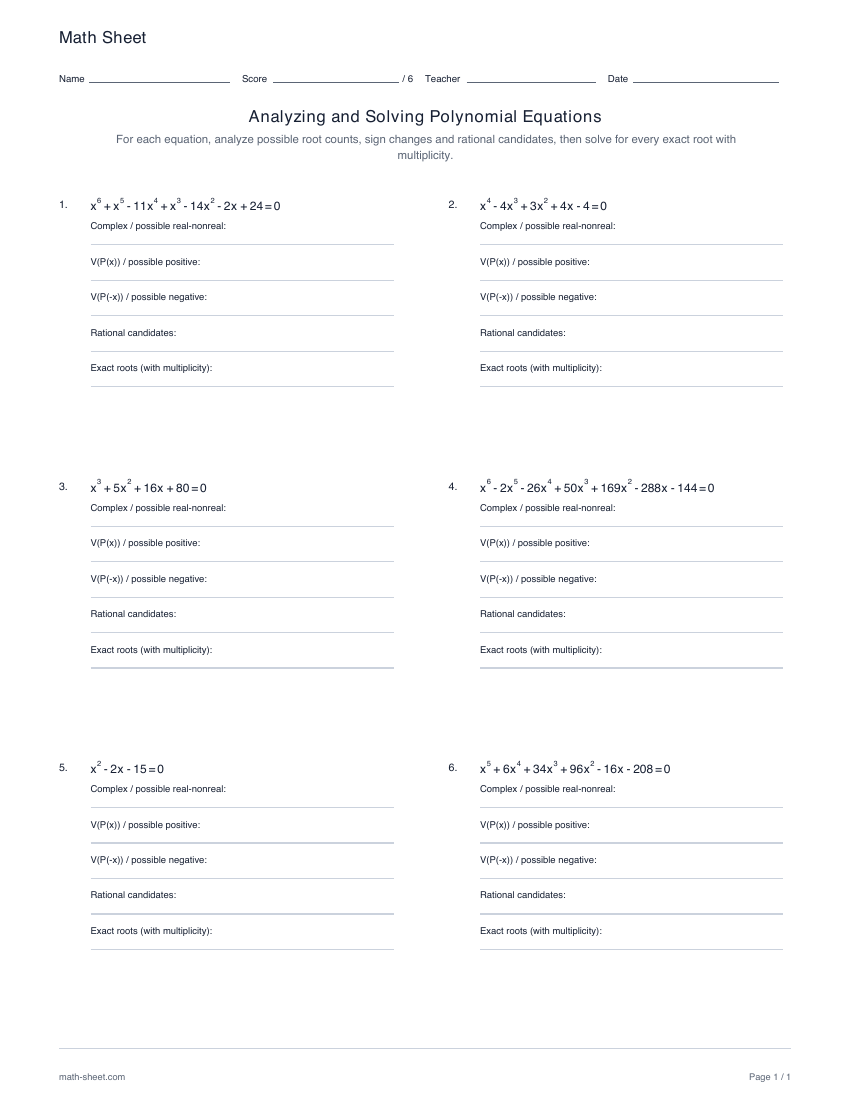
Polynomials
Analyze and solve six expanded monic polynomial equations of selected degrees two through six. Each exact key separates degree and Descartes possibilities from rational candidates and the complete roots with multiplicity.
Preview and download →Step 2
Radicals and rational expressions
State domain restrictions before simplifying. After raising powers or clearing denominators, check candidate solutions in the original equation.
Exponents and radicals
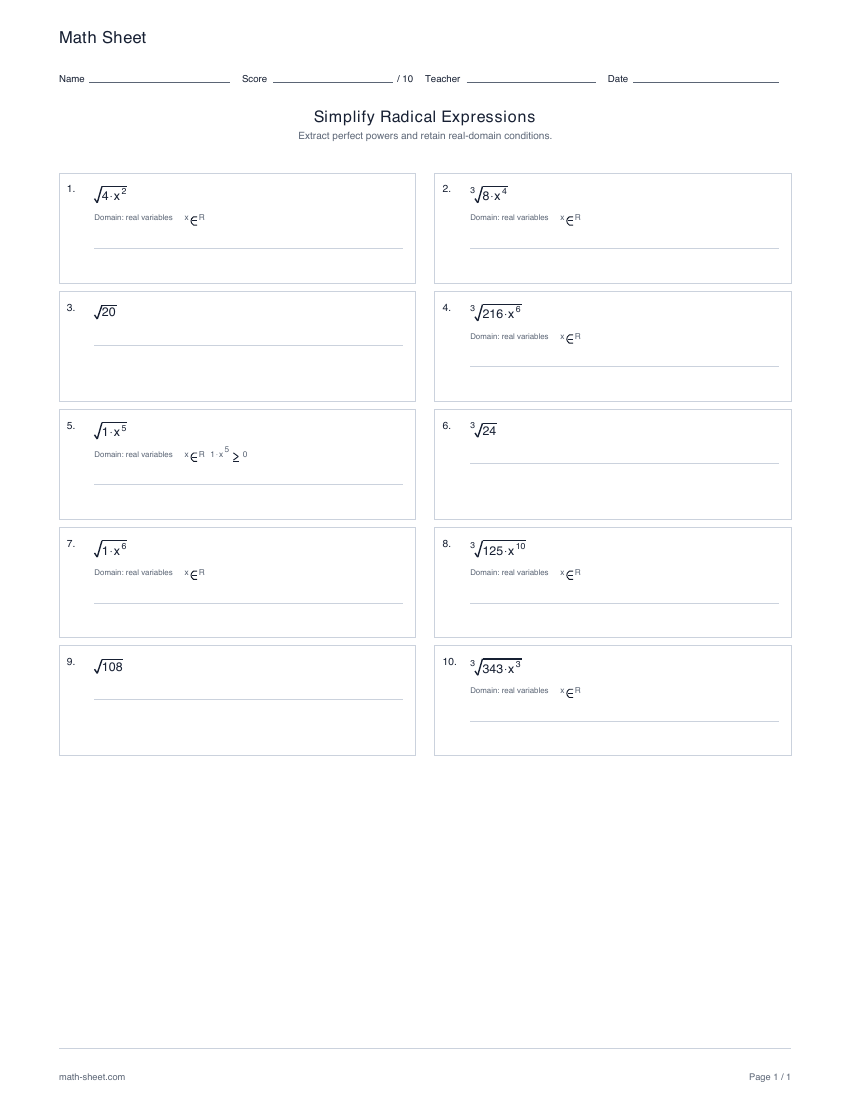
Practice 10 numeric-only, variable-only or mixed radicals with square, cube, fourth, fifth or sixth roots. Extract perfect powers and use absolute values where even roots require them.
Preview and download →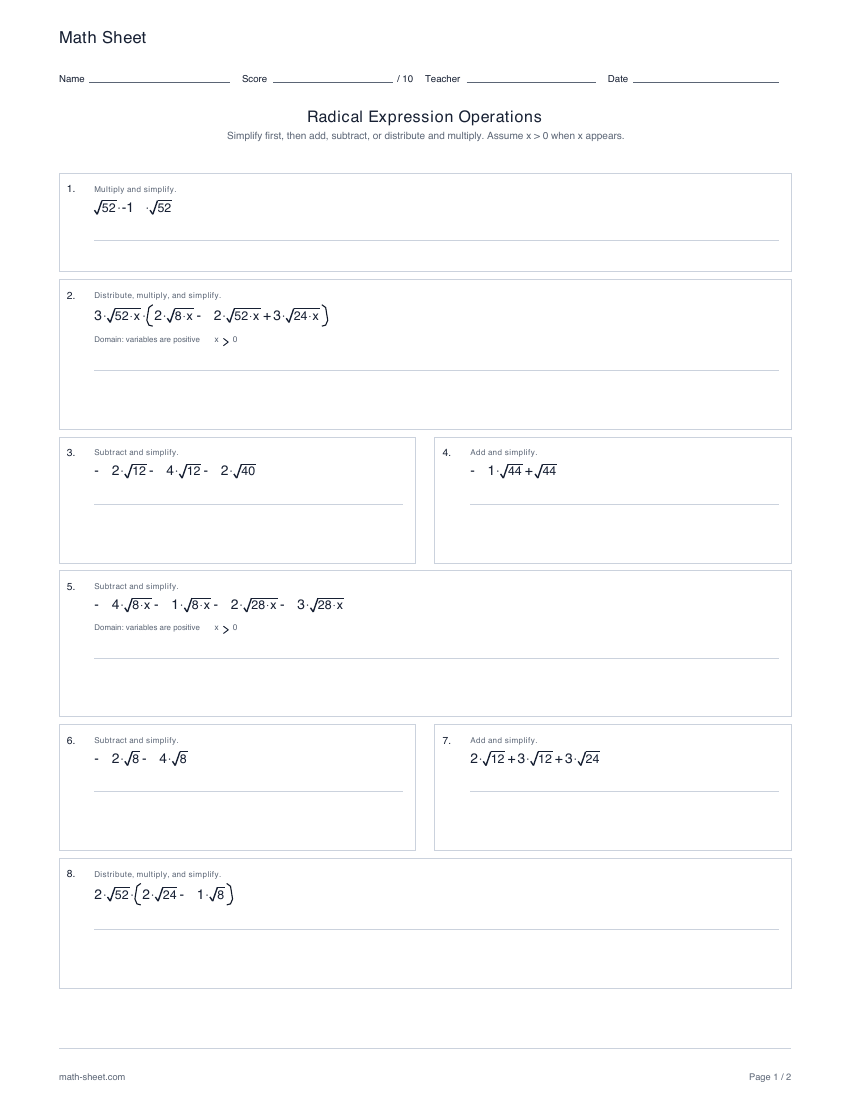
Exponents and radicals
Generate 10 mixed addition, subtraction and multiplication problems with independently selectable Easy, Medium and Hard profiles. Numeric practice progresses from two to three visible radical terms; Hard problems use x with x > 0 and include genuine trinomial products.
Preview and download →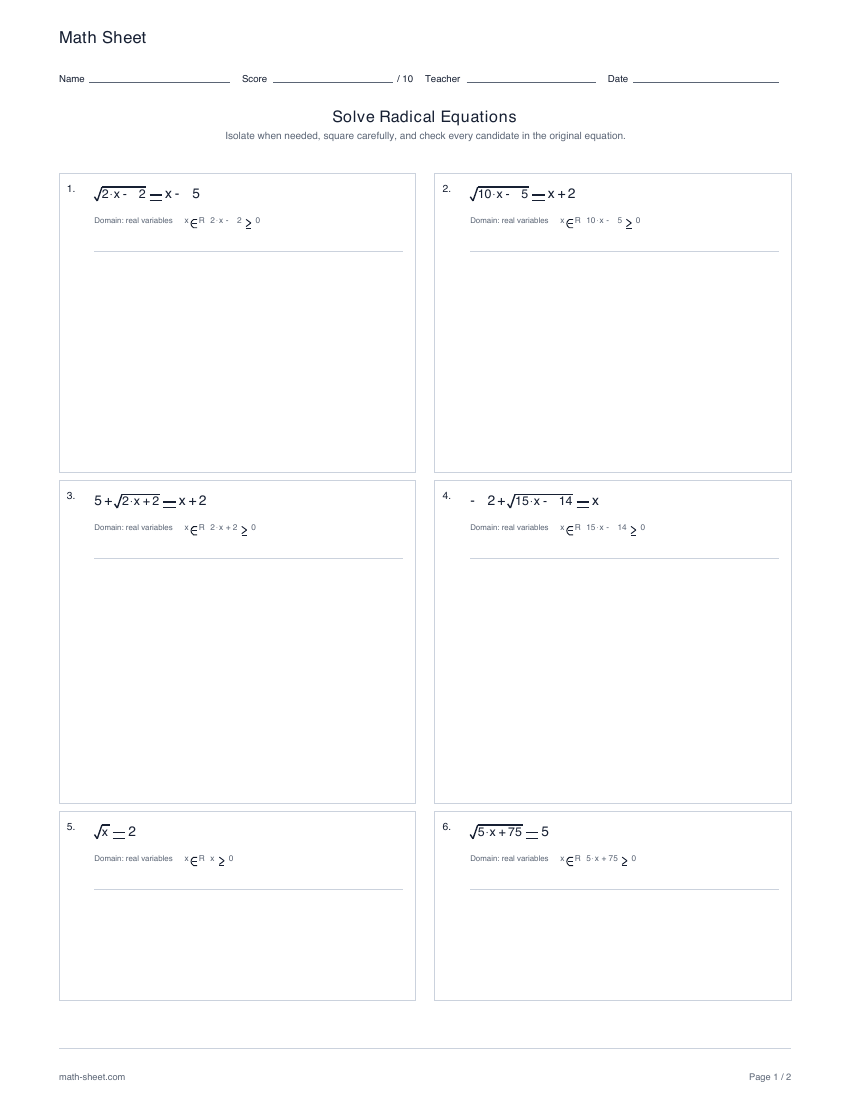
Exponents and radicals
Generate 10 radical equations in independently selectable Easy, Medium and Hard profiles. Practice isolating roots, solving, and rejecting candidates that fail the original equation.
Preview and download →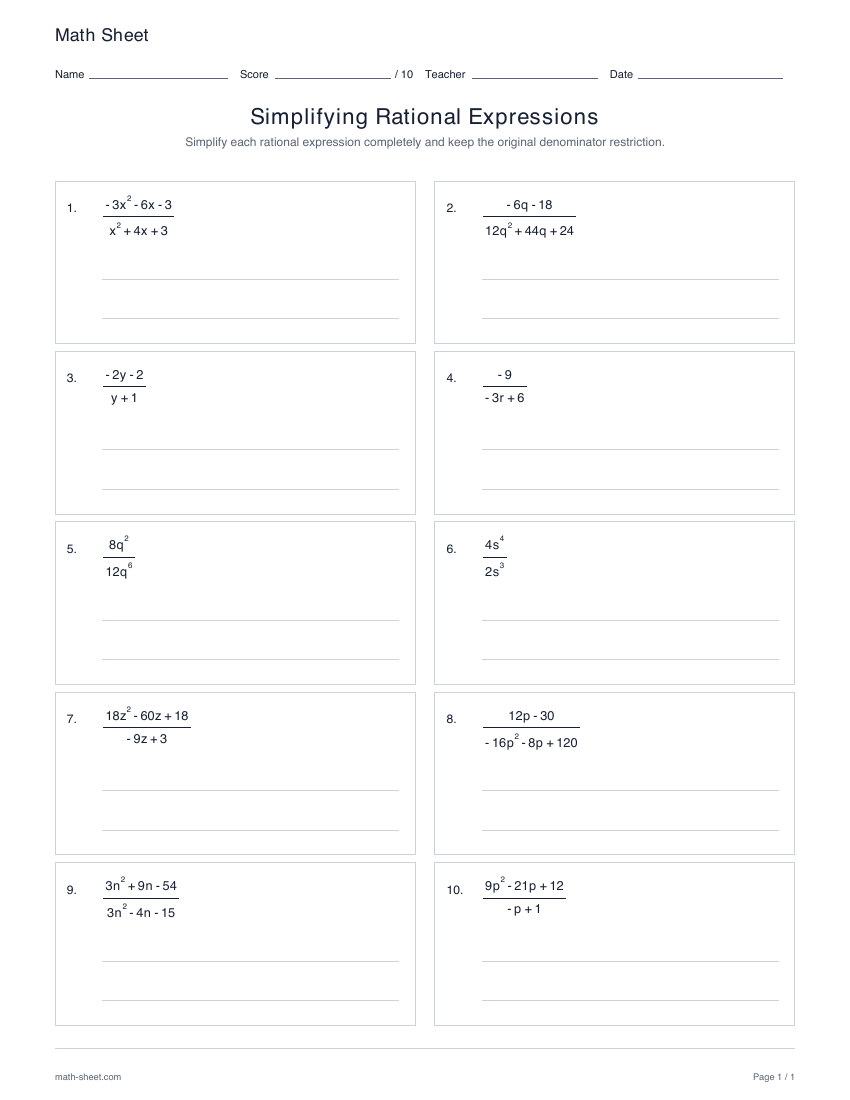
Rational expressions
Practice ten exact single-quotient reductions with monomial, binomial or trinomial inputs, complete cancellation and retained original denominator restrictions.
Preview and download →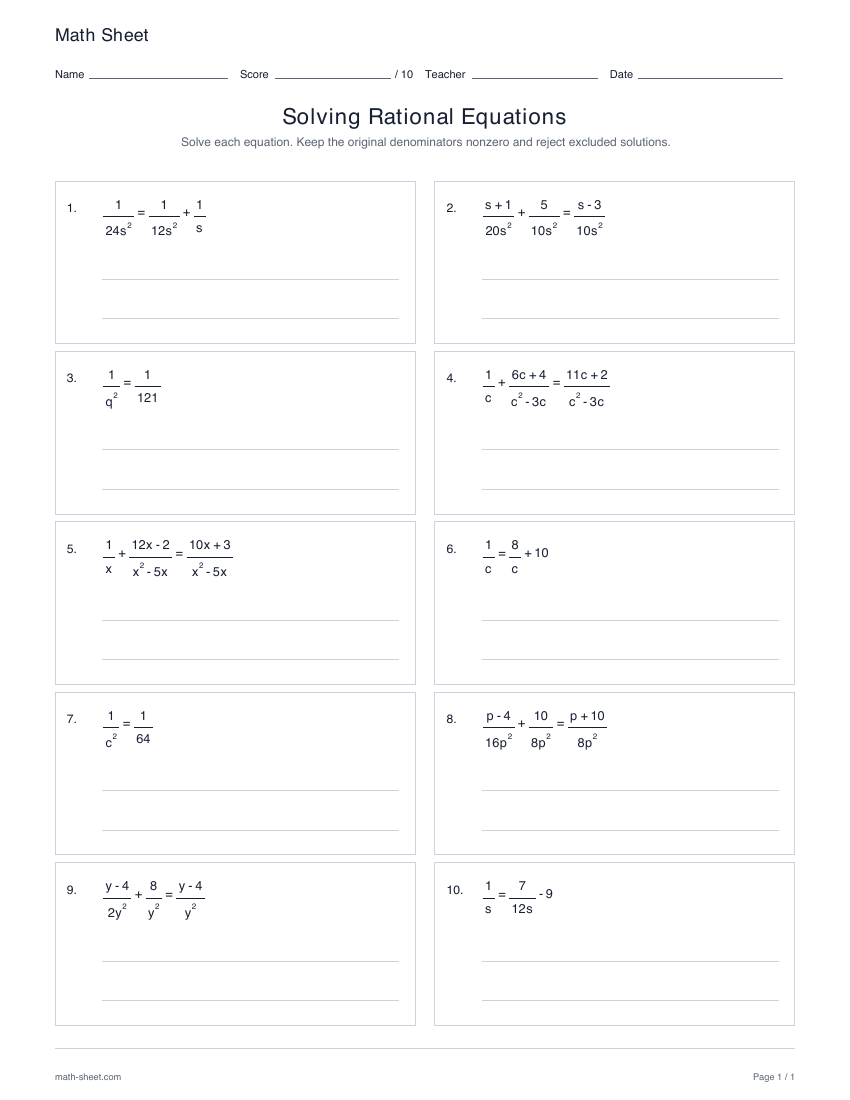
Rational expressions
Practice ten exact rational equations with monomial or binomial expressions, original-domain restrictions and checked rational solutions.
Preview and download →Step 3
Exponential and logarithmic relationships
Treat logarithms and exponentials as inverse forms. Use log properties to reveal structure, then check that logarithm arguments remain positive.
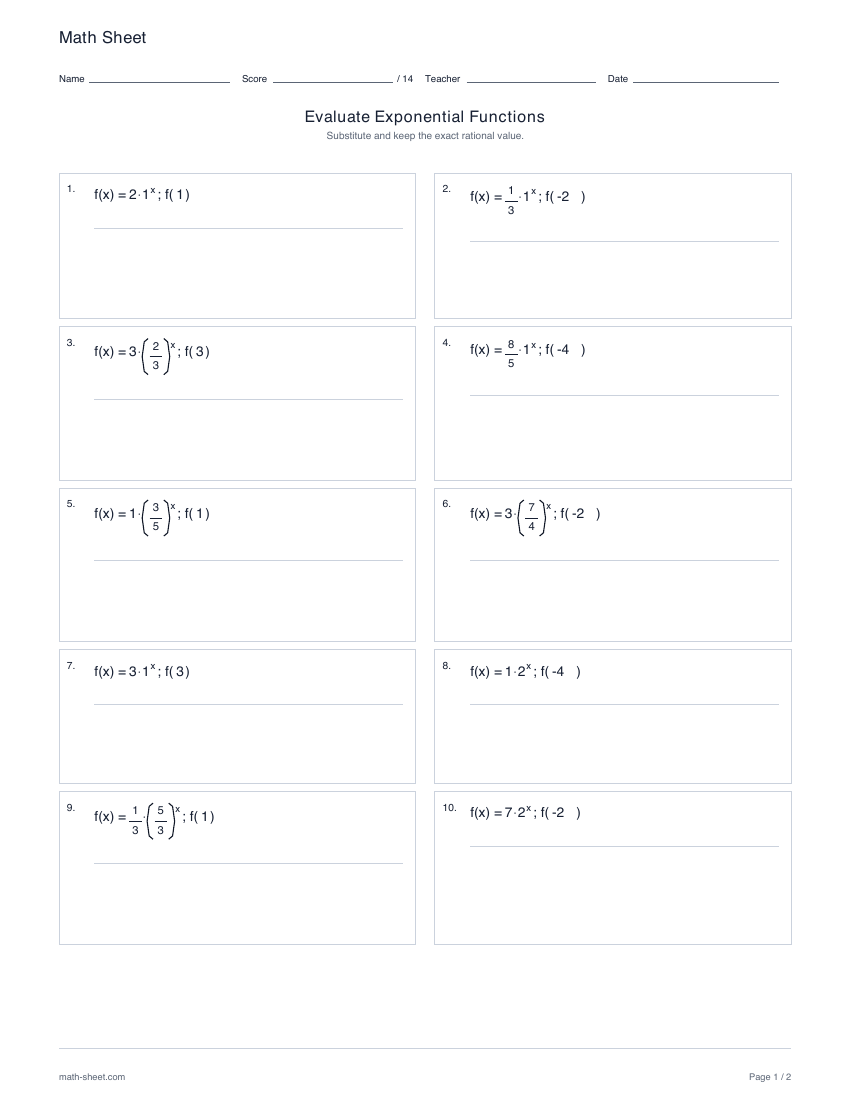
Exponents and radicals
Evaluate 14 exponential functions at positive, negative or mixed integer inputs. Keep exact fraction answers and show a hundredth approximation when needed.
Preview and download →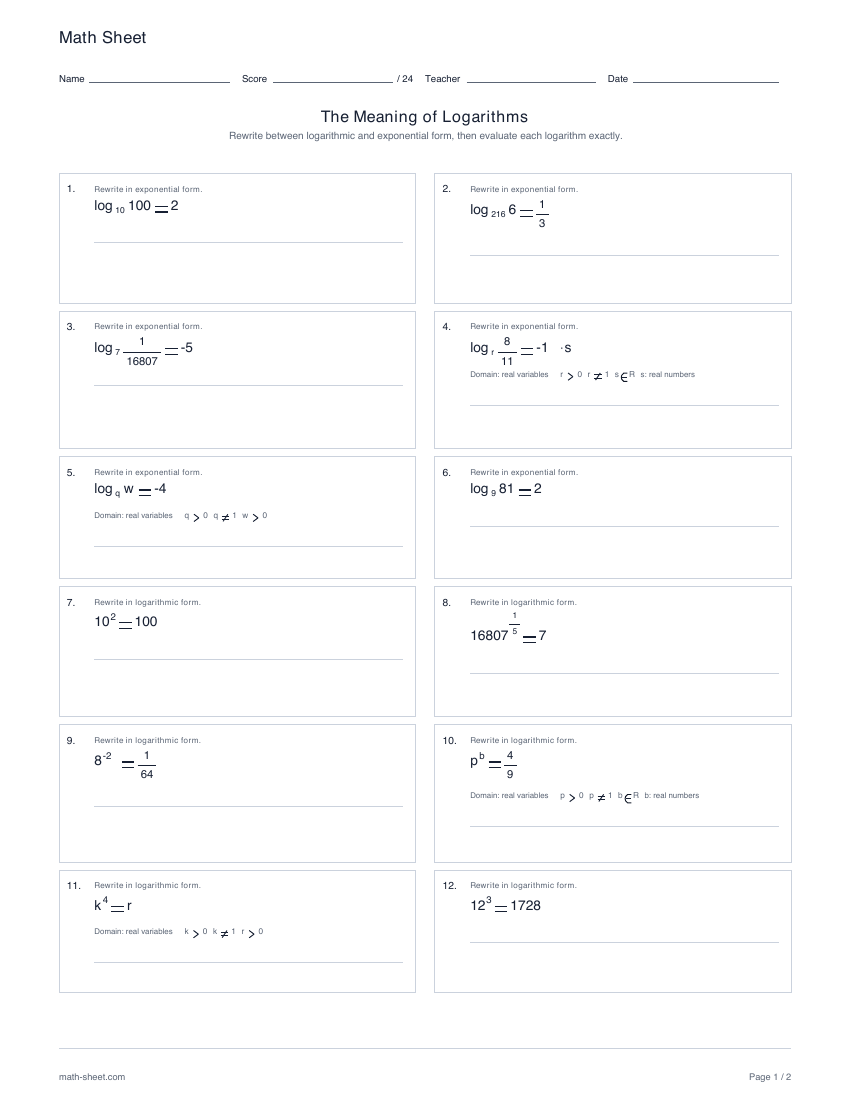
Exponents and radicals
Rewrite exponential and logarithmic equations and evaluate exact logarithms. Choose numeric or symbolic forms, fractional exponents and reciprocal arguments, with separate answers.
Preview and download →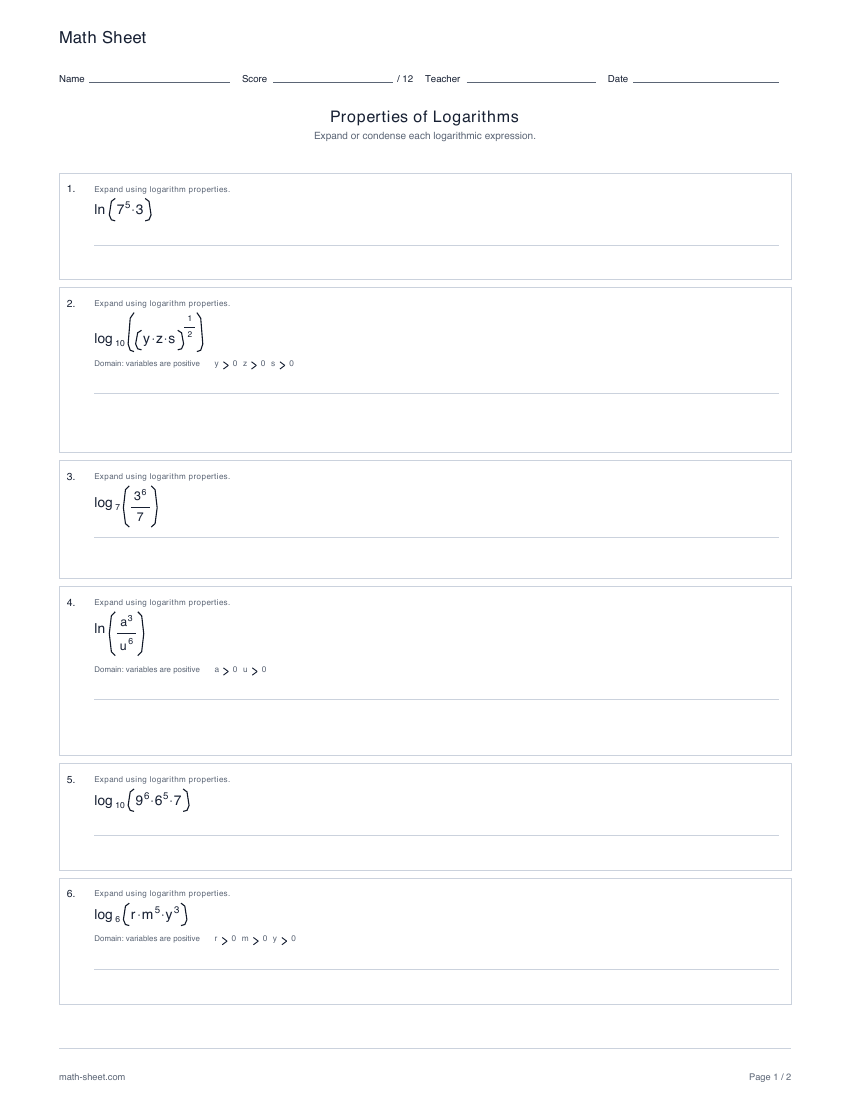
Exponents and radicals
Expand and condense logarithms with 16 selectable product, quotient and power forms. Practice natural logs, base-ten logs and fractional powers with exact symbolic answers.
Preview and download →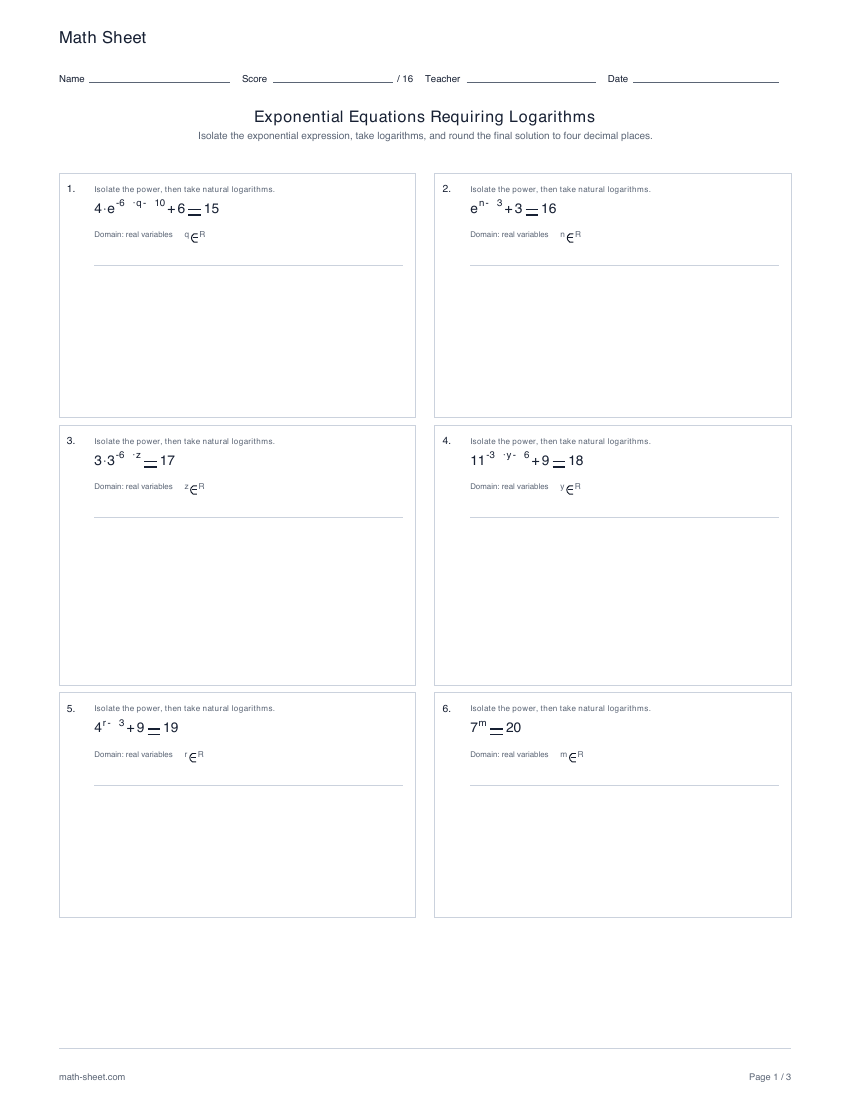
Exponents and radicals
Solve six types of exponential equations using logarithms, including natural-base equations. Choose 12, 14 or 16 questions with worked keys and four-place answers.
Preview and download →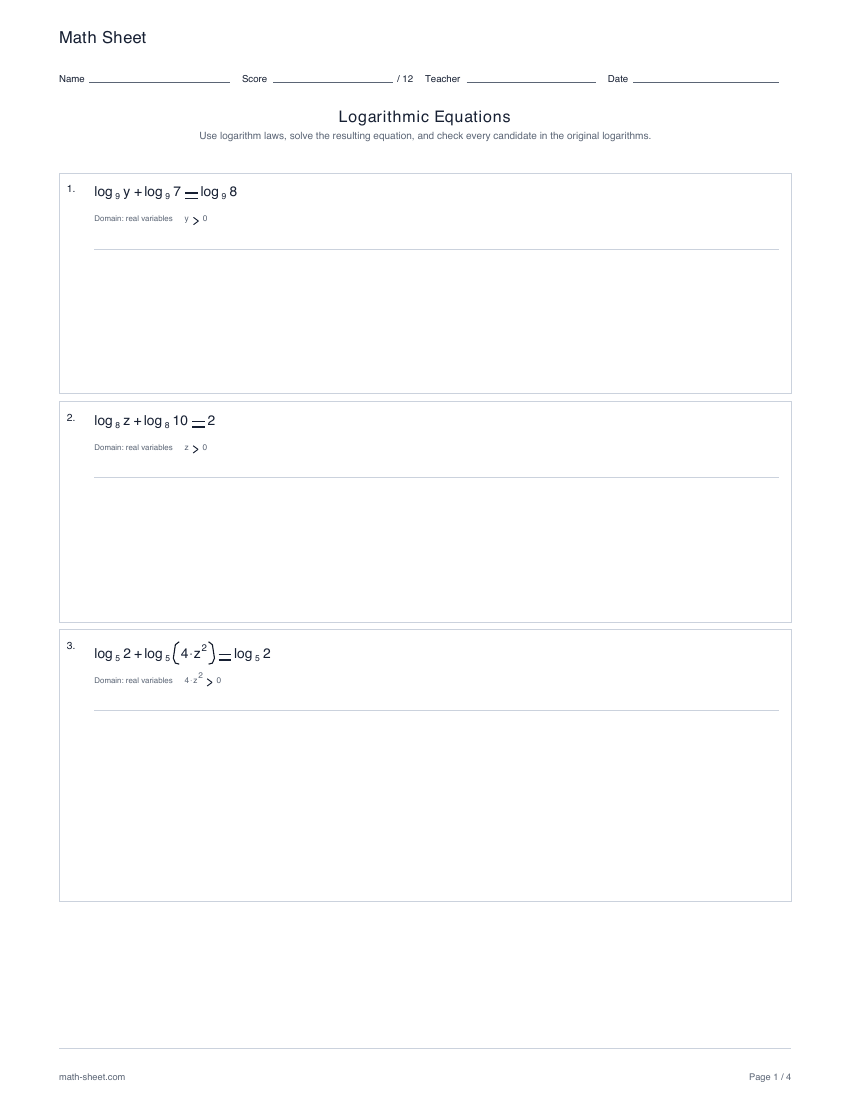
Exponents and radicals
Solve six types of logarithmic equations with exact answers. Choose 12, 14 or 16 questions and check every solution in the original logarithms.
Preview and download →Step 4
Sequences and complex numbers
Compare constant differences with constant ratios, and keep the real and imaginary parts organized when operating with complex numbers.
Sequences and series
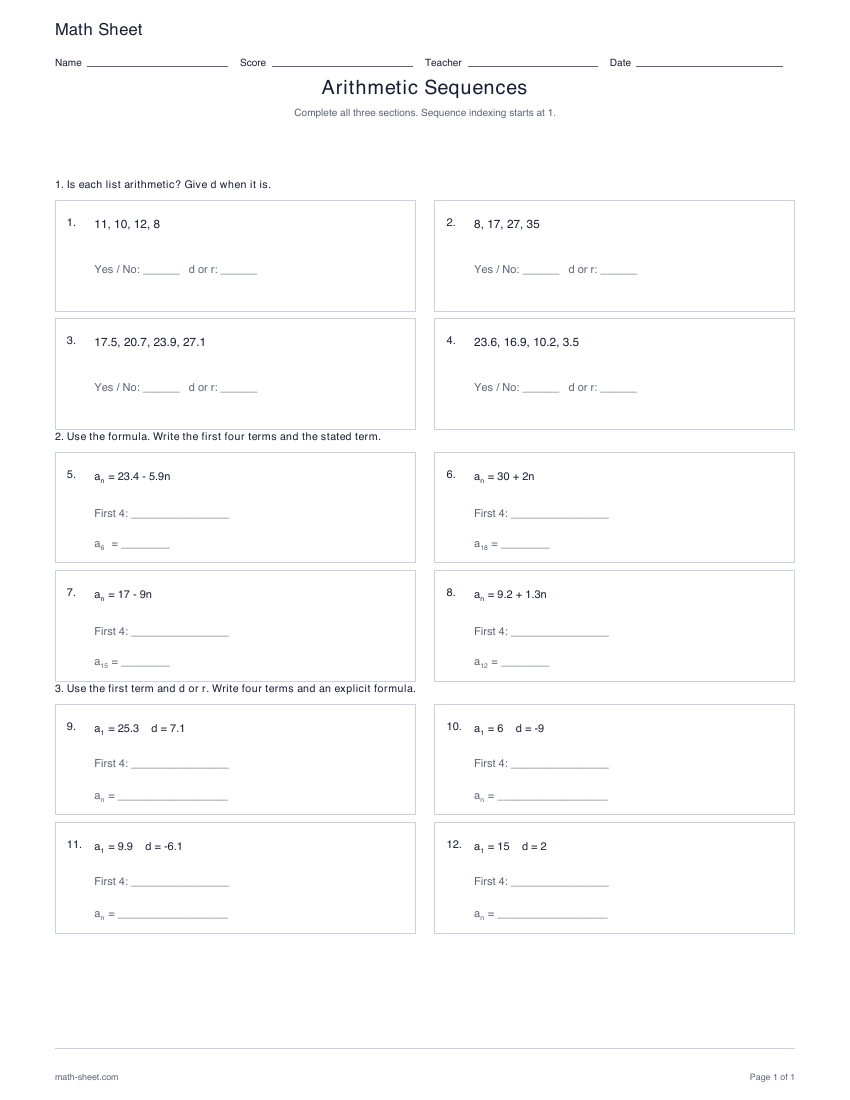
Identify arithmetic sequences, find common differences, evaluate specified terms and write explicit formulas with integer or tenths practice.
Preview and download →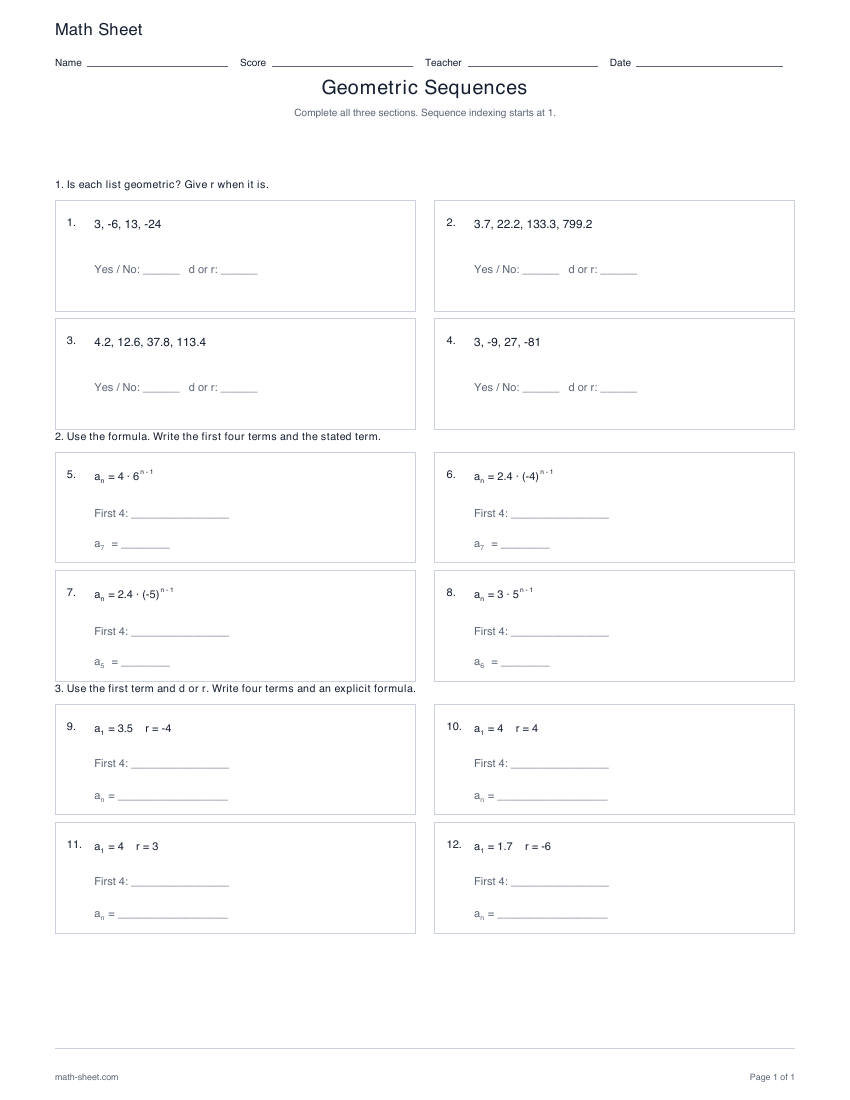
Sequences and series
Identify geometric sequences, find common ratios, evaluate specified terms and write explicit formulas with integer or tenths first terms.
Preview and download →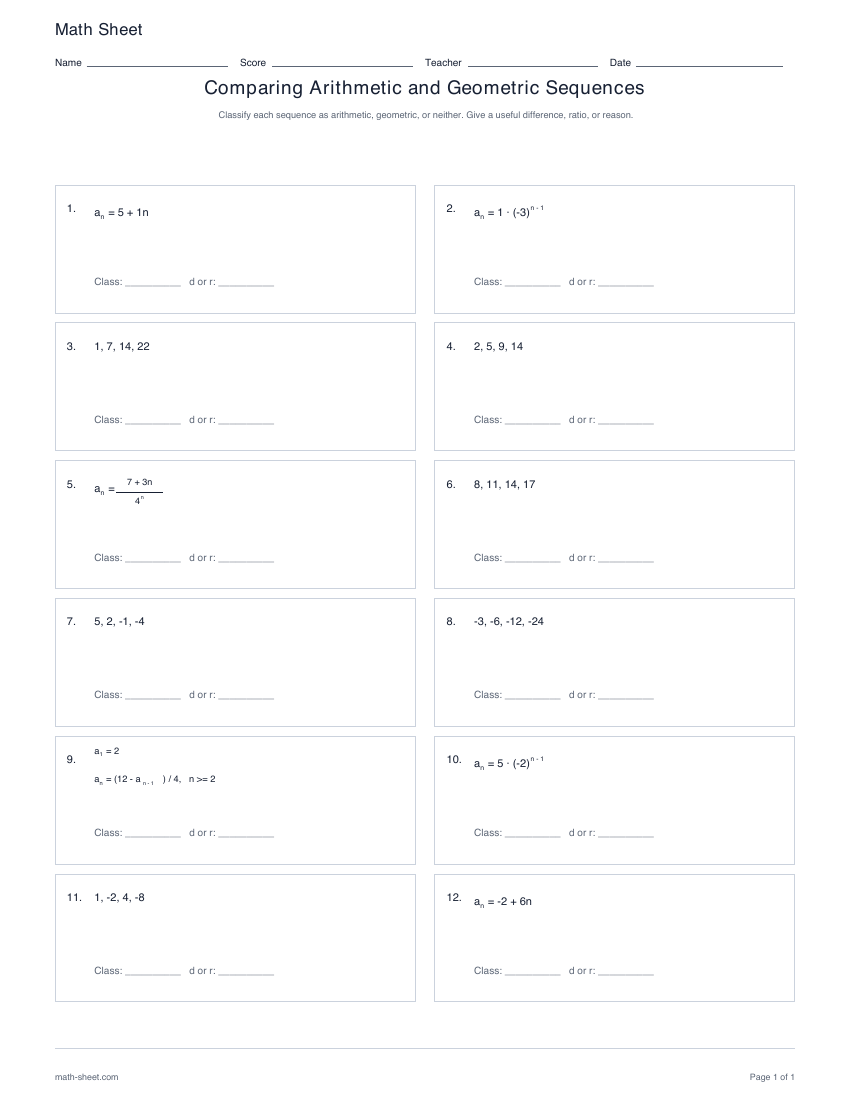
Sequences and series
Classify sequences from four terms or a formula as arithmetic, geometric or neither, with twelve questions and a separate answer key.
Preview and download →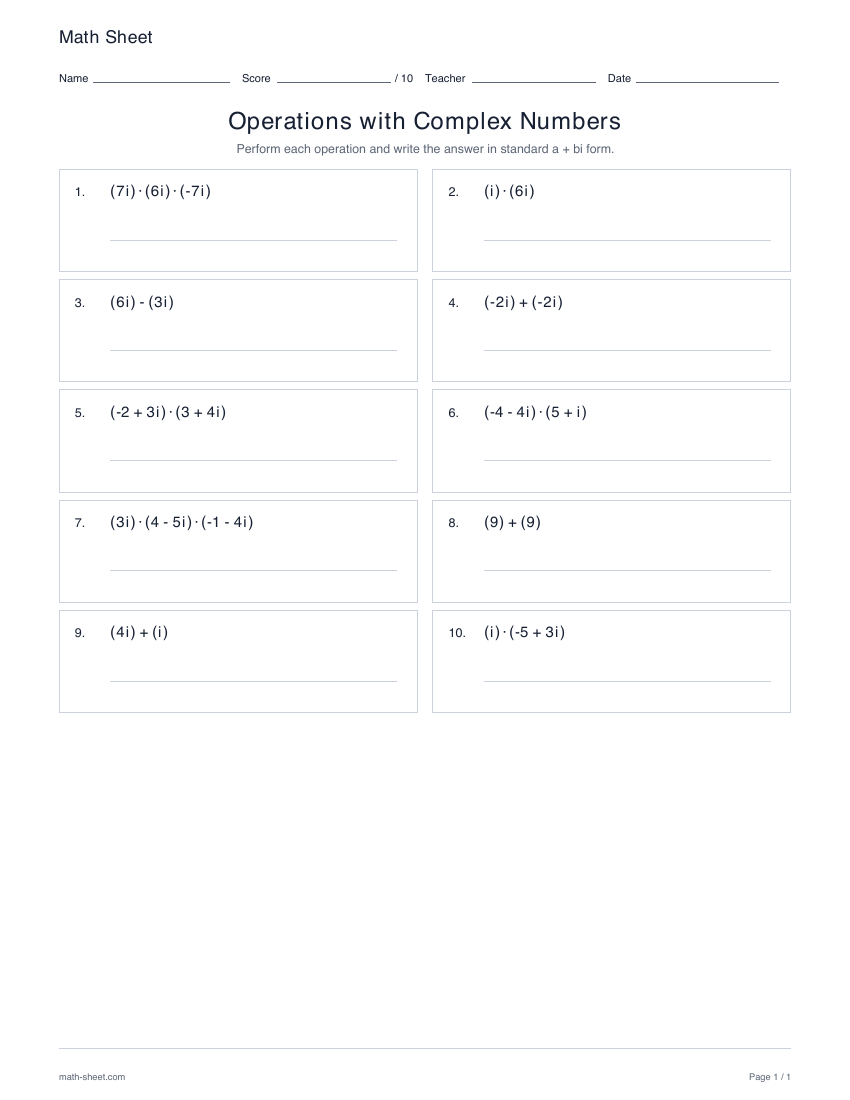
Complex numbers
Add, subtract and multiply complex numbers in ten-question sets. Select sums and differences, imaginary monomial products or binomial products and squares.
Preview and download →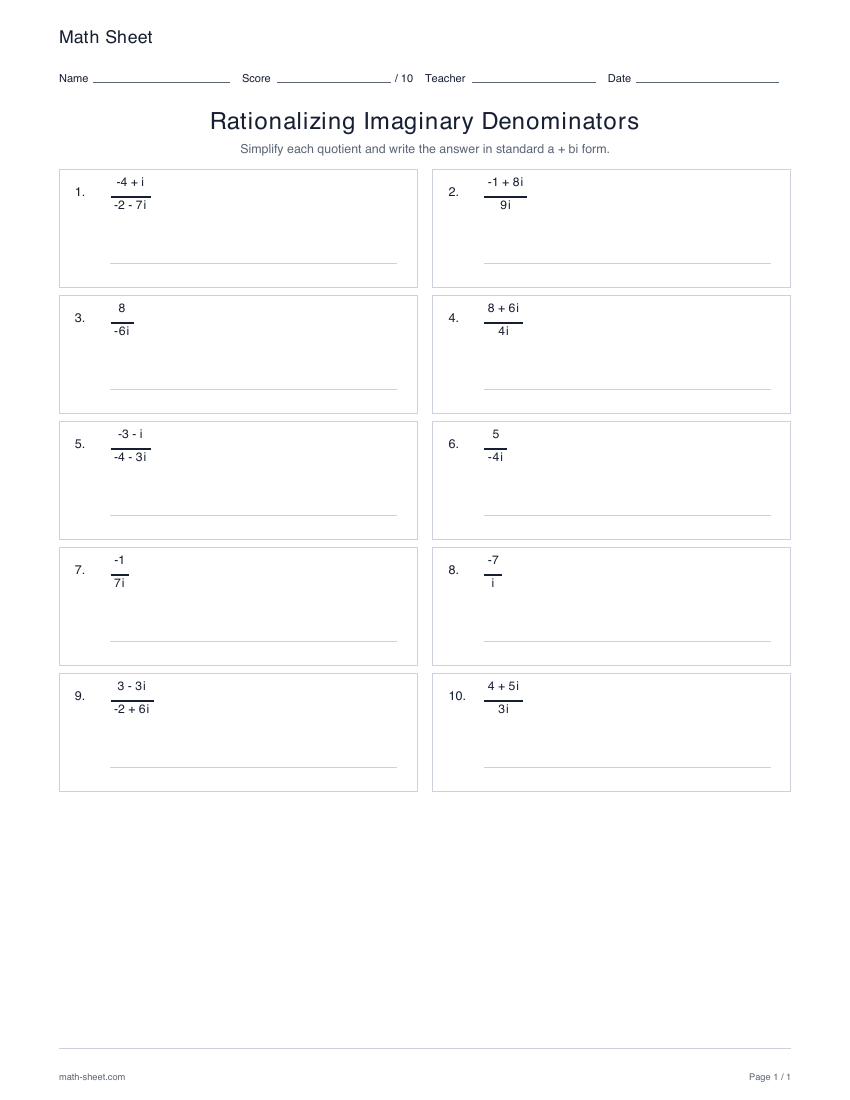
Complex numbers
Rewrite ten complex quotients with real denominators. Select real-over-imaginary, binomial-over-imaginary or binomial-over-binomial questions and print worked answers.
Preview and download →Optional extension
Optional bridge to trigonometry
Use after exact unit-circle values and function transformations are secure. Connect periodic graphs, basic identities and interval-based equations before moving into a Precalculus course.
Trigonometry
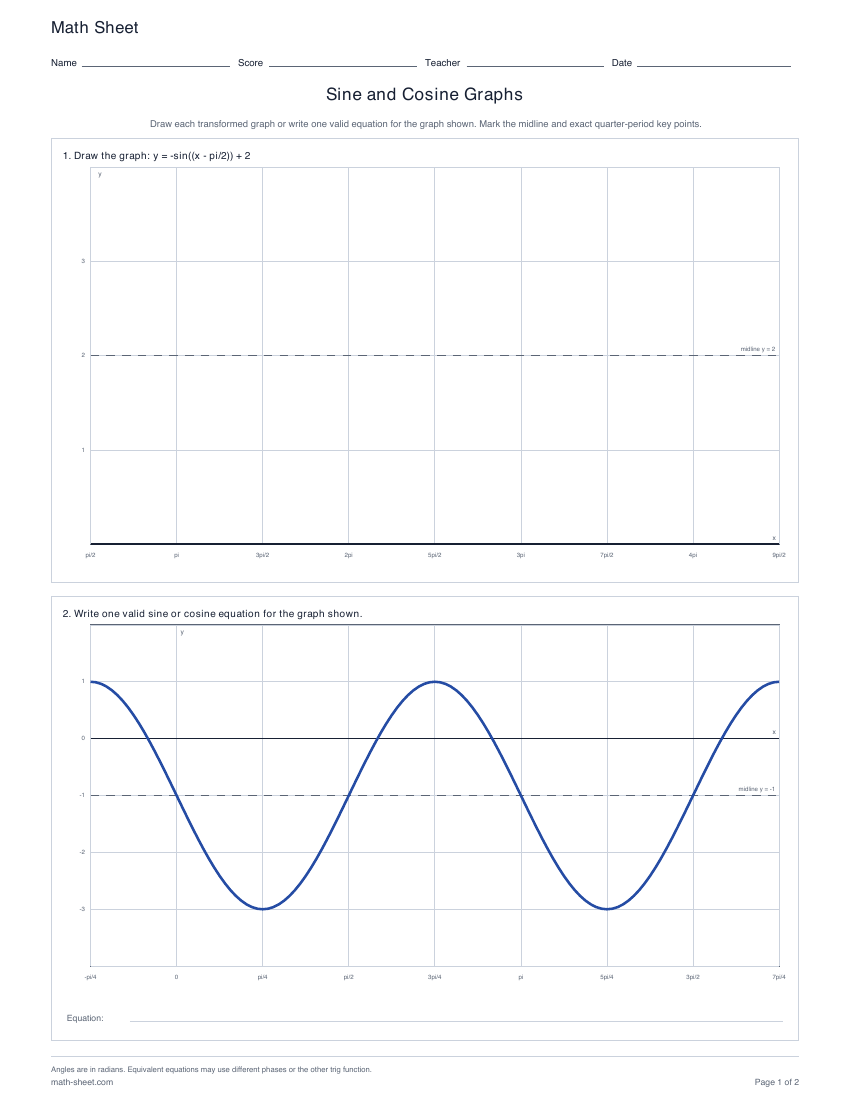
Graph transformed sine and cosine functions or write one valid equation from a graph, using exact radians or degrees.
Preview and download →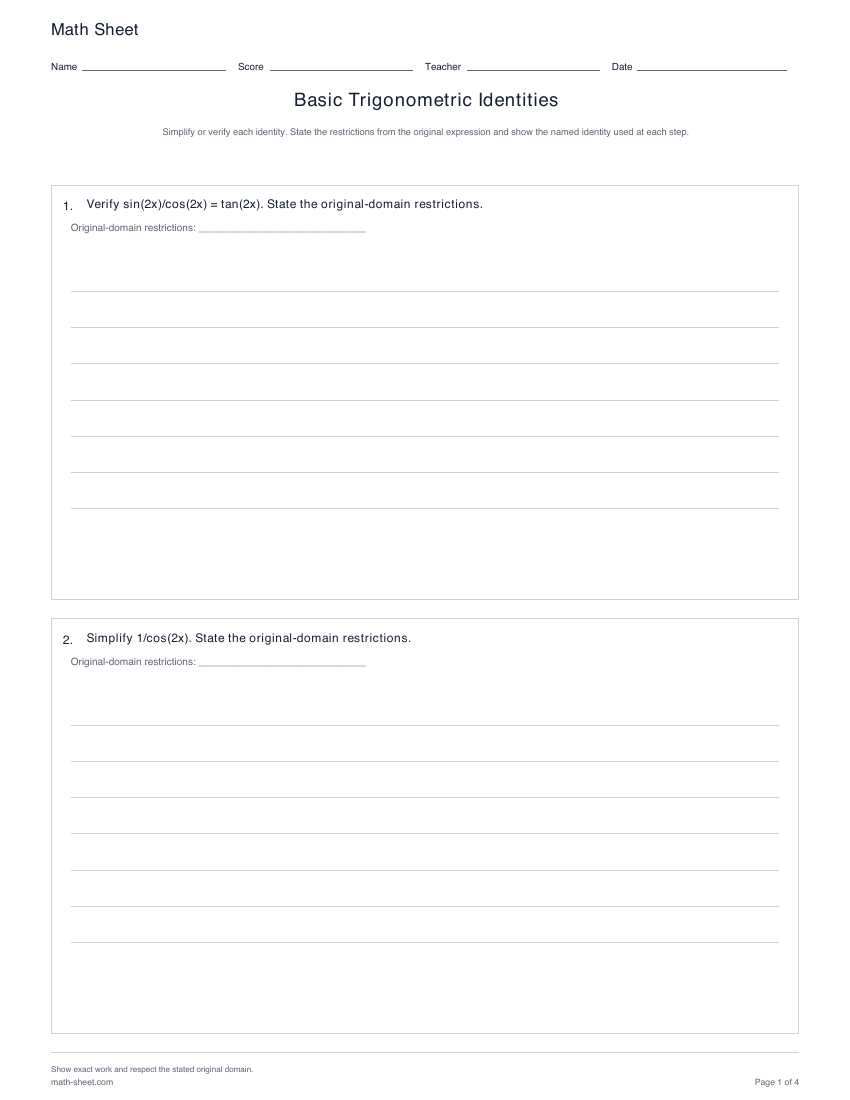
Trigonometry
Simplify and verify finite reciprocal, quotient, and Pythagorean identity recipes with the original-domain restrictions made explicit.
Preview and download →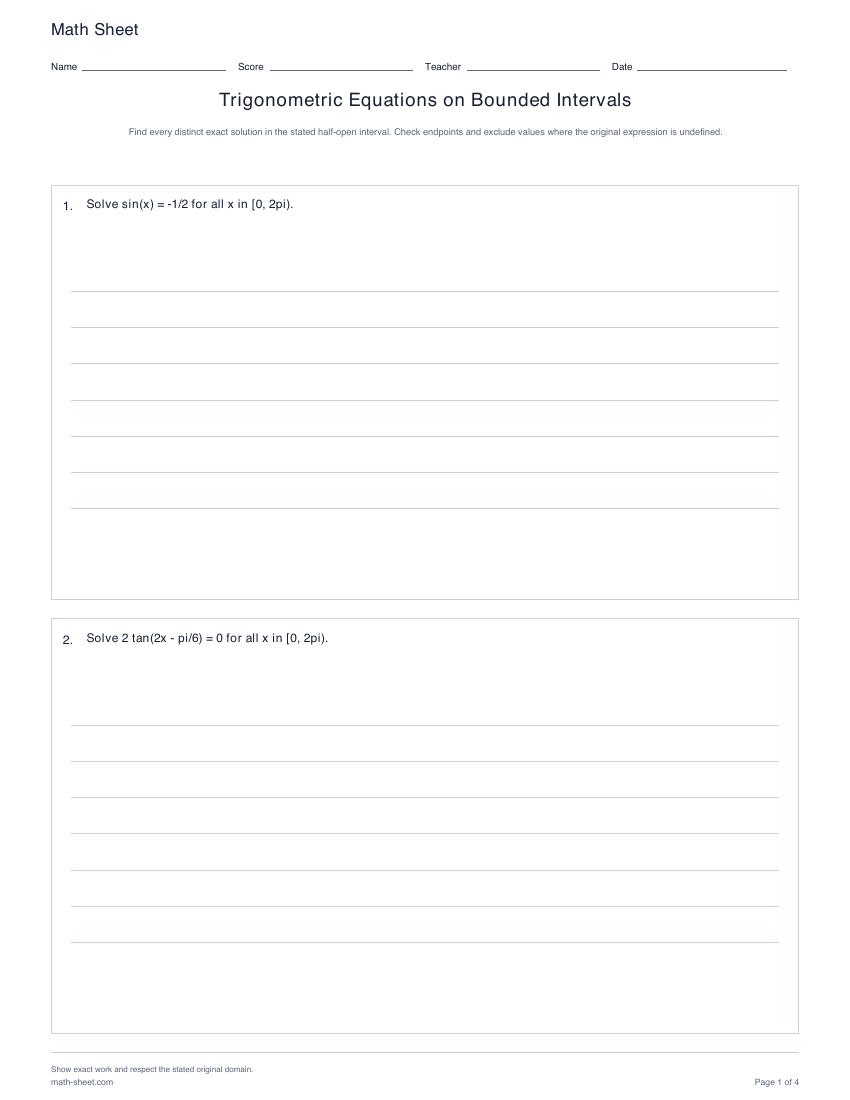
Trigonometry
Find all exact sine, cosine, and tangent solutions in explicit half-open radian or degree intervals, including simple frequency and phase transformations.
Preview and download →Step 6
Triangle laws and probability reasoning
Use after triangle ratios, inverse trigonometric functions and fraction arithmetic are secure. Solve non-right triangles, choose ordered or unordered counting methods, and update a sample space when a condition is known.
Trigonometry
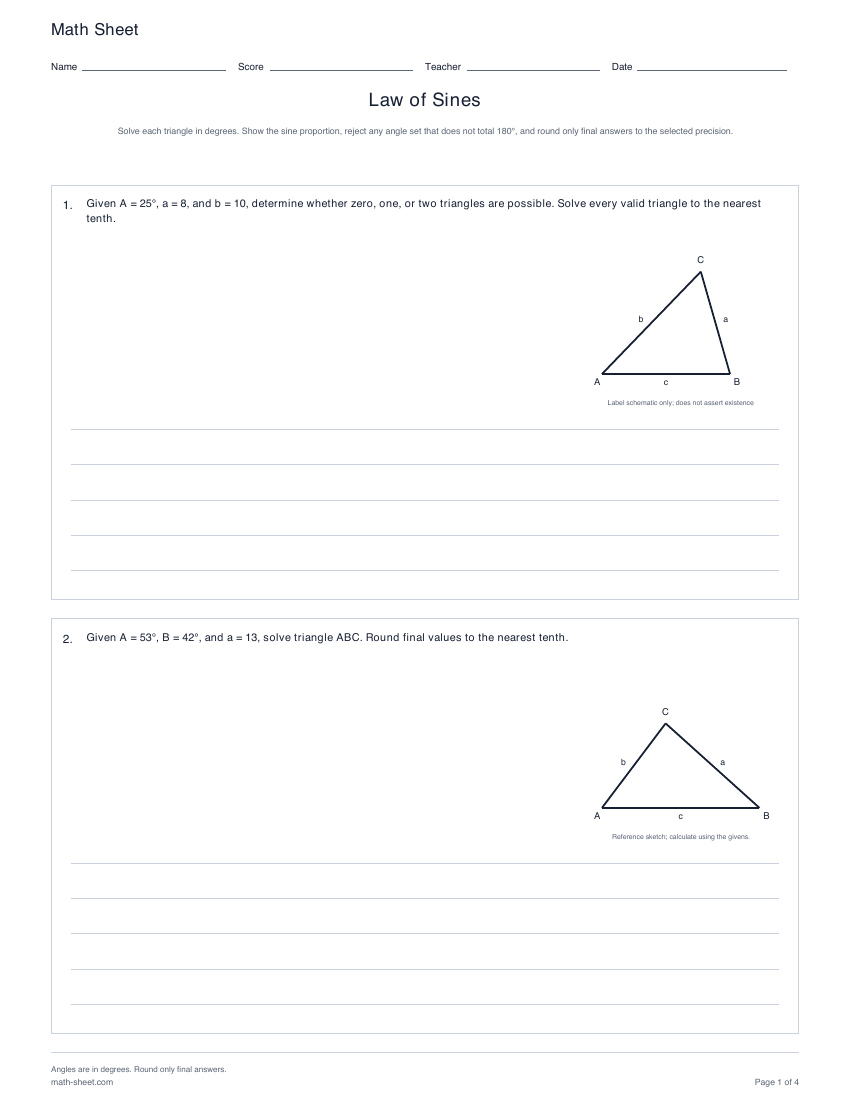
Solve AAS, ASA, and ambiguous SSA triangles, including cases with zero, one, or two valid solutions.
Preview and download →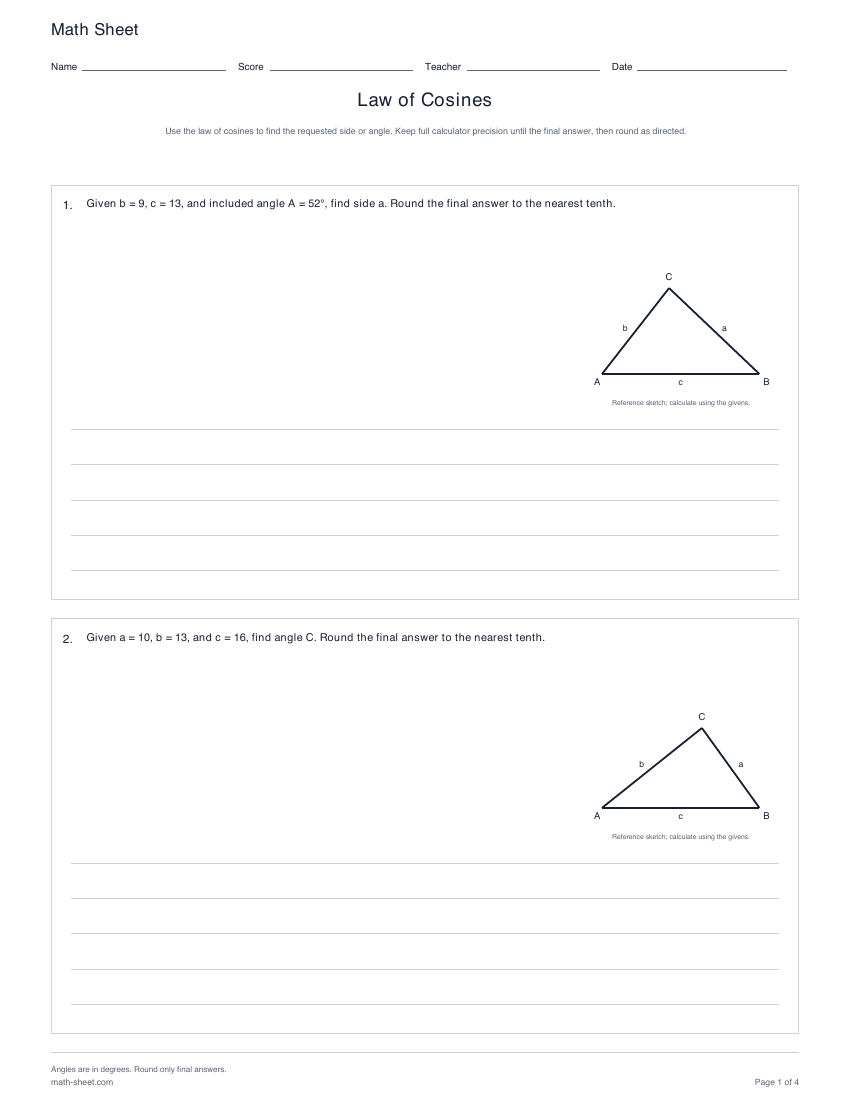
Trigonometry
Find a missing side from SAS data or a missing angle from SSS data, with acute and obtuse examples.
Preview and download →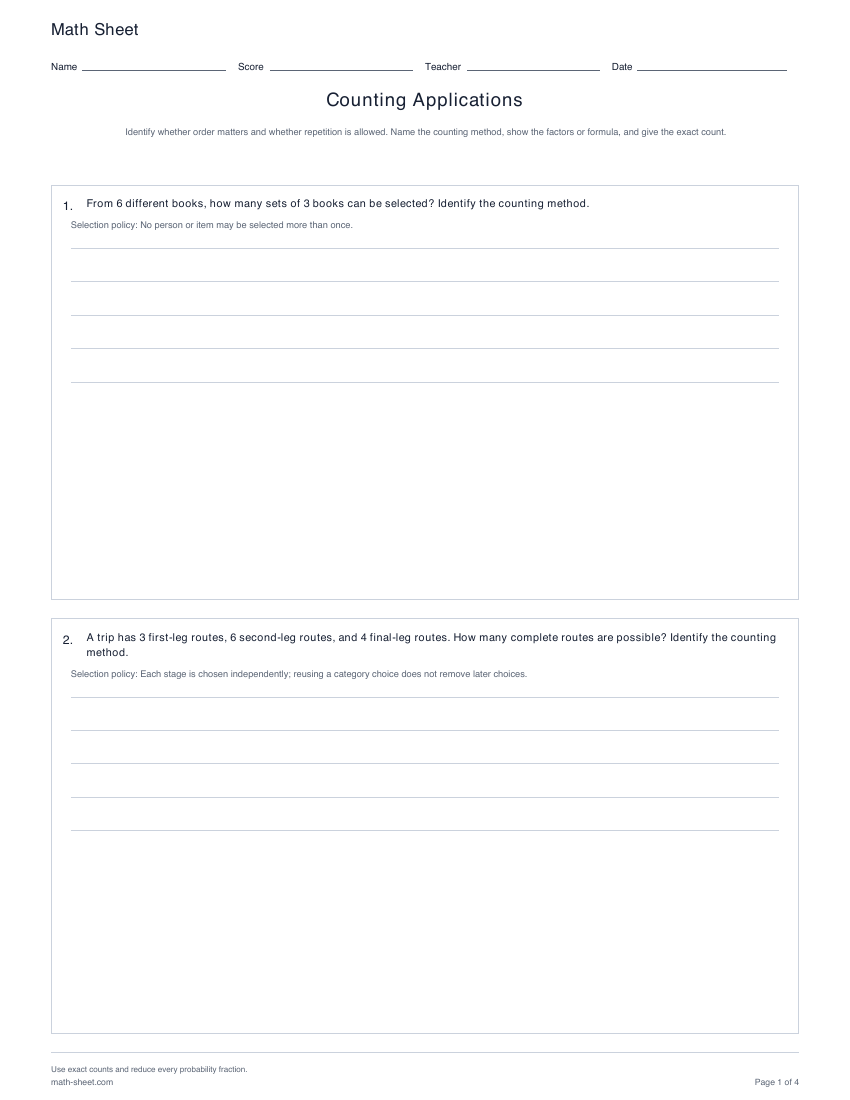
Probability
Choose among the multiplication principle, ordered selections without replacement, and unordered combinations in varied finite contexts.
Preview and download →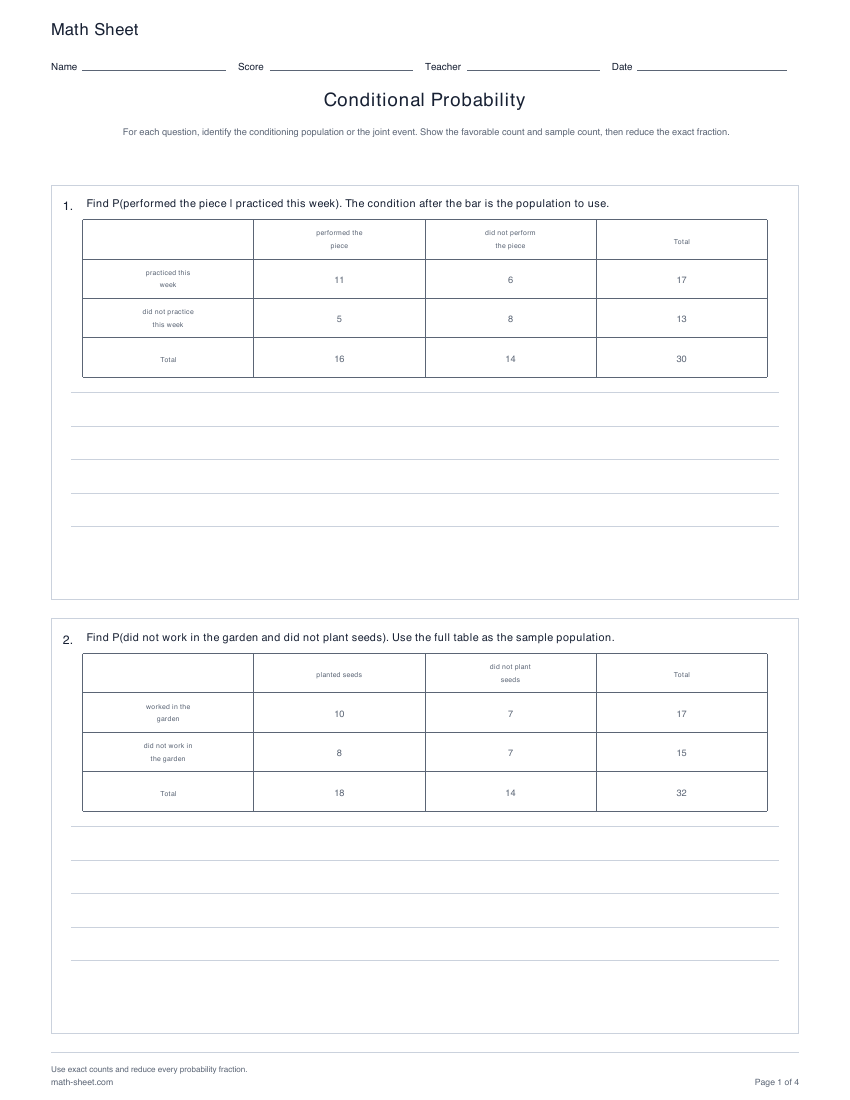
Probability
Compare conditional and joint probabilities using complete two-way count tables and two sequential draws without replacement.
Preview and download →Choose what to practice next
Begin with one short resource, review the learner's written reasoning and adjust the difficulty on the activity page. Revisit an earlier group when arithmetic errors obscure the new idea.
Follow the Precalculus learning path →
Browse the complete worksheet library →
