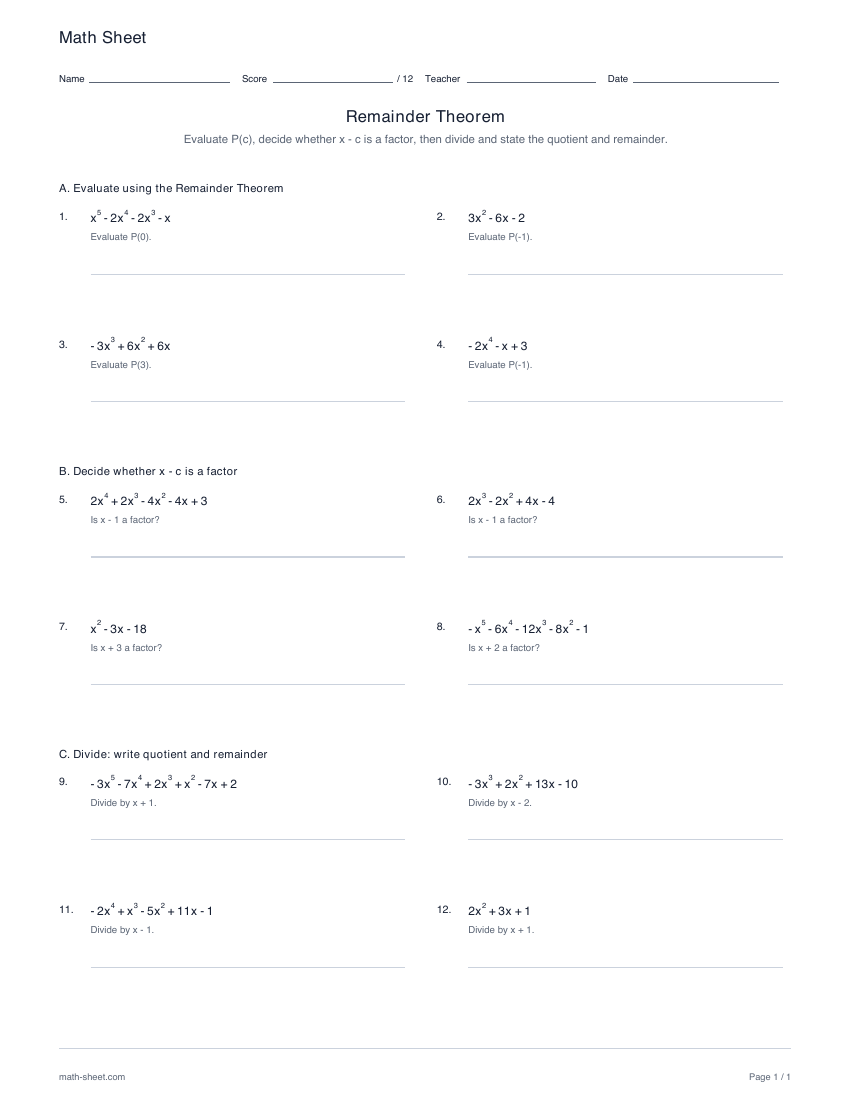
Use the Remainder Theorem in twelve structured problems: evaluate four polynomials at a point, make four factor decisions from zero remainders, and divide four polynomials by signed monic linear divisors with exact quotient-and-remainder answers.
Evaluating P(c) gives the same number as the remainder after division by x − c. A zero value proves that x − c is a factor; a nonzero value is the signed remainder.
Write a signed divisor as x − c before substituting. For example, x + 3 means c = −3. Check every division with P(x) = (x − c)Q(x) + R.
Learning objective
What this activity builds
Connect P(c), divisibility by x − c, and the quotient-remainder identity for polynomial division.
Worked example
For P(x) = x³ − 2x² − 5x + 6, evaluate P(1) and decide whether x − 1 is a factor.
P(1) = 0, so x − 1 is a factor.
The Remainder Theorem says that the remainder after division by x − c equals P(c). A zero remainder makes the division exact.
Teaching notes
Make the practice count
Substitute the entire signed value of c into every occurrence of the variable.
Match x − c carefully: x + 3 corresponds to c = −3.
A divisor is a factor exactly when the remainder is zero.
Check division by confirming P(x) = (x − c)Q(x) + R.
Make it yours
Customize the practice
Choose your options, update the preview, then download the exact same pages.
Choose the expression structures to practice. Answer editions show the steps for each problem.
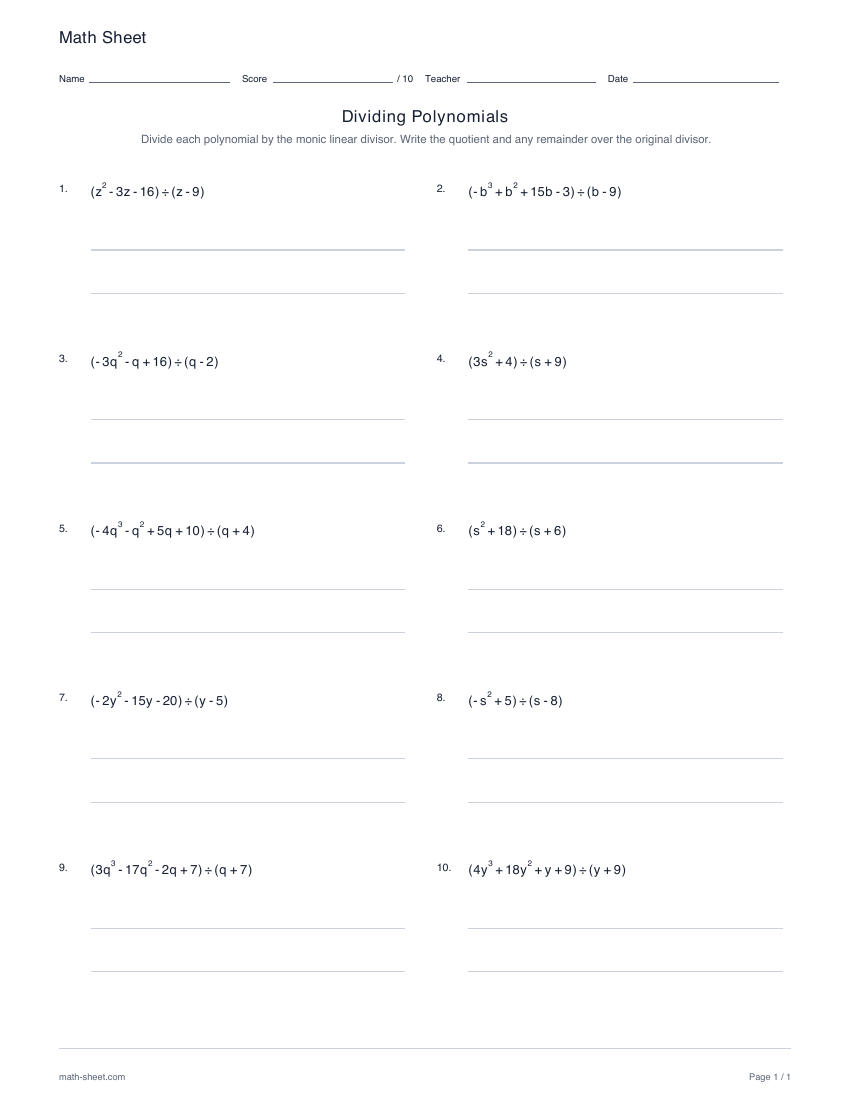
Divide polynomials by monic linear divisors in ten expression problems or six long-division problems. Choose binomial, trinomial, four-term or mixed dividends and check exact quotient-and-remainder keys.
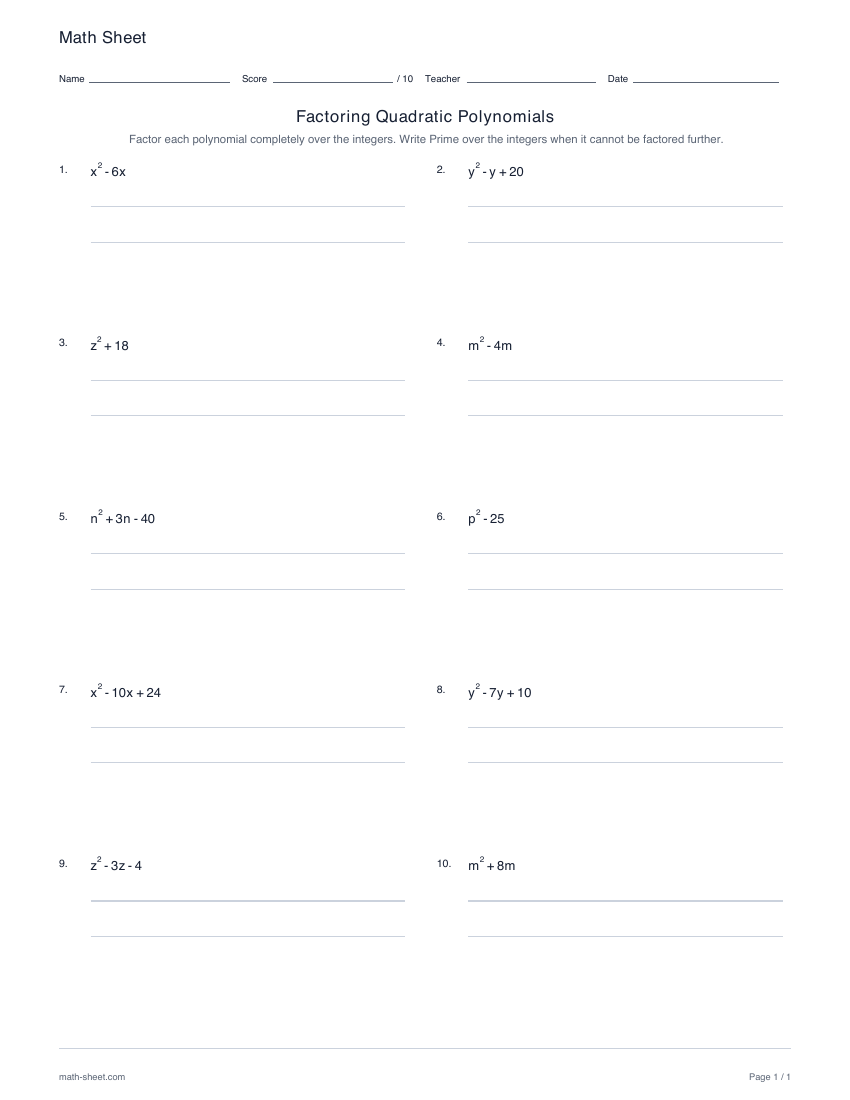
Factor ten quadratic binomials and trinomials completely over the integers. Choose factorable-only practice or include two prime quadratics, and vary monic and nonmonic leading coefficients.