Build an understanding of variables from the arithmetic learners already know. Follow a sequence through operation order, mathematical language, equivalent expressions, substitution, solving equations, graphing inequalities, polynomial operations connecting line equations with coordinate graphs and finding the point shared by two equations.
This is a selected foundation sequence. Choose the starting point by readiness; pre-algebra courses vary by school and country.
Begin with a conversation, then choose the sheet
Ask the learner to calculate 6 + 2 × 4, explain what 3x means, and describe the difference between 2(x + 5) and 2x + 5. These questions reveal different prerequisites: order of operations, multiplication notation and grouping.
If arithmetic is insecure, start with numbers. If the calculation is accurate but the notation is unfamiliar, begin with short phrases and one variable. A learner who can explain both is ready to rewrite expressions and track more than one input.
1. Make the arithmetic reliable
Check grouping, operation order and signed arithmetic before adding variable notation. Ask learners to explain which operation happens next.
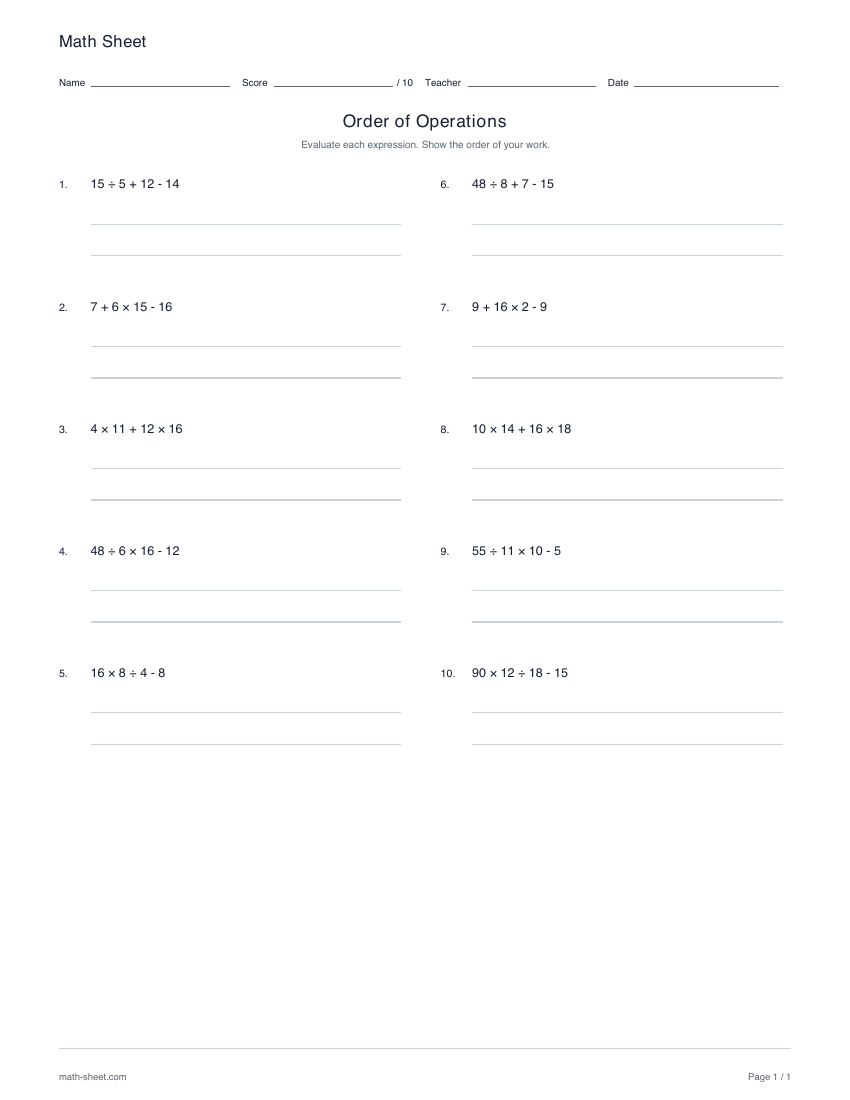
Evaluate ten expressions with all four arithmetic operations. Select easy or hard practice and five grouping/exponent formats, then print the questions and a separate worked key.
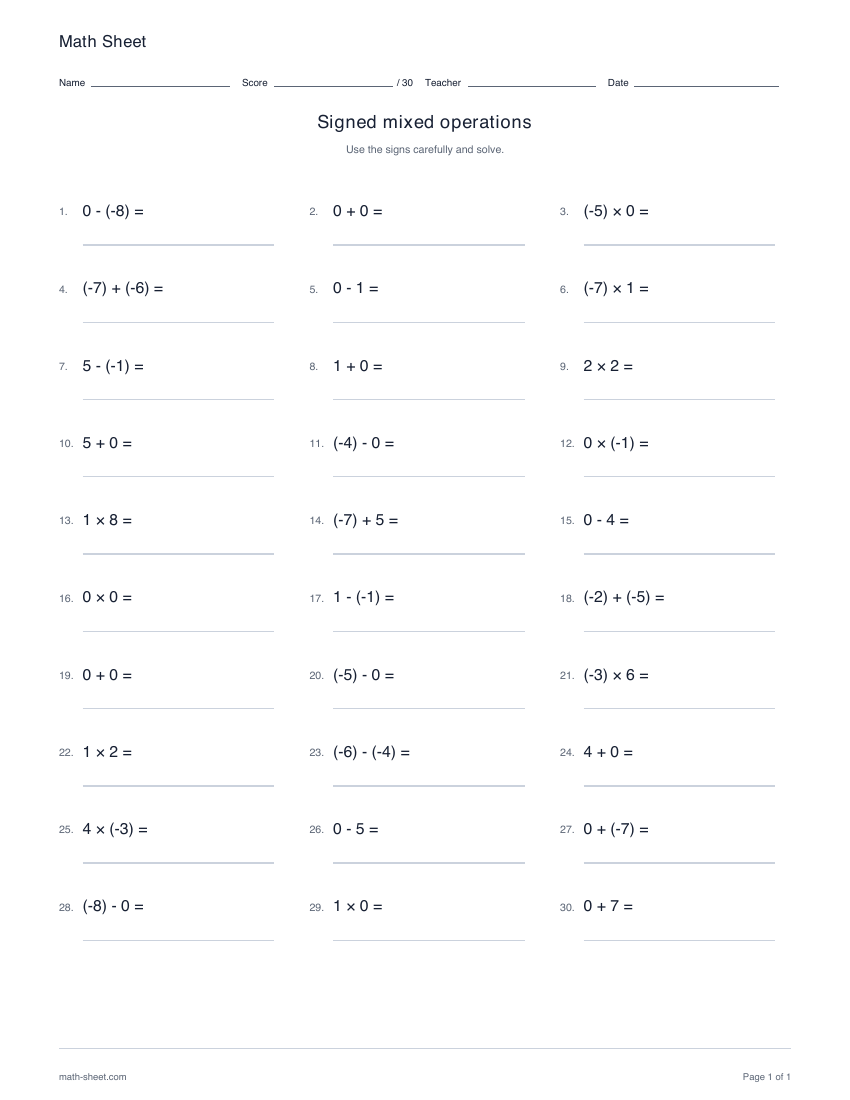
Mix addition, subtraction and multiplication with positive and negative integers, or opt into balanced exact division practice. Choose positive, mixed-sign, or two-negative operands.
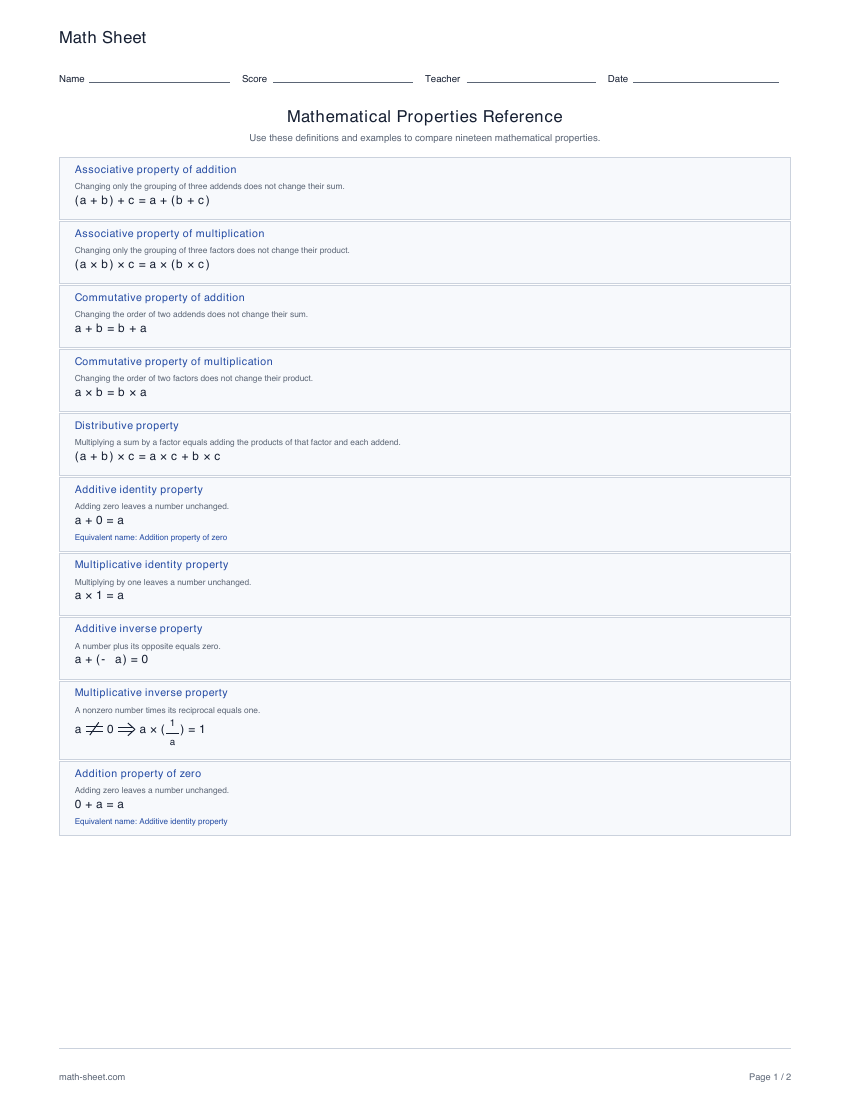
A printable guide to arithmetic and equality properties, with definitions, equations, equivalent names and the nonzero conditions needed for reciprocals and division.
Preview and download →
2. Read and write relationships
Move from quantities in words to variables, coefficients and grouped expressions. Pay special attention to subtraction and division order.
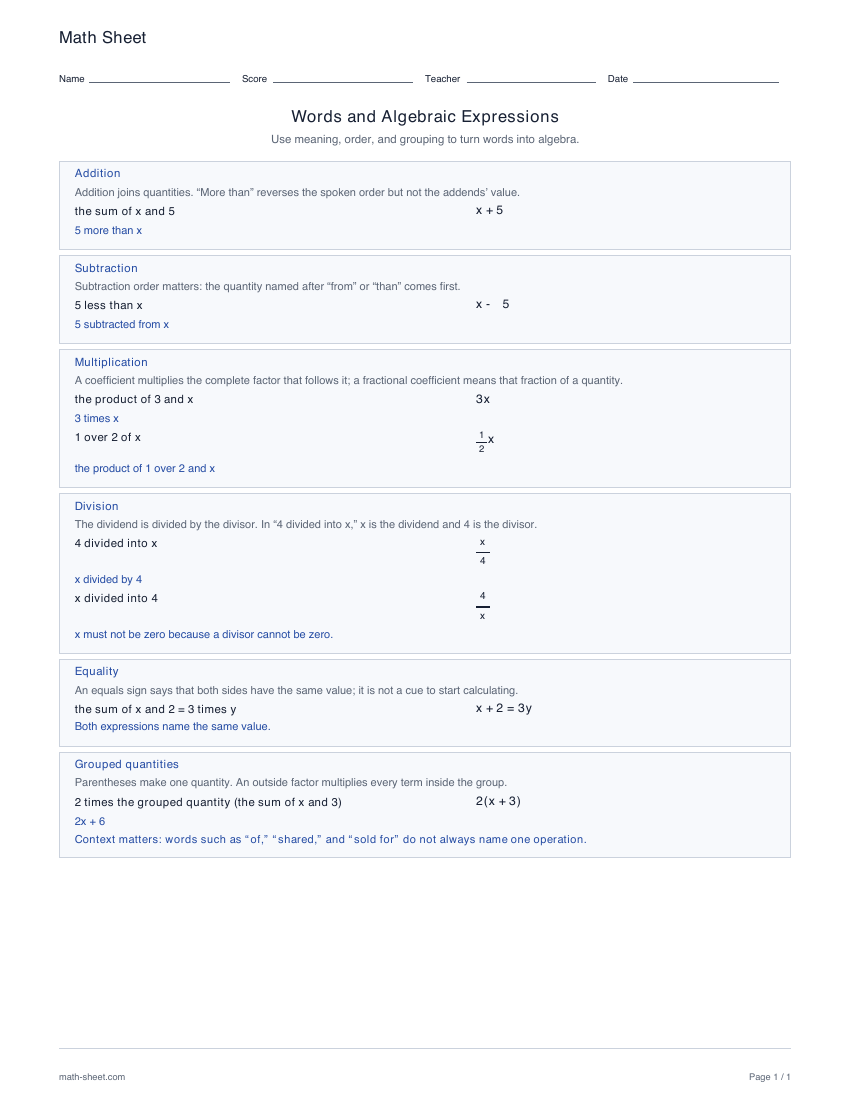
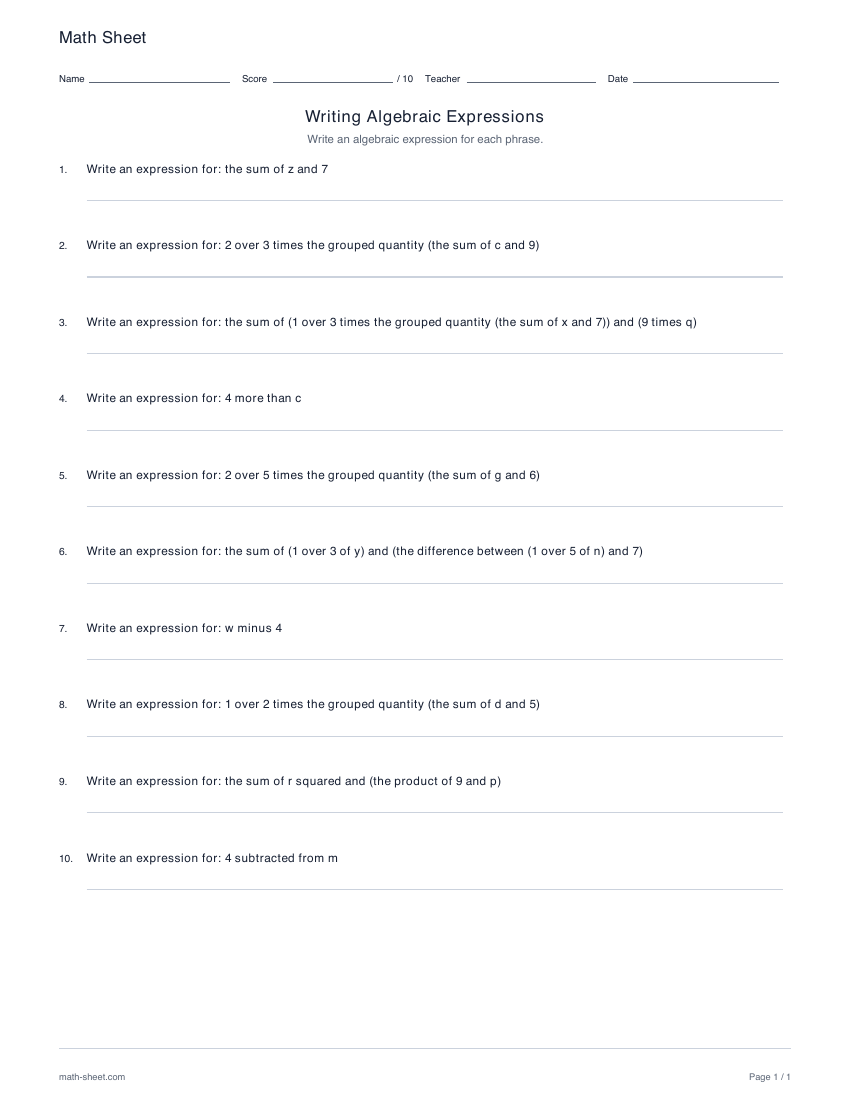
A printable guide to the language of algebra. Connect words with addition, subtraction, products, quotients, equality and grouping, with examples that explain operand order.
Translate words into algebra with ten questions per worksheet. Select easy, medium and hard phrases, including grouping, fractions and powers, and print an explained answer key.
Preview and download →
3. Recognize equivalent expressions
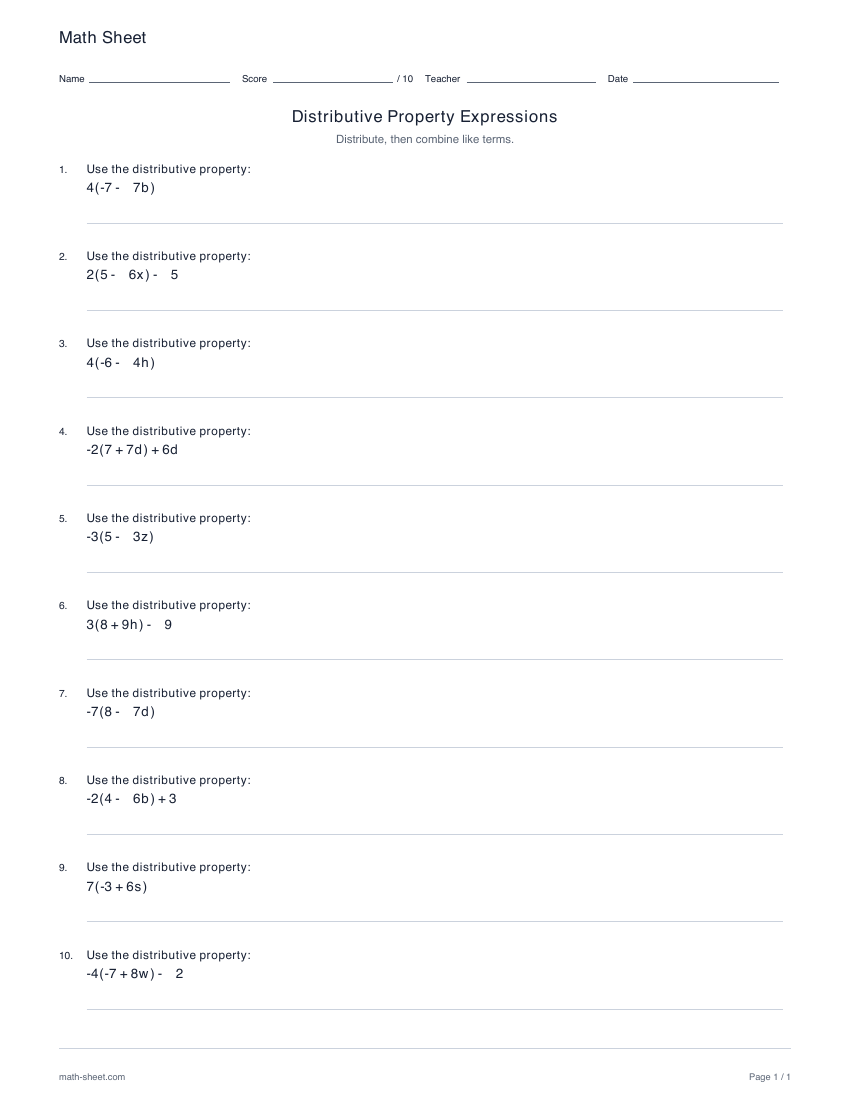
Use the distributive property and collect like terms. Each transformation must preserve the value for every allowed input.
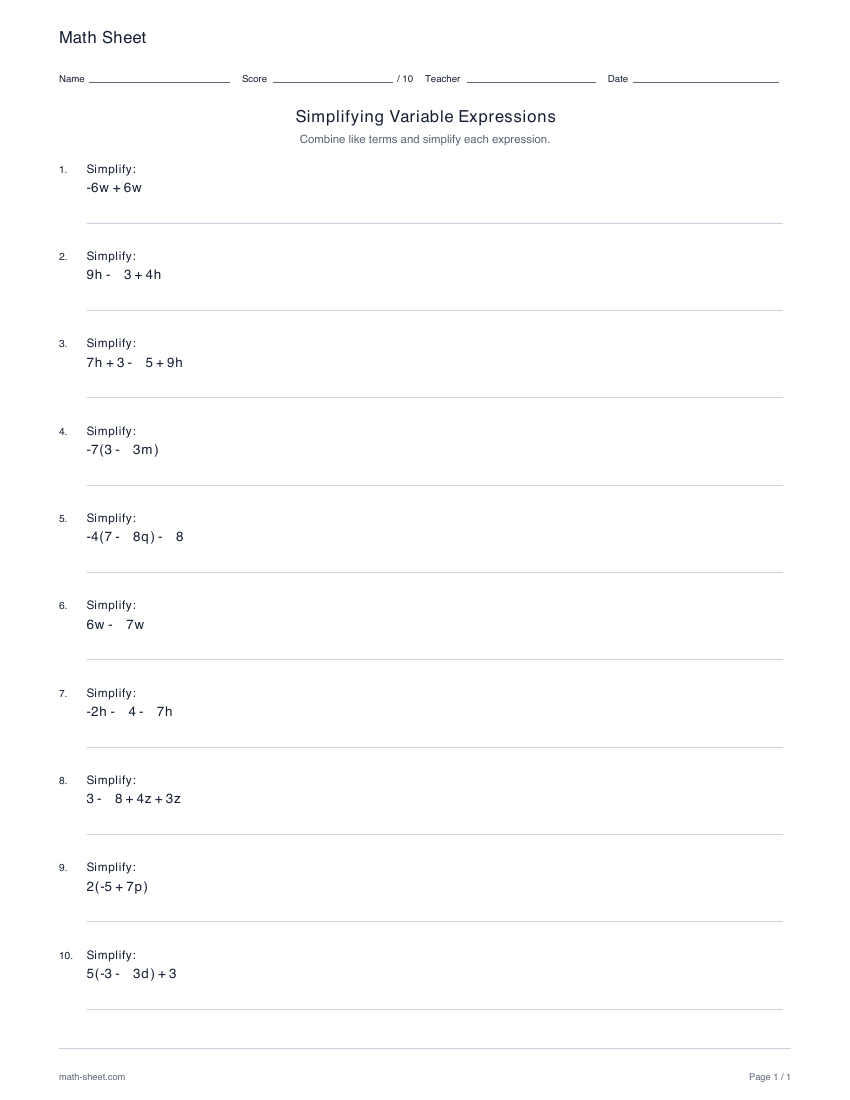
Print ten combining-like-terms questions and a separate worked key. Choose original one-variable practice or a progressive English lesson with two-variable grouping, distribution, error analysis, and perimeter.
Preview and download →
4. Substitute values and apply rules
Replace one variable, then two, with their assigned values. Use a function table to apply a consistent rule to several inputs.
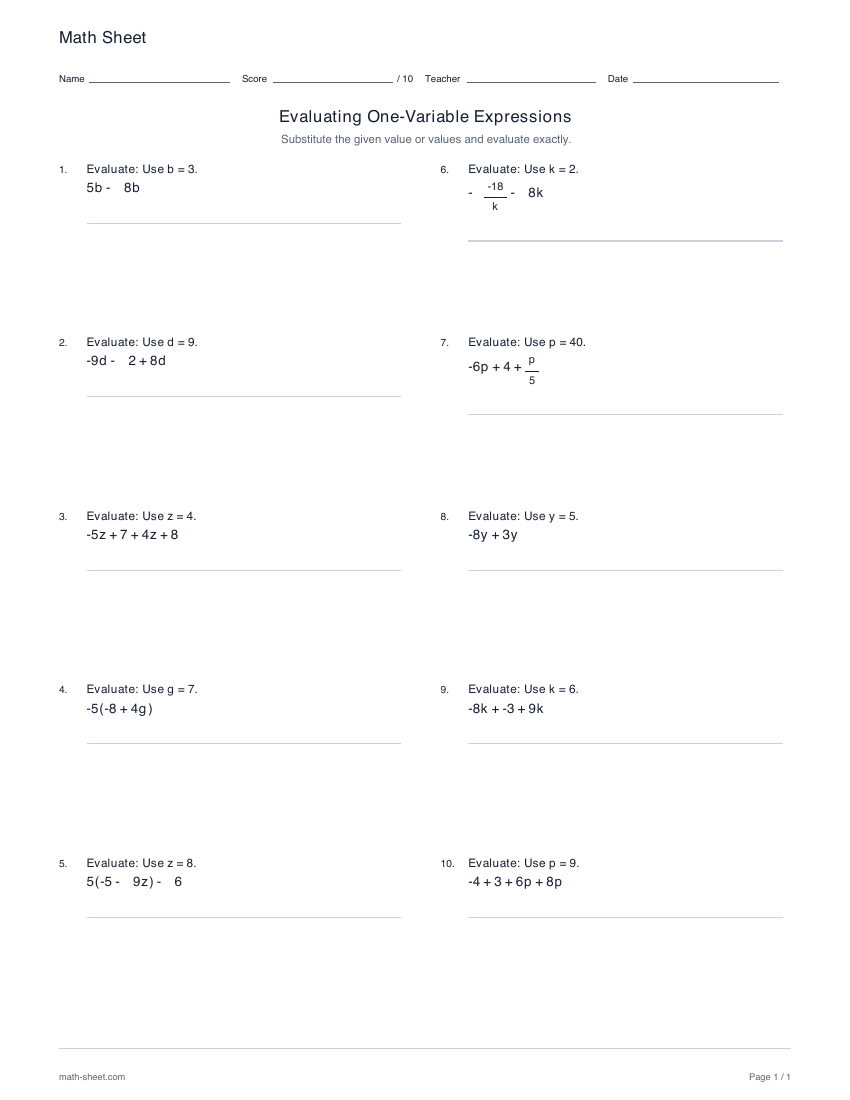
Substitute a given value and evaluate expressions with one variable. Choose addition, subtraction, grouped products or exact division, with whole-number or signed integer inputs.
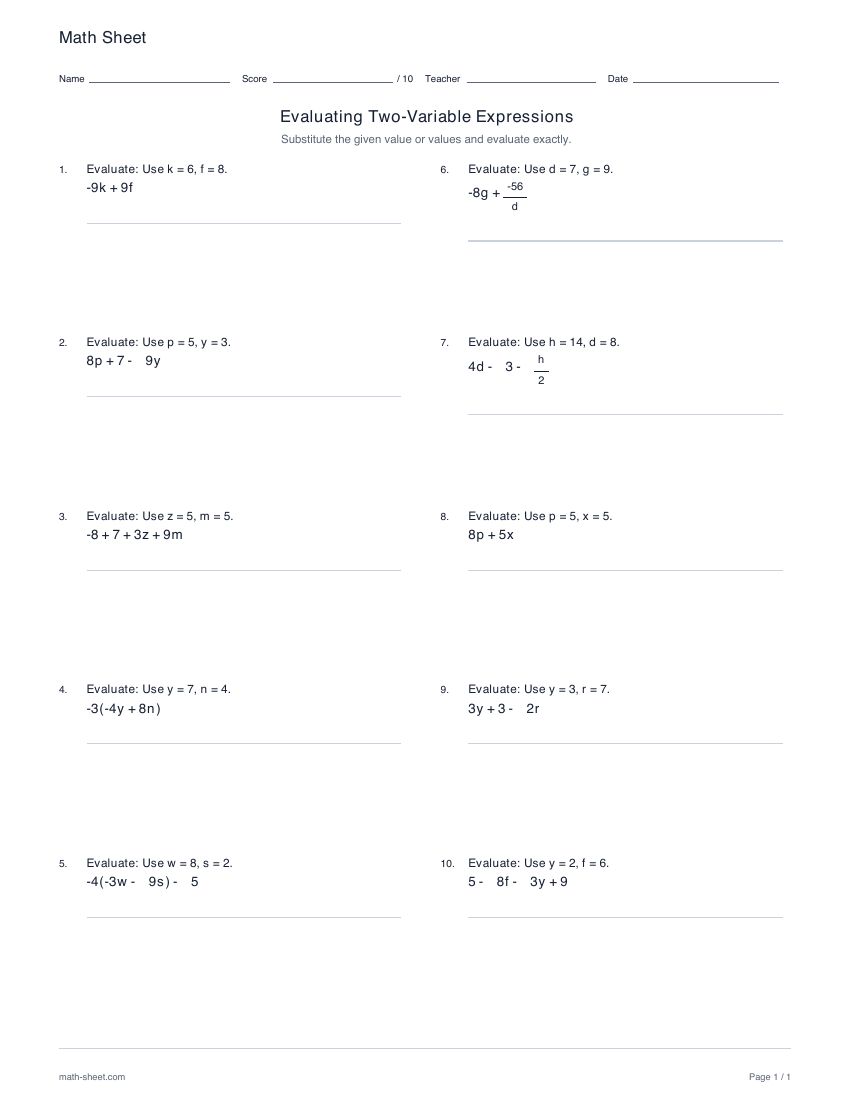
Evaluate expressions using two distinct variable values. Select sums, grouped multiplication and exact-division forms with whole numbers or integers, plus an explained answer key.
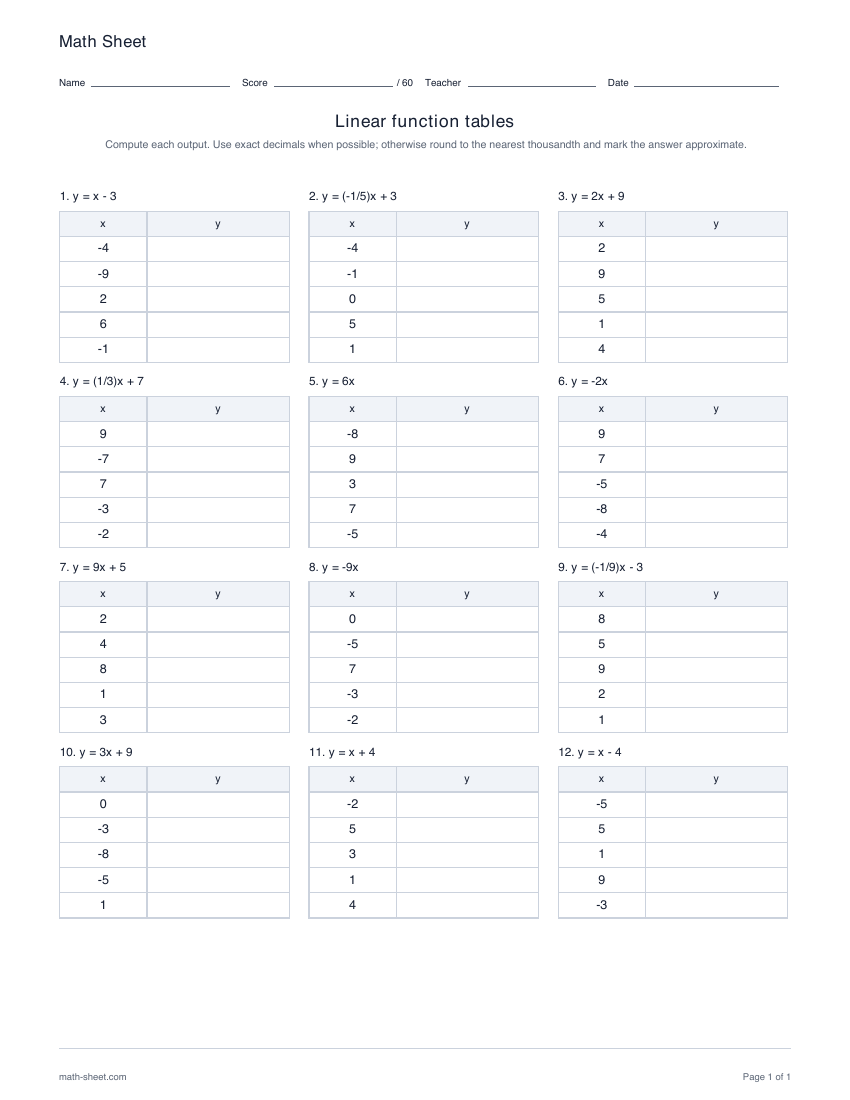
Substitute five inputs into each of twelve linear rules. Choose whole or fractional slopes, signed or nonnegative inputs, and decimal or exact fraction answers.
Preview and download →
5. Solve and check an unknown
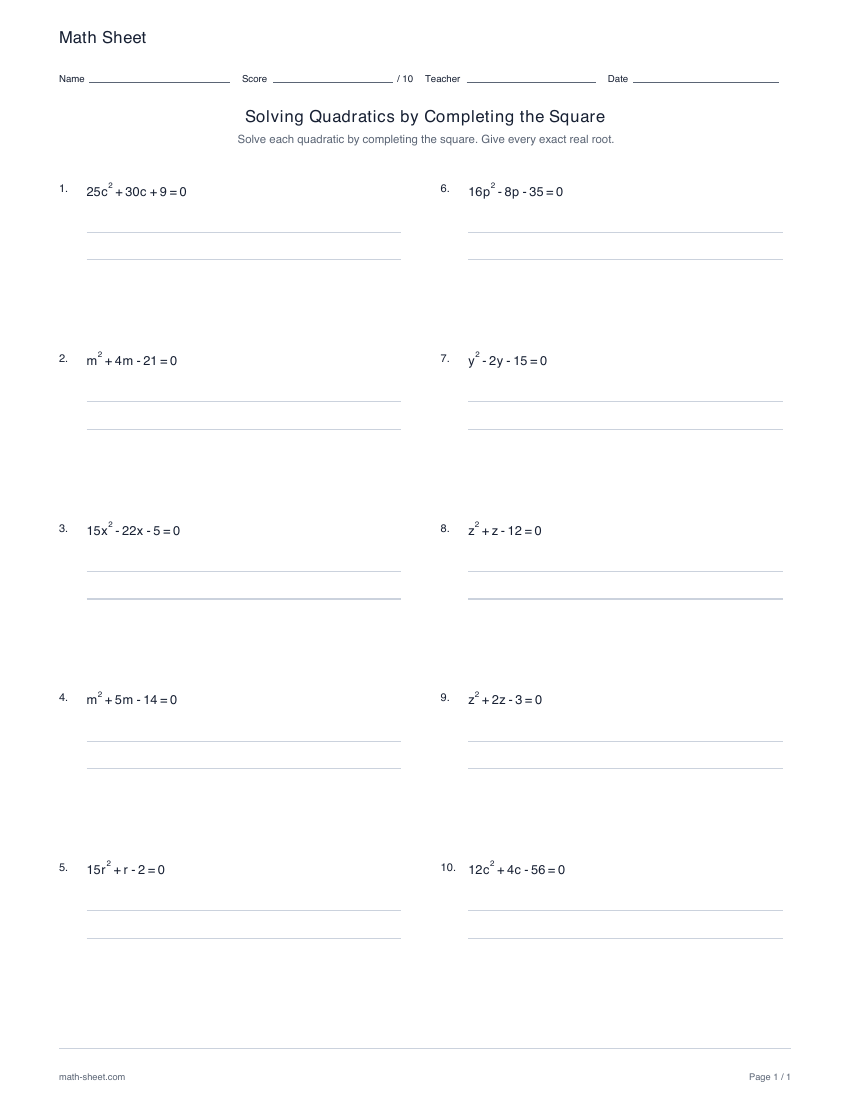
Use inverse operations, distribution and exact quadratic methods to preserve equality and find every solution. Classify equations when cancellation leaves every value or no value.
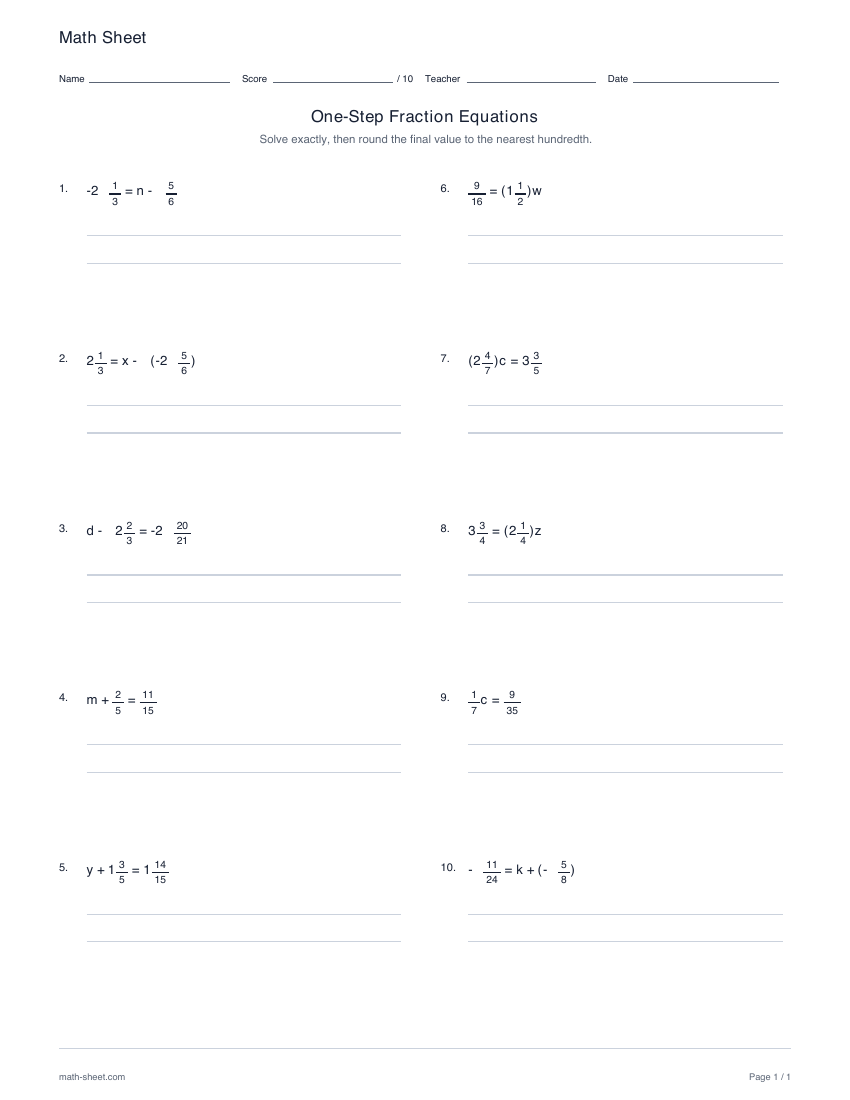
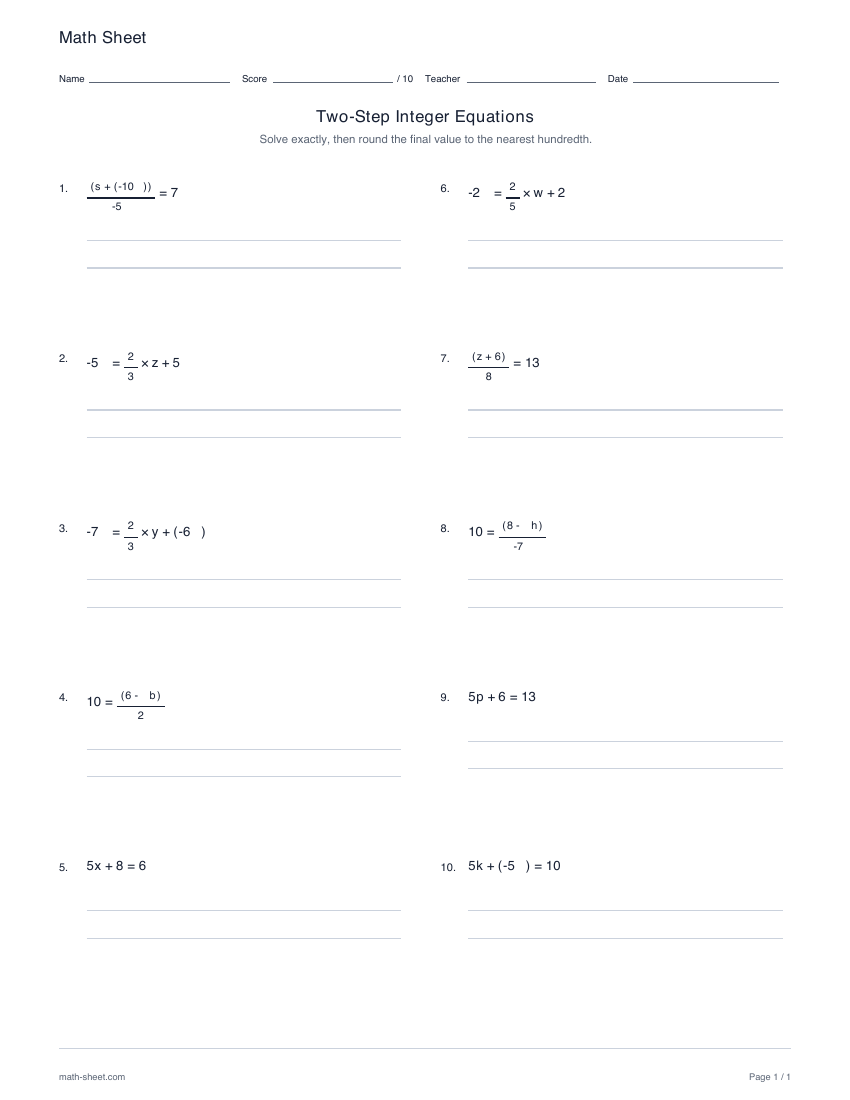
Solve ten equations containing proper fractions and signed mixed numbers. Practice fractional coefficients and inverse operations, with exact working and answers rounded to hundredths.
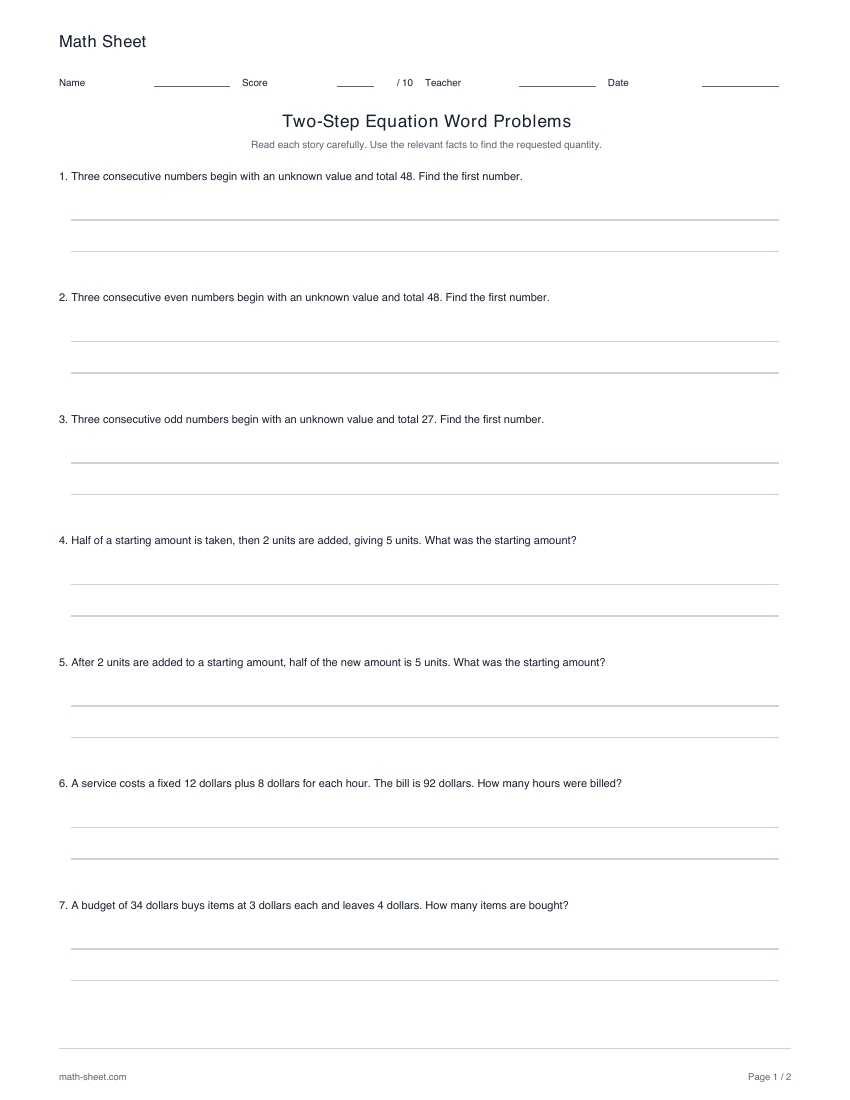
Print a 10-question two-step equations worksheet with integer quantities, fractional coefficients, grouped quotients, worked answers, and exact checks.
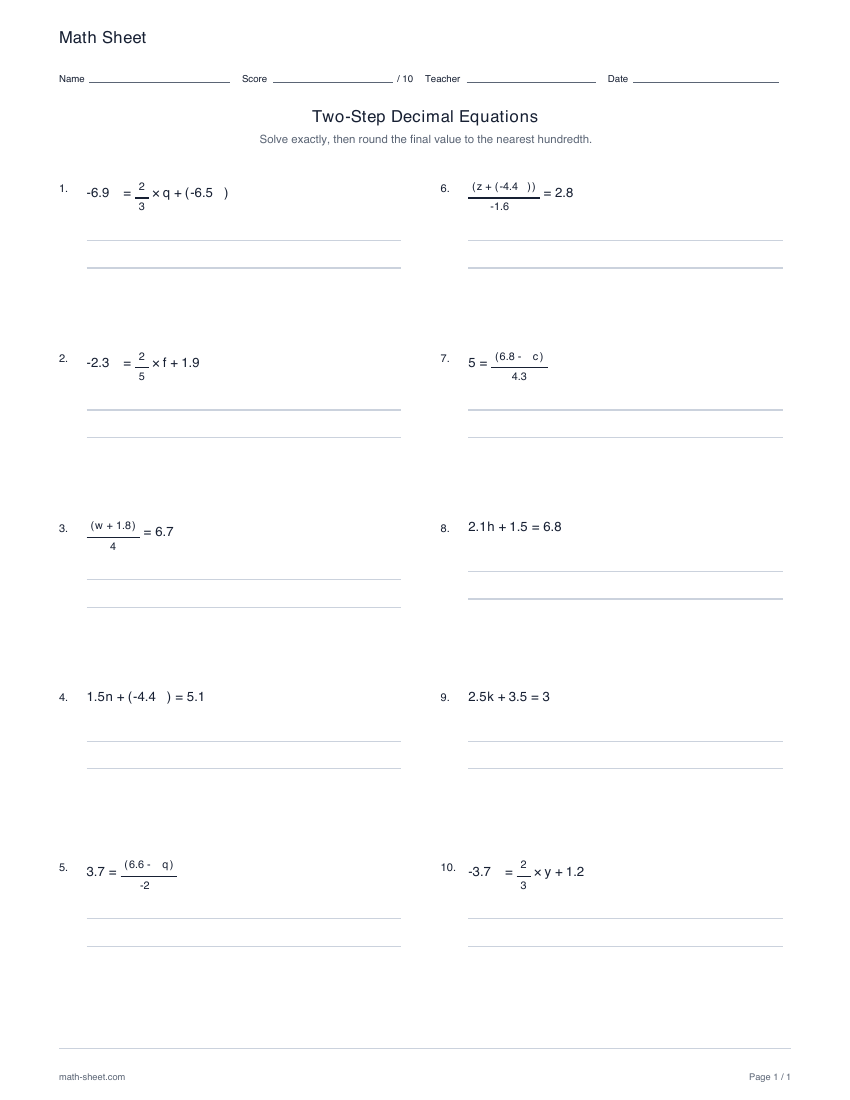
Practice ten two-step equations with decimals, fractional coefficients and grouped division. Keep exact values during the solution and round the final answer to two decimal places.
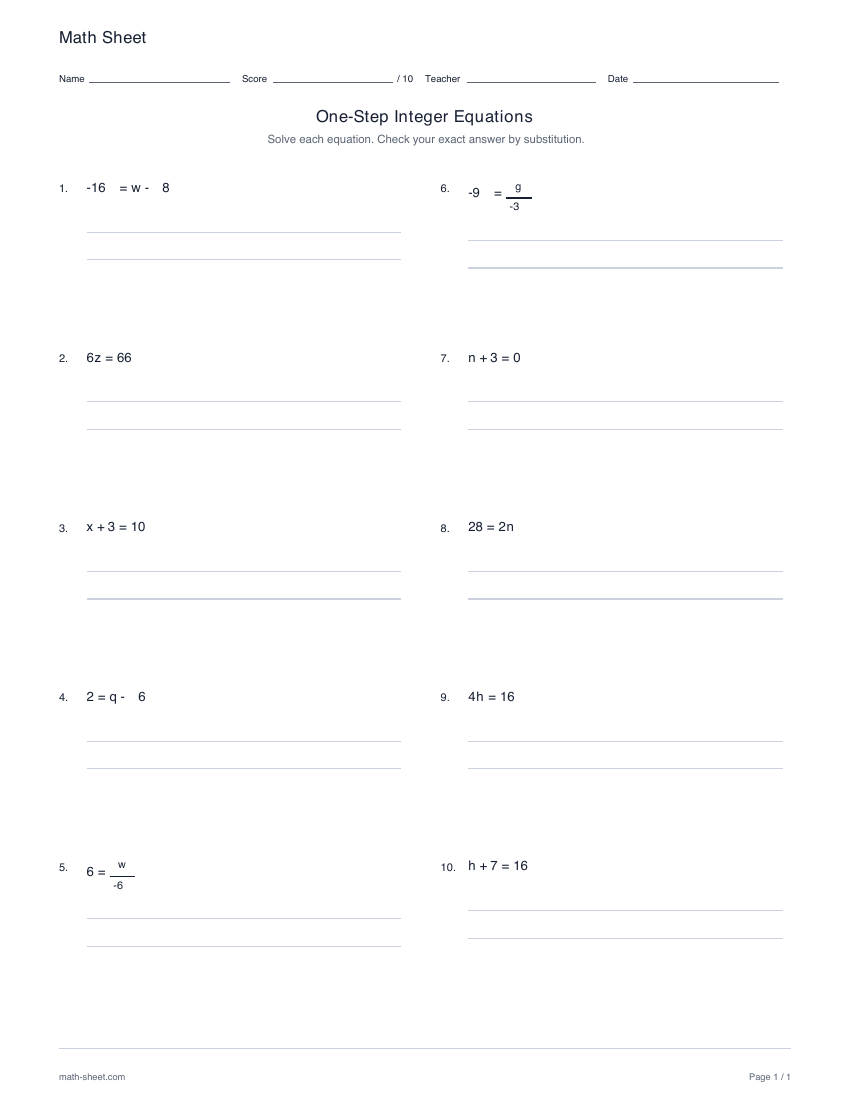
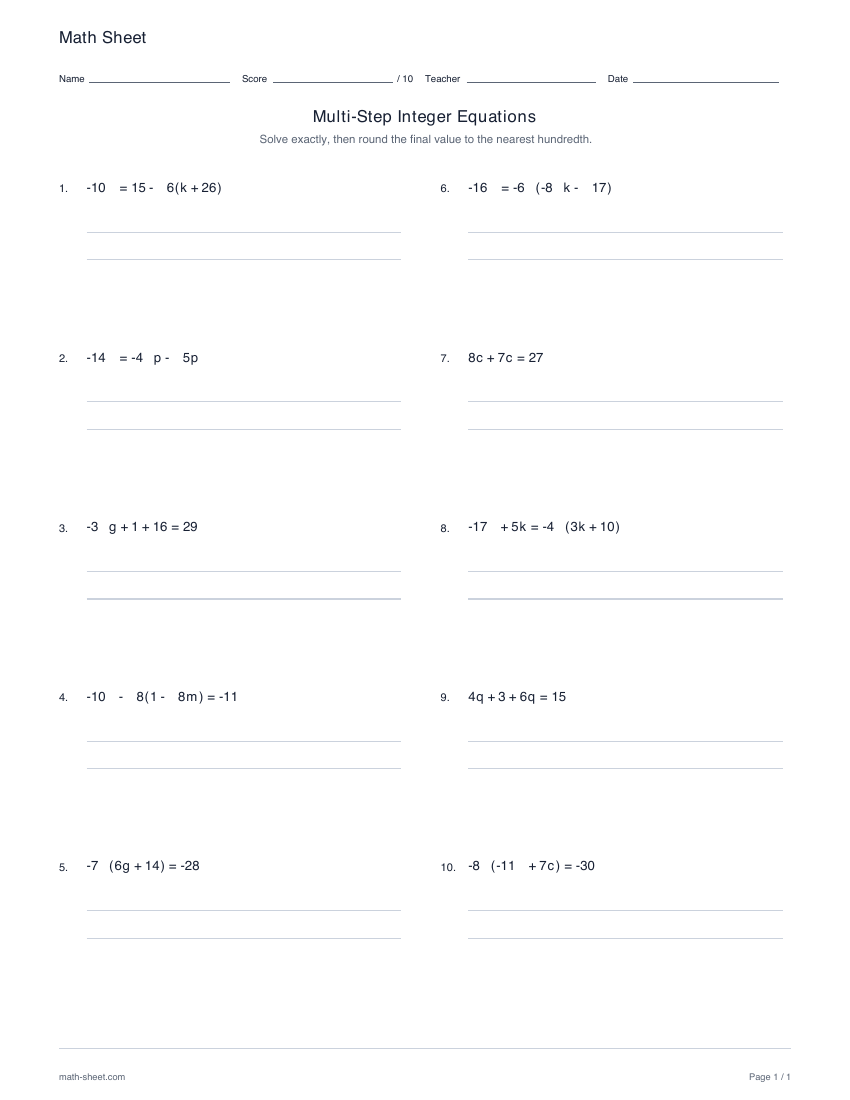
Choose from eleven equation structures for ten questions with integer operands. Practice like terms, grouped expressions and variables on either side, with exact worked solutions and separately rounded answers.
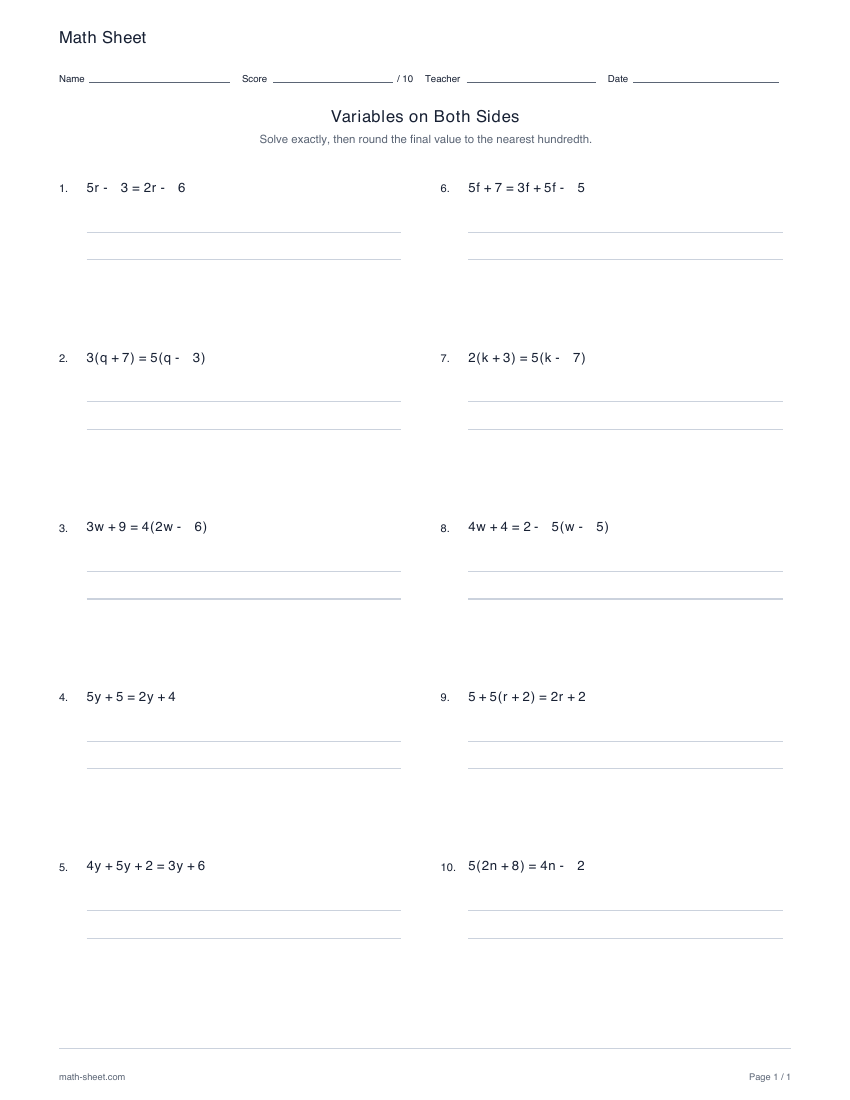
Solve ten equations with the same variable on both sides. Choose the letter policy, constant and coefficient ranges, and signed or positive-only operands, with full worked solutions.
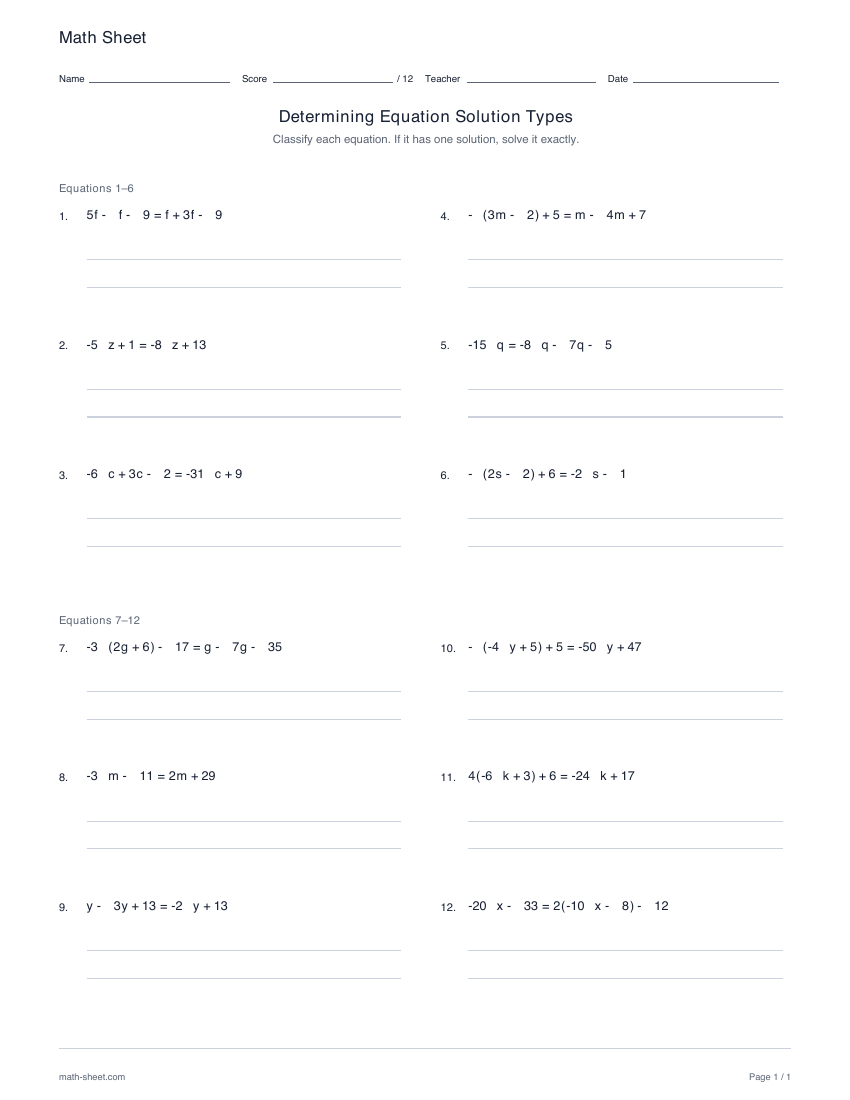
Classify twelve linear equations as having no solutions, one solution or infinitely many solutions. Choose any nonempty combination, with exact rational roots on separate keys.
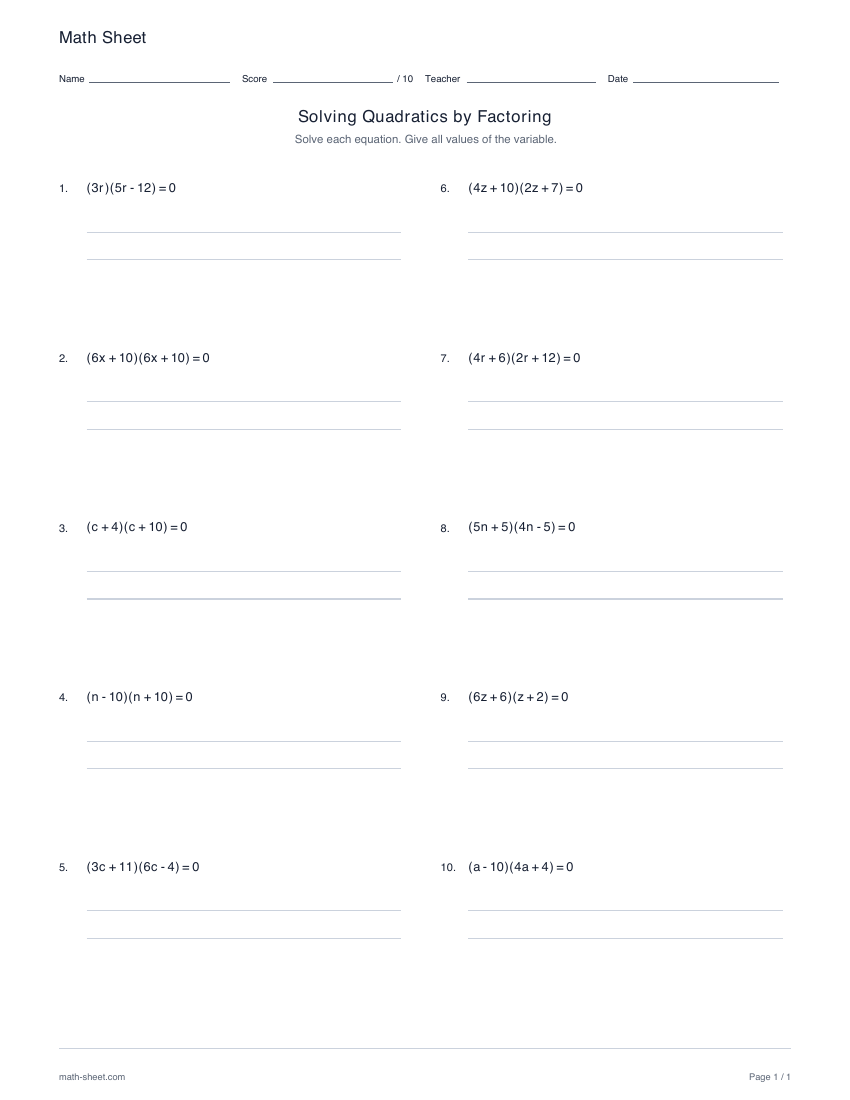
Solve ten factorable quadratic equations with complete exact root sets. Choose factored form, expanded form, rearrangement practice or a balanced mixed sheet.
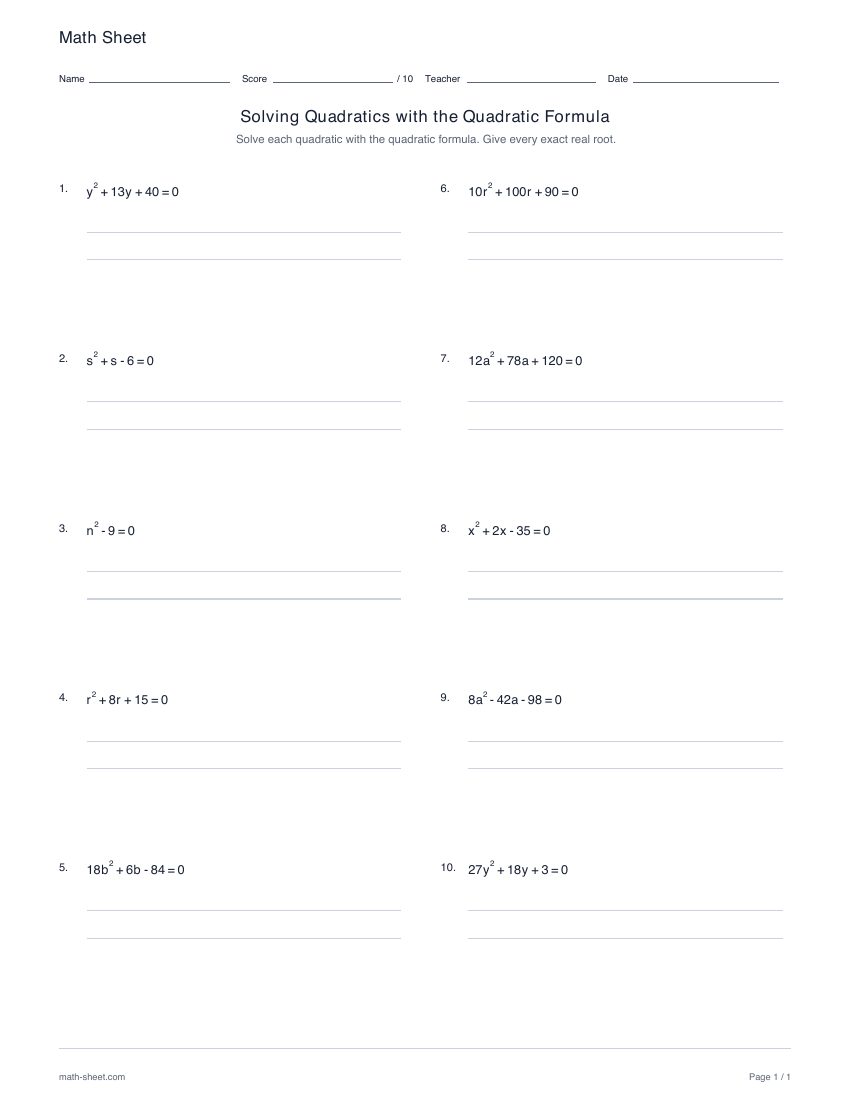
Solve ten quadratic equations with the quadratic formula. Practice original monic and nonmonic equations with rational and exact radical answers.
Preview and download →
6. Describe a set of possible values
Read open and filled endpoints, connect comparisons with number-line rays, then solve with inverse operations. Explain why multiplying or dividing by a negative number reverses order.
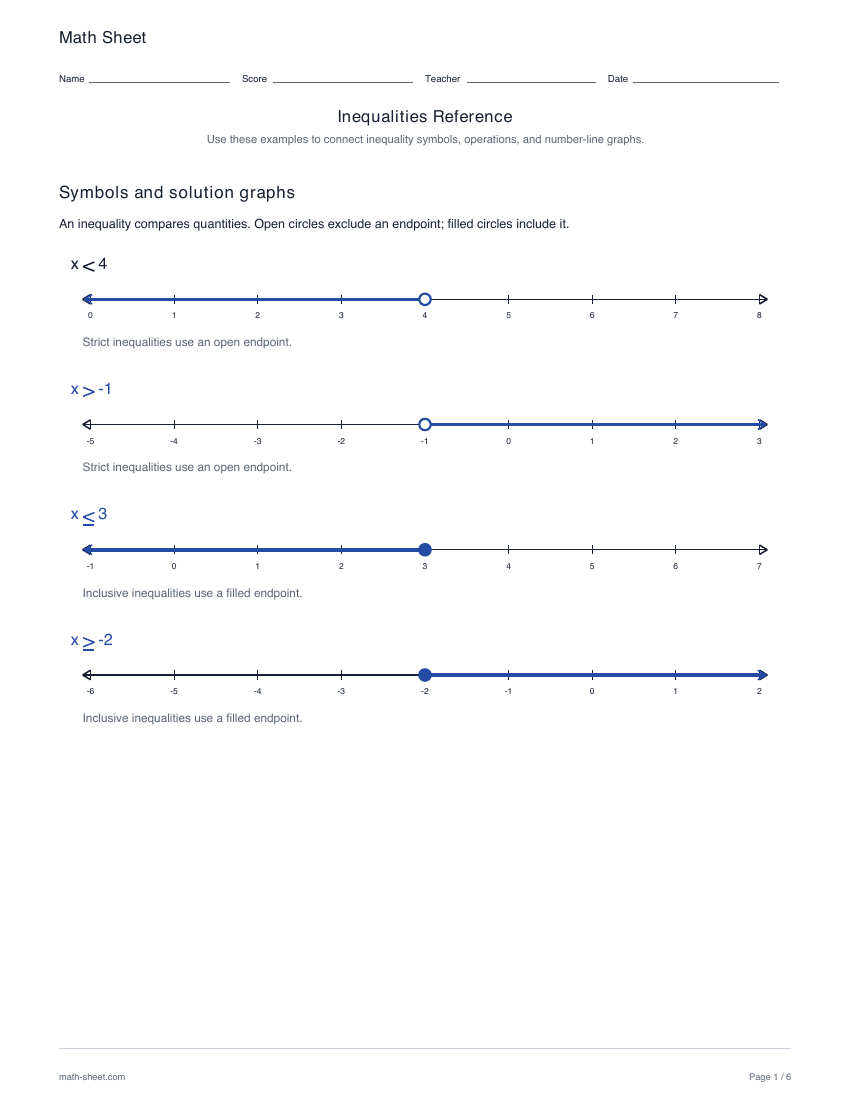
Print a complete guide to inequality symbols, number-line graphs and equivalent transformations. Explore addition, subtraction, signed multiplication and division, and transitive comparisons with examples.
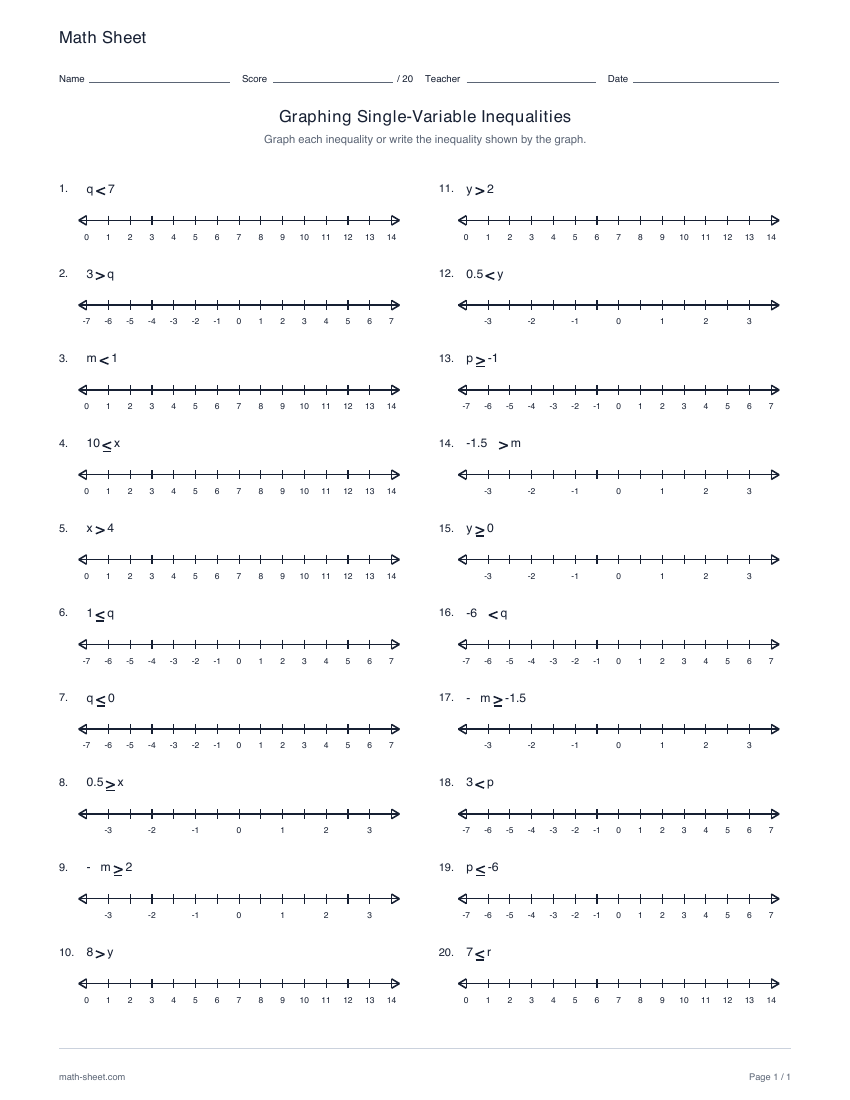
Translate between an inequality and a number-line graph in twenty questions. Choose whole numbers, signed integers or halves; draw graphs, read graphs or mix both tasks, with a separate key.
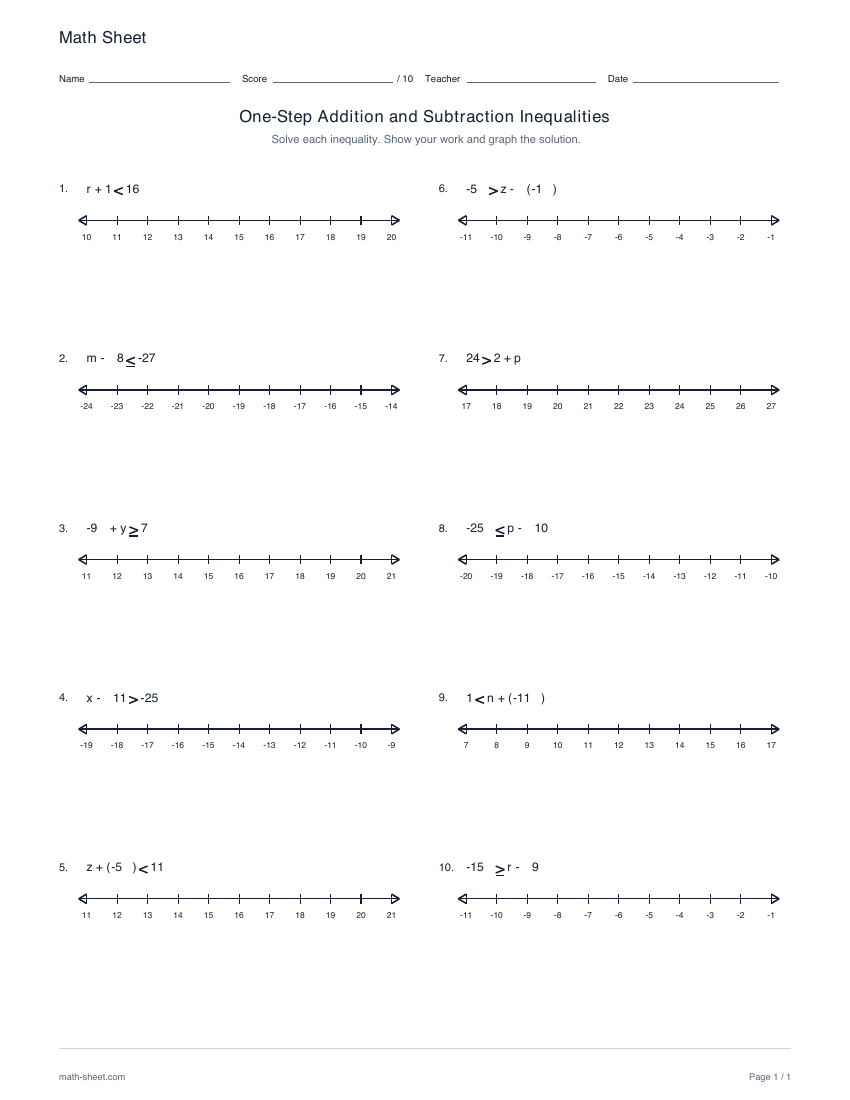
Solve and graph ten one-step inequalities using addition or subtraction. Practice expressions on either side, choose comparison symbols and print a worked solution key.
Solve and graph ten one-step inequalities with signed coefficients and divisors. Learn when to reverse the comparison, using exact integer boundaries and explained answer keys.
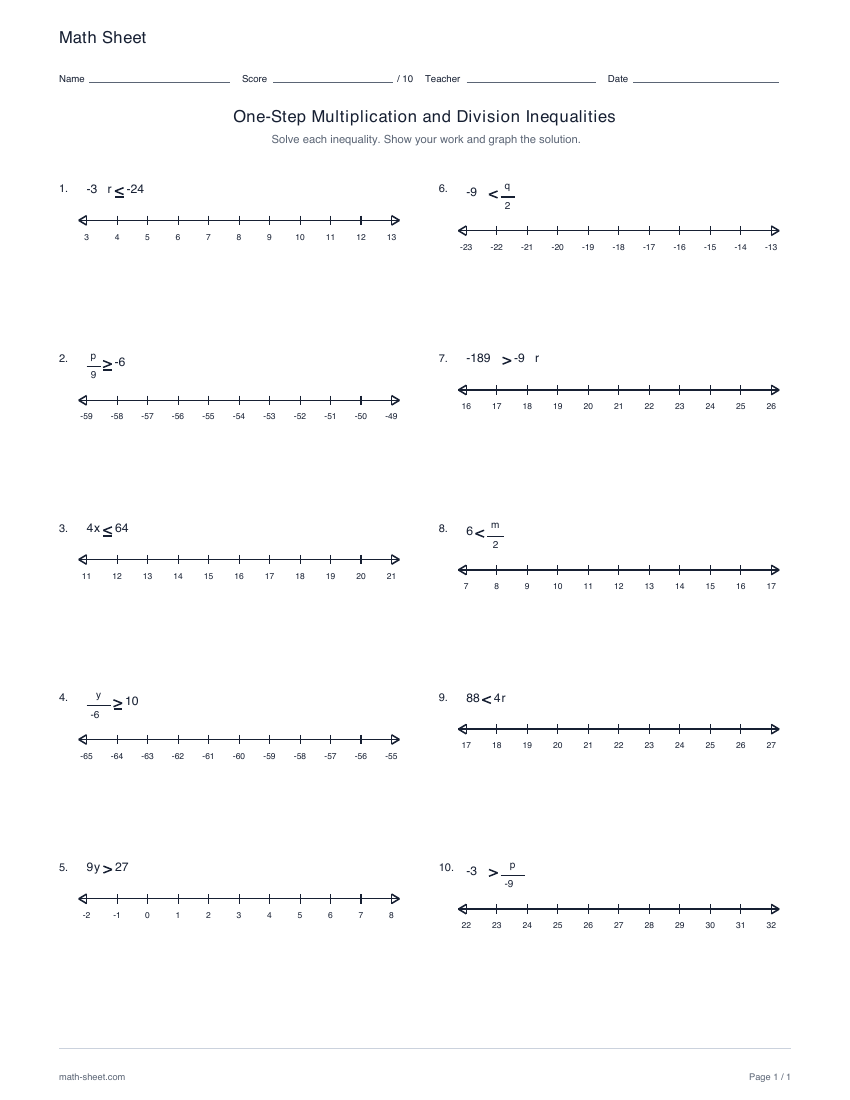
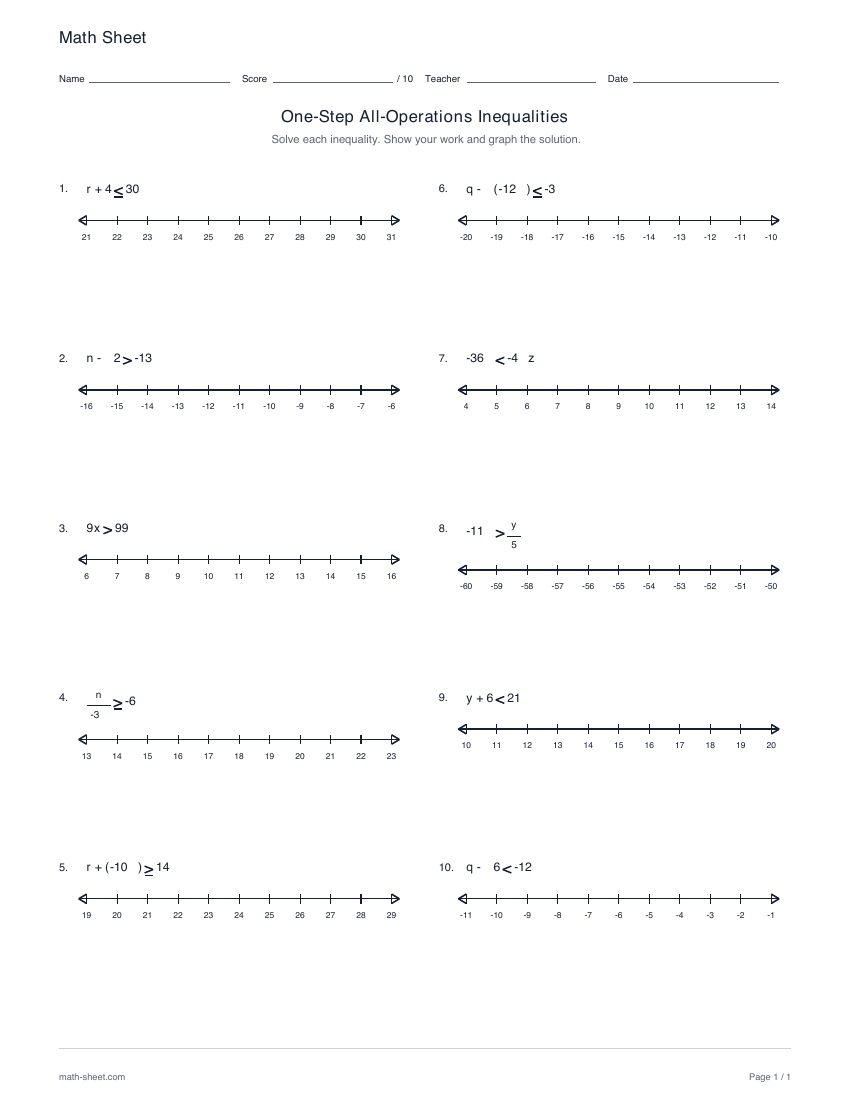
Solve and graph ten one-step inequalities in one mixed set: three addition, three subtraction, two multiplication and two division questions. Choose the prompt relationships and print separate worked answers.
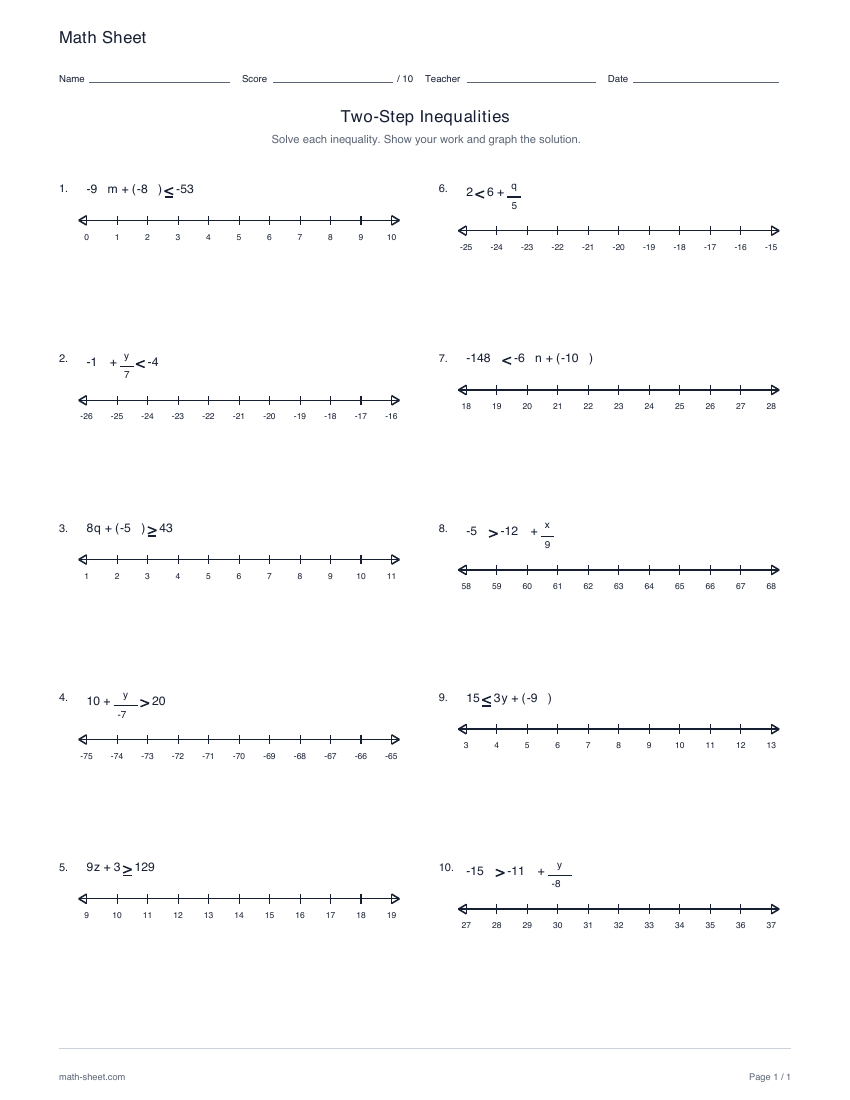
Solve and graph ten two-step inequalities with signed coefficients, constants and variable quotients. Keep boundaries exact and use the worked key to follow each equivalent transformation.
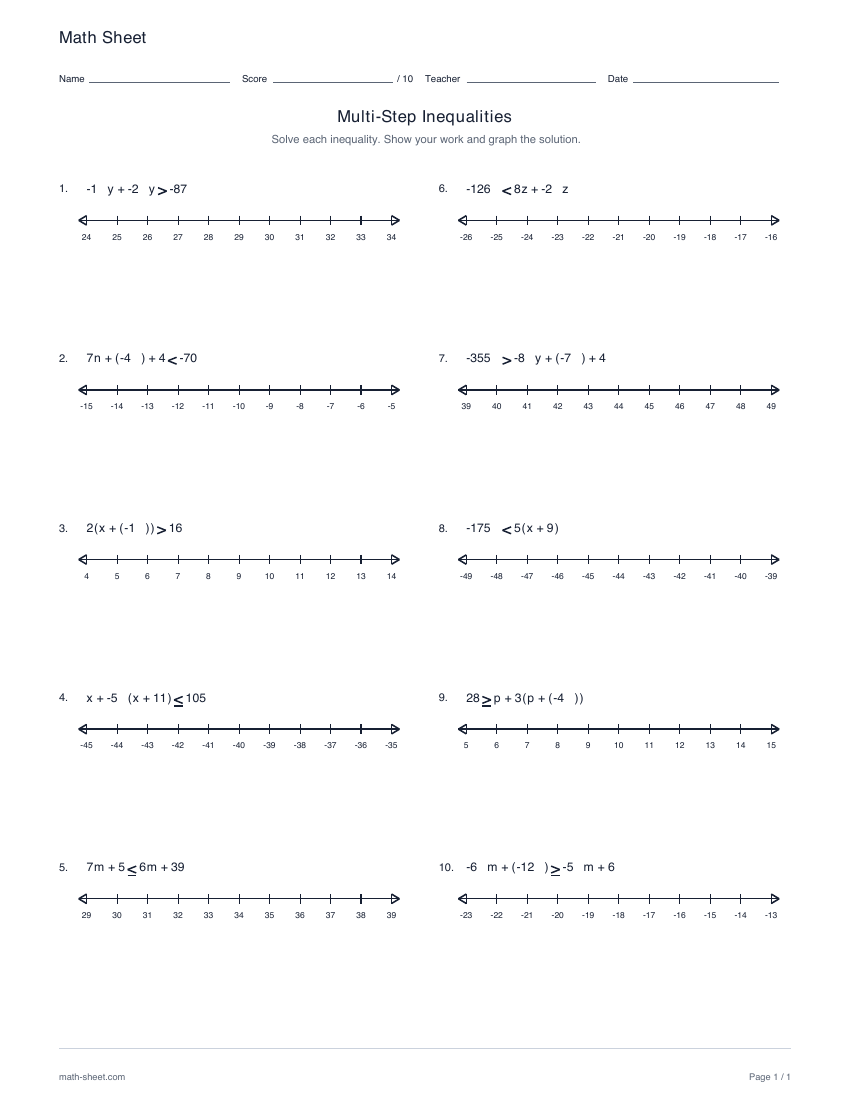
Distribute factors, combine like terms and solve ten linear inequalities with variables on either or both sides. Print exact solutions, explained sign reversals and number-line graphs.
Preview and download →
7. Work with polynomial structure
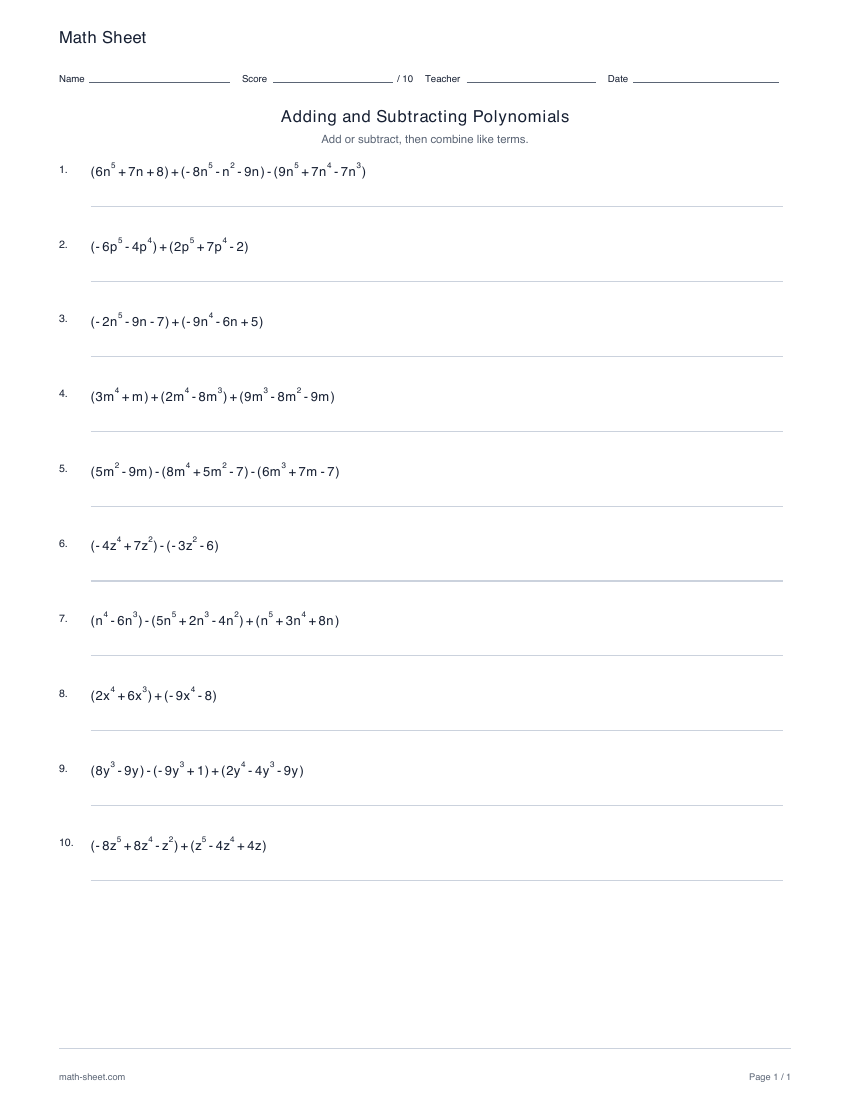
Count terms, compare degrees, factor expressions, complete squares, and carry out exact polynomial operations including division.
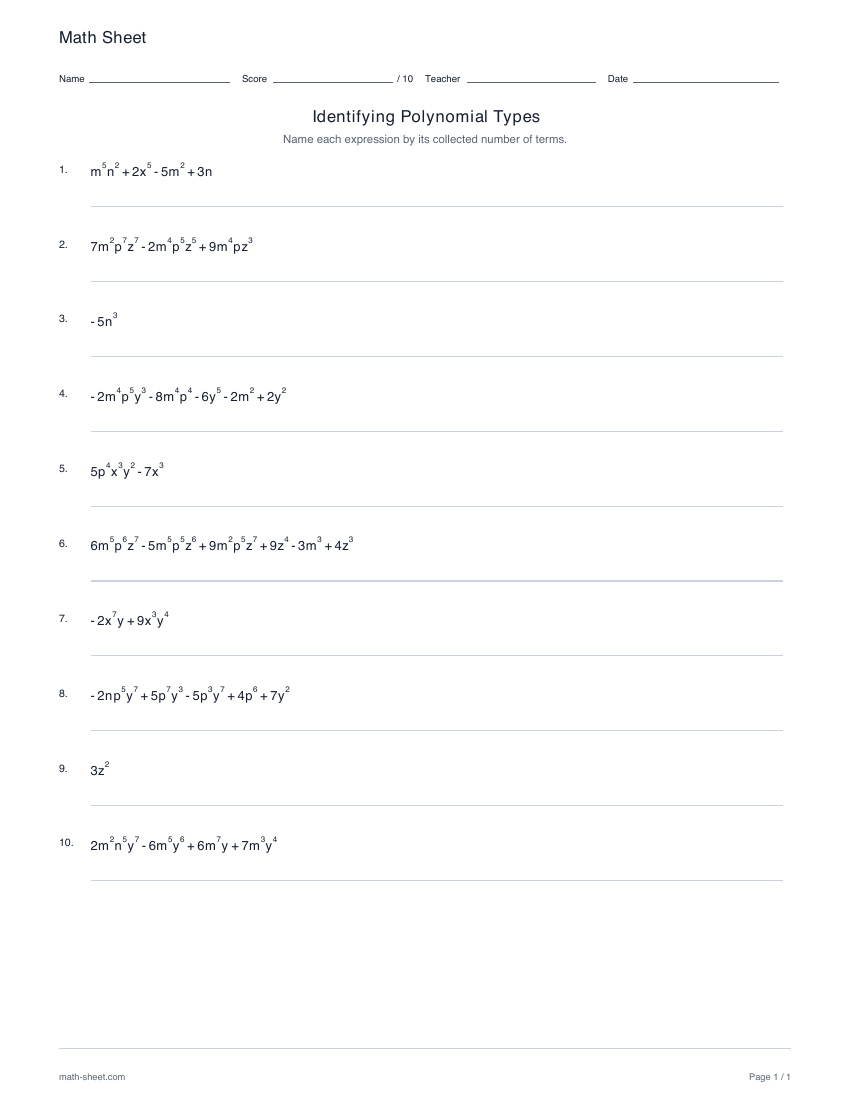
Classify ten expressions by their number of terms. Choose one through six terms and use a separate worked key to distinguish monomials, binomials, trinomials and longer polynomials.
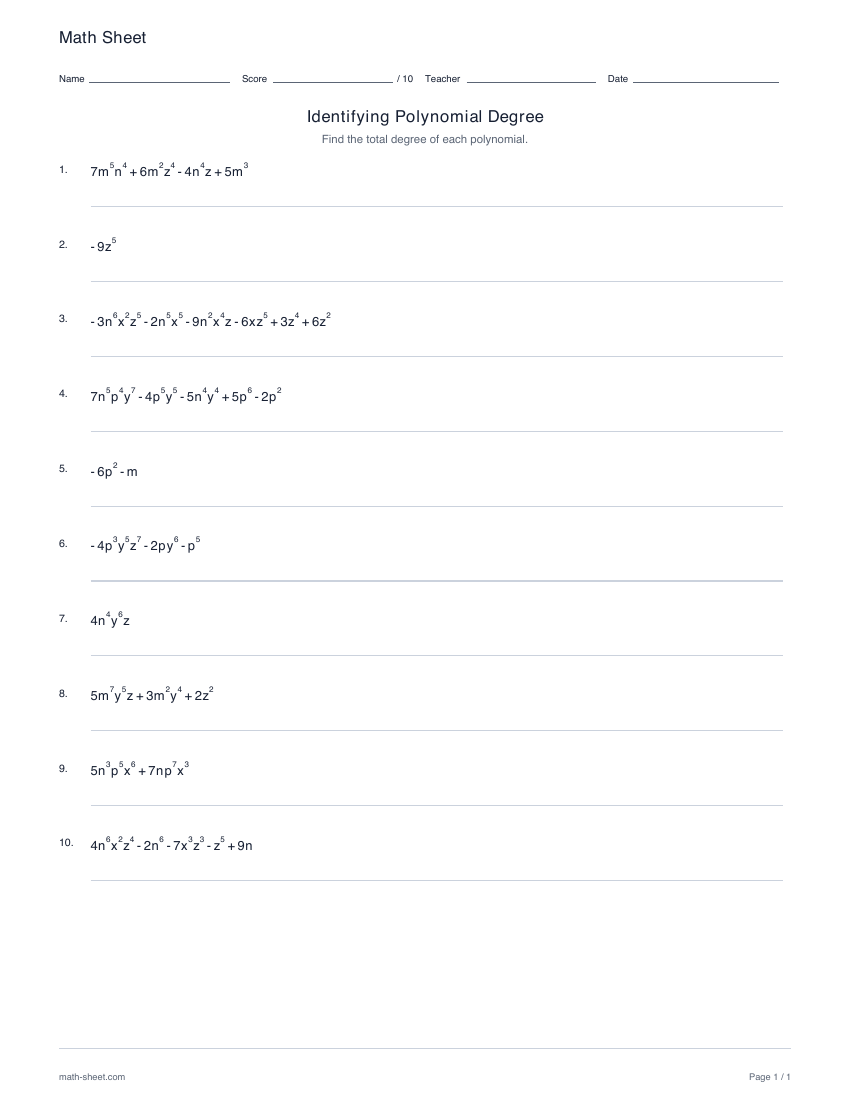
Find the degree of ten monomials and polynomials. Select one through six terms, compare term degrees and check a separate key with the exponent calculations.
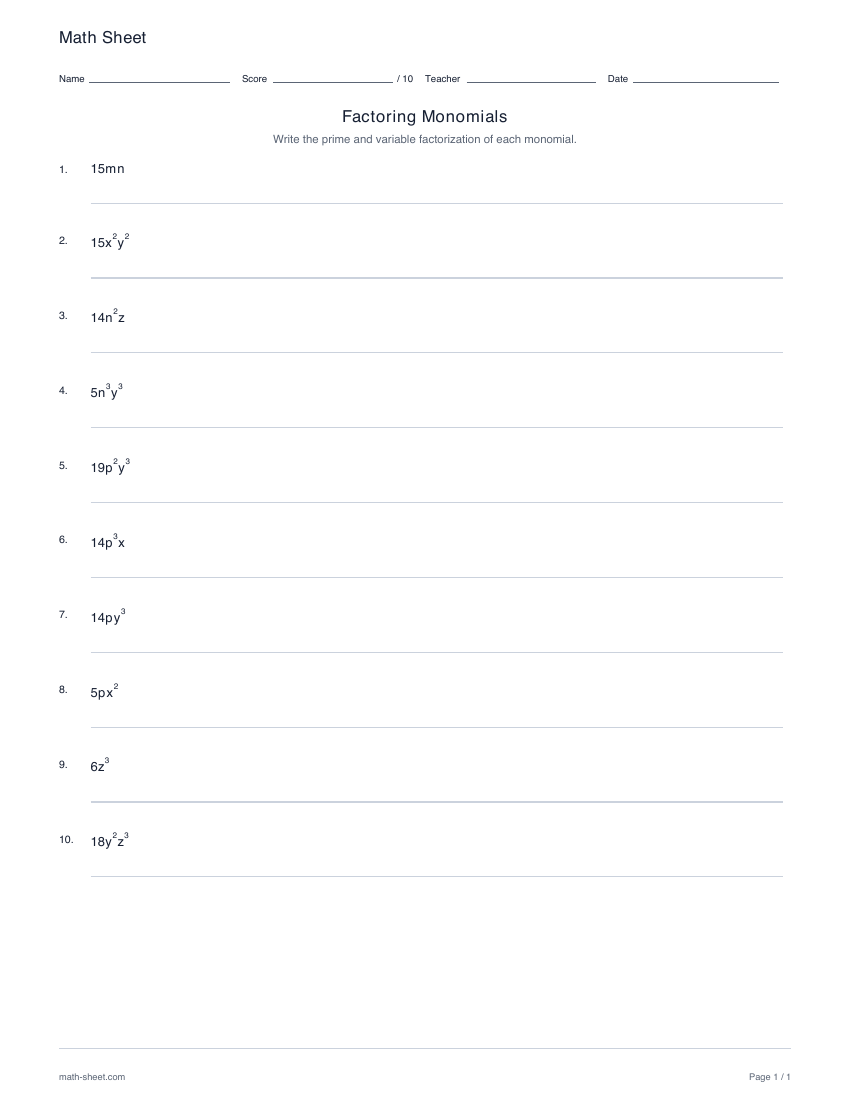
Factor ten monomials into primes and variable factors. Choose expression structures, coefficient ranges and repeated factors or prime-power notation, with exact worked answers.
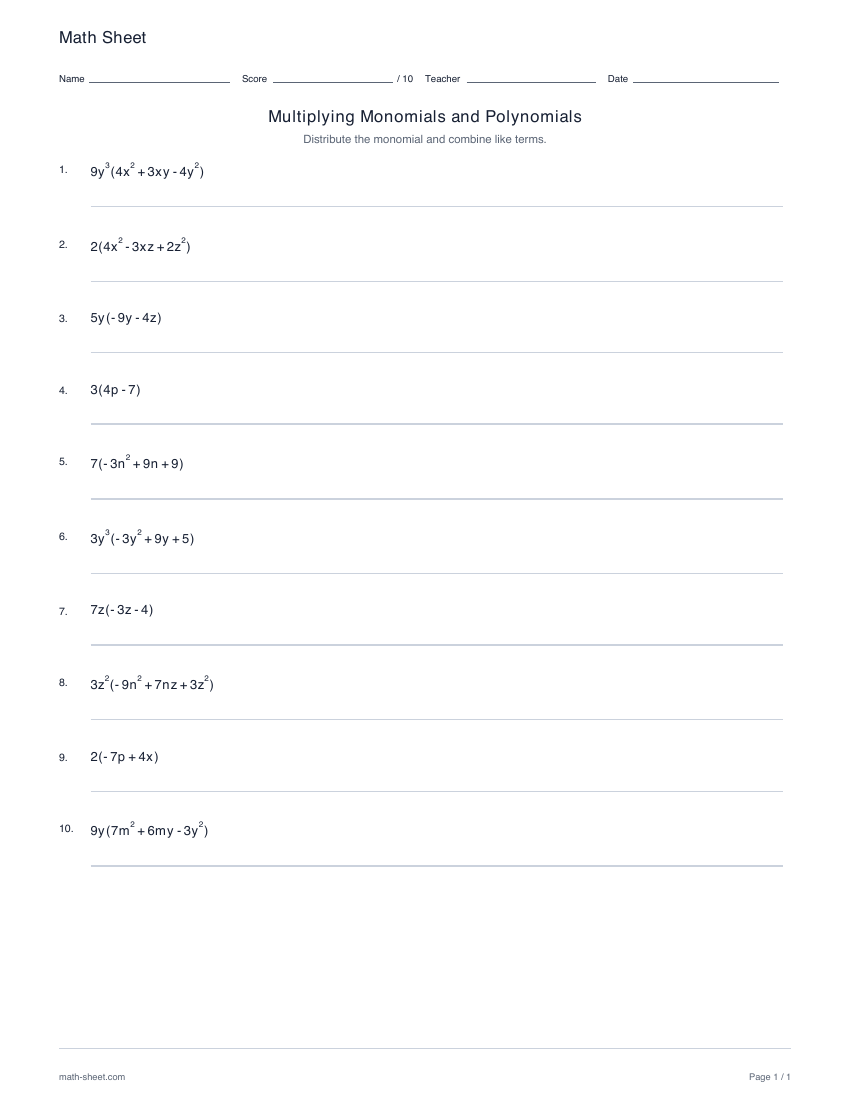
Distribute a monomial across a polynomial in ten problems. Select from twelve expression structures, keep powers and signs exact, and check a separate worked answer key.
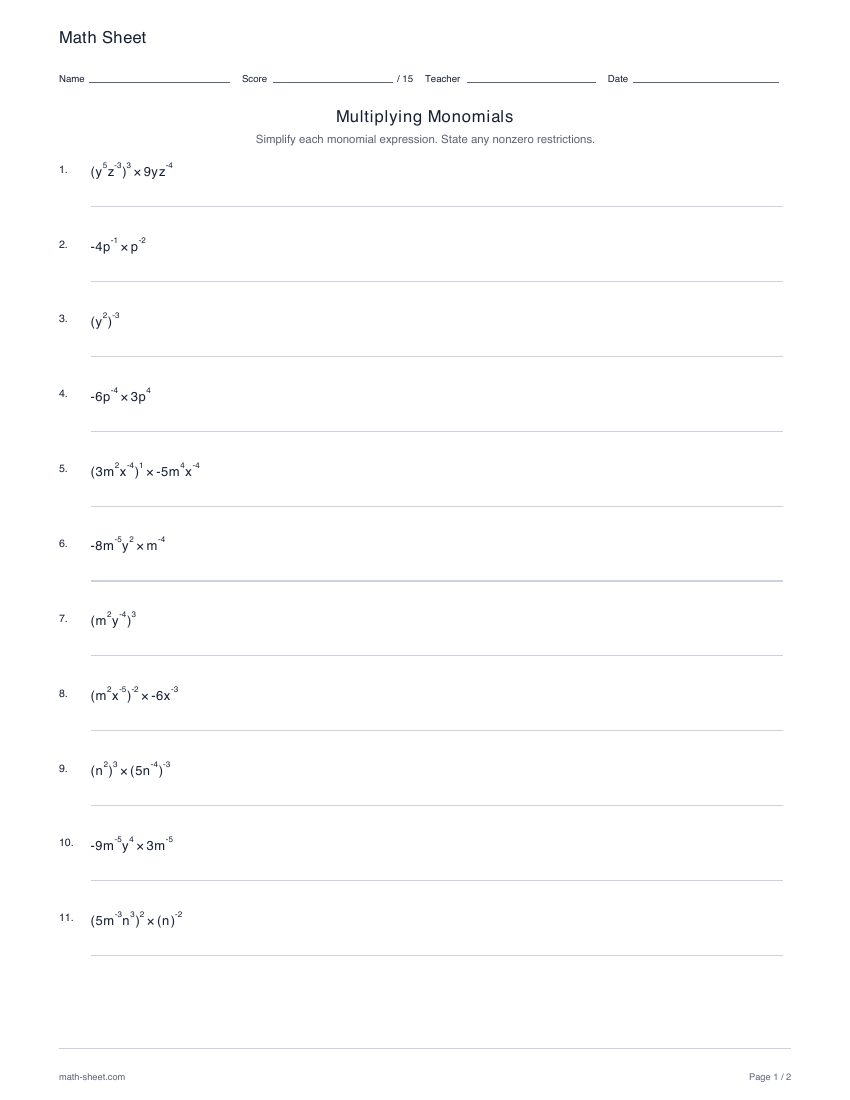
Simplify products and powers of monomials. Choose from 48 structures, positive or negative exponents and coefficients, and 12, 15 or 18 problems with exact answers.
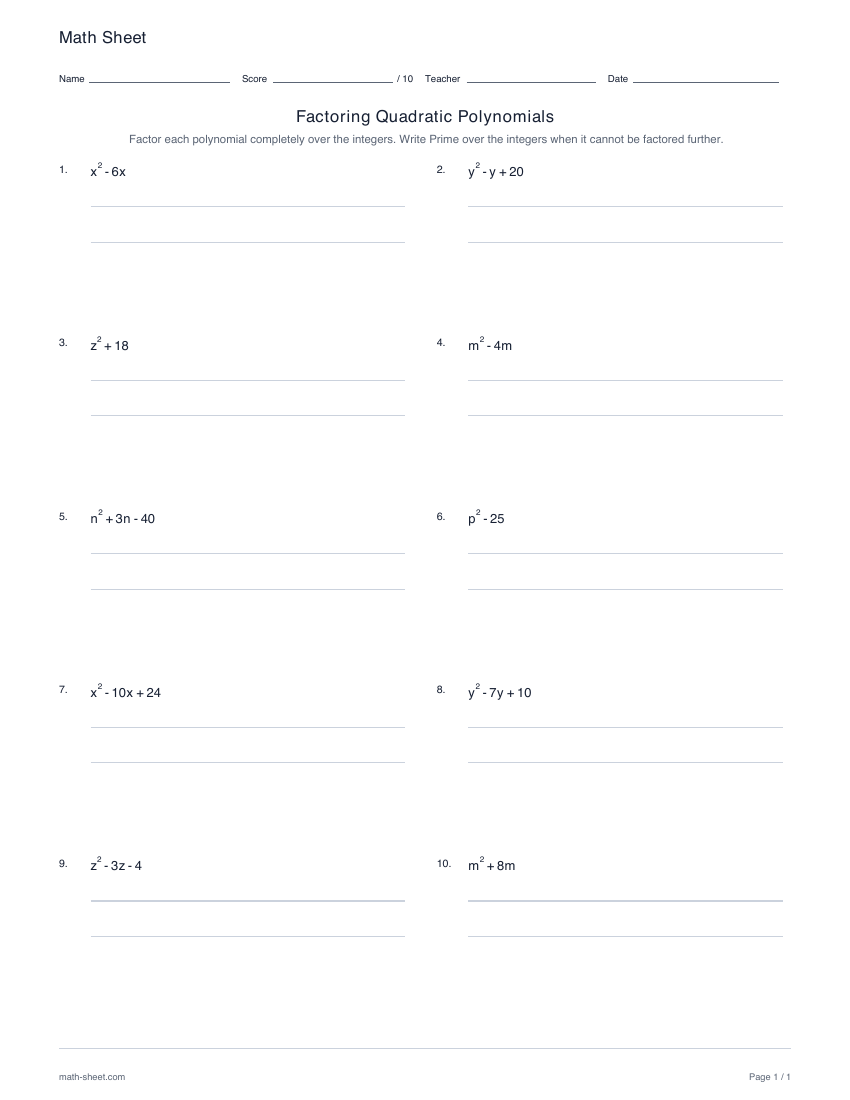
Factor ten quadratic binomials and trinomials completely over the integers. Choose factorable-only practice or include two prime quadratics, and vary monic and nonmonic leading coefficients.
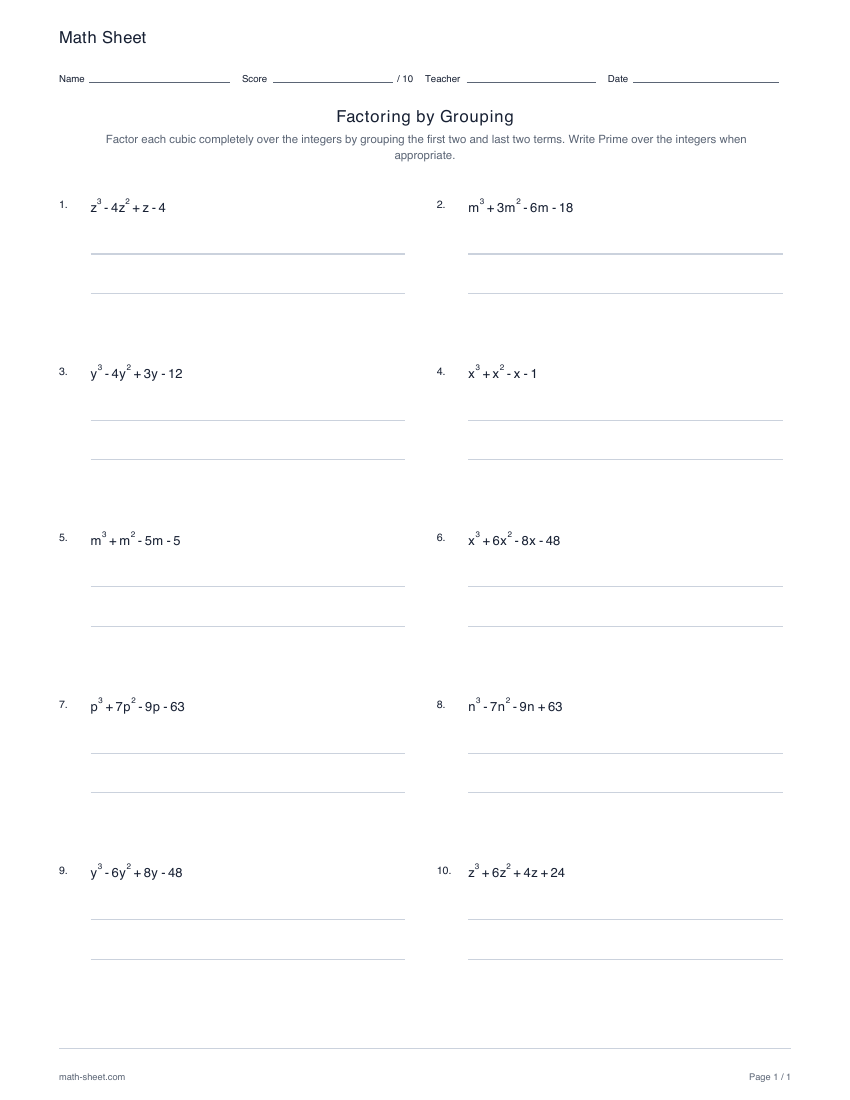
Factor ten four-term cubics completely over the integers. Choose displayed monic, nonmonic or mixed leading coefficients and factorable-only practice or a set with three primitive prime cubics.
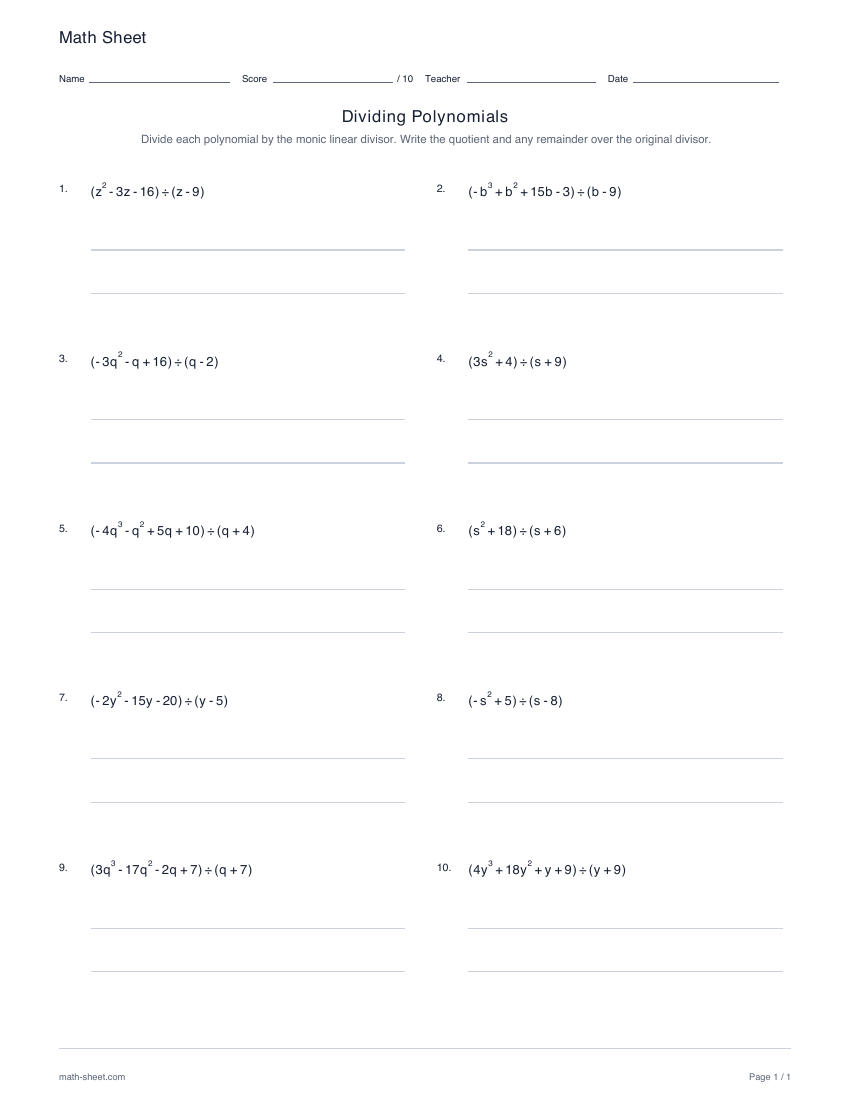
Divide polynomials by monic linear divisors in ten expression problems or six long-division problems. Choose binomial, trinomial, four-term or mixed dividends and check exact quotient-and-remainder keys.
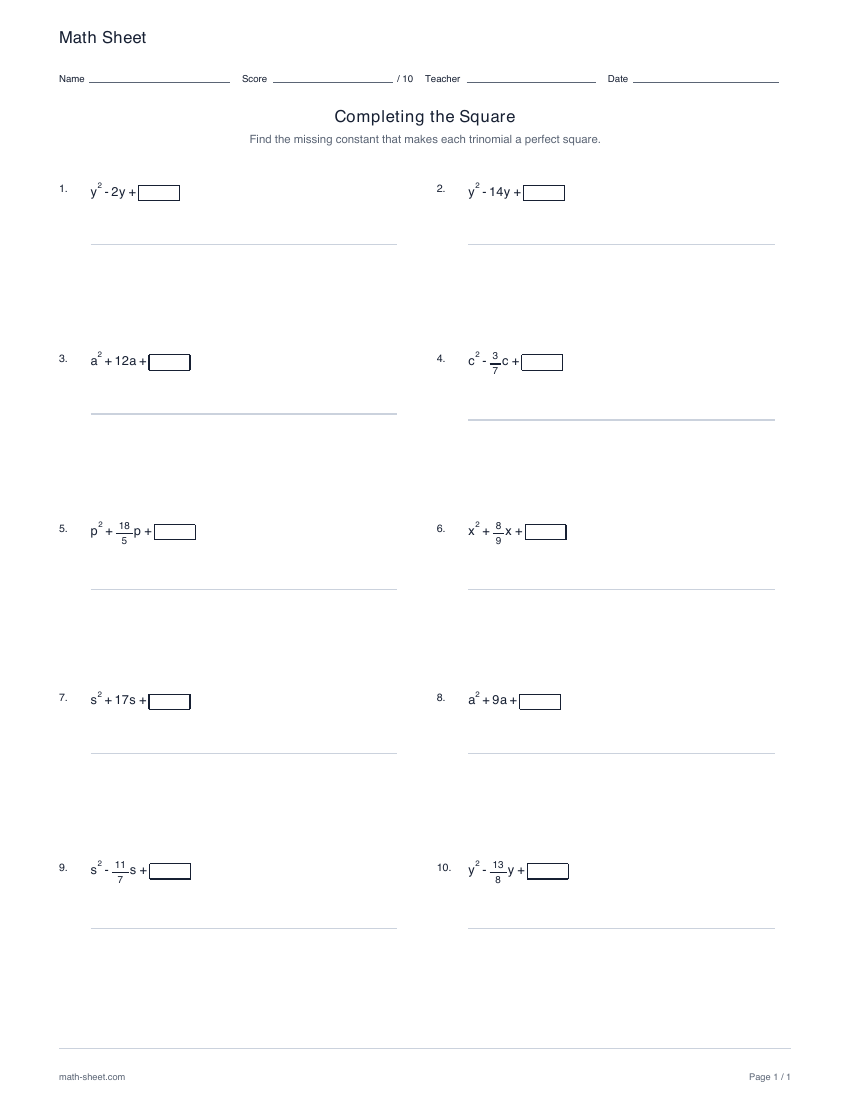
Find the missing constant in ten monic quadratic trinomials. Choose whole, fractional or mixed linear coefficients and check exact reduced answers.
Preview and download →
8. Connect equations with coordinate graphs
Classify relations, read their domains and ranges, then find slope, intercepts and equations. Extend from lines to the vertex and symmetry of a quadratic.
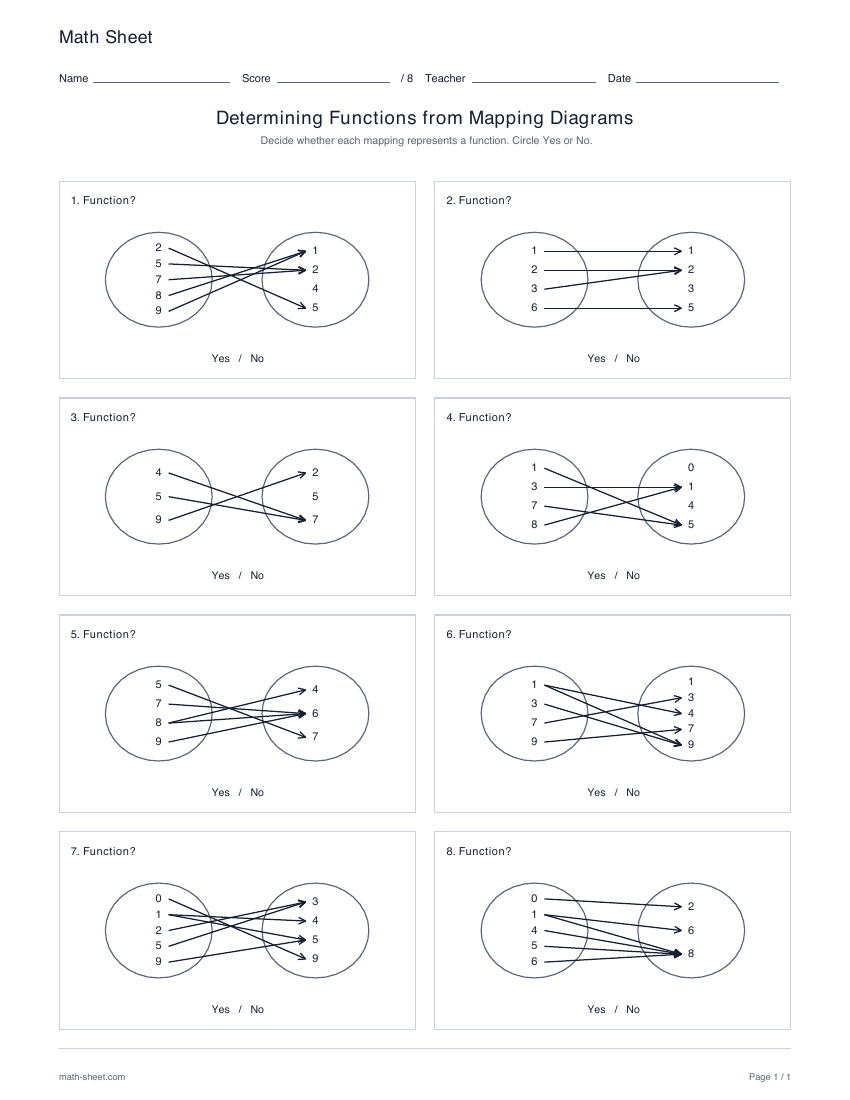
Classify eight mapping diagrams as functions or nonfunctions. Choose two to five numeric or letter values on each side, with four of each classification and a separate answer key.
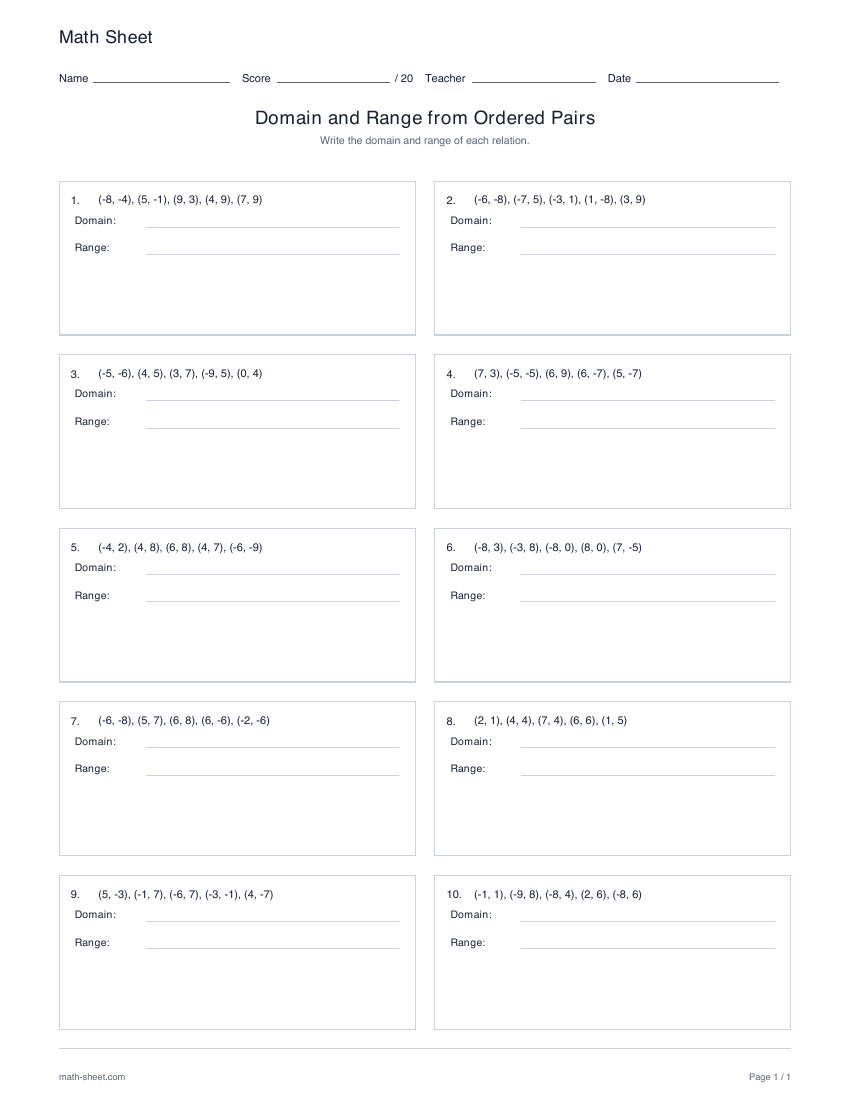
Find the domain and range of ten five-pair relations. Choose negative or nonnegative coordinates, control repeats independently and optionally classify each relation as a function.
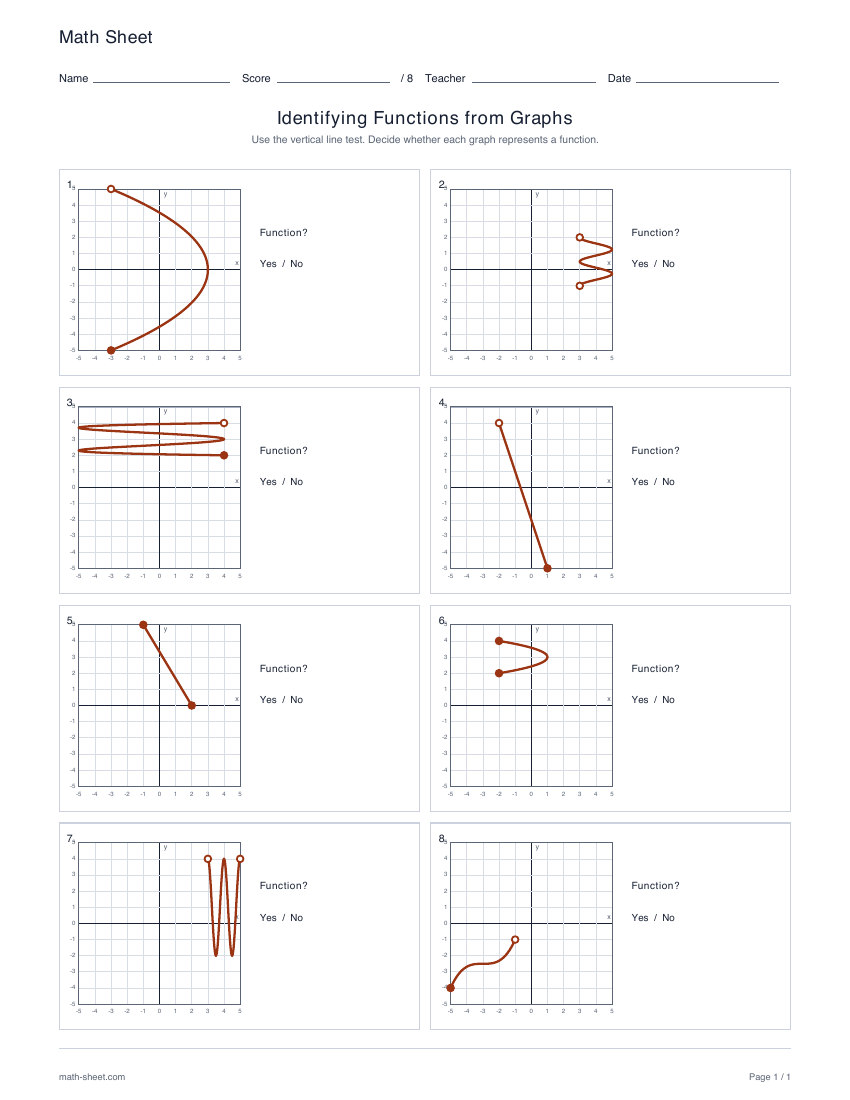
Apply the vertical line test to eight finite graph relations. Choose lines, polynomials, special curves, horizontal parabolas or rotated curves, with balanced endpoints and a separate key.
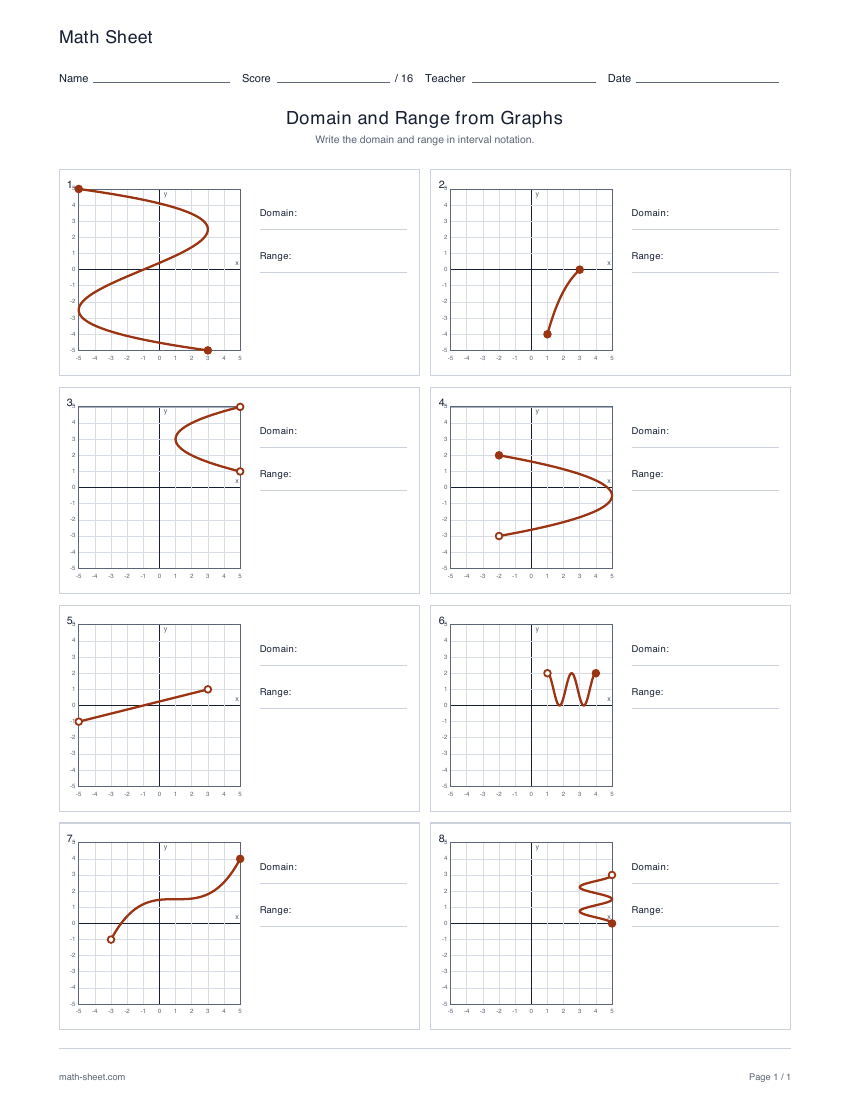
Read finite domain and range intervals from eight varied relation graphs. Practice open and closed extrema and optionally apply the vertical line test.
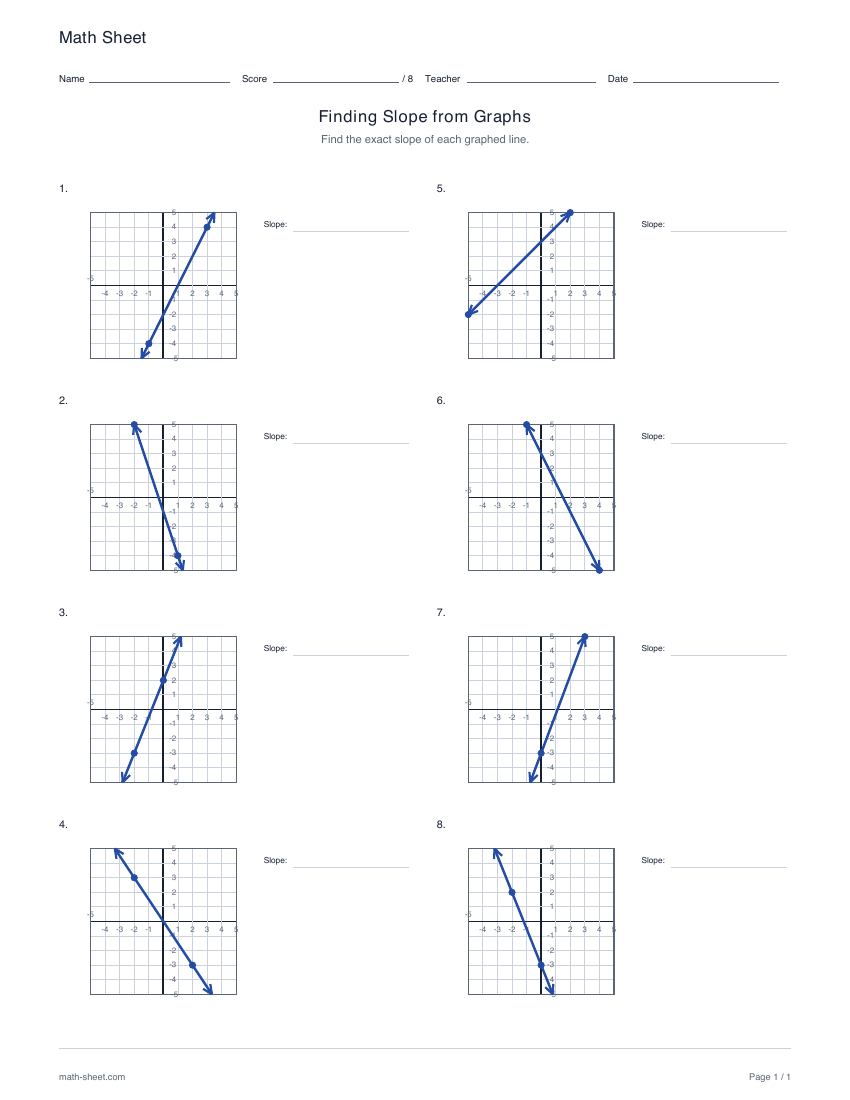
Read eight graphed lines and find each exact slope. Use the coordinate scale to compare rise and run, then check a separate answer key with worked calculations.
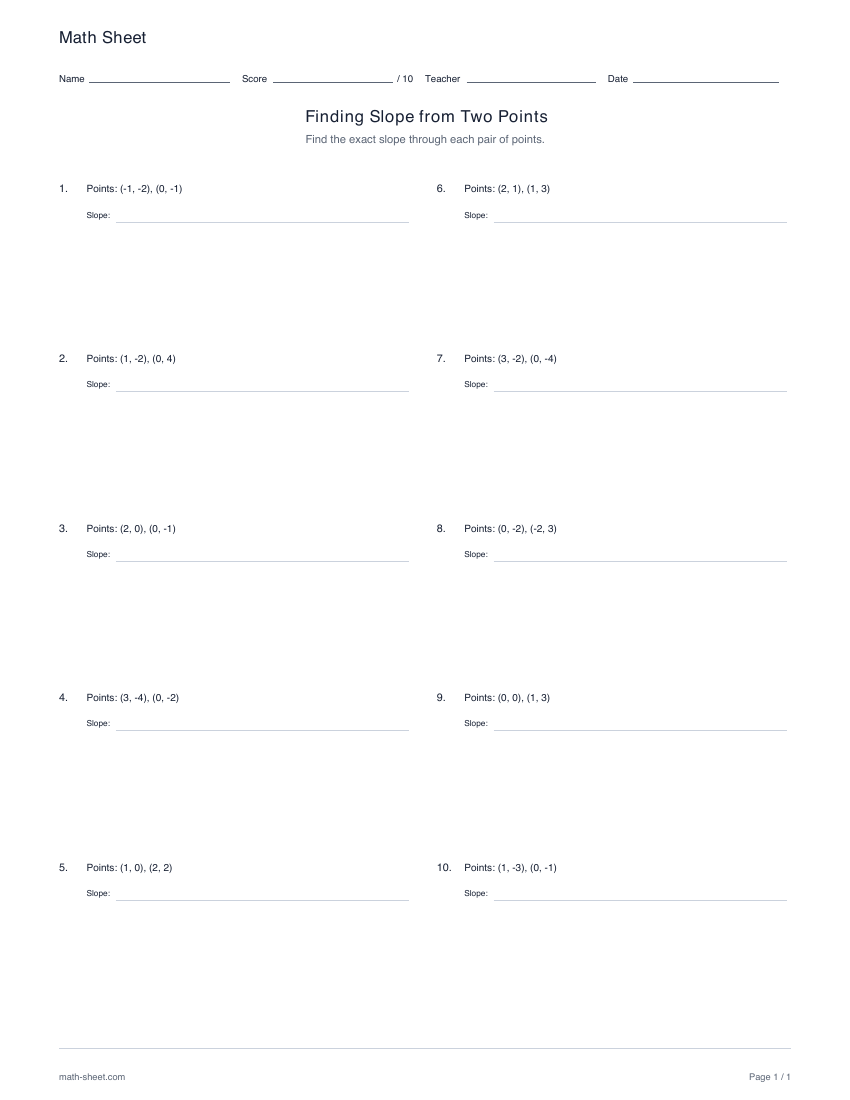
Calculate exact slopes from ten pairs of integer-coordinate points. Practice signed differences and reduced fractions, with a separate key that explains the slope calculation.
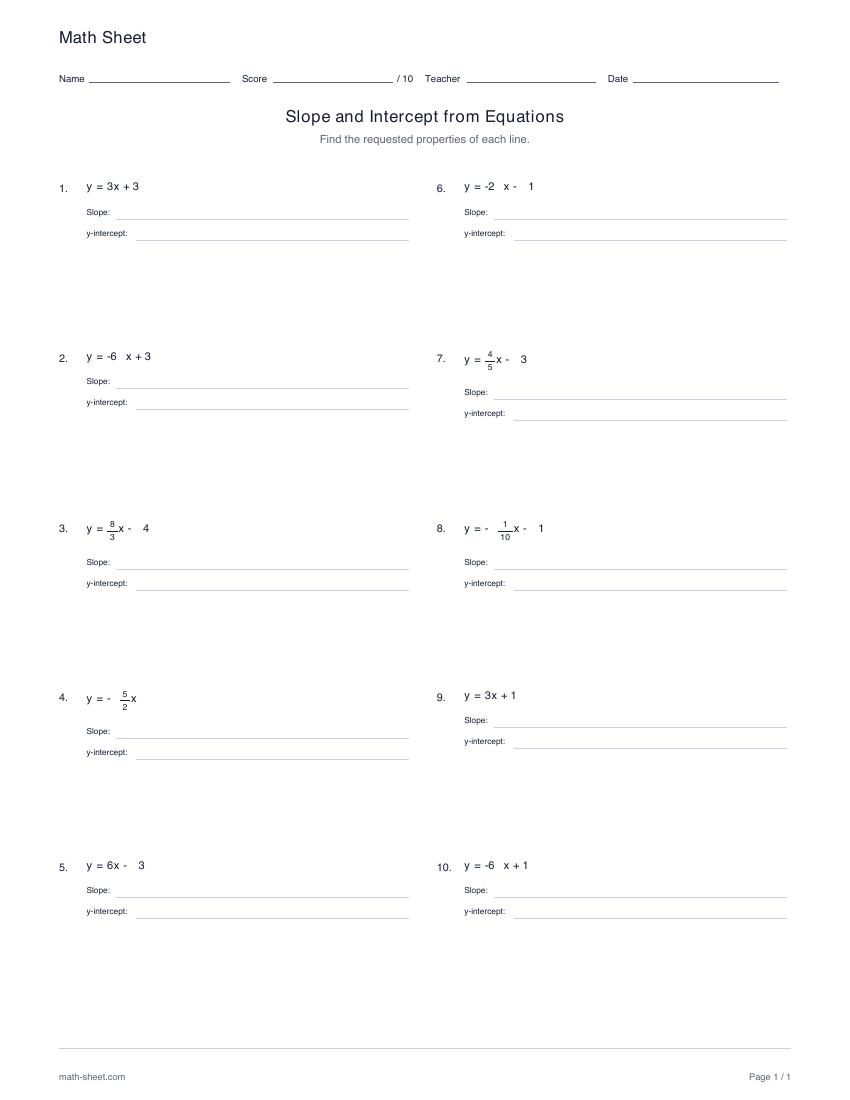
Find slope and y-intercept in ten linear equations. Choose slope-intercept form, standard form or both, and practice slope alone or both properties with exact answers.
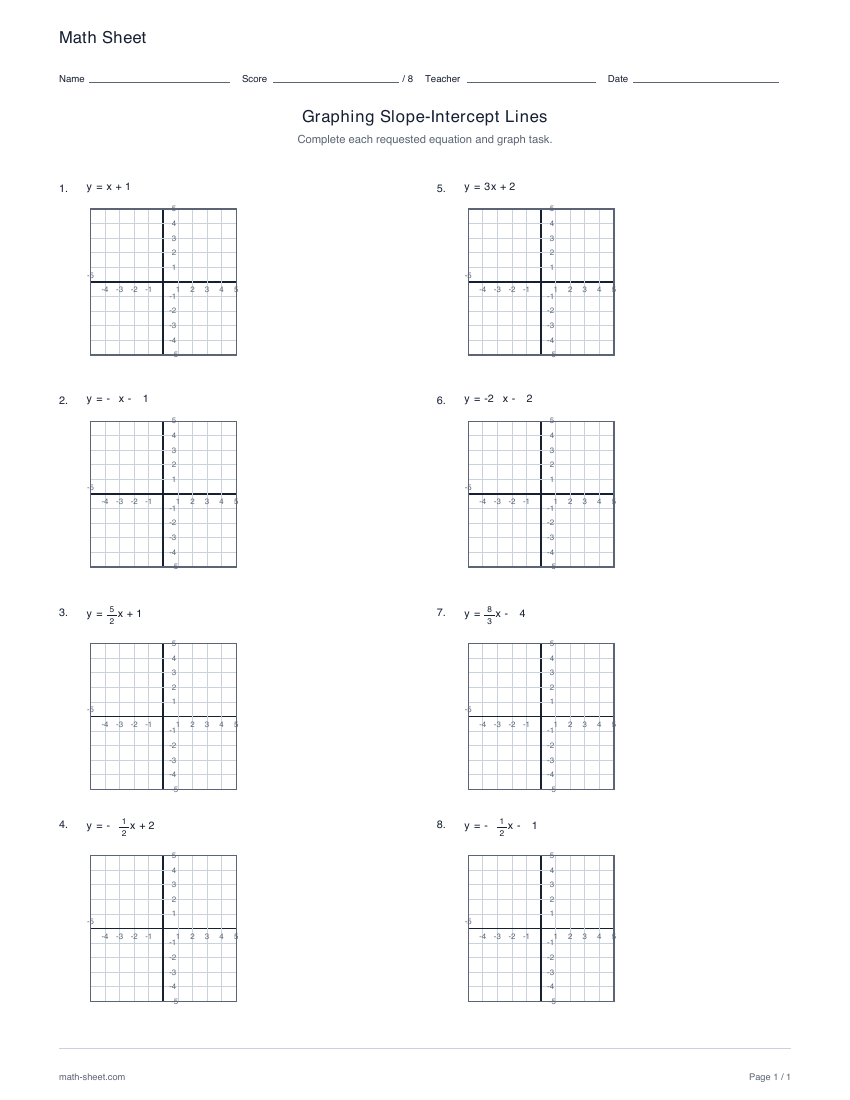
Graph eight lines in slope-intercept form. Choose graphing alone, graphing with slope and intercept questions, or writing an equation and graph from supplied properties.
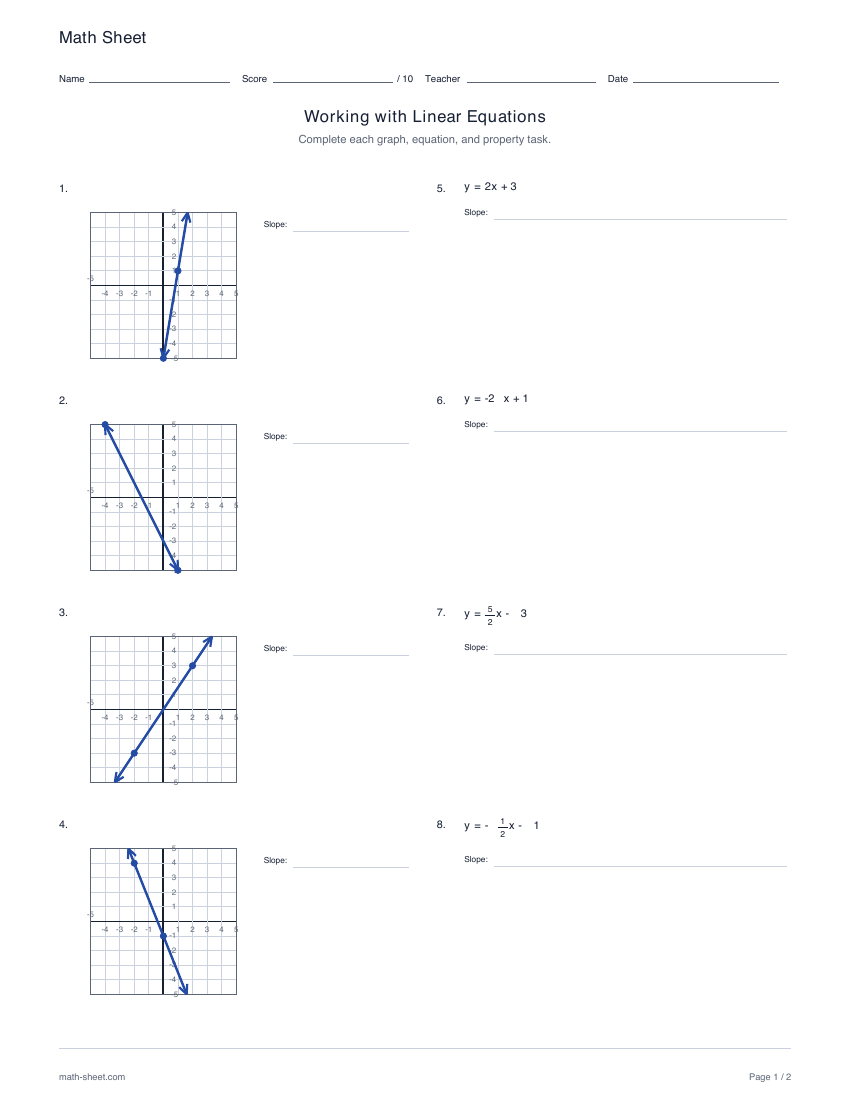
Connect graphs, equations and line properties in ten tasks: four graph-to-slope questions, four equation-to-slope questions and two write-and-graph problems.
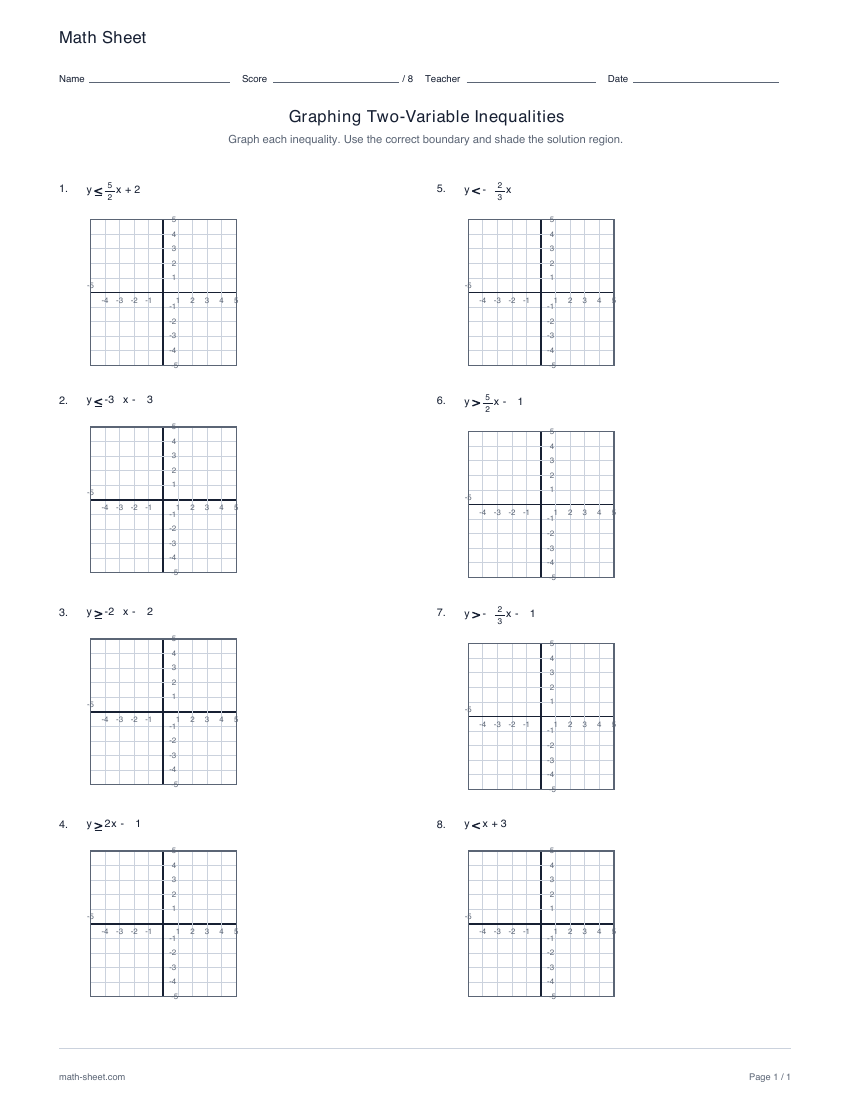
Graph eight linear inequalities on coordinate planes. Select any nonempty combination of <, ≤, > and ≥, then draw the boundaries and shade the solution regions with a separate graphical key.
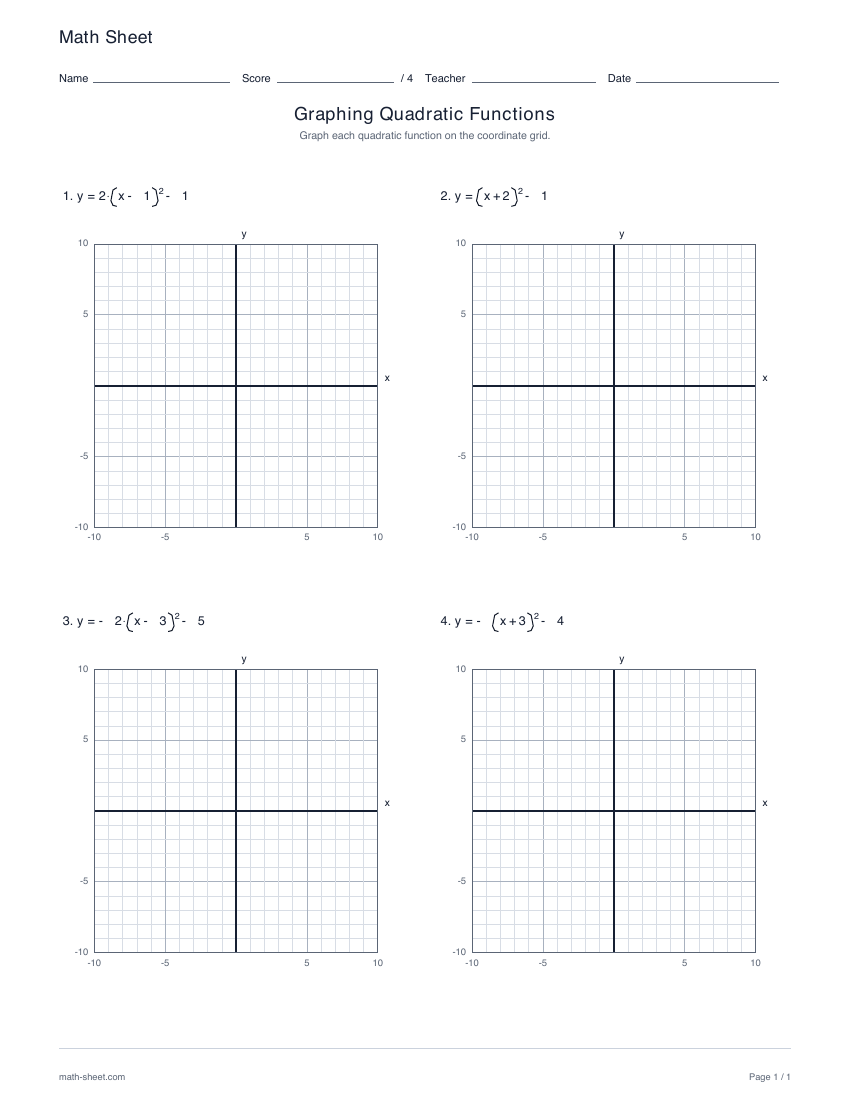
Graph four quadratic functions in vertex form on blank coordinate grids. Each sheet includes every leading coefficient from −2, −1, 1 and 2, with a separate completed graph key.
Preview and download →
9. Find solutions shared by two statements
Compare substitution, elimination and graphing. Solve equation systems or shade the common region of two linear inequalities.
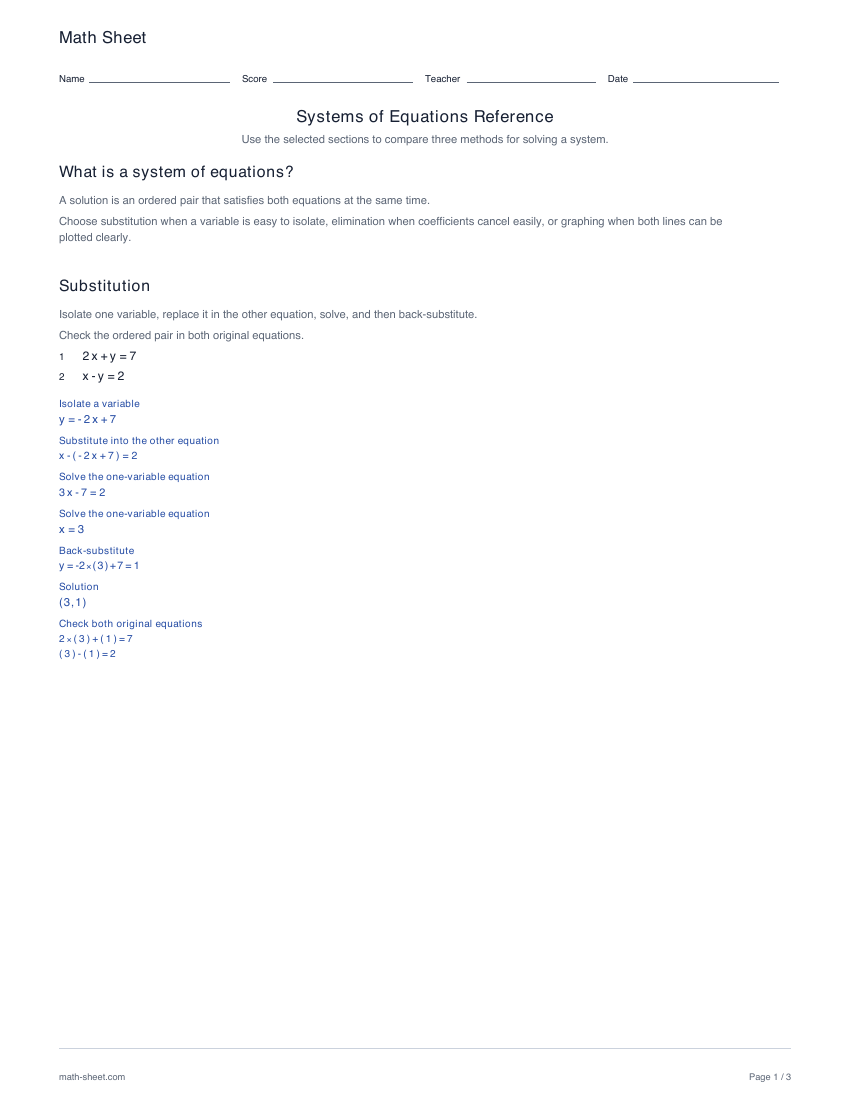
Compare substitution, elimination and graphing in an original printable guide. Choose the methods to include and follow worked examples that check both equations.
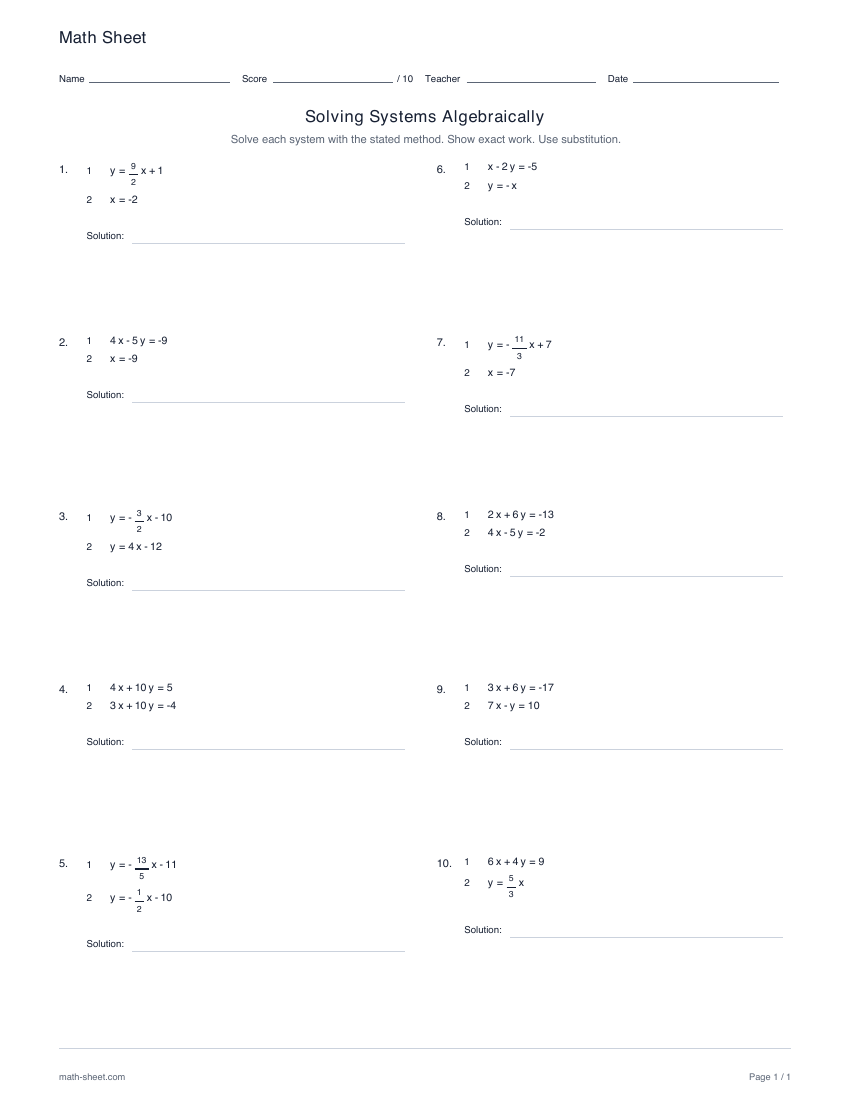
Solve ten two-variable systems using substitution, elimination or any method. Choose four equation-pair structures and download exact, step-by-step answer keys.
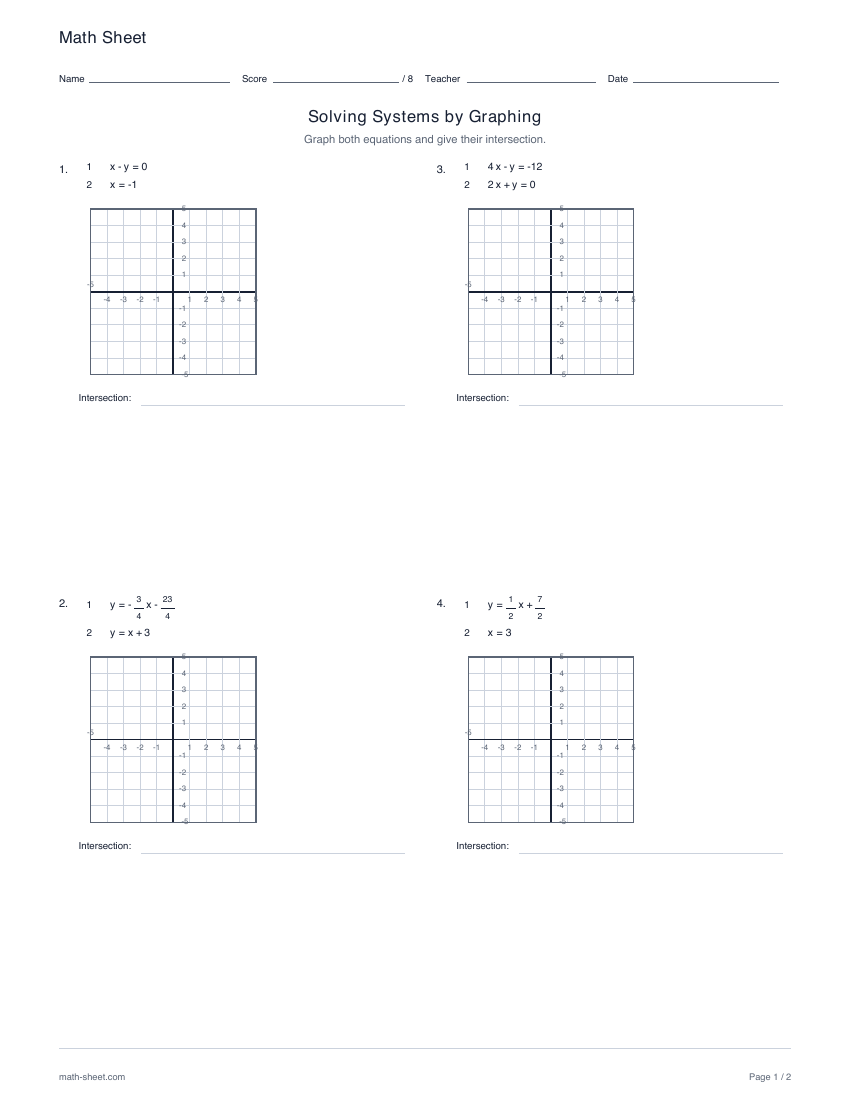
Graph eight pairs of linear equations on blank coordinate grids. Choose equation forms, locate each intersection and check a separate key with both lines and the exact solution.
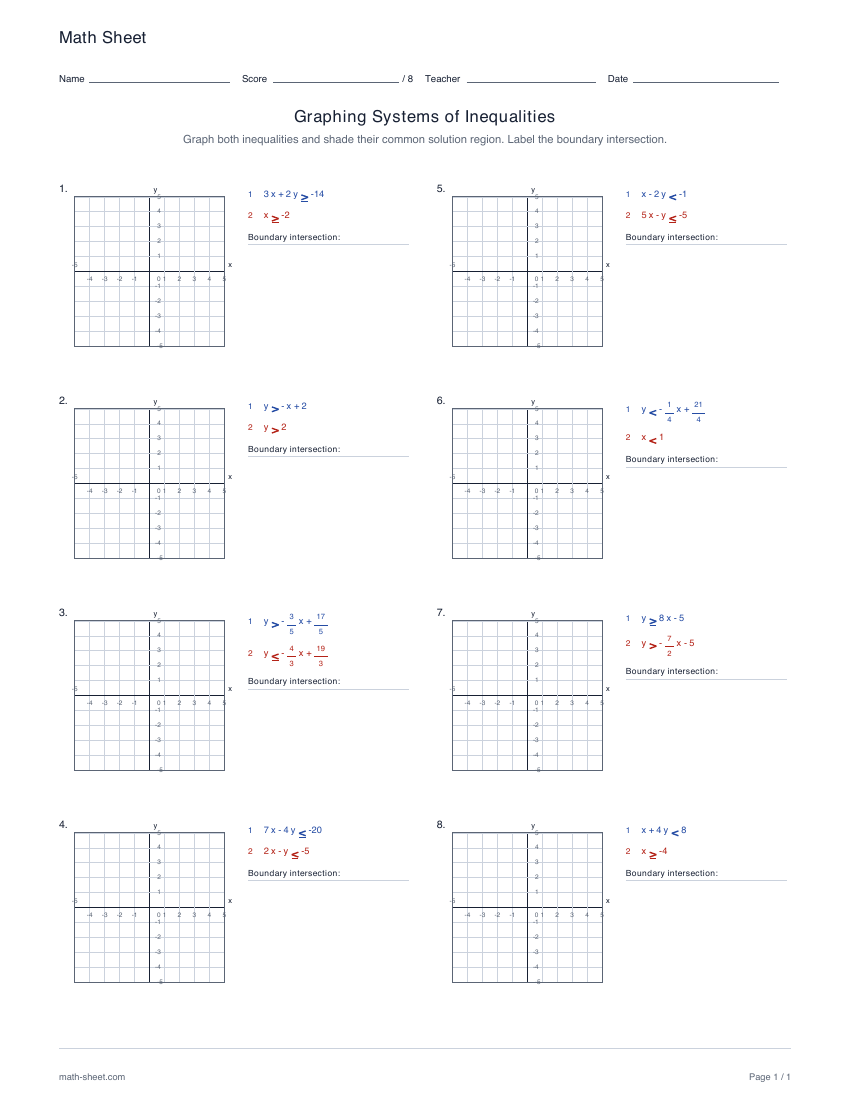
Graph eight pairs of linear inequalities, distinguish strict and inclusive boundaries, and shade each common solution region on a coordinate grid.
Preview and download →
Distinguish writing, evaluating and solving
Writing an expression records a relationship. Simplifying it gives a different form with the same value. Evaluating it gives a number after values have been assigned to the variables. Solving an equation finds which unknown value makes two expressions equal.
Use one example across all three jobs: “four more than three times n” becomes 3n + 4. An equivalent form is n + n + n + 4. With n = 2, both forms evaluate to 10. If 3n + 4 = 10 is given instead, solving finds n = 2. Ask learners to say which job the instruction requests.
Explore sets alongside algebra
Set notation describes membership and collections. Use Venn diagrams to make unions, intersections and complements visible, then connect those ideas with sets of possible values and probability events.
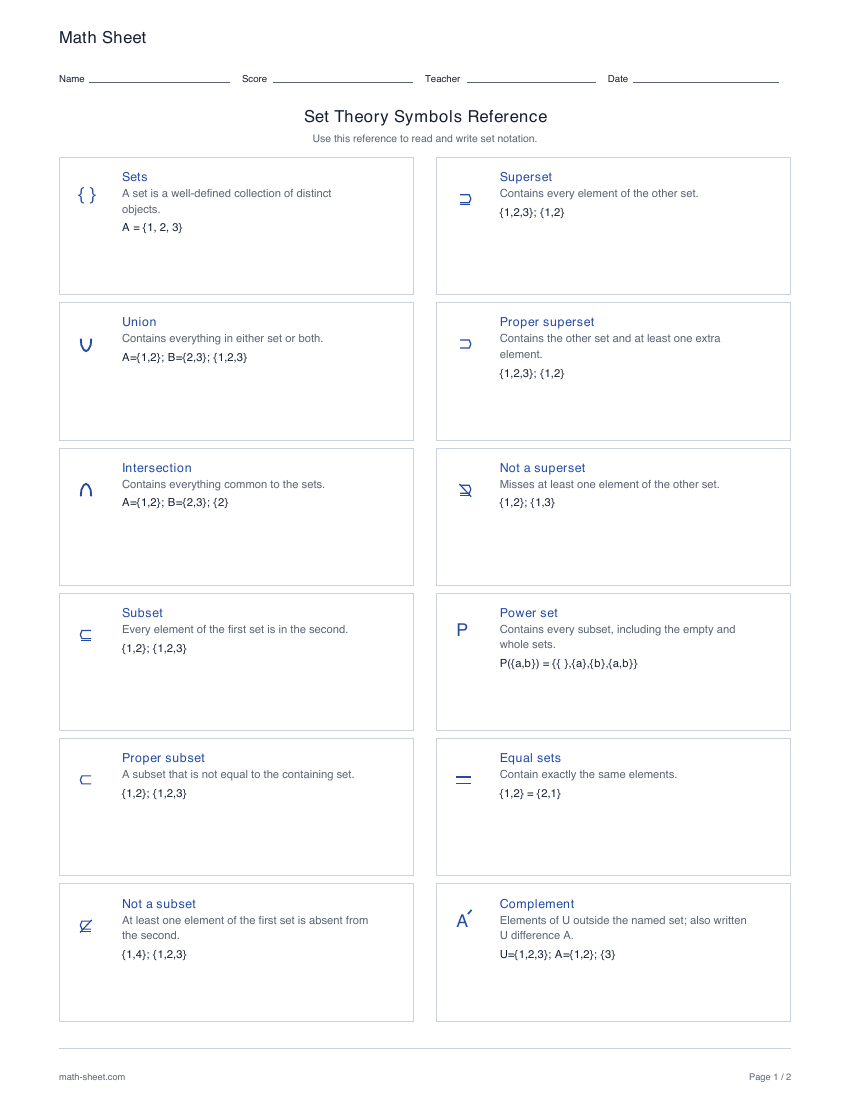
Use an original printable reference to set notation, unions, intersections, complements, subset relations and number sets, with clear definitions and examples.
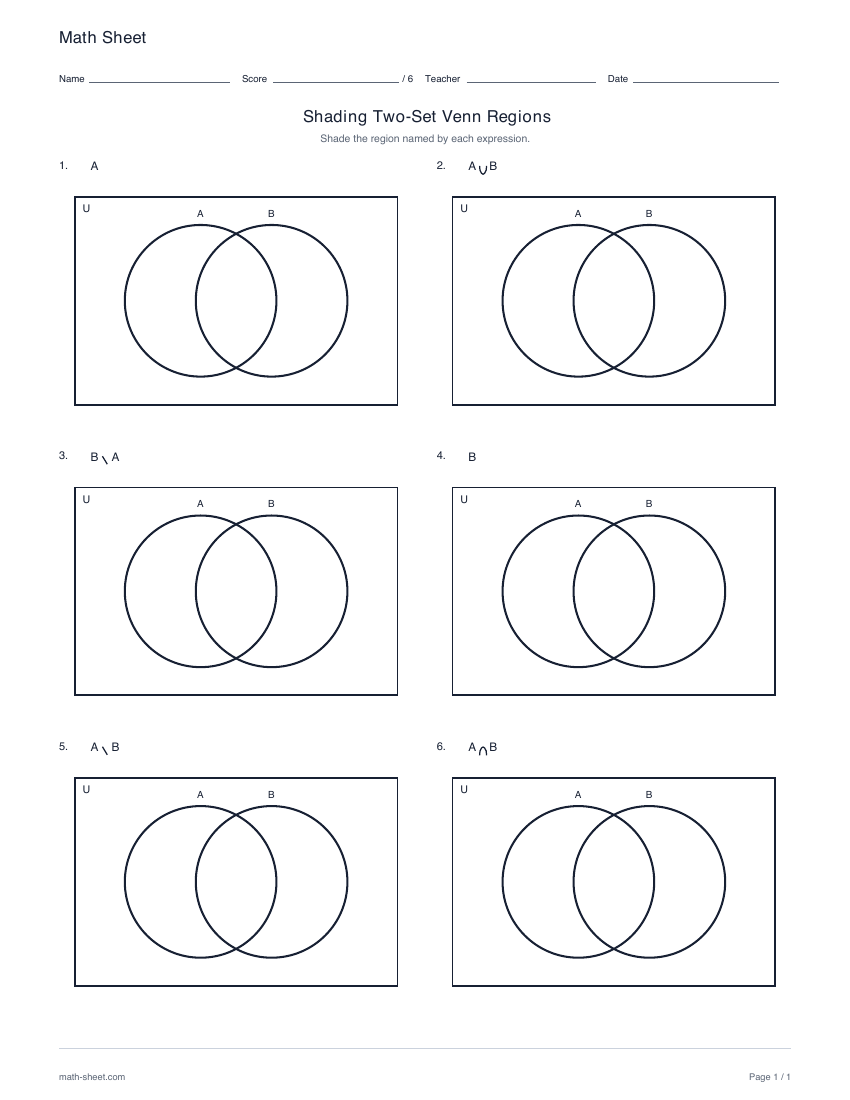
Shade two-set Venn diagrams from union, intersection, difference and complement expressions. Choose operation families and print a separate shaded answer key.
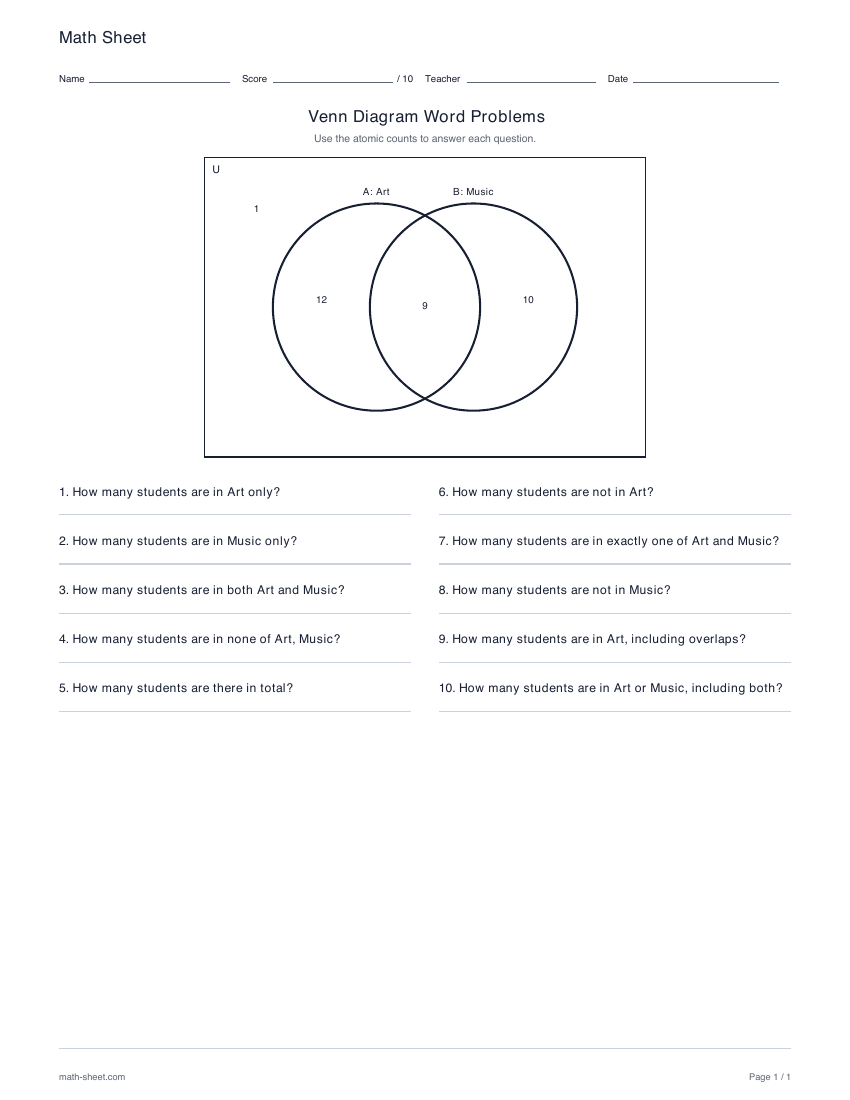
Answer ten counting questions from a two-set or three-set context diagram. Practice only, both, neither, totals and overlapping groups with a separate key.
Preview and download →
Explain why a conclusion follows
Read simple propositions, combine them with logical operators and use truth tables to check every case. Then practice the law of detachment: when a conditional and its hypothesis are given, its conclusion follows.
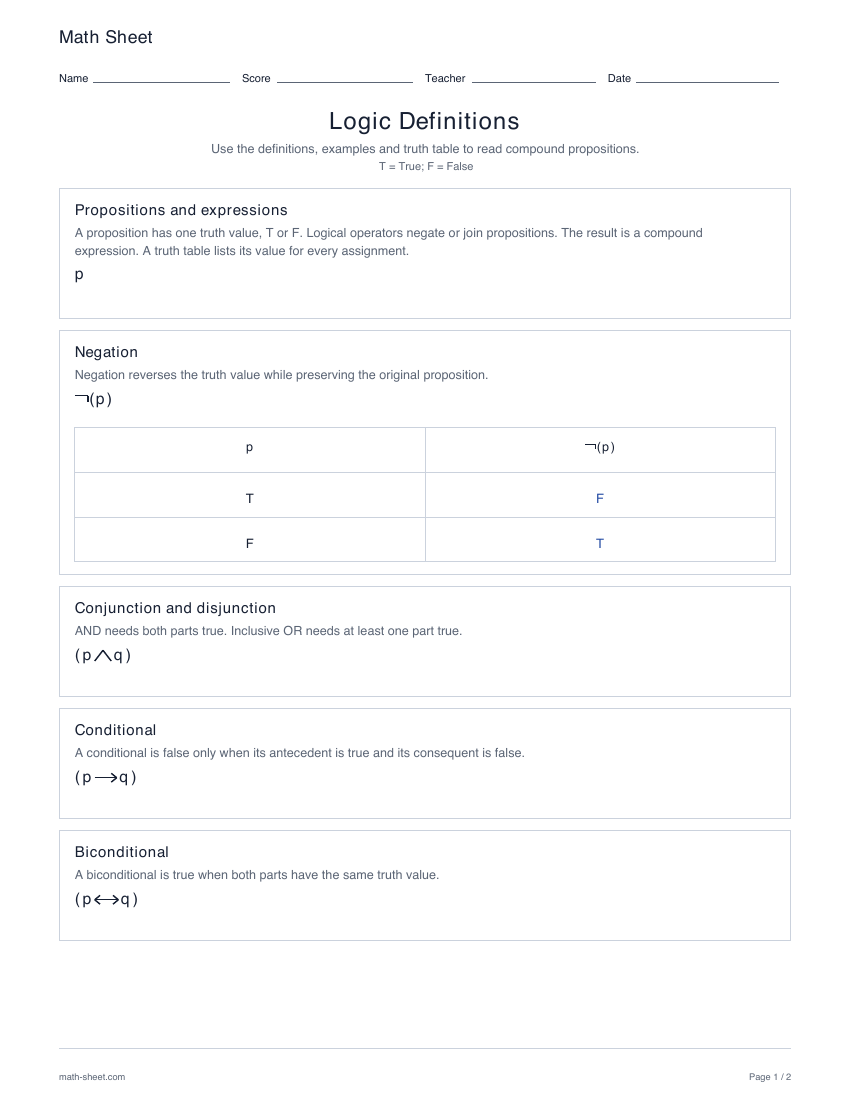
Introduce propositions, logical operators, compound expressions and truth tables with a printable reference. Use clear examples before starting symbolic logic practice.
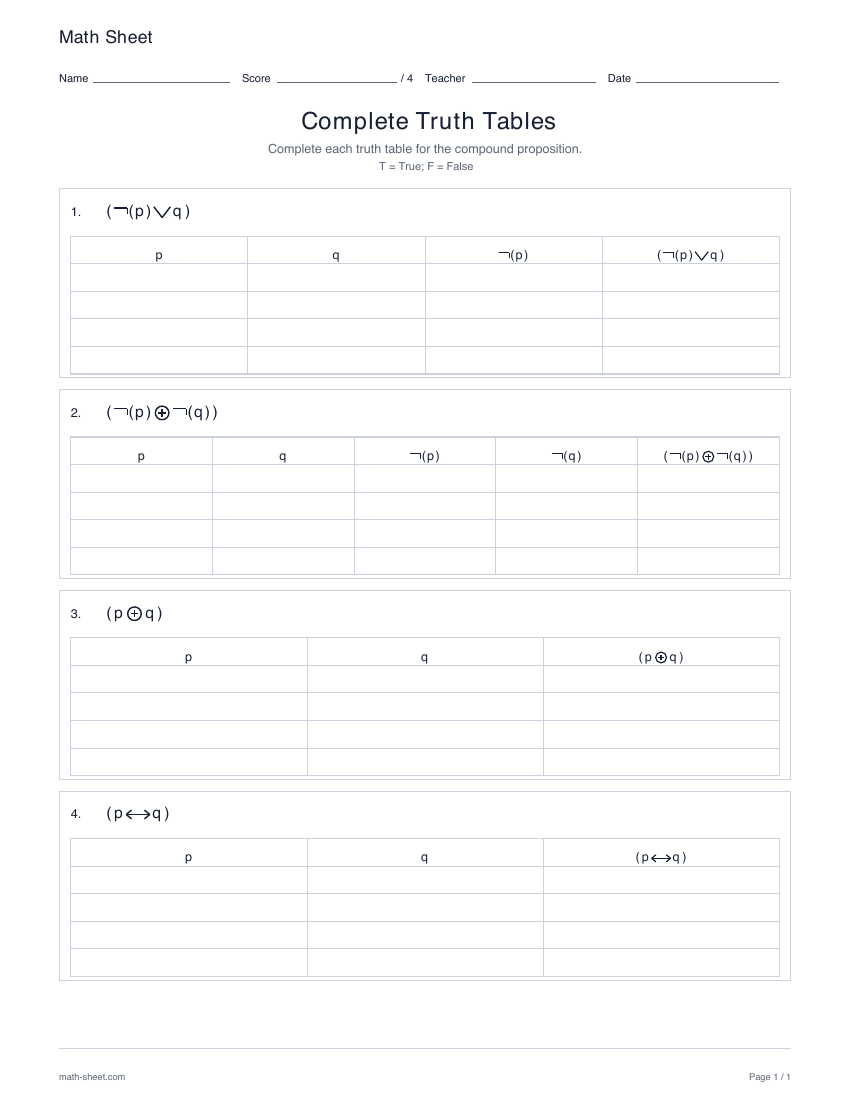
Generate four truth tables with AND, OR, conditional, biconditional or exclusive OR. Choose negated atoms and fill either every cell or only the result column.
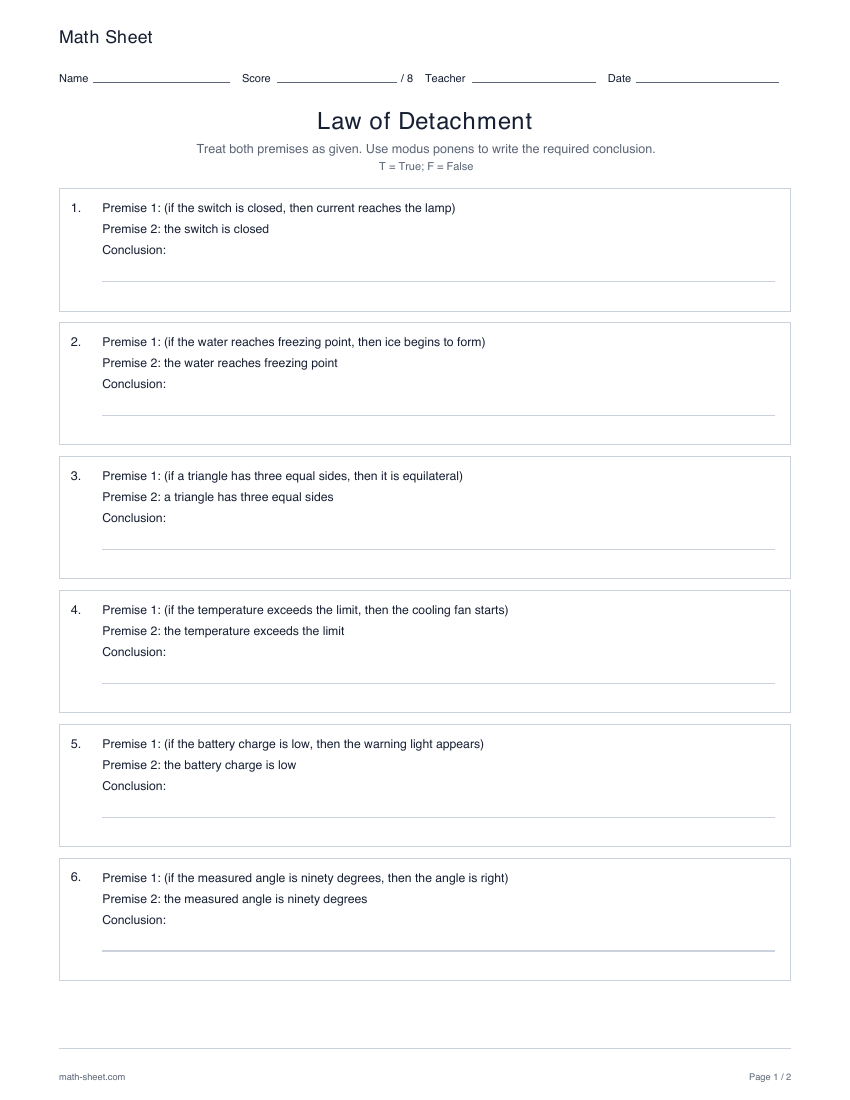
Use two given premises to draw a valid conclusion in eight original scenarios. Practice the law of detachment, also called modus ponens, with a separate answer key.
Preview and download →
Connect powers, roots and exponent laws
Evaluate a power before simplifying powers with variables. Then connect perfect squares with principal roots and learn why a square equation can have two solutions.
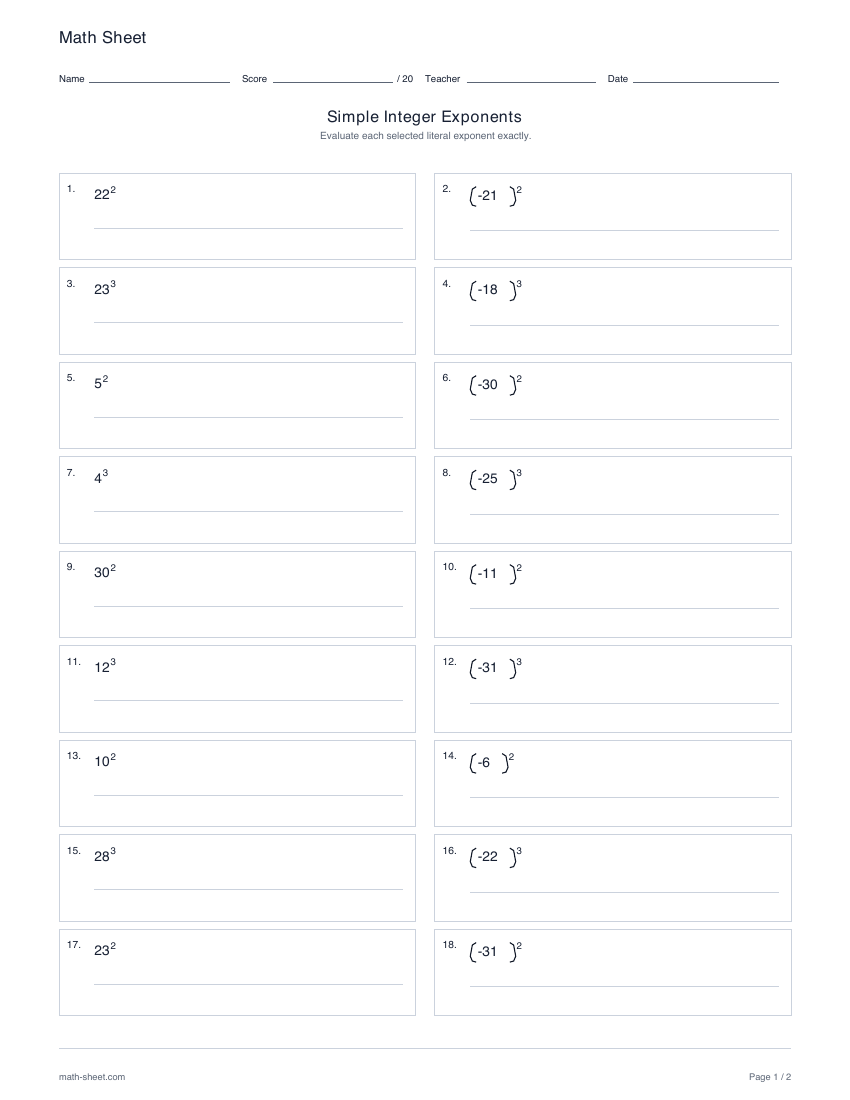
Generate 20 powers using positive or negative integer bases. Choose any exponent values from −4 through 5, including zero and negative powers, with a separate answer key.
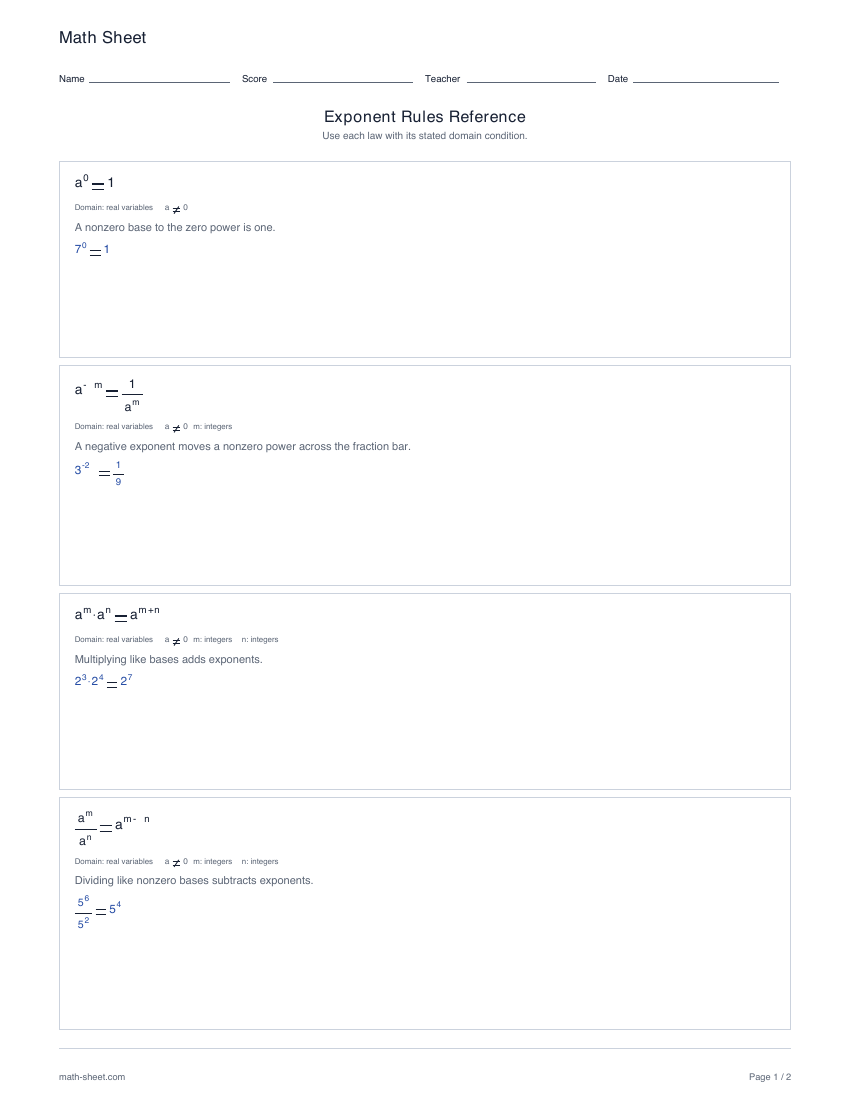
Print an exponent rules reference with original examples of zero, negative and rational exponents, products, quotients and powers. Includes the conditions each rule needs.
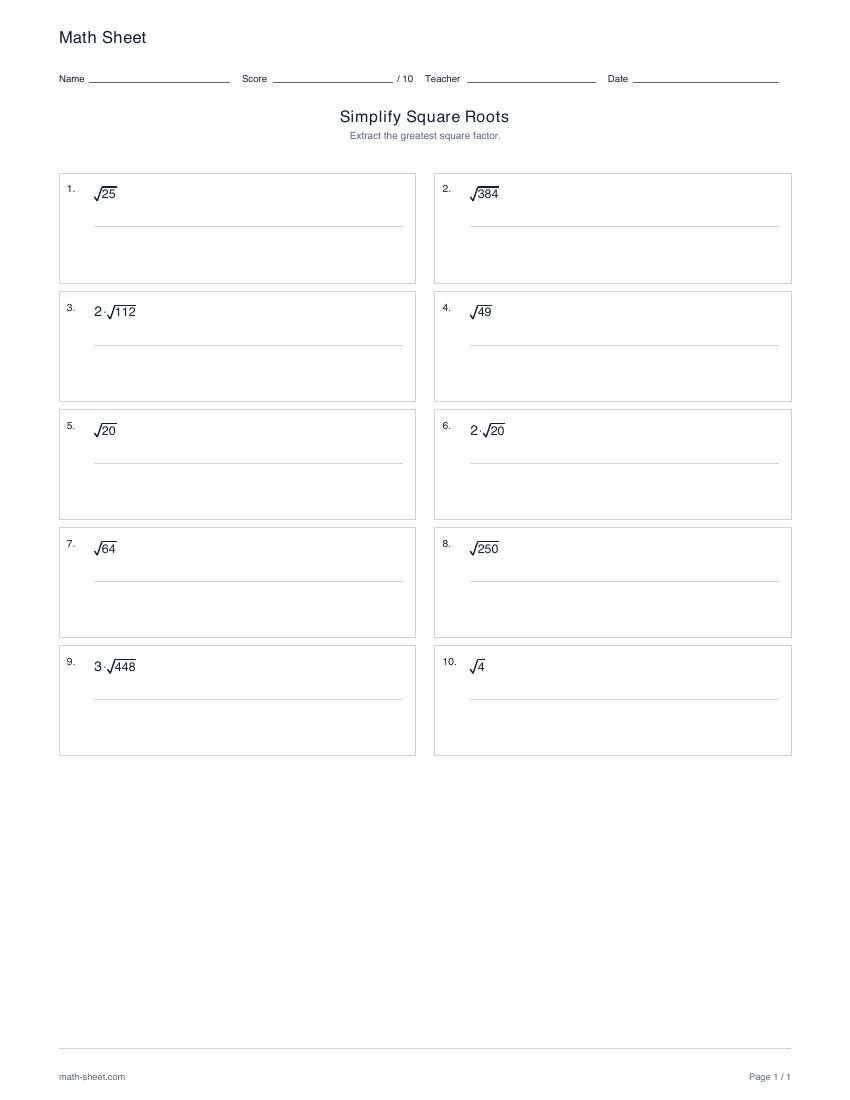
Generate 10 square-root problems using perfect squares, nonperfect radicands or outside coefficients. Practice exact factor extraction with a separate answer key.
Preview and download →
Report the precision of a calculation
Count significant digits, distinguish the addition and multiplication rules, and keep meaningful zeroes in the final answer.
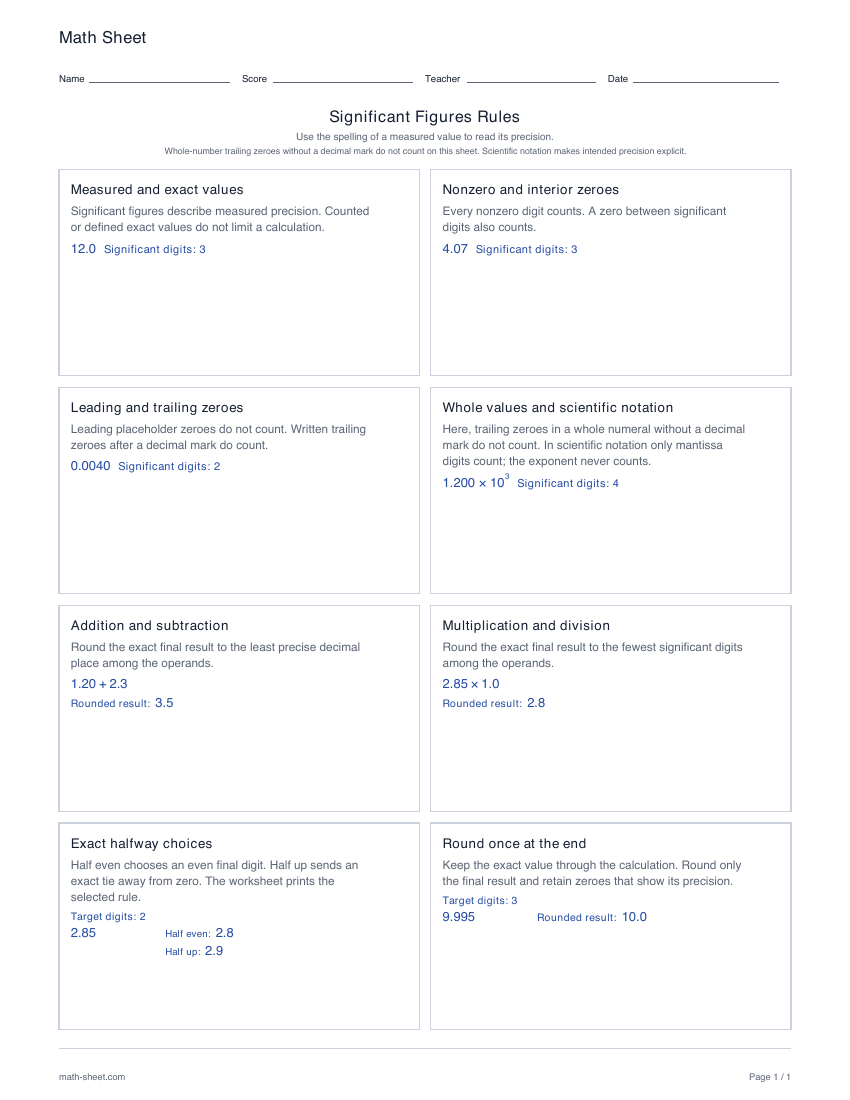
Print an original significant figures reference with zero rules, scientific notation, calculation rules and rounding examples. Choose Letter or A4 and a printed language.
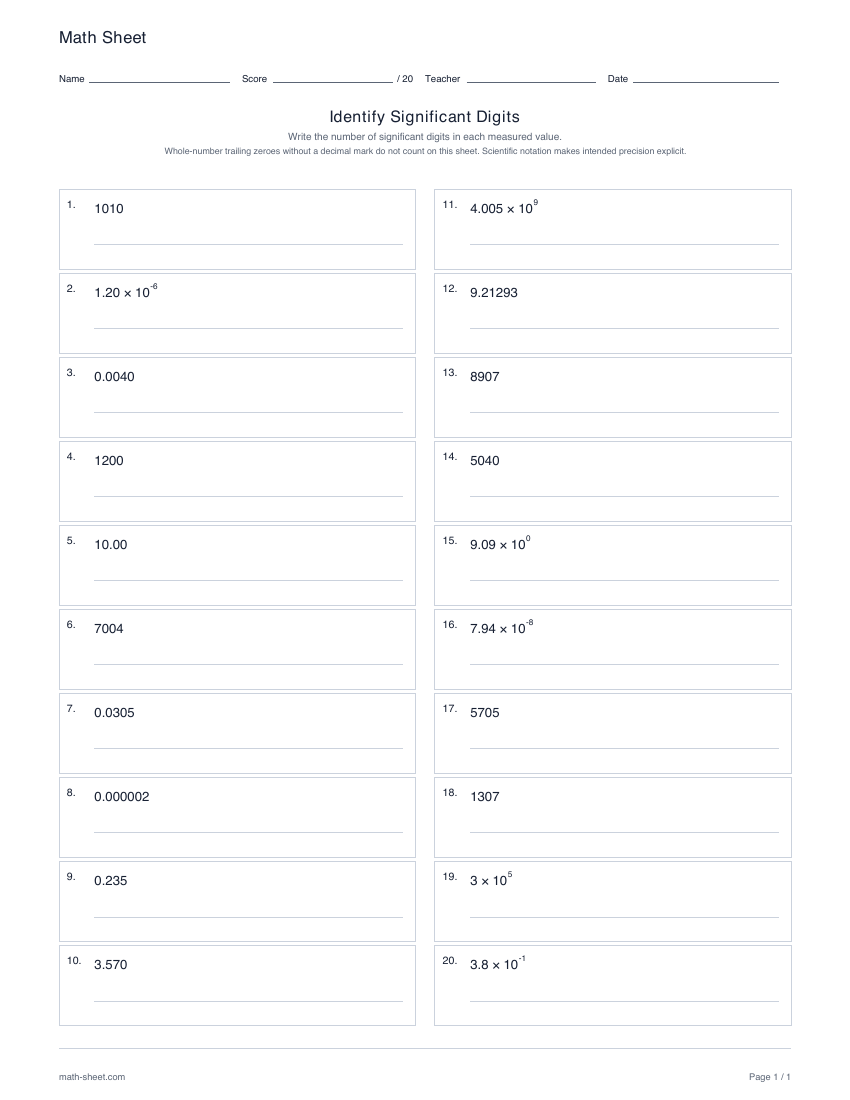
Count significant digits in whole numbers, decimals and scientific notation. Select any combination, generate 20 questions and print a separate answer key.
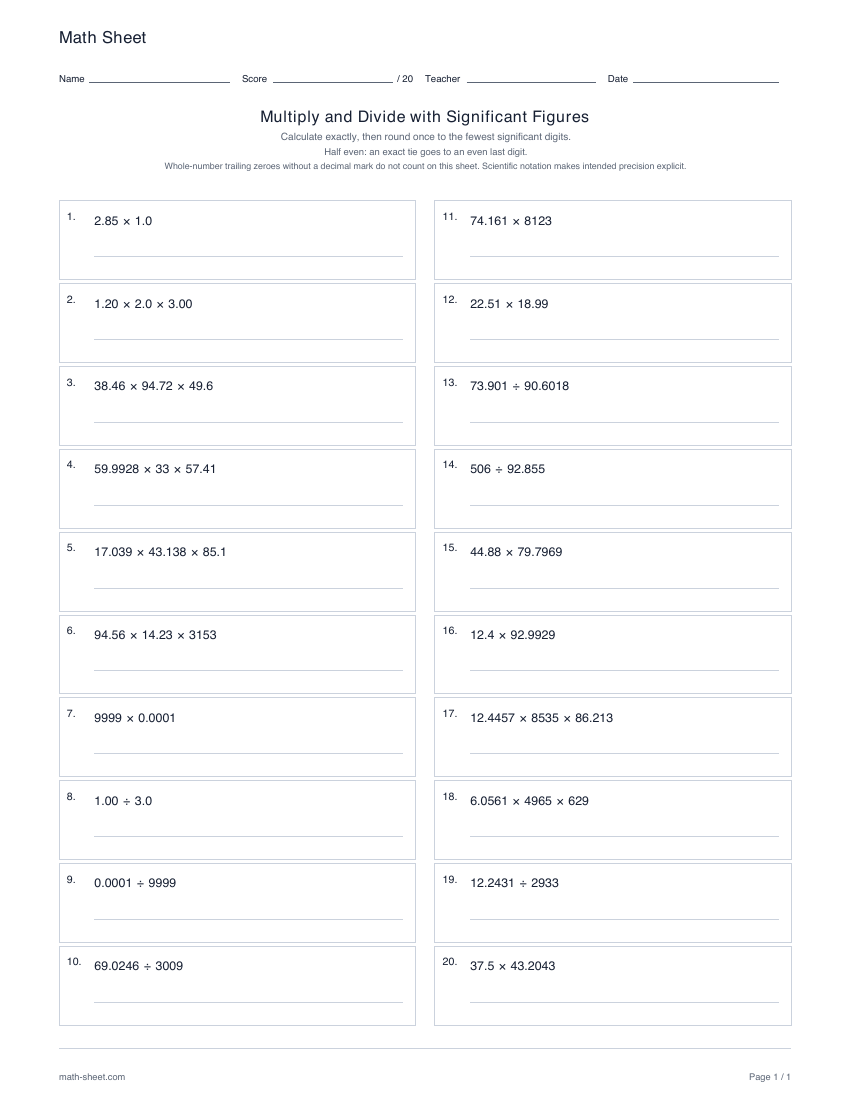
Generate 20 two-factor, three-factor or division problems. Round to the fewest significant digits, preserve meaningful zeroes and download the worksheet with answers.
Preview and download →
Explore how numbers are represented
Changing a number’s base changes its notation, not its value. Practice conversion before calculation, and distinguish arithmetic from independent bitwise comparisons.
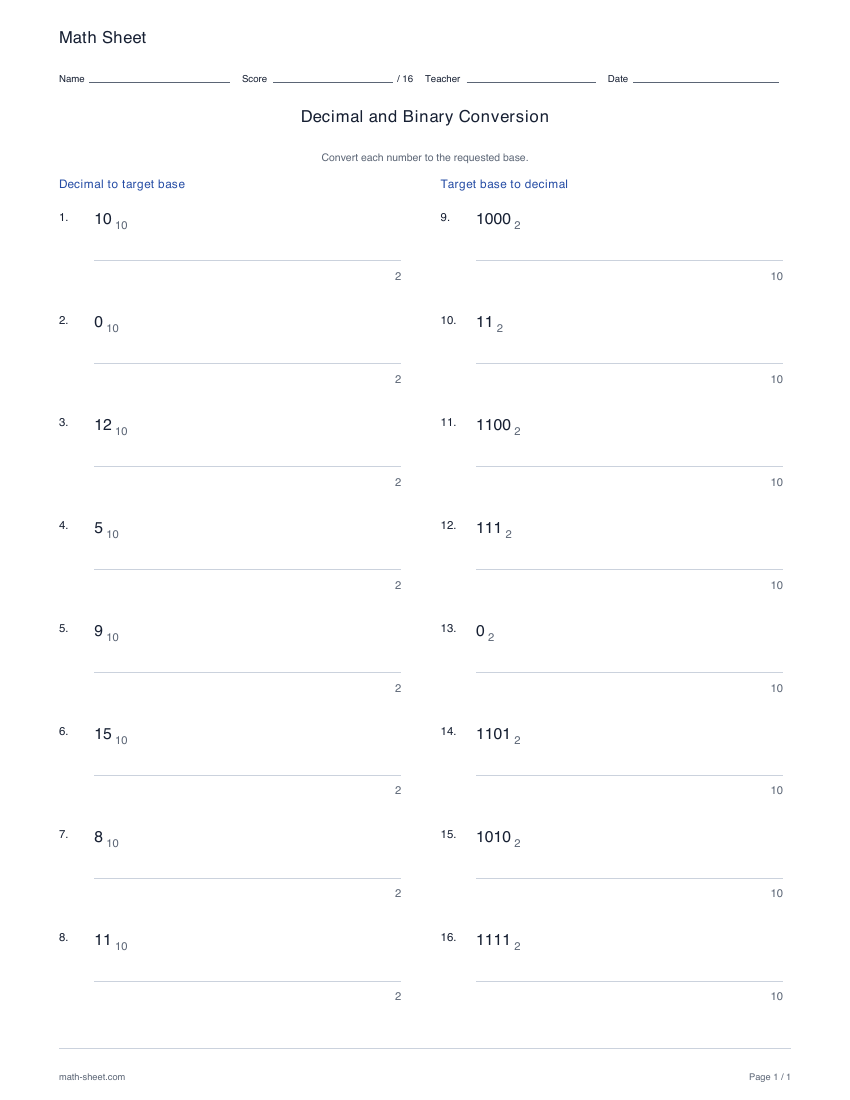
Convert between decimal and binary with 16 questions, four number ranges and a separate answer key. Customize the worksheet and download a Letter or A4 PDF.
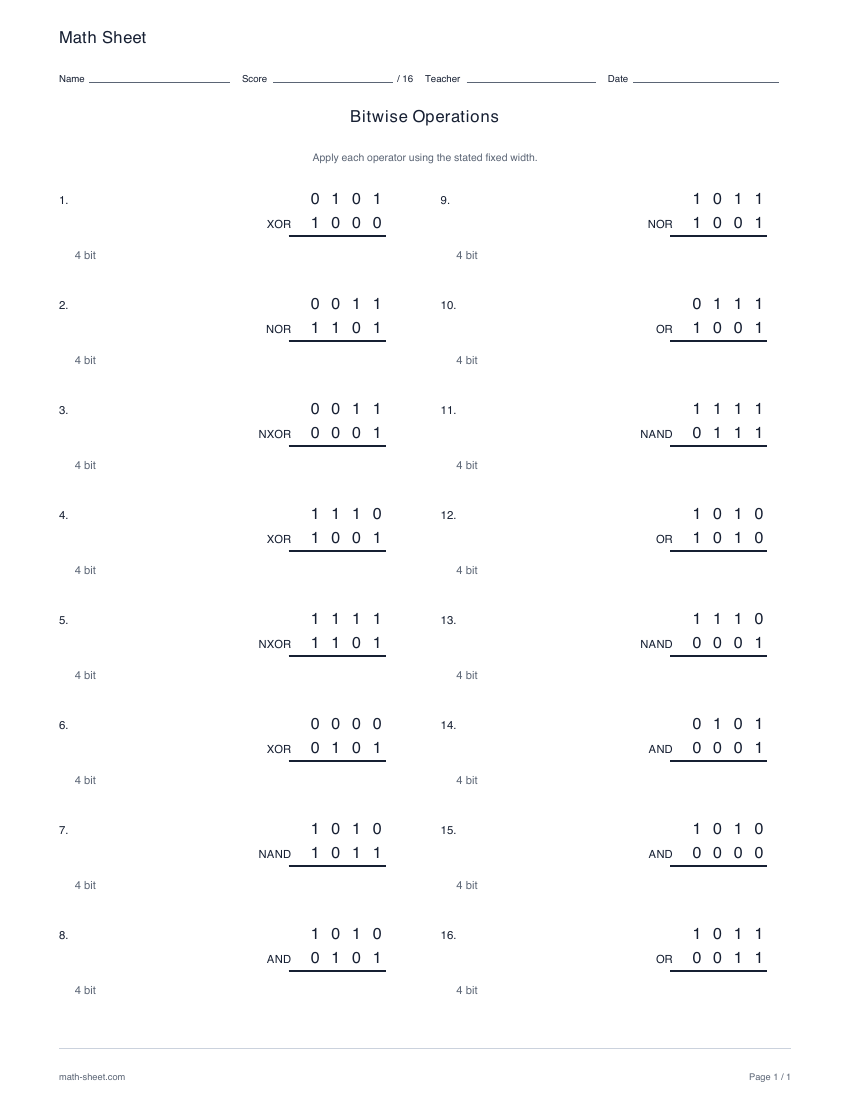
Practice AND, OR, XOR, NAND, NOR and NXOR with four-bit or eight-bit numbers. Choose operators, generate 16 problems and print width-correct answers.
Preview and download →
Plan a short lesson with a visible check
Use one familiar numerical example to recall the prerequisite.
Model one expression while explaining the meaning of every symbol.
Ask the learner to explain a second example before independent practice.
Choose a focused practice set, then review the reasoning with the separate key.
Adjust one setting at a time for the next set.
For distribution, keep coefficient magnitudes small at first. For evaluation, begin with one variable and add a second only after each substitution is reliable. Negative inputs and longer verbal phrases are separate increases in difficulty.
Return to a prerequisite when it helps
Fractions and coefficients
Review equivalent fractions and fraction arithmetic before working with fractional coefficients.