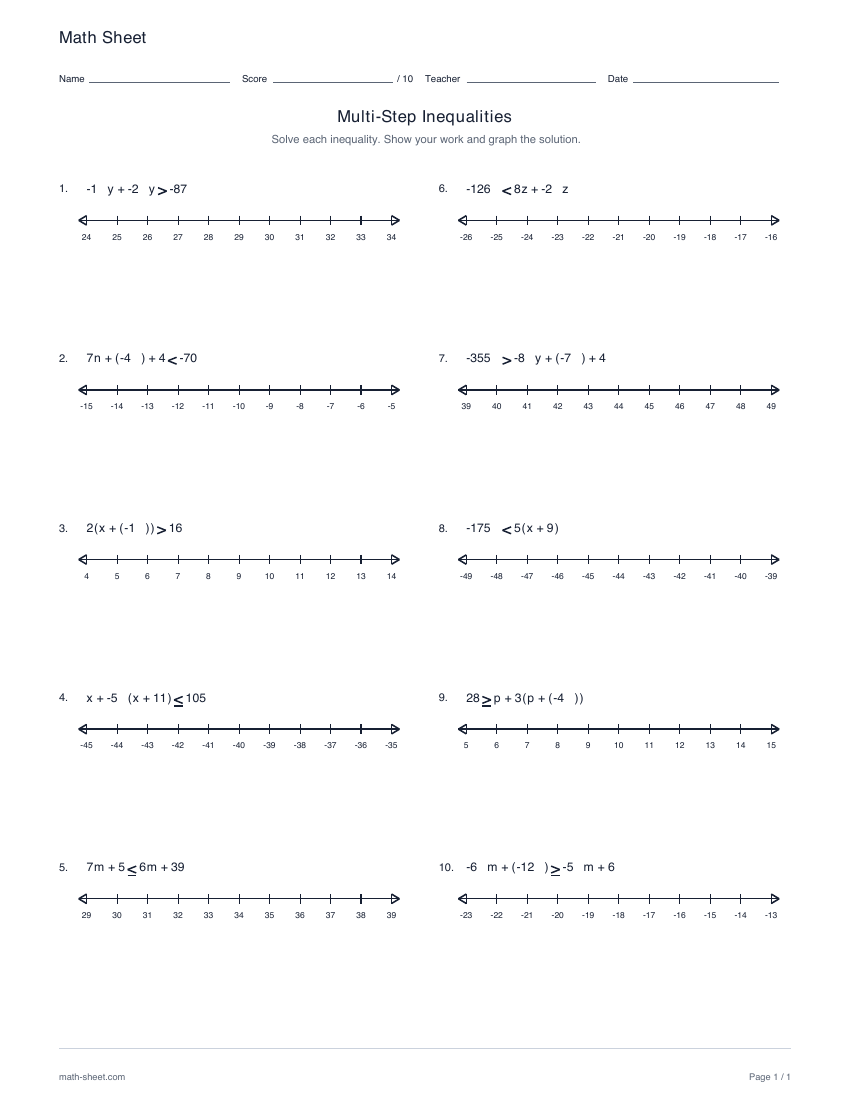
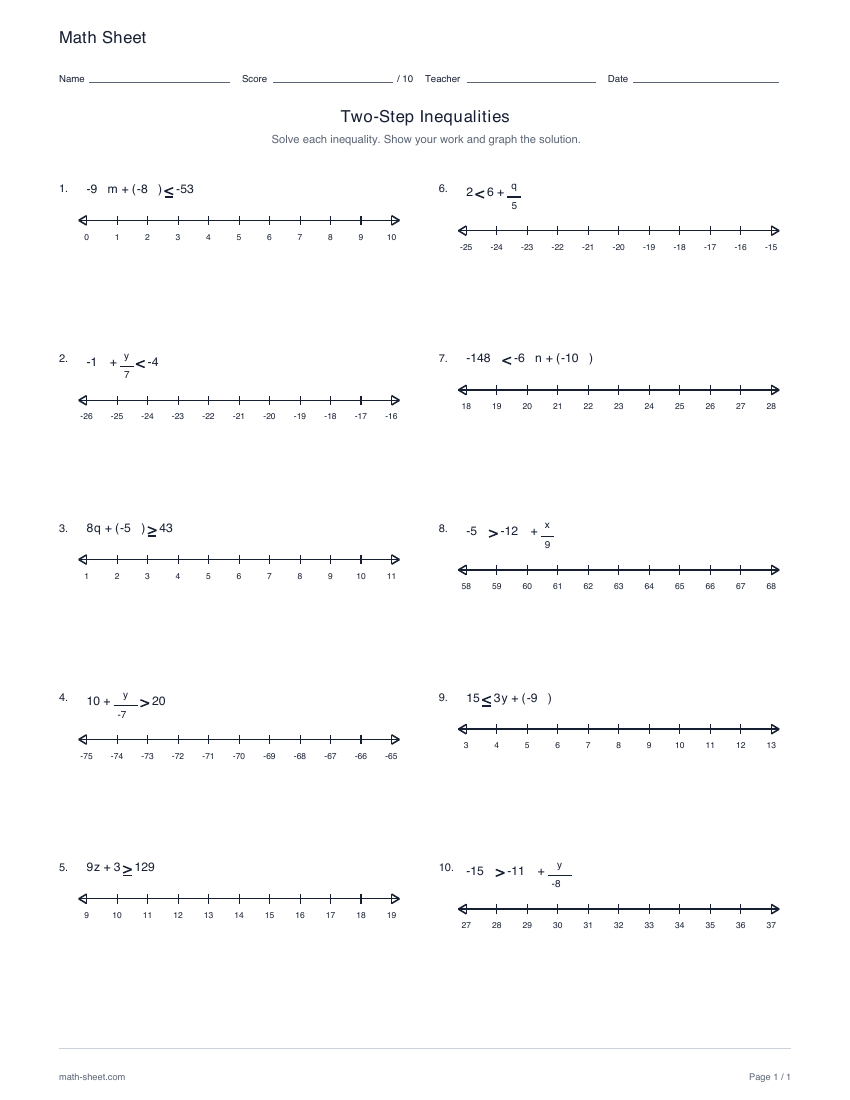
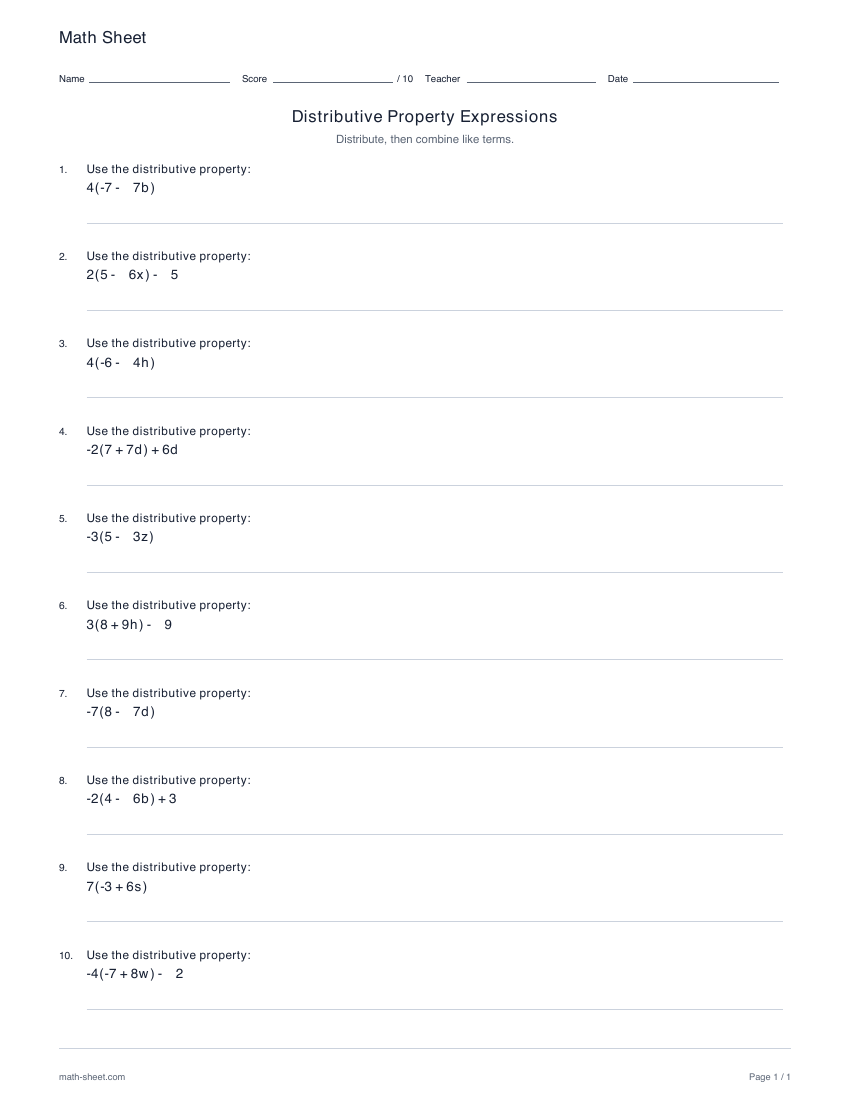
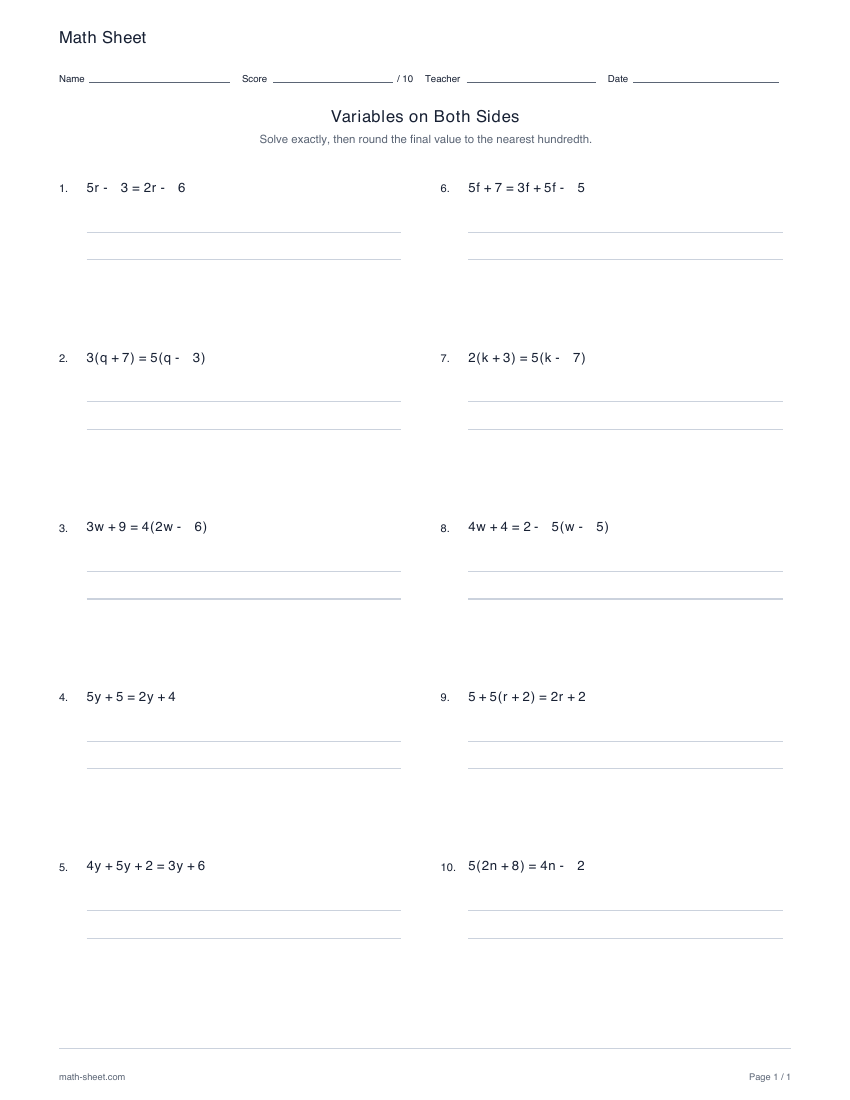
Distribute factors, combine like terms and solve ten linear inequalities with variables on either or both sides. Print exact solutions, explained sign reversals and number-line graphs.
Fixed English ready-made files. Custom settings below apply only to the configured PDF.
Ready to print
Start with a ready-made worksheet
Expand grouped expressions and collect like terms before isolating the variable. Watch the sign of the final coefficient, then graph the exact boundary and direction.
Download the practice pages alone, or include a separate answer key or teacher model. Longer activities may use more than one page.
Each set has ten inequalities with exact integer boundaries. The number-line window follows the answer, so larger positive and negative solutions remain visible. The key repeats each problem and explains its equivalent transformations.
The comparison checkboxes select symbols in the original question. A negative variable, a negative coefficient or the variable appearing on the right can mean that the solved inequality uses the opposite direction. Always normalize the relationship before choosing the ray.
Learning objective
What this activity builds
Simplify both sides and use equivalent transformations to describe a complete linear solution set.
Worked example
Solve 2(3x − 4) ≥ 8x + 6.
x ≤ −7.
Distribute to get 6x − 8 ≥ 8x + 6. Subtract 8x and add 8: −2x ≥ 14. Dividing by −2 reverses the comparison, giving x ≤ −7. The graph includes −7 and all smaller values.
Teaching notes
Make the practice count
Complete distribution before gathering variable terms.
Keep the sign attached to each term while collecting.
Write an entire inequality on every line of working.
Check a value inside and outside the final ray to catch a reversal error.
Make it yours
Customize the practice
Choose your options, update the preview, then download the exact same pages.
Relationships select the literal operator printed in each prompt. Dividing by a negative coefficient reverses the normalized solution direction.
Combined operations adds like terms with constants and distribution with variables on both sides. Standard preserves the original worksheet mix.
Solve and graph ten two-step inequalities with signed coefficients, constants and variable quotients. Keep boundaries exact and use the worked key to follow each equivalent transformation.
Solve ten equations with the same variable on both sides. Choose the letter policy, constant and coefficient ranges, and signed or positive-only operands, with full worked solutions.