A boundary, a direction, a set of solutions

Inequality worksheets

Read a comparison, show every value that satisfies it, and explain each step. Begin with symbols and number-line rays, then solve with inverse operations, distribution and like terms.

Choose a worksheet

Dividing by a negative reverses order

  1. Start−2x + 3 ≤ 11
  2. Subtract 3 from both sides−2x ≤ 8
  3. Divide by −2 and reverse the signx ≥ −4
A filled endpoint at −4 and a ray to the right. Check: x = 0 makes 3 ≤ 11 true.

Connect notation and meaning

Read the symbols and the graph

Connect a comparison with its full set of solutions. Use the reference to discuss properties, then translate between notation and number-line rays.

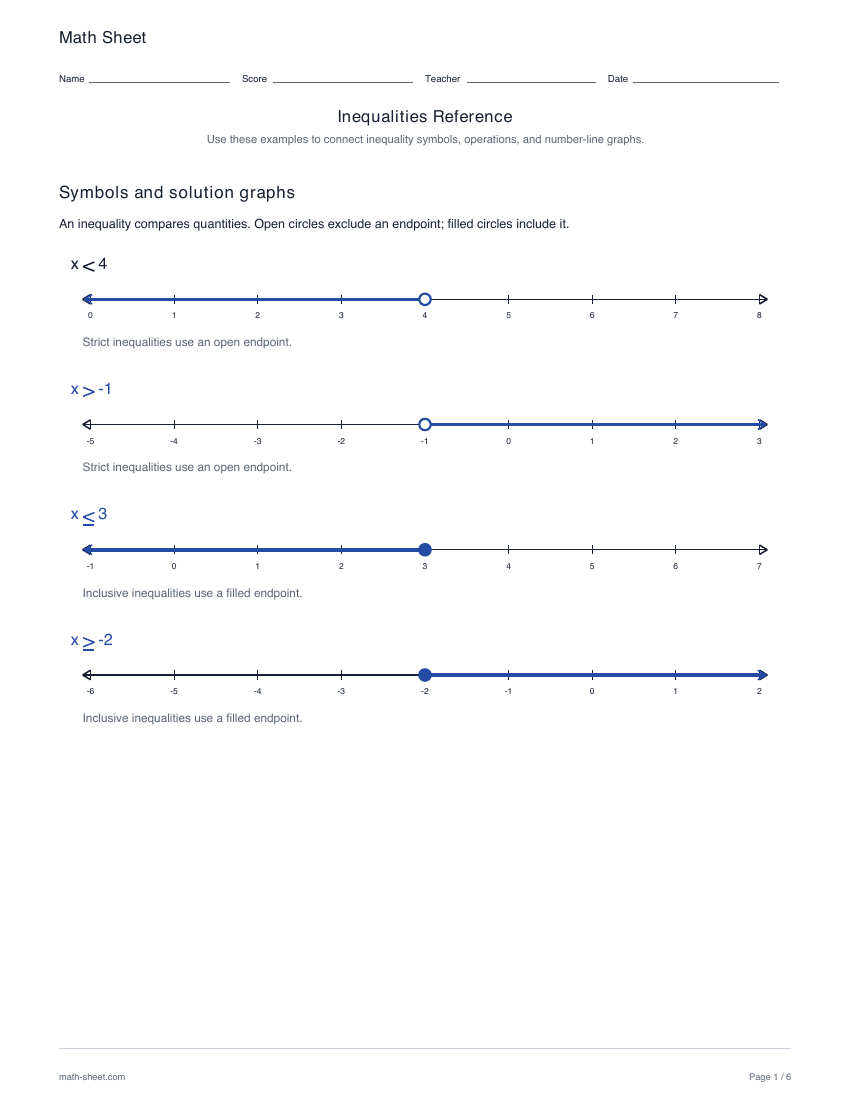
First page preview: Inequality symbols and properties reference

Inequalities

Inequality symbols and properties reference

Print a complete guide to inequality symbols, number-line graphs and equivalent transformations. Explore addition, subtraction, signed multiplication and division, and transitive comparisons with examples.

Preview and download
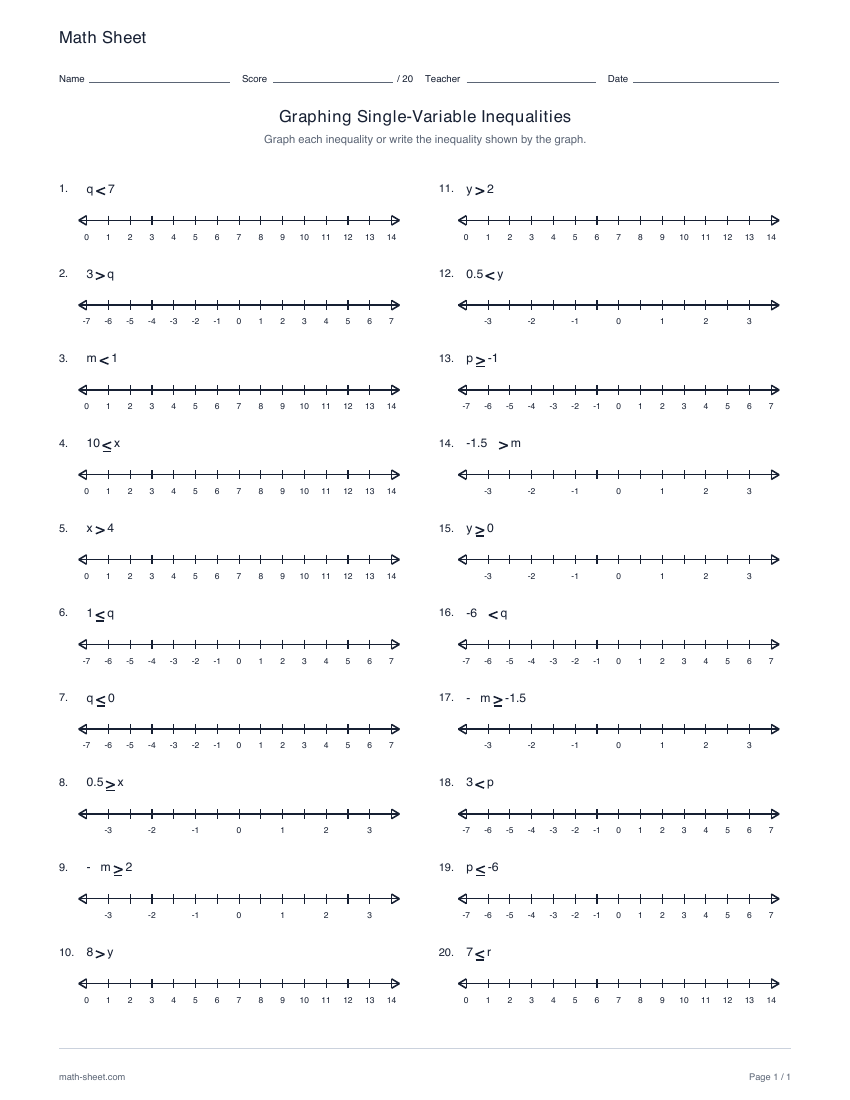
First page preview: Graphing single-variable inequalities worksheets

Inequalities

Graphing single-variable inequalities worksheets

Translate between an inequality and a number-line graph in twenty questions. Choose whole numbers, signed integers or halves; draw graphs, read graphs or mix both tasks, with a separate key.

Preview and download

Connect notation and meaning

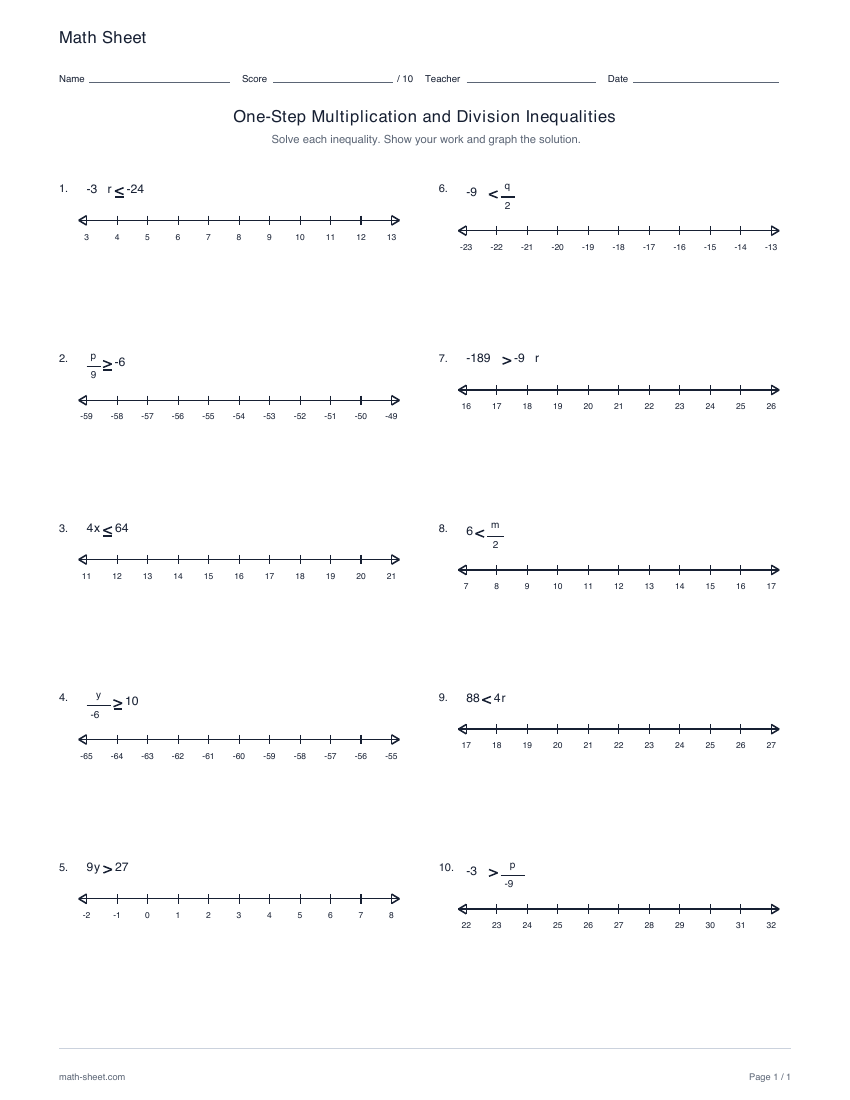
Solve with one inverse operation

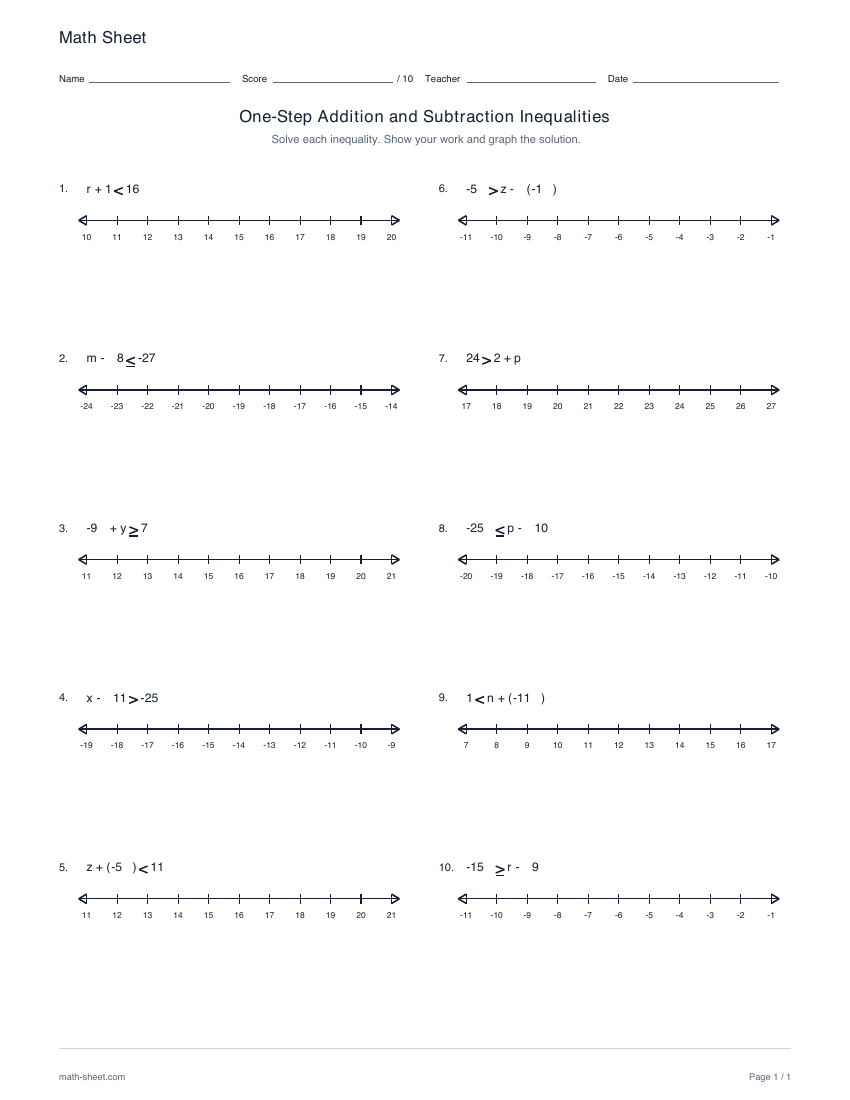
Start with addition and subtraction, then introduce signed multiplication and division. Use the combined sheet when learners are ready to choose among all four operations.

First page preview: One-step all-operations inequalities worksheets

Inequalities

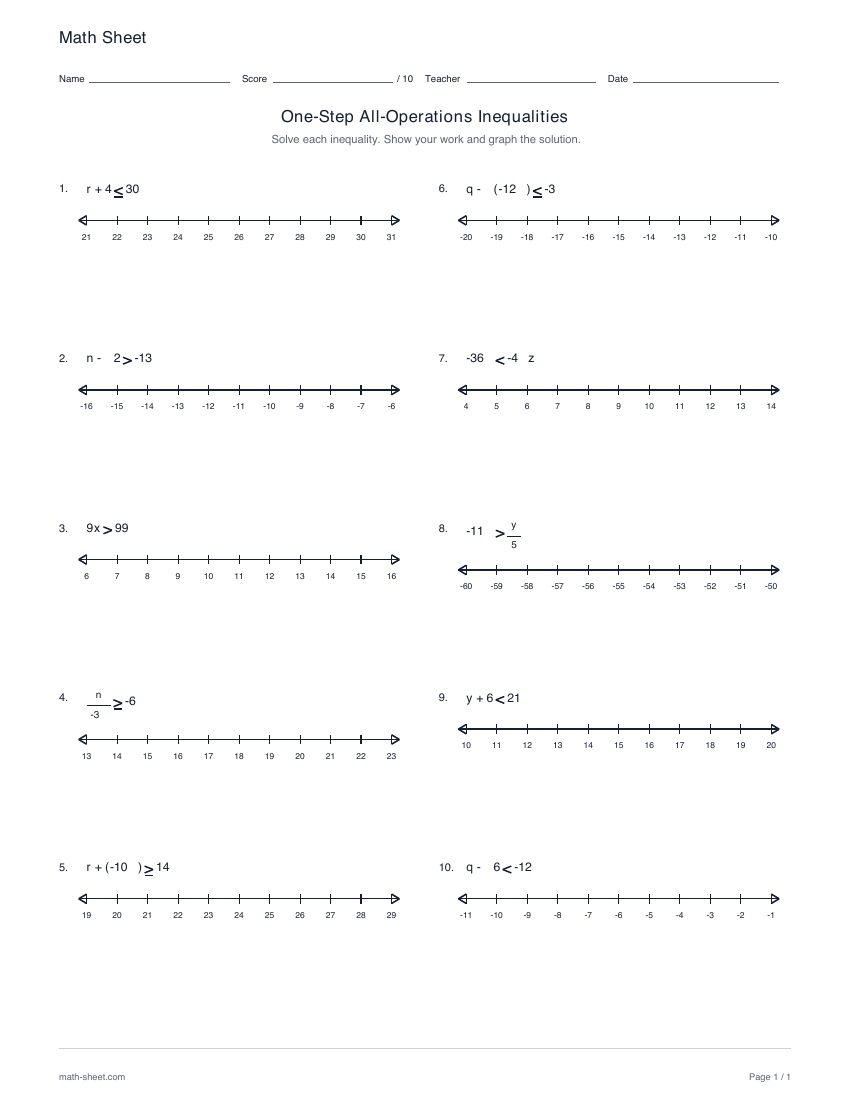
One-step all-operations inequalities worksheets

Solve and graph ten one-step inequalities in one mixed set: three addition, three subtraction, two multiplication and two division questions. Choose the prompt relationships and print separate worked answers.

Preview and download

Connect notation and meaning

Simplify and follow the relationship

Combine inverse operations, distribution and like terms while keeping the same solution set. Every practice question ends with a number-line graph.

First page preview: Two-step inequalities worksheets

Inequalities

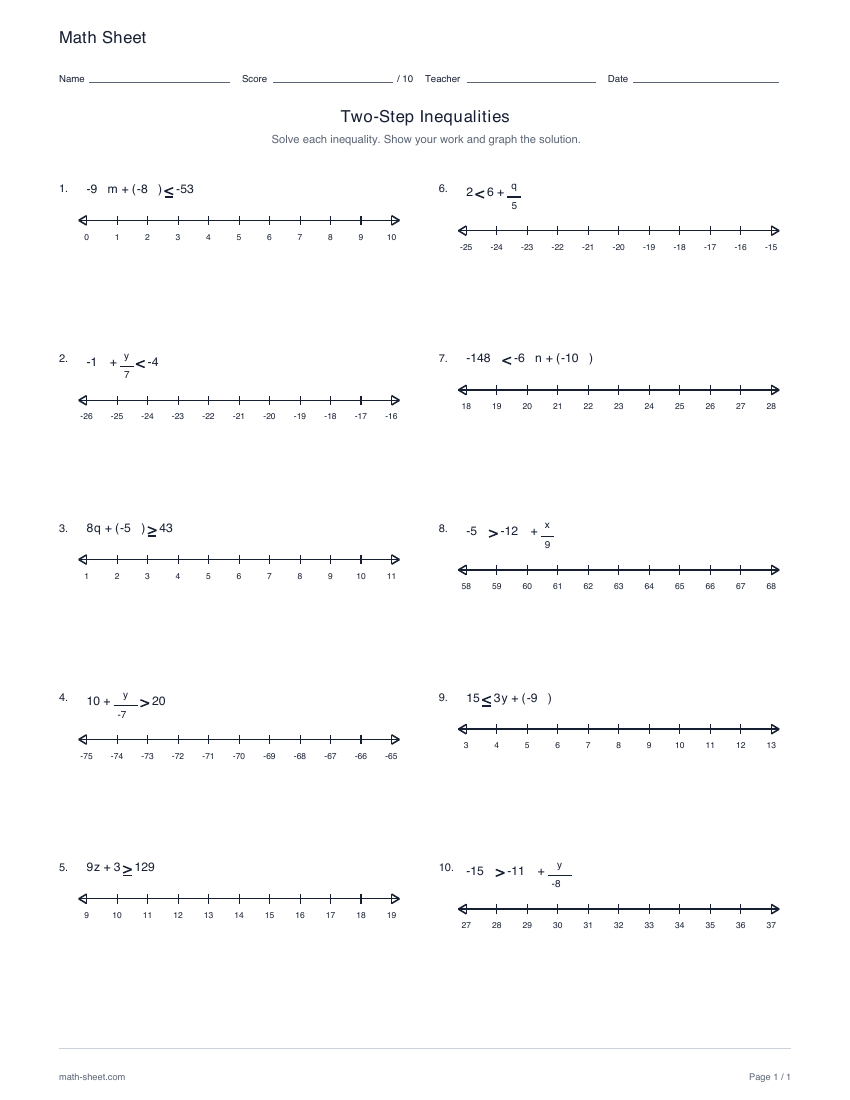
Two-step inequalities worksheets

Solve and graph ten two-step inequalities with signed coefficients, constants and variable quotients. Keep boundaries exact and use the worked key to follow each equivalent transformation.

Preview and download
First page preview: Multi-step inequalities worksheets

Inequalities

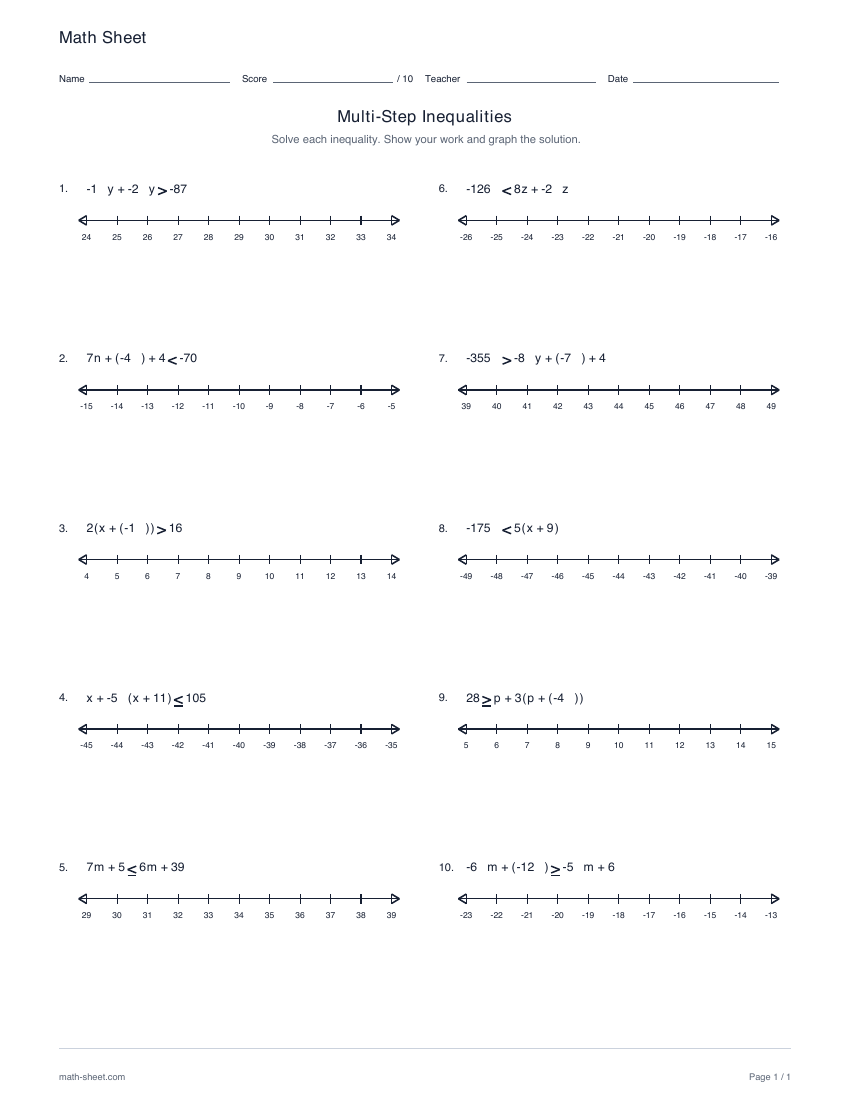
Multi-step inequalities worksheets

Distribute factors, combine like terms and solve ten linear inequalities with variables on either or both sides. Print exact solutions, explained sign reversals and number-line graphs.

Preview and download

Combine two conditions

Intervals and pairs of rays

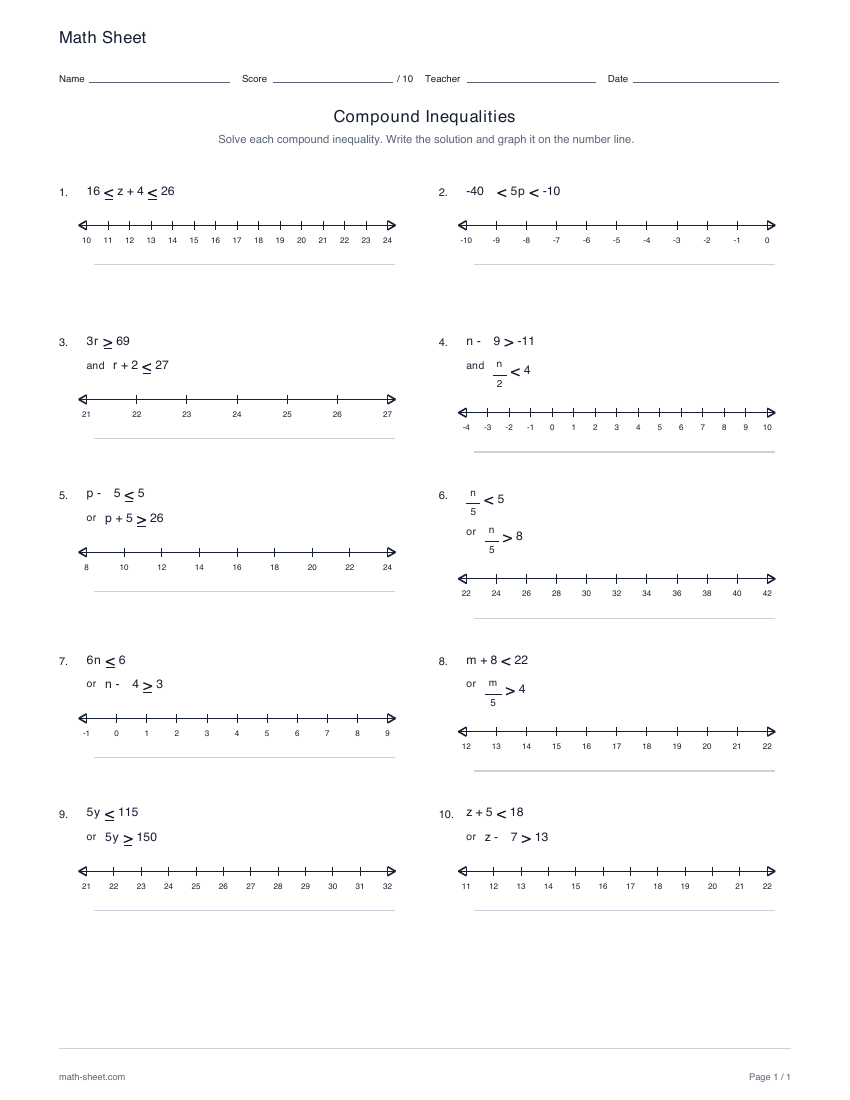
AND keeps the intersection of two solution sets. OR takes their union. Solve chained or joined comparisons, then show the result with correct open or filled boundaries on a number line.

First page preview: compound inequalities worksheets

Inequalities

Compound inequalities worksheets

Solve and graph ten compound inequalities. Choose addition and subtraction, multiplication and division, or mixed operations, then connect AND intervals and OR rays with a separate graphical answer key.

Preview and download

Use distance to describe a solution set

Absolute value inequalities

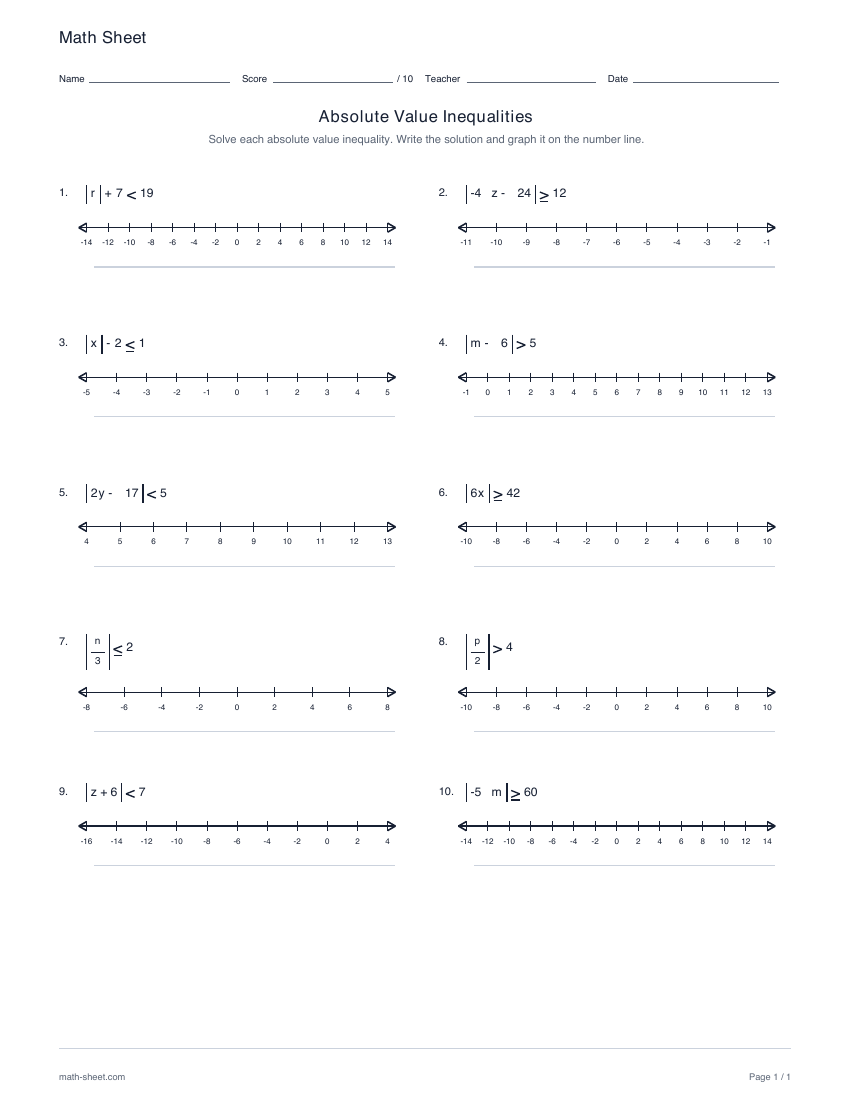
Isolate the absolute value before splitting the comparison. Practice shifts, adjustments outside the bars, negative inner coefficients and fractions, then graph an interval or two outward rays.

First page preview: absolute value inequalities worksheets

Inequalities

Absolute value inequalities worksheets

Solve and graph ten absolute value inequalities. Choose addition and subtraction, multiplication and division, or mixed operations, with shifts, negative inner coefficients and separate worked graphical answers.

Preview and download

Choose a starting point by readiness

A familiar number domain helps learners focus on the comparison. Move to signed values and negative transformations when the endpoint and direction are secure.

Explain the symbols and properties

Read the complete handout together, moving from open and filled endpoints to equivalent transformations.

Open this starting point →

Begin with whole-number boundaries

Draw twenty rays on a nonnegative number line, with positive variables and all four comparison symbols.

Open this starting point →

Read and draw signed graphs

Alternate ten graphing tasks with ten graph-reading tasks, including negative boundaries and half units.

Open this starting point →

Explain the negative sign reversal

Compare positive and negative multipliers or divisors before moving to two-step inequalities.

Open this starting point →

Choose among all four inverse operations

Mix three addition, three subtraction, two multiplication and two division questions in one ten-question review.

Open this starting point →

Keep the two operations separate

Use additive and multiplicative inverse steps, then check the endpoint and ray in the original inequality.

Open this starting point →

Read three things from every graph

  1. Boundary: find the exact value where the solution set starts or stops.
  2. Inclusion: an open circle excludes that value; a filled circle includes it.
  3. Direction: the ray shows smaller or larger values that satisfy the comparison.

For x < 3, the value 3 is excluded but 2.9 is included. The graph describes all qualifying values, including values between labeled ticks. A worksheet with integer boundaries does not restrict the solution to integers.

Have learners test one value on each side and the boundary itself. This checks both the direction and whether equality is allowed.

Use equations as a bridge

An equation may ask for one value that makes two sides equal. A linear inequality usually describes a ray of possible values. Both use equivalent transformations, but multiplication or division by a negative number changes the direction of an inequality.

Adding or subtracting a negative number does not reverse the comparison. Write each operation explicitly to distinguish that step from division by a negative coefficient.