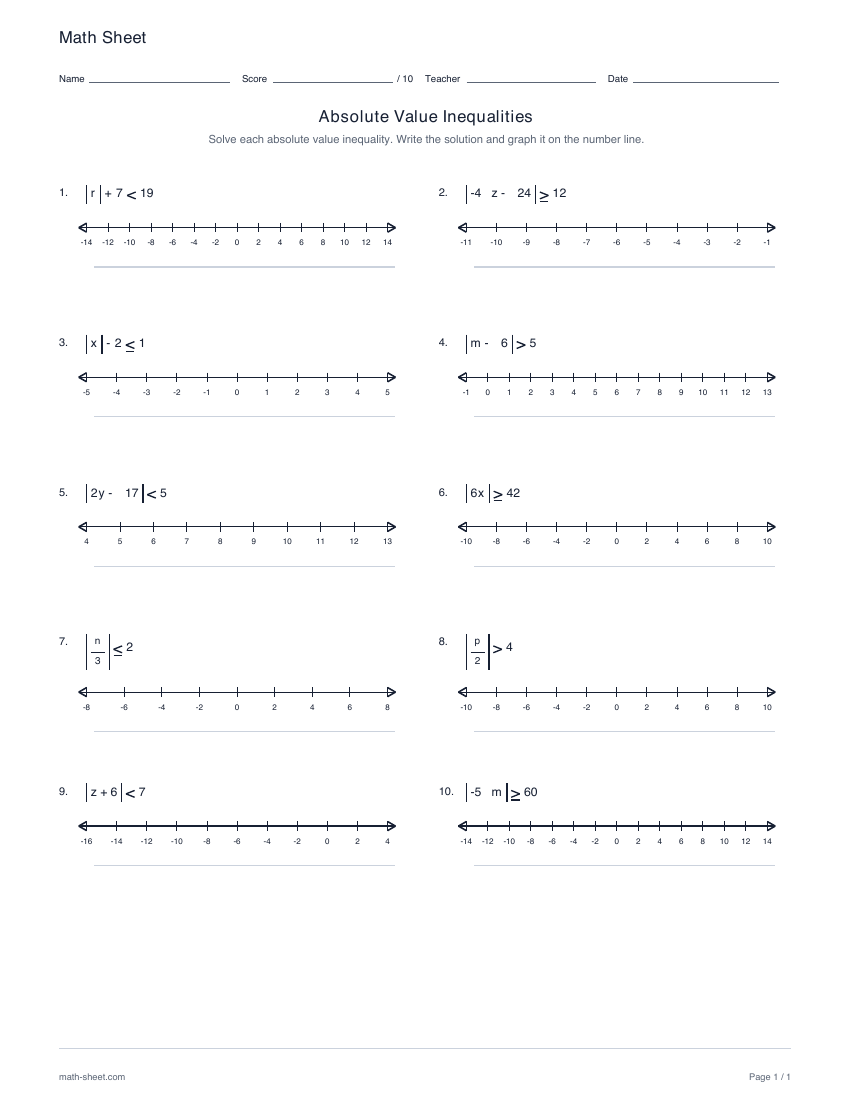
Solve and graph ten absolute value inequalities. Choose addition and subtraction, multiplication and division, or mixed operations, with shifts, negative inner coefficients and separate worked graphical answers.
The bars take the absolute value of everything inside them. An outside adjustment is applied afterward. For |x| − 2 < 5, add 2 first to obtain |x| < 7, then solve −7 < x < 7. For |x − 2| < 5, the distance is measured from 2, giving −3 < x < 7.
A greater-than absolute comparison produces two alternatives. For |−3x| > 9, the inside coefficient is negative, but |−3x| = 3|x|. The solution is x < −3 or x > 3: use two open endpoints and outward rays.
Each task provides a blank labeled number line and a symbolic response space. Separate answer pages connect the original prompt, the solving steps, the simplified set and the graph. The student and answer editions use the same scale.
Questions about absolute value inequalities
When should I shade between the boundaries?
After isolating an absolute value with a positive threshold, < or ≤ means the inner expression stays between the negative and positive threshold. Solve the two conditions together and shade their overlap. For > or ≥, solve two alternatives and shade the outward rays.
What happens to a negative coefficient inside the bars?
For |−3x| > 9, use |−3x| = 3|x|. Dividing by positive 3 gives |x| > 3, so x < −3 or x > 3. The coefficient inside the bars does not make the absolute value negative.
What does each operation mode include?
Addition/subtraction includes shifts inside the bars and adjustments outside them. Multiplication/division includes positive and negative inner multipliers and fractions with positive divisors. Mixed mode also combines multiplication and a shift inside one absolute expression.
How many tasks are on each worksheet?
Each worksheet has ten different solution sets: five bounded intervals and five pairs of outward rays. Five comparisons are strict and five allow equality. Finite boundaries are integers, and the graphs describe all real solutions between or beyond them.
How do I choose open or filled endpoints?
Use open circles for < and > because equality is excluded. Use filled circles for ≤ and ≥ because the boundaries are included. Check a boundary in the original absolute-value comparison to confirm it.
Learning objective
What this activity builds
Isolate an absolute value, find its two boundaries and represent the solution as an interval or two outward rays.
Worked example
Solve and graph |2x − 3| + 1 ≤ 6.
Subtract 1: |2x − 3| ≤ 5. Write −5 ≤ 2x − 3 ≤ 5, add 3, then divide by 2: −1 ≤ x ≤ 4.
An absolute value at most 5 keeps the inner expression between −5 and 5. The solution is a closed interval from −1 to 4. Both endpoints make the original left side equal to 6, while x = 0 gives 4 and satisfies the comparison. Draw a filled circle at each boundary and shade between them.
Teaching notes
Make the practice count
Apply any outside addition or subtraction before splitting the absolute comparison.
Keep an inside shift inside the bars until you write the two boundary conditions.
For a positive threshold, less-than comparisons give an interval; greater-than comparisons give two outward rays.
A negative coefficient inside the bars affects the inner expression; it does not make the absolute value negative.
Check the original prompt at both endpoints and at a value in each region.
Use the labeled tick scale, including positions between ticks, when plotting boundaries.
Make it yours
Customize the practice
Choose your options, update the preview, then download the exact same pages.
Choose addition/subtraction, multiplication/division or mixed operations. Each set has ten tasks with integer boundaries: five intervals and five pairs of outward rays, with five strict and five inclusive comparisons. Graphs include all real solutions, including values between labeled ticks.
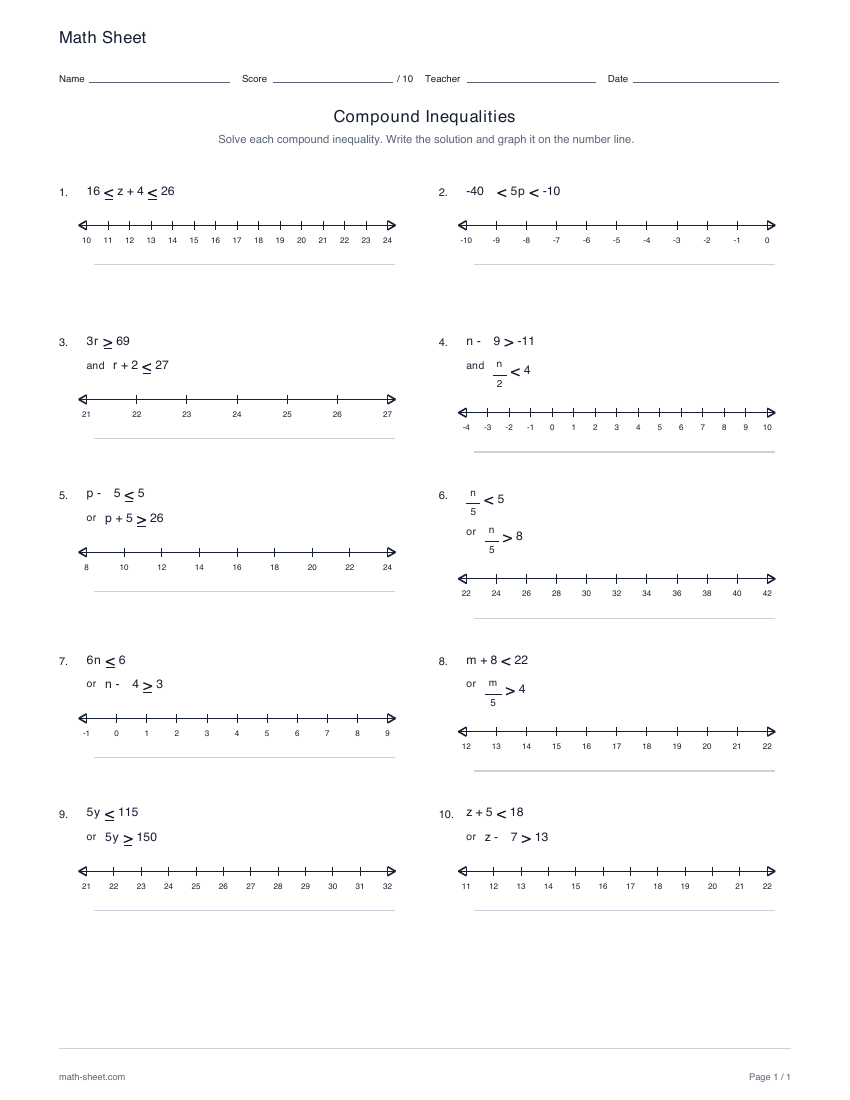
Solve and graph ten compound inequalities. Choose addition and subtraction, multiplication and division, or mixed operations, then connect AND intervals and OR rays with a separate graphical answer key.
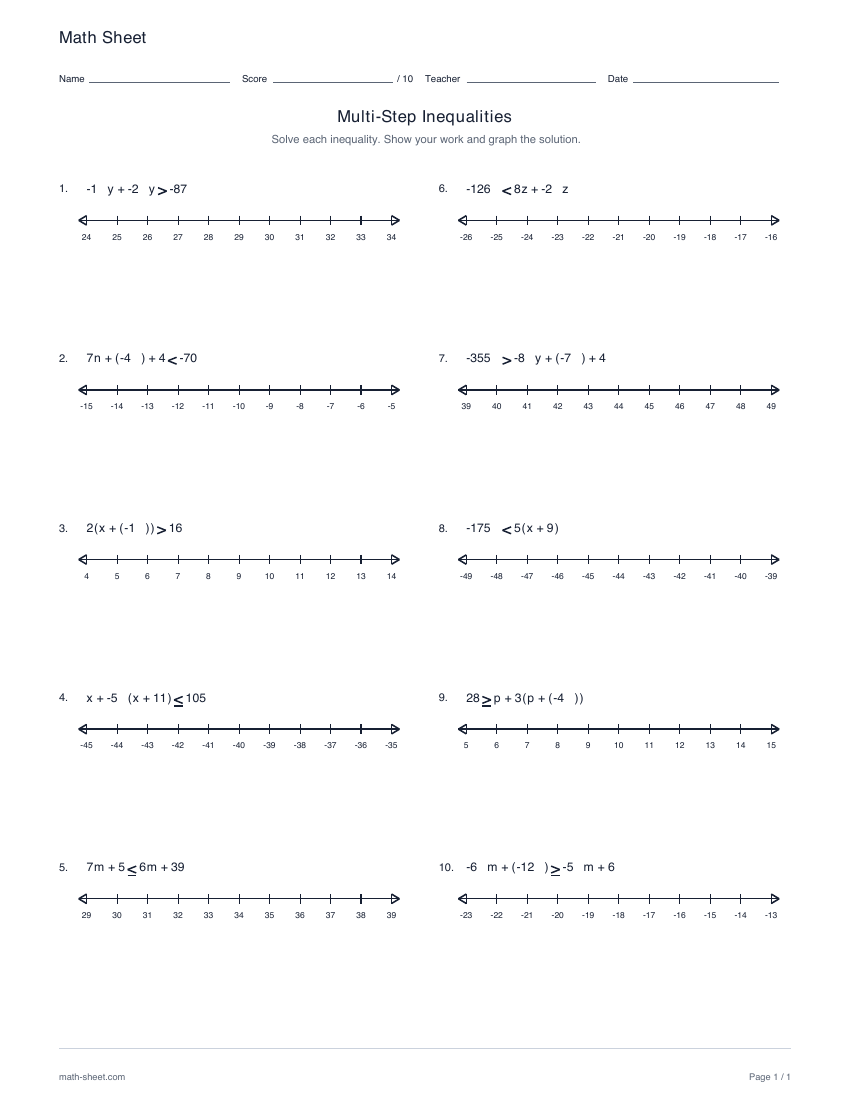
Distribute factors, combine like terms and solve ten linear inequalities with variables on either or both sides. Print exact solutions, explained sign reversals and number-line graphs.
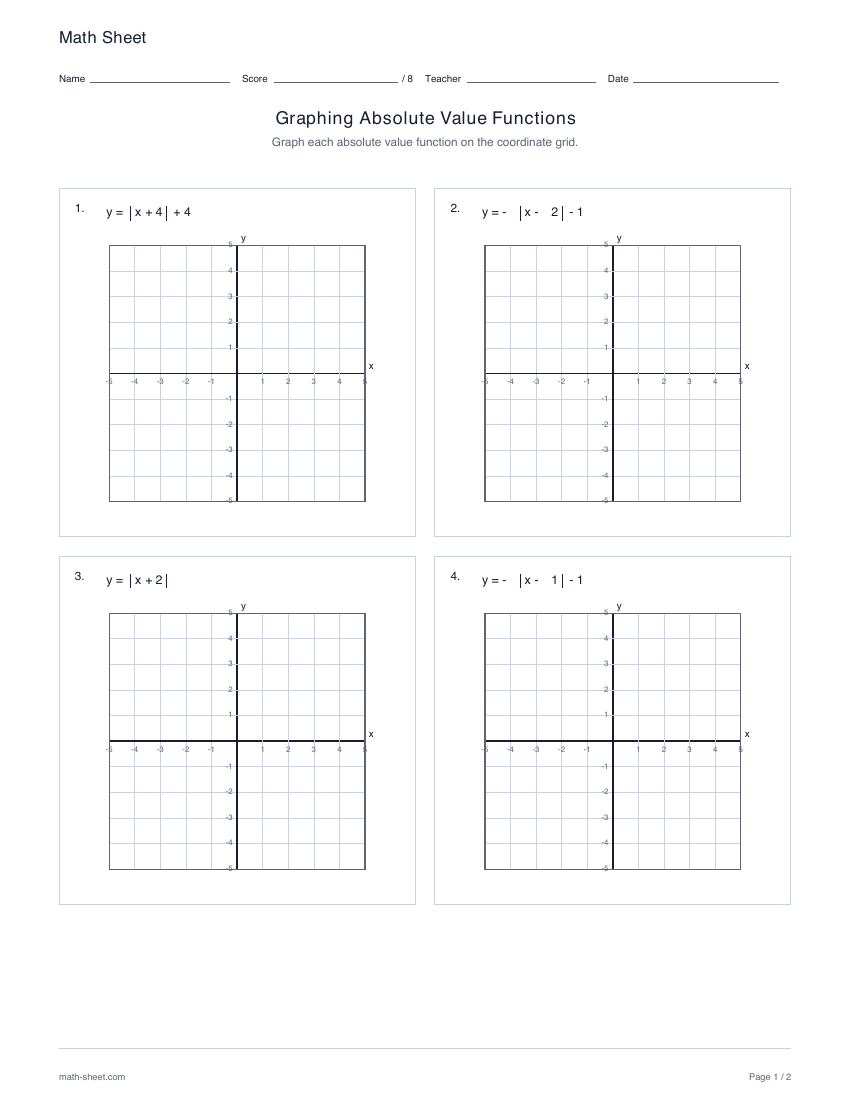
Graph eight absolute value functions or write equations from eight V-shaped graphs. Practice translations and reflections of y = |x| with integer vertices and a separate worked graphical key.