
Linear functions
Graphing slope-intercept form worksheets
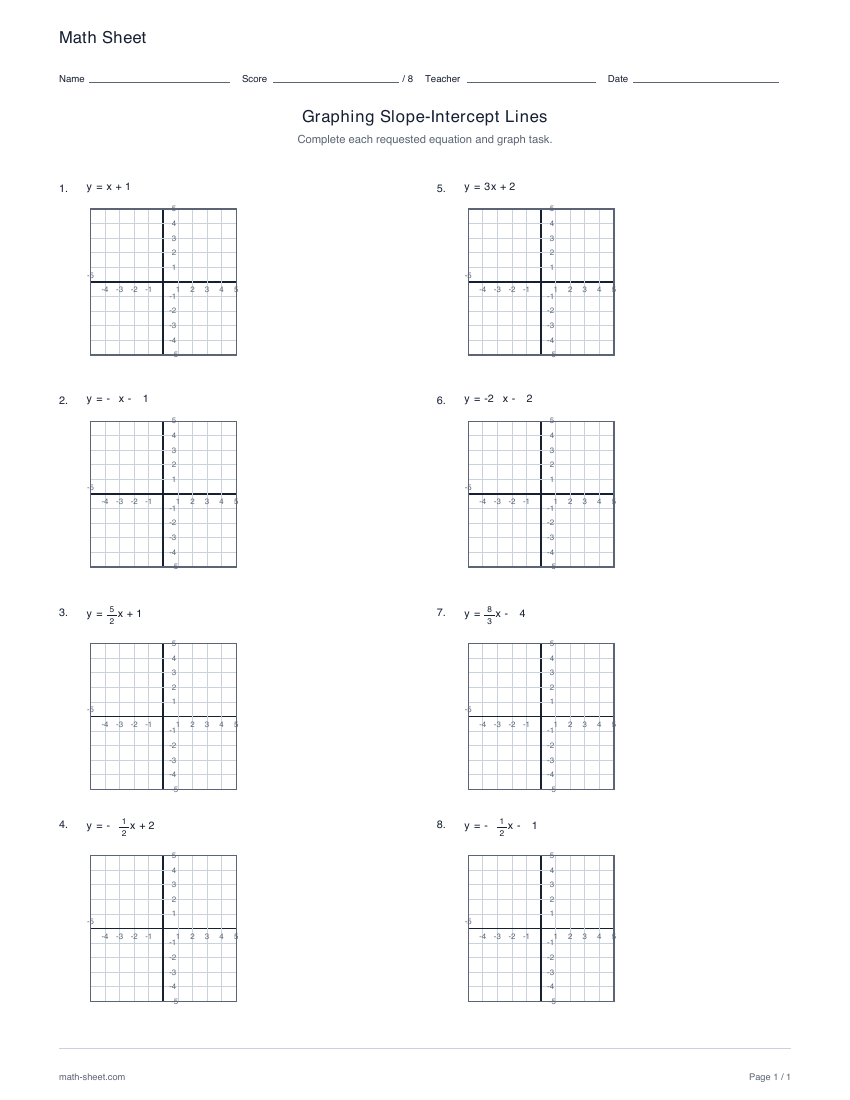
Graph eight lines in slope-intercept form. Choose graphing alone, graphing with slope and intercept questions, or writing an equation and graph from supplied properties.
Preview and downloadLinear functions practice
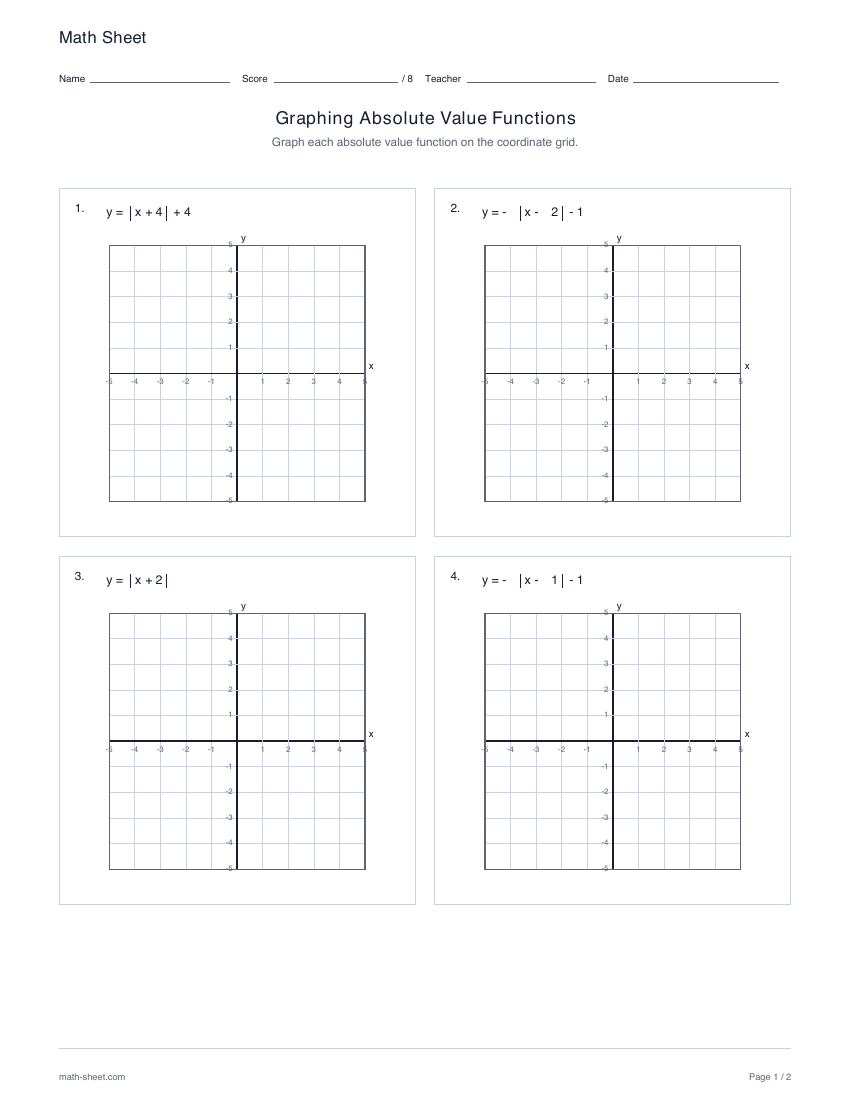
Graph eight absolute value functions or write equations from eight V-shaped graphs. Practice translations and reflections of y = |x| with integer vertices and a separate worked graphical key.
Ready-made English PDF · fixed settings
Customization below makes a separate PDF.
Fixed English ready-made files. Custom settings below apply only to the configured PDF.
Ready to print
In graph mode, plot the vertex and draw both branches from the supplied equation. In write-equation mode, read the vertex and opening direction of each V, then write its equation.
Download the practice pages alone, or include a separate answer key or teacher model. Longer activities may use more than one page.
Customize this worksheetPaper sizes and printing help · More linear functions activities
For y = a|x − h| + k, the vertex is (h, k). A coefficient a = 1 opens the graph upward; a = −1 reflects it downward. Equal horizontal distances on either side of the vertex give equal y-values.
Each worksheet contains eight unique functions with integer vertices from −4 to 4 and unit-scaled axes from −5 to 5. Four open upward and four downward. Choose graph mode to draw from equations, or write-equation mode to recover a formula from each graph.
Graph mode supplies an equation and a blank coordinate grid. Write-equation mode supplies the V-shaped graph and an equation response line. Each worksheet has eight tasks and eight marks; the key completes the equation, vertex, opening direction and graph.
Each set has four upward and four downward functions with a = 1 or −1. Integer vertex coordinates h and k range from −4 to 4. This activity focuses on translations and reflection; it does not include other stretch factors.
No. The grid shows the part of the function within −5 to 5 on each axis, with unit ticks. The branches continue beyond that viewing window. The vertex is where the two branches meet, not an endpoint of the whole function.
Read the vertex (h, k), choose a = 1 for an upward V or a = −1 for a downward V, then write y = a|x − h| + k. Check a second point on one branch and a matching point on the other.
Learning objective
Connect the vertex and opening direction of an absolute value graph with y = a|x − h| + k.
Worked example
The vertex is (2, 1). The graph opens downward and passes through (1, 0), (3, 0), (0, −1) and (4, −1).
At x = 2 the absolute value is zero, giving y = 1. Moving one unit to either side makes the absolute value one, so the negative coefficient lowers y by one. Both branches begin at the vertex; they do not continue through it as crossing lines.
Teaching notes
Make it yours
Choose your options, update the preview, then download the exact same pages.
Choose graphing or equation-writing practice. Each set has eight functions with upward and downward graphs. Every grid uses unit intervals from −5 to 5.
A useful next step
Linear functions
Graph eight lines in slope-intercept form. Choose graphing alone, graphing with slope and intercept questions, or writing an equation and graph from supplied properties.
Preview and download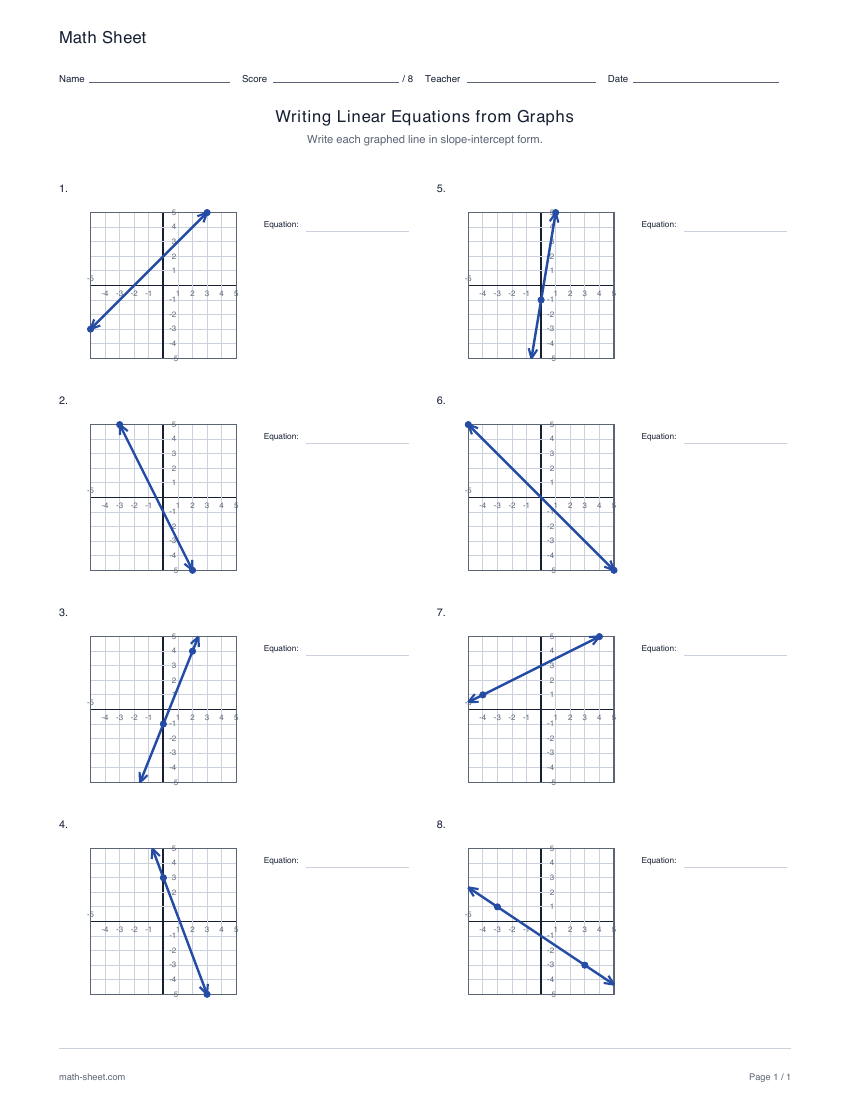
Linear functions
Write slope-intercept equations for eight graphed lines. Read the y-intercept, calculate an exact slope and check the equation against visible points with a separate worked key.
Preview and download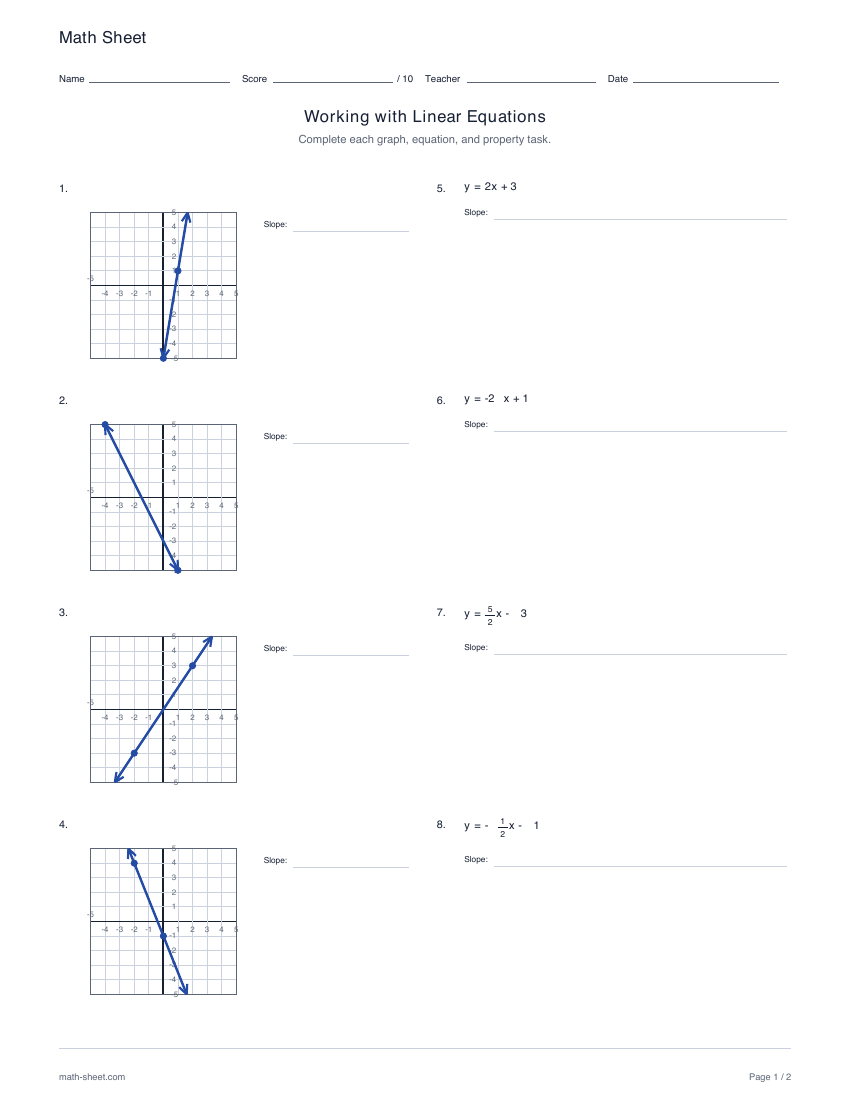
Linear functions
Connect graphs, equations and line properties in ten tasks: four graph-to-slope questions, four equation-to-slope questions and two write-and-graph problems.
Preview and download