
Rounding
Rounding by comparison
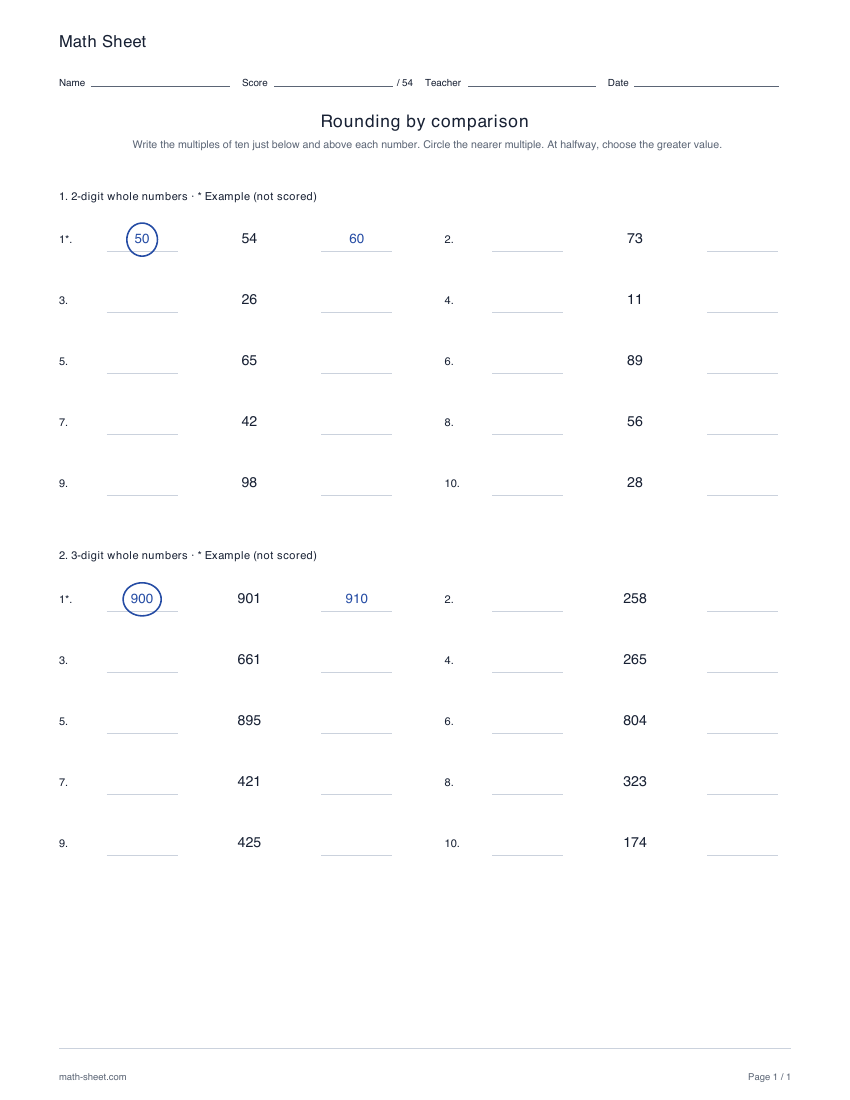
Fill in the multiples immediately below and above each number, then circle the nearer value. Practice tens, hundreds or thousands with an optional worked example in each group.
Preview and downloadPractice by skill
Find the neighbors. Compare the distances. Make an estimate you can explain, from the nearest ten to the nearest thousandth.
Choose a rounding skill743 to the nearest ten
3 away ← 743 → 7 away
Place value in practice
Compare the neighboring multiples, then practice choosing the nearest ten, hundred or thousand.
Rounding
Fill in the multiples immediately below and above each number, then circle the nearer value. Practice tens, hundreds or thousands with an optional worked example in each group.
Preview and download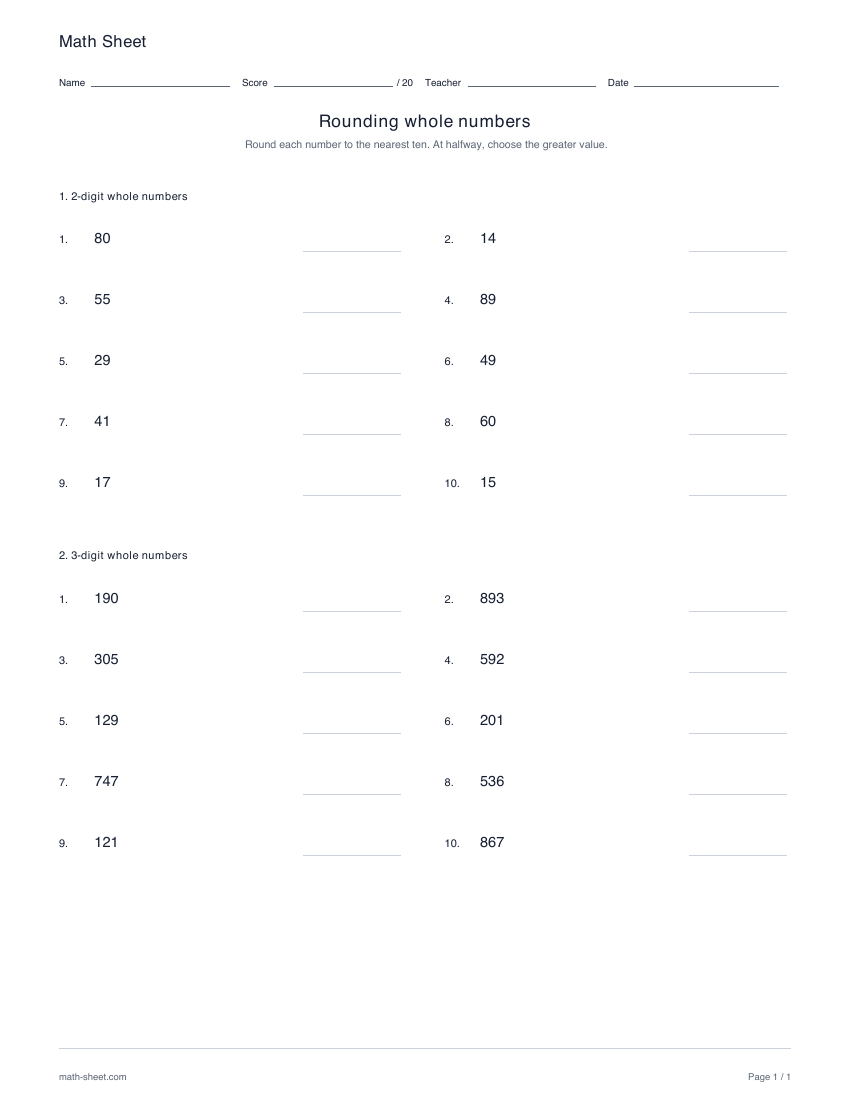
Rounding
Round positive whole numbers to the nearest ten, hundred or thousand. Choose fixed or mixed digit ranges, 10, 20 or 30 questions, and a separate answer key.
Preview and downloadPlace value in practice
Carry the same place-value reasoning into decimal values and amounts with currency symbols.
Rounding
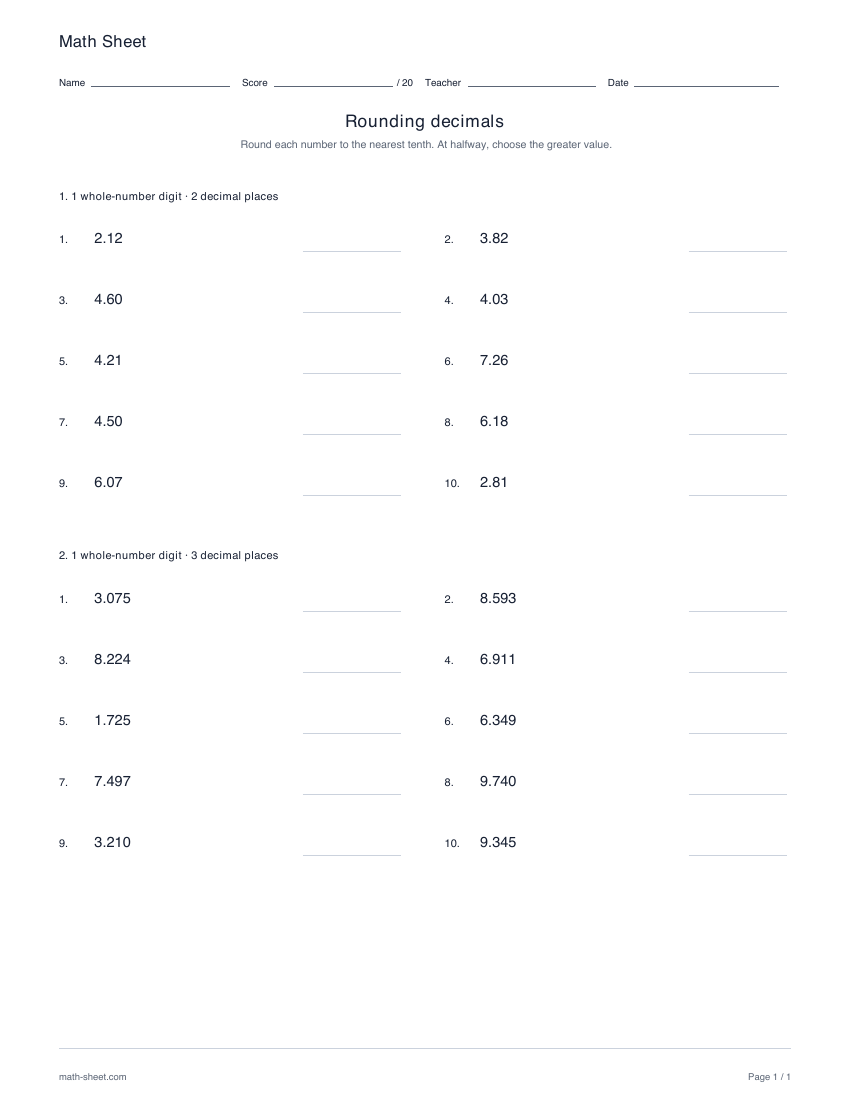
Round decimals to the nearest tenth, hundredth or thousandth. Two groups add one then two extra decimal places, with exact answers that preserve the requested precision.
Preview and download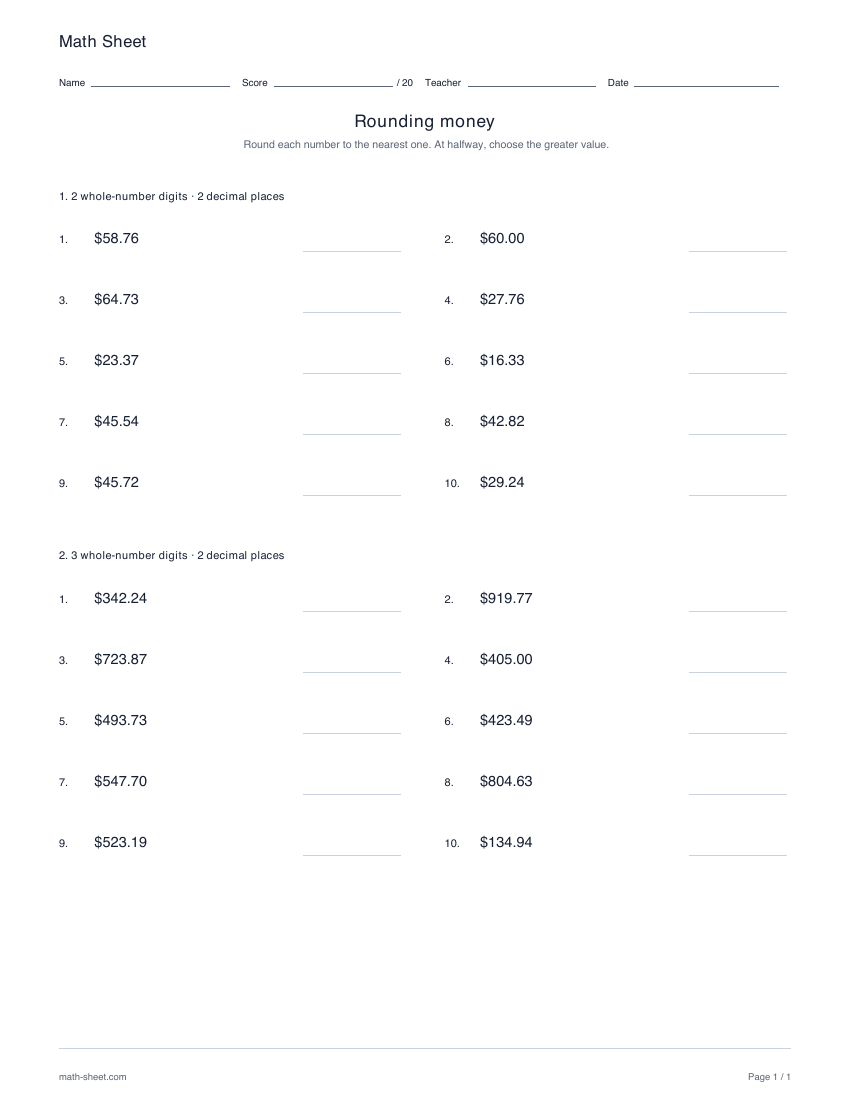
Rounding
Round amounts to the nearest one or ten units with dollar, pound, euro or yen symbols. Print two groups of increasingly large amounts, with two-decimal-place answers.
Preview and downloadPlace value in practice
Use these fixed 0–100 teaching references before moving to independent practice. They share the existing hundreds-chart pages.
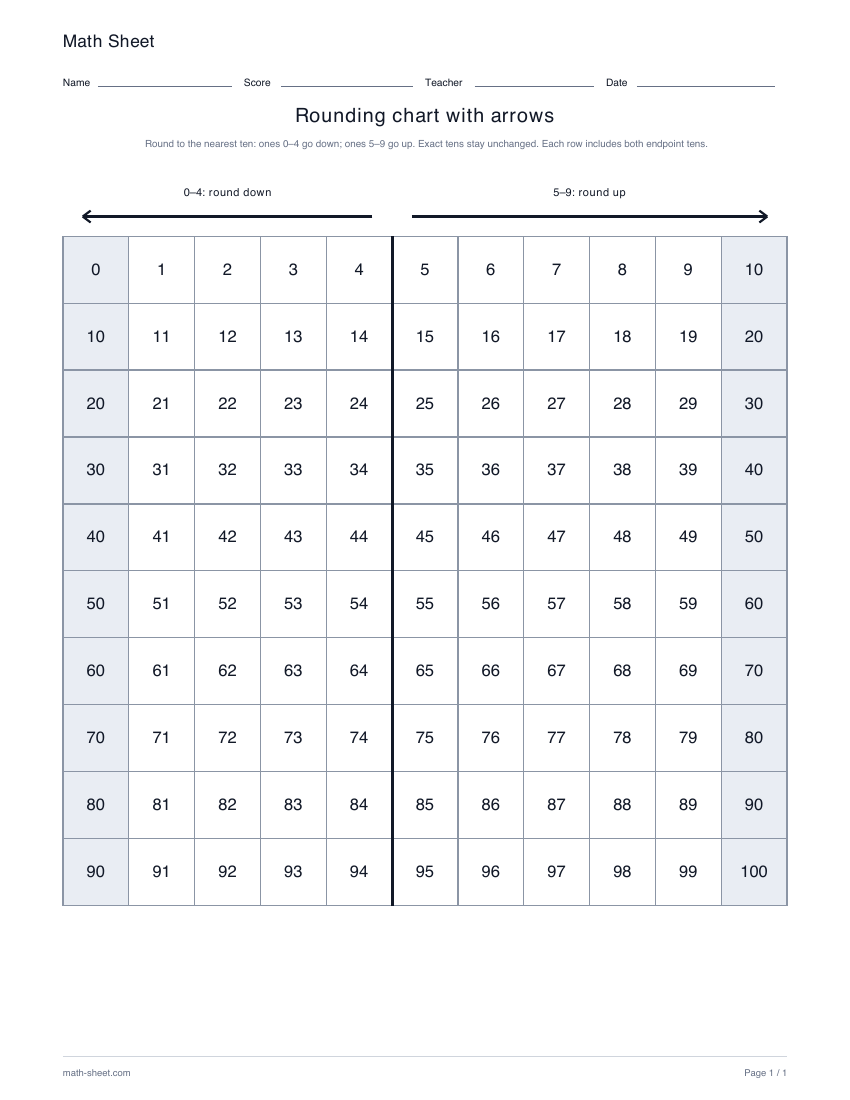
Hundreds chart
Use an 11-column reference chart with directional arrows to round numbers from 0 to 100 to the nearest ten.
Preview and download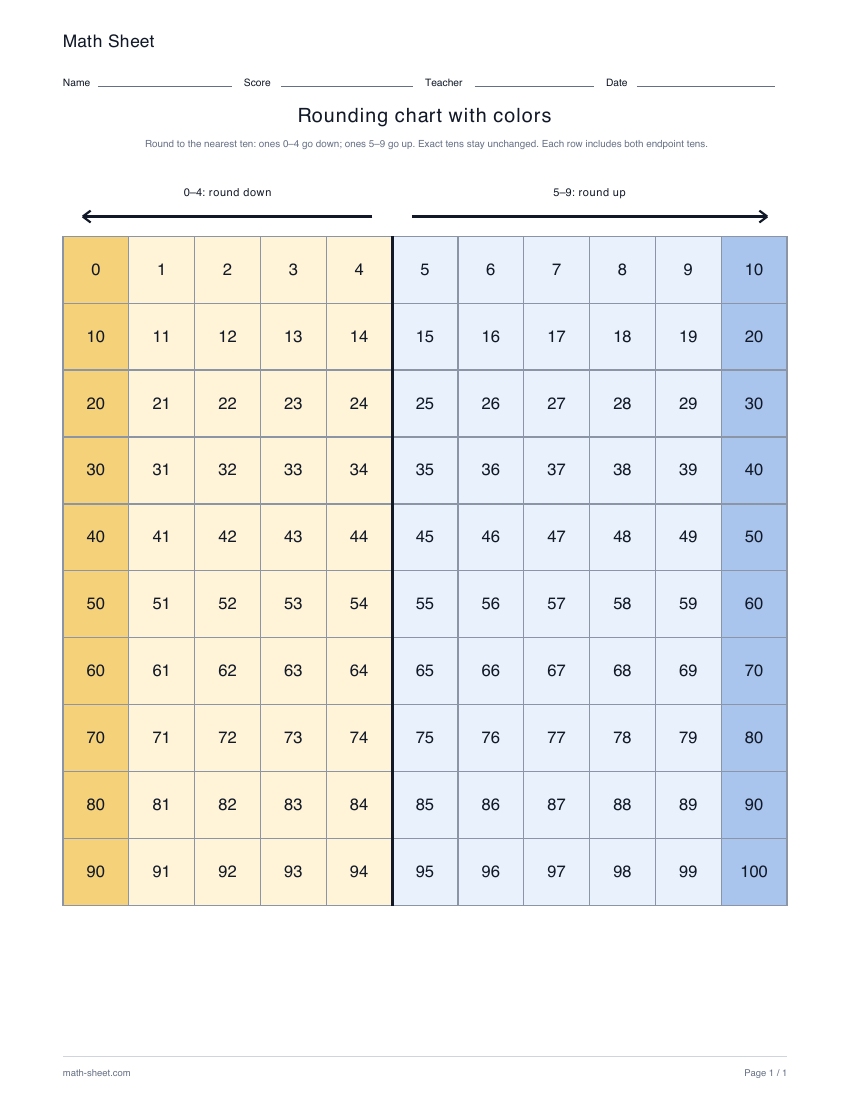
Hundreds chart
Read a labeled, softly colored 0–100 reference chart to see which numbers round down or up to the nearest ten.
Preview and downloadChoose by readiness
Begin when learners can order the relevant numbers and explain the gap between consecutive multiples. These starting points describe skills rather than a required national curriculum.
Use after counting by ten and comparing two-digit numbers. Explain both neighboring multiples.
Open this focused practice →Use after reading and comparing decimal values. Preserve one decimal place in the answer.
Open this focused practice →Work with four- and five-place decimals, including carry. Avoid repeated rounding through intermediate places.
Open this focused practice →For 743, the neighboring tens are 740 and 750. The neighboring hundreds are 700 and 800. Both pairs are useful, but they answer different questions. Identify the rounding place before changing any digits.
The comparison worksheet makes this reasoning visible: students write both neighbors and circle the closer value. Each group can begin with a completed example. The direct worksheet then asks students to apply the same reasoning independently.
Rounding 3.989 to the nearest tenth gives 4.0. The extra zero records the requested precision. At the nearest hundredth, 3.999 becomes 4.00. A carry can change the whole-number part as well as the decimal digits.
Round directly to the requested place. For example, 3.449 rounds to 3.4 at one decimal place. Rounding it first to 3.45 and then to one decimal place would give 3.5 instead.
The arrows and colors charts show nearest-ten rounding from 0 through 100. They are teaching references. Use them to discuss why 4 is closer to 0 while 5 rounds to 10, then move to problems that require students to choose their own answer.
The four practice generators offer 10, 20 or 30 positions, split into two groups. Comparison examples count as positions but earn no marks. Turn them off to score every position; the same seed keeps the same numbers.
Each practice page includes English Letter and A4 downloads, with a student-only file and a file that adds a separate answer key. The generator lets you choose the rounding place, number range, paper size, teacher note and seed.
All four practice generators support English, German, Albanian, Spanish, Italian, French, Turkish and Norwegian Bokmål. Changing the printed language or paper size preserves the same questions. Each page keeps the Name, Score, Teacher and Date fields and the math-sheet.com footer.