
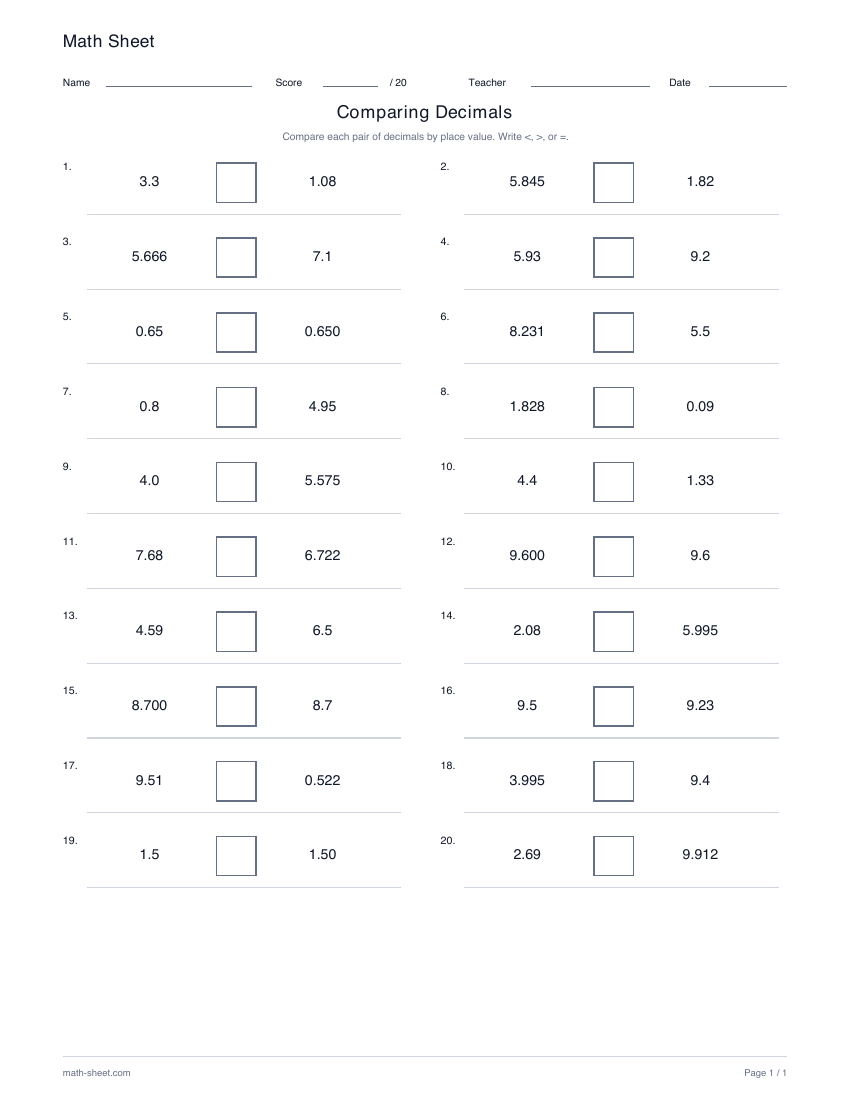
Comparing numbers
Compare decimals
Compare decimal values displayed with one to three decimal places, including equal values, close pairs and changes in place value.
Preview and downloadPractice by skill
Understand the place. Compare the value. Build from tenths to confident decimal calculations.
Choose a decimal skill| Number | Tenths | Hundredths | Thousandths |
|---|---|---|---|
| 0.65 | 6 | 5 | 0 |
| 0.7 | 7 | 0 | 0 |
| 0.708 | 7 | 0 | 8 |
Compare values, not the number of digits.
Read, calculate, explain
Connect decimal place value to size and position. Compare pairs, order complete lists, and mark or read points on number lines.
Comparing numbers
Compare decimal values displayed with one to three decimal places, including equal values, close pairs and changes in place value.
Preview and download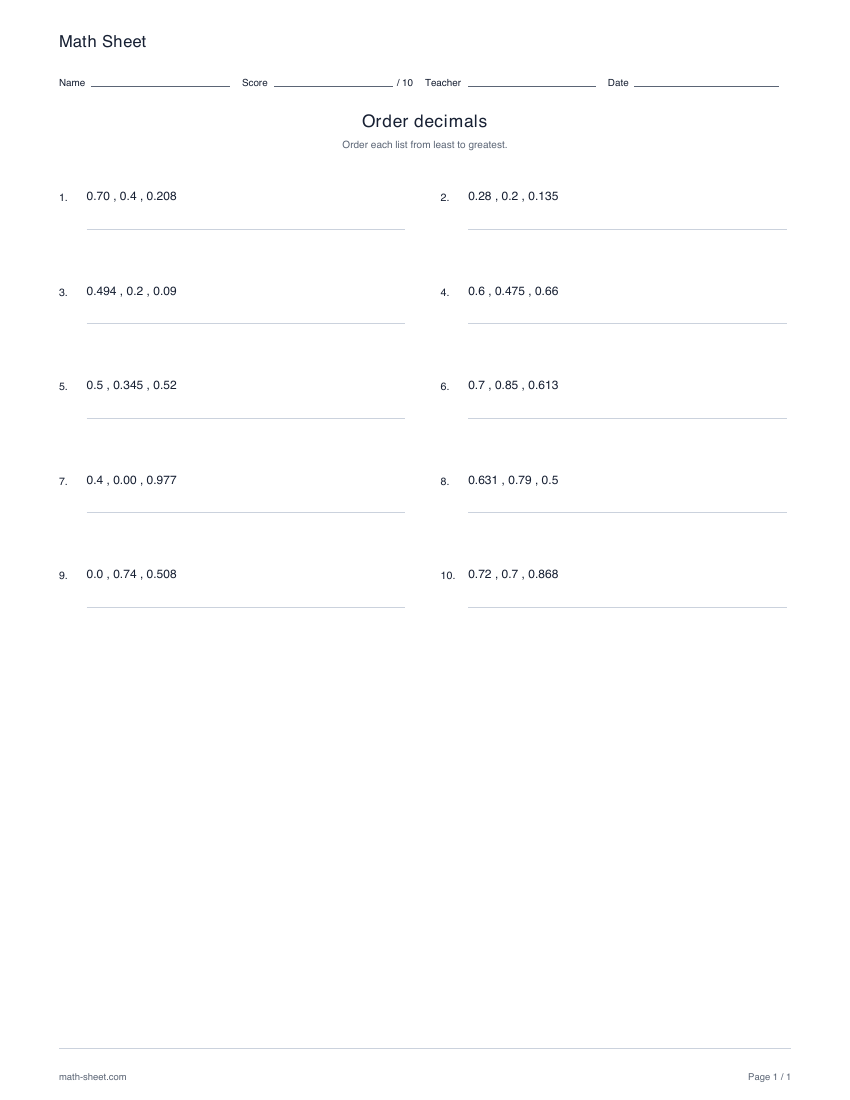
Decimals
Order three or four decimals from least to greatest or greatest to least. Mix tenths, hundredths and thousandths, choose the whole-number part, and print 10–16 questions.
Preview and download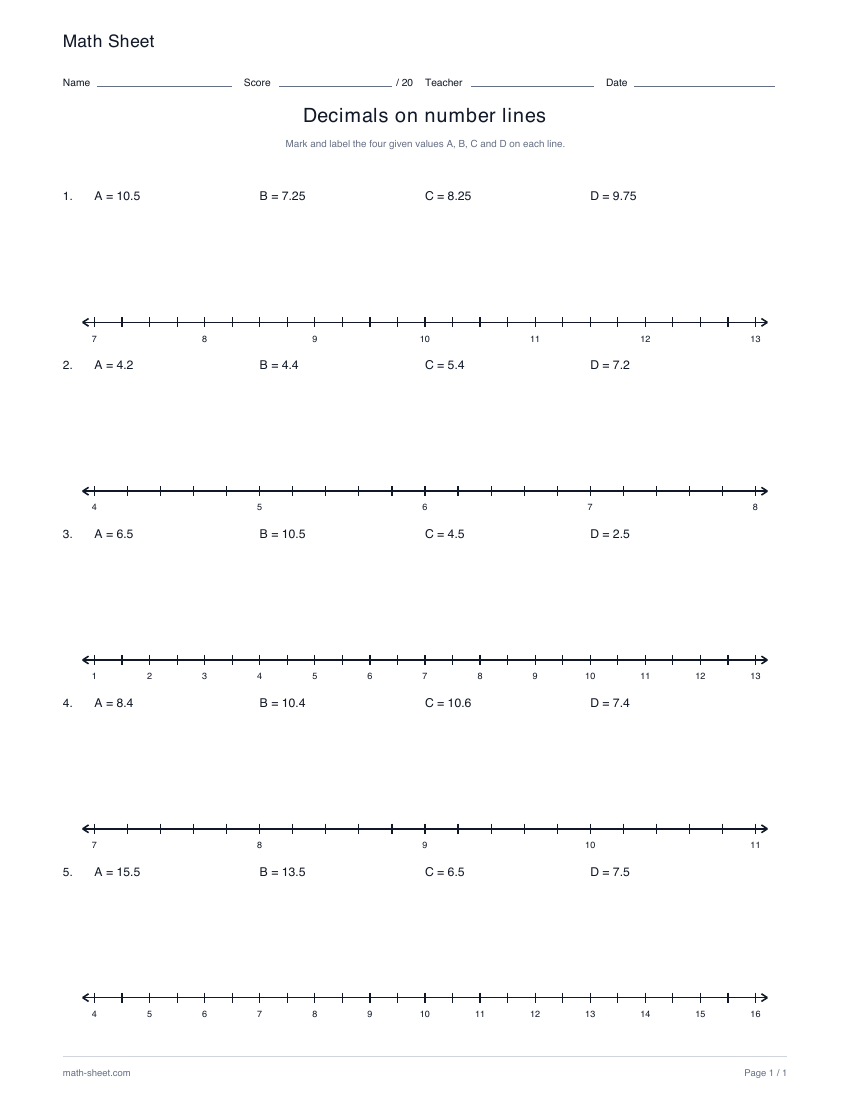
Number line
Locate four decimal values on each of five lines using halves, quarters, fifths, thirds, eighths or tenths. Choose plotting or reading practice.
Preview and downloadRead, calculate, explain
Align equal places, then calculate. Practice one operation, mix addition and subtraction, or focus on regrouping a whole number into decimal parts.
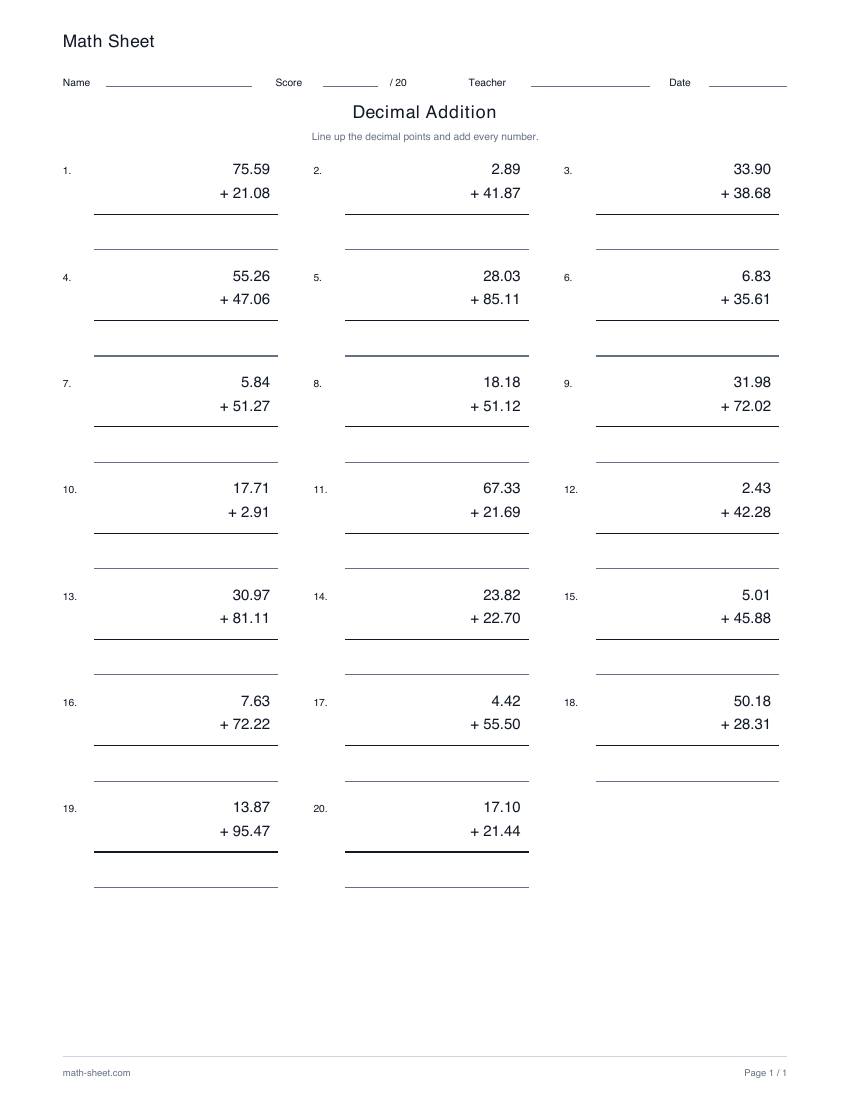
Addition
Print adding decimals worksheets with a separate answer key. Choose two, three or four addends, one to three decimal places and aligned vertical working.
Preview and download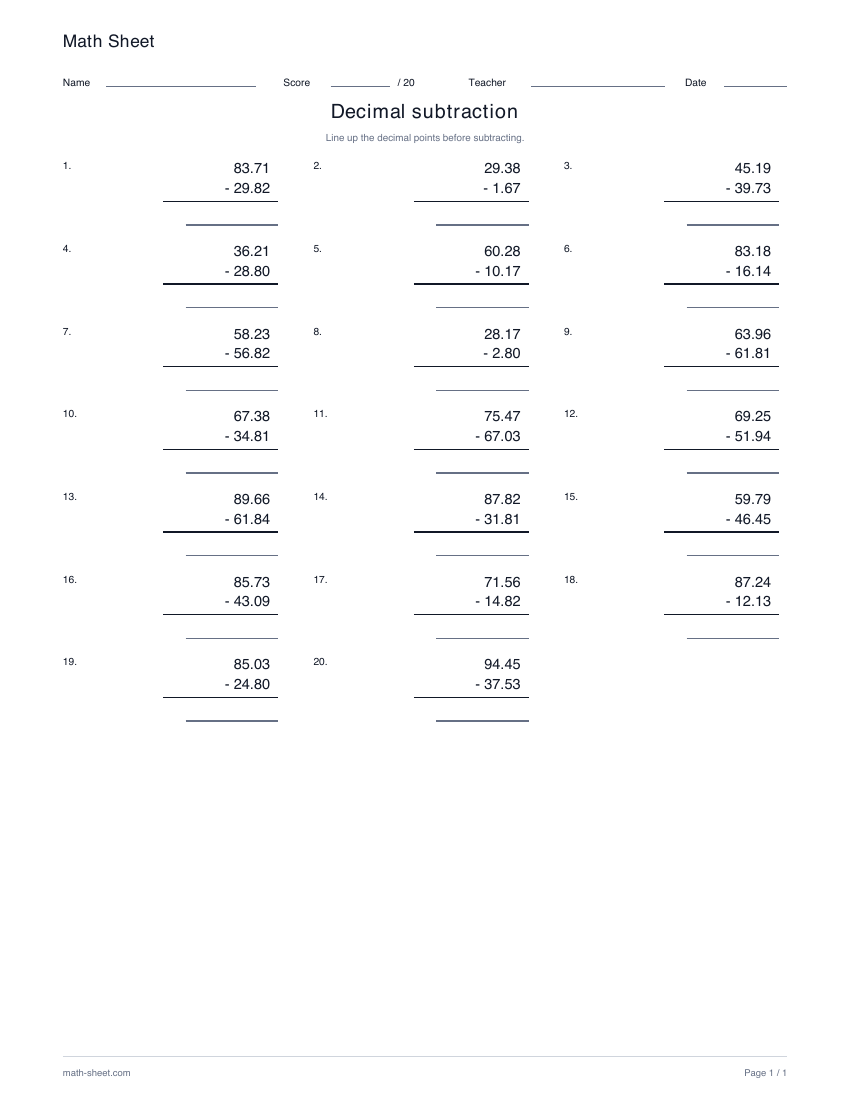
Subtraction
Subtract decimal numbers with configurable whole and fractional places while preserving decimal-point alignment.
Preview and download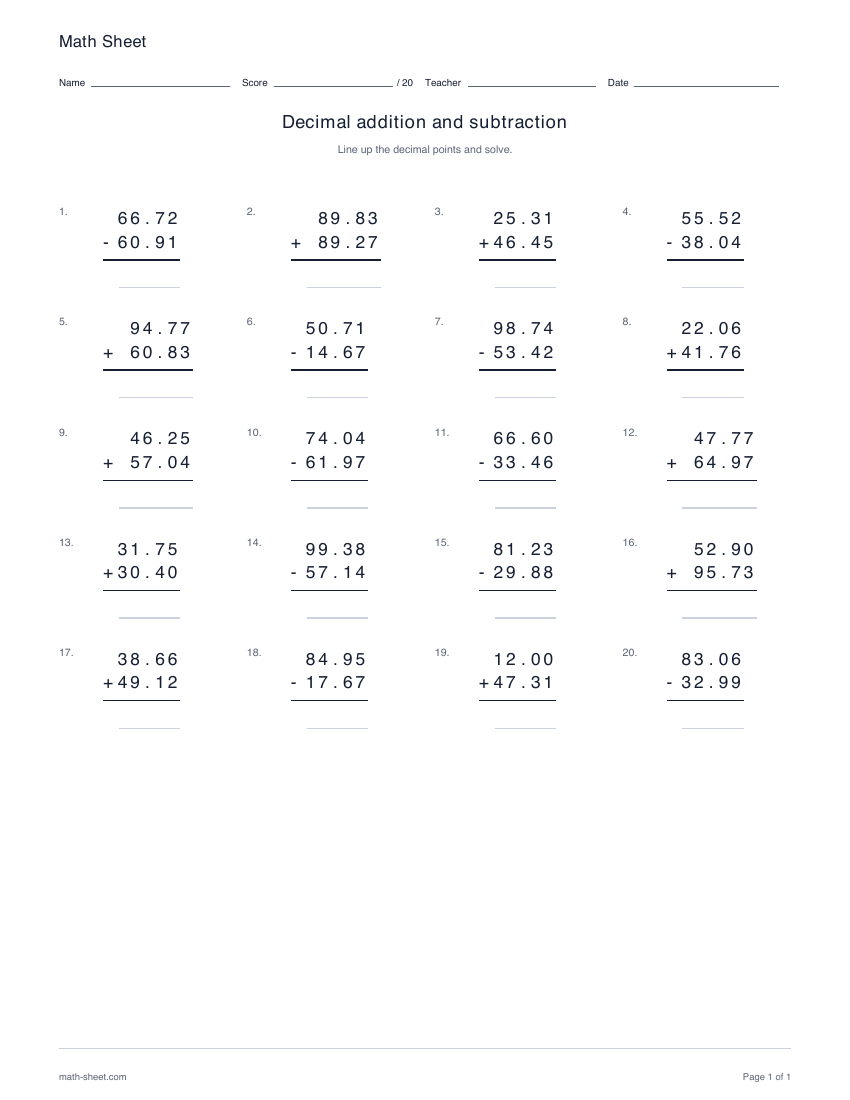
Mixed operations
Add and subtract exact fixed-place decimals with one to three fractional digits and up to four digits left of the decimal.
Preview and download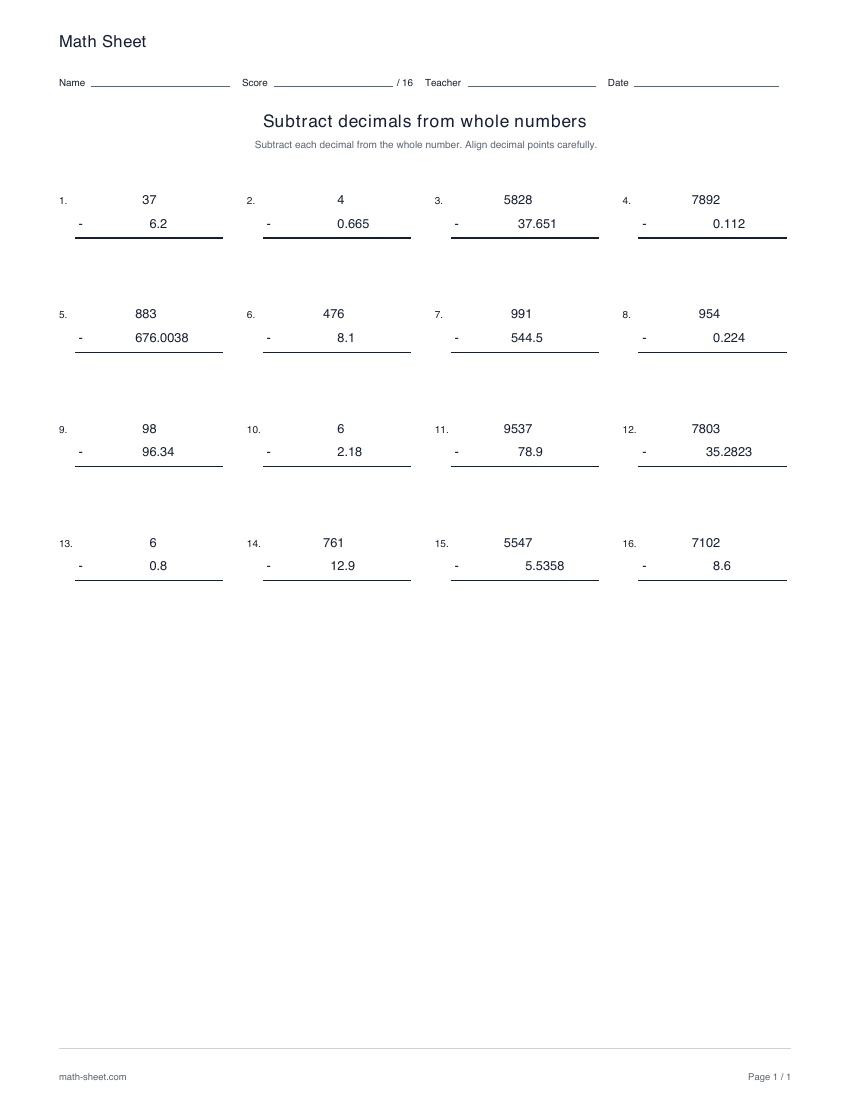
Decimals
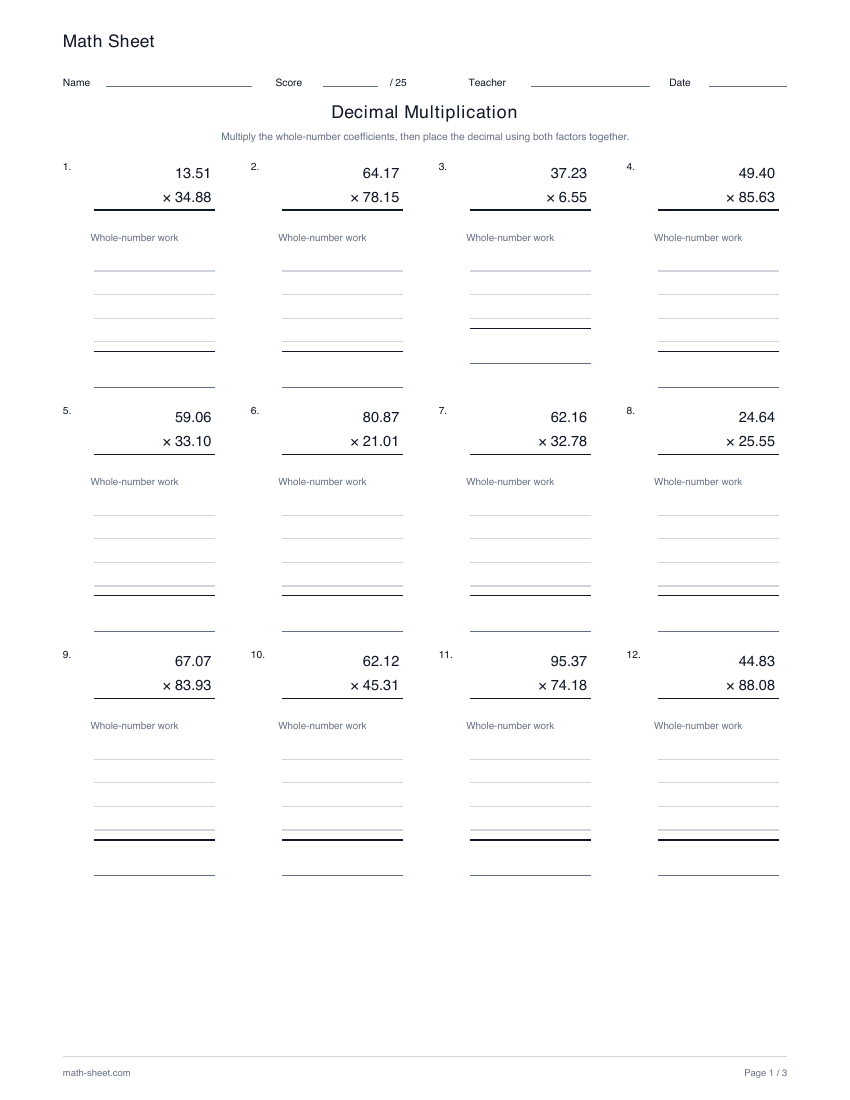
Subtract decimals from whole numbers with up to four decimal places. Choose number ranges, optional trailing zeros, negative answers and 12–24 vertical problems.
Preview and downloadRead, calculate, explain
Multiply two decimal factors or isolate the place-value change caused by ×10, ×100 and ×1000.
Multiplication
Create multiplying decimals worksheets with tenths or hundredths, adjustable whole-number width, 12–25 vertical problems, exact products, and answer keys.
Preview and download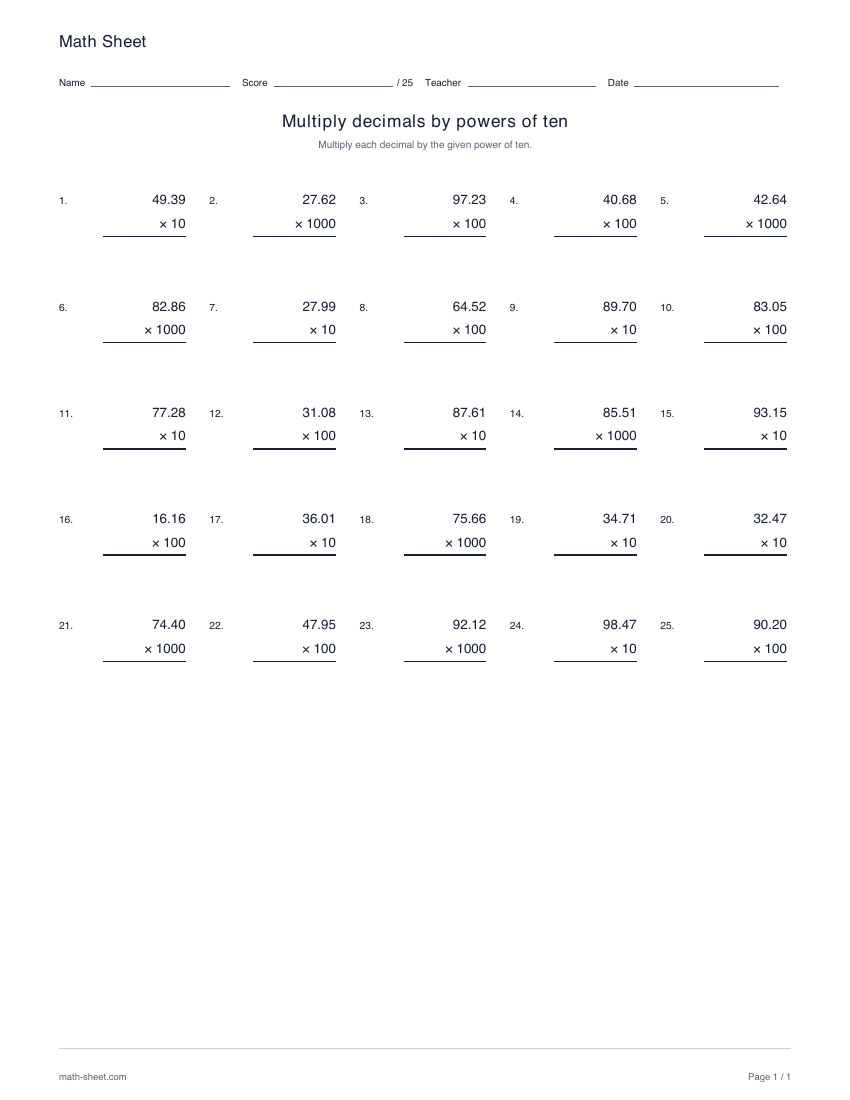
Decimals
Multiply decimals by 10, 100 or 1000. Choose tenths, hundredths or thousandths, the integer-part width and 12–25 vertical problems, with printable answer keys.
Preview and downloadRead, calculate, explain
Choose whole-number or decimal divisors, small-operand practice, noninteger exact answers or a stated rounding precision. Related sheets offer hundredths residuals and whole-operand mixed quotient types.
Division
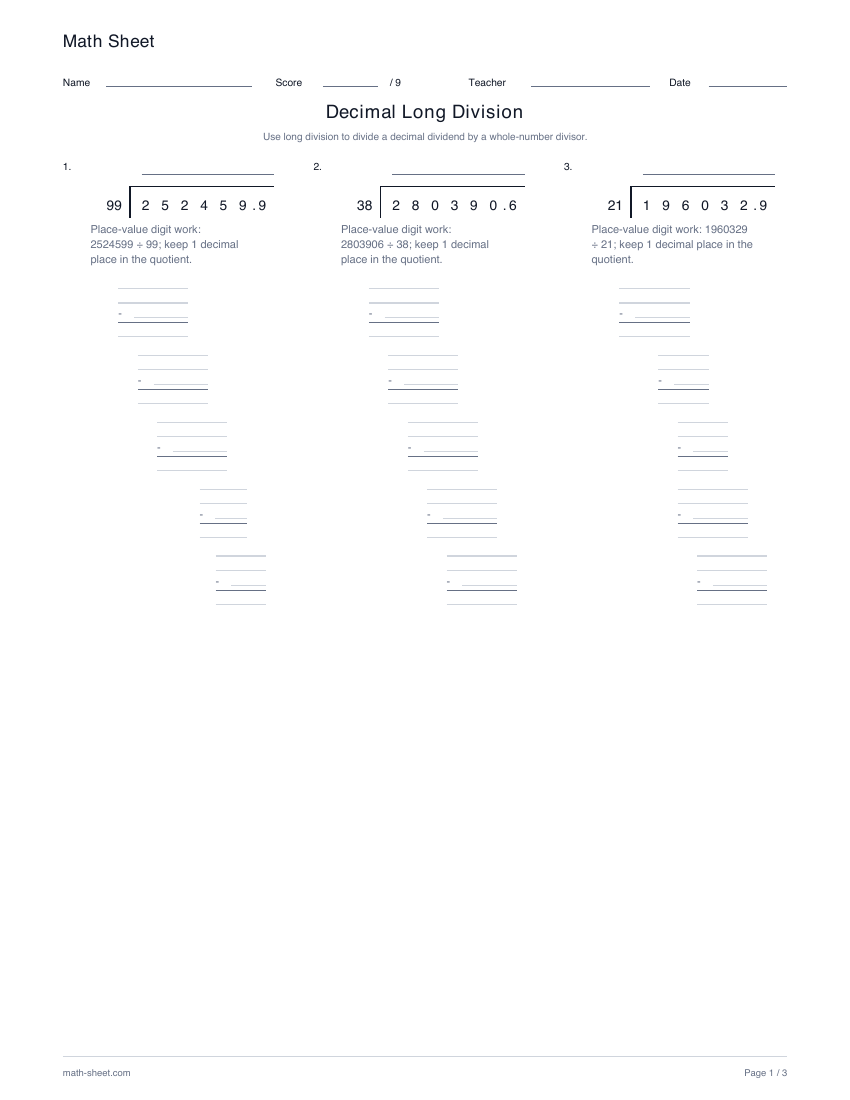
Print dividing decimals worksheets with whole-number or decimal divisors. Choose small operands, exact noninteger decimal answers, or rounding to 0–3 decimal places, with a separate answer key.
Preview and download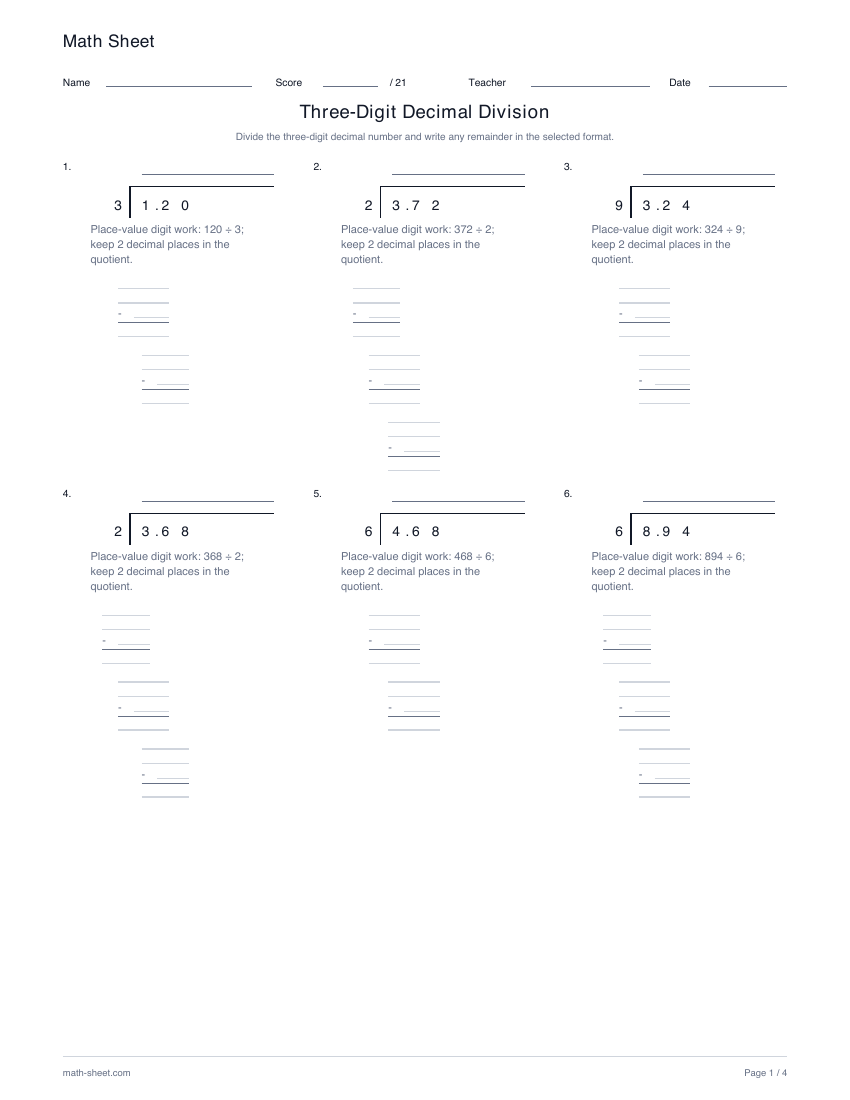
Division
Divide decimal amounts expressed in hundredths by a selected single-digit divisor, using exact answers or stopping at hundredths and recording the remaining amount.
Preview and download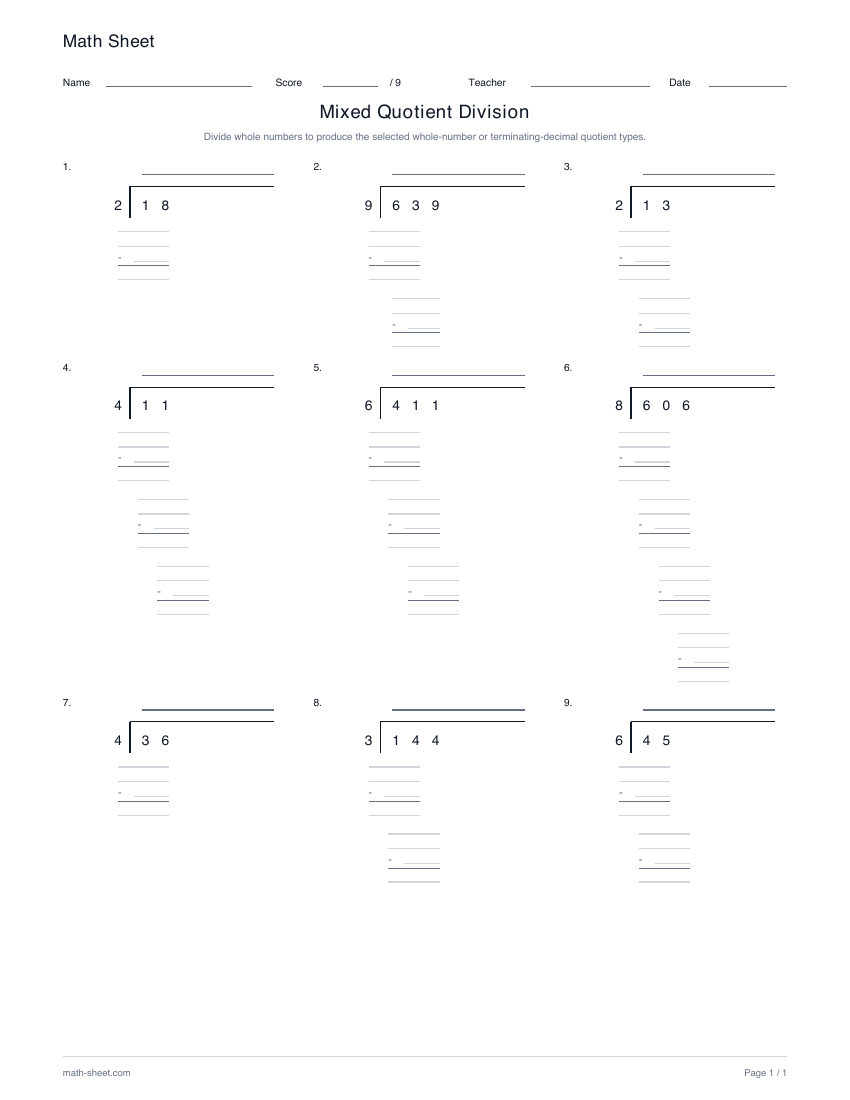
Division
Divide whole-number operands to obtain a selected mixture of whole-number, one-decimal-place and two-decimal-place quotients.
Preview and downloadRead, calculate, explain
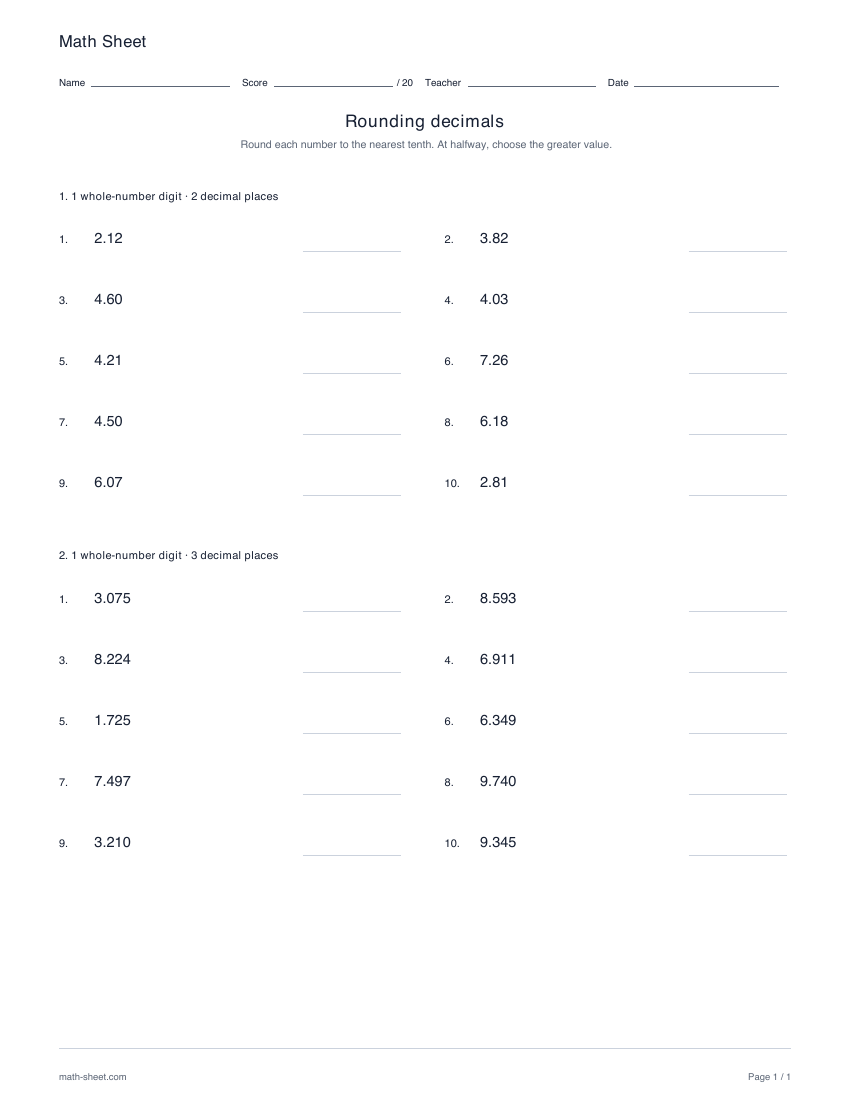
Round directly to tenths, hundredths or thousandths. Compare the neighboring values and use the stated halfway rule.
Rounding
Round decimals to the nearest tenth, hundredth or thousandth. Two groups add one then two extra decimal places, with exact answers that preserve the requested precision.
Preview and downloadChoose by readiness
These starting points describe prerequisite skills. Grade names are general guides and do not claim alignment with a particular national curriculum.
Use after decimal place value is familiar. Compare three values below one and explain equivalent trailing zeros.
Open this focused practice →Begin with printed decimal zeros and positive answers. Explain why 5 and 5.0 have the same value.
Open this focused practice →Track the value of every digit before introducing a third multiplier.
Open this focused practice →Seven tenths is seventy hundredths. Rewrite 0.7 as 0.70 for comparison: seventy hundredths is greater than sixty-five hundredths. A longer decimal is not automatically a larger number.
Ordering practice keeps the integer part the same within a question, so students must compare fractional places. Mix tenths, hundredths and thousandths only after students can explain the value of each position.
For addition and subtraction, align ones with ones, tenths with tenths, and so on. In 8 −3.047, think of the whole number as 8.000 before regrouping. The answer is 4.953.
The whole-minus-decimal generator can print those zeros or leave them for students to supply. Negative answers are optional and off by default. Choose them after students can compare the operands and predict the sign.
In 3.047 ×100, every digit takes a place worth one hundred times as much. The result is 304.7. The answer key writes 304.700 to retain the original three decimal places; both forms represent the same value.
Start with one multiplier, then mix ×10, ×100 and ×1000. A place-value chart helps students explain the change instead of remembering a direction without understanding why.
Divide a decimal dividend by a whole divisor. These problems have exact terminating quotients; students do not need to guess a rounding precision.
Choose a division sign, slash or long-division layout. With remainders enabled, stop the quotient at hundredths and state the leftover value in decimal units.
Divide whole operands and find either a whole-number or terminating decimal quotient. Read the answer as a value, not a whole-number remainder.
For example, 2.19 ÷6 can be written as a quotient of 0.36 with a remaining value of 0.03 when stopping at hundredths: 6 ×0.36 +0.03 =2.19. That leftover is not 3 whole units, and this is not the same instruction as rounding the exact quotient.
Rounding practice specifies tenths, hundredths or thousandths and consistently rounds positive halfway values upward. Round directly to the requested place rather than repeatedly rounding through intermediate places.
The ordering generator can add a dollar symbol while preserving the chosen decimal precision. A value such as $1.387 includes a fraction of a cent: it is useful for comparing decimal notation, but is not an ordinary cash-payment amount. Use the money collection for counting actual denominations.
Each activity has ready-made English PDFs in Letter and A4, including a student-only file and a version with a separate answer key. The generator provides the options supported by that specific skill.
The three activities for ordering, powers of ten and subtraction from whole numbers also print in German, Albanian, Spanish, Italian, French, Turkish and Norwegian Bokmål. Language support varies on the other linked activities; check their settings.