Inequalities reference

Inequality symbols and properties reference

Print a complete guide to inequality symbols, number-line graphs and equivalent transformations. Explore addition, subtraction, signed multiplication and division, and transitive comparisons with examples.

Ready-made English PDF · fixed settings

Customization below makes a separate PDF.

Fixed English ready-made files. Custom settings below apply only to the configured PDF.

Ready to print

Print the reference handout

Read the examples beside each property. Compare open and filled endpoints, then use the worked transformations to explain when the inequality sign must reverse.

Print all six sections of the reference, with explanations and original examples. There is no separate answer edition.

Choose paper and language

Paper sizes and printing help · More inequalities activities

Connect the graph with the properties

The handout covers symbols and graphs, addition, subtraction, multiplication, division, and transitive comparisons. Read one section at a time and ask the learner to explain why each new comparison remains true.

This fixed teaching reference does not regenerate random questions. Choose the paper size, language and note to match the lesson.

Learning objective

What this activity builds

Explain which numbers satisfy an inequality and why an operation preserves or reverses its order.

Worked example

Why does multiplying 2 < 5 by −3 give −6 > −15?

A negative multiplier reverses order.

On a number line, −6 is to the right of −15. Multiplication by a negative number reverses the order of the two values; a greater-than sign keeps the new comparison true.

Teaching notes

Make the practice count

  • Read each inequality aloud in both directions.
  • Connect inclusion of the boundary with a filled endpoint.
  • Use numerical examples before a property written with variables.
  • Distinguish adding a negative number from multiplying by one.

Make it yours

Customize the reference

Choose your options, update the preview, then download the exact same pages.

This fixed six-section reference explains symbols, graphs, operation properties, negative reversals, and transitive comparisons in the selected print language.

Worksheet settings

Page note

Add an optional note to the reference page. Shared links include your page note; leave personal information out. Notes use the selected language’s supported characters; English accepts basic Latin text.

Configured PDF · Inequalities Reference · US Letter

Preview ready. Download includes these exact pages.

6 reference pages
Enlarged pages scroll. PDF size stays the same.
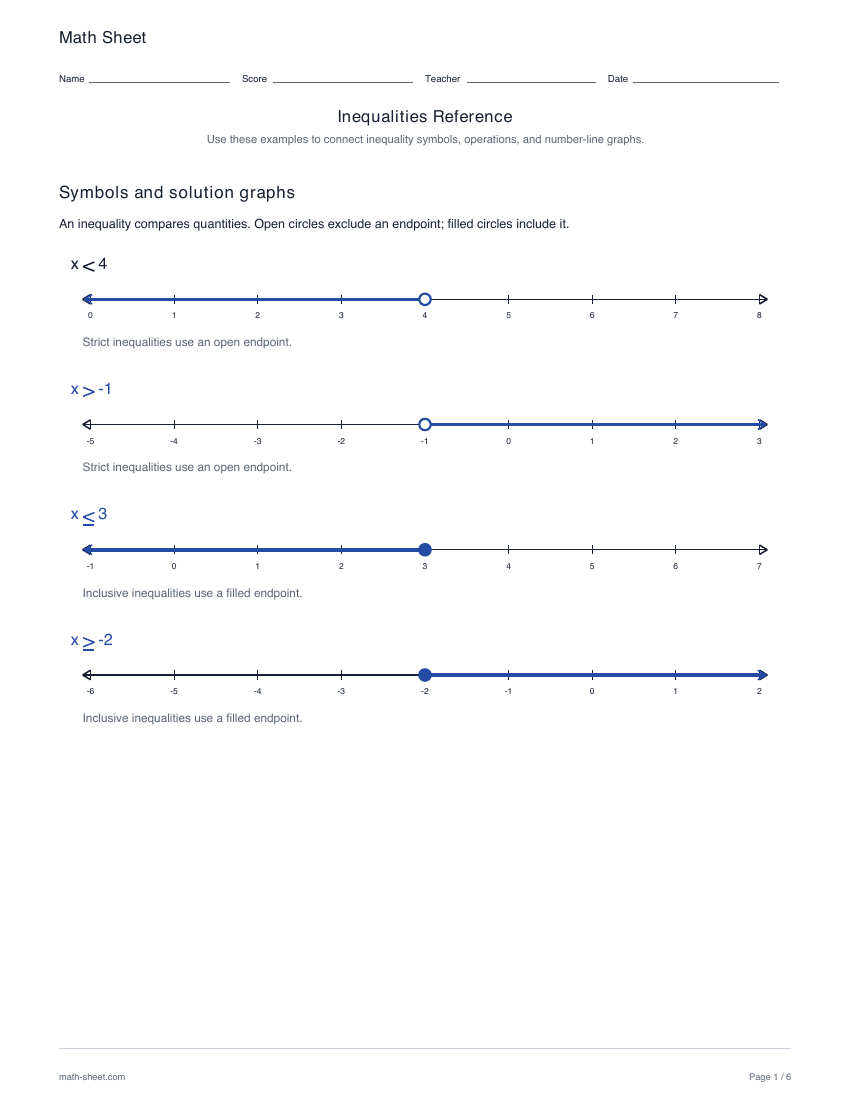
Math SheetNameScoreTeacherDateInequalities ReferenceUse these examples to connect inequality symbols, operations, and number-line graphs.Symbols and solution graphsAn inequality compares quantities. Open circles exclude an endpoint; filled circles include it.x4012345678Strict inequalities use an open endpoint.x-1-5-4-3-2-10123Strict inequalities use an open endpoint.x3-101234567Inclusive inequalities use a filled endpoint.x-2-6-5-4-3-2-1012Inclusive inequalities use a filled endpoint.math-sheet.comPage 1 / 6
Math SheetNameScoreTeacherDateInequalities ReferenceUse these examples to connect inequality symbols, operations, and number-line graphs.Addition propertyAdding the same value to both sides preserves the solution set.x7Begin with x less than 7.x+512Add 5 to both sides; the direction stays the same.math-sheet.comPage 2 / 6
Math SheetNameScoreTeacherDateInequalities ReferenceUse these examples to connect inequality symbols, operations, and number-line graphs.Subtraction propertySubtracting the same value from both sides preserves the inequality direction.x9Begin with x greater than or equal to 9.x-36Subtract 3 from both sides; the direction stays the same.math-sheet.comPage 3 / 6
Math SheetNameScoreTeacherDateInequalities ReferenceUse these examples to connect inequality symbols, operations, and number-line graphs.Multiplication propertyPositive factors preserve direction. Negative factors reverse direction.x4Begin with x less than 4.3x12Multiply both sides by 3; the direction stays the same.-2x-8Multiply both sides by negative 2; reverse the direction.Never omit the reversal with a negative multiplier.math-sheet.comPage 4 / 6
Math SheetNameScoreTeacherDateInequalities ReferenceUse these examples to connect inequality symbols, operations, and number-line graphs.Division propertyA positive nonzero divisor preserves direction. A negative divisor reverses direction.6x18Begin with 6x greater than 18.3x9Divide both sides by 2; the direction stays the same.-2x-6Divide both sides by negative 3; reverse the direction.Division by zero is undefined.math-sheet.comPage 5 / 6
Math SheetNameScoreTeacherDateInequalities ReferenceUse these examples to connect inequality symbols, operations, and number-line graphs.Transitive and comparison propertiesChain comparisons when their directions connect consistently.25Two is less than five, and five is less than nine, so two is less than nine.59The two comparisons form one increasing chain.x+3xAdding a positive number makes a quantity greater.math-sheet.comPage 6 / 6

A useful next step

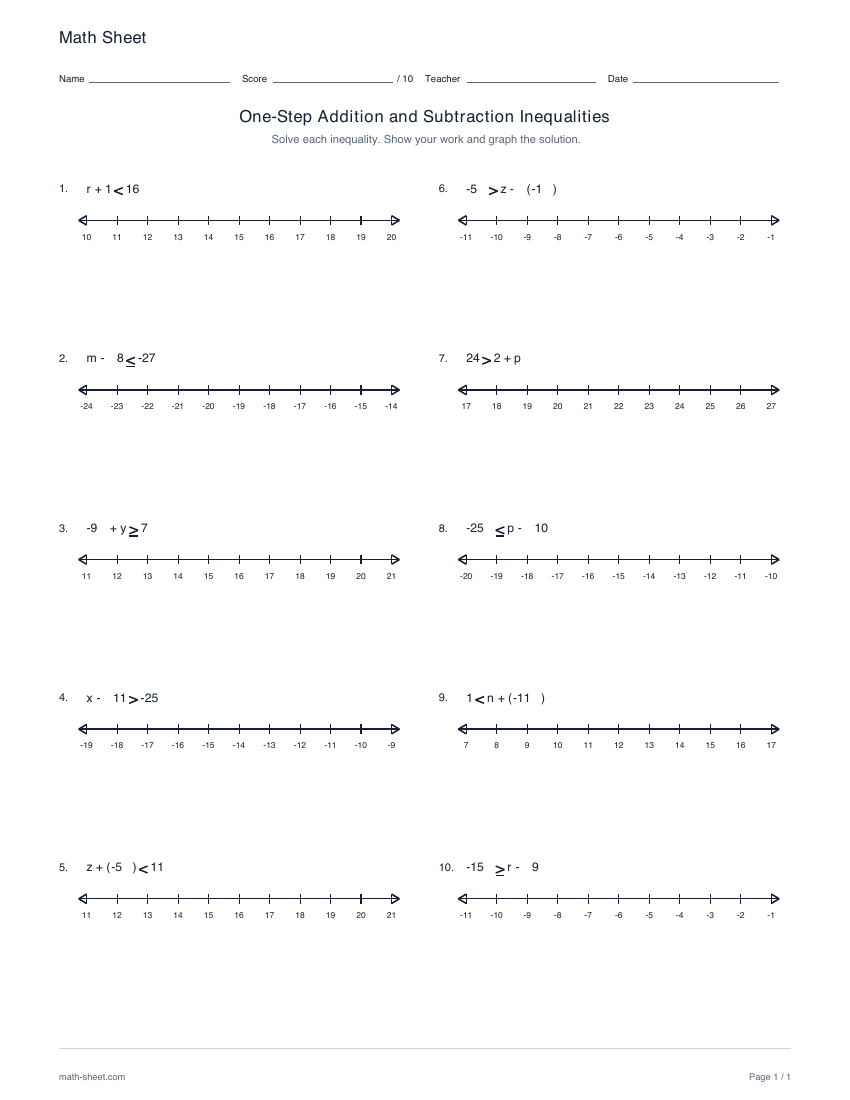
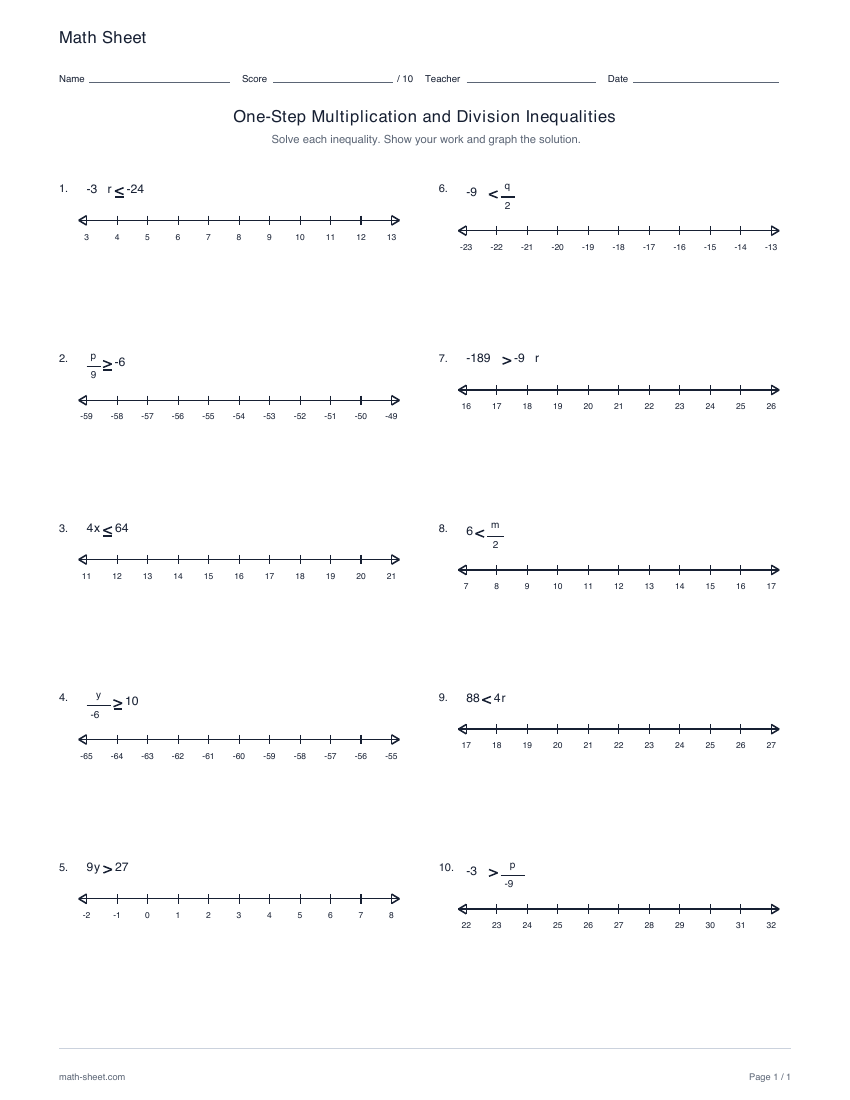
Related activities

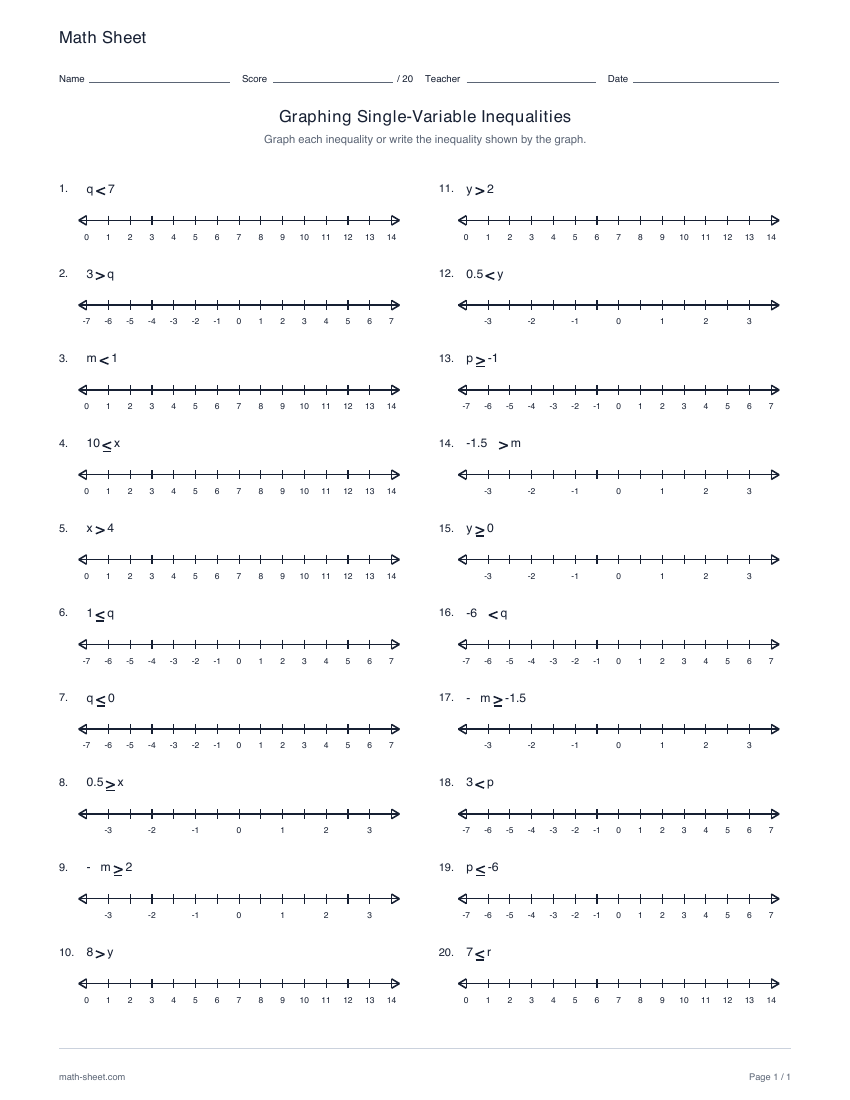
First page preview: Graphing single-variable inequalities worksheets

Inequalities

Graphing single-variable inequalities worksheets

Translate between an inequality and a number-line graph in twenty questions. Choose whole numbers, signed integers or halves; draw graphs, read graphs or mix both tasks, with a separate key.

Preview and download