Give a relationship a precise form

Algebraic expressions worksheets

Turn a phrase into an expression, rewrite it without changing its value, and evaluate it for a given input. Choose a focused set with room to show the reasoning.

Choose a worksheet

Three ways to work with one expression

Read
Twice the sum of x and 3
Write
2(x + 3)
Rewrite
2x + 6
Evaluate at x = 4
2(4 + 3) = 14
The relationship stays the same. The task changes.

Understand every step

Read and write algebra

Connect a relationship in words with the variables, operations and grouping that express it.

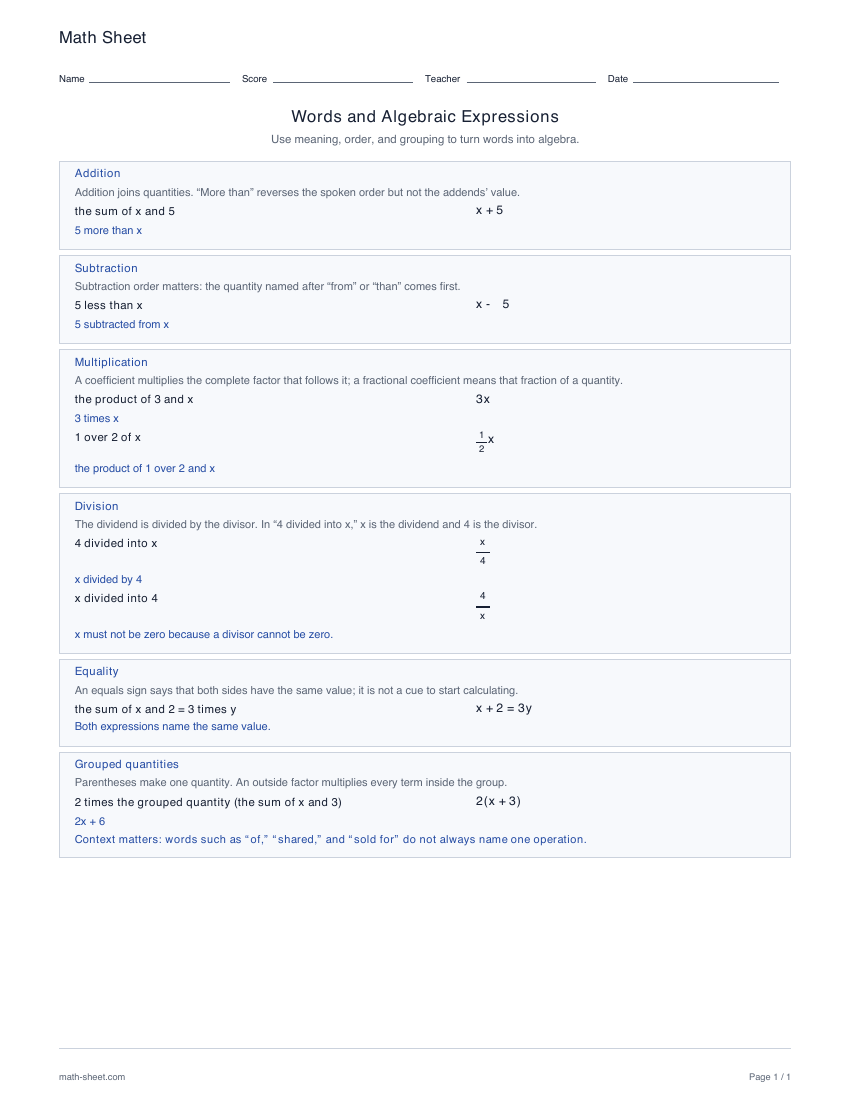
First page preview: Words to algebraic expressions reference sheet

Algebraic expressions

Words to algebraic expressions reference sheet

A printable guide to the language of algebra. Connect words with addition, subtraction, products, quotients, equality and grouping, with examples that explain operand order.

Preview and download
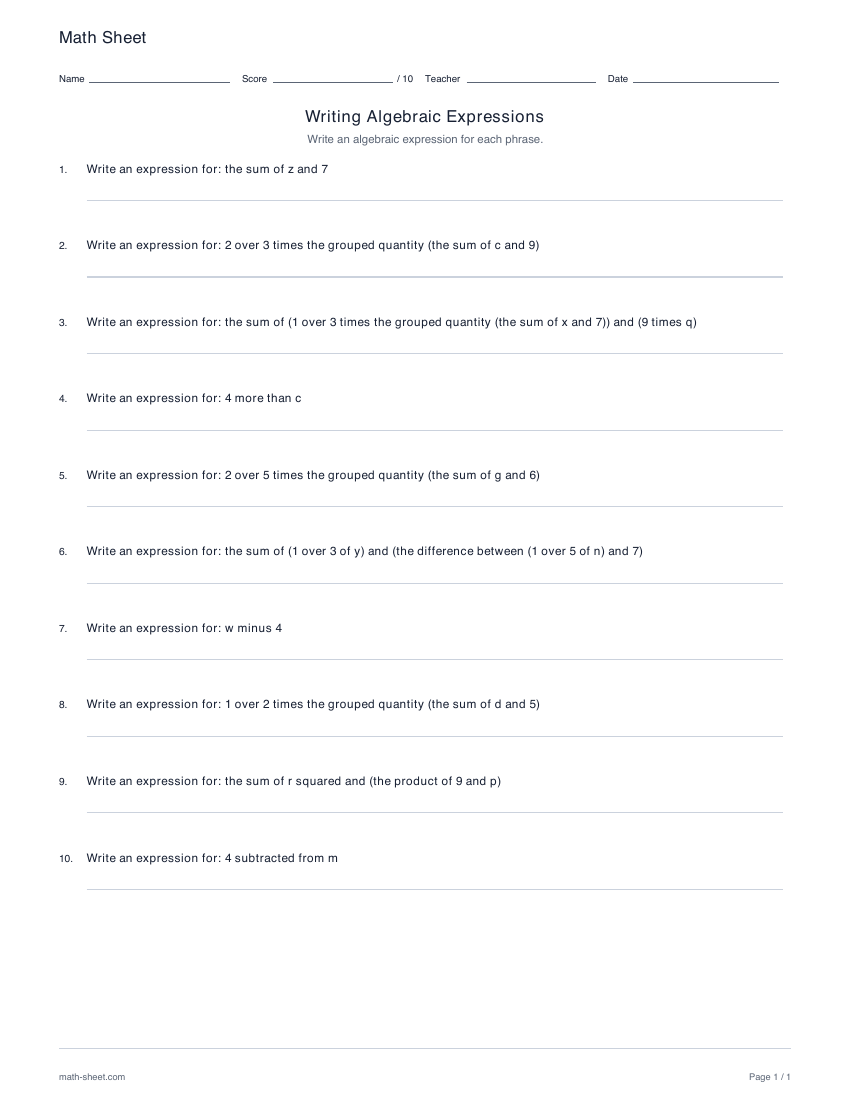
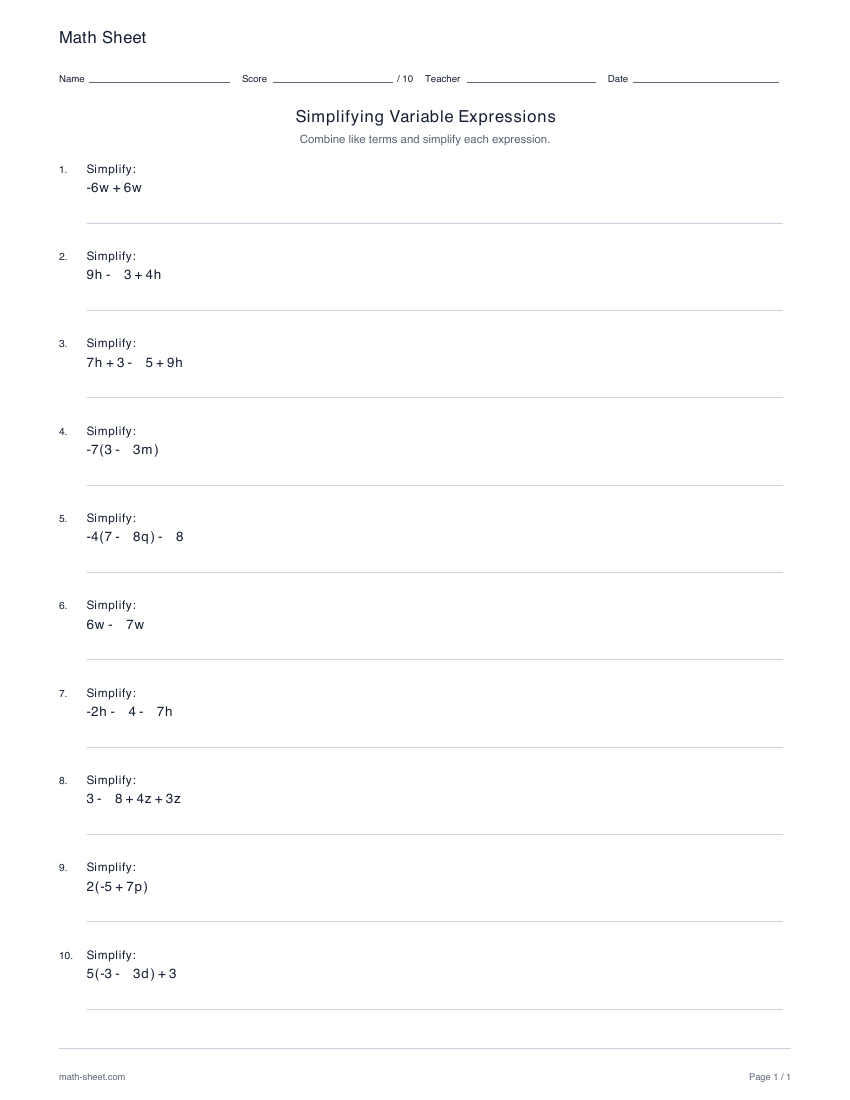
First page preview: Writing algebraic expressions worksheets

Algebraic expressions

Writing algebraic expressions worksheets

Translate words into algebra with ten questions per worksheet. Select easy, medium and hard phrases, including grouping, fractions and powers, and print an explained answer key.

Preview and download

Understand every step

Rewrite without changing the value

Expand grouped products and collect like terms. Explain why each new expression is equivalent.

First page preview: Combining like terms worksheets

Algebraic expressions

Combining like terms worksheets

Print ten combining-like-terms questions and a separate worked key. Choose original one-variable practice or a progressive English lesson with two-variable grouping, distribution, error analysis, and perimeter.

Preview and download
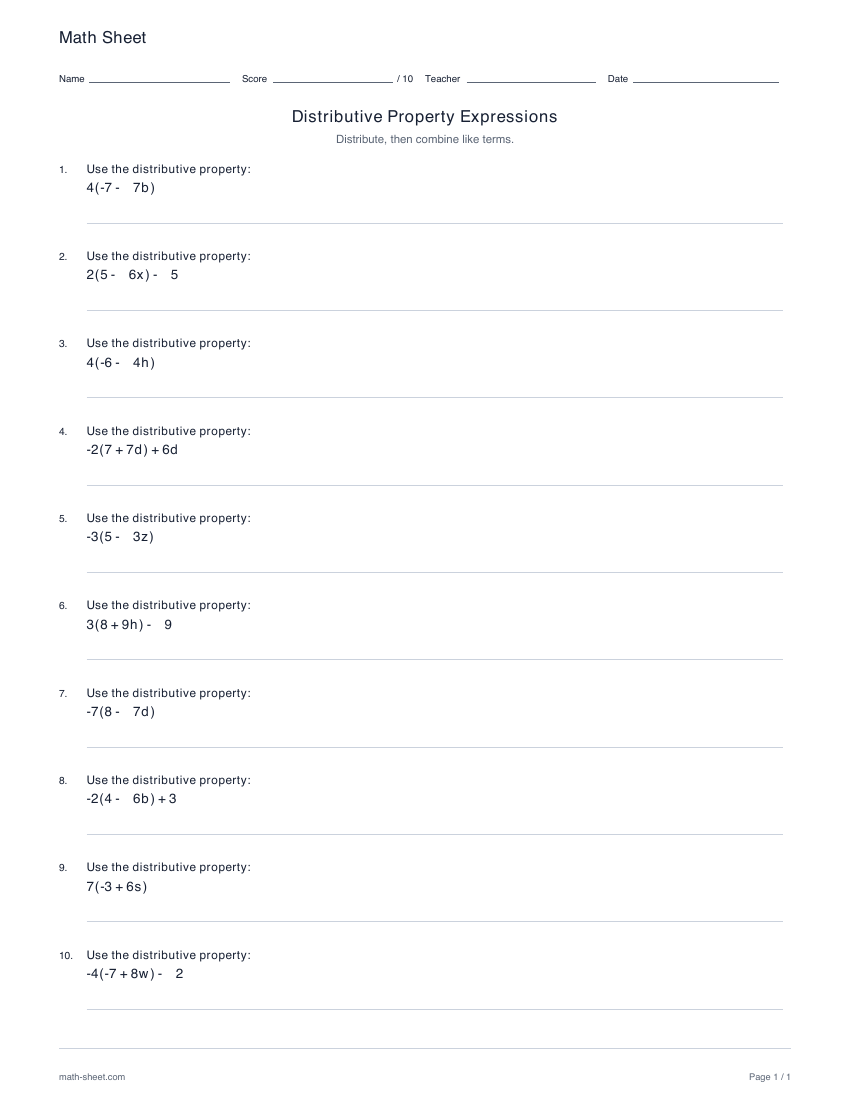
First page preview: Distributive property worksheets

Algebraic expressions

Distributive property worksheets

Print 10 distributive property expressions. Choose grouped three- or four-term forms, signed factors and coefficient ranges, with worked answers.

Preview and download

Understand every step

Substitute and evaluate

Use the given value for each variable, then calculate with parentheses and exact arithmetic.

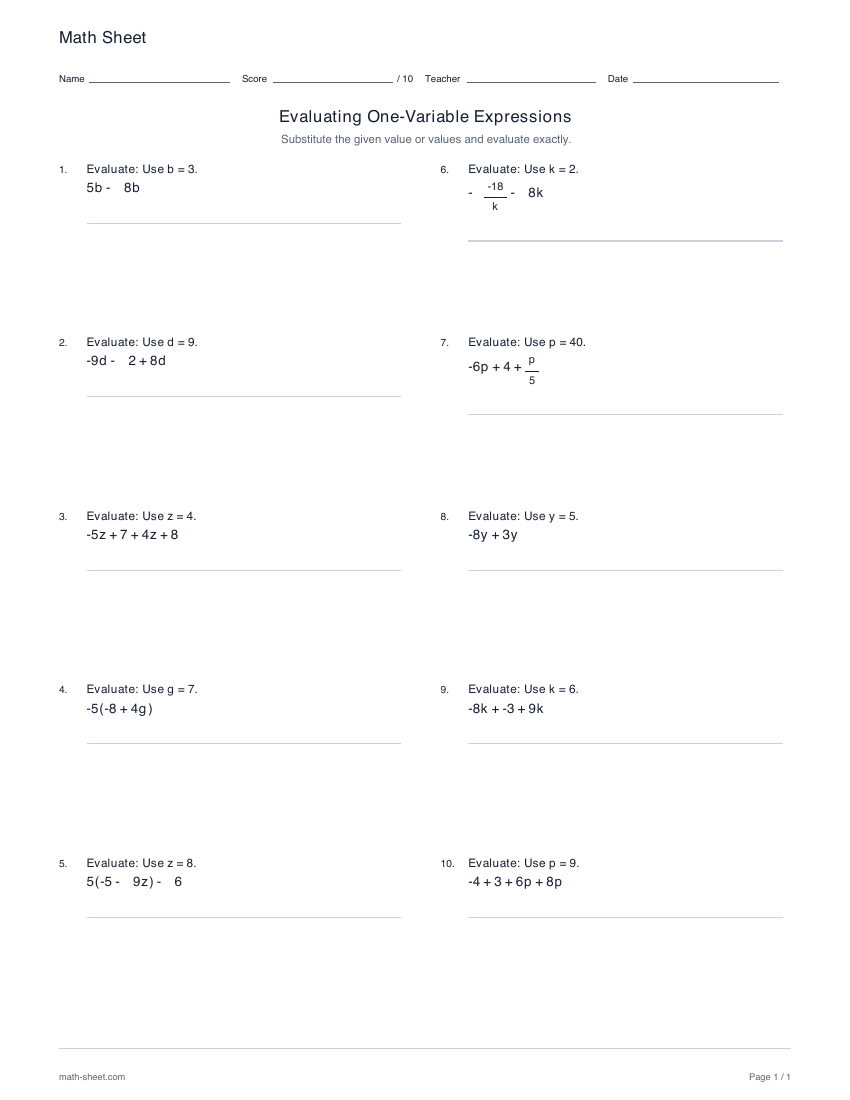
First page preview: Evaluating one-variable expressions worksheets

Algebraic expressions

Evaluating one-variable expressions worksheets

Substitute a given value and evaluate expressions with one variable. Choose addition, subtraction, grouped products or exact division, with whole-number or signed integer inputs.

Preview and download
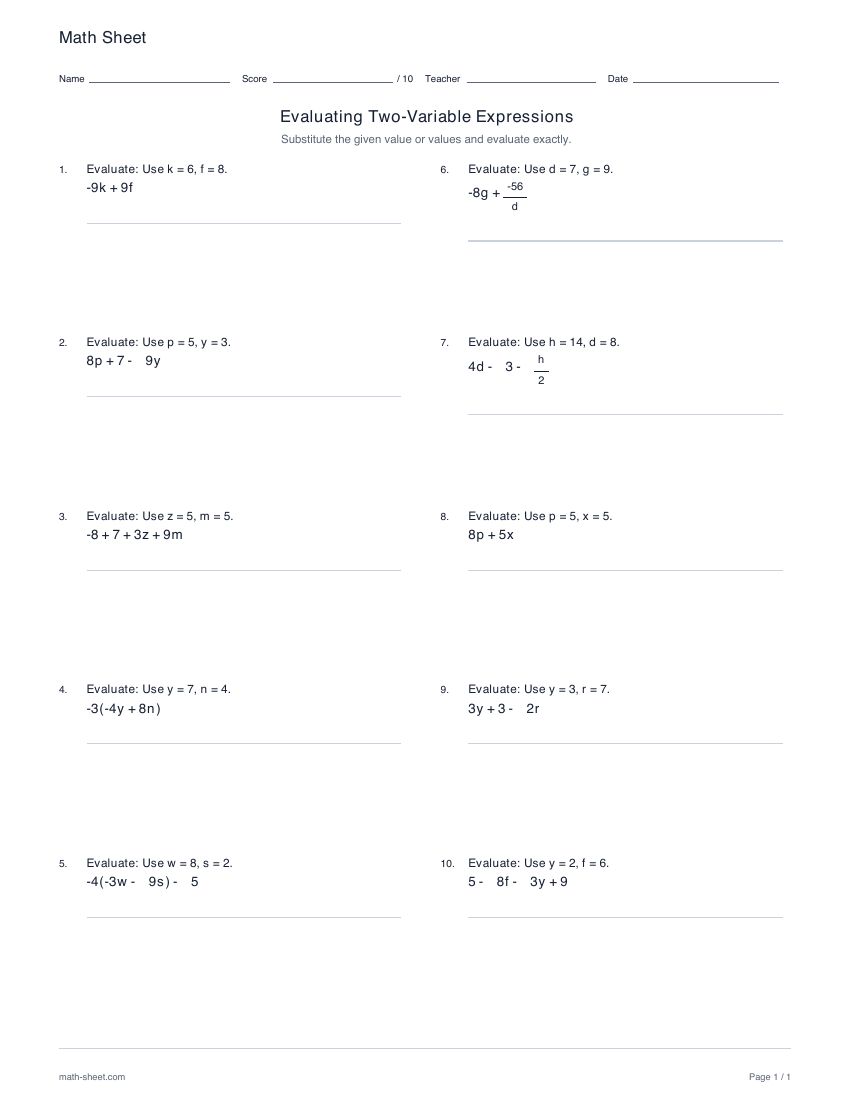
First page preview: Evaluating two-variable expressions worksheets

Algebraic expressions

Evaluating two-variable expressions worksheets

Evaluate expressions using two distinct variable values. Select sums, grouped multiplication and exact-division forms with whole numbers or integers, plus an explained answer key.

Preview and download

An expression describes a quantity

The expression 3x + 5 can describe a starting amount of 5 plus three equal groups of size x. It does not tell us one numerical result until a value of x is supplied.

An equation makes a statement that two expressions are equal. In this collection, the task is to write, simplify or evaluate an expression. When a question supplies x = 4, that is a given input to use in the calculation.

Let the whole phrase determine the order

“Seven less than n” means n − 7. “Seven minus n” means 7 − n. Try n = 10: the first expression is 3, while the second is −3. The words describe different relationships.

Likewise, twice the sum of n and 7 means 2(n + 7). Twice n plus 7 means 2n + 7. Parentheses show which entire quantity is multiplied.

Keep simplification different from evaluation

Simplifying 5x + 2x − 4 gives 7x − 4, an equivalent expression valid for every input. Evaluating it at x = 3 gives 17, a number for that particular input.

Like terms have the same variable part. Combine their coefficients and keep constants separate. To expand −2(x − 5), multiply both terms by −2, giving −2x + 10.

Choose by readiness

Start with the skill the learner can explain

These Grade 5–6 entry points use prerequisites rather than a particular national curriculum. Hard writing levels, fractional coefficients and negative inputs may be appropriate later.

Read the relationship first

Use the phrase guide to discuss operation order and the meaning of grouped quantities.

Open this starting point →

Replace a letter with a number

Use whole-number inputs in short expressions; signed coefficients still require careful arithmetic.

Open this starting point →

Collect variable terms

Combine like terms with smaller coefficient magnitudes before adding more terms and groups.

Open this starting point →

Track two signed inputs

Match each variable with its own value, then calculate with positive and negative integers.

Open this starting point →

Substitute above and below the fraction bar

Practice a variable as the dividend or divisor, with whole-number inputs chosen for exact division.

Open this starting point →

Evaluate signed quotients with two variables

Keep track of both inputs, negative divisors and the other terms in the expression.

Open this starting point →

Make a short practice set useful

Model one example aloud, let the learner explain another, then use a ten-question sheet. Review the kind of error before adding difficulty: a reversed phrase, a missed sign and an arithmetic slip need different follow-up.

Use the separate key to discuss equivalent forms and intermediate steps. Create a new set with the same settings after revisiting the idea.