
Math properties
Identifying math properties worksheets
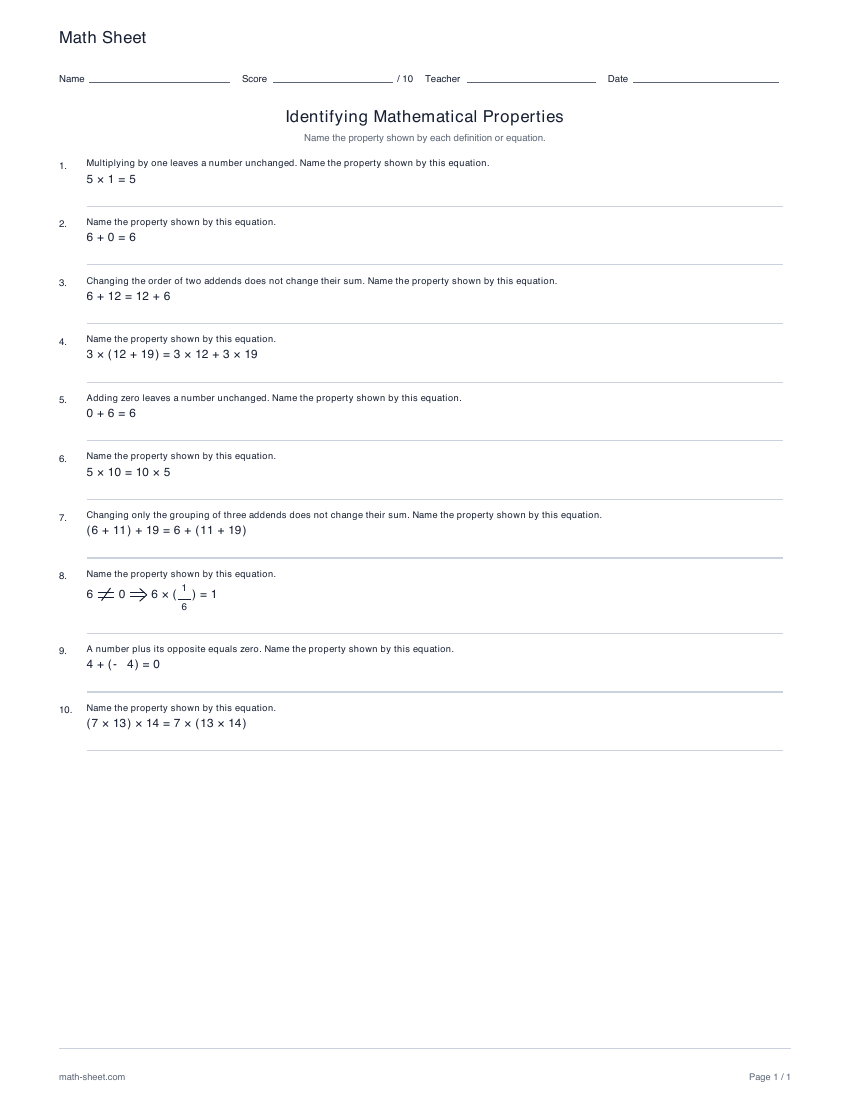
Name the property shown by an explanation and example. Choose 10, 12 or 15 questions from arithmetic and equality properties, with a separate answer key.
Preview and downloadName the rule. Explain the reasoning.
Explore why changing an order, regrouping numbers or distributing a factor can preserve a value. Choose identification practice, four-choice questions or a printable reference.
Choose a worksheetSame value, different grouping
Understand the change
Start by naming properties, then choose between examples, non-examples and equivalent expressions.
Math properties
Name the property shown by an explanation and example. Choose 10, 12 or 15 questions from arithmetic and equality properties, with a separate answer key.
Preview and download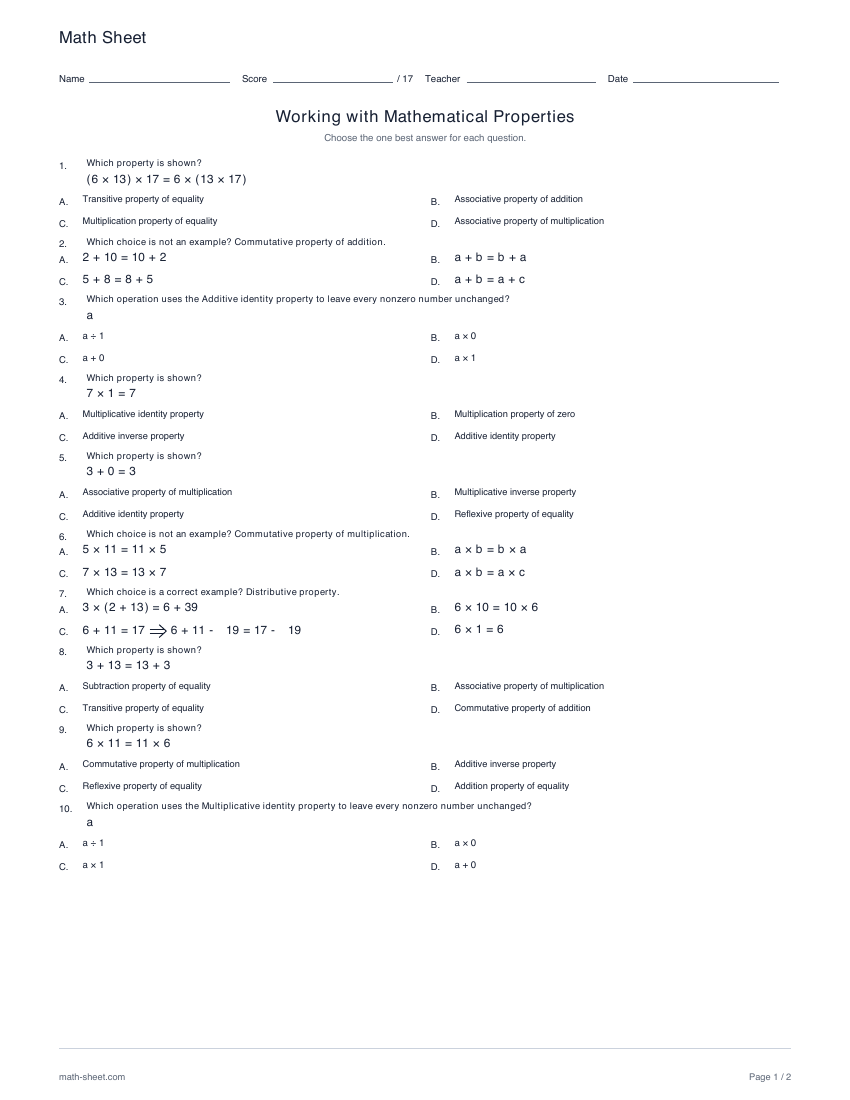
Math properties
Four-choice questions about examples, non-examples, distribution and equality rules. Select the properties to practice and download a separate explained answer key.
Preview and downloadUnderstand the change
Use a printable guide that distinguishes order, grouping, identity, inverse and equality rules.
Math properties
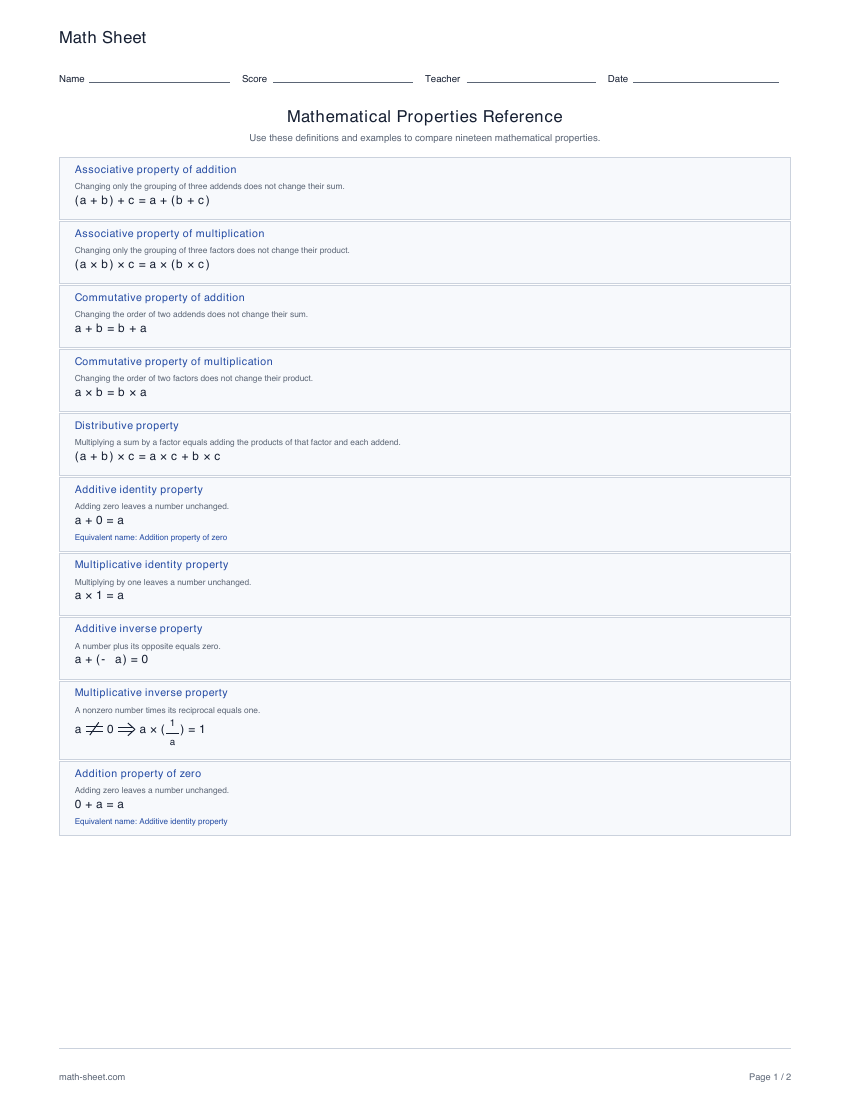
A printable guide to arithmetic and equality properties, with definitions, equations, equivalent names and the nonzero conditions needed for reciprocals and division.
Preview and downloadIn 3 + 8 = 8 + 3, the addends switch places: that is the commutative property of addition. In (3 + 8) + 2 = 3 + (8 + 2), the parentheses move while the order remains the same: that is the associative property.
Both laws also hold for multiplication. They do not hold generally for subtraction or division. For example, 8 − 3 differs from 3 − 8; checking a calculation helps show why the operation matters.
In 6 × (10 + 3) = 6 × 10 + 6 × 3, the factor 6 multiplies both addends. This gives 60 + 18 = 78 and explains a useful mental-math method. The same structure works with variables: 6(x + y) = 6x + 6y.
The focused practice includes recognizing distribution, multiplying from either side of a sum, expanding an expression and comparing the expanded calculation.
Adding 0 or multiplying by 1 preserves a number. Adding its opposite gives 0; multiplying a nonzero number by its reciprocal gives 1. Multiplying any number by 0 gives 0, which is different from preserving the original number.
“Additive identity” and “addition property of zero” are two names for the same rule, a + 0 = a. The identification answer key accepts either name, and multiple-choice questions do not place these aliases in competition.
If a = b, adding or subtracting the same quantity on both sides preserves equality. Multiplying both sides by the same quantity also preserves equality. Dividing both sides is allowed only when that divisor is nonzero.
Reflexive equality states that a value equals itself. Symmetric equality lets us reverse an equality. Transitive equality connects a = b and b = c to conclude a = c.
Choose by readiness
Begin with whole-number examples and the language of order and grouping. Move to variables, inverses and equality rules after learners can interpret equations. These Grade 4–6 entry points are suggestions based on prerequisites, not claims of curriculum alignment.
Eight questions compare the commutative and associative laws using familiar operations.
Open this starting point →Use the definitions beside practice, including the two names for addition with zero.
Open this starting point →Five questions connect multiplication across a sum with examples and symbolic expansion.
Open this starting point →Move from noticing a change to identifying the mathematical property behind it.
Open this starting point →Seven enrichment questions introduce equality rules and the restriction on dividing by zero.
Open this starting point →Put the rules to work
Order of operations
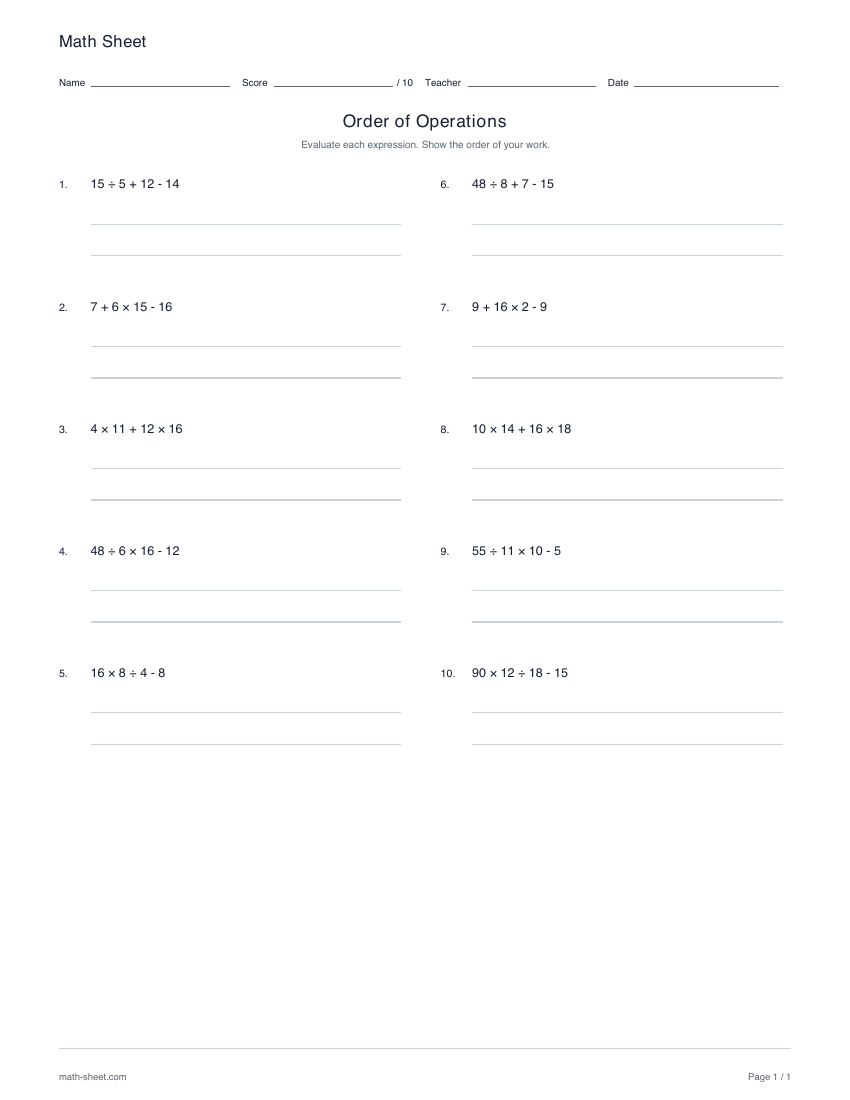
Evaluate ten expressions with all four arithmetic operations. Select easy or hard practice and five grouping/exponent formats, then print the questions and a separate worked key.
Preview and download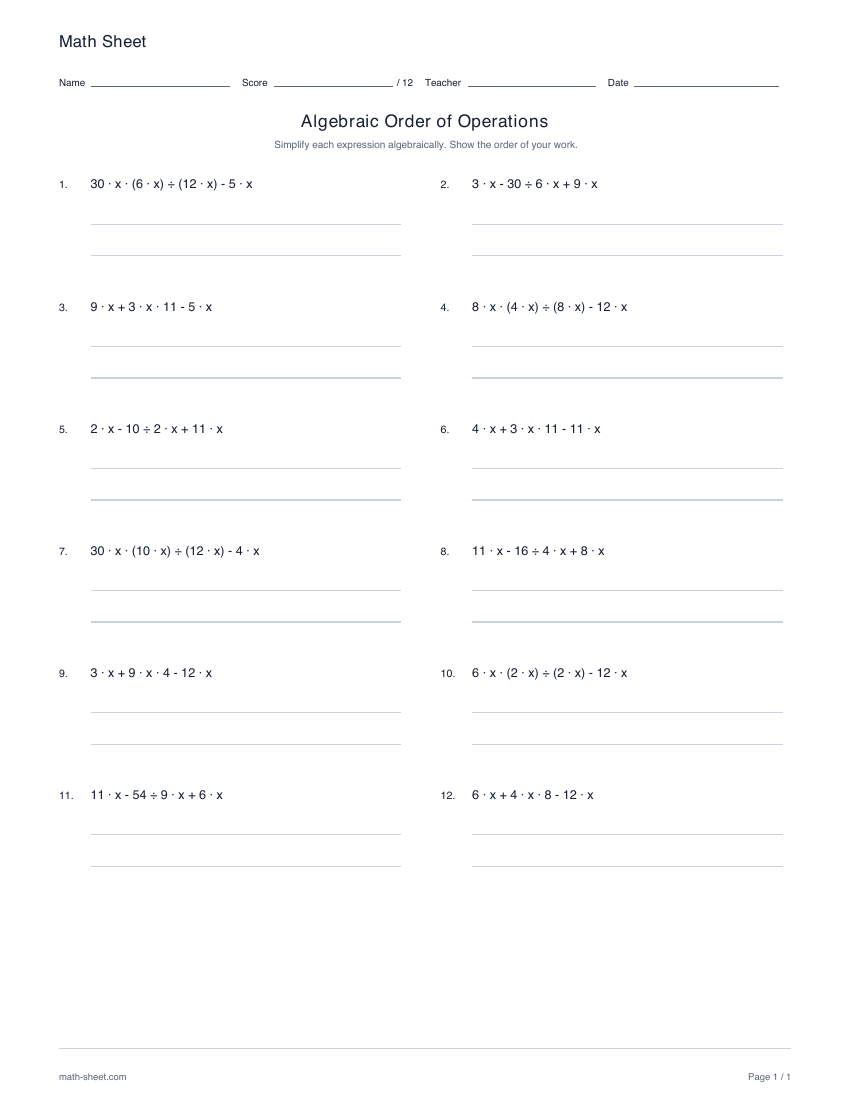
Order of operations
Simplify twelve expressions containing x, with configurable signs, grouping and powers. Practice combining like terms and simplifying products and quotients without substituting a number for x.
Preview and download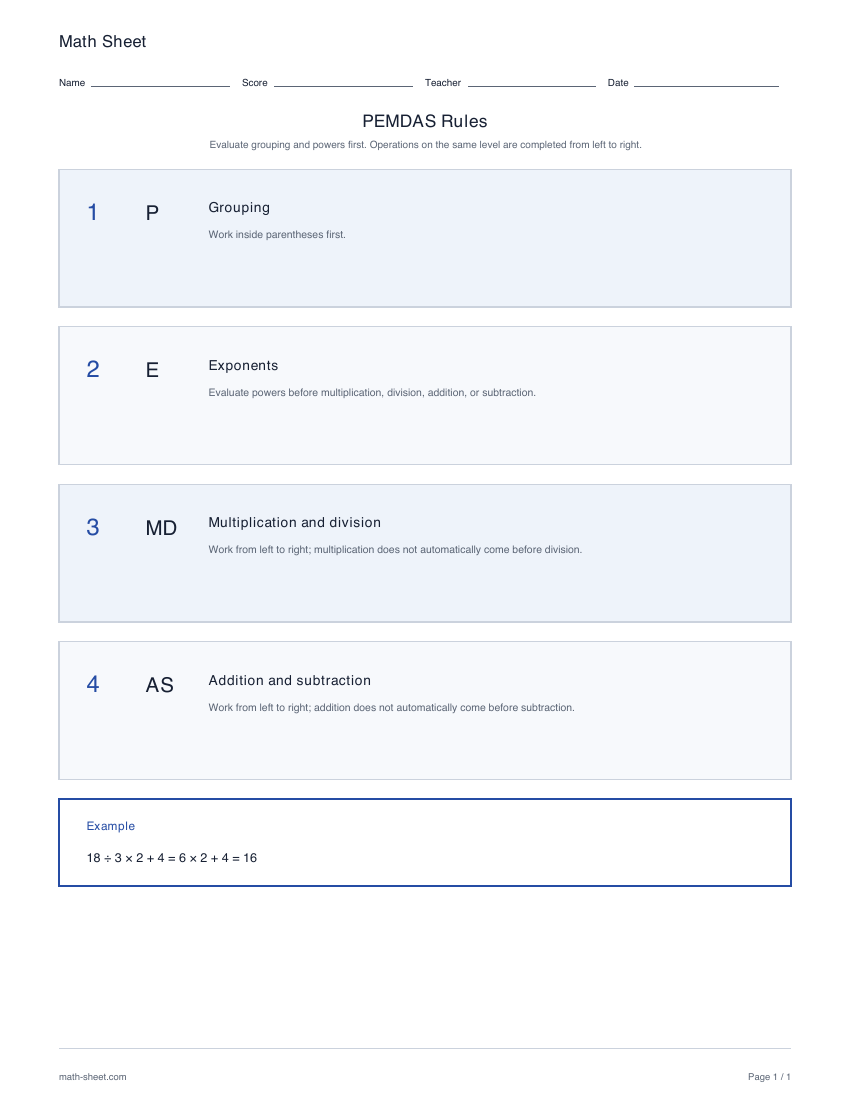
Order of operations
Print a clear order-of-operations reference with grouping, powers, multiplication and division, then addition and subtraction. Worked examples explain equal precedence and left-to-right calculation.
Preview and download