
Algebraic expressions
Distributive property worksheets
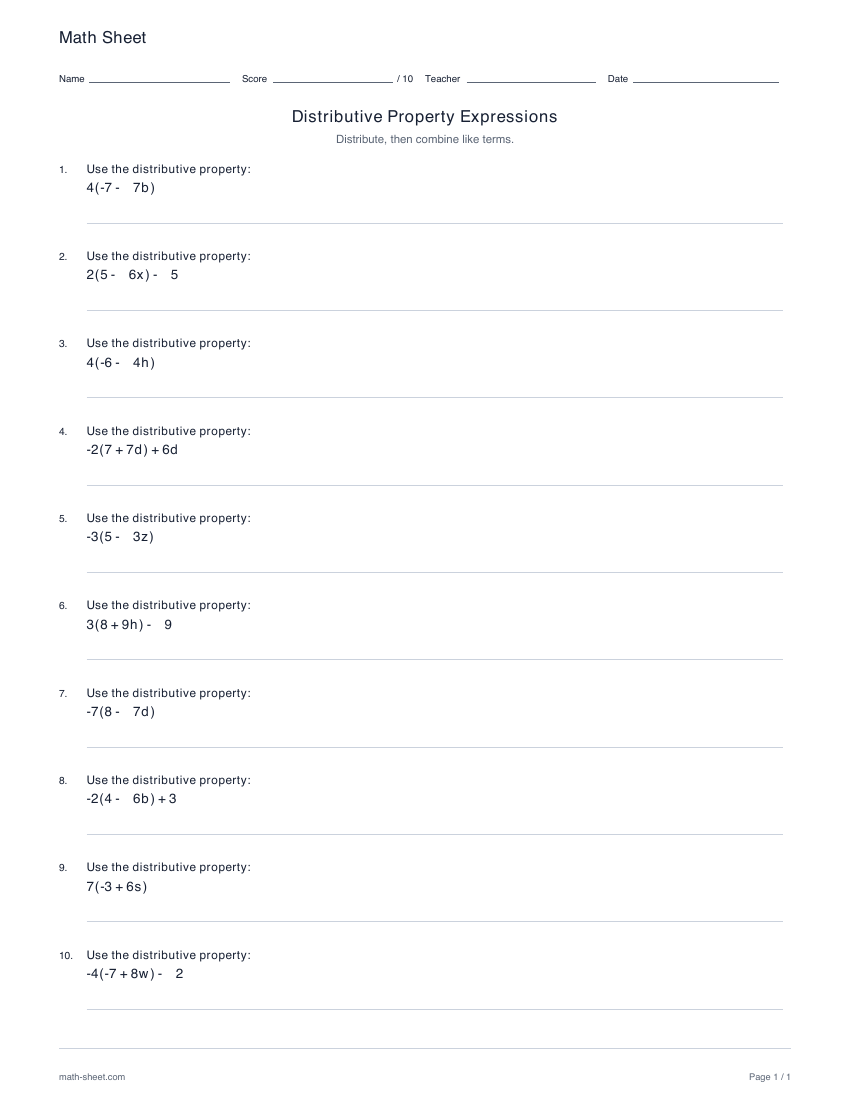
Print 10 distributive property expressions. Choose grouped three- or four-term forms, signed factors and coefficient ranges, with worked answers.
Preview and downloadAlgebraic expressions practice
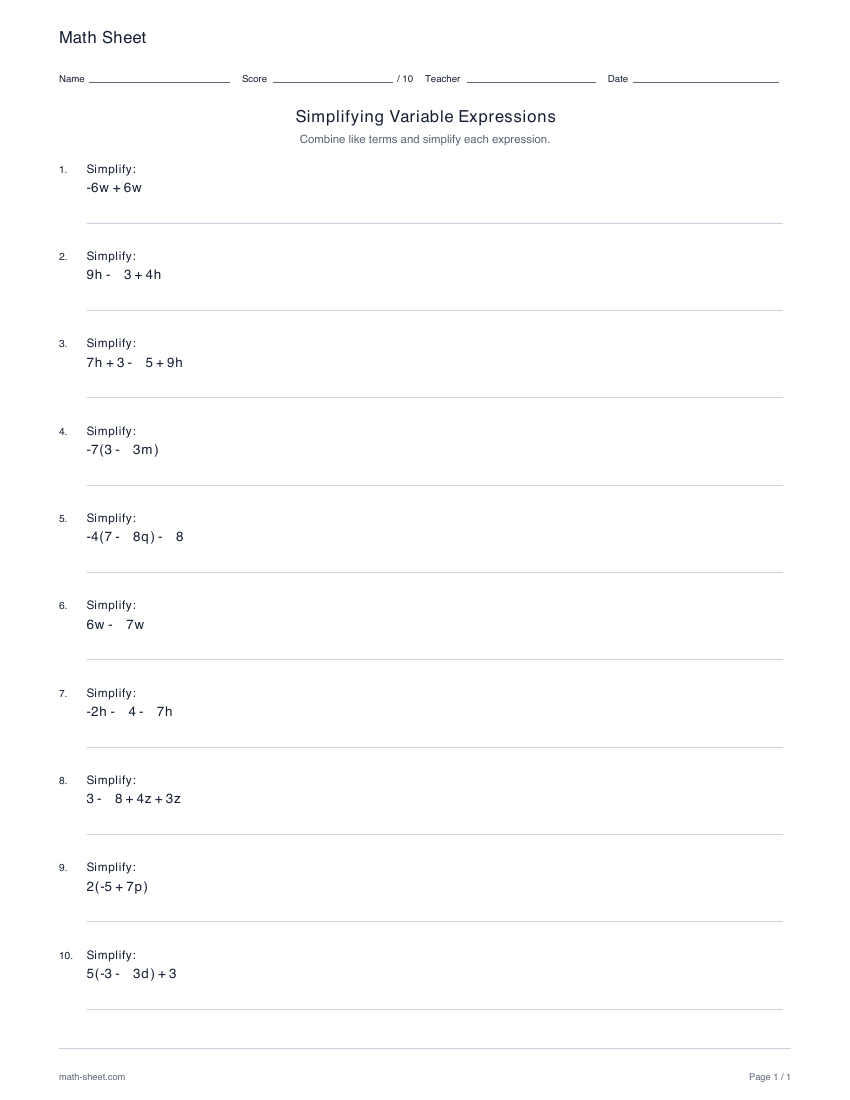
Print ten combining-like-terms questions and a separate worked key. Choose original one-variable practice or a progressive English lesson with two-variable grouping, distribution, error analysis, and perimeter.
Ready-made English PDF · fixed settings
Customization below makes a separate PDF.
Fixed English ready-made files. Custom settings below apply only to the configured PDF.
Ready to print
Expand a grouped product when needed, then combine like terms. Keep the sign with its term and write an equivalent simplified expression.
Download the practice pages alone, or include a separate answer key or teacher model. Longer activities may use more than one page.
Customize this worksheetPaper sizes and printing help · More algebraic expressions activities
Choose original selected-forms practice or a progressive English lesson. Original practice uses the selected one-variable forms. The progressive lesson fixes ten stages, including signed cancellation, repeated x and y groups, constants, distribution, error analysis, and perimeter; its form checkboxes are disabled. Number range still controls input magnitudes, and calculated answers can be larger.
A separate answer key repeats each question and explains the transformation. Use the space on the student sheet for an expression, an expansion or substitution steps, rather than recording only a final answer.
Learning objective
Collect like variable terms and constants while preserving the value of an expression.
Worked example
9x + 5.
Combine the variable coefficients: 7x + 2x = 9x. Combine the constants: −4 + 9 = 5. The variable term and constant are unlike terms, so leave them separate.
Teaching notes
For combining only, select the two-, three- and four-term add/subtract forms. These use signed coefficients of x and constants, with no grouped multiplication. Select only two-term forms for a shorter first step.
For distribution, select the three- and four-term grouped multiplication forms. For example, 3(2x + 4) − 5x becomes 6x + 12 − 5x, then x + 12. Distribute to every term before combining the variable terms.
The default mixes both tasks using one-variable linear expressions and constants. The optional progressive lesson is English only: ten original tasks move from warm-ups and signed cancellation to repeated x and y groups, constants, positive and negative distribution, an error explanation, and rectangle perimeter. Allow 20–30 minutes for learners who already know signed integers and distribution. It prints two student pages with room for working plus a separate explained key.
Choose Progressive lesson in Practice sequence, or use the lesson link above. Its sequence fixes the forms, so their checkboxes are disabled; number range still sets input magnitudes, while products and answers can be larger. The configured PDF matches the applied preview. Ready-made PDFs remain the original practice. Continue to polynomial practice when learners are ready for powers.
No. Add/subtract forms only require collecting like terms; grouped multiplication forms require distribution first. Use the expression-form checkboxes in selected-forms practice. The progressive lesson sets a fixed sequence that includes both skills.
Make it yours
Choose your options, update the preview, then download the exact same pages.
Choose selected-forms practice or a progressive English lesson with ten tasks: signed terms, two variables, distribution, an error check, and perimeter. The lesson fixes its own forms and disables their checkboxes. Number range sets the magnitudes of input coefficients, constants, and factors; calculated answers can be outside it. The configured PDF includes the applied lesson and optional separate key; ready-made downloads keep the original practice.
A useful next step
Algebraic expressions
Print 10 distributive property expressions. Choose grouped three- or four-term forms, signed factors and coefficient ranges, with worked answers.
Preview and download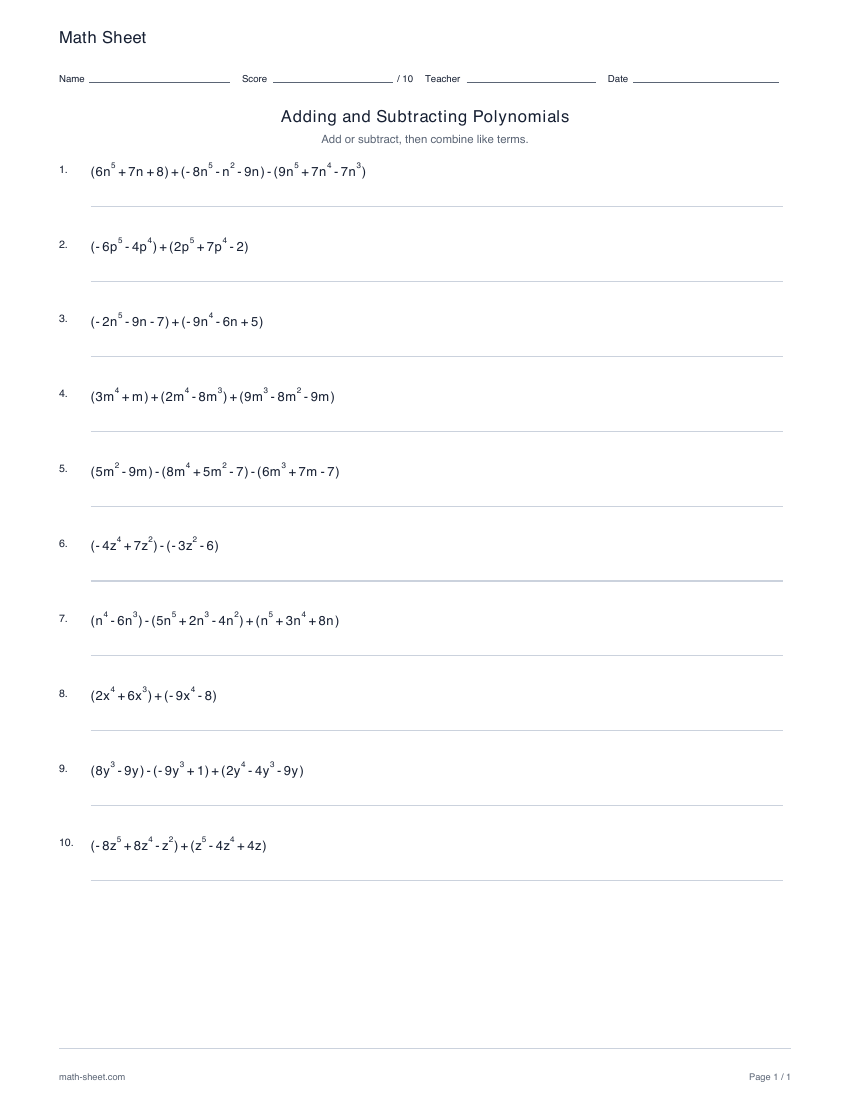
Polynomials
Print a 10-question adding and subtracting polynomials worksheet. Choose two or three grouped polynomials with four to nine terms and worked answers.
Preview and download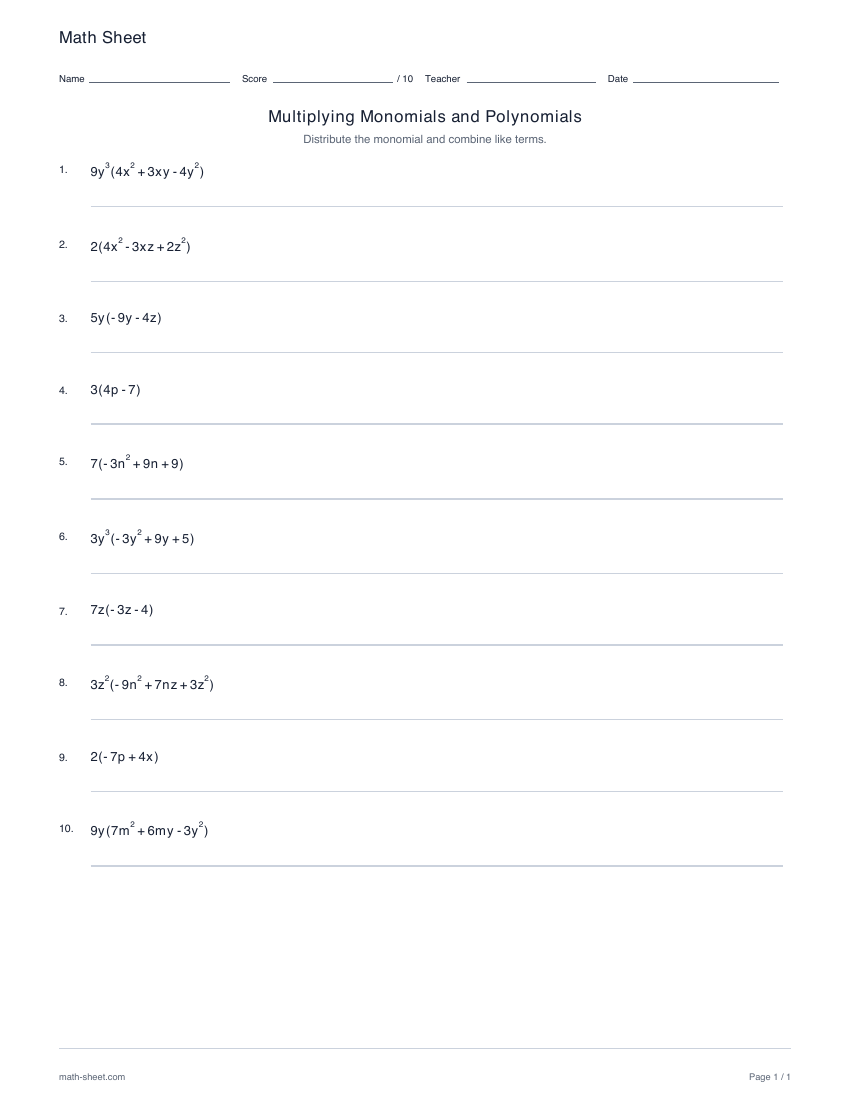
Polynomials
Distribute a monomial across a polynomial in ten problems. Select from twelve expression structures, keep powers and signs exact, and check a separate worked answer key.
Preview and downloadBegin with the combine-only preset, then choose grouped products to include the distributive property. These are one-variable expressions with integer coefficients; simplify them without solving an equation. For terms with different variable powers, use the polynomial activity.