
Equations
One-step equations worksheet with integers
Print a 10-question one-step equations worksheet with signed integers, four inverse operations, exact answers, worked steps, and substitution checks.
Preview and downloadKeep both sides equal
Find the unknown, explain each operation and check the result. Start with one inverse operation, then add grouped quantities, distribution and variables on both sides.
Choose a worksheetOne relationship, equivalent equations
Show the reasoning
Identify the operation acting on the unknown, then use its inverse on both sides. Choose one number domain or combine integers, decimals and fractions in one balanced sheet.
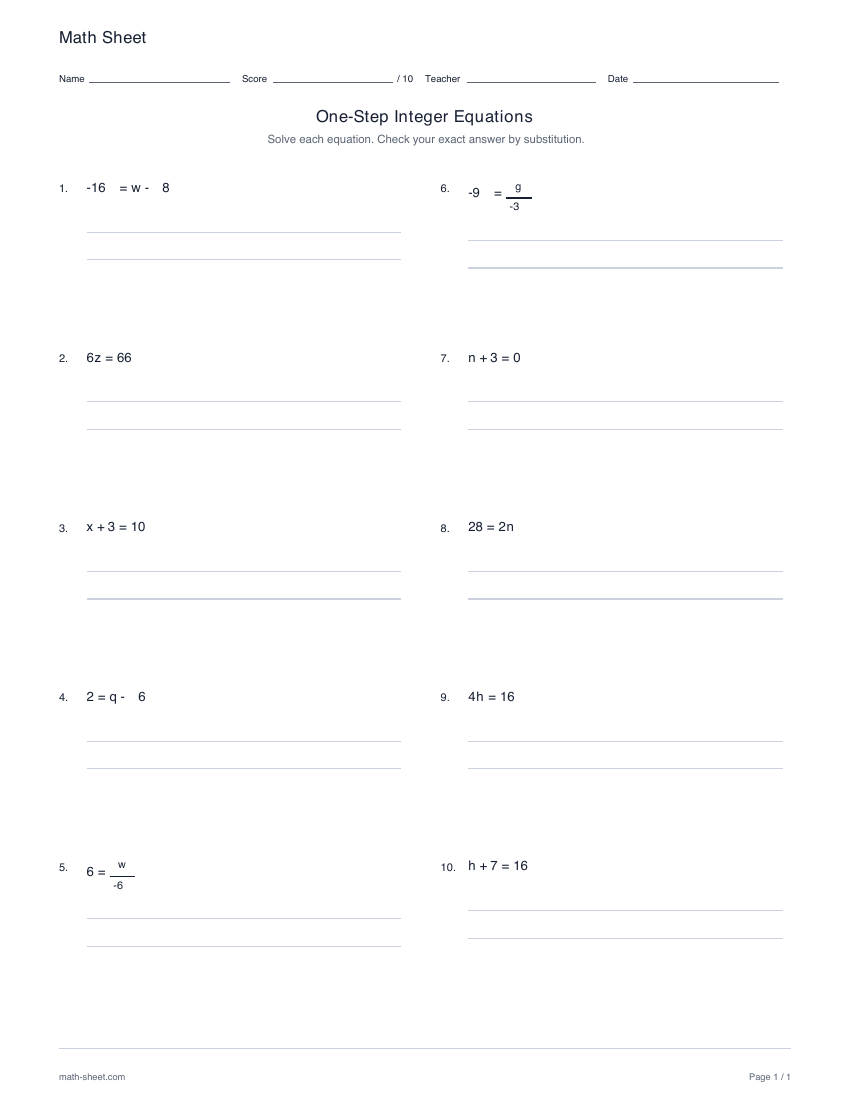
Equations
Print a 10-question one-step equations worksheet with signed integers, four inverse operations, exact answers, worked steps, and substitution checks.
Preview and download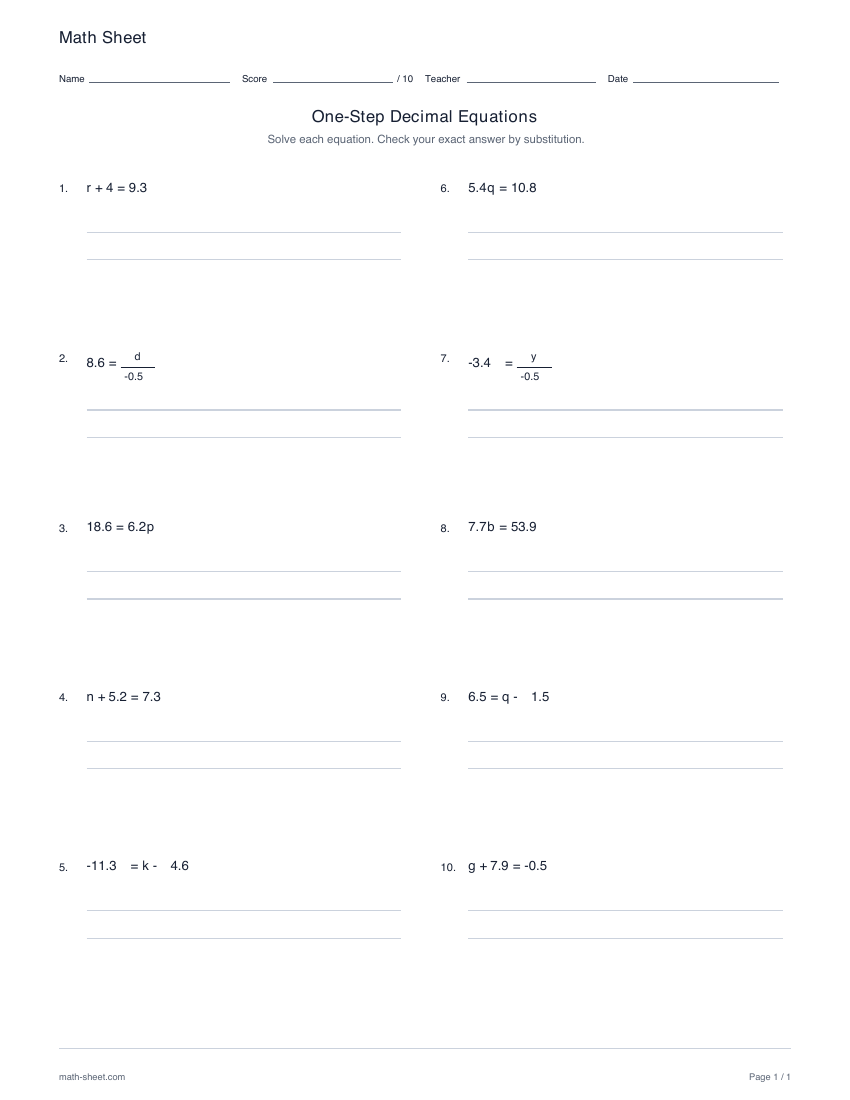
Equations
Practice ten one-step equations with decimal operands and exact terminating solutions. Use inverse operations and check each solution with the original decimal values.
Preview and download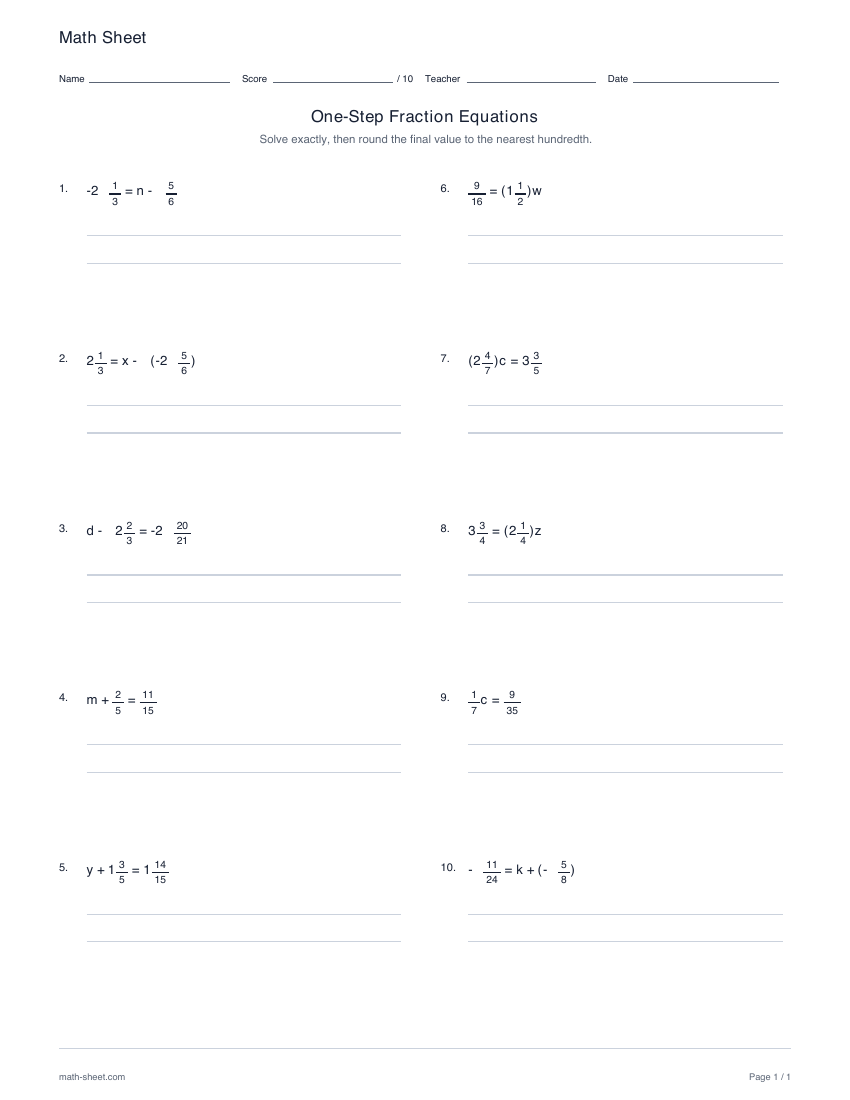
Equations
Solve ten equations containing proper fractions and signed mixed numbers. Practice fractional coefficients and inverse operations, with exact working and answers rounded to hundredths.
Preview and download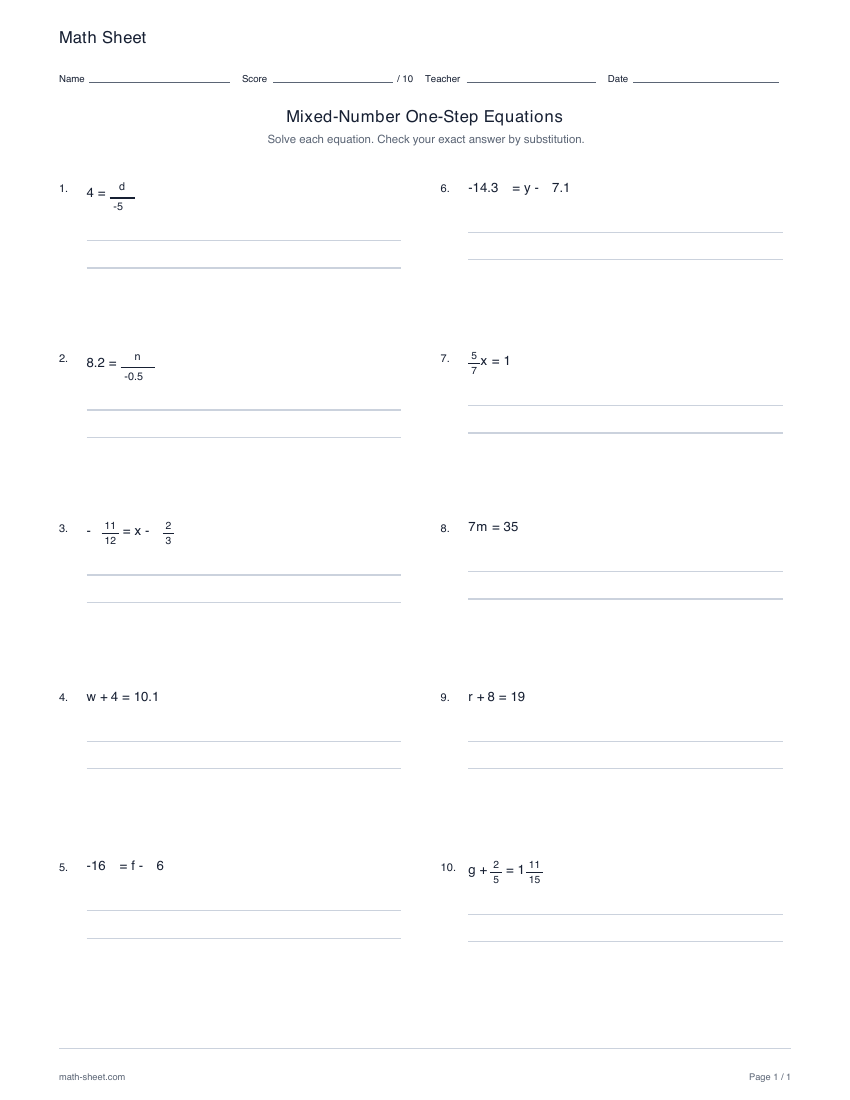
Equations
Build ten one-step equations from any nonempty mix of integers, decimals and fractions. The selected number types are balanced across the sheet, and every answer and substitution check stays exact.
Preview and downloadShow the reasoning
Read a coefficient, an added quantity or a grouped numerator before deciding what to undo first. A fraction bar groups its entire numerator.
Equations
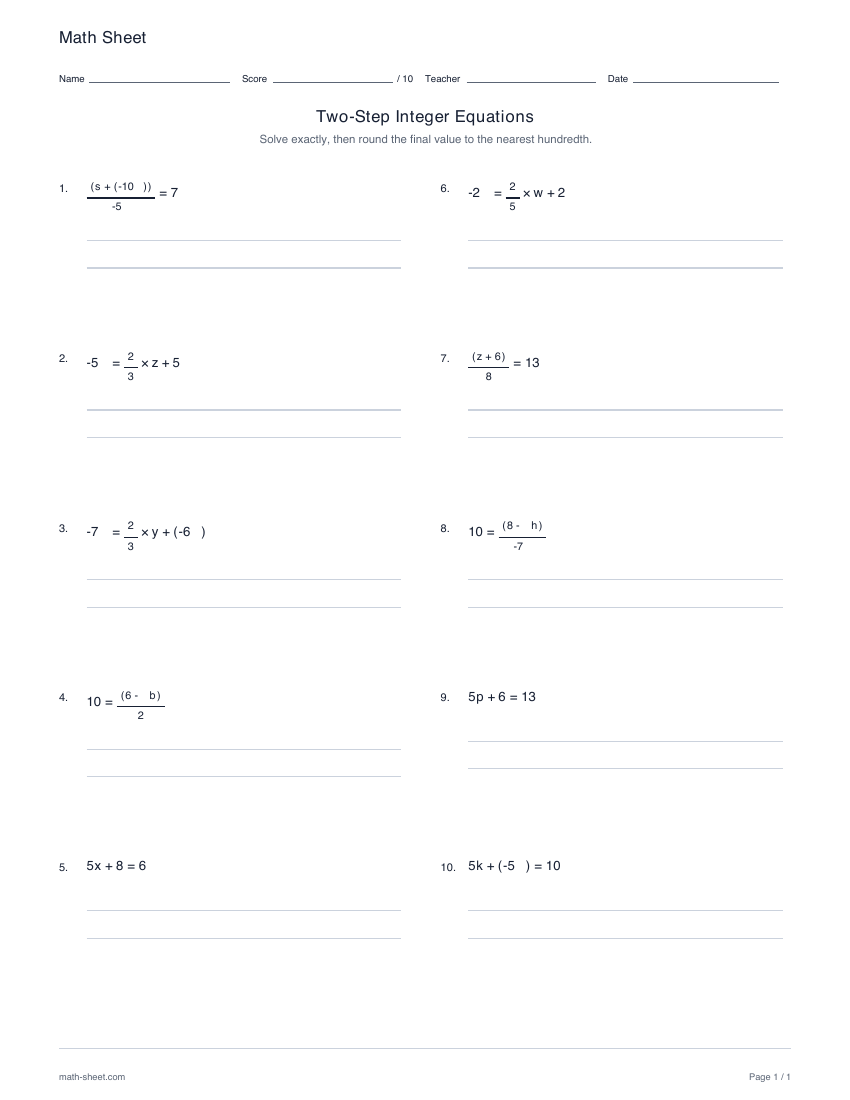
Print a 10-question two-step equations worksheet with integer quantities, fractional coefficients, grouped quotients, worked answers, and exact checks.
Preview and download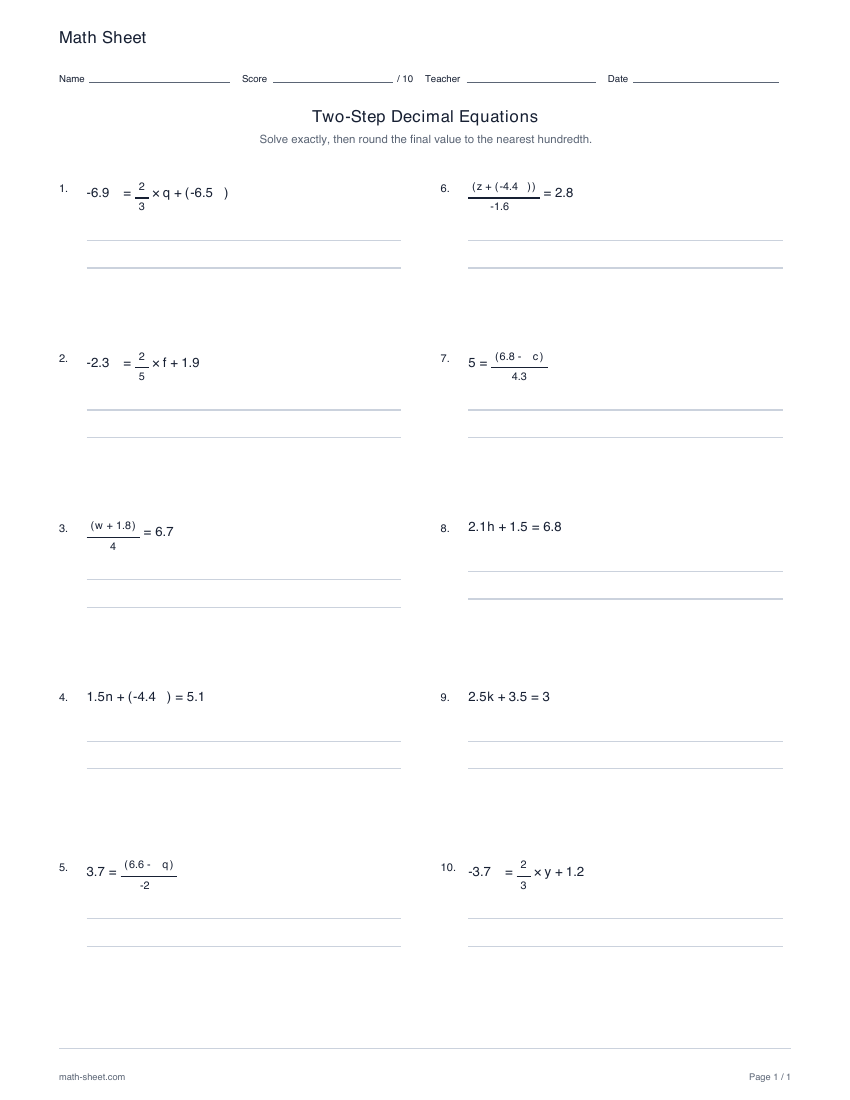
Equations
Practice ten two-step equations with decimals, fractional coefficients and grouped division. Keep exact values during the solution and round the final answer to two decimal places.
Preview and downloadShow the reasoning
Distribute factors and collect like terms, including equations with variable terms on both sides. Choose eleven displayed structures for integer practice, or continue with decimal and focused both-sides questions. Keep each new line equivalent to the original.
Equations
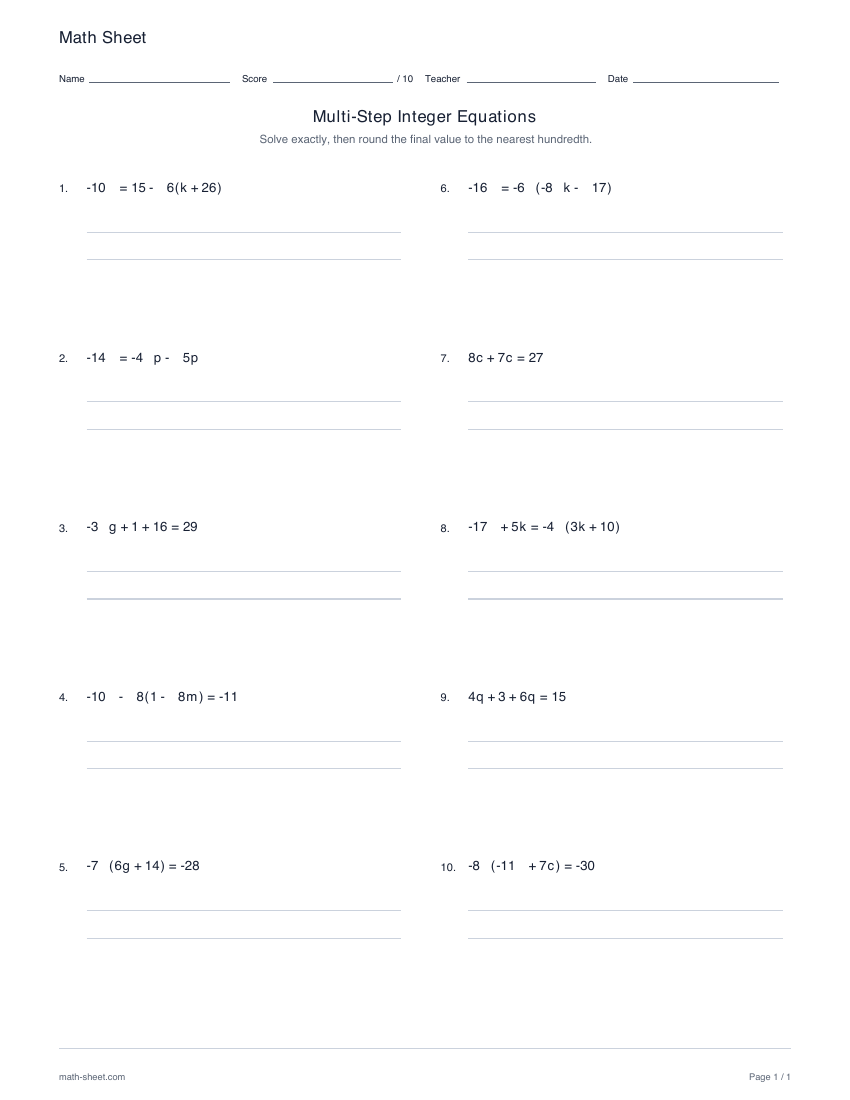
Choose from eleven equation structures for ten questions with integer operands. Practice like terms, grouped expressions and variables on either side, with exact worked solutions and separately rounded answers.
Preview and download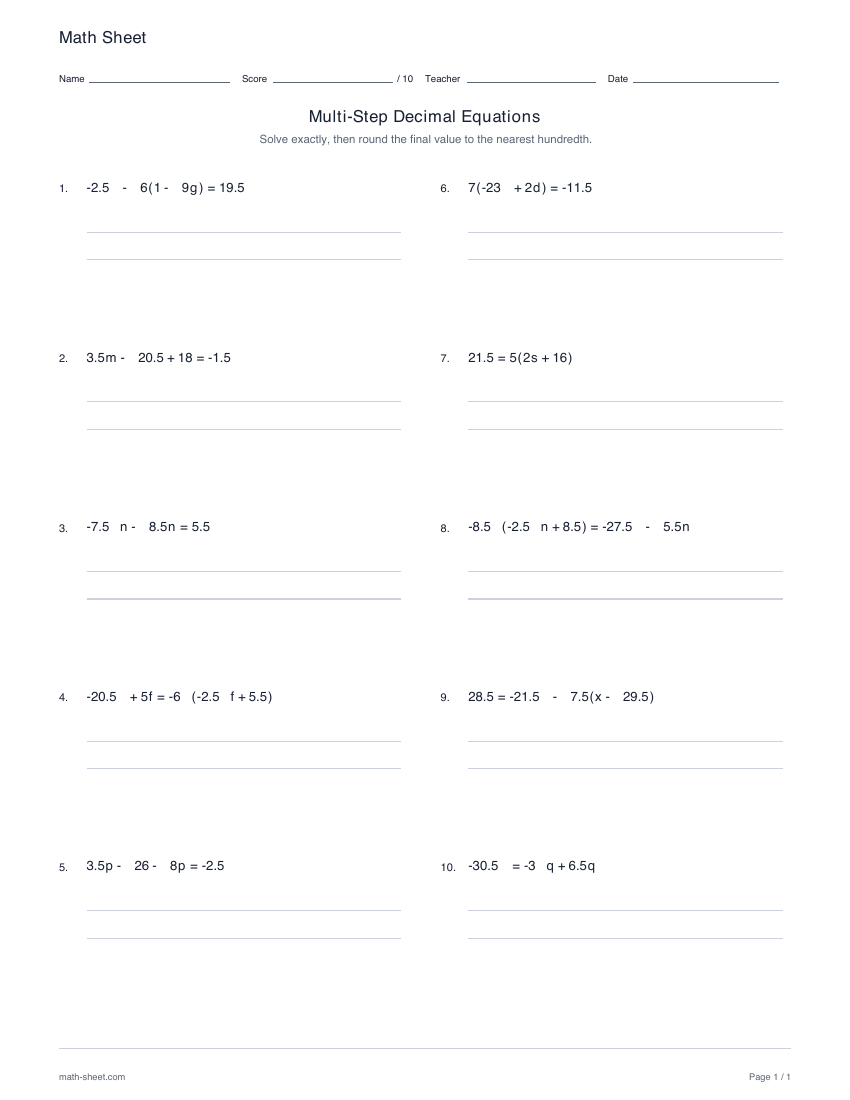
Equations
Choose from eleven equation structures for ten questions with signed half-step decimal operands. Practice like terms, grouped expressions and variables on either side, with exact worked solutions and separately rounded answers.
Preview and download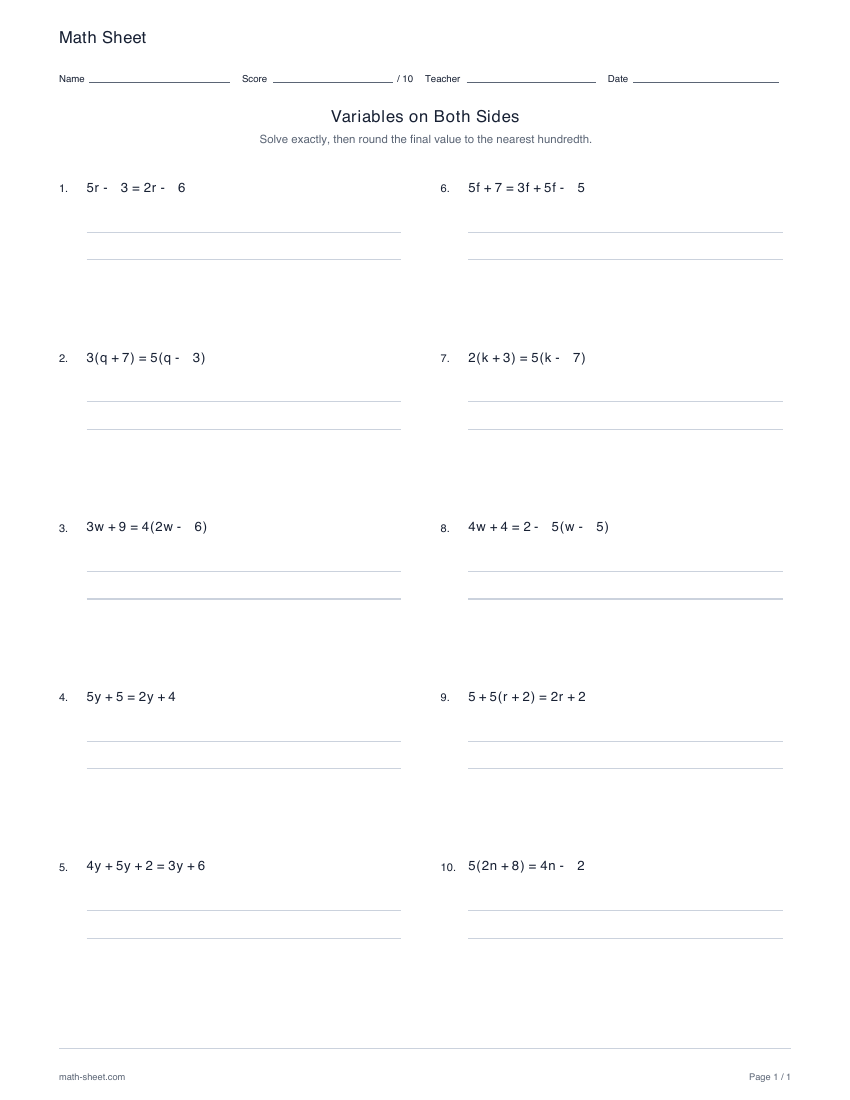
Equations
Solve ten equations with the same variable on both sides. Choose the letter policy, constant and coefficient ranges, and signed or positive-only operands, with full worked solutions.
Preview and downloadShow the reasoning
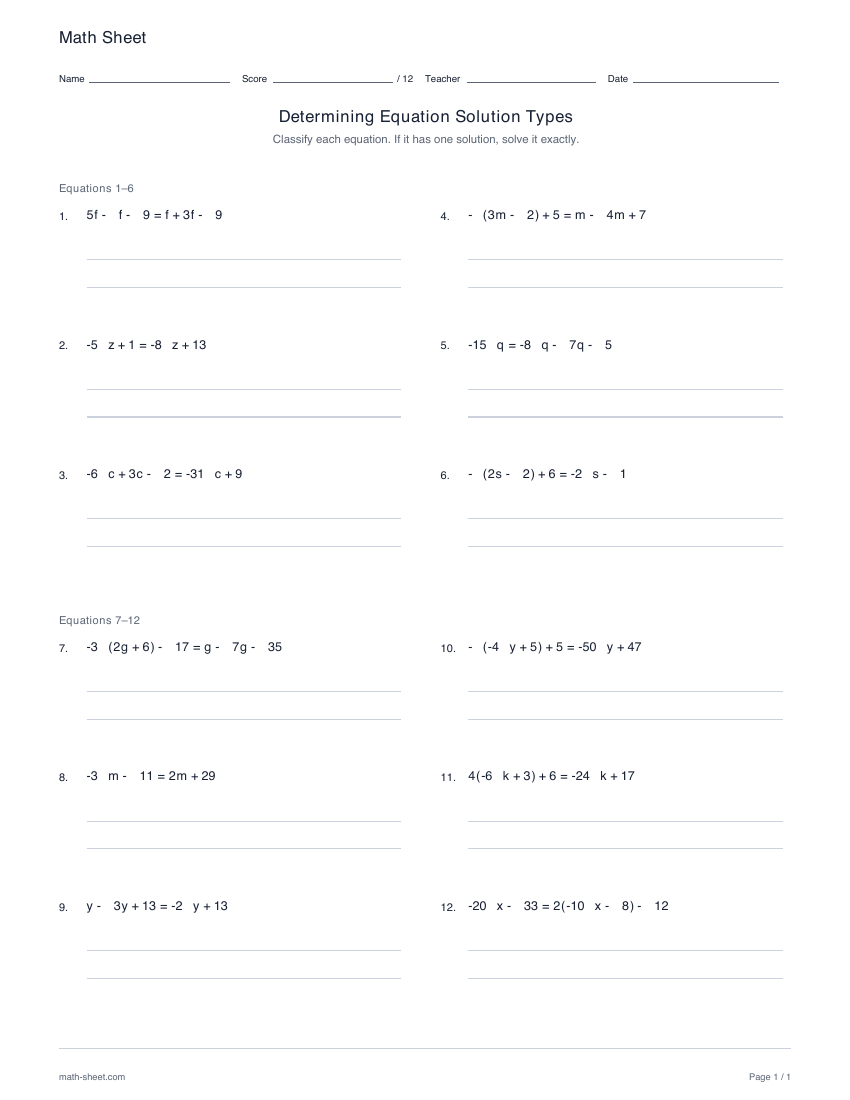
Simplify equations with distribution, negation and repeated terms. Decide whether each has no solutions, one exact solution or infinitely many solutions.
Equations
Classify twelve linear equations as having no solutions, one solution or infinitely many solutions. Choose any nonempty combination, with exact rational roots on separate keys.
Preview and downloadShow the reasoning
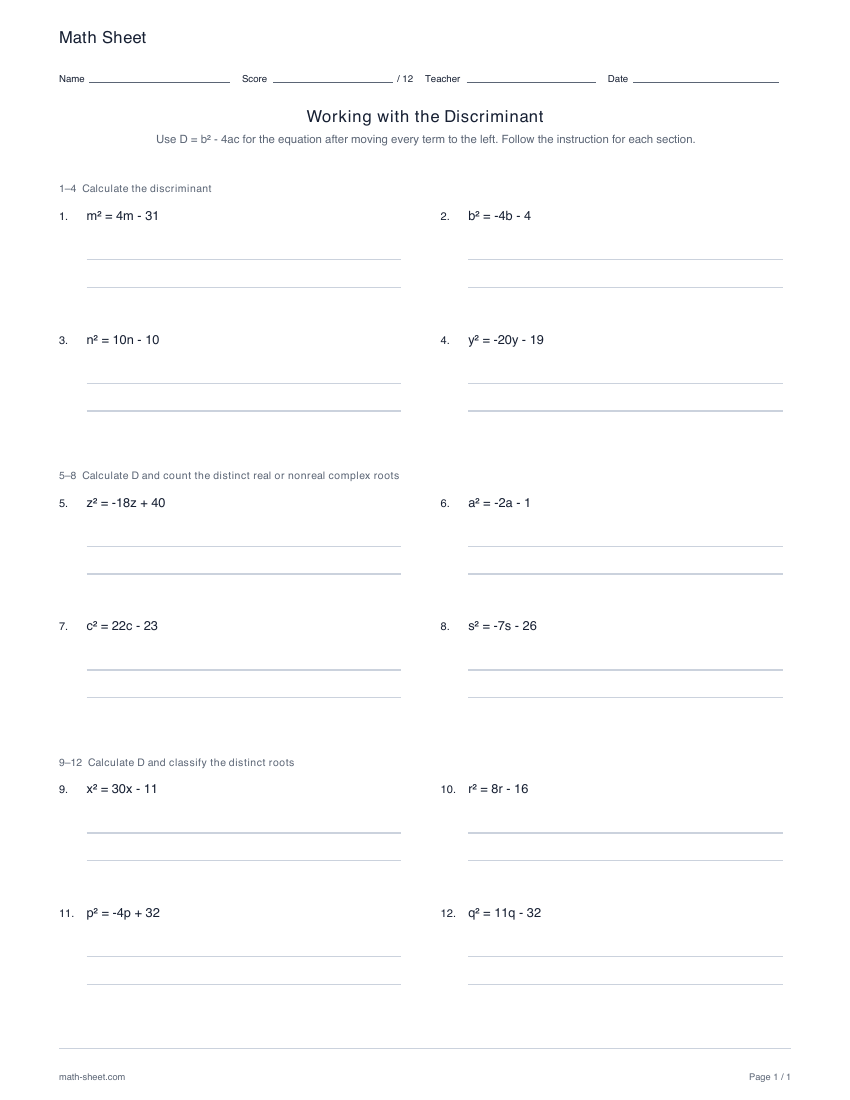
Use the discriminant to predict the number and type of roots, then compare taking square roots, factorization, completing the square and the quadratic formula. Keep the displayed coefficients when calculating D.
Equations
Calculate the discriminant for twelve quadratic equations, then use its sign and square status to count and classify distinct roots. Choose monic, signed nonmonic or mixed leading coefficients.
Preview and download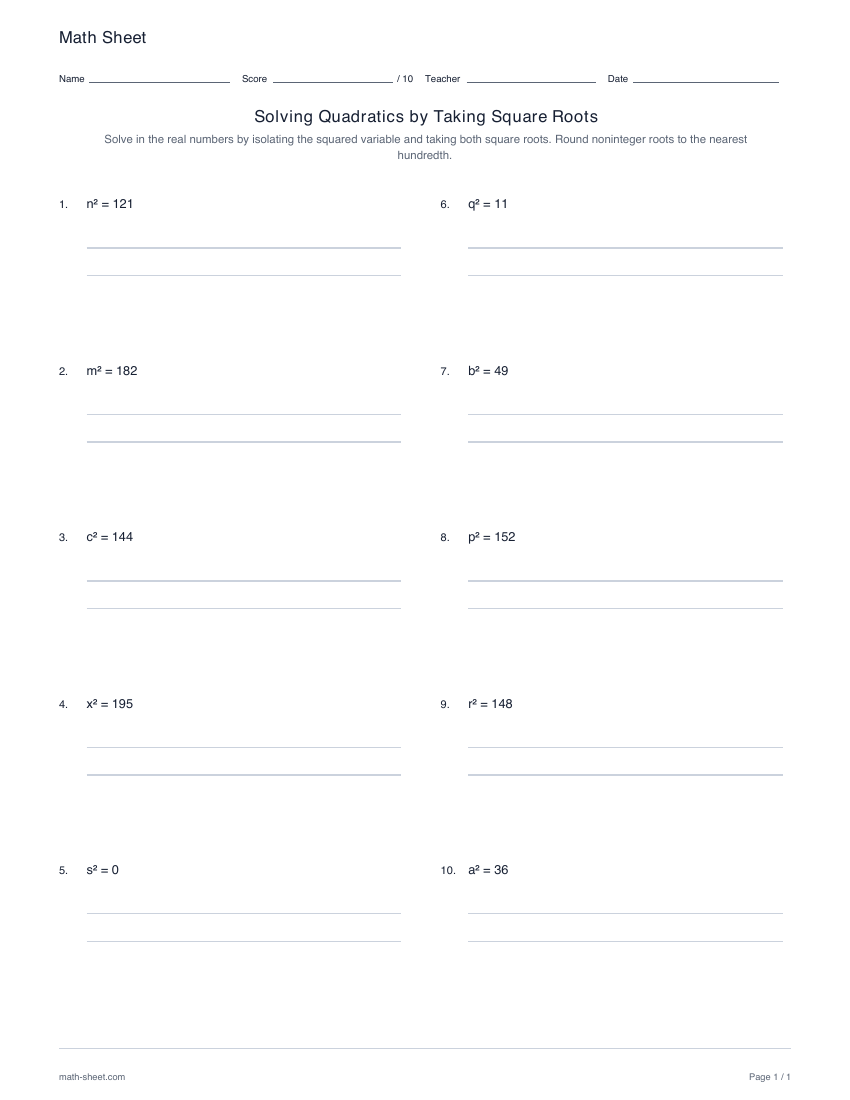
Equations
Solve ten quadratic equations by isolating a squared variable and taking both square roots. Choose direct, offset, scaled, multi-step or mixed equations with rounded real, exact real, no-real or imaginary results.
Preview and download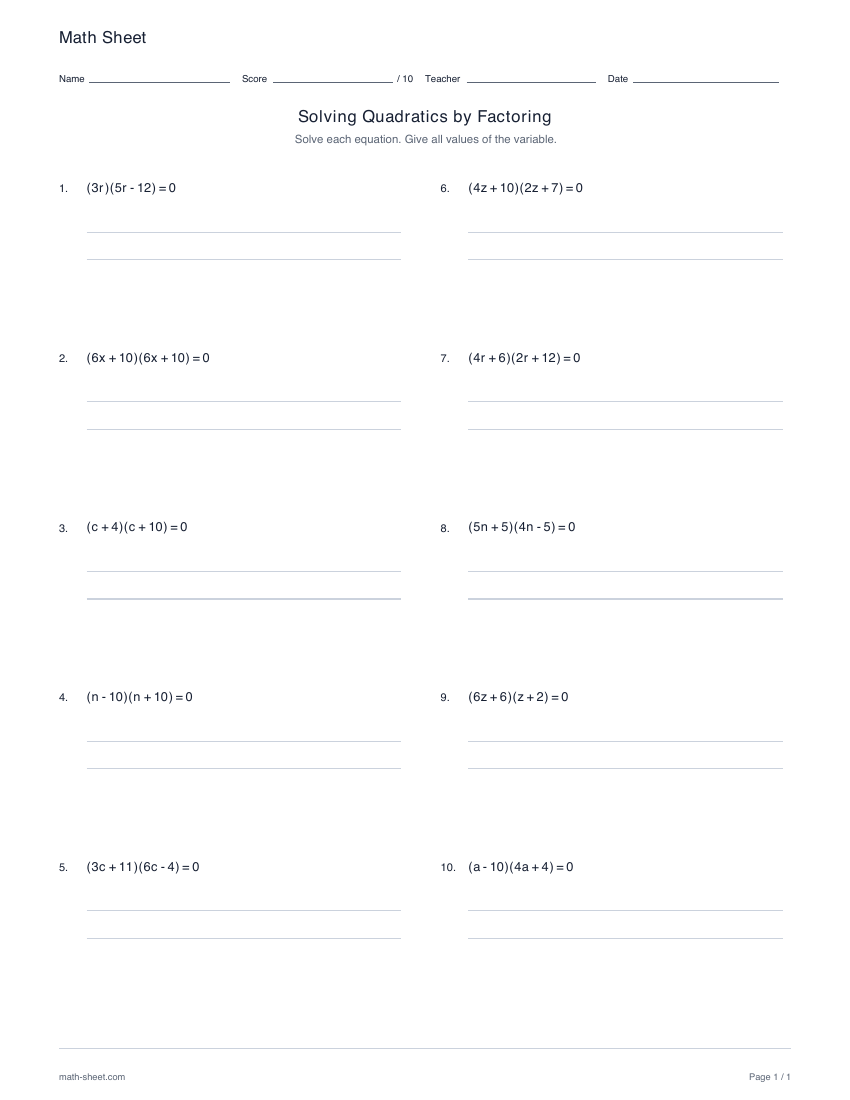
Equations
Solve ten factorable quadratic equations with complete exact root sets. Choose factored form, expanded form, rearrangement practice or a balanced mixed sheet.
Preview and download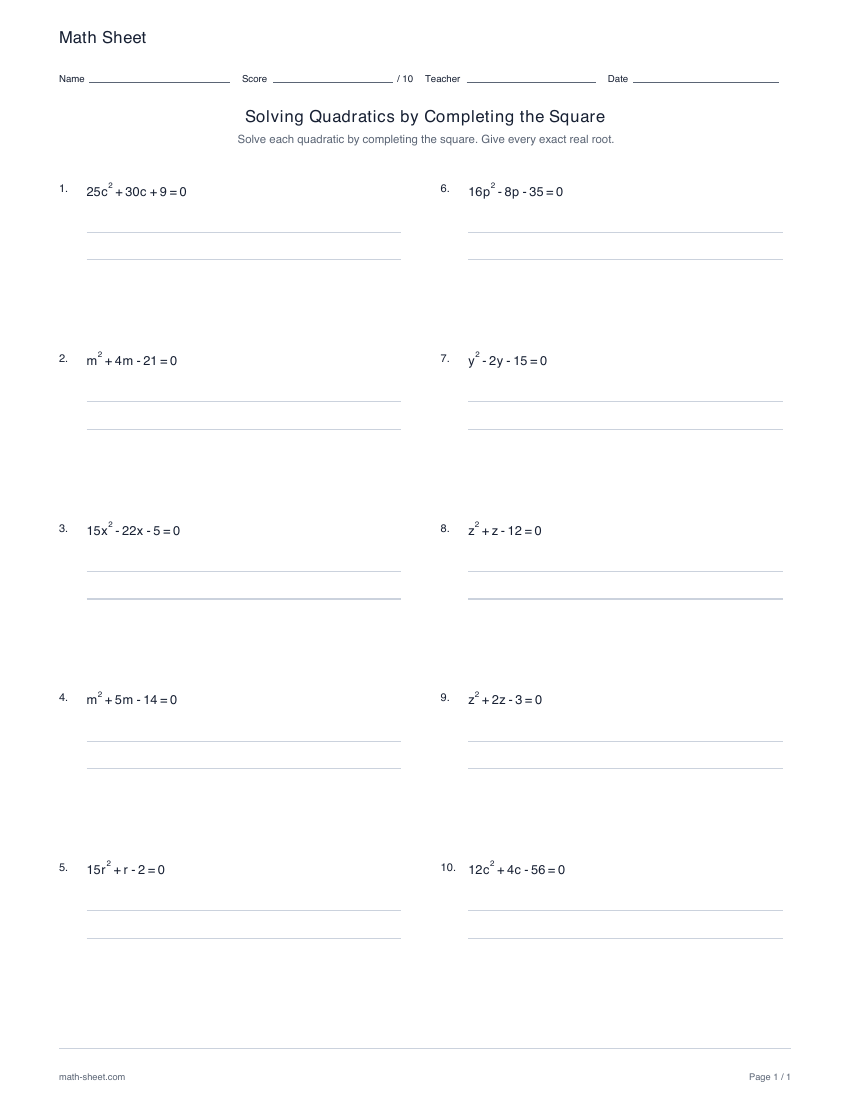
Equations
Solve ten quadratic equations by completing the square. Choose easy, hard or mixed equations and rational-only answers or exact radical roots.
Preview and download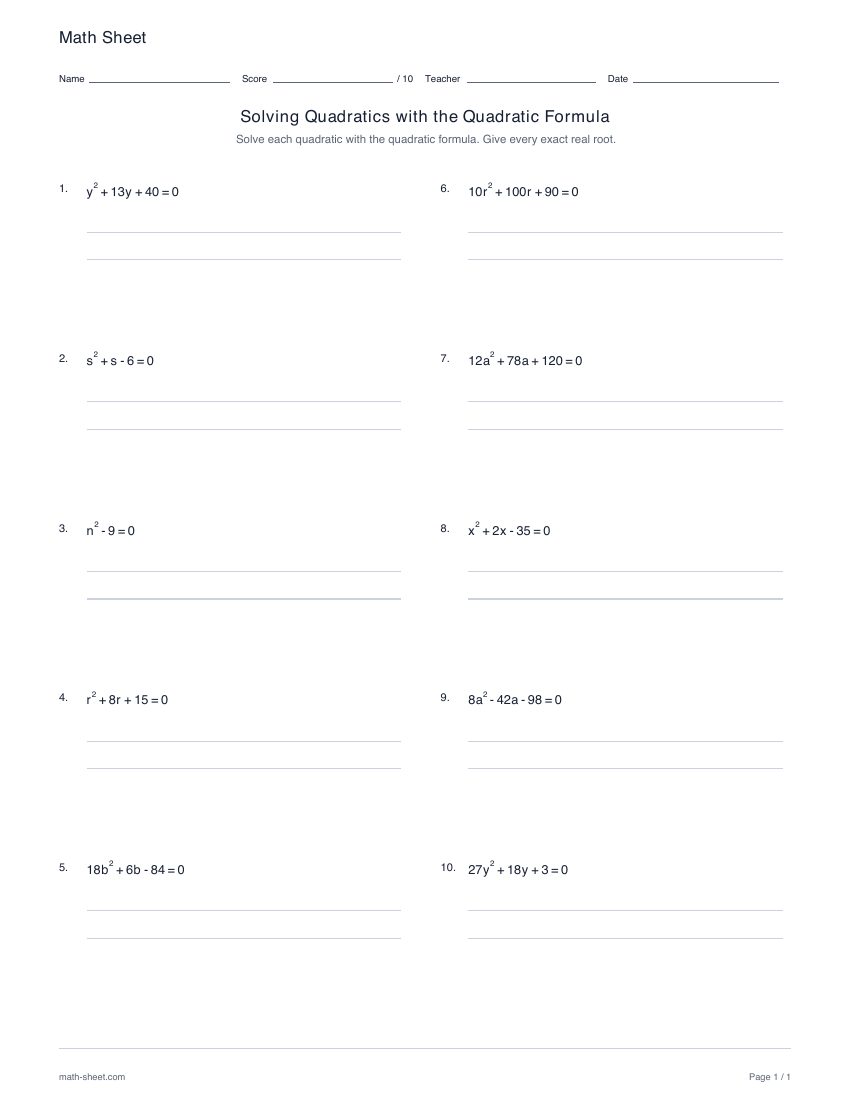
Equations
Solve ten quadratic equations with the quadratic formula. Practice original monic and nonmonic equations with rational and exact radical answers.
Preview and downloadRead the whole expression before solving
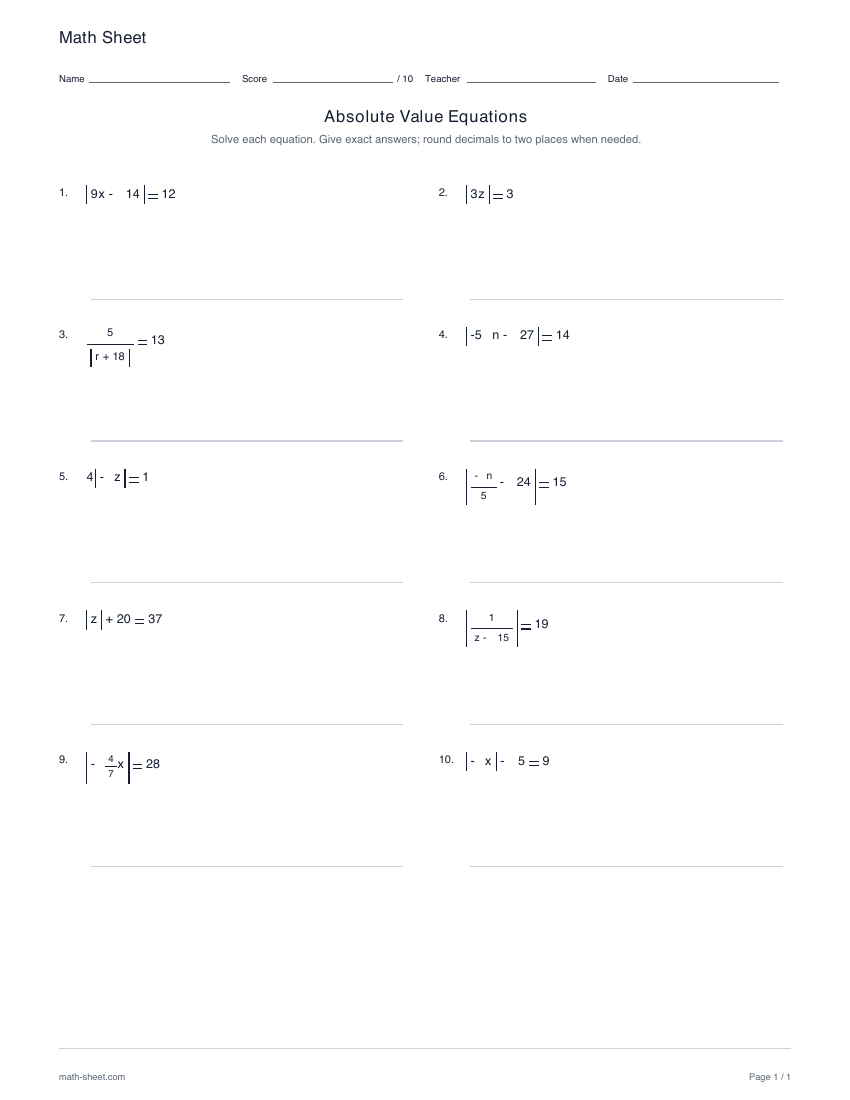
Choose among six families covering signed interiors, outside coefficients, fractional expressions and variable denominators. Read bar placement, keep domain exclusions and check every exact solution in the original equation.
Equations
Solve ten absolute value equations from six selectable families. Practice signed interiors, outside coefficients, fractions and variable denominators, with exact solutions, clearly marked approximations and separate worked keys.
Preview and downloadIdentify the unknown quantity before choosing an operation. A missing total, a missing group size and a missing number of groups can use the same multiplication relationship in different ways.
The expanded one-step story set includes quantities removed, unknown group counts and totals shared equally. Choose digits, number words or a mixture, and decide whether to include extra information.
Word problems
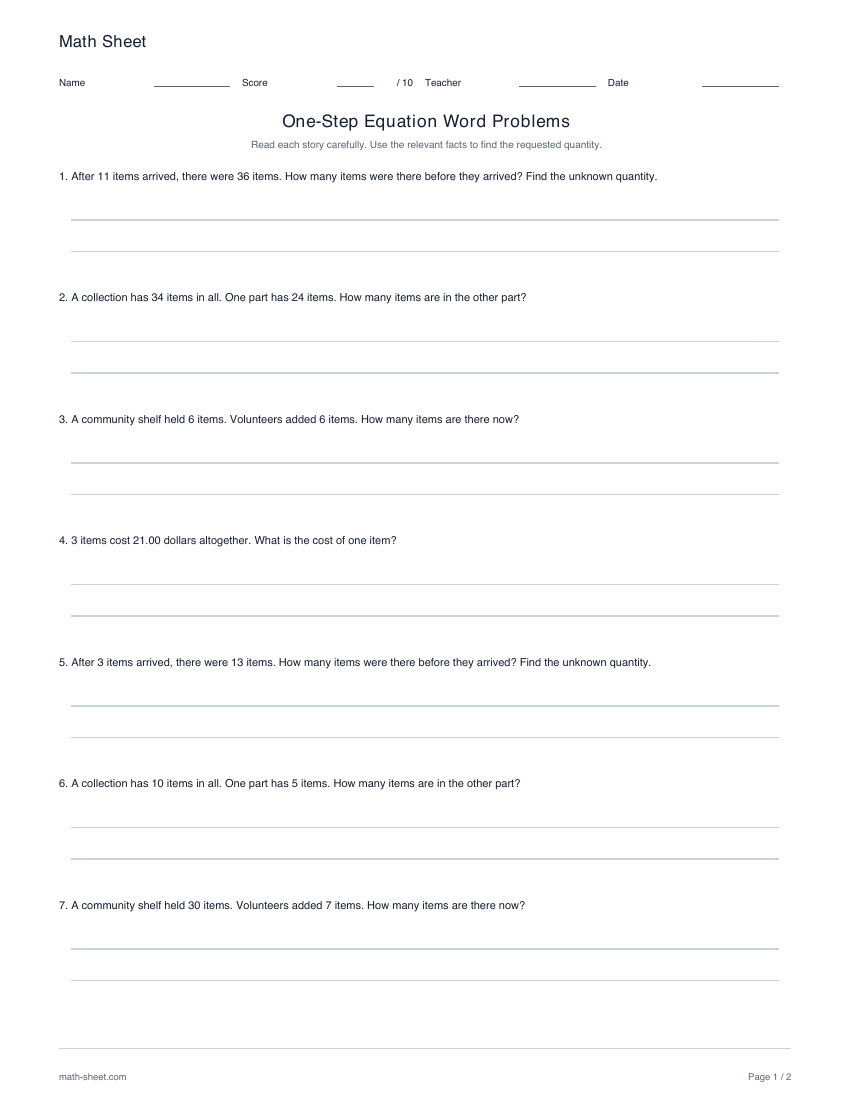
Find a missing starting amount, part, total or unit cost in ten short stories. Choose digits, number words or a mixture, and optional irrelevant information.
Preview and download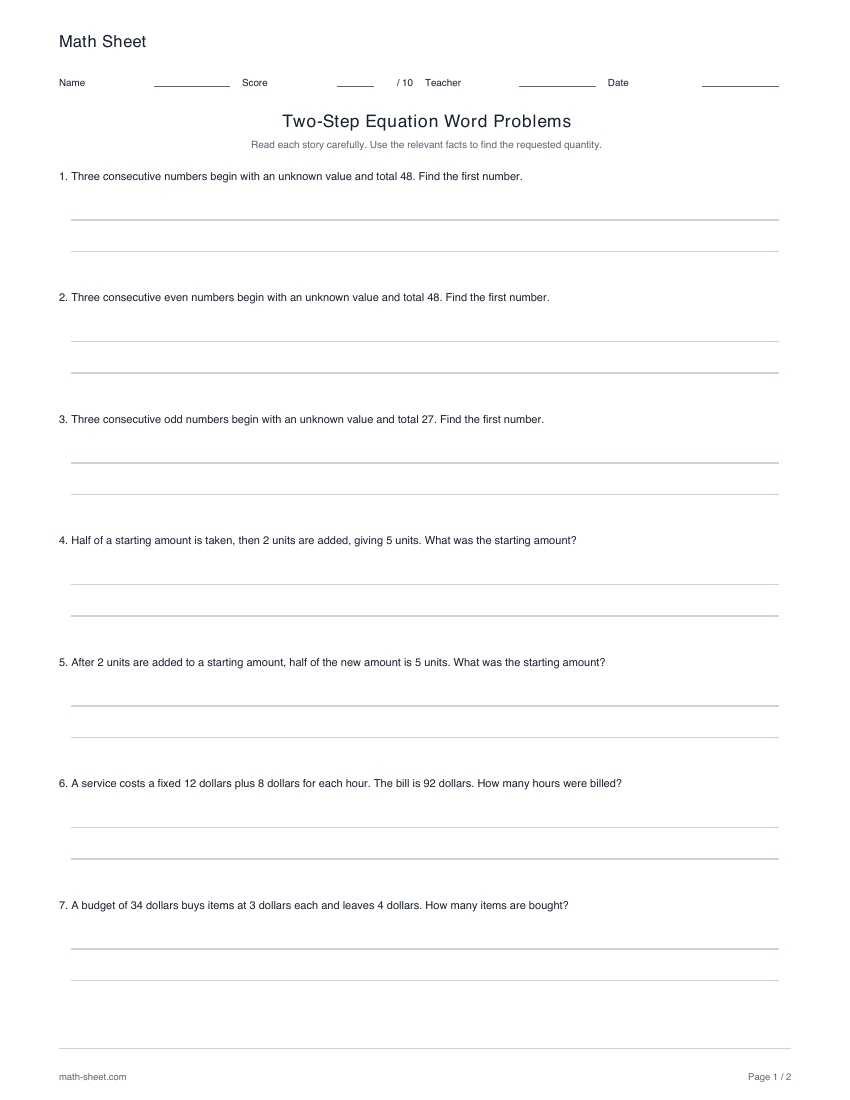
Word problems
Solve ten stories involving fixed fees and rates, budgets, halves and consecutive numbers. Choose number wording and print a separate answer key.
Preview and downloadIn 3x + 5 = 20, the unknown is multiplied by 3 and then increased by 5. Undo the addition first: subtract 5 from each side. Divide both remaining sides by 3 to isolate x.
A fraction bar can group a whole expression. For (7 − x) ÷ 3 = 5, multiply both sides by 3 before dealing with 7 − x. After subtracting 7, the equation is −x = 8, so x = −8.
The one-step integer, decimal and mixed-number sheets ask for exact answers. The fraction-only, two-step and multi-step sheets ask for answers to the nearest hundredth; their worked keys keep an exact value as well.
For 3x = 10, the exact solution is 10/3 and its rounded report is 3.33. Multiplying 3.33 by 3 gives 9.99, so that rounded number cannot provide an exact substitution check. Use 10/3 to verify the original equation.
Replace every occurrence of the variable with the exact solution. Evaluate the two original sides independently. Matching values confirm the answer for that equation and can reveal an earlier sign or distribution error.
For 4(2x − 3) = 3x + 8 and x = 4, the left side is 4(8 − 3) = 20, and the right side is 12 + 8 = 20. Both sides agree.
Choose by readiness
Grade 5–6 links are starting guides, not claims of alignment to a national curriculum. Fractional coefficients, signed distribution and variables on both sides may belong later in a local course.
Use a short equation to explain how one operation can be undone on both sides. Signed-number knowledge is needed.
Open this starting point →Use familiar inverse operations with decimal operands and terminating solutions.
Open this starting point →Interpret mixed numbers and reciprocals, then distinguish an exact fraction from a rounded decimal.
Open this starting point →Balance integer, decimal and fraction equations while keeping every solution and check exact.
Open this starting point →Practice two-step equations, including fractional coefficients and a whole numerator divided by a constant.
Open this starting point →Move from expanding expressions to simplifying both sides of a complete equation.
Open this starting point →Keep the visible inputs simpler while practicing variables on both sides. The resulting solution may still be negative.
Open this starting point →Model one equation aloud, ask the learner to explain the next, then use a ten-question sheet. Review the cause of an error before increasing difficulty: operation order, a signed coefficient, a fraction bar or a missed term in distribution.
Each resource includes ready-made Letter and A4 PDFs. Customize the seed, paper, available printed language and note below its teaching guide. Worked answers are separate pages, and the preview and download use the same questions.