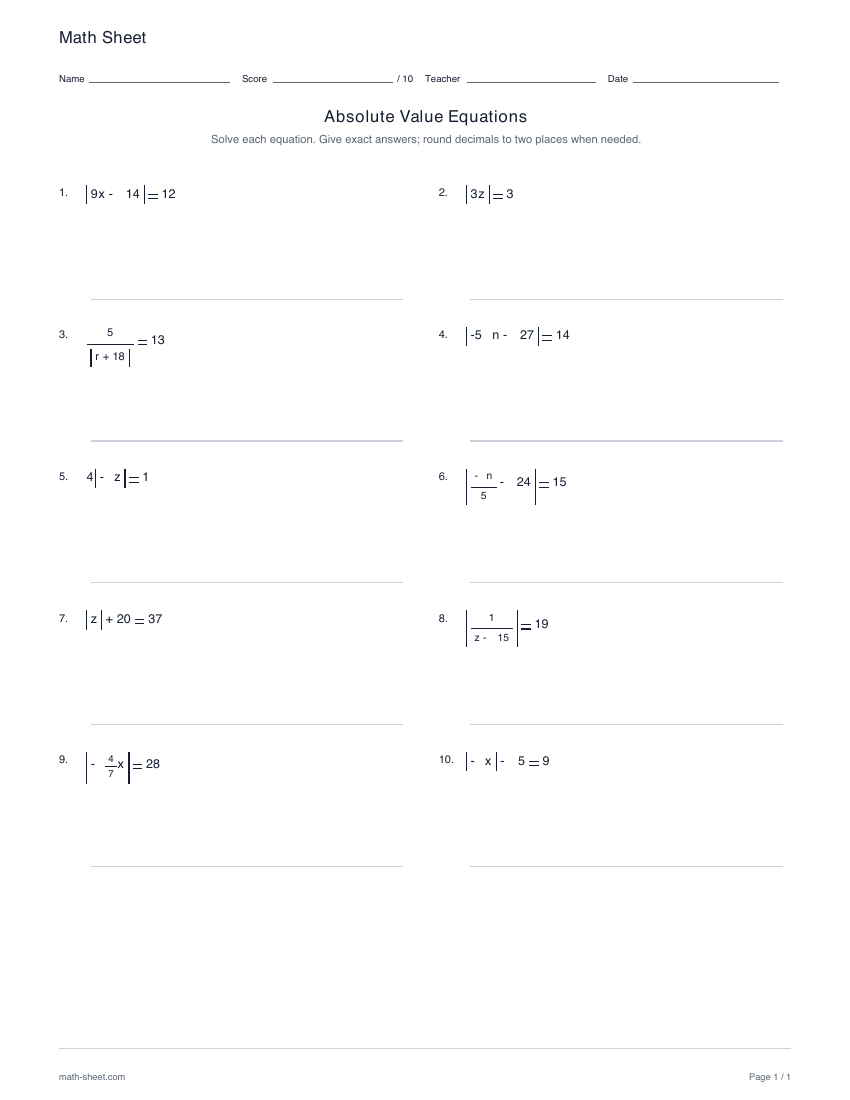
Solve ten absolute value equations from six selectable families. Practice signed interiors, outside coefficients, fractions and variable denominators, with exact solutions, clearly marked approximations and separate worked keys.
Fixed English ready-made files. Custom settings below apply only to the configured PDF.
Ready to print
Start with a ready-made worksheet
Read what is inside the bars, note any denominator restrictions and isolate the absolute value. Solve each appropriate branch, then check the exact candidates in the original equation.
Download the practice pages alone, or include a separate answer key or teacher model. Longer activities may use more than one page.
Locate the bars before deciding how many branches to solve
For |−4x| = 8, the variable is inside the absolute value. Both x = 2 and x = −2 work. For |−4| x = 8, evaluate the constant inside the bars first: 4x = 8 has the single solution x = 2.
Fractions require another check. In 3/|x + 2| = 6, x = −2 is excluded because it makes the denominator zero. The allowed solutions are x = −3/2 and x = −5/2. Substitute the exact values into the original denominator before accepting them.
Choose any nonempty combination of the six families. The ten questions include only the families you select, and the separate key keeps exact answers beside decimal approximations. Student sheets provide working space and an answer line; answer pages show domain restrictions and each solving branch.
Questions about absolute value equations
Which question families can I choose?
Choose monomials, shifted expressions, affine expressions with coefficients, fractional monomials, fractional polynomial expressions, or mixed fractions. All six are selected to begin with. Select at least one family; every worksheet has ten questions distributed across your choices.
Why can moving a coefficient change the answers?
For 2|x − 3| = 10, divide by 2 before splitting: x = 8 or x = −2. For |2x − 3| = 10, split first: x = 13/2 or x = −7/2. Read the opening and closing bars to decide which expression is being measured.
How do I handle a variable in a denominator?
For |2/(x + 1)| = 4, exclude x = −1. Solving the two branches gives x = −1/2 or x = −3/2; both are allowed and satisfy the original equation. Keep original denominator restrictions even if later simplification cancels a factor.
What happens when a reciprocal expression has a shift?
For |2/x + 1| = 3, first exclude x = 0. The branches 2/x + 1 = 3 and 2/x + 1 = −3 give x = 1 and x = −1/2. Check both in the original expression.
How are decimal approximations rounded?
The key keeps exact roots and separately marks noninteger roots with an approximation to the nearest hundredth. At an exact halfway value, choose the nearest result whose final digit is even: 1.125 becomes 1.12 and 1.135 becomes 1.14. Use the exact fraction for substitution checks.
Learning objective
What this activity builds
Read absolute-value bar placement, solve each valid branch and check exact solutions in the original equation and its domain.
Worked example
Solve |3x − 2| + 1 = 8.
Subtract 1 to get |3x − 2| = 7. Solve 3x − 2 = 7 and 3x − 2 = −7. The exact solutions are x = 3 and x = −5/3; the second is approximately −1.67.
Both 7 and −7 have absolute value 7, so both branches matter. Substituting either exact solution makes the original left side equal to 8. Keep −5/3 for the exact check; the rounded decimal is an approximation.
Teaching notes
Make the practice count
Mark the operand enclosed by the bars before applying any operations.
Keep an outside coefficient separate from a coefficient inside the absolute value.
Exclude values that make any original denominator zero before simplifying.
A positive isolated absolute value usually produces two branches; absolute bars around only a constant can leave one ordinary linear equation.
Substitute every exact candidate into the original unsimplified equation.
Keep exact fractions beside rounded decimal approximations when a solution is not an integer.
Make it yours
Customize the practice
Choose your options, update the preview, then download the exact same pages.
Select at least one of the six families. Every set has ten questions, balanced across the selected families. Read bar placement carefully: some equations have one solution, while others have two. Keys show exact roots, denominator restrictions and separately marked decimal approximations.
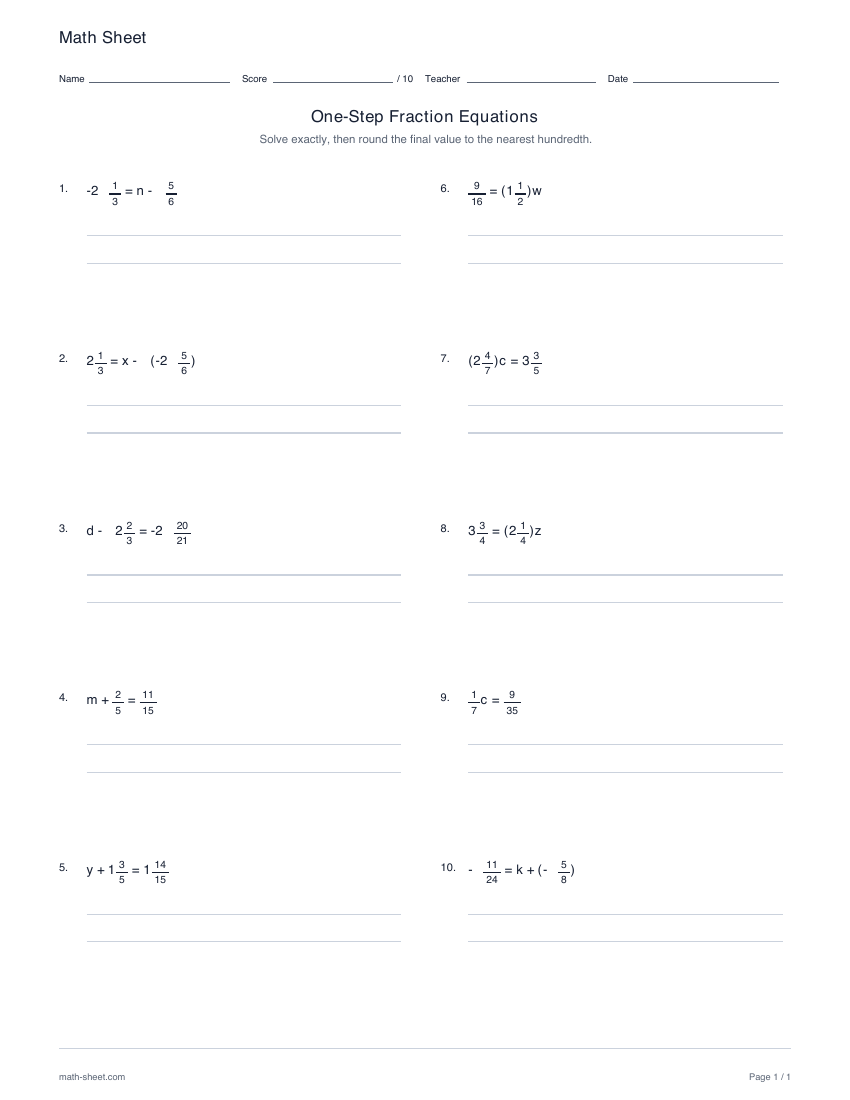
Solve ten equations containing proper fractions and signed mixed numbers. Practice fractional coefficients and inverse operations, with exact working and answers rounded to hundredths.
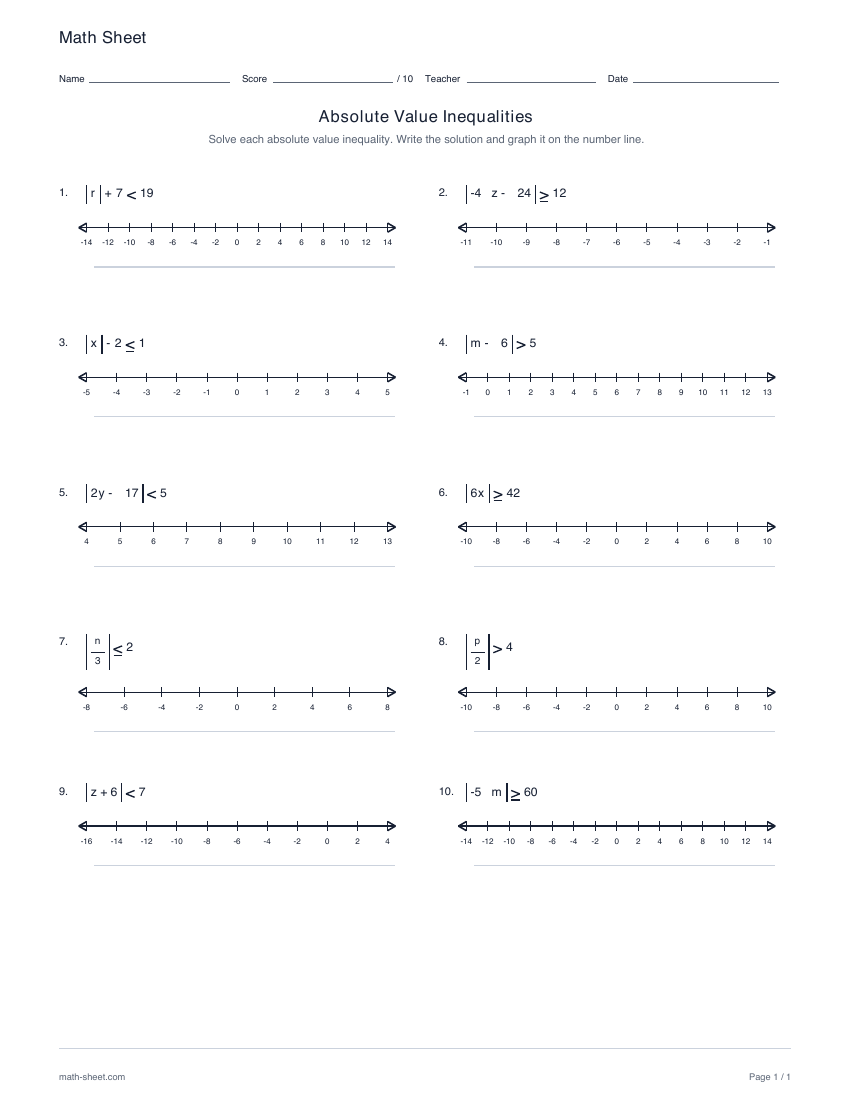
Solve and graph ten absolute value inequalities. Choose addition and subtraction, multiplication and division, or mixed operations, with shifts, negative inner coefficients and separate worked graphical answers.
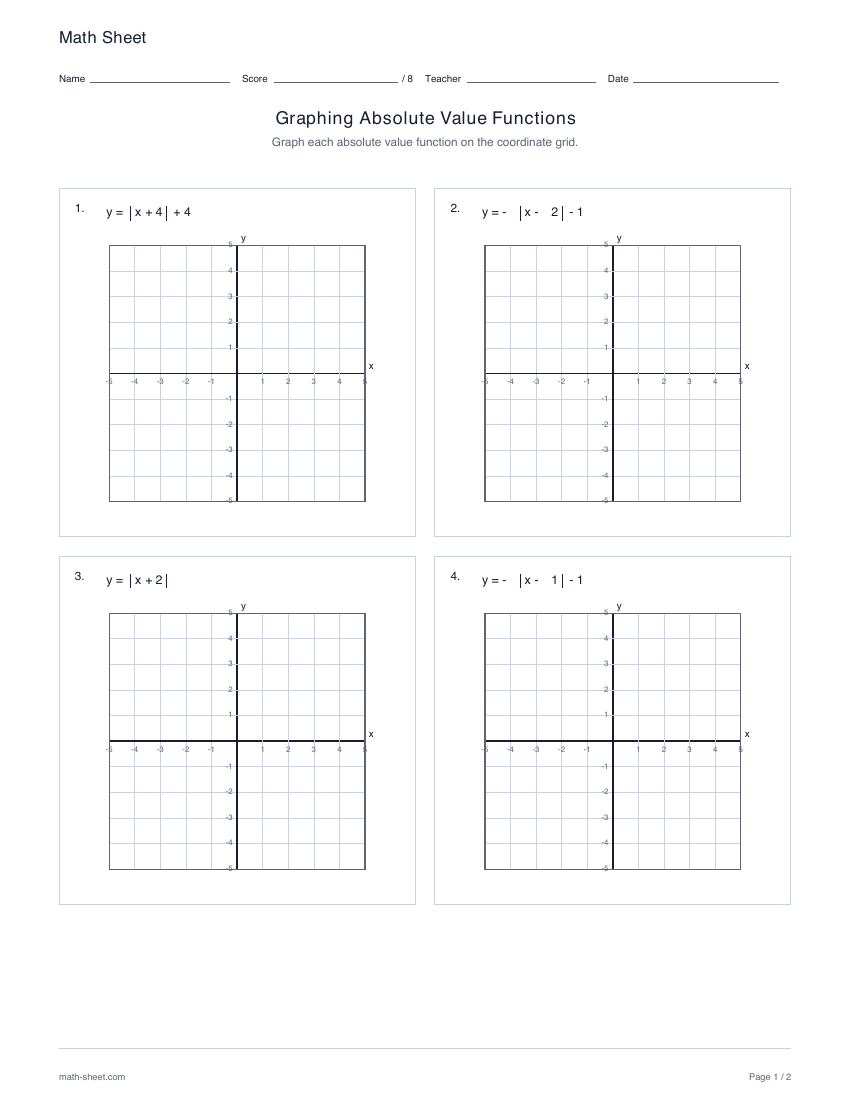
Graph eight absolute value functions or write equations from eight V-shaped graphs. Practice translations and reflections of y = |x| with integer vertices and a separate worked graphical key.