
Equations
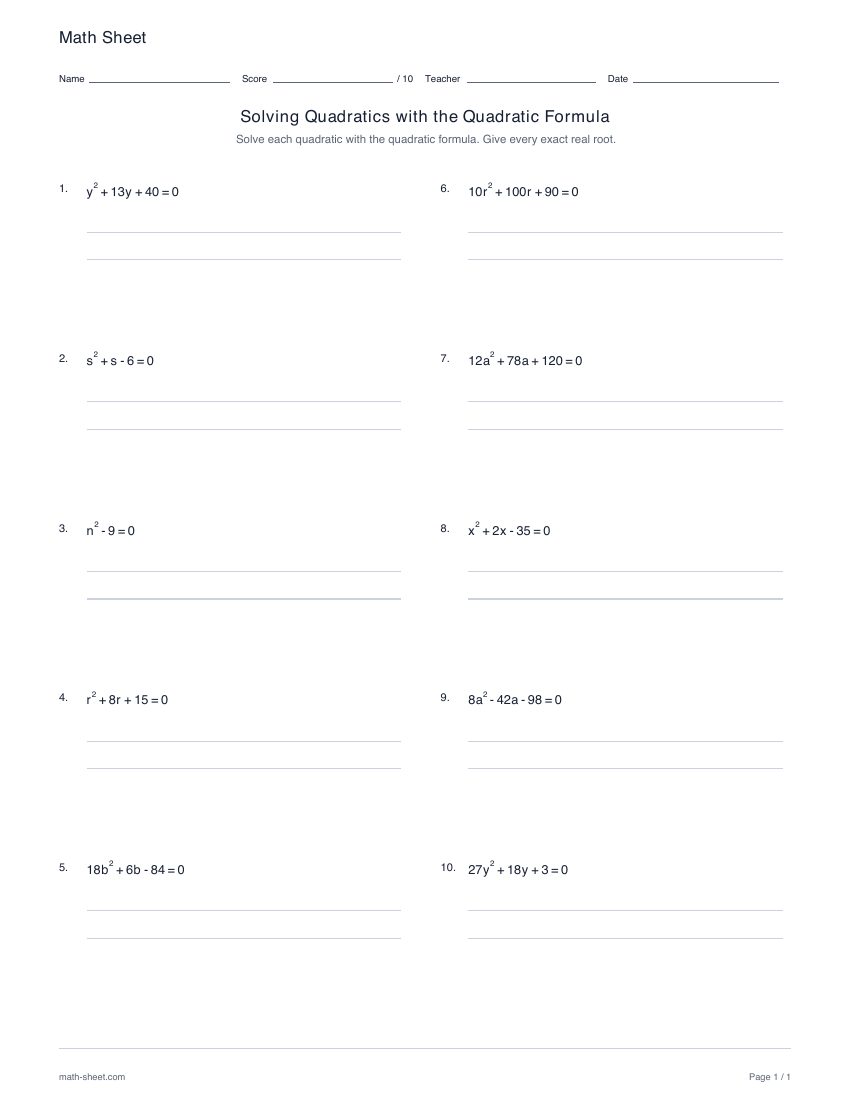
Solving quadratics with the quadratic formula worksheets
Solve ten quadratic equations with the quadratic formula. Practice original monic and nonmonic equations with rational and exact radical answers.
Preview and downloadEquations practice
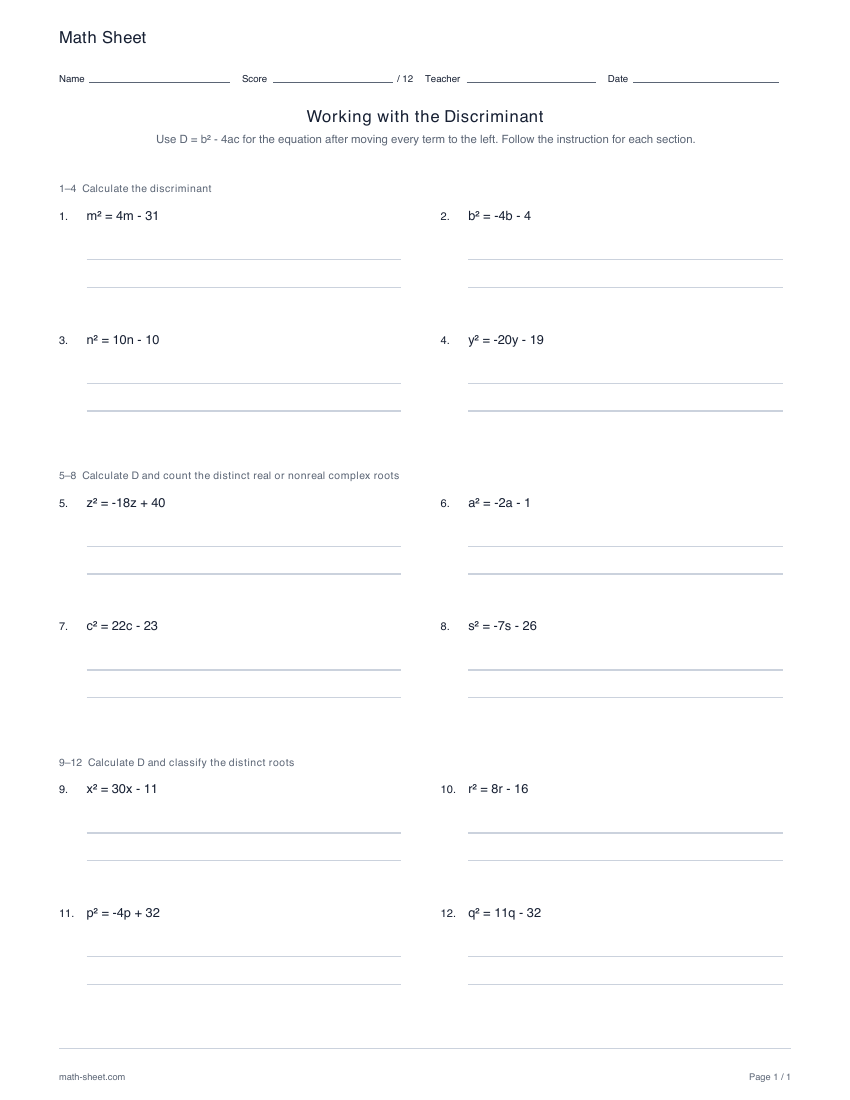
Calculate the discriminant for twelve quadratic equations, then use its sign and square status to count and classify distinct roots. Choose monic, signed nonmonic or mixed leading coefficients.
Ready-made English PDF · fixed settings
Customization below makes a separate PDF.
Fixed English ready-made files. Custom settings below apply only to the configured PDF.
Ready to print
Move every term to the left and identify a, b and c without reducing the equation. Calculate D from those displayed coefficients, then follow the section instruction.
Download the practice pages alone, or include a separate answer key or teacher model. Longer activities may use more than one page.
Customize this worksheetEach prompt puts the quadratic term on the left and the linear and constant terms on the right. Move them to standard form, retain their signs and calculate D = b² − 4ac from the unreduced coefficients.
A negative D gives two distinct nonreal complex roots. Zero gives one distinct repeated rational root. A positive perfect square gives two distinct rational roots; a positive nonsquare gives two distinct irrational real roots. Every section includes all four cases.
Learning objective
Identify the standard-form coefficients and use D = b² − 4ac to predict the number and type of distinct roots.
Worked example
D = 425; two distinct irrational real roots.
Move the terms left: 5k² + 15k − 10 = 0, so a = 5, b = 15 and c = −10. D = 15² − 4(5)(−10) = 425. It is positive and not a perfect square.
Teaching notes
Make it yours
Choose your options, update the preview, then download the exact same pages.
Each twelve-question sheet has three four-question sections and includes negative, zero, positive-square and positive-nonsquare discriminants in every section.
A useful next step
Equations
Solve ten quadratic equations with the quadratic formula. Practice original monic and nonmonic equations with rational and exact radical answers.
Preview and download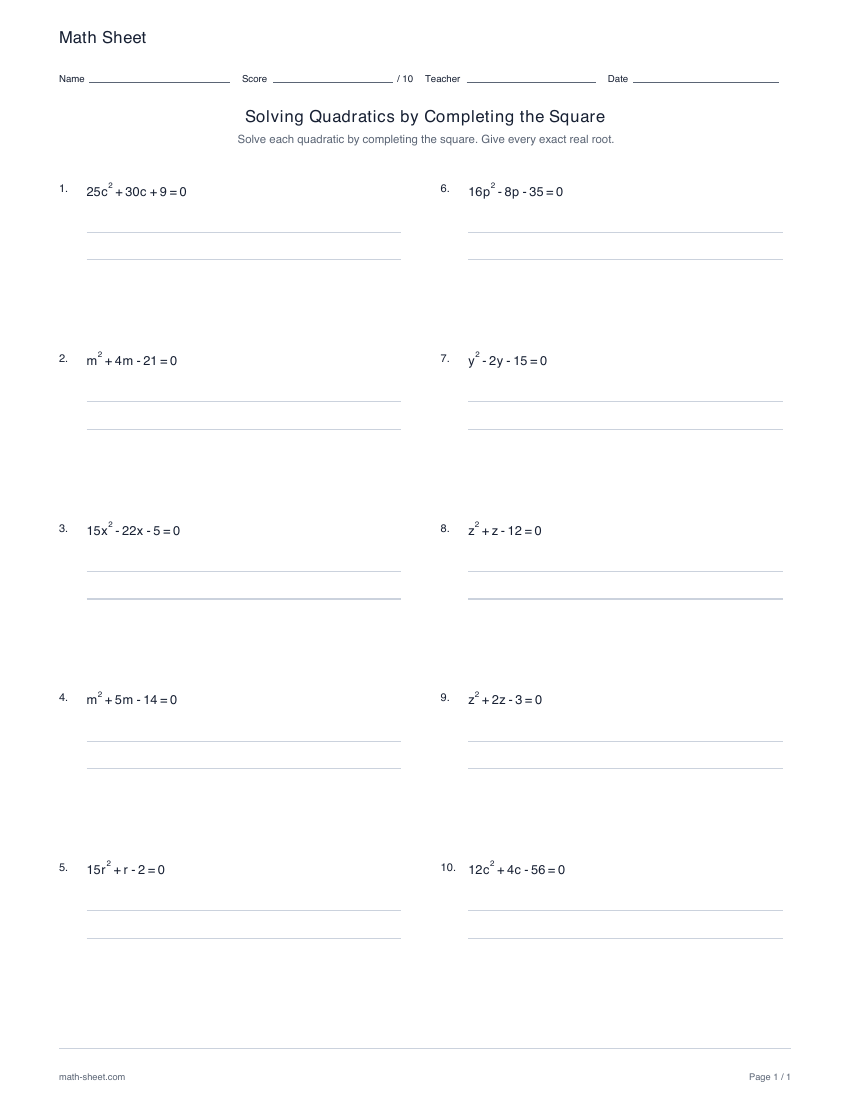
Equations
Solve ten quadratic equations by completing the square. Choose easy, hard or mixed equations and rational-only answers or exact radical roots.
Preview and download
Equations
Solve ten factorable quadratic equations with complete exact root sets. Choose factored form, expanded form, rearrangement practice or a balanced mixed sheet.
Preview and download