
Systems of equations
Systems of equations methods handout
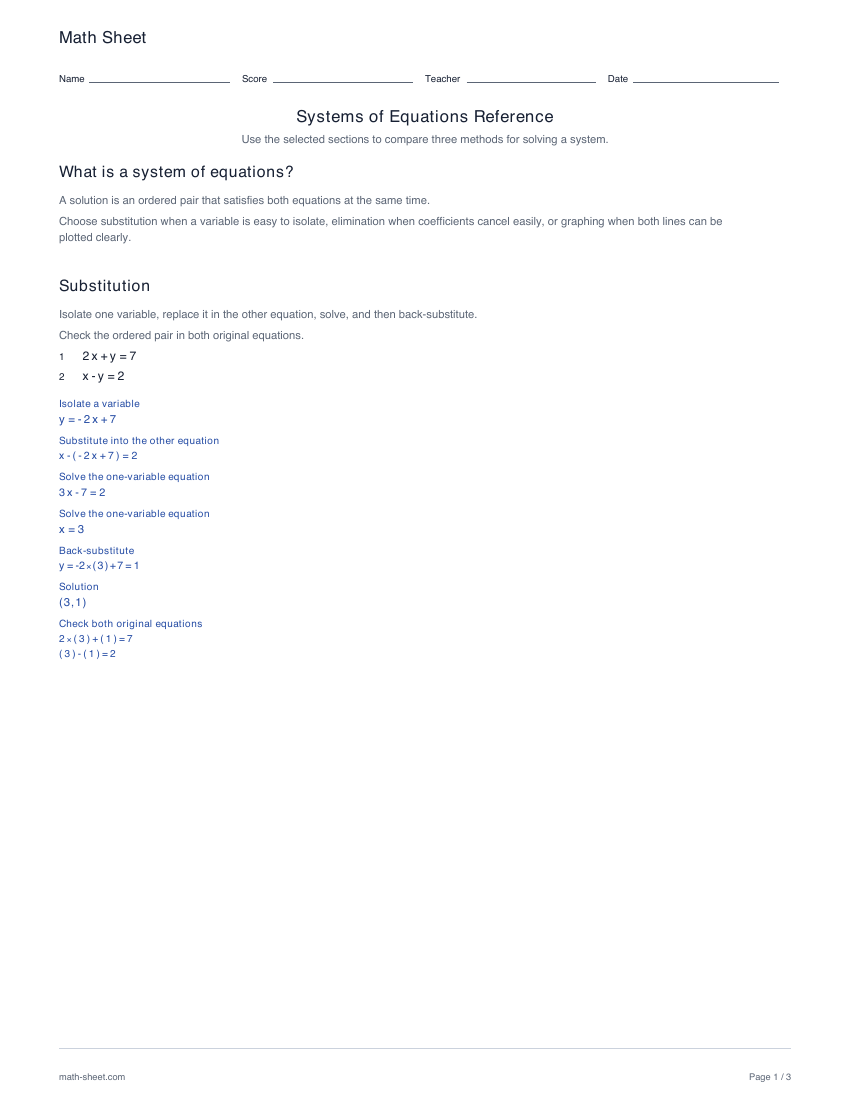
Compare substitution, elimination and graphing in an original printable guide. Choose the methods to include and follow worked examples that check both equations.
Preview and downloadTwo statements. Find what they share.
Connect algebra with graphs. Solve two equations for a shared point, or graph two inequalities and shade the common solution region.
Choose a worksheetA solution passes both checks
Try the point (3, 1)
Find the shared solution
See why one point must satisfy both equations. Read an original guide to substitution, elimination and graphing, with a worked example for each selected method.
Systems of equations
Compare substitution, elimination and graphing in an original printable guide. Choose the methods to include and follow worked examples that check both equations.
Preview and downloadFind the shared solution
Work algebraically, graph equations, or shade the common region of two inequalities. Each practice worksheet has a separate answer edition built from the same questions.
Systems of equations
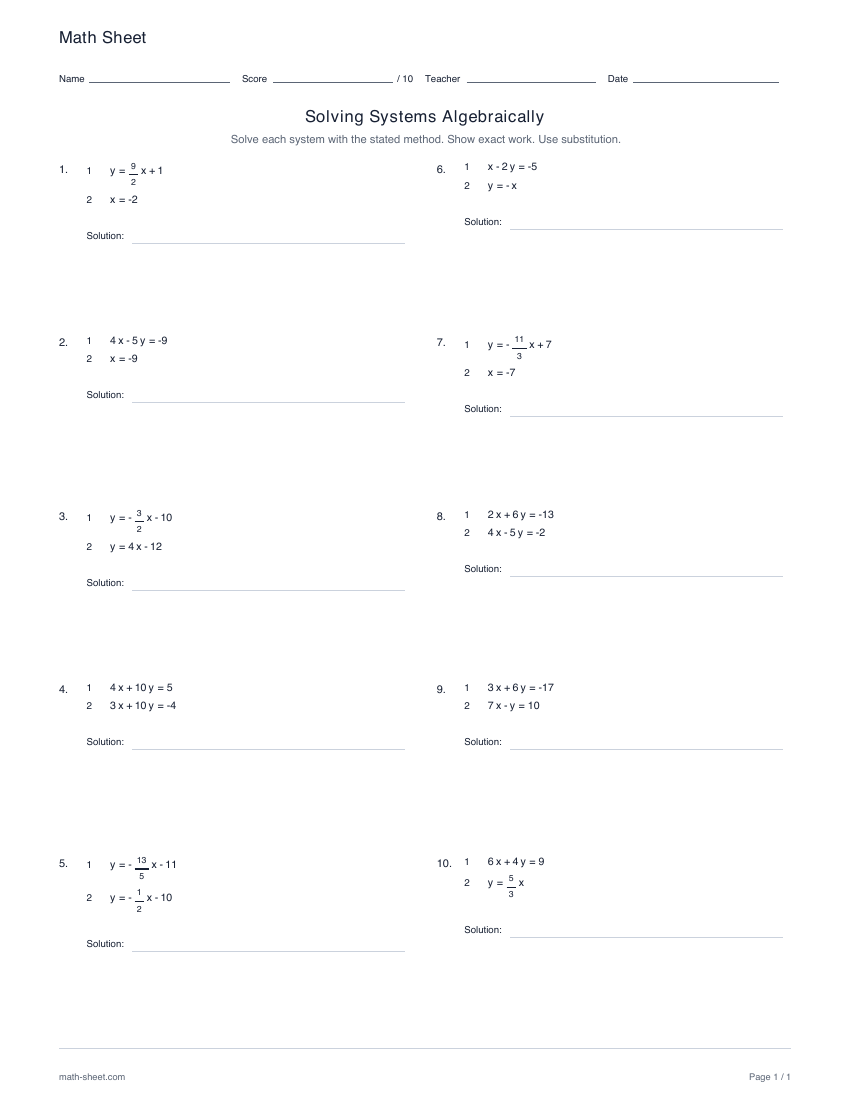
Solve ten two-variable systems using substitution, elimination or any method. Choose four equation-pair structures and download exact, step-by-step answer keys.
Preview and download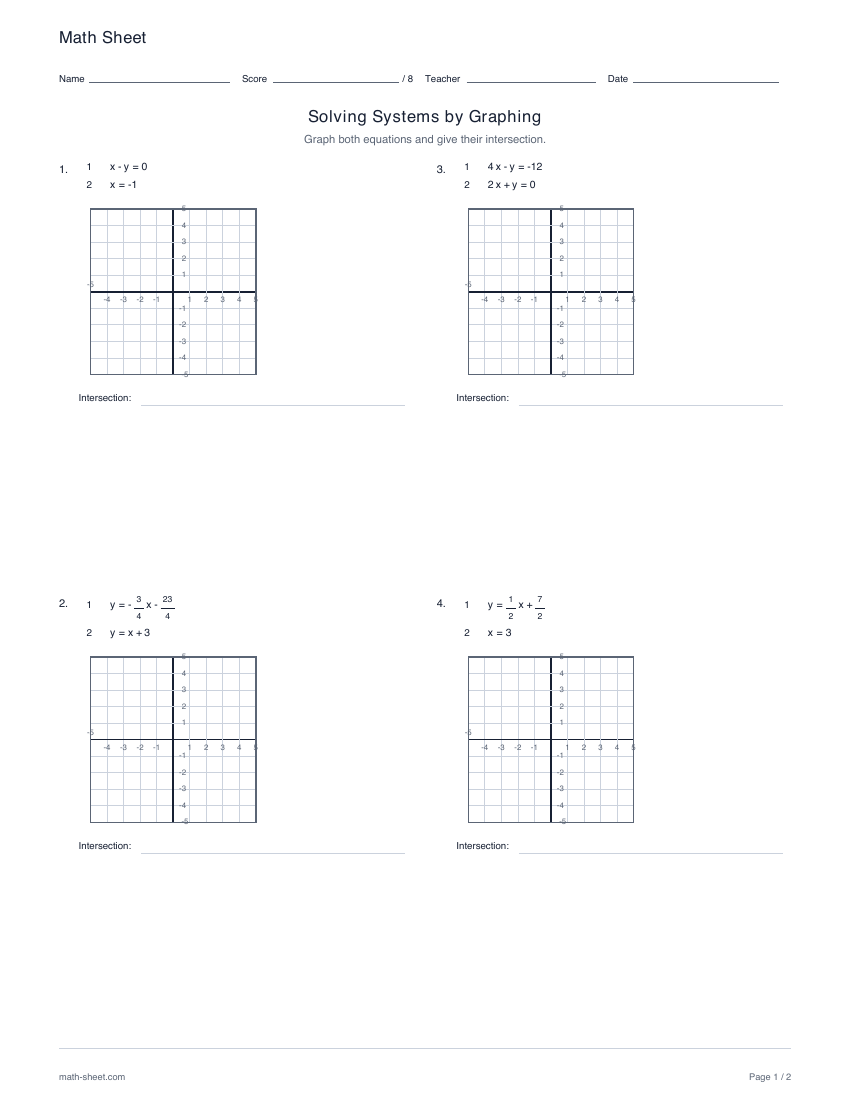
Systems of equations
Graph eight pairs of linear equations on blank coordinate grids. Choose equation forms, locate each intersection and check a separate key with both lines and the exact solution.
Preview and download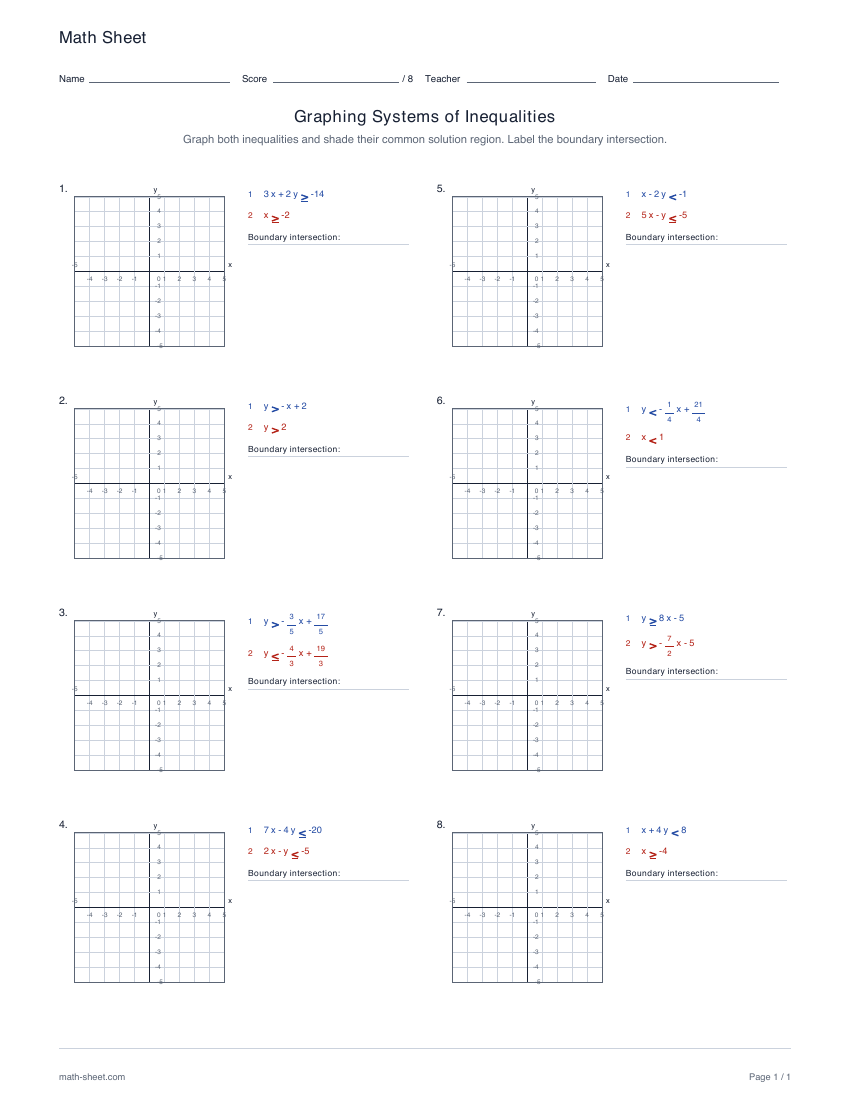
Systems of equations
Graph eight pairs of linear inequalities, distinguish strict and inclusive boundaries, and shade each common solution region on a coordinate grid.
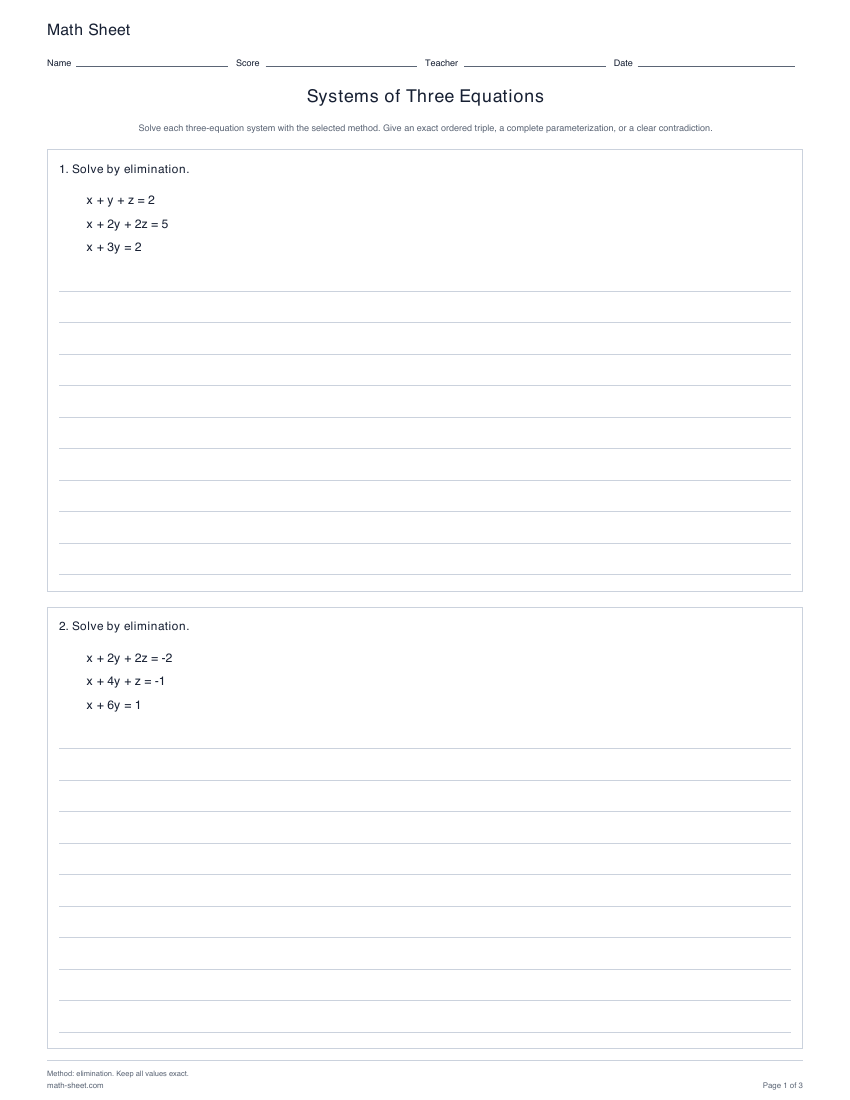
Preview and downloadThree variables
Practice exact elimination or recursive substitution across unique, dependent, and inconsistent systems.
Systems of equations
Solve three-variable linear systems by true elimination or substitution, including one solution, infinitely many solutions, and no solution.
Preview and downloadStart after single-variable equations and coordinate graphs are familiar. Keep the equation structure focused while learning a new method, then compare methods on mixed structures.
Compare substitution with the point where two lines meet. Use the worked reference after single equations and coordinate graphs are familiar.
Open this starting point →Pair a general equation with a simpler equation and use substitution. A simpler form can still lead to an exact fractional answer.
Open this starting point →Work with two standard-form equations. Scale complete equations, eliminate one variable, then check both coordinates.
Open this starting point →Graph a slope-intercept equation with a horizontal or vertical line. Find the shared point and verify its coordinates.
Open this starting point →Isolate a variable in one equation, then replace that variable in the other. A coefficient of 1 or −1 often makes a convenient starting point.
Scale the equations so one variable cancels when they are added. Multiply every term and the constant, then solve the remaining equation.
Draw both lines on the same axes. Their intersection is a shared solution. Check the coordinates algebraically when precision matters.
A system can have a fractional solution even when its equations contain whole-number coefficients. Carry exact fractions through the working and check both original equations before rounding for a separate application.
These practice sets use systems with one shared solution. More generally, distinct parallel lines have no shared solution and coincident lines have infinitely many. Those cases explain why it matters to consider both equations together.
Practice equivalent transformations, signed arithmetic and fractional coefficients before combining two equations.
Linear equation worksheets →Review standard form, slope-intercept form and accurate plotting on a coordinate plane.
Linear function worksheets →Connect expressions, equations, inequalities and graphs with this next algebraic step.
Pre-algebra sequence →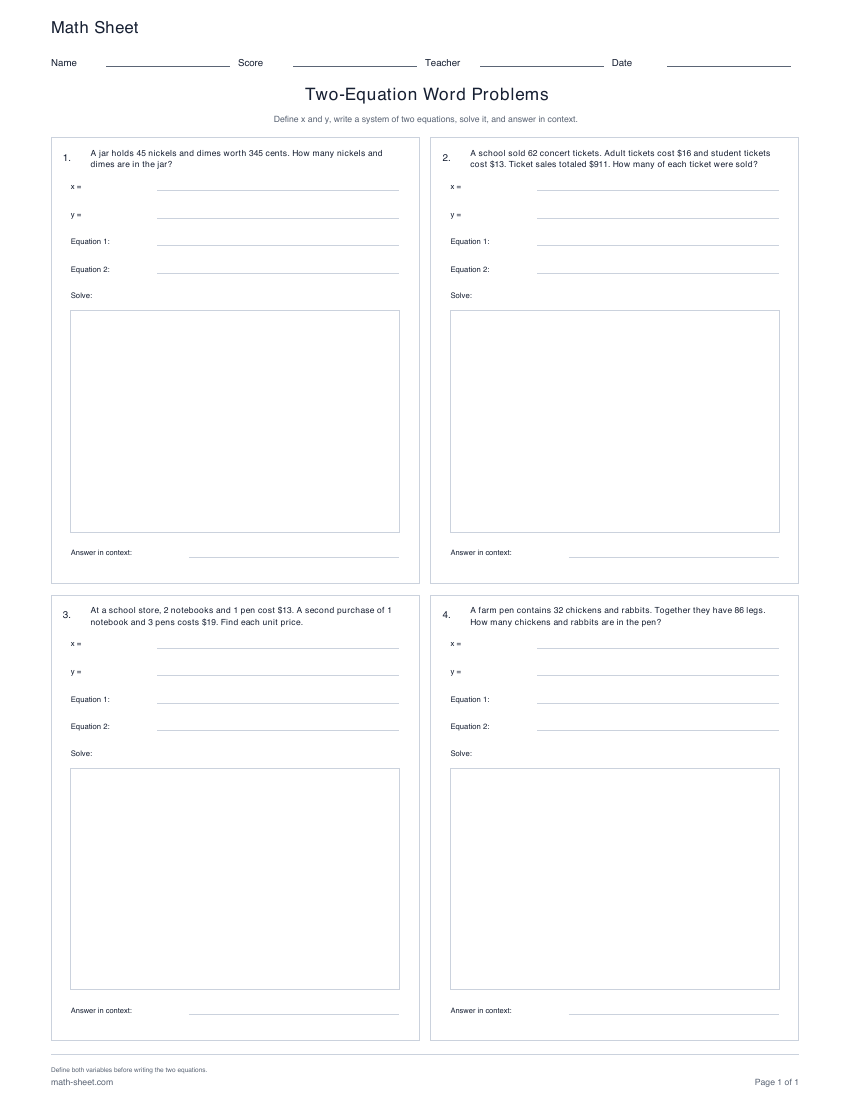
Algebra 2
Build and solve systems of two equations from printable stories, with variable-definition lines and worked contextual answers.
Preview and download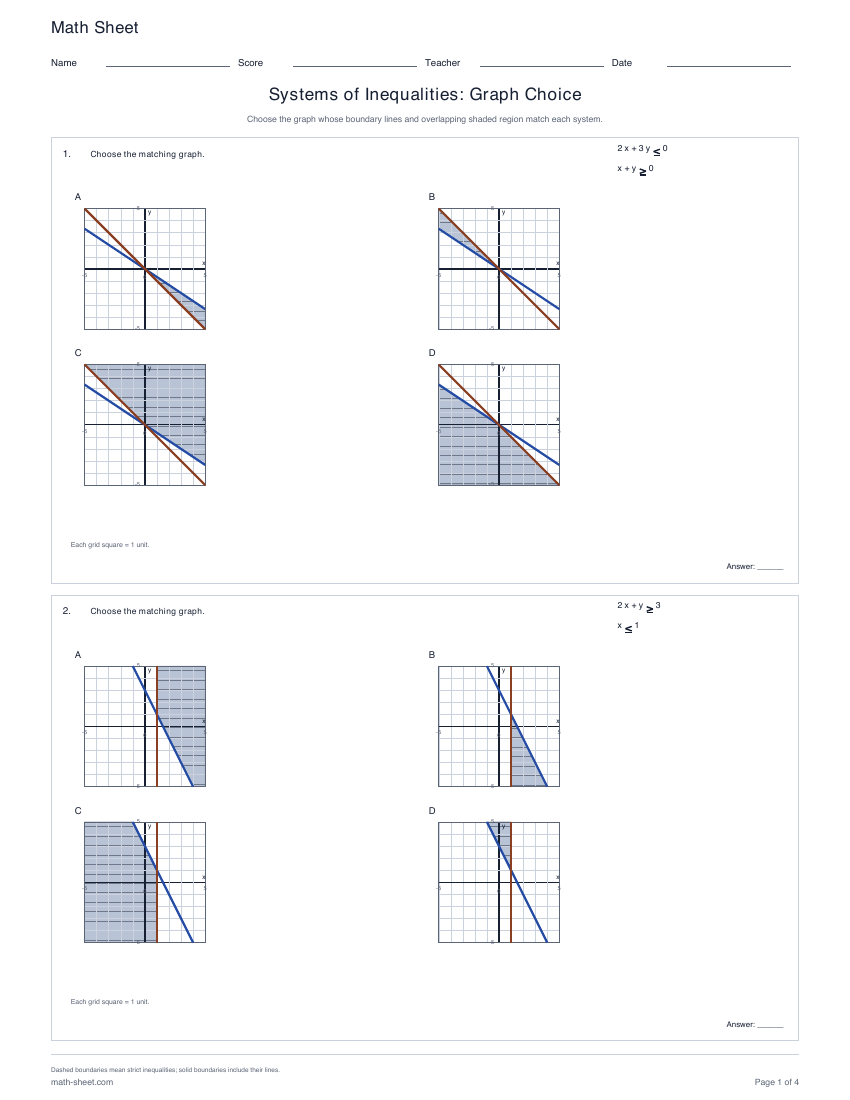
Algebra 2
Choose the correct printed solution graph for a system of inequalities, with selectable forms and two problems per page.
Preview and download