Fixed English ready-made files. Custom settings below apply only to the configured PDF.
Ready to print
Start with a ready-made worksheet
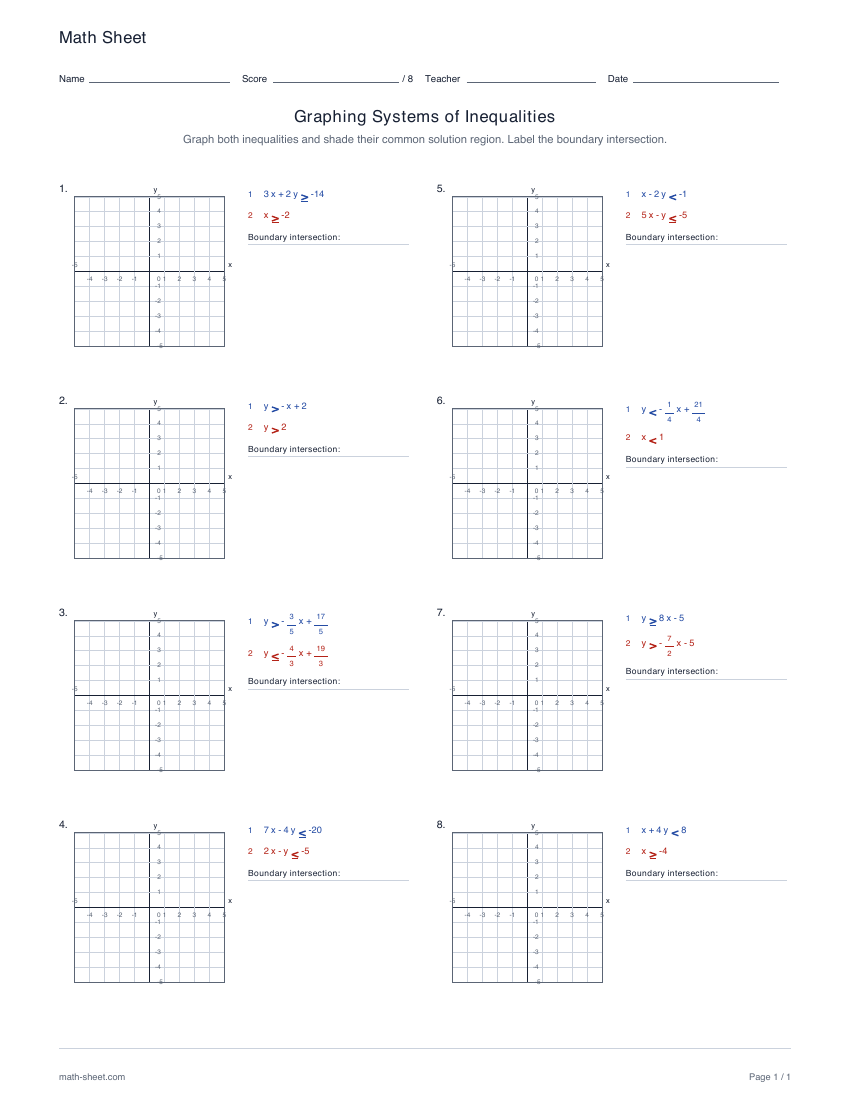
Graph both boundaries, choose the correct side of each line and shade only the common region. Label the boundary intersection and note whether it is included.
Download the practice pages alone, or include a separate answer key or teacher model. Longer activities may use more than one page.
Graph each boundary, use a dashed line for a strict inequality and a solid line when equality is included, then shade only the overlap. The boundary intersection is labeled separately because the full solution is a region.
Check a point inside the proposed overlap in both original inequalities. A strict boundary can make the boundary intersection itself excluded.
Learning objective
What this activity builds
Graph two linear inequalities and identify the points that satisfy both statements.
Worked example
Graph y ≤ x + 1 and y > −x − 1. Does (0, 0) belong to the common region?
Yes. Shade above the dashed line y = −x − 1 and on or below the solid line y = x + 1.
At (0, 0), 0 ≤ 1 and 0 > −1, so the point satisfies both inequalities. The common region is the overlap of the two half-planes, not only the boundary intersection.
Teaching notes
Make the practice count
Draw and label both boundary lines before shading.
Use a test point away from a boundary to choose each half-plane.
Keep strict boundaries dashed and inclusive boundaries solid.
Check the final overlap with a point inside the shaded region.
Make it yours
Customize the practice
Choose your options, update the preview, then download the exact same pages.
Choose boundary forms. Student grids stay blank; answer editions show the exact common region, boundary styles and boundary intersection.
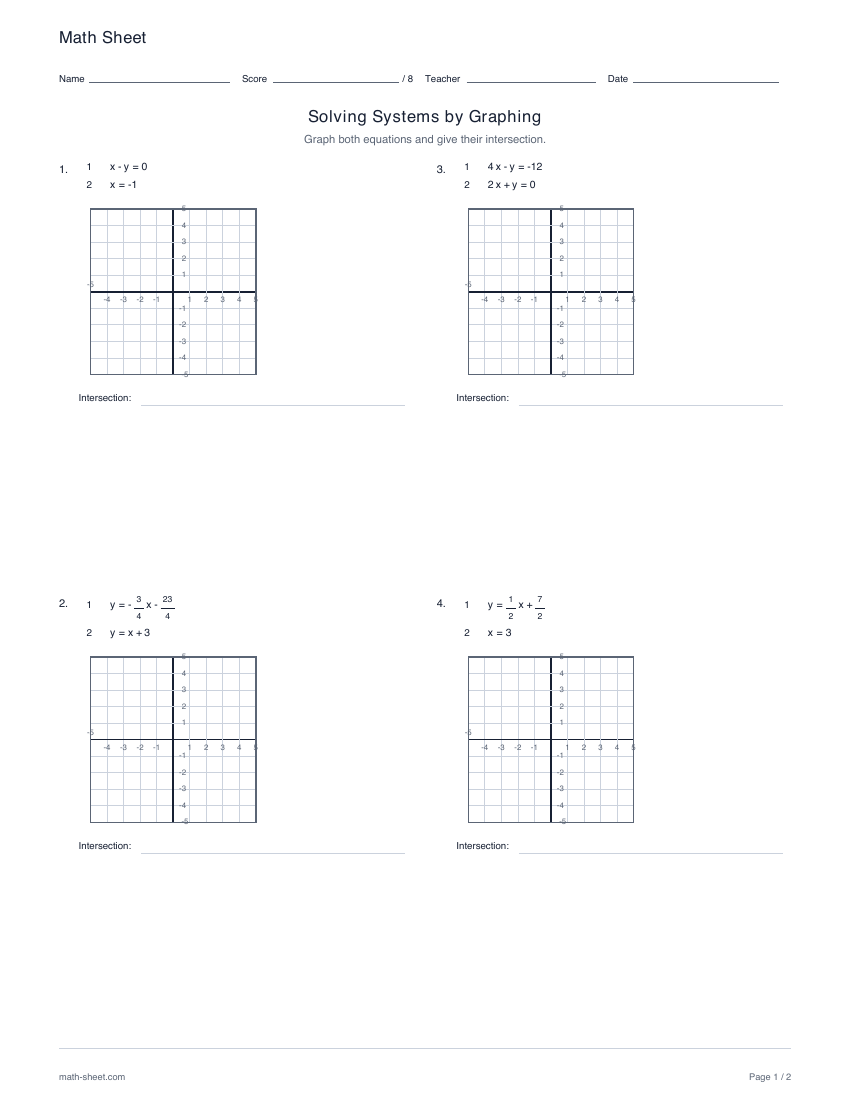
Graph eight pairs of linear equations on blank coordinate grids. Choose equation forms, locate each intersection and check a separate key with both lines and the exact solution.
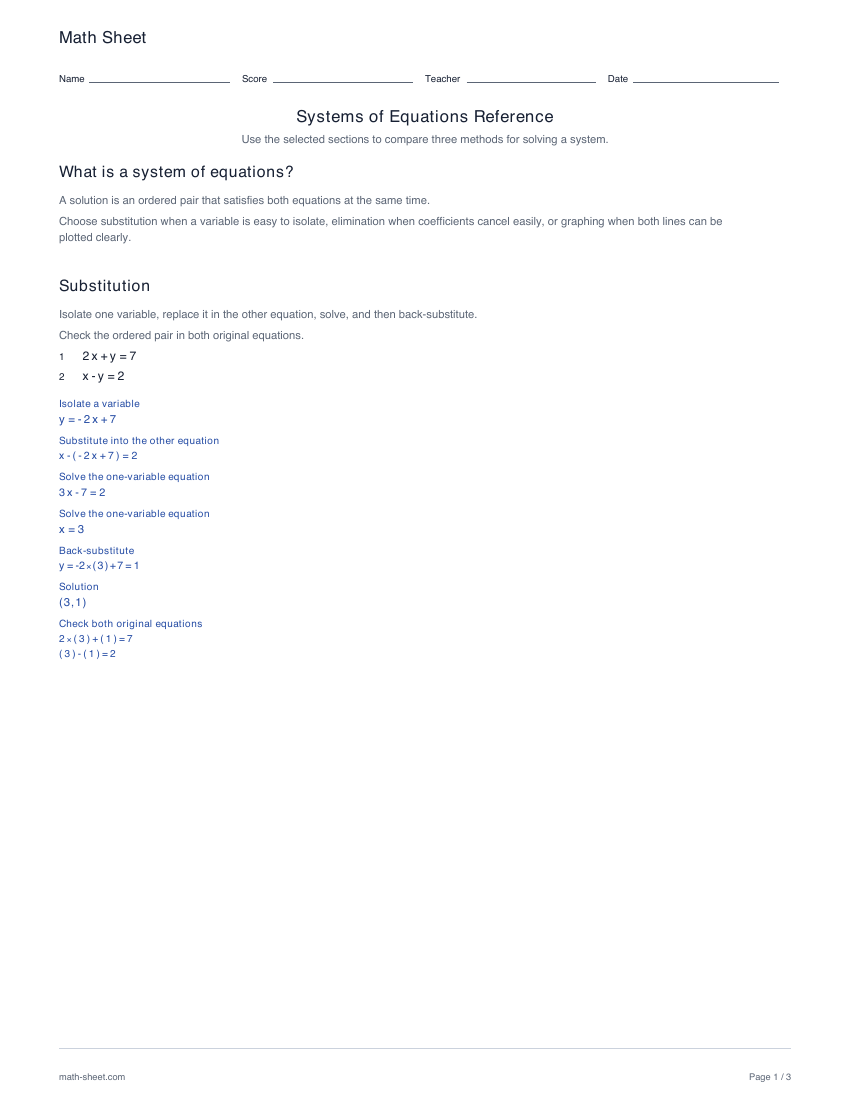
Compare substitution, elimination and graphing in an original printable guide. Choose the methods to include and follow worked examples that check both equations.