
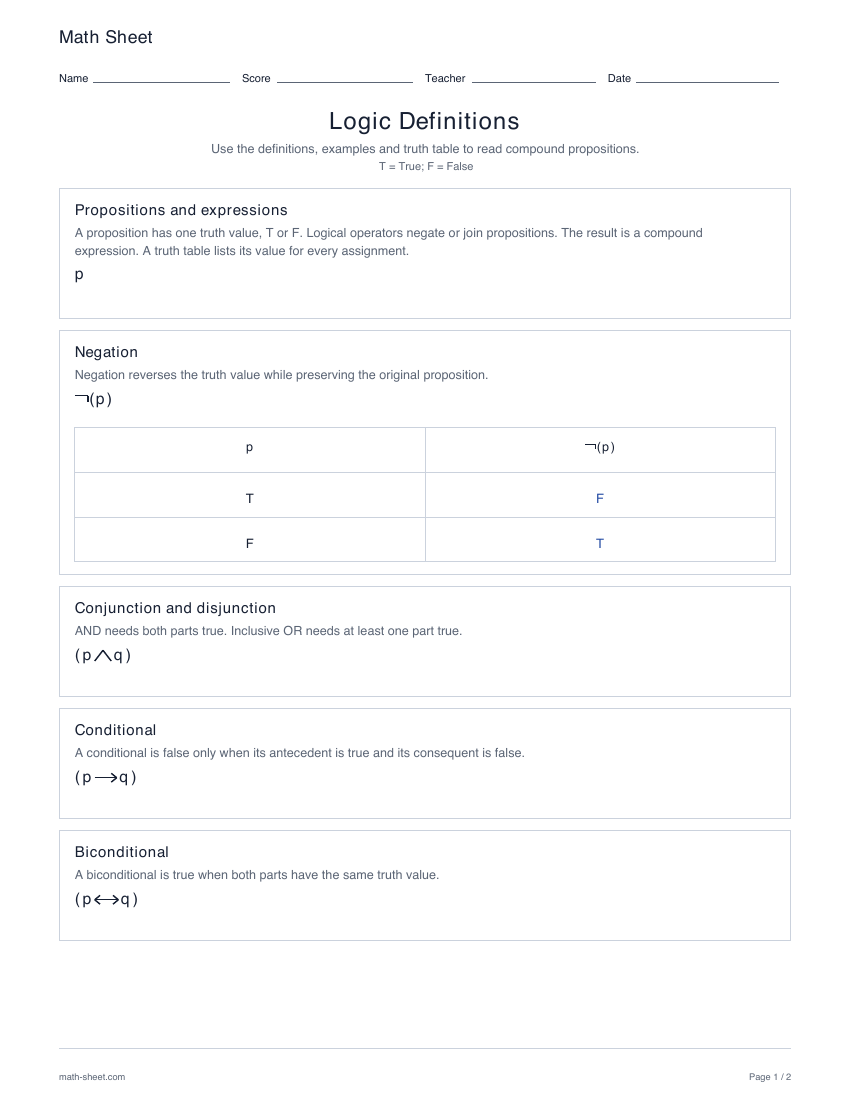
Logic
Logic definitions reference sheet
Introduce propositions, logical operators, compound expressions and truth tables with a printable reference. Use clear examples before starting symbolic logic practice.
Preview and downloadRead a statement. Check every case.
Build from true and false statements to truth tables and valid deductions. Keep a reference nearby, choose a focused practice set and print a separate answer key when you need it.
Choose a logic resourceSame inputs. Different rules.
| p | q | AND | OR | p → q | XOR |
|---|---|---|---|---|---|
| T | T | T | T | T | F |
| T | F | F | T | F | T |
| F | T | F | T | T | T |
| F | F | F | F | T | F |
Build the next skill
Keep the definitions and truth conditions visible while learning a new connective. These three references have fixed content.
Logic
Introduce propositions, logical operators, compound expressions and truth tables with a printable reference. Use clear examples before starting symbolic logic practice.
Preview and download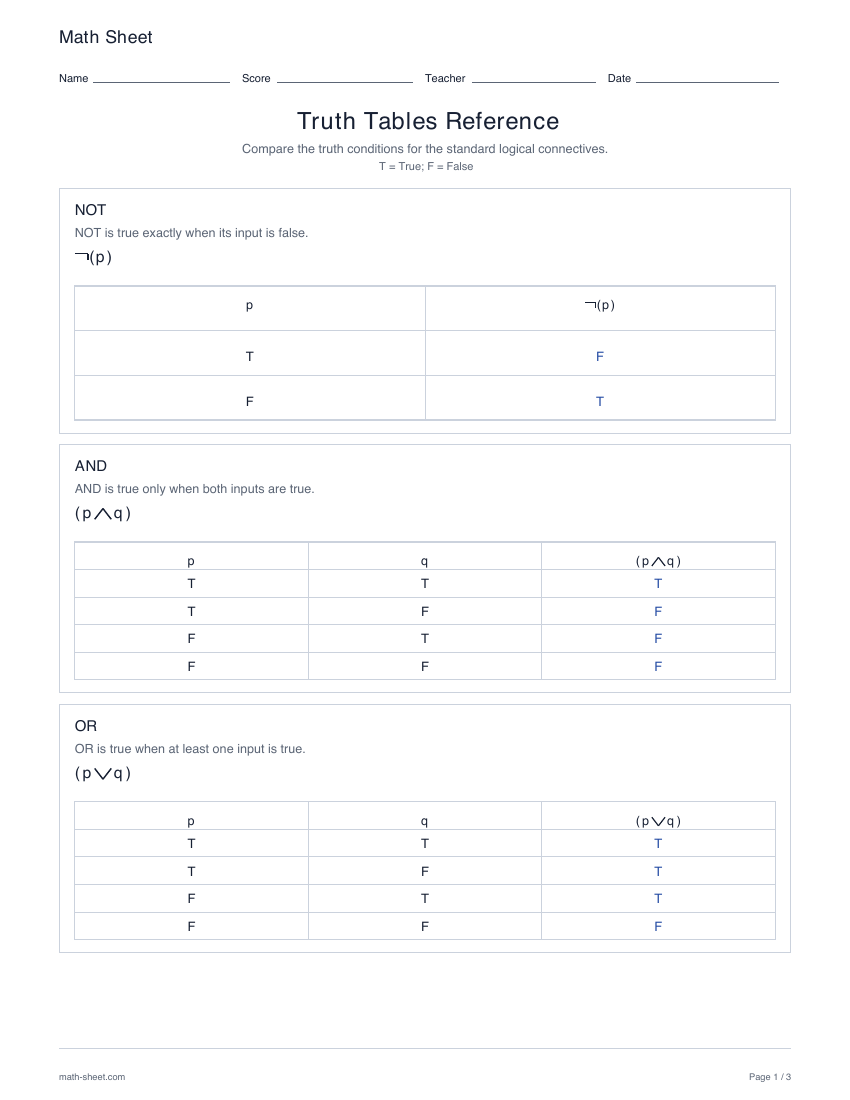
Logic
Print truth tables for NOT, AND, OR, conditional, biconditional and exclusive OR. Compare their truth conditions in individual tables and a combined reference.
Preview and download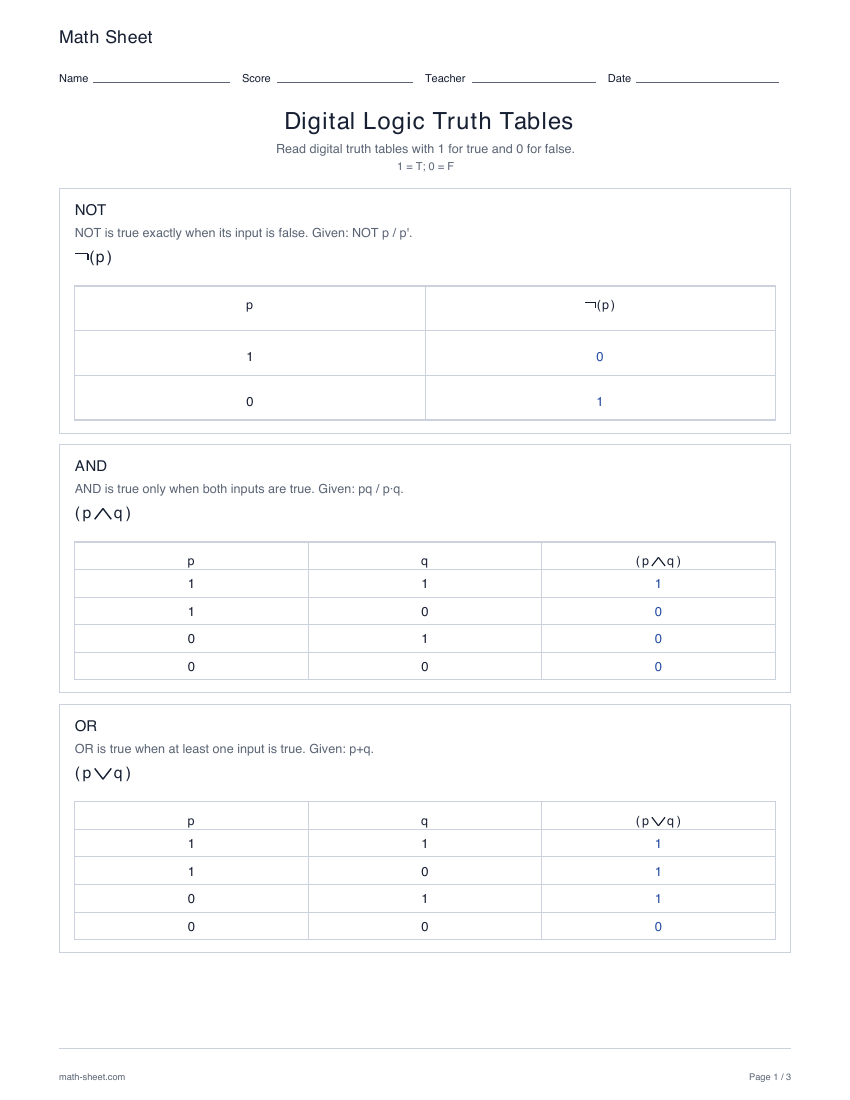
Logic
Explore NOT, AND, OR, NAND, NOR and XOR using 1 and 0. Print individual digital truth tables, a combined comparison and common Boolean notation aliases.
Preview and downloadBuild the next skill
Complete a supplied table, construct one independently, then connect verbal statements with several result columns.
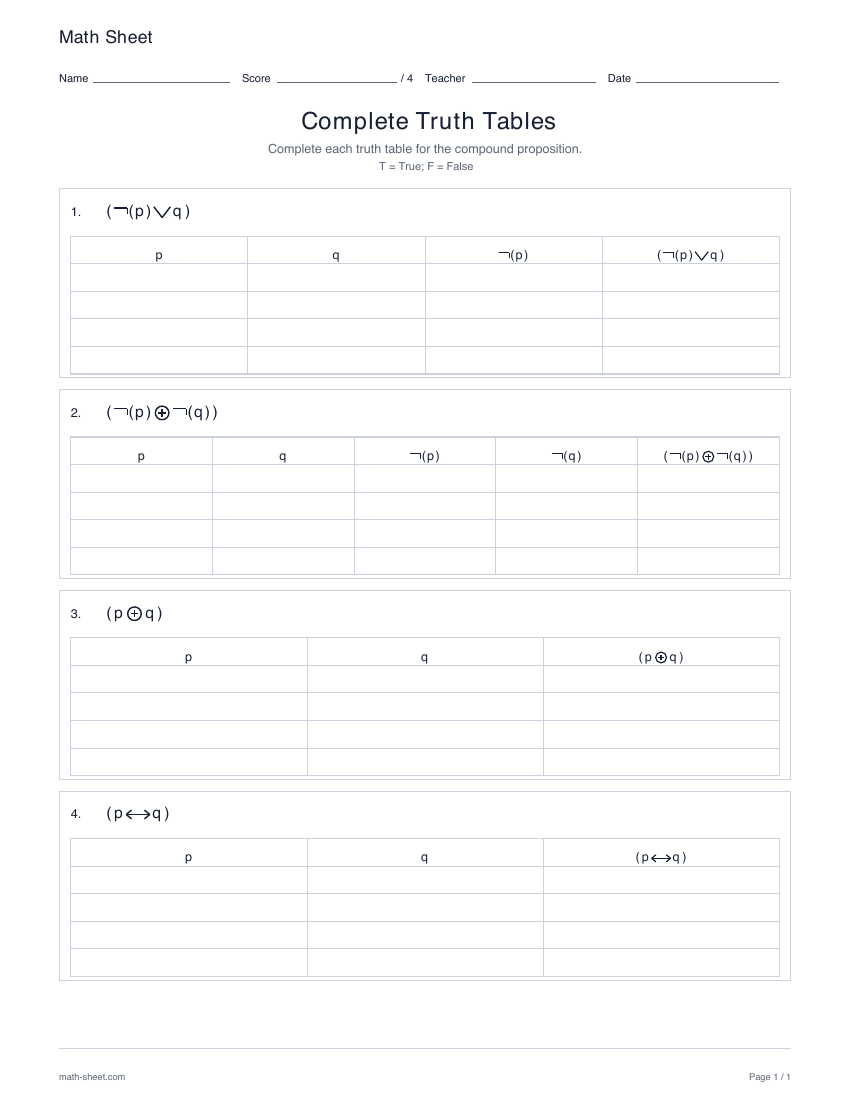
Logic
Generate four truth tables with AND, OR, conditional, biconditional or exclusive OR. Choose negated atoms and fill either every cell or only the result column.
Preview and download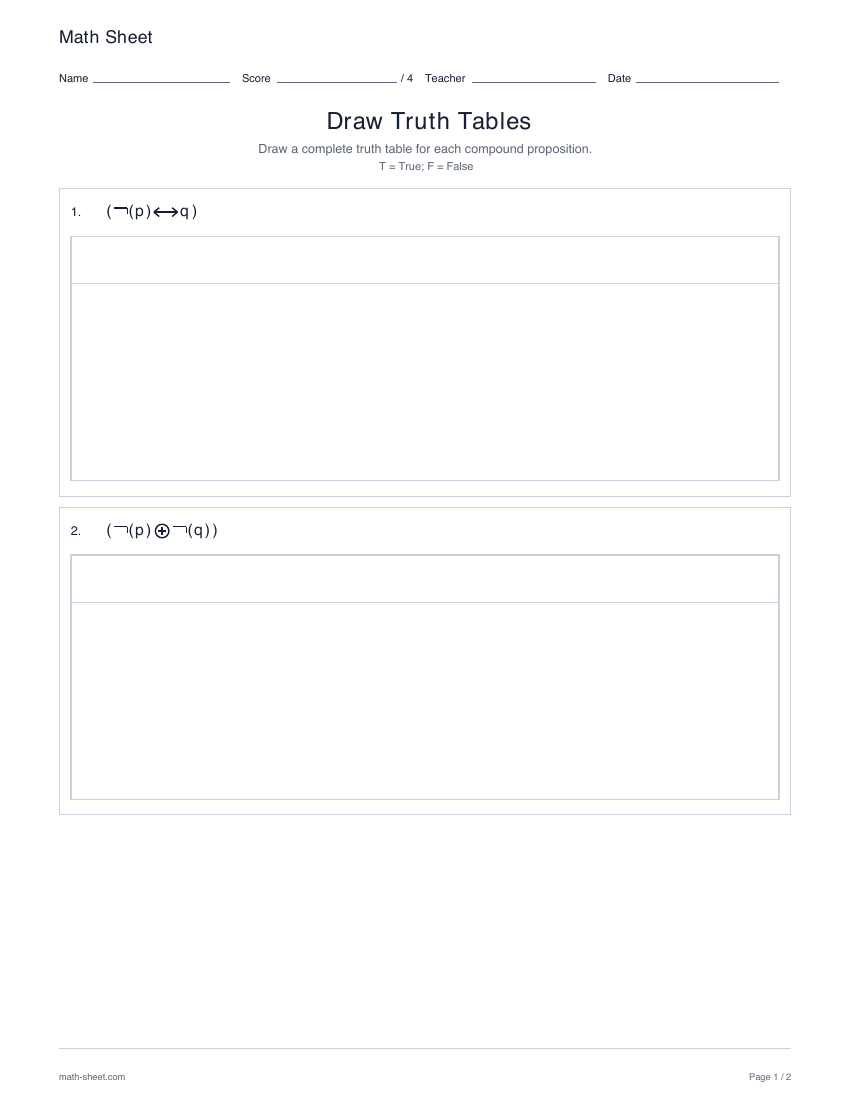
Logic
Build four truth tables from their expressions, with open space to plan columns and rows. Select operators and negations, then compare your construction with the complete answer tables.
Preview and download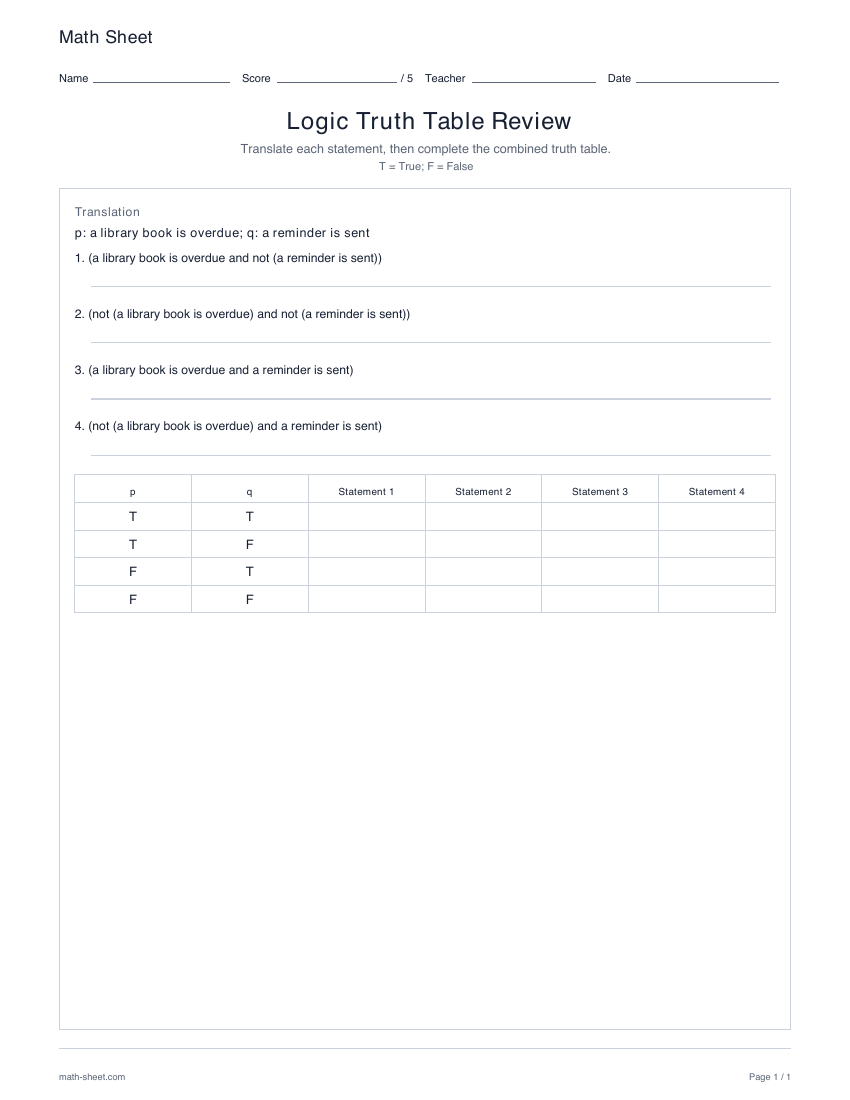
Logic
Translate four verbal statements into expressions and complete one combined truth table. Choose an operator and practice every combination of negated and unnegated atoms.
Preview and downloadBuild the next skill
Evaluate grouped statements using numerical facts. Then draw a conclusion from two given premises.
Logic
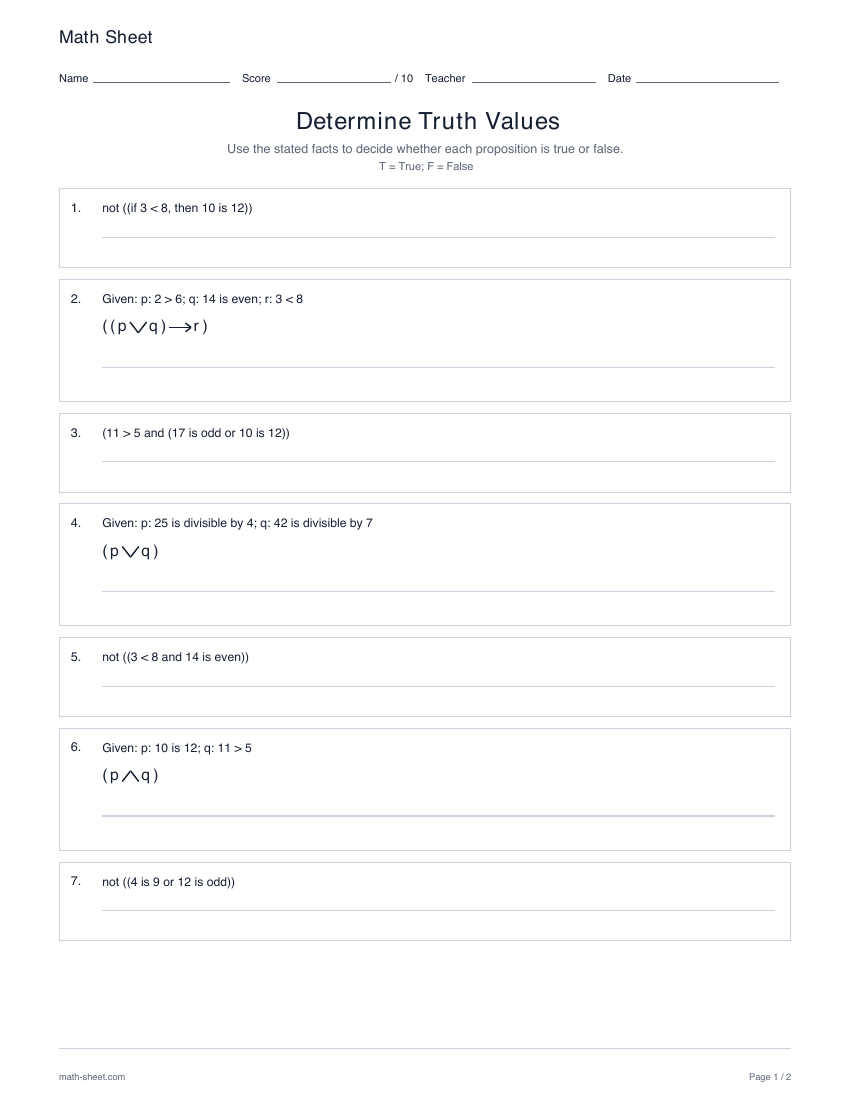
Practice ten true-or-false logic questions using verifiable numerical facts. Choose simple compounds, whole-statement negation or three-proposition expressions in words, symbols or both.
Preview and download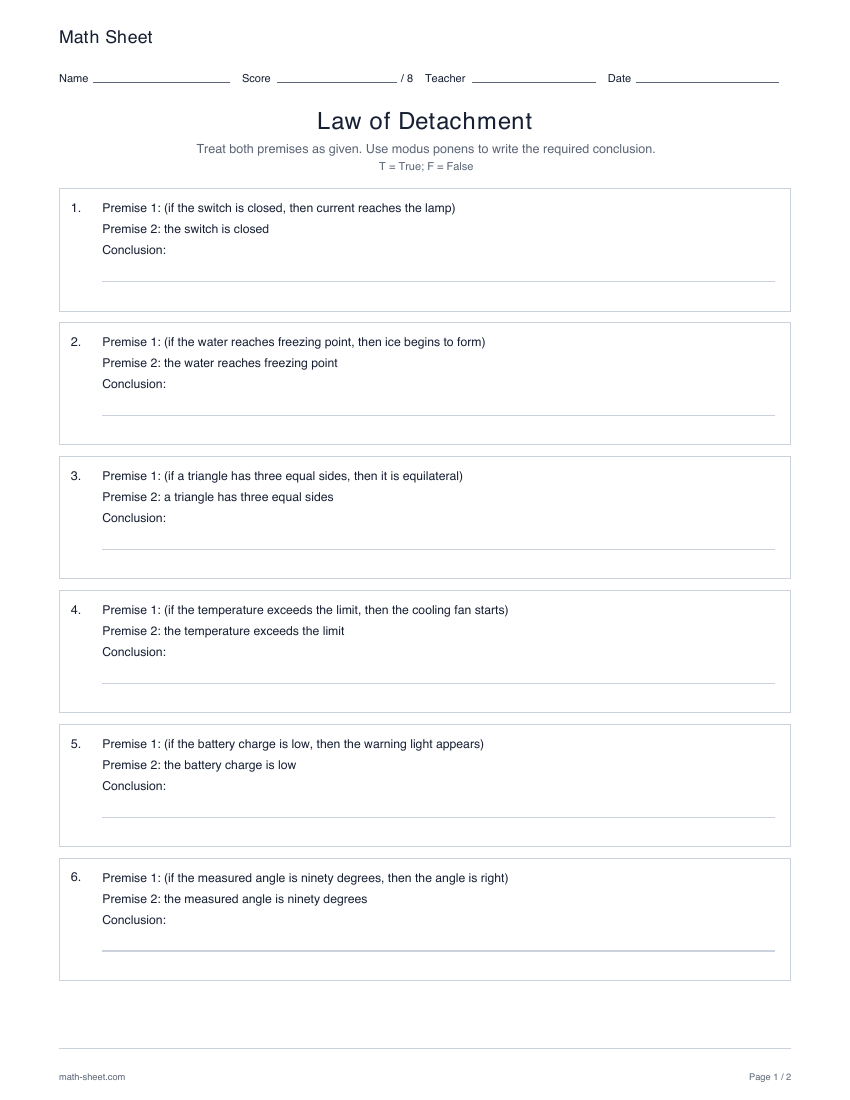
Logic
Use two given premises to draw a valid conclusion in eight original scenarios. Practice the law of detachment, also called modus ponens, with a separate answer key.
Preview and downloadChange one challenge at a time: the operator, a negated atom, the amount of table structure or the number of propositions. These links open focused settings in the same worksheet studio.
Keep input values visible and fill just the final column. No negated atoms yet.
Open this starting point →Organize every row and follow the change to one atom.
Open this starting point →Plan your own columns and compare conditional with biconditional.
Open this starting point →Check simple numerical facts before combining their truth values.
Open this starting point →Keep the grouping intact as you move between words and symbols.
Open this starting point →Evaluate nested parts in order before finding the final truth value.
Open this starting point →Translate either-but-not-both statements with all four negation combinations.
Open this starting point →Is this statement true? In truth-value practice, check the particular numerical facts and combine their truth values. There is one actual assignment to evaluate.
When is this expression true? A truth table lists every possible assignment. For p and q, that means four rows, even if the statement happens to be true in only one of them.
What follows from these premises? In law-of-detachment practice, a conditional and its hypothesis are given. Use their structure to justify the conclusion.
Negate one atom
Reverse p first, then combine that value with q.
For p = F and q = T: T AND T gives T.
Negate the whole compound
Evaluate the conjunction first, then reverse its result.
For p = T and q = F: NOT (T AND F) gives T.
These expressions are not interchangeable. For p = T and q = F, the first is F while the second is T. Read the parentheses before calculating.
Begin with the definitions if propositions or operators are unfamiliar. Use the truth-table reference alongside result-only completion, then remove the supplied structure with Draw truth tables.
No. Inclusive OR is true when at least one input is true, including when both are true. Exclusive OR is true when exactly one input is true.
The formal truth table defines p → q to fail only when p is true and q is false. A false hypothesis is not that failure case. Keep this convention separate from how an everyday promise might be interpreted.
One of p and q is negated, and the other is left unchanged. “Two” negates each atom once. The choice does not ask for double negation of the same atom.
The five practice resources offer separate answer pages. The three reference sheets contain fixed explanations and tables, so they have no separate key or random regeneration.
Custom printouts support English, German, Albanian, Spanish, Italian, French, Turkish and Norwegian Bokmål. Choose Letter or A4. Ready-made downloads are English.
Logic appears in different courses and at different ages across school systems. Choose by readiness: understanding statements, following grouping and explaining a reasoning step.
It can. Two propositions, one operator and no negation have only one expression structure. Repetition is useful for recall; add operators or negations when variety is the goal.
Compare AND with intersection and OR with union, while keeping statements distinct from sets.
Explore Venn diagrams →Apply digital logic independently to corresponding positions in fixed-width bit patterns.
Practice bitwise operations →Connect exact statement structure with mathematical language and checking solutions.
Explore the pre-algebra sequence →