
Venn diagrams
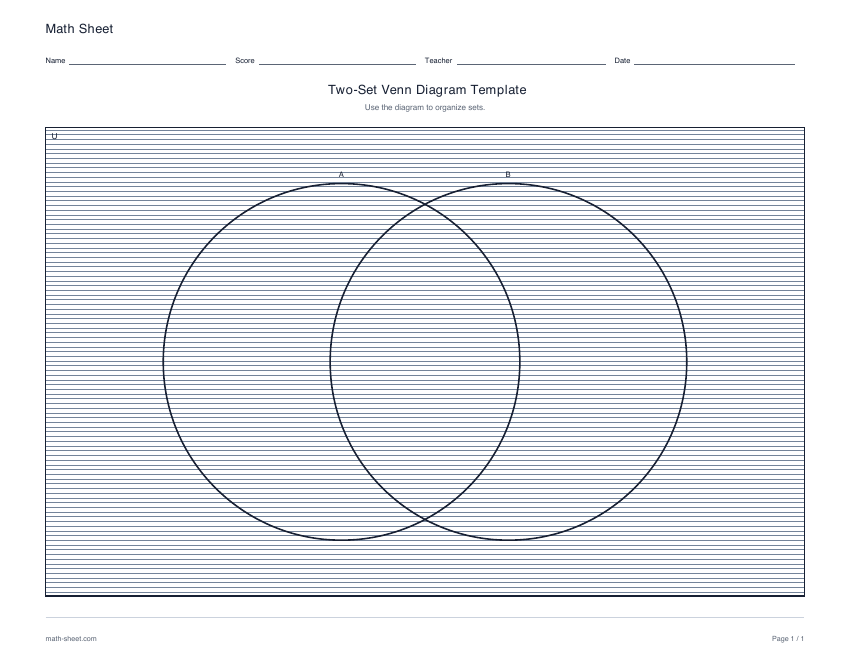
Two-set Venn diagram template
Print a large landscape Venn diagram with two overlapping circles and a universal-set frame. Choose blank regions or writing guides, in Letter or A4.
Preview and downloadSee how sets fit together
Sort by two or three rules, connect set notation with shaded regions, and count overlapping groups. Start with a blank template or choose a focused practice set with answers.
Choose a starting pointCount each learner once
From membership to meaning
Use a large landscape template for your own sorting rules, objects or examples. Choose two or three sets and optional writing guides.
Venn diagrams
Print a large landscape Venn diagram with two overlapping circles and a universal-set frame. Choose blank regions or writing guides, in Letter or A4.
Preview and download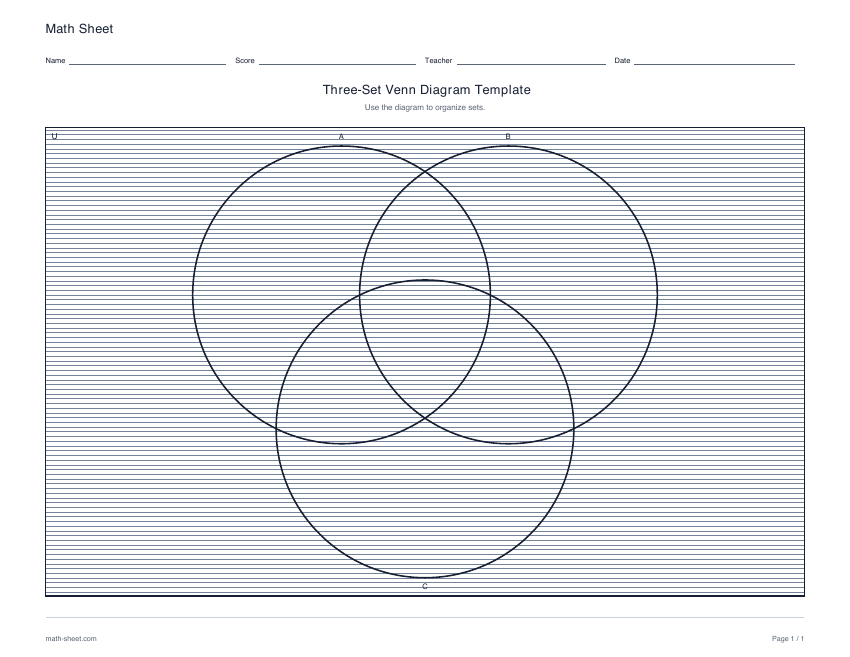
Venn diagrams
Download a landscape three-circle Venn diagram with room for all eight regions. Add writing guides or leave the template blank for your own lesson.
Preview and downloadFrom membership to meaning
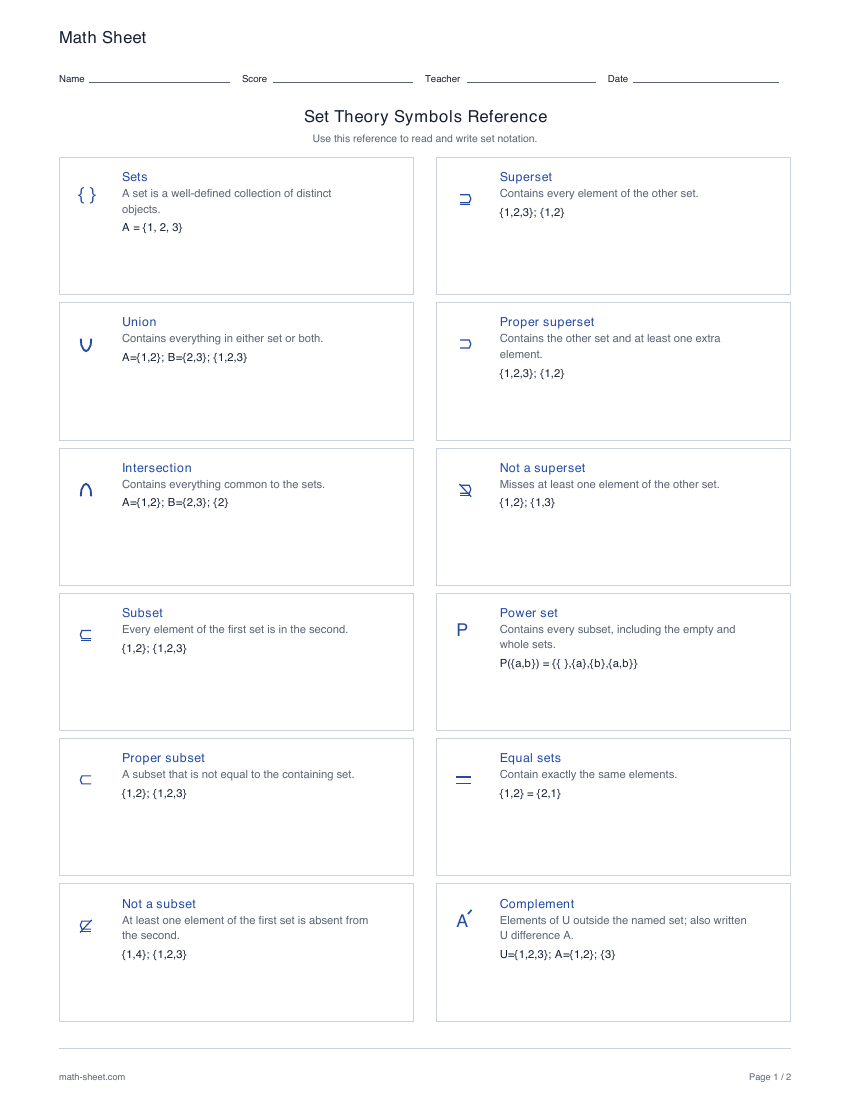
Keep definitions, membership rules and original examples beside the practice. The reference includes subset relations, complements, power sets and number sets.
Venn diagrams
Use an original printable reference to set notation, unions, intersections, complements, subset relations and number sets, with clear definitions and examples.
Preview and downloadFrom membership to meaning
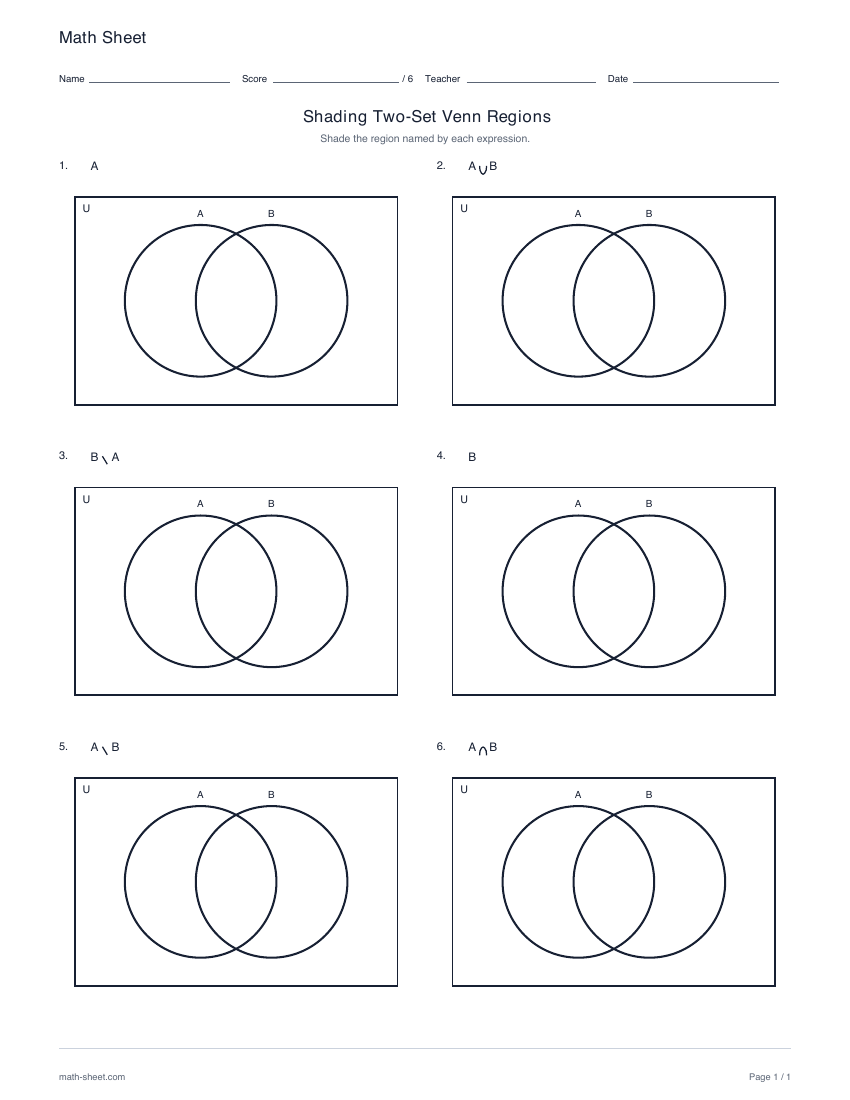
Read an expression and shade its result, or work backward from a shaded diagram to a valid expression. Begin with two sets before adding a third.
Venn diagrams
Shade two-set Venn diagrams from union, intersection, difference and complement expressions. Choose operation families and print a separate shaded answer key.
Preview and download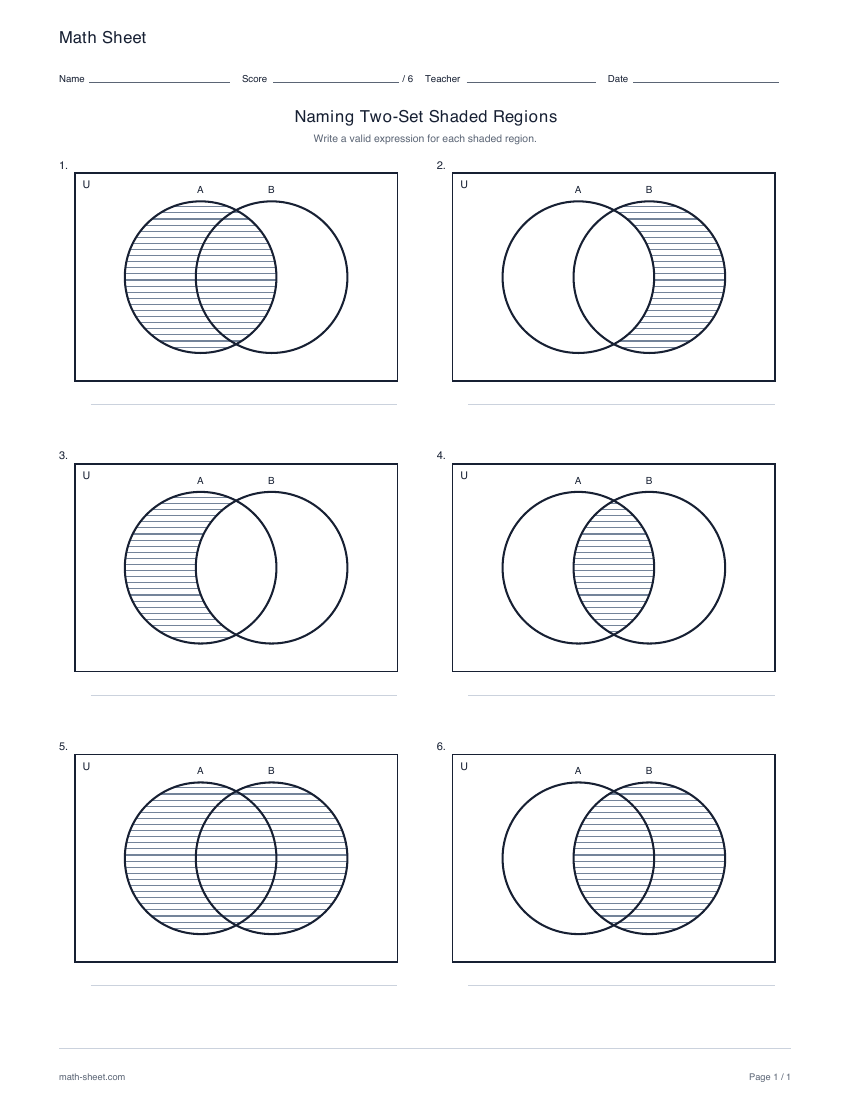
Venn diagrams
Write set notation for shaded two-circle diagrams. Select operation families and use an answer key that recognizes mathematically equivalent expressions.
Preview and download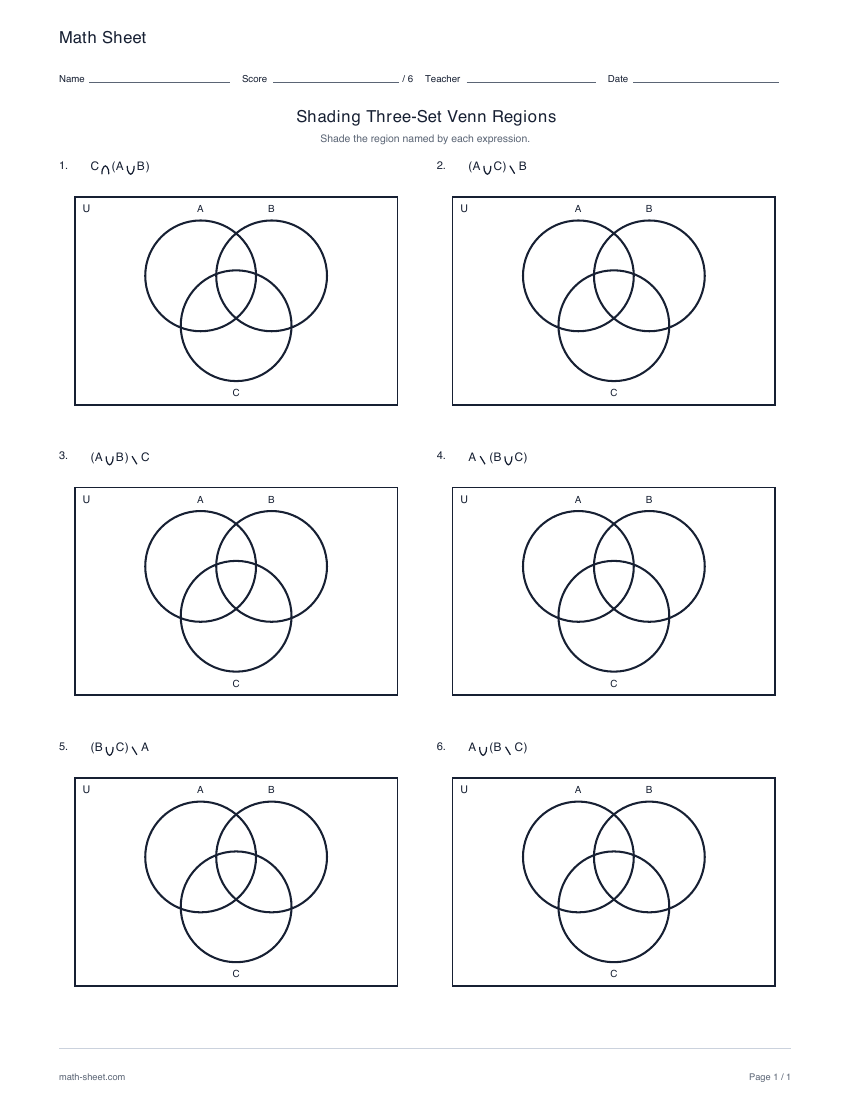
Venn diagrams
Practice nested three-set expressions, complements and disconnected regions. Print six diagrams with a separate key showing exactly which regions to shade.
Preview and download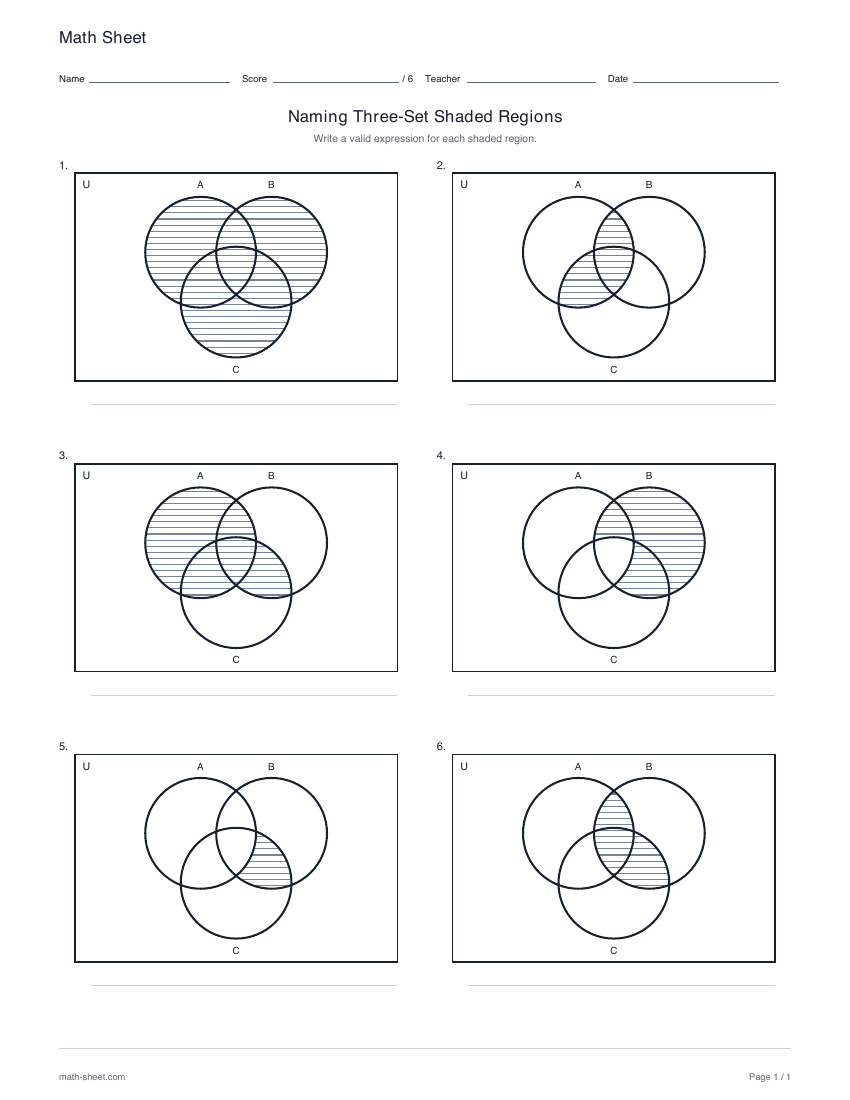
Venn diagrams
Describe shaded three-circle regions with compound set notation. Practice standard and complemented expressions with a separate answer key.
Preview and downloadFrom membership to meaning
Use populated diagrams to write roster-set answers or solve ten contextual counting questions. The answer key is a separate edition.
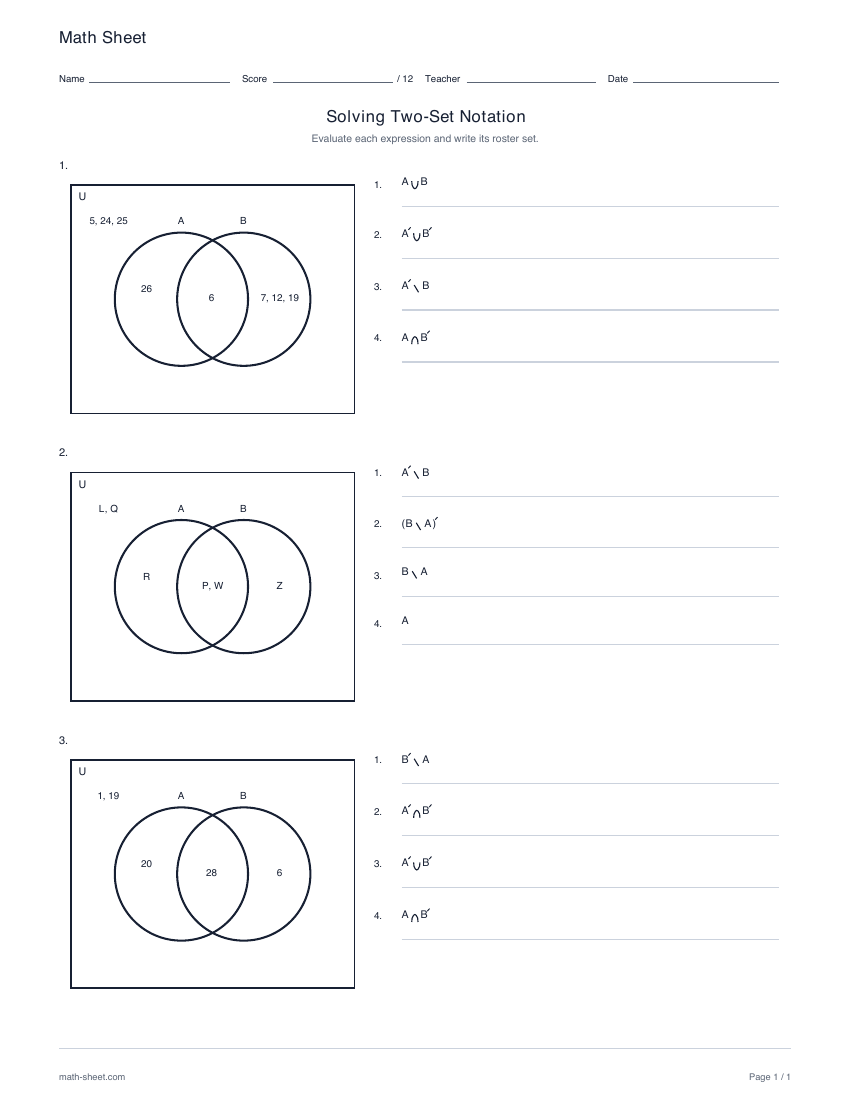
Venn diagrams
Find roster-set answers from three populated two-circle diagrams. Choose unions, intersections, differences, complements and whether empty answers are allowed.
Preview and download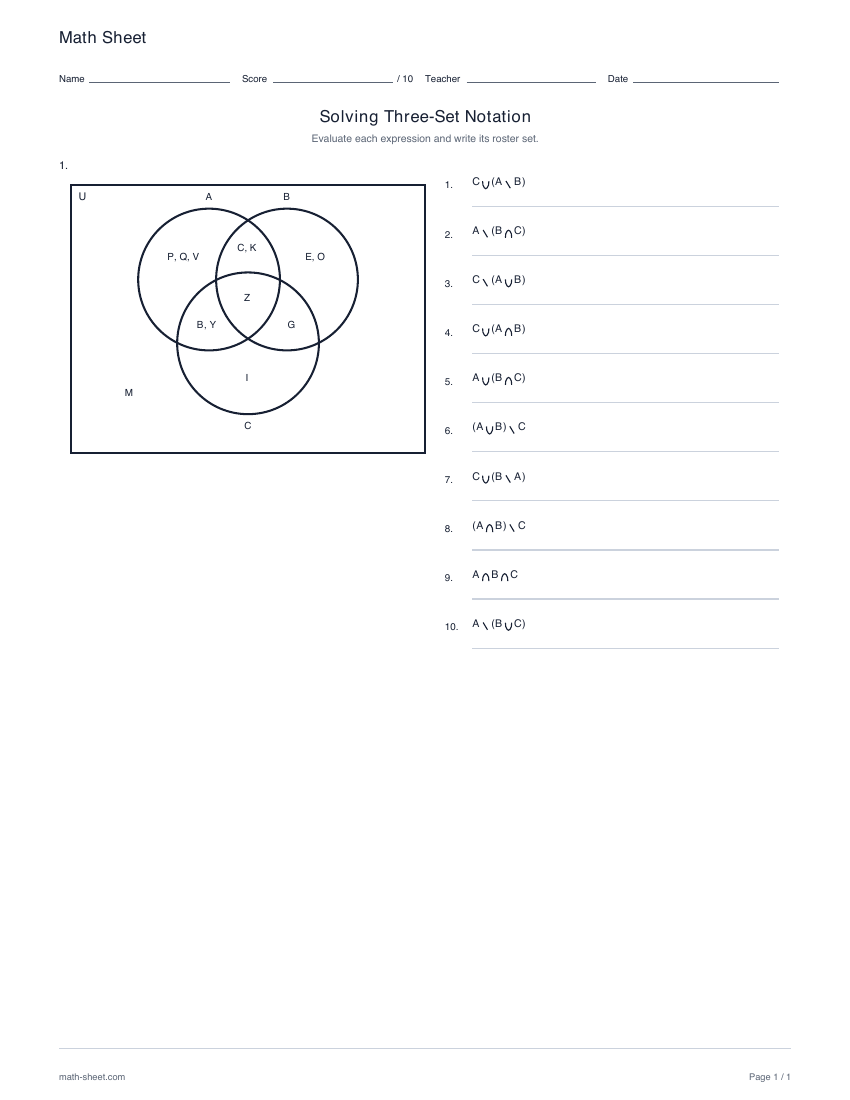
Venn diagrams
Evaluate ten compound expressions from one populated three-set diagram. Practice standard or complemented forms with exact roster-set answers.
Preview and download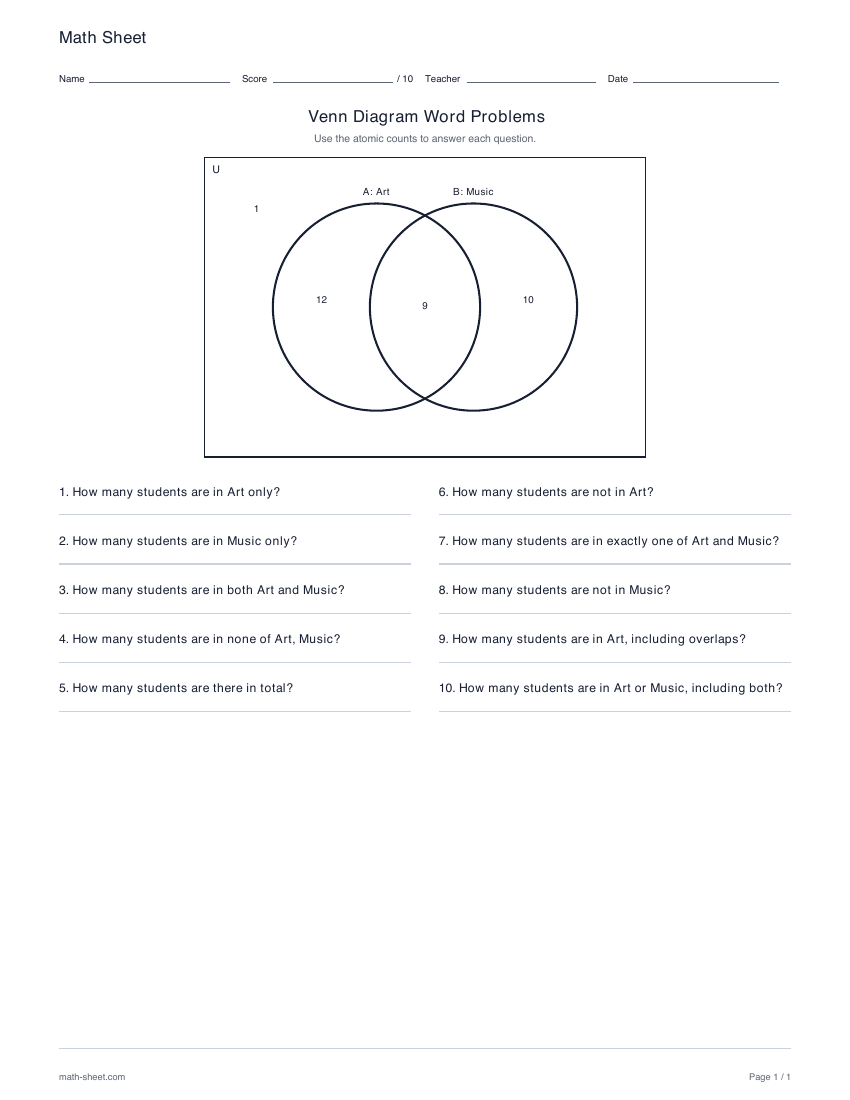
Venn diagrams
Answer ten counting questions from a two-set or three-set context diagram. Practice only, both, neither, totals and overlapping groups with a separate key.
Preview and downloadSorting by a rule comes before formal set notation. Move to three circles after the learner can explain the four regions of a two-set diagram, including the space outside both circles.
Choose two clear criteria and classify a small collection, including items that fit neither rule.
Open this starting point →Focus on unions and intersections before adding complements or relative differences.
Open this starting point →Allow empty answers and distinguish the empty set from a set containing the number zero.
Open this starting point →Practice nested complements and include the region outside all three sets when the expression requires it.
Open this starting point →Work with all eight regions and distinguish a pairwise intersection from its pair-only part.
Open this starting point →Include elements in A, in B, or in both. The mathematical “or” includes the overlap.
Include elements that belong to both A and B. In a three-set diagram, that can include the central region too.
Begin with A and remove its elements that are also in B. Reversing the order generally changes the result.
Include elements in the stated universe that are not in A. The rectangle tells you where the universe ends.
For shading, test each region against an expression. For roster problems, collect the elements in those regions. For word problems, add their counts. The same membership decisions support all three tasks.
Three overlapping circles divide the universe into eight regions: three single-set regions, three pair-only overlaps, the central triple overlap and the region outside every circle. Keep those separate when interpreting “only” and “both”.
Items that are in the universe but in none of the named sets. That region matters for neither questions and complements.
No. A ∩ B includes elements also in C. To exclude C, use (A ∩ B) ∖ C or say “A and B, but not C”.
Yes. A valid expression may select no displayed elements. Use the empty-set symbol or empty braces; {0} means a set containing zero.
Practice worksheets generate a new set with the same options. The blank templates and symbols reference have fixed content, so they have no New problems control or separate answer key.
Use set membership to describe an event before finding its probability.
Probability worksheets →Practice reading notation, applying definitions and checking each transformation.
Explore pre-algebra →Return to a blank template to build your own universe and explain every region.
Print a three-set template →