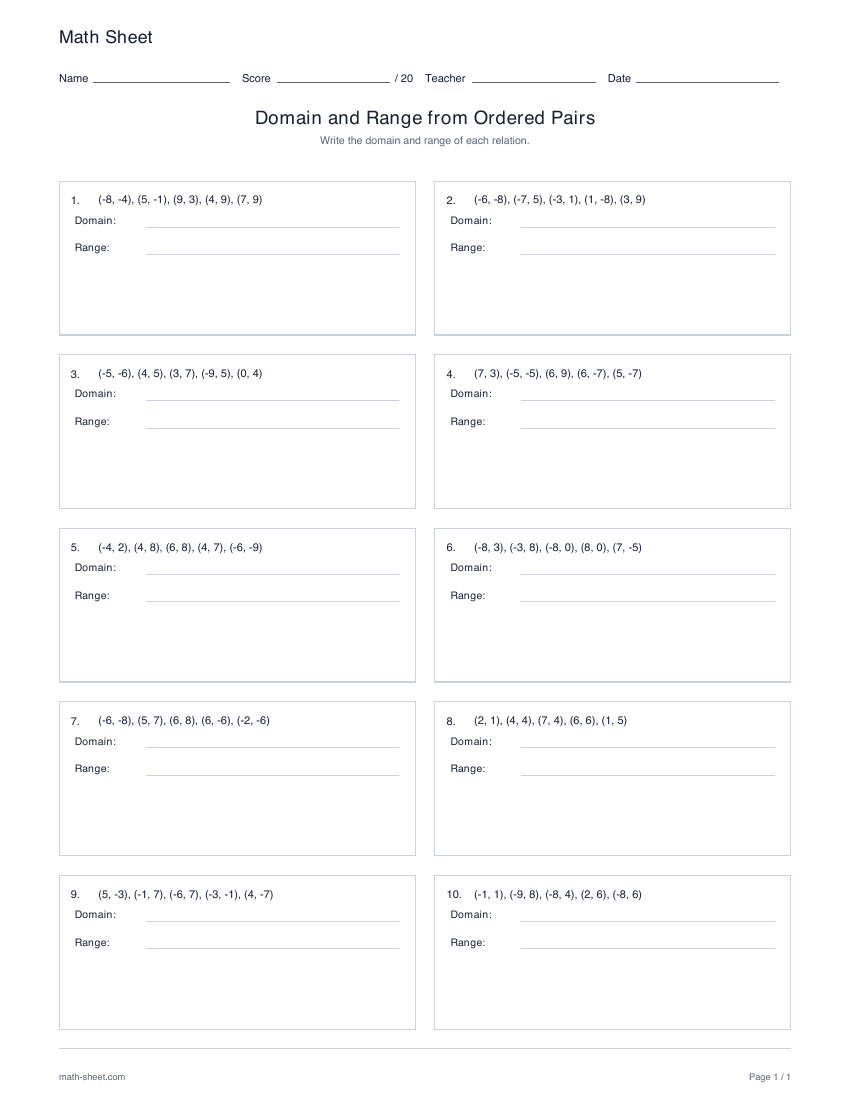
Find the domain and range of ten five-pair relations. Choose negative or nonnegative coordinates, control repeats independently and optionally classify each relation as a function.
Fixed English ready-made files. Custom settings below apply only to the configured PDF.
Ready to print
Start with a ready-made worksheet
List each distinct first coordinate in the domain and each distinct second coordinate in the range. If asked, decide whether each input has exactly one output.
Download the practice pages alone, or include a separate answer key or teacher model. Longer activities may use more than one page.
Each sheet contains ten relations with five distinct ordered pairs. Choose negative or nonnegative coordinates and control repeated domain and range values independently.
Turn on function classification to add a Yes or No decision. When domain repeats are enabled, each sheet includes five functions and five nonfunctions.
Learning objective
What this activity builds
Collect the distinct first and second coordinates of a relation and use repeated inputs to test whether it is a function.
Worked example
For {(4, −9), (9, 8), (8, −5), (−7, 6), (−7, −6)}, find the domain and range and classify the relation.
Domain {−7, 4, 8, 9}; range {−9, −6, −5, 6, 8}; not a function.
Sets list each value once in order. The input −7 has two different outputs, so the relation is not a function.
Teaching notes
Make the practice count
Read first coordinates vertically before sorting.
Write each set value only once.
Keep negative signs attached to their numbers.
Repeated outputs are allowed in a function.
A repeated input is a problem only when it has different outputs.
Make it yours
Customize the practice
Choose your options, update the preview, then download the exact same pages.
Choose the practice settings, update the preview and print the same questions with a separate answer key.
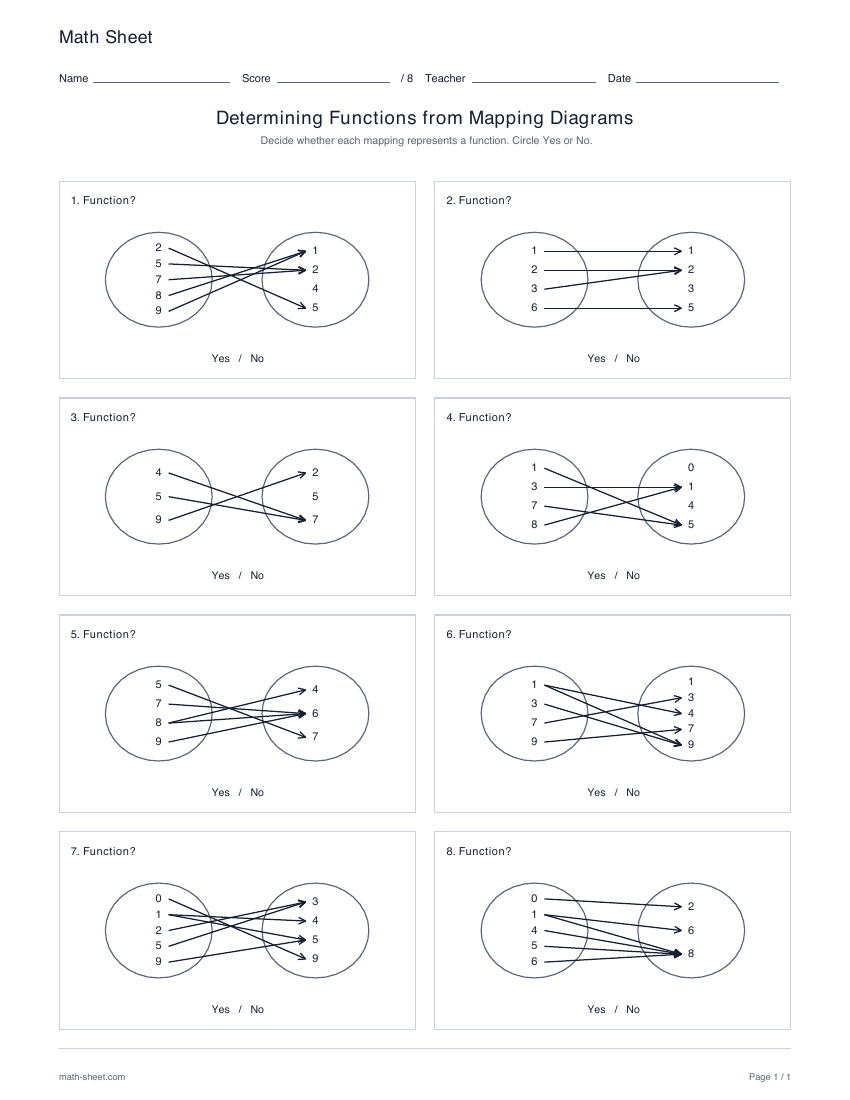
Classify eight mapping diagrams as functions or nonfunctions. Choose two to five numeric or letter values on each side, with four of each classification and a separate answer key.
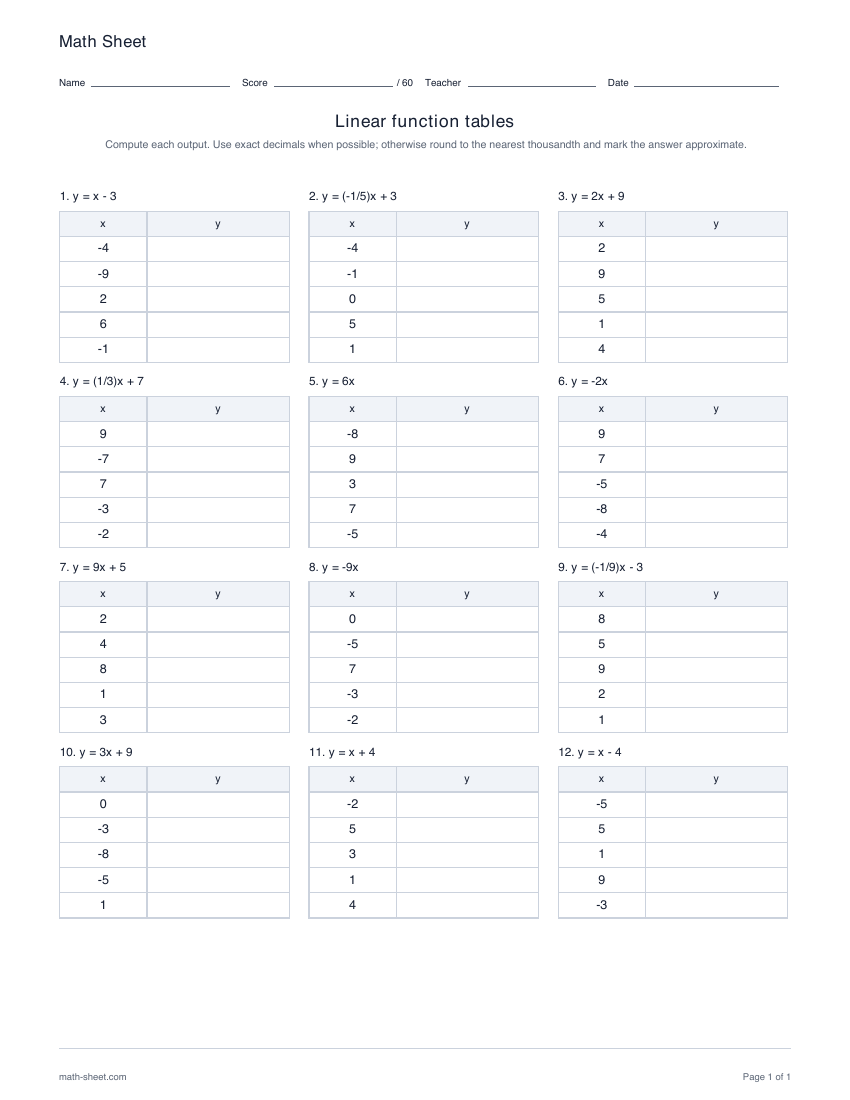
Substitute five inputs into each of twelve linear rules. Choose whole or fractional slopes, signed or nonnegative inputs, and decimal or exact fraction answers.
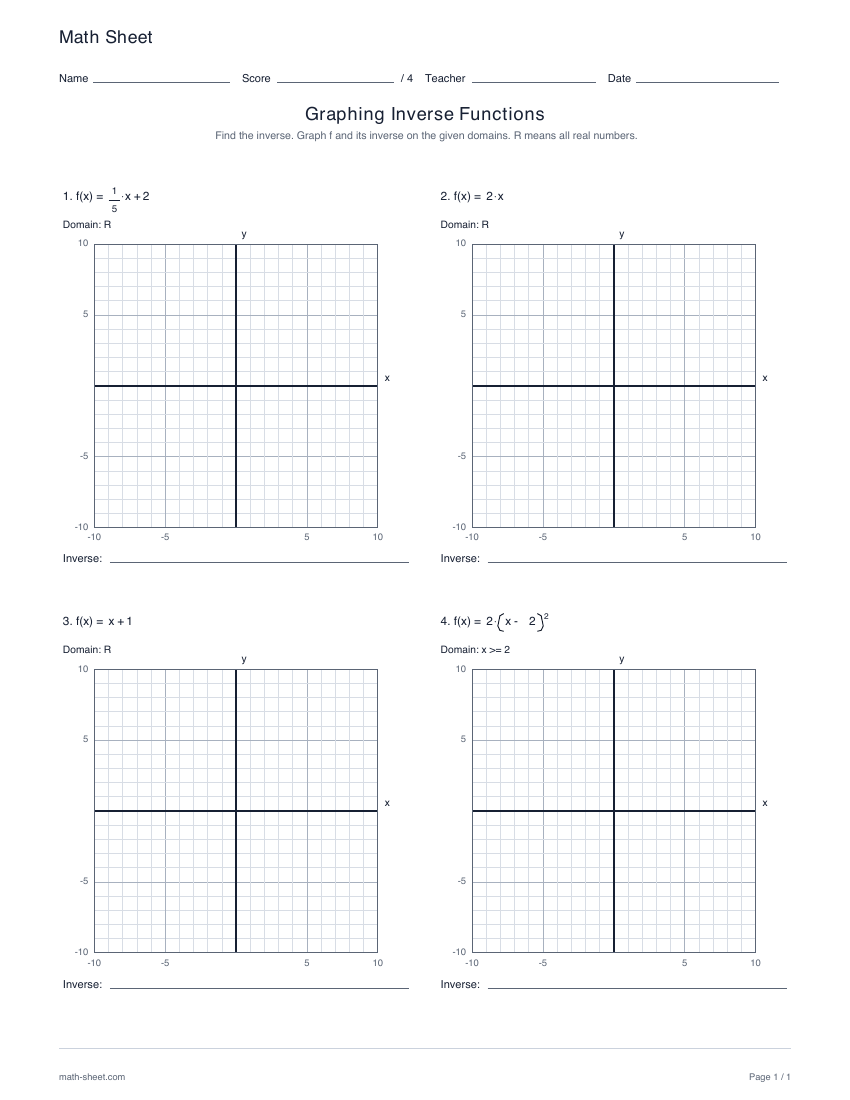
Find and graph four inverse functions. Choose fractional or integer linear rules, lines through the origin, quadratic branches and cubic functions, with completed graph keys.