
Number systems
Decimal and binary conversion worksheets
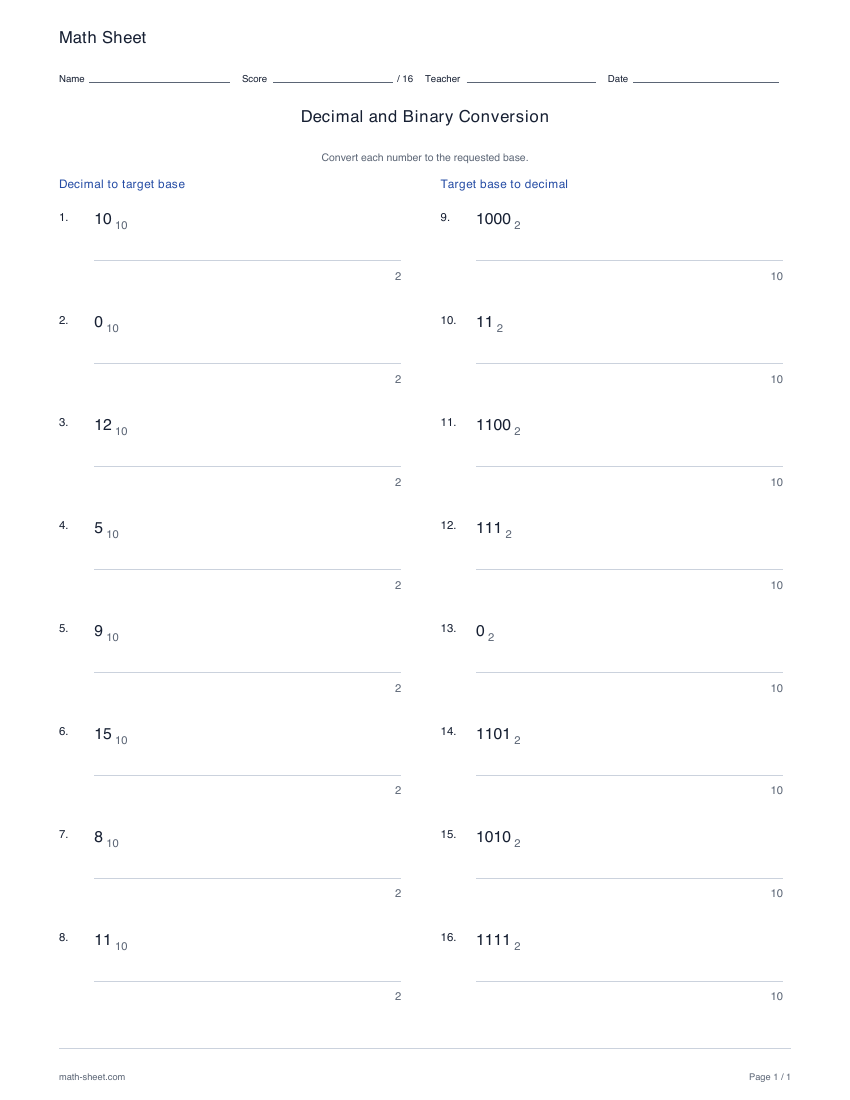
Convert between decimal and binary with 16 questions, four number ranges and a separate answer key. Customize the worksheet and download a Letter or A4 PDF.
Preview and downloadSame value. Different notation.
Convert between decimal, binary, octal and hexadecimal. Calculate in another base, compare bits or read Roman numerals, with focused practice and separate answer keys.
Choose a worksheetFour ways to write forty-five
| Number system | Representation |
|---|---|
| Decimal · base 10 | 4510 |
| Binary · base 2 | 1011012 |
| Octal · base 8 | 558 |
| Hexadecimal · base 16 | 2D16 |
Understand the notation
Represent the same value in decimal, binary, octal or hexadecimal. Each worksheet practices both directions in separate groups.
Number systems
Convert between decimal and binary with 16 questions, four number ranges and a separate answer key. Customize the worksheet and download a Letter or A4 PDF.
Preview and download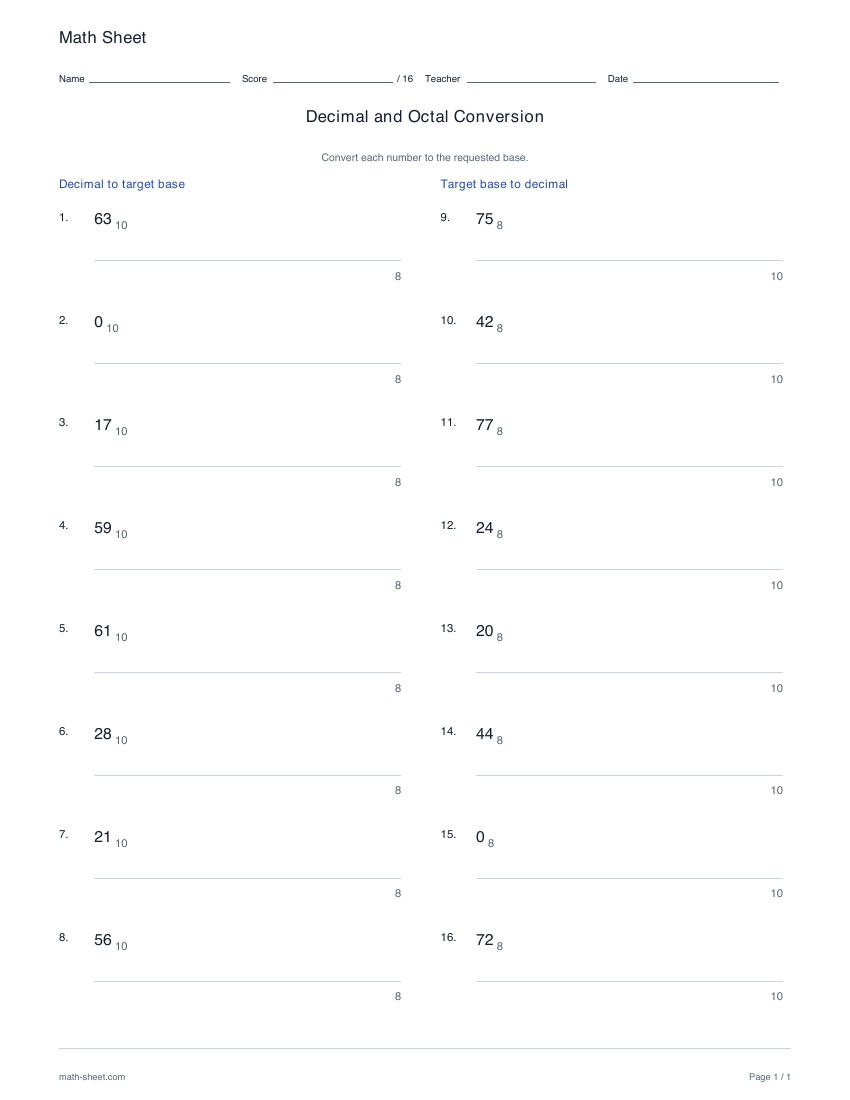
Number systems
Practice decimal-to-octal and octal-to-decimal conversion with four ranges, 16 questions and printable answers. All selected ranges describe decimal values.
Preview and download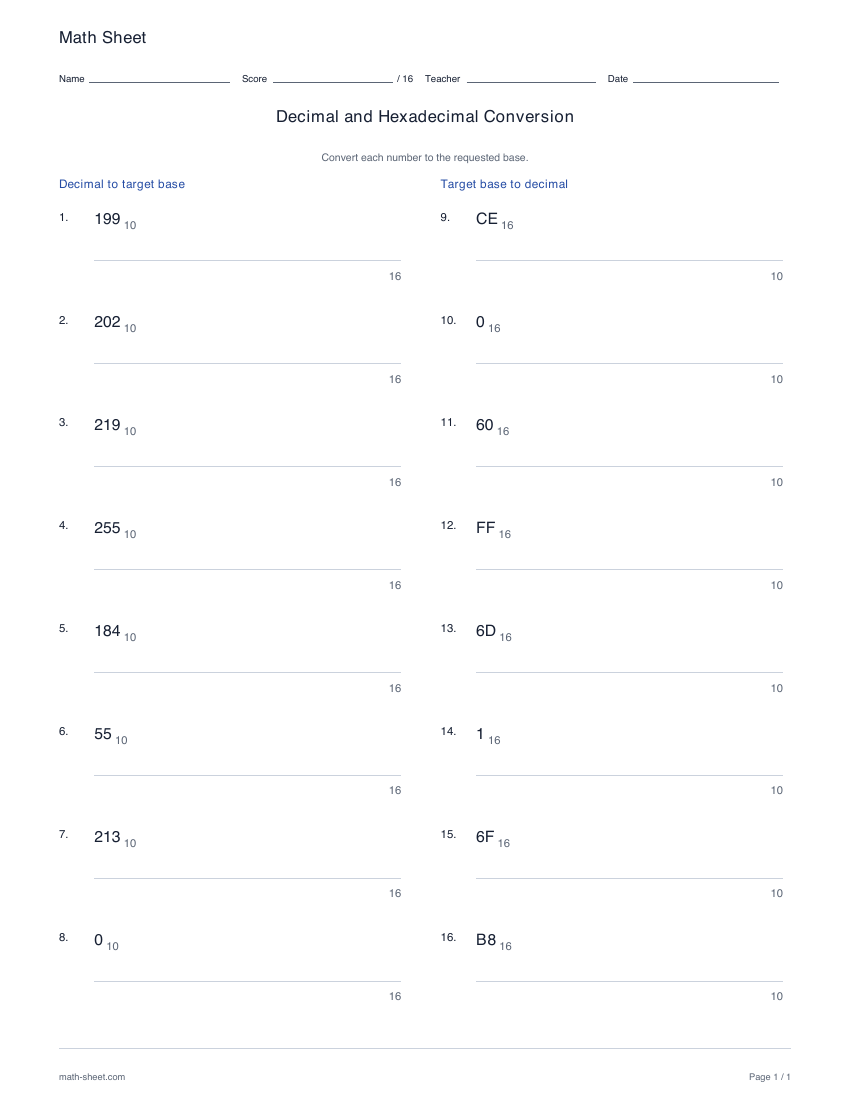
Number systems
Convert decimal and hexadecimal numbers with uppercase A–F, two ranges and 16 questions. Print the worksheet and a separate answer key in Letter or A4.
Preview and downloadUnderstand the notation
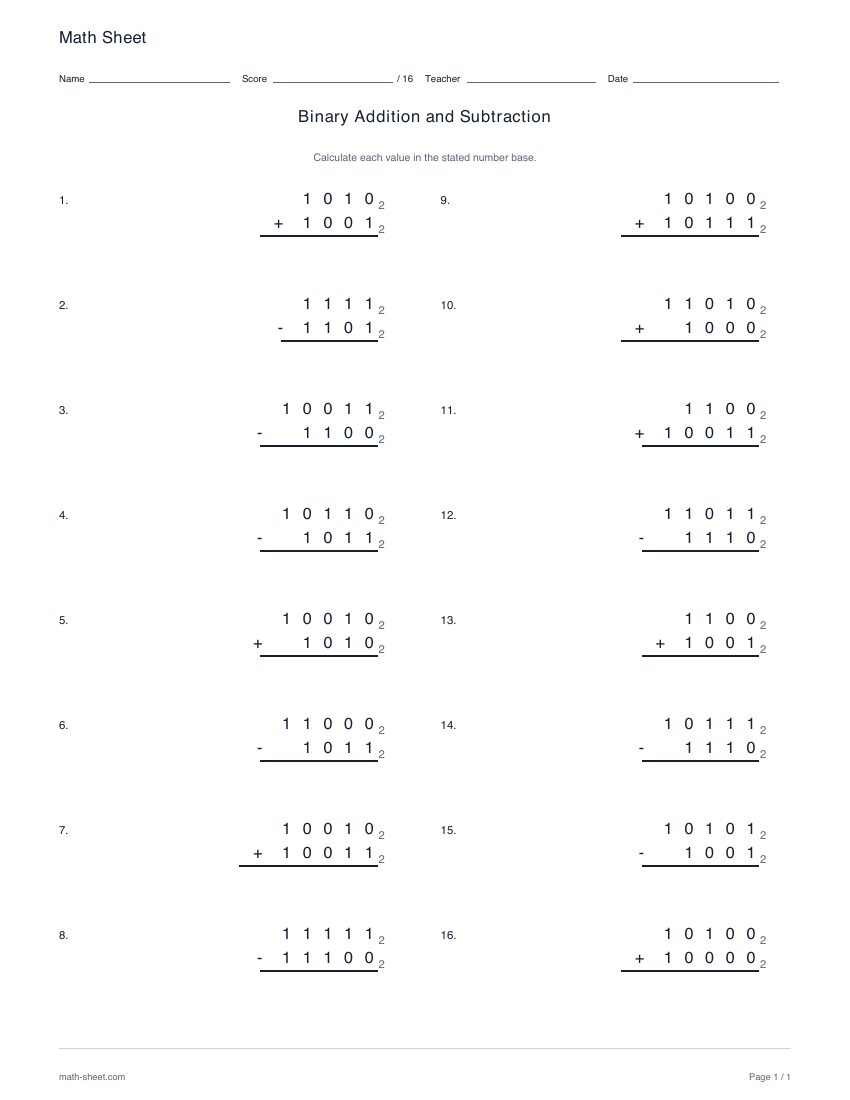
Practice vertical addition, subtraction or a balanced mix. Ranges apply to operands, so an addition answer can need an extra digit.
Number systems
Print 16 binary arithmetic problems with addition, subtraction or a balanced mix. Choose four operand ranges and include a separate answer key.
Preview and download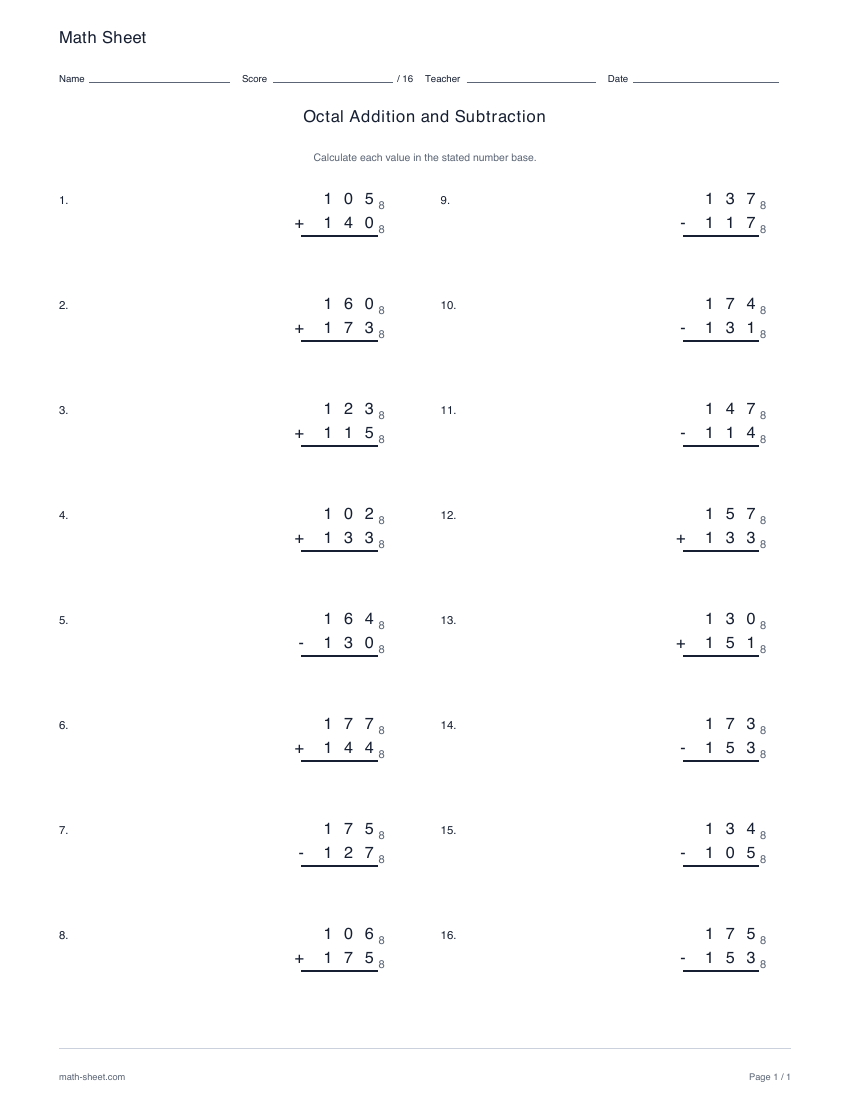
Number systems
Practice vertical base-eight addition and subtraction with four operand ranges, 16 problems and optional answers. Generate a fresh printable set with the same settings.
Preview and download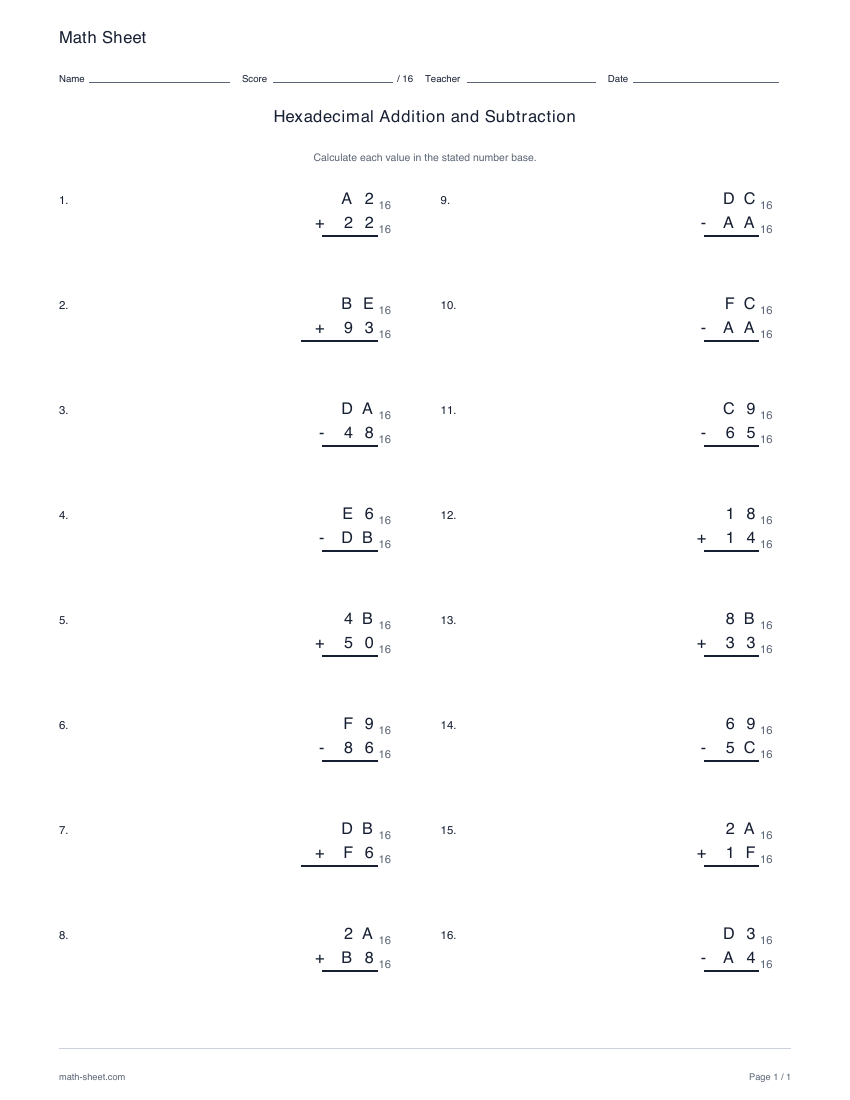
Number systems
Add and subtract hexadecimal numbers using digits 0–9 and A–F. Choose an operand range, print 16 questions and download a separate answer key.
Preview and downloadUnderstand the notation
Choose AND, OR, XOR and their complements. Four-bit and eight-bit sheets keep all leading zeroes visible.
Number systems
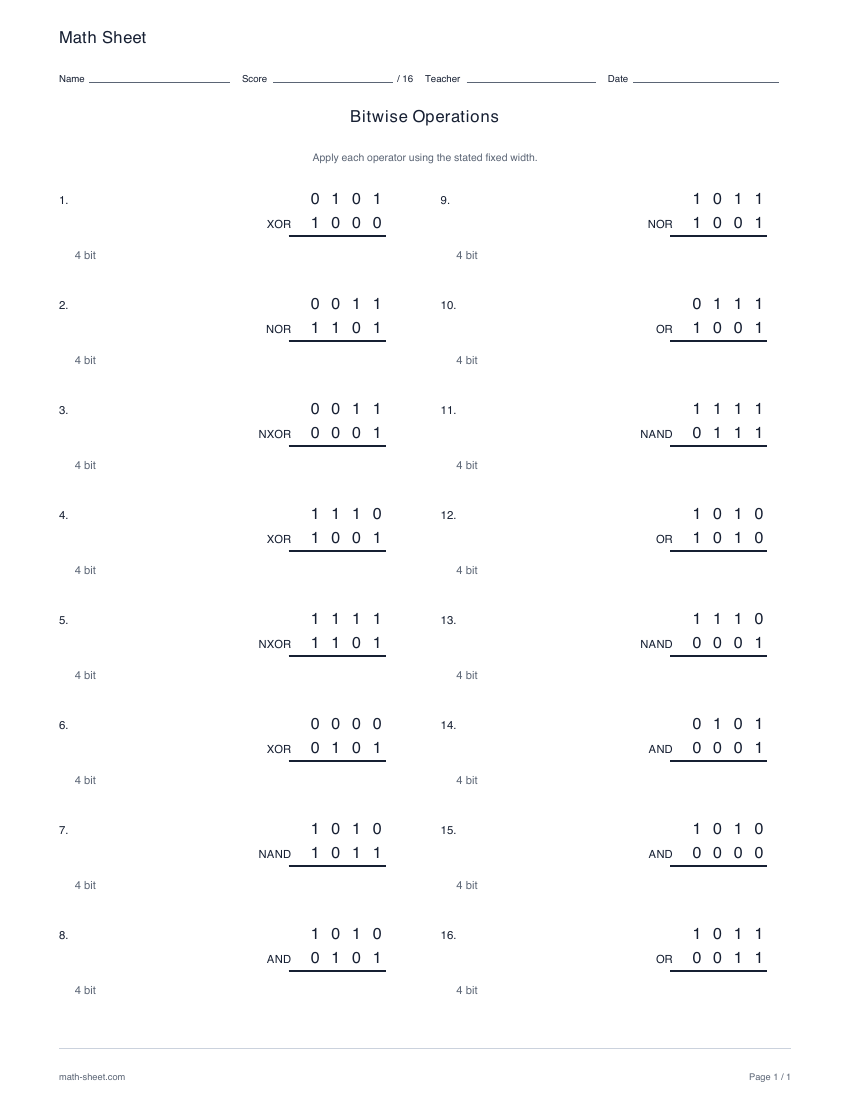
Practice AND, OR, XOR, NAND, NOR and NXOR with four-bit or eight-bit numbers. Choose operators, generate 16 problems and print width-correct answers.
Preview and downloadUnderstand the notation
Practice subtractive notation across nine ranges. The 1000–4000 range includes its upper endpoint and explains the overlined IV notation.
Number systems
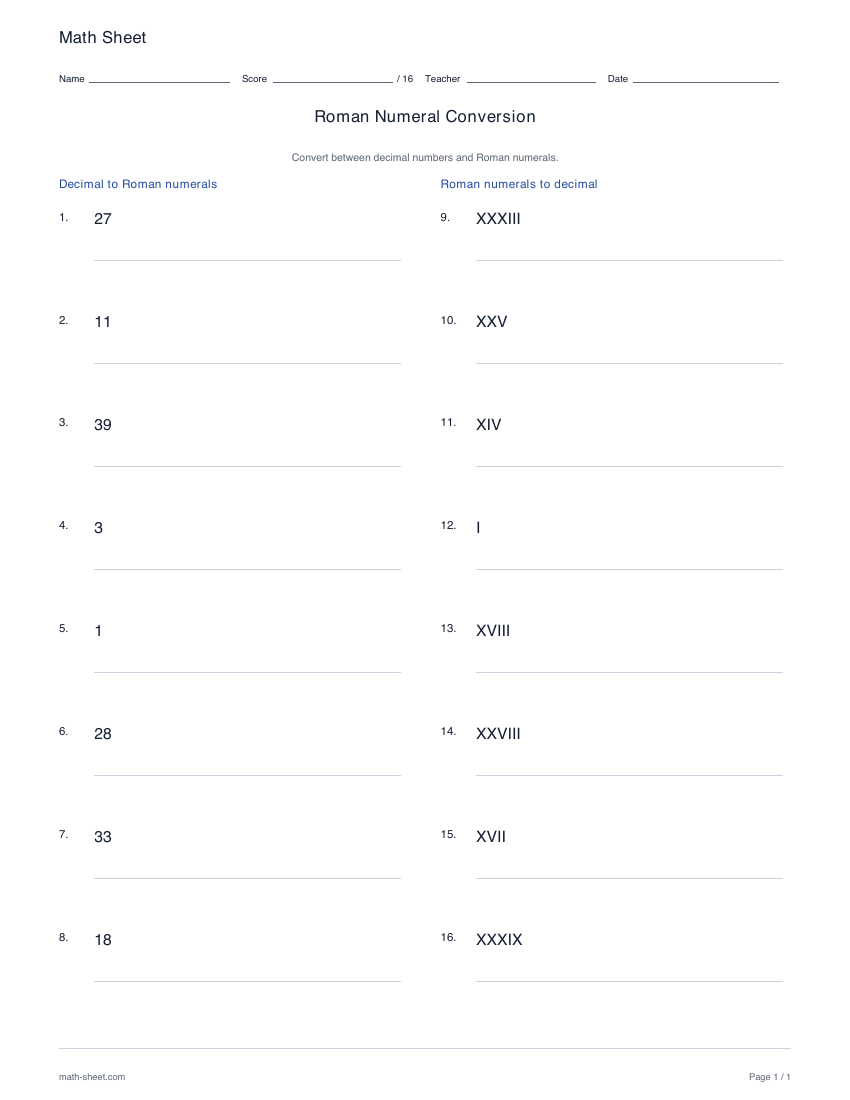
Convert between decimal and Roman numerals with nine ranges, 16 questions and printable answers. The highest range includes 4000 with an explained overline convention.
Preview and downloadStart with short representations and one operation. Move to longer numbers when the learner can explain the value of each place and check a result by converting it back.
Use decimal values 0–15 to connect binary digits with weights 8, 4, 2 and 1.
Open this starting point →Work with values up to octal 77 and check each digit against the base.
Open this starting point →Focus on subtraction before mixing operations. Every difference is positive.
Open this starting point →Use decimal values 255–65535 and place weights through 4096.
Open this starting point →Use eight bits to compare different-bit and equal-bit rules without arithmetic carries.
Open this starting point →Practice long subtractive forms and the explicit overlined IV representation of 4000.
Open this starting point →Use digits 0 and 1. Places grow by a factor of two: 1, 2, 4, 8, 16 and so on.
Use digits 0–7. The first four place weights are 1, 8, 64 and 512.
Use digits 0–9 and A–F. A means ten, and F means fifteen. The places grow by sixteen.
Combine symbols such as X and L using the stated additive and subtractive conventions. Roman numerals do not use positional base weights.
A conversion changes how a value is written. Arithmetic changes the value through addition or subtraction. A bitwise operation compares corresponding binary digits independently.
These differences matter when checking answers. Binary addition can carry into another place; XOR never carries. A leading zero does not change a number’s value, but keeping every bit visible is essential on a fixed-width worksheet.
On conversion sheets it controls the decimal value in either direction. On arithmetic sheets it controls each operand. An addition result may be larger than the upper operand limit.
XOR returns 1 when the input bits differ. NXOR, also called XNOR, returns 1 when they agree. The complement stays inside the chosen four-bit or eight-bit width.
The highest-range worksheet uses IV with an overline. Here the line means multiply by 1000, so 4 × 1000 = 4000. Ordinary IV means four. The notation rule is printed on the worksheet.
Yes. Use the student-only download or turn off Include answers in the worksheet settings. The answer-enabled edition appends a separate key after the student pages.
Yes. Each conversion worksheet has eight questions in each direction, with separate headings. Both selected range endpoints appear in each group.
Customized worksheets support English, German, Albanian, Spanish, Italian, French, Turkish and Norwegian Bokmål. The ready-made downloads are in English.
Practice interpreting symbols and applying a rule before calculating.
Explore pre-algebra →Use unions, intersections and complements to describe membership.
Venn diagram worksheets →Choose Letter or A4 and use the actual-size print setting for clear work space.
Printing help →