
Exponents and radicals
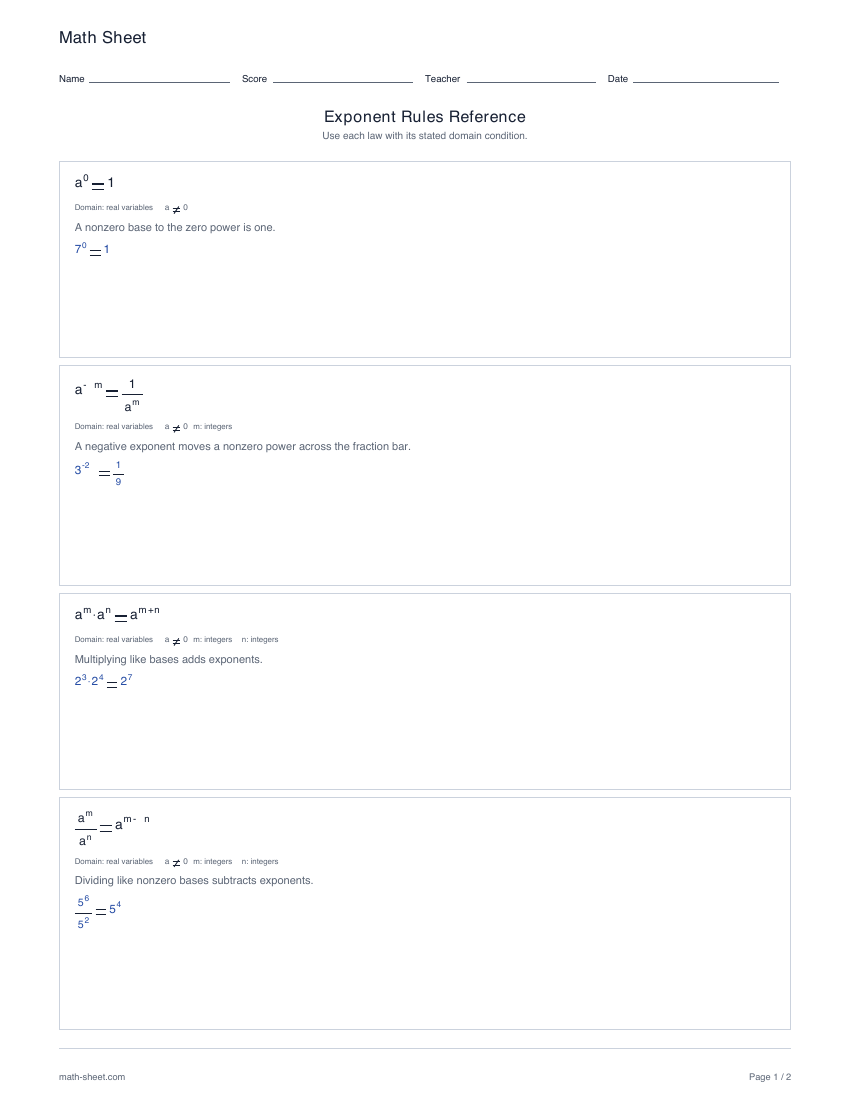
Exponent rules reference sheet
Print an exponent rules reference with original examples of zero, negative and rational exponents, products, quotients and powers. Includes the conditions each rule needs.
Preview and downloadPowers, roots and the rules that connect them
Start with squares and cubes. Build toward exponent laws, logarithm properties and change of base, exact radical arithmetic and equations with checked solutions. Choose a skill, adjust the practice and print the same questions you preview.
Choose a worksheetTwo ways to read the same relationship
Build the next skill
Use the reference sheets, then evaluate powers with integer or fraction bases. Connect squares and cubes with their inverse roots.
Exponents and radicals
Print an exponent rules reference with original examples of zero, negative and rational exponents, products, quotients and powers. Includes the conditions each rule needs.
Preview and download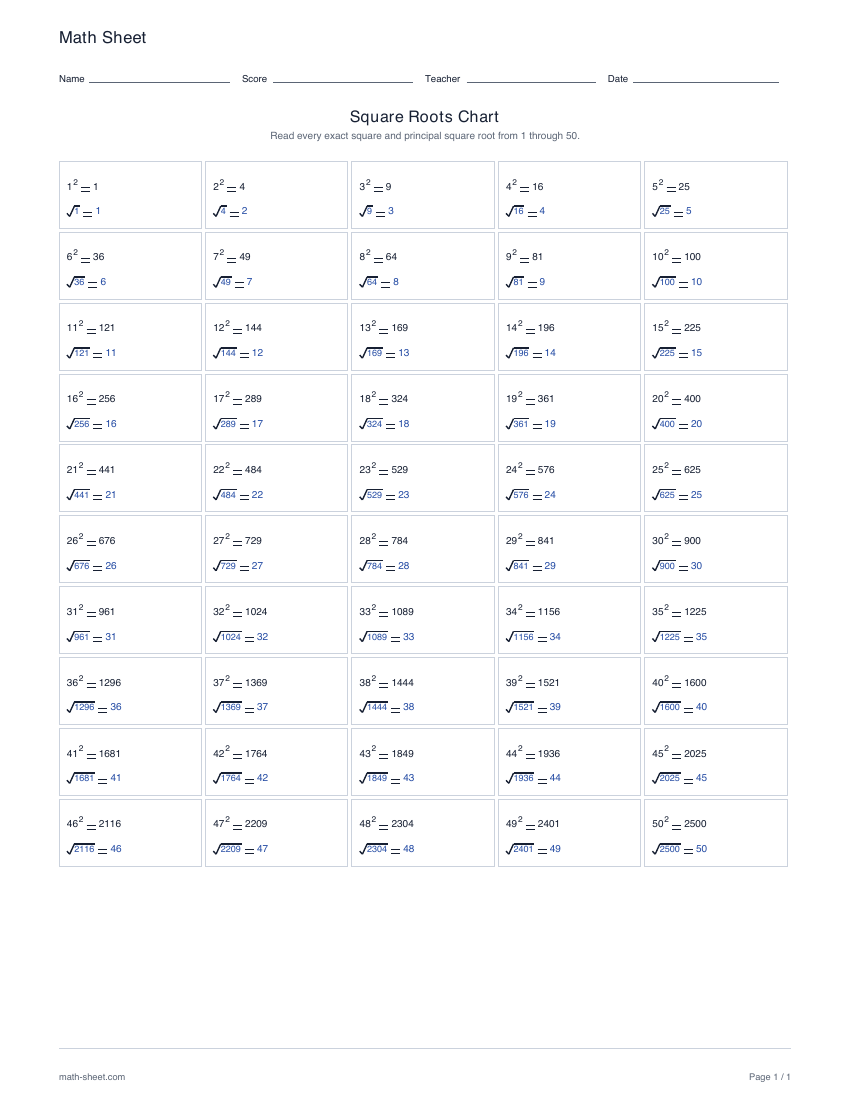
Exponents and radicals
Print a square roots chart showing the 50 perfect squares from 1² to 50² and their principal roots. Choose Letter or A4 and a printed language.
Preview and download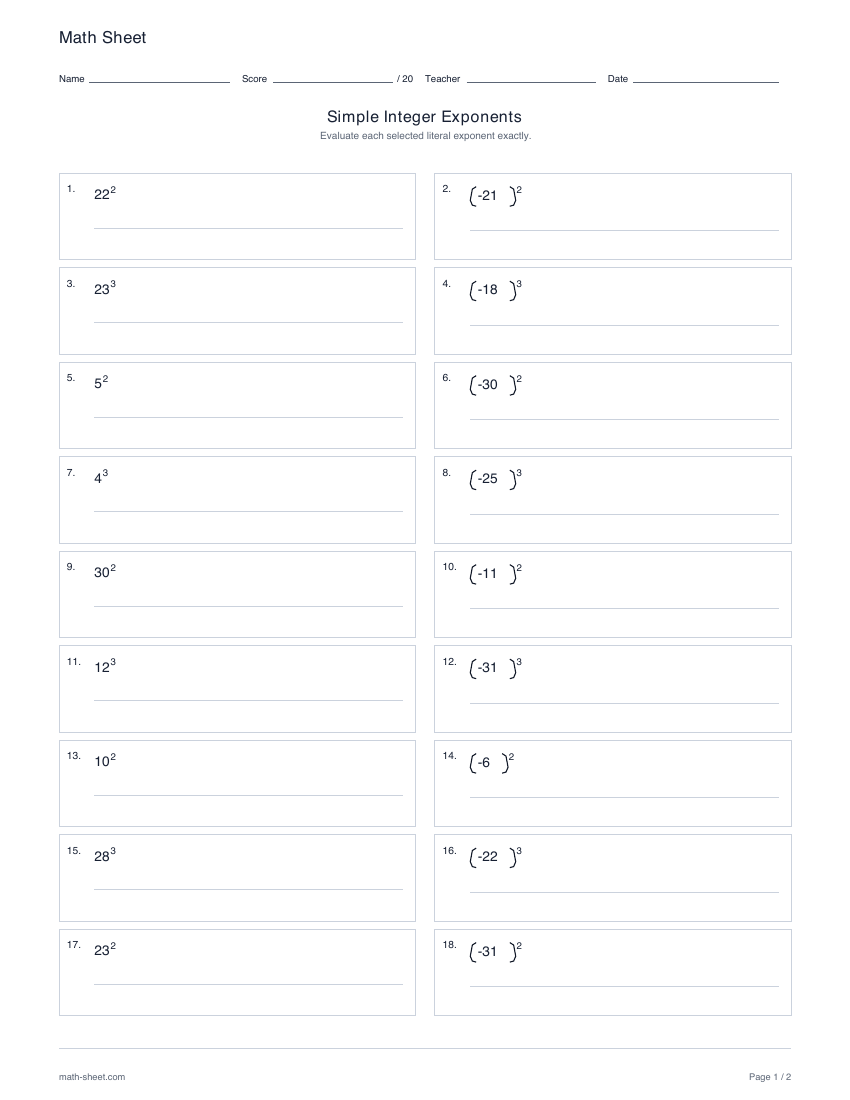
Exponents and radicals
Generate 20 powers using positive or negative integer bases. Choose any exponent values from −4 through 5, including zero and negative powers, with a separate answer key.
Preview and download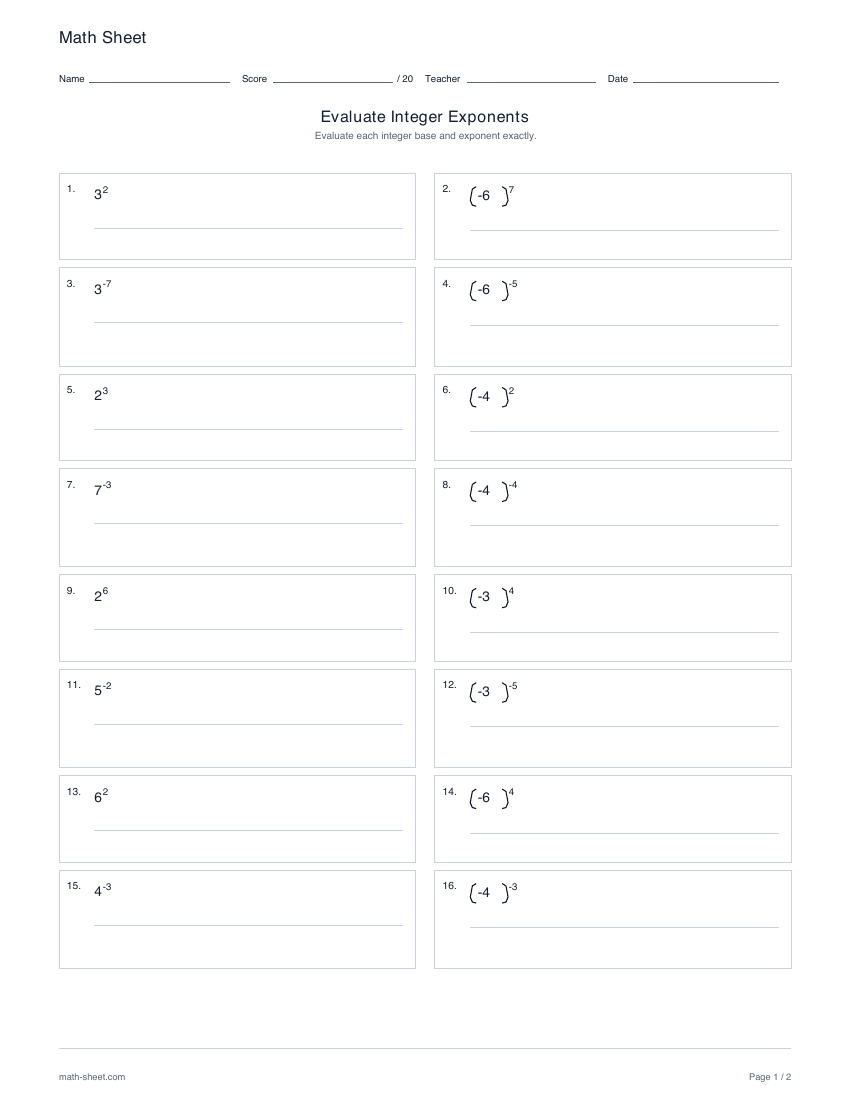
Exponents and radicals
Choose positive, negative, zero, unit or fractional exponents for 20 integer-base problems. Practice exact real-number values with independently selected base signs.
Preview and download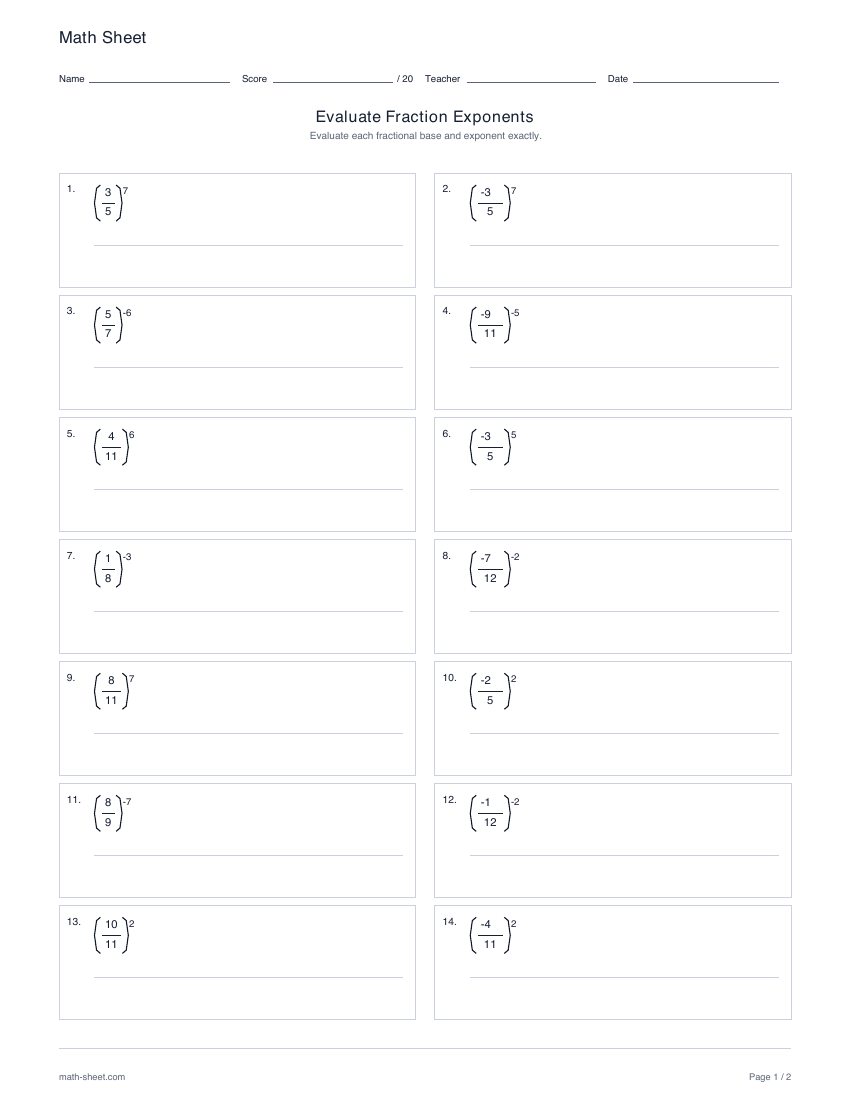
Exponents and radicals
Practice 20 powers with fraction bases and positive, negative, zero, unit or fractional exponents. Select base signs and print exact reduced answers.
Preview and download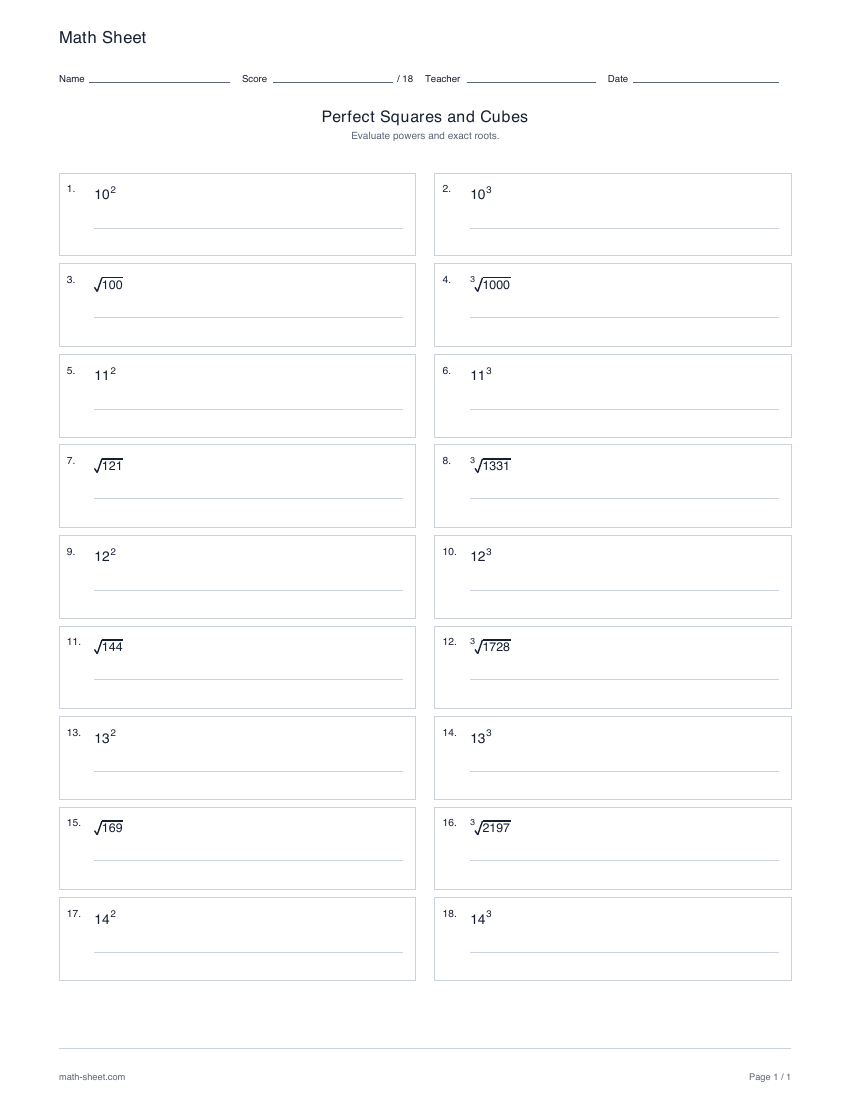
Exponents and radicals
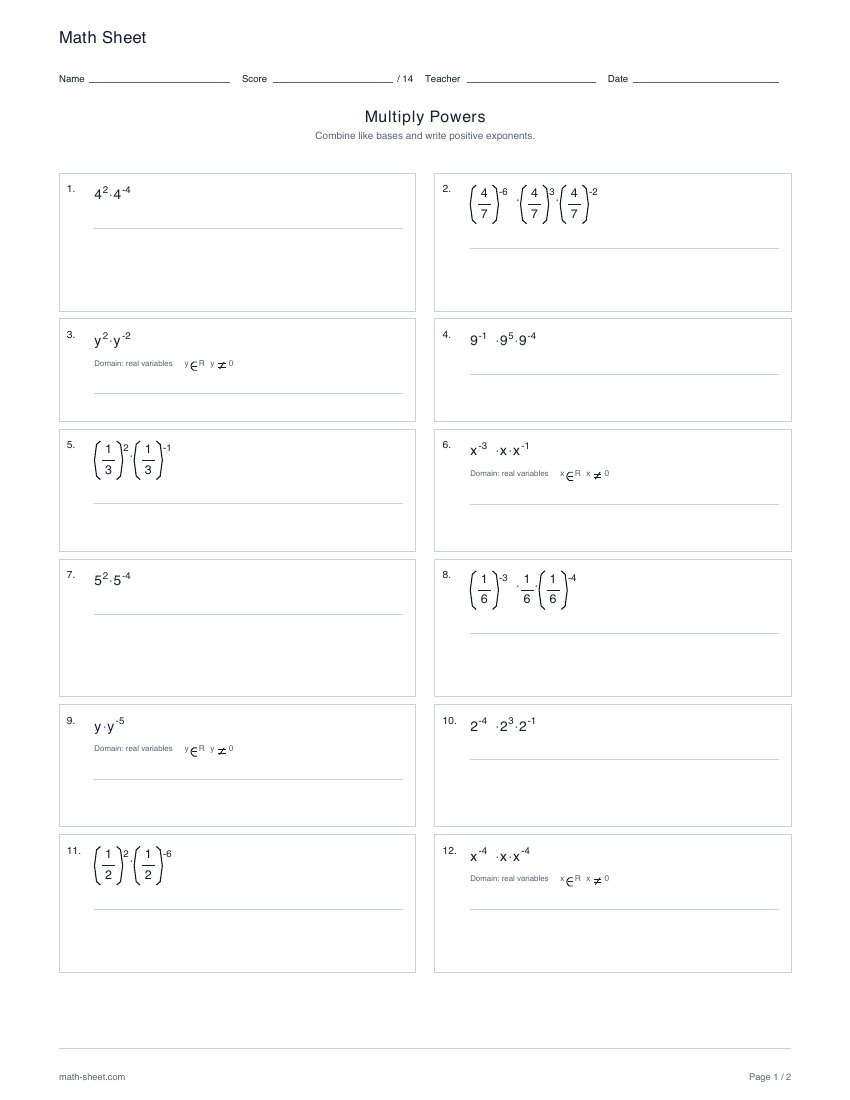
Create 18 questions on squares, cubes, square roots or cube roots. Set a base or root magnitude range from 1 to 20 and choose powers, roots or both.
Preview and downloadBuild the next skill
Practice one operation at a time before combining products, quotients and outer powers. Keep the nonzero restrictions from the original expression.
Exponents and radicals
Practice 14 products of powers with numeric, fractional and variable bases. Choose positive exponents or mixed signs and write simplified positive-exponent answers.
Preview and download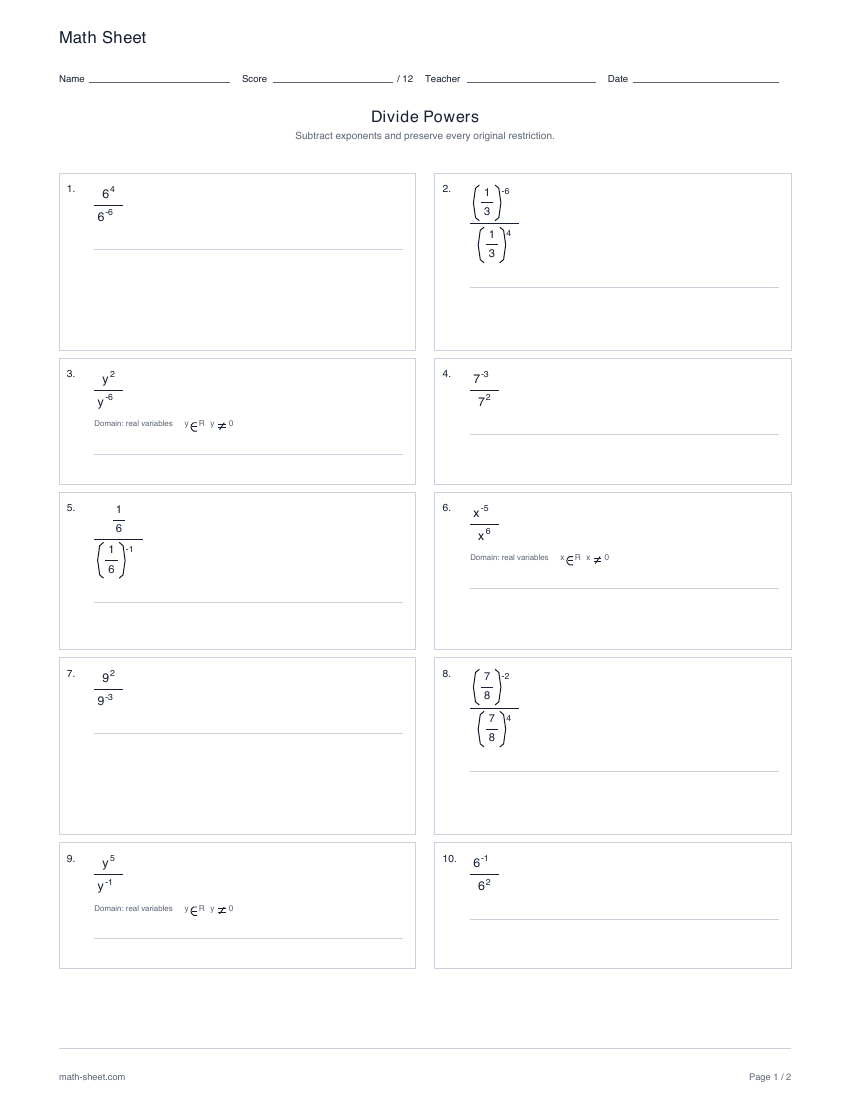
Exponents and radicals
Generate 12 quotients of powers with positive or mixed signed exponents. Simplify coefficients and variable powers while retaining restrictions from denominators and negative powers.
Preview and download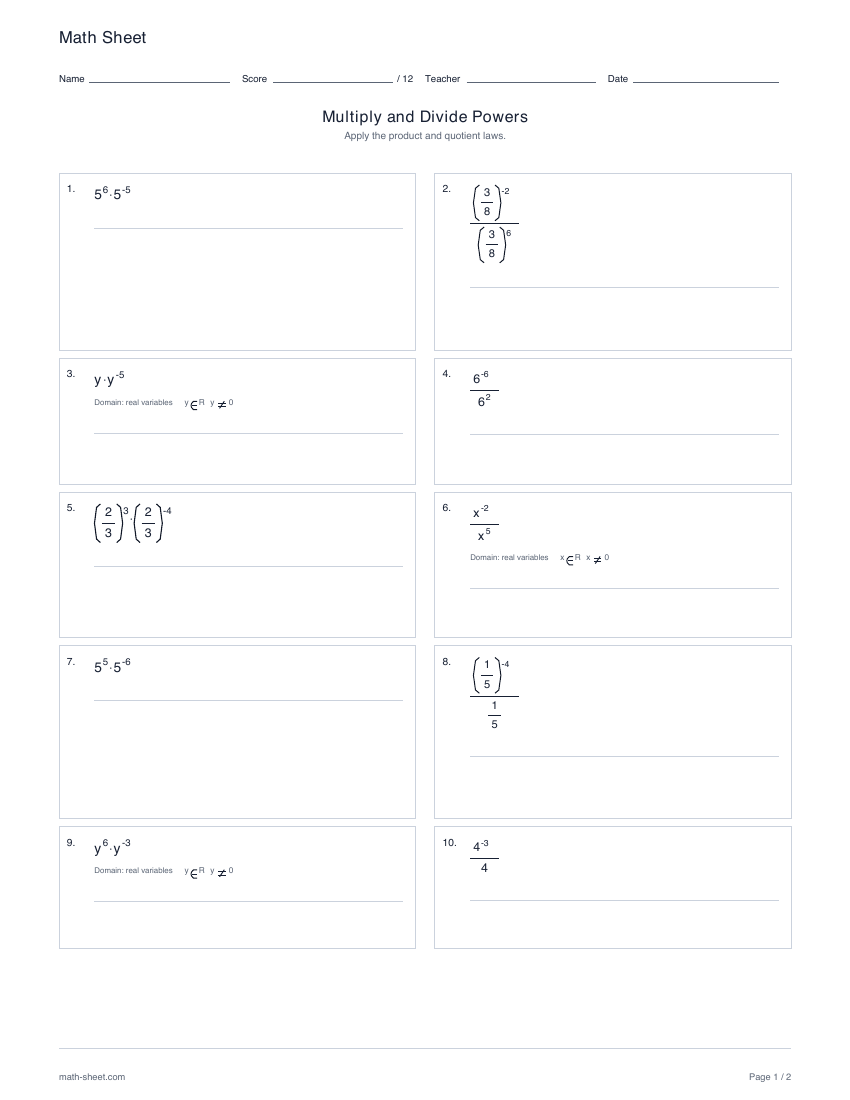
Exponents and radicals
Choose multiplication, division or a balanced mix for 12 exponent-law problems. Use positive or mixed signed exponents with exact simplified answers.
Preview and download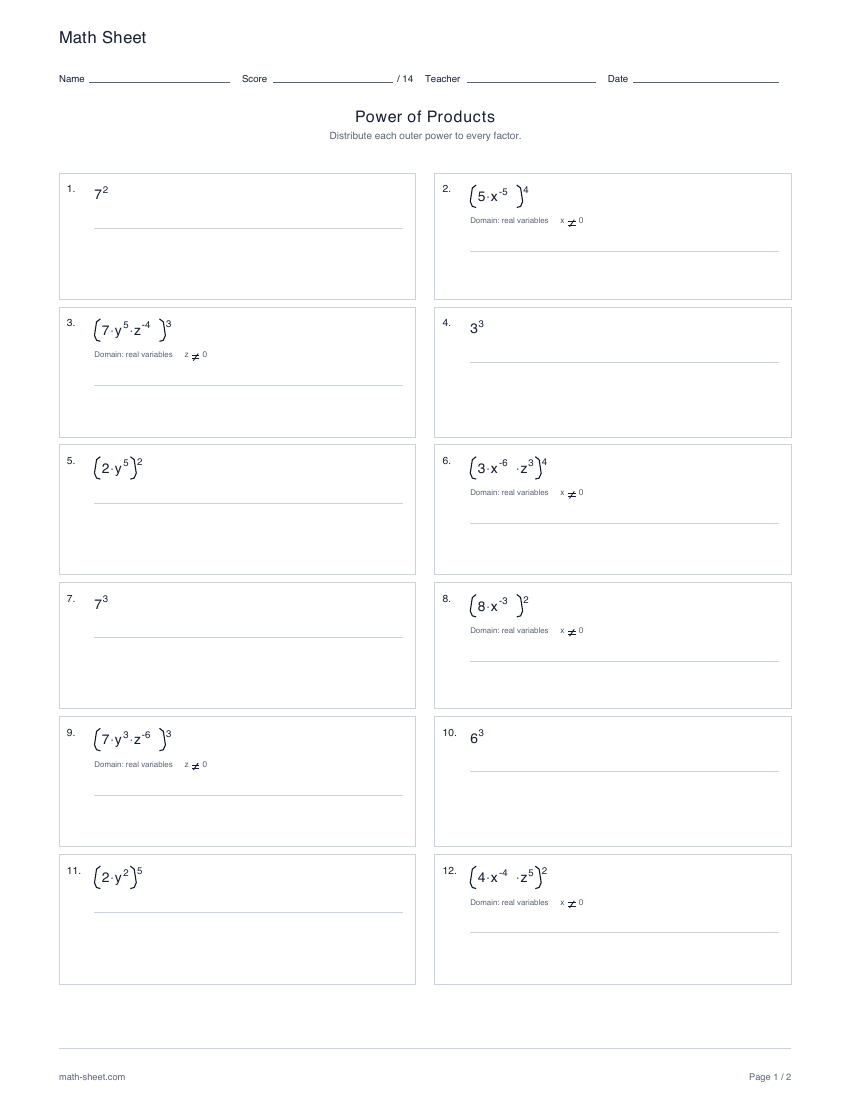
Exponents and radicals
Practice 14 powers of products. Choose one-, two- or three-factor cases and apply the outside exponent to coefficients and variable powers.
Preview and download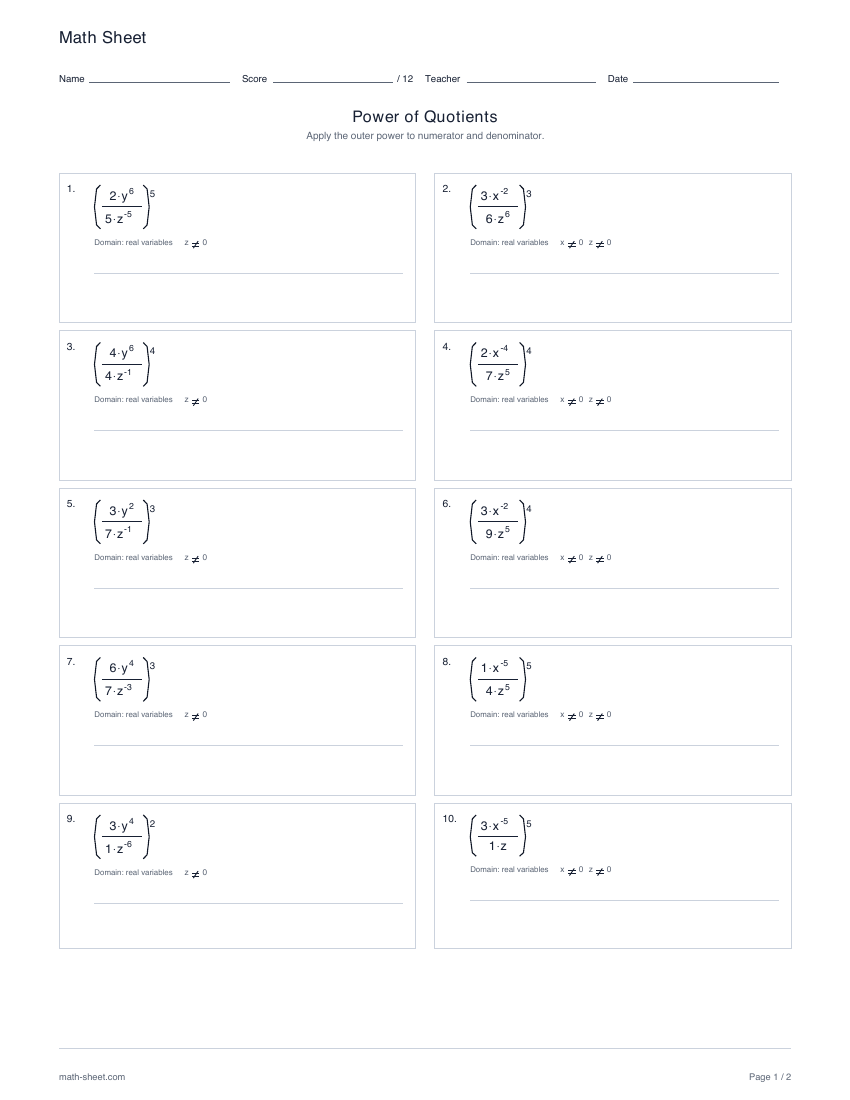
Exponents and radicals
Generate 12 powers of numeric and algebraic quotients. Apply the exponent to numerator and denominator, reduce the result and preserve excluded values.
Preview and download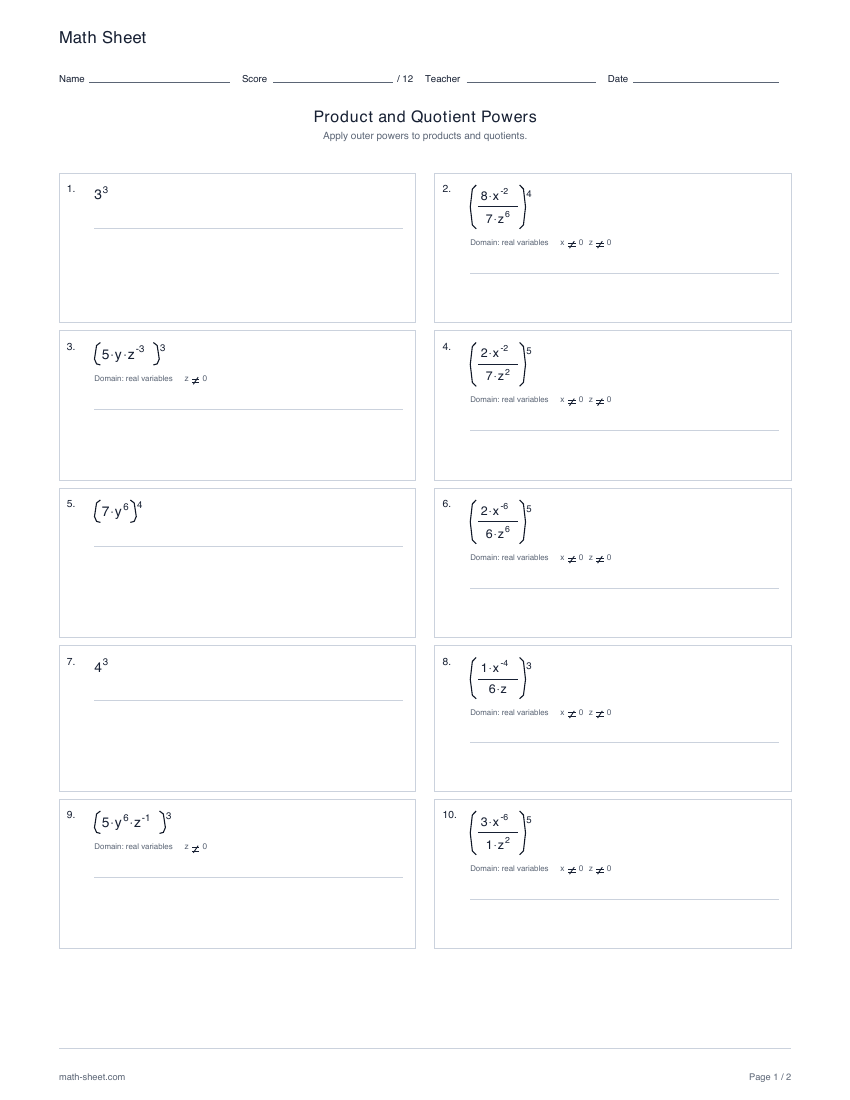
Exponents and radicals
Choose product powers, quotient powers or both in a 12-question worksheet. Practice distributing outer powers and simplifying exact algebraic results.
Preview and download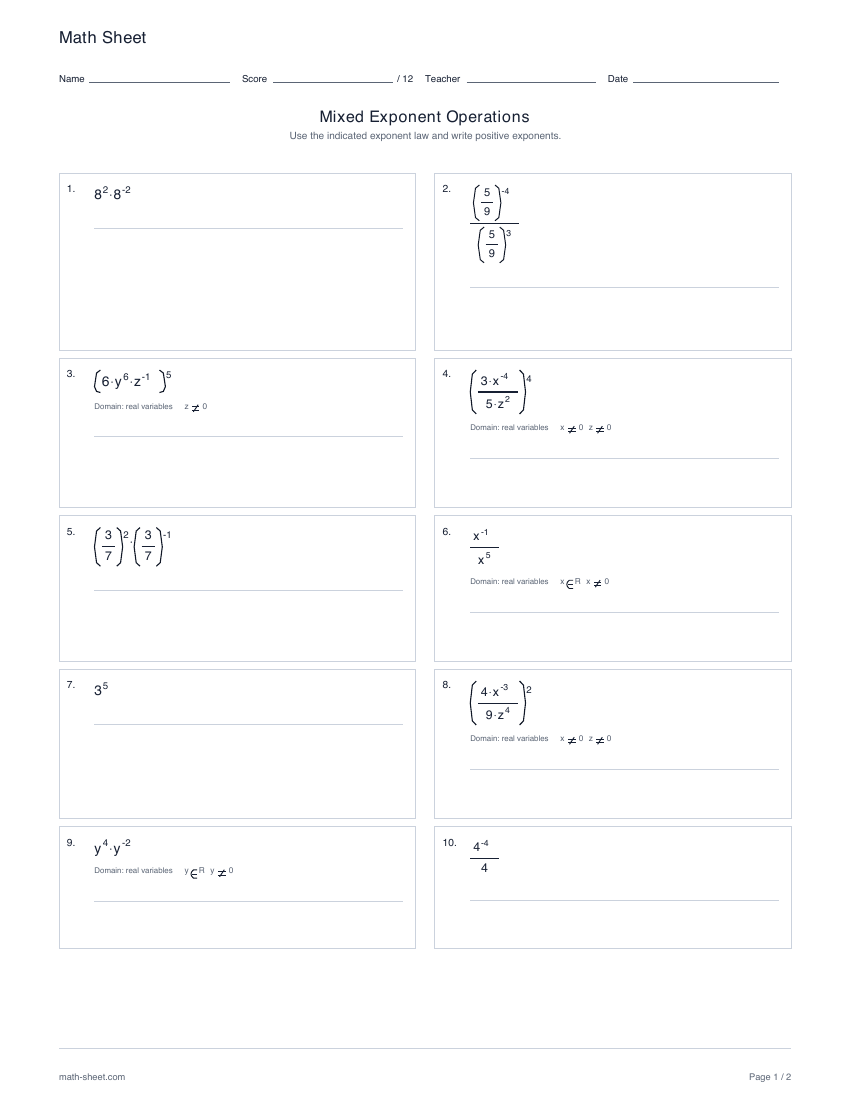
Exponents and radicals
Combine multiplication, division, powers of products and powers of quotients in 12 questions. Select the operations and positive, negative or mixed exponents.
Preview and download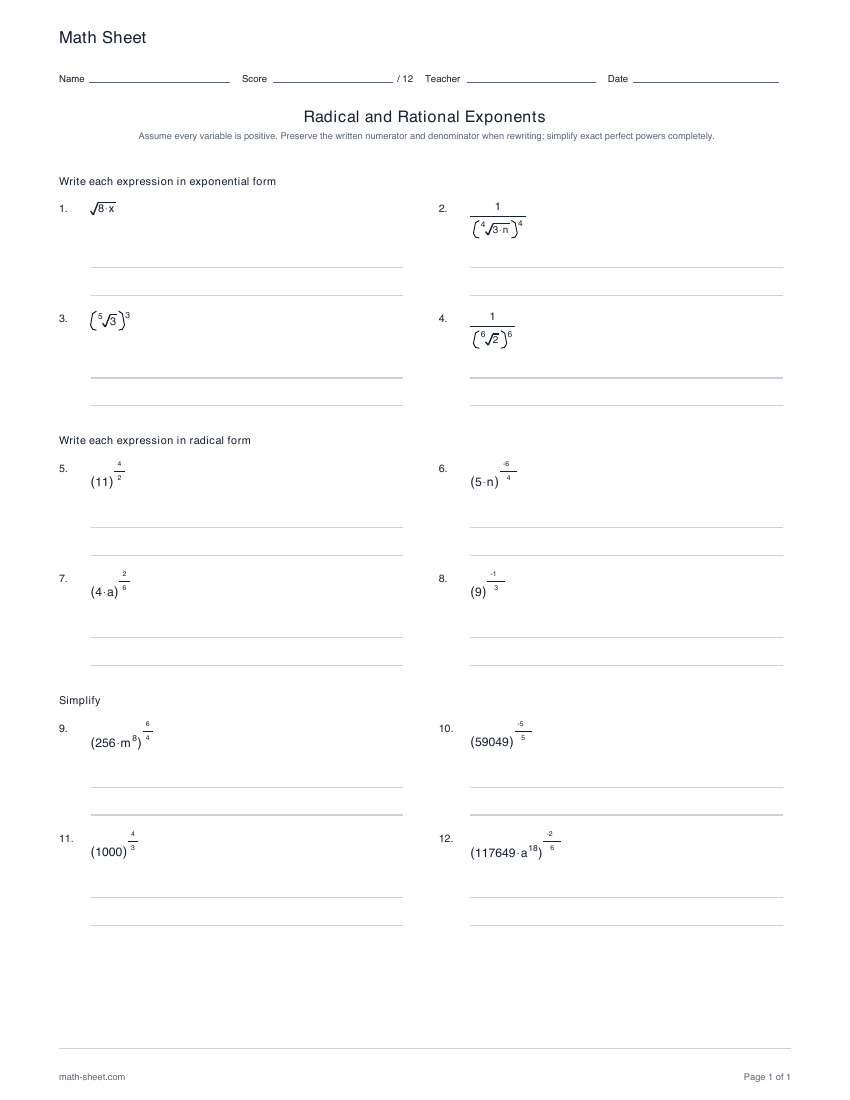
Exponents and radicals
Rewrite radicals as rational exponents, rewrite rational exponents as radicals and simplify exact perfect-power monomials. Each sheet has twelve source-aligned tasks with numeric, positive-variable or mixed expressions.
Preview and download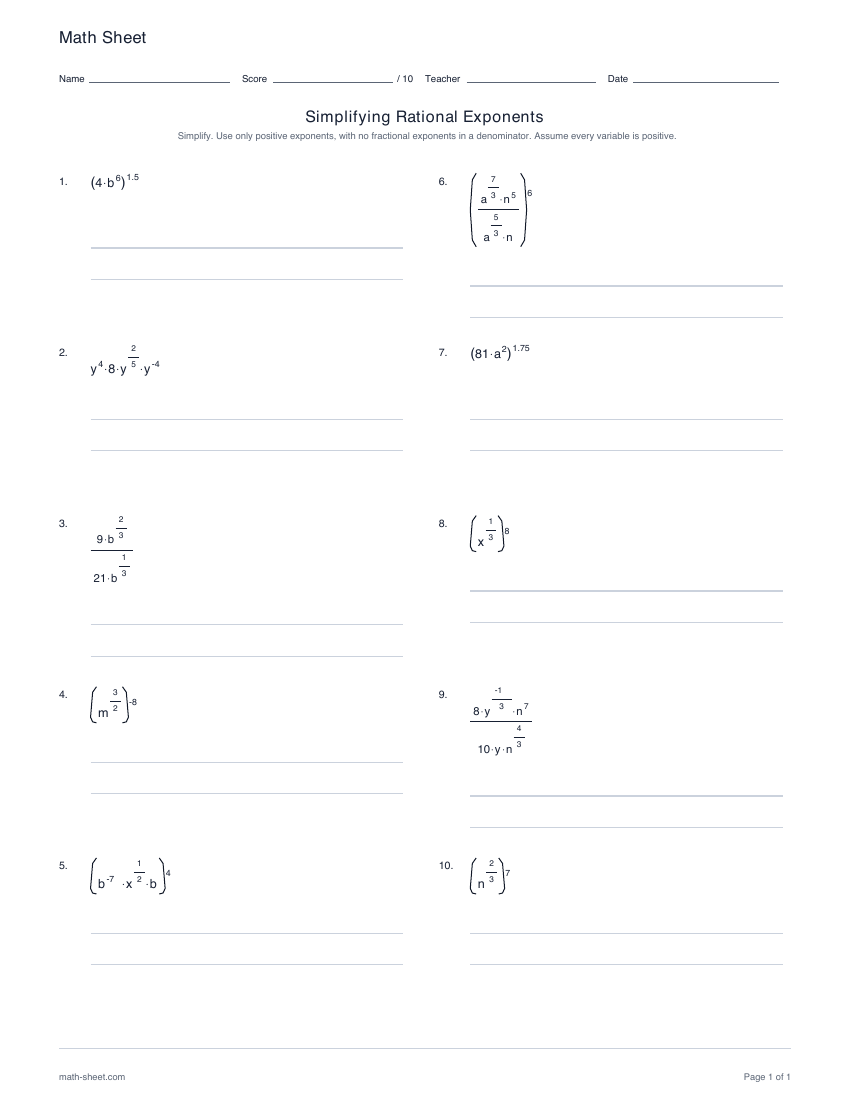
Exponents and radicals
Simplify ten exact monomial powers, products and quotients with rational exponents. Choose easy, medium or hard profiles and print a worked answer key.
Preview and downloadBuild the next skill
Extract perfect powers, recognize like radical terms, distribute products and rationalize quotients. Read the variable domain before simplifying.
Exponents and radicals
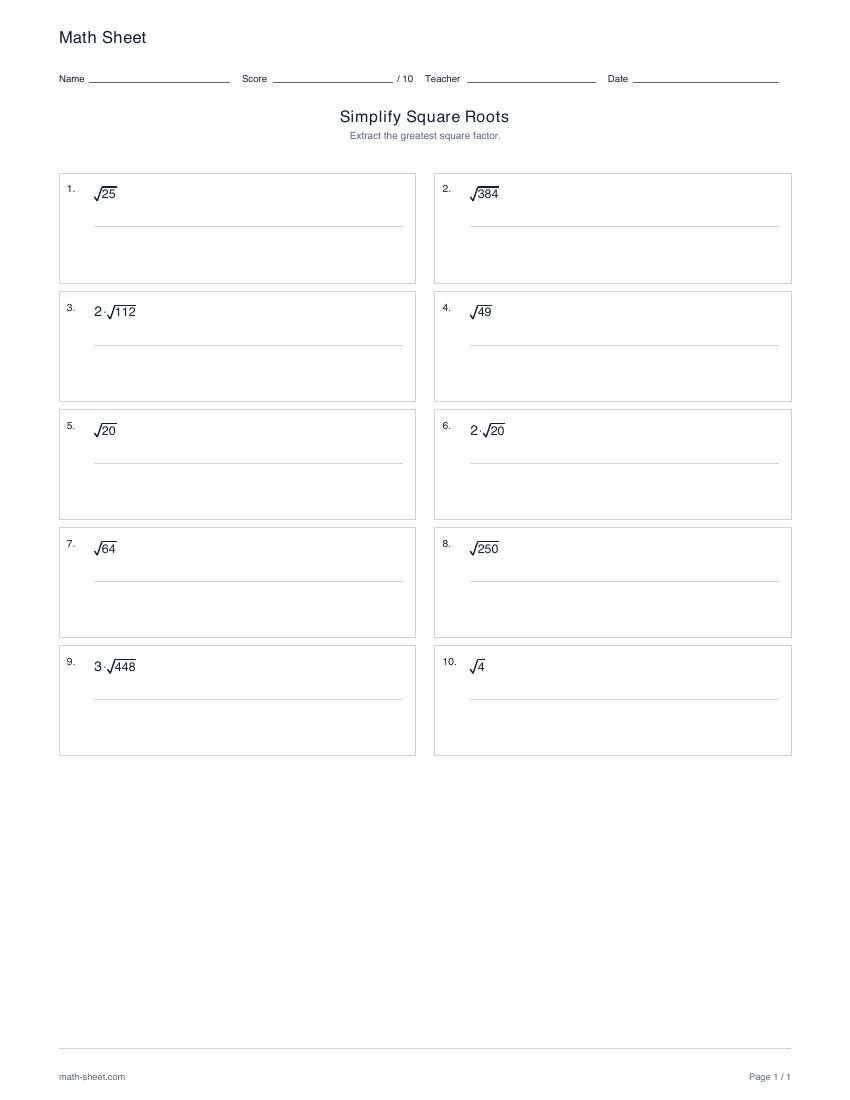
Generate 10 square-root problems using perfect squares, nonperfect radicands or outside coefficients. Practice exact factor extraction with a separate answer key.
Preview and download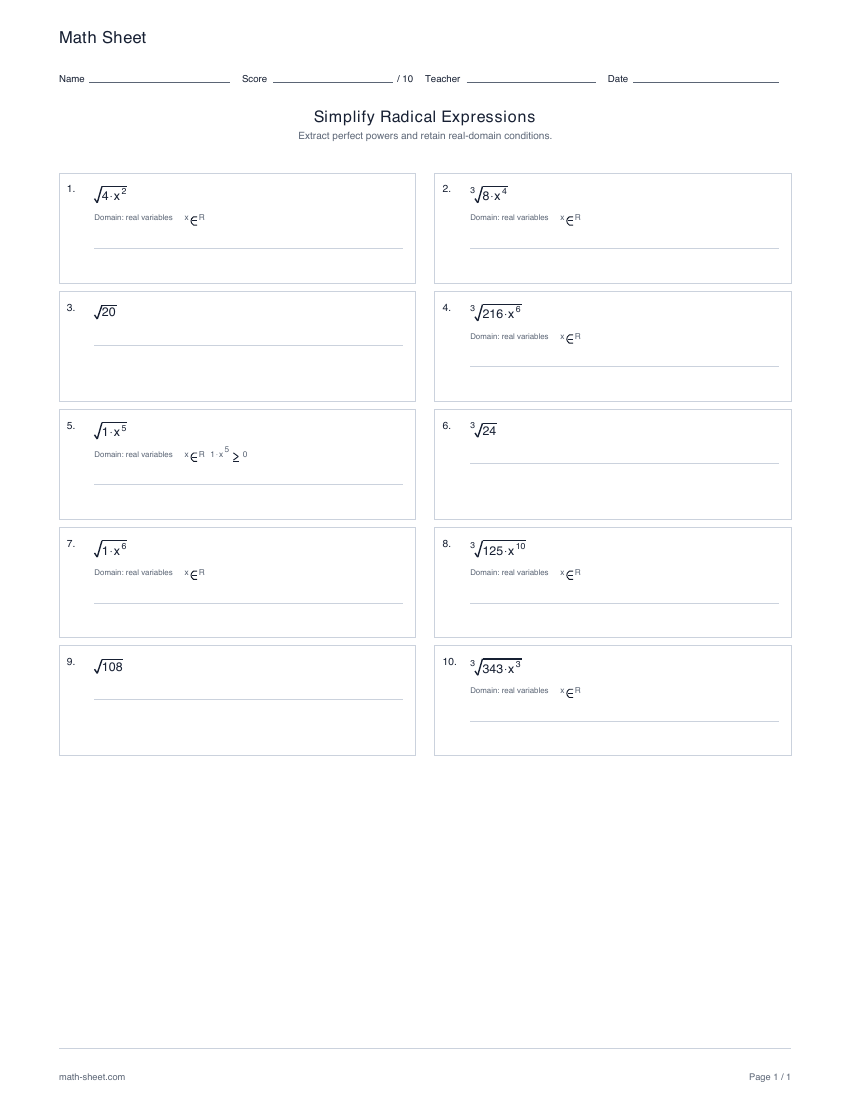
Exponents and radicals
Practice 10 numeric-only, variable-only or mixed radicals with square, cube, fourth, fifth or sixth roots. Extract perfect powers and use absolute values where even roots require them.
Preview and download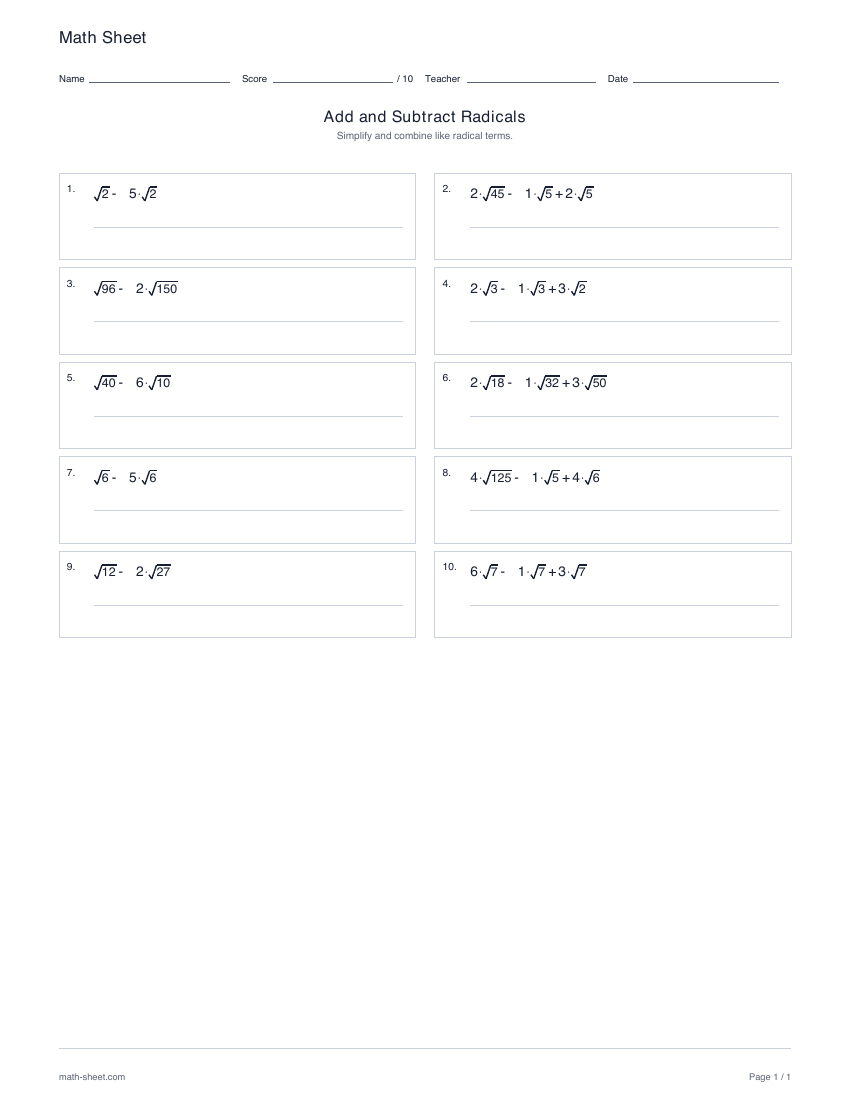
Exponents and radicals
Choose already simplified radicals, simplify-one, simplify-all or mixed problems for 10 sums and differences. Select unit, nonunit or mixed coefficients.
Preview and download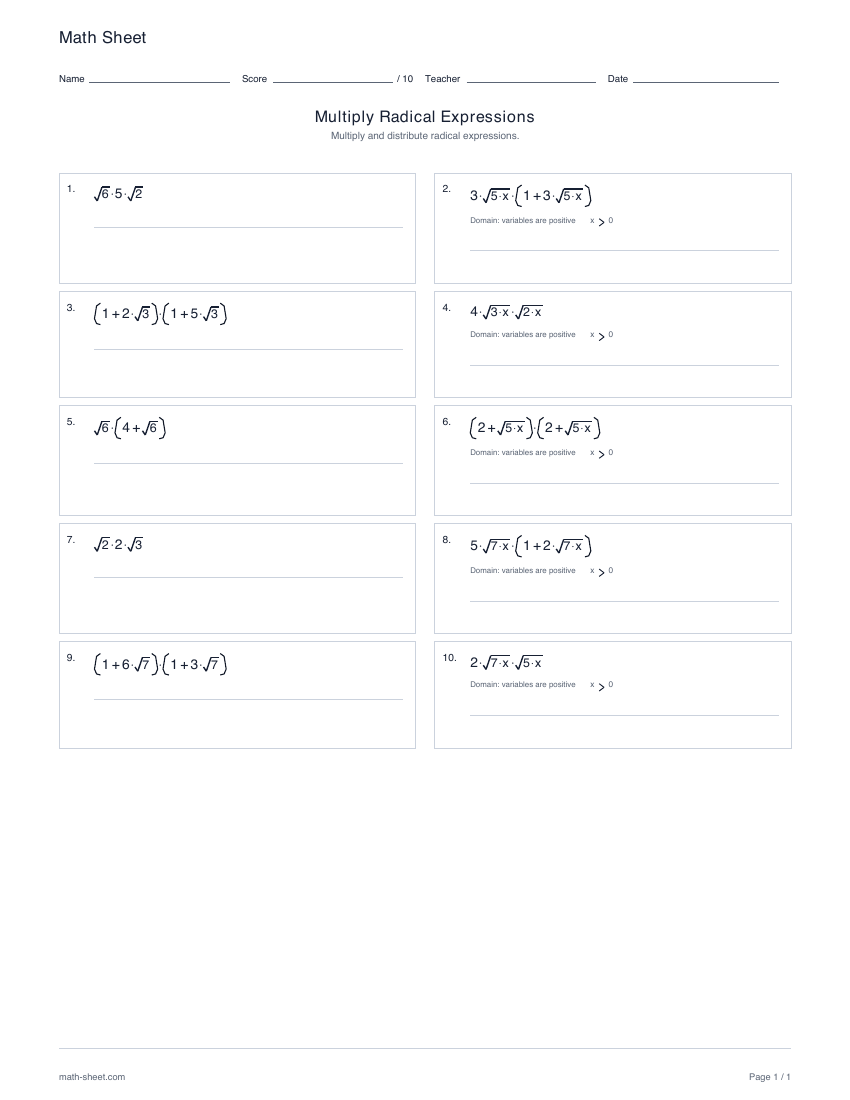
Exponents and radicals
Print 10 monomial-by-monomial, monomial-by-binomial or binomial-by-binomial radical products. Choose coefficient types and practice distributing before simplifying.
Preview and download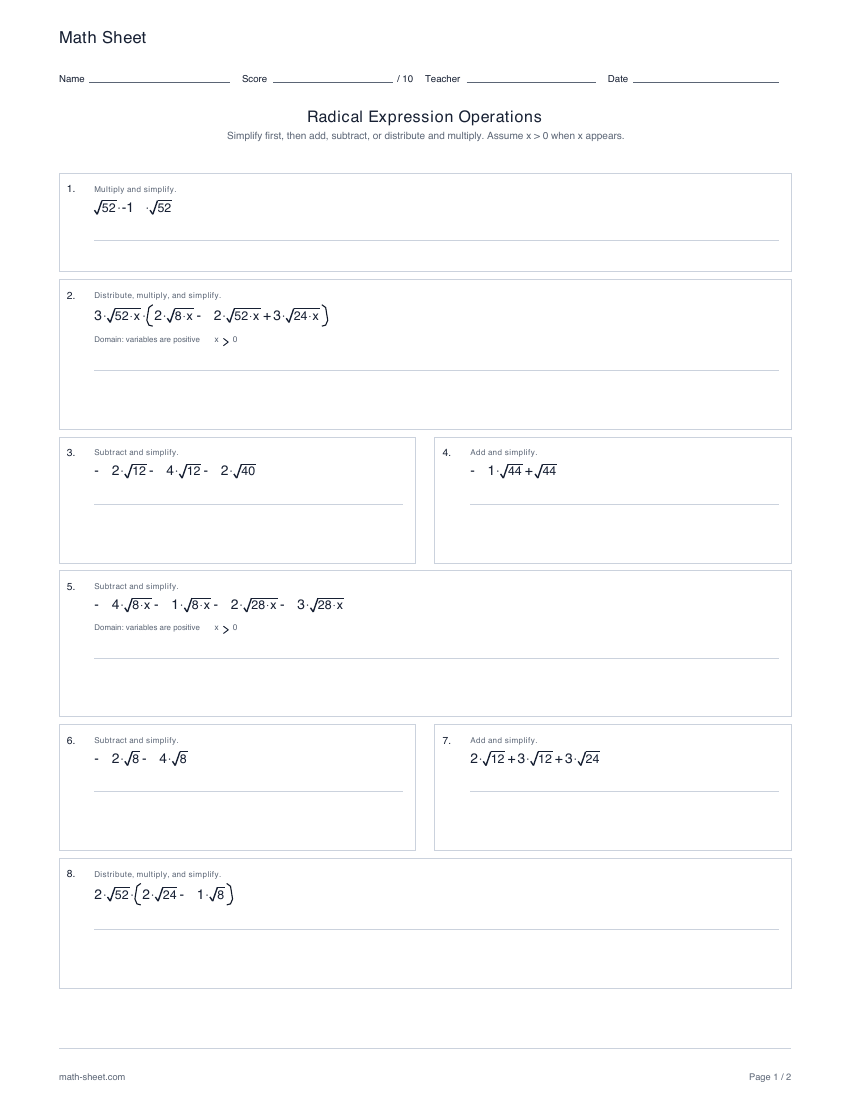
Exponents and radicals
Generate 10 mixed addition, subtraction and multiplication problems with independently selectable Easy, Medium and Hard profiles. Numeric practice progresses from two to three visible radical terms; Hard problems use x with x > 0 and include genuine trinomial products.
Preview and download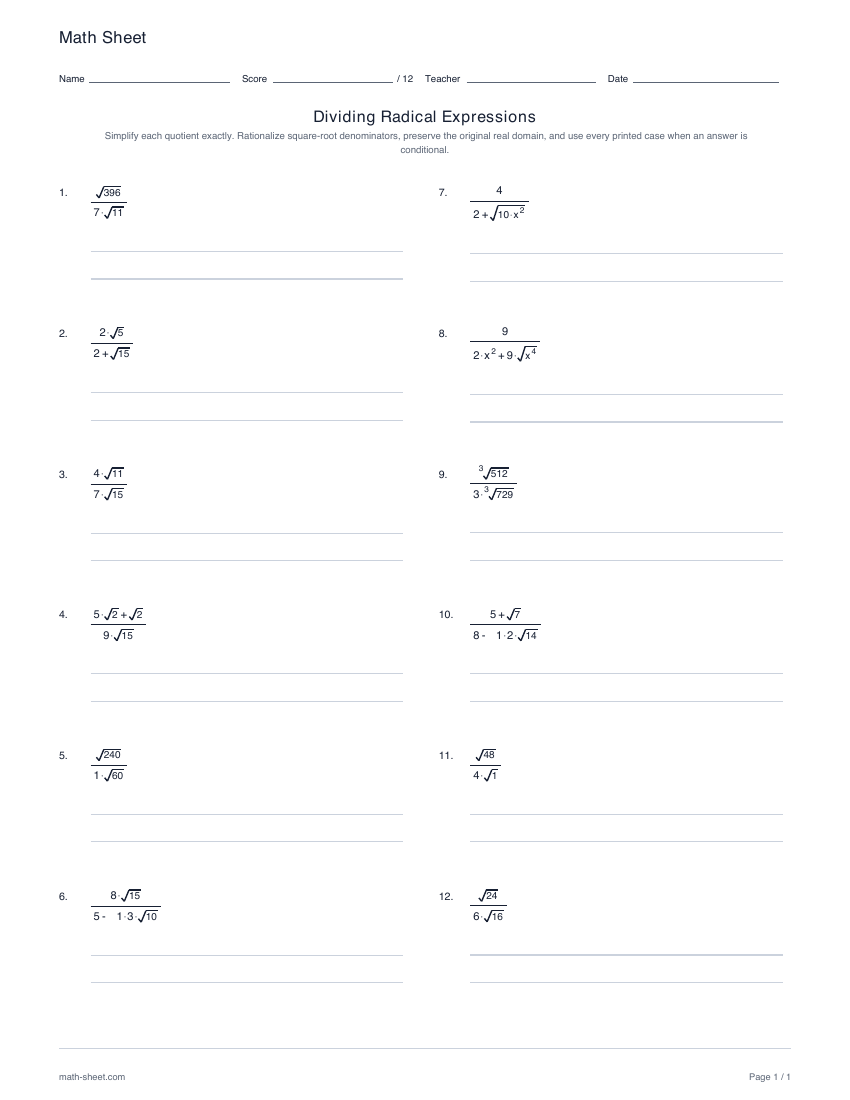
Exponents and radicals
Generate twelve dividing-radicals questions in independently selectable easy, medium and hard profiles, with exact rationalization, higher perfect roots and real-variable domain cases.
Preview and downloadBuild the next skill
Distinguish substituting a known input from finding an unknown. Connect logarithms with powers, expand and condense their expressions, use change of base or supplied log values, and check equation candidates against the original domain.
Exponents and radicals
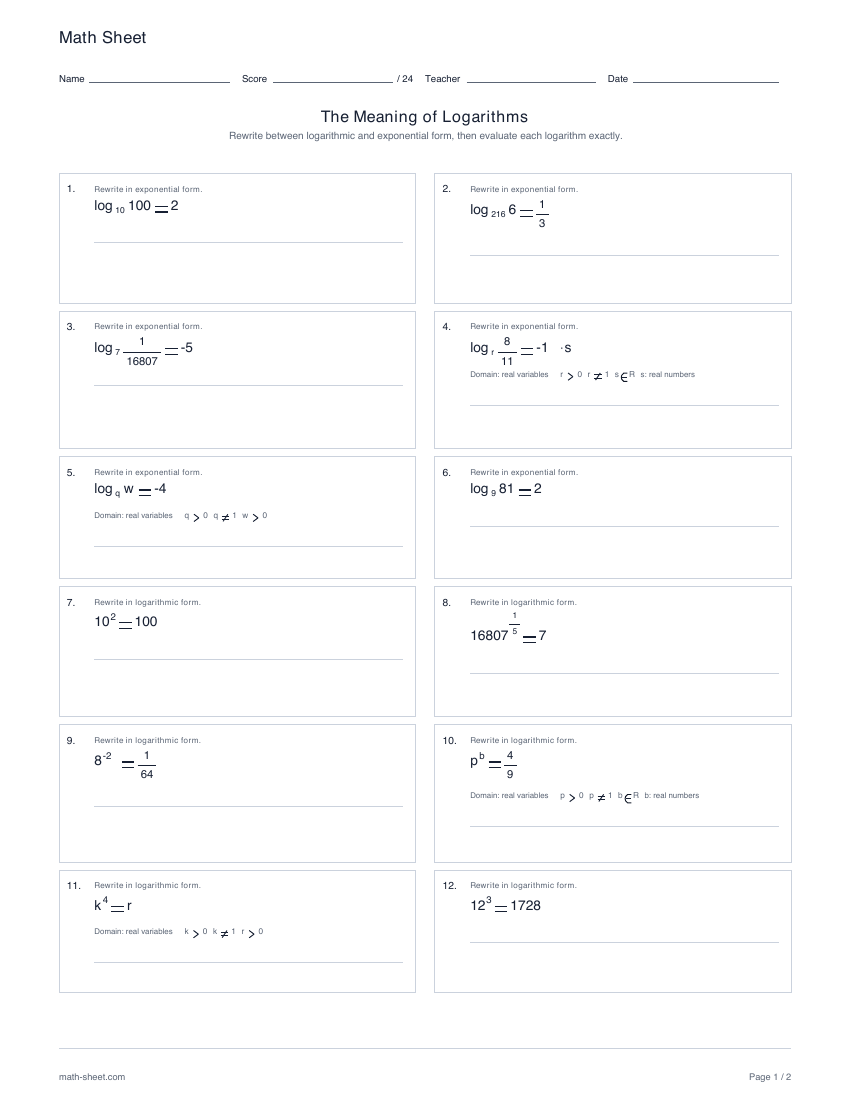
Rewrite exponential and logarithmic equations and evaluate exact logarithms. Choose numeric or symbolic forms, fractional exponents and reciprocal arguments, with separate answers.
Preview and download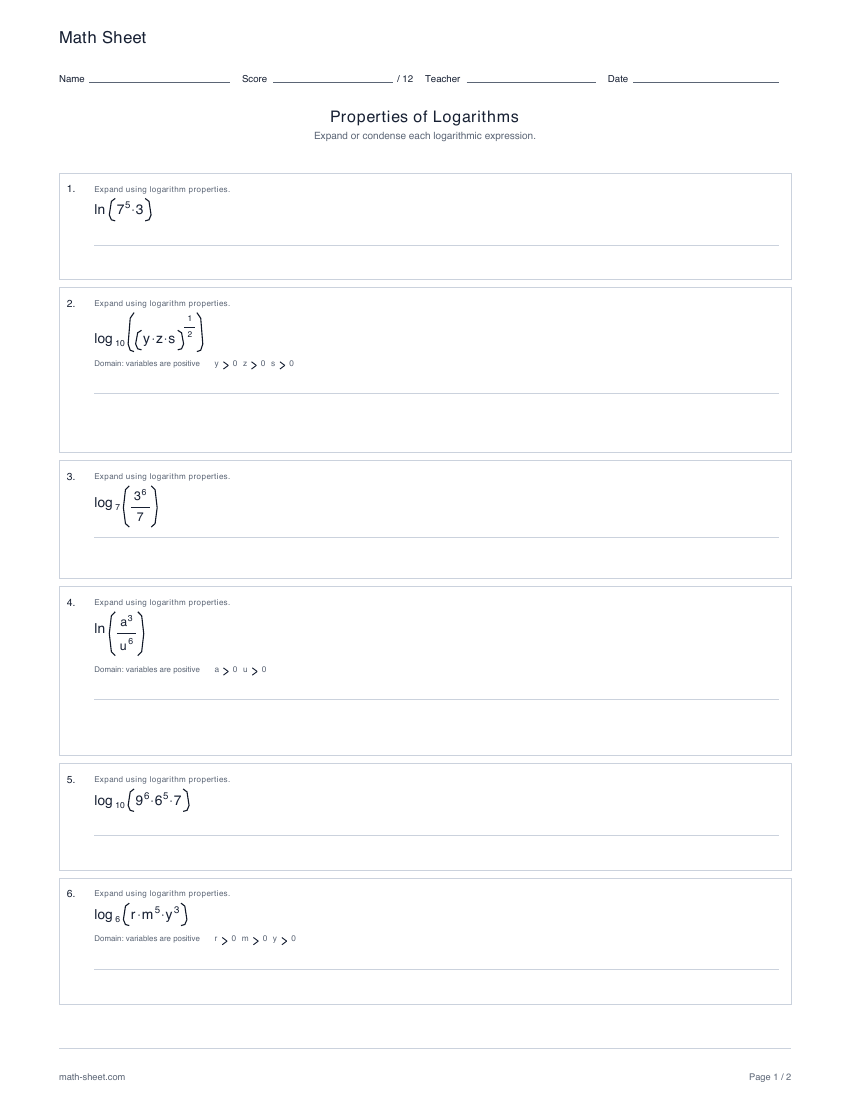
Exponents and radicals
Expand and condense logarithms with 16 selectable product, quotient and power forms. Practice natural logs, base-ten logs and fractional powers with exact symbolic answers.
Preview and download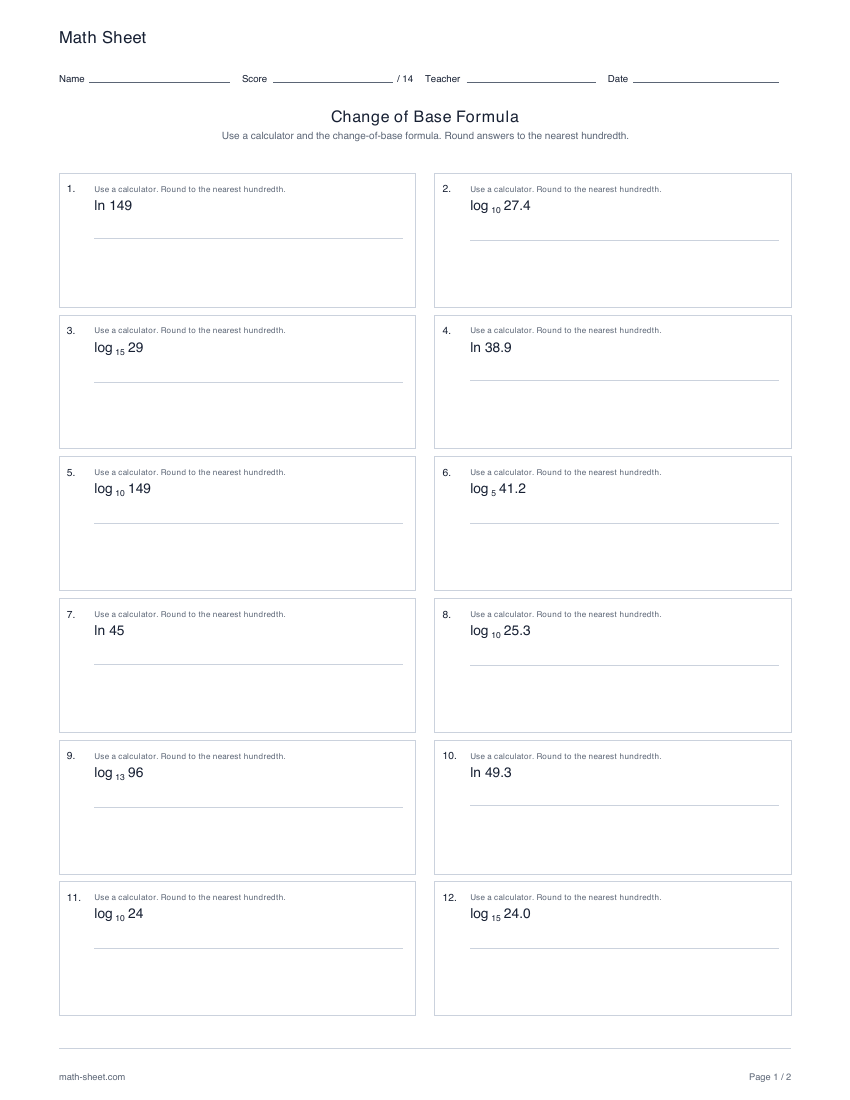
Exponents and radicals
Use a calculator to evaluate natural, common and other logarithms. Choose 12, 14 or 16 questions and round answers to two or three decimal places.
Preview and download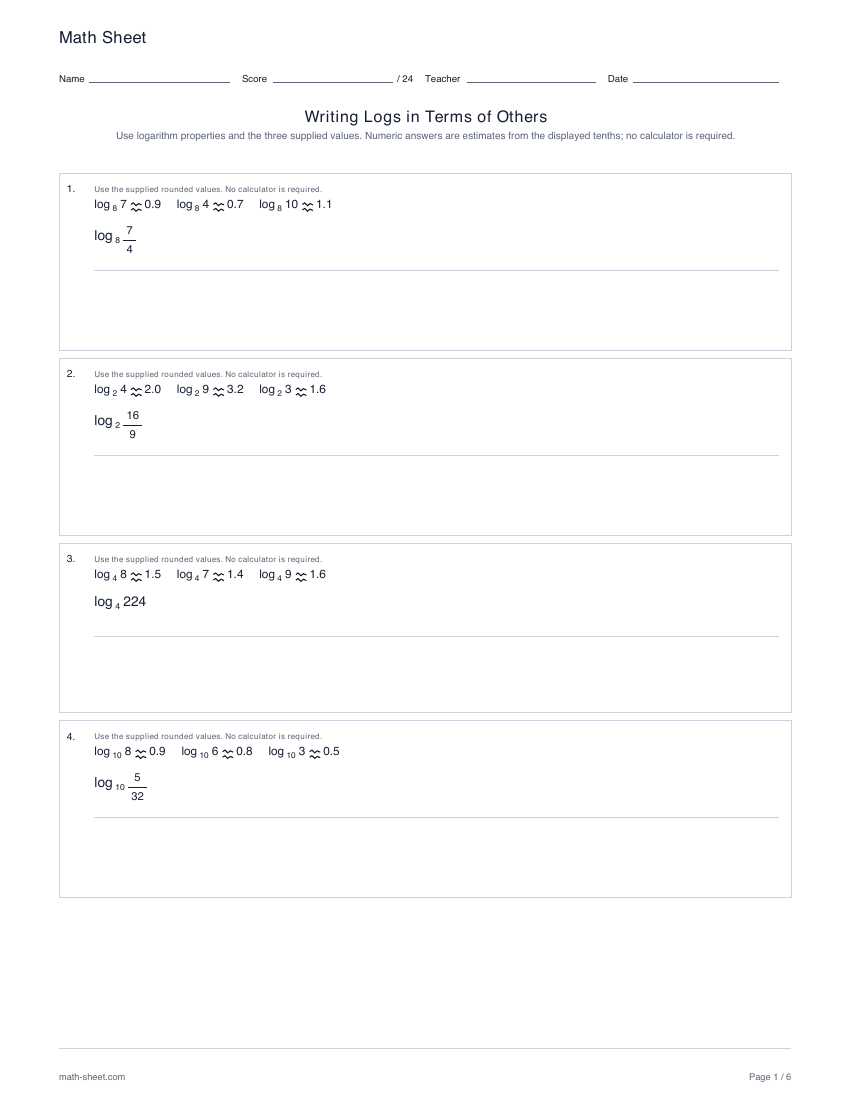
Exponents and radicals
Use three given logarithms to find another value without a calculator. Select nine forms and practice with numbers, letters or a mix of both.
Preview and download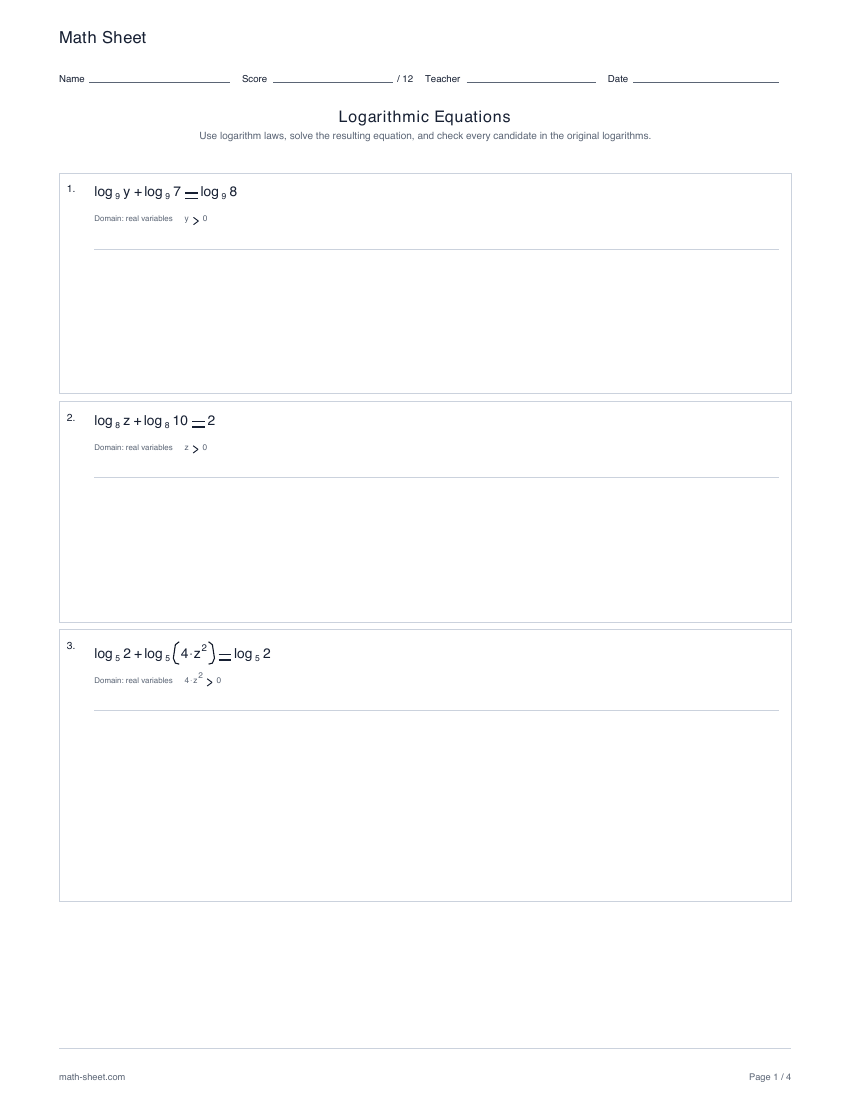
Exponents and radicals
Solve six types of logarithmic equations with exact answers. Choose 12, 14 or 16 questions and check every solution in the original logarithms.
Preview and download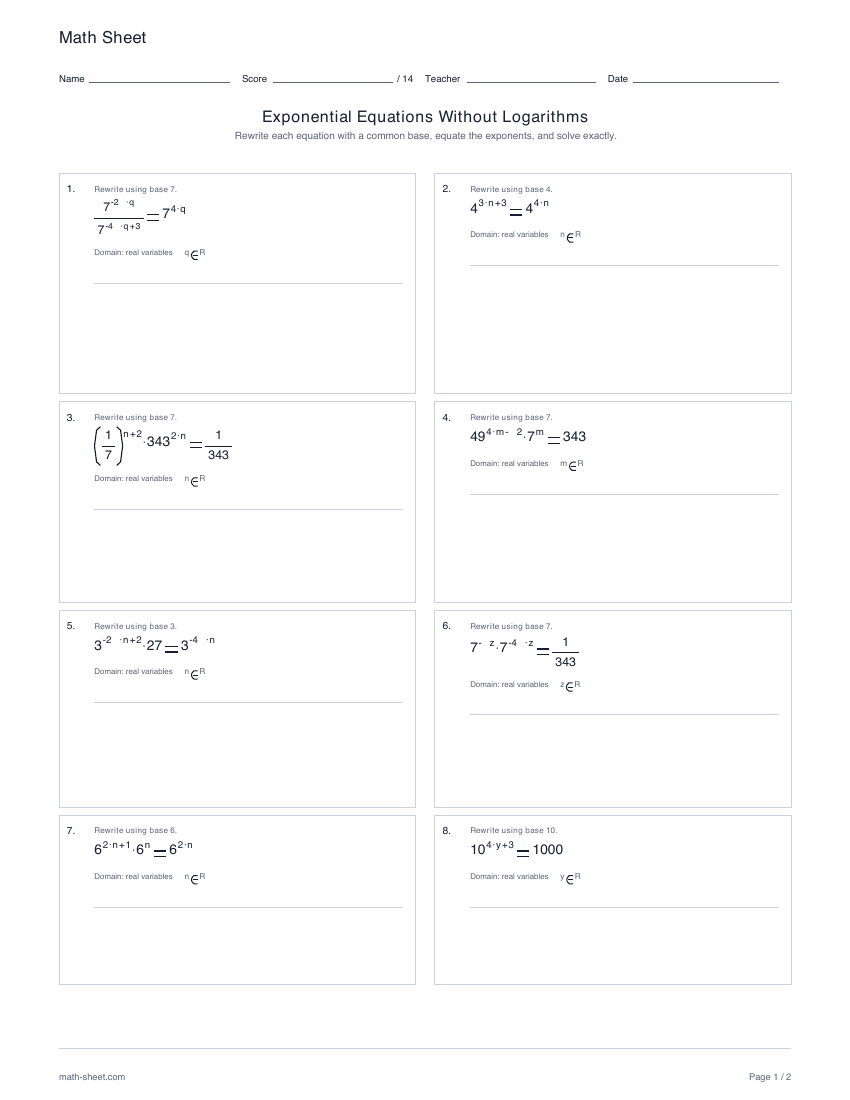
Exponents and radicals
Solve nine types of exponential equations by rewriting to a common base. Choose 12 or 14 questions with exact fraction answers and worked keys.
Preview and download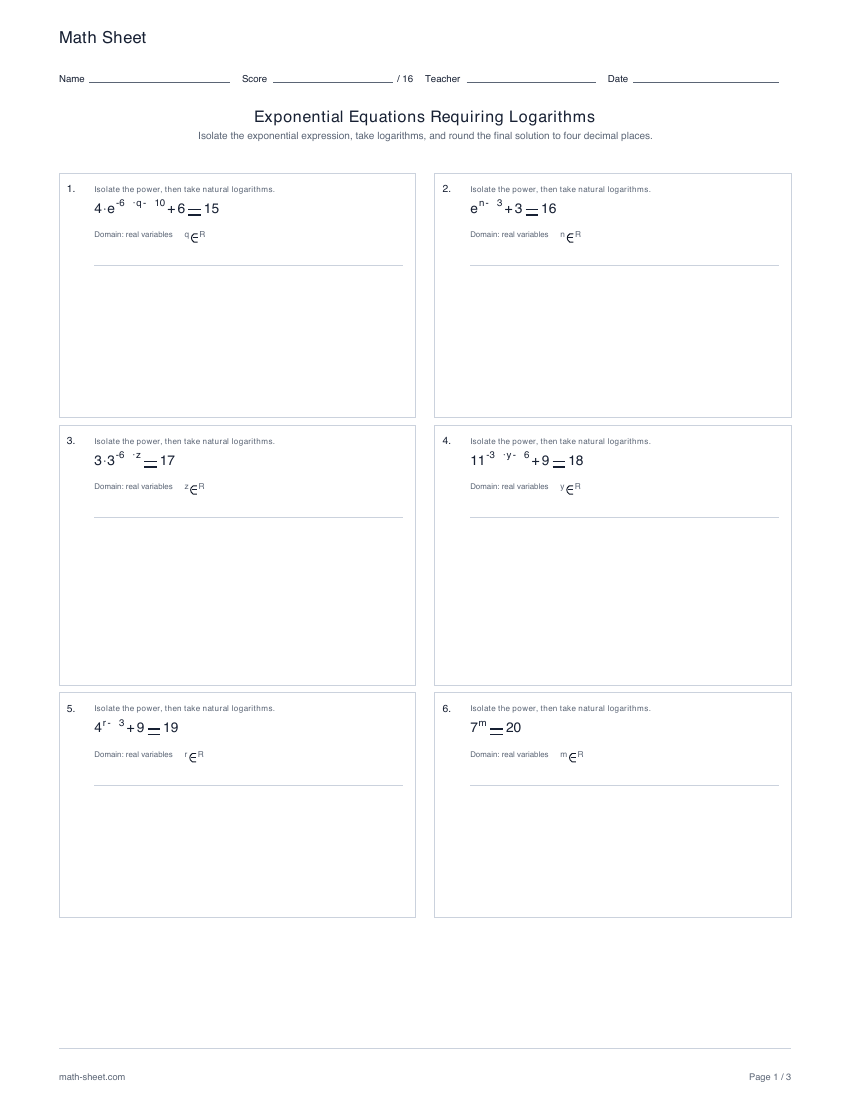
Exponents and radicals
Solve six types of exponential equations using logarithms, including natural-base equations. Choose 12, 14 or 16 questions with worked keys and four-place answers.
Preview and download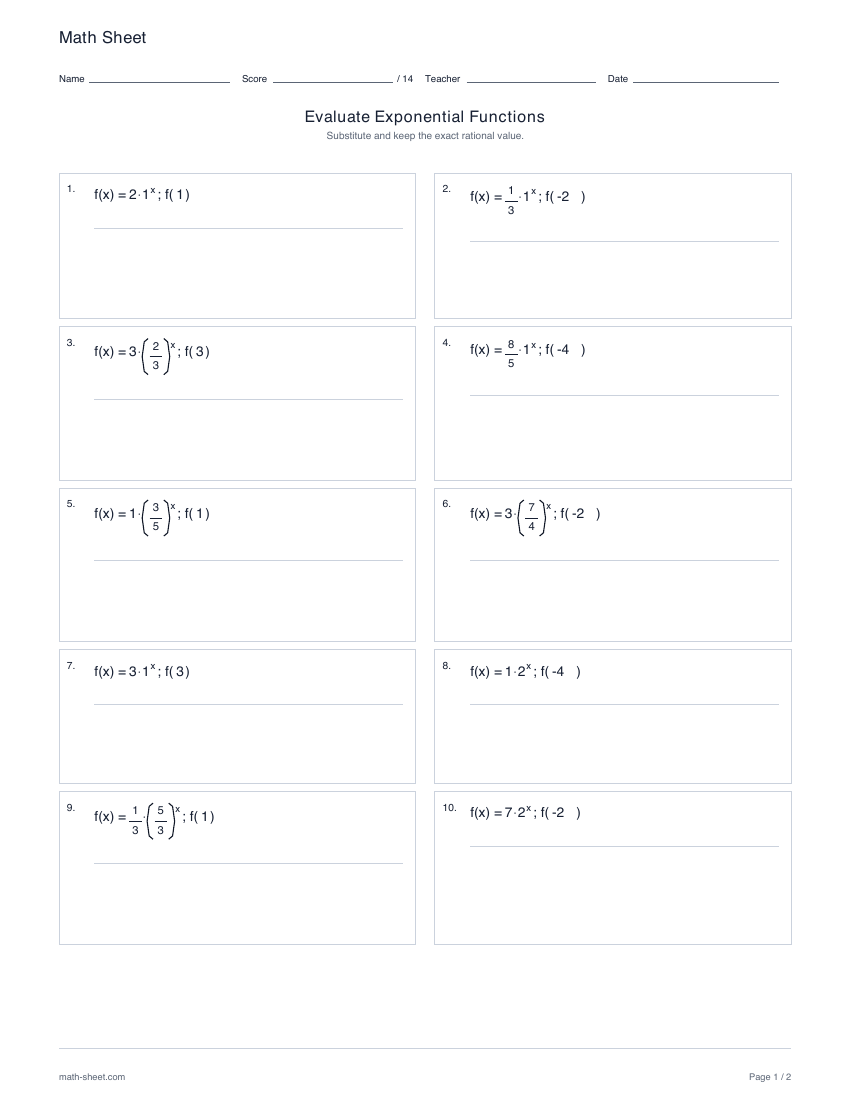
Exponents and radicals
Evaluate 14 exponential functions at positive, negative or mixed integer inputs. Keep exact fraction answers and show a hundredth approximation when needed.
Preview and download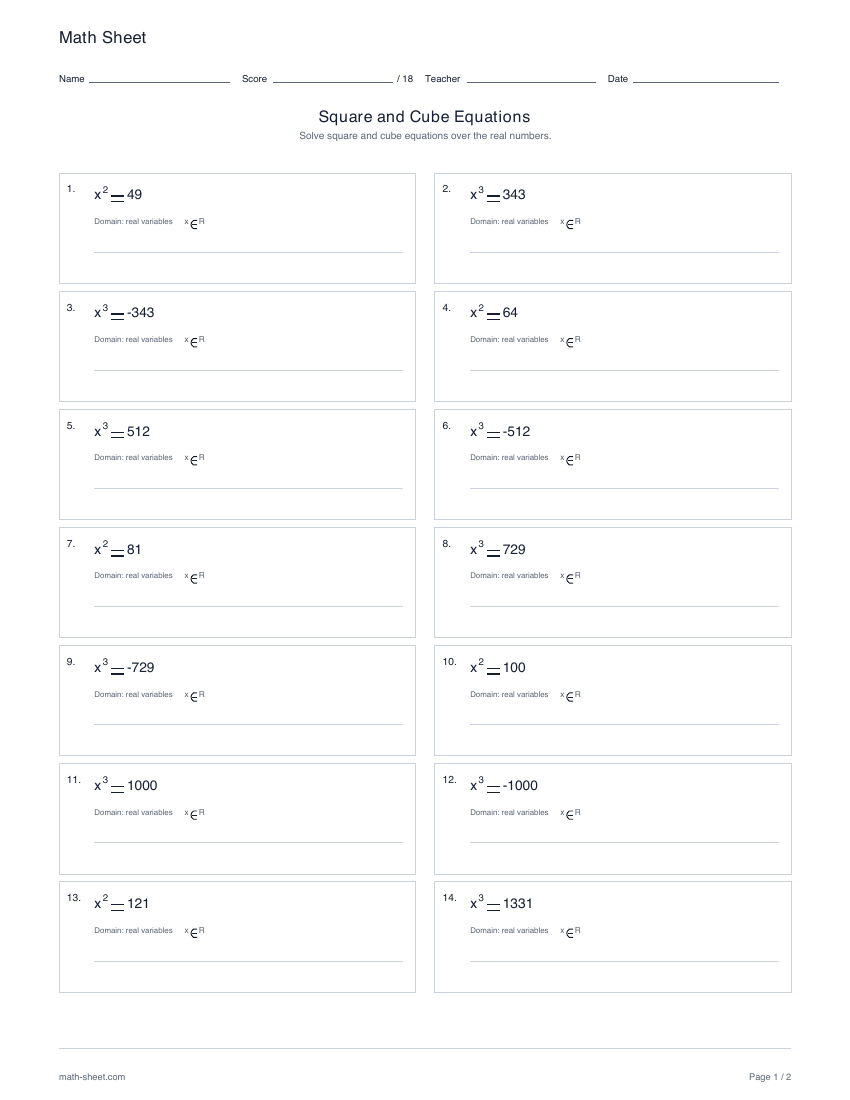
Exponents and radicals
Generate 18 equations with squared, cubed or rooted variables. Set magnitudes from 1 to 20, choose equation types and select the signs of cubic values.
Preview and download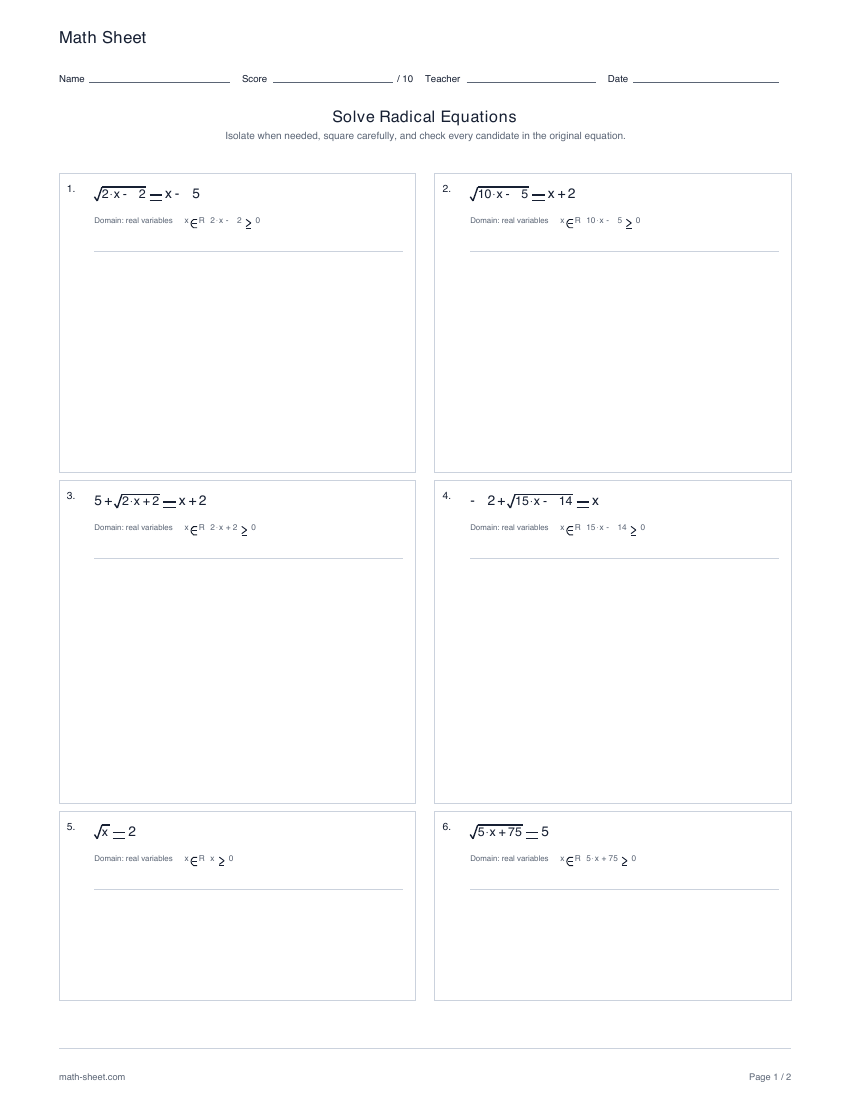
Exponents and radicals
Generate 10 radical equations in independently selectable Easy, Medium and Hard profiles. Practice isolating roots, solving, and rejecting candidates that fail the original equation.
Preview and download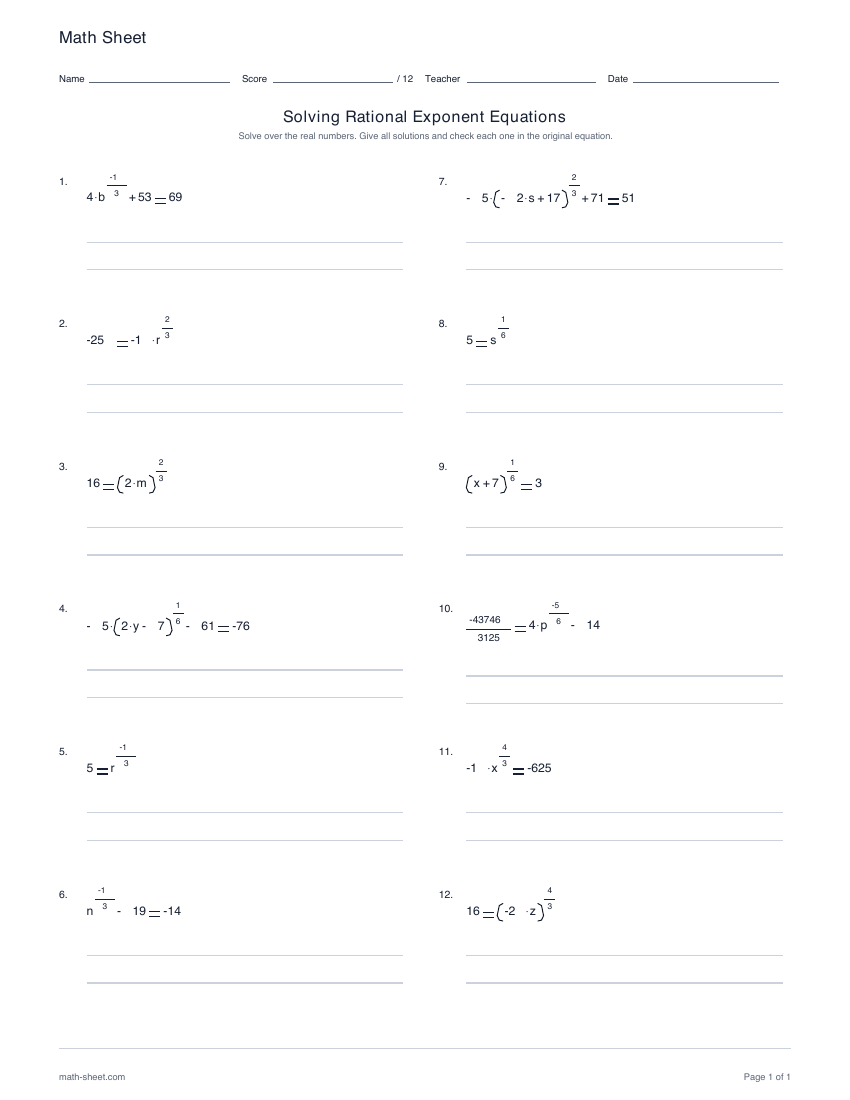
Exponents and radicals
Solve twelve exact rational exponent equations over the real numbers. Choose easy, medium or hard profiles and print a worked answer key with domain and substitution checks.
Preview and downloadBuild the next skill
Convert between ordinary and scientific notation, then calculate with normalized coefficients. These are exact-number exercises; measurement precision has its own collection.
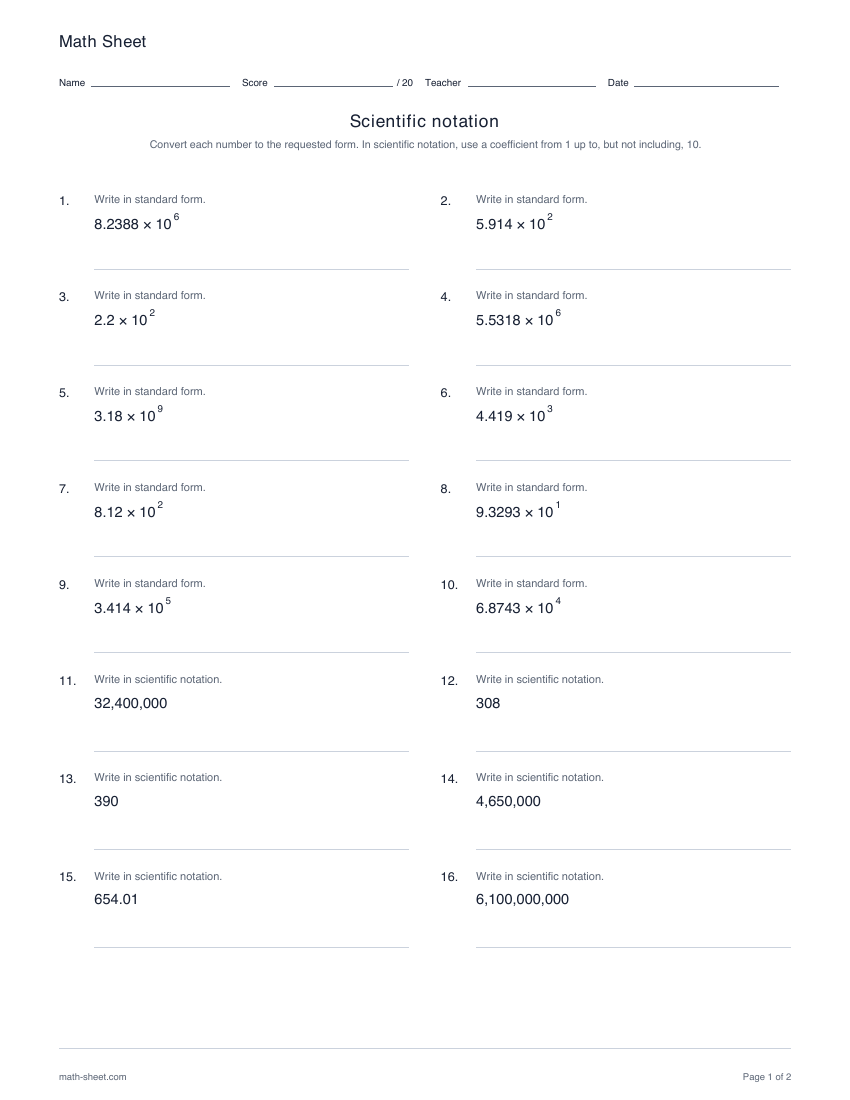
Place value
Choose 20 conversion questions or an optional English 10-task understanding lesson with coefficient normalization, misconception checks and a separate reasoning key.
Preview and download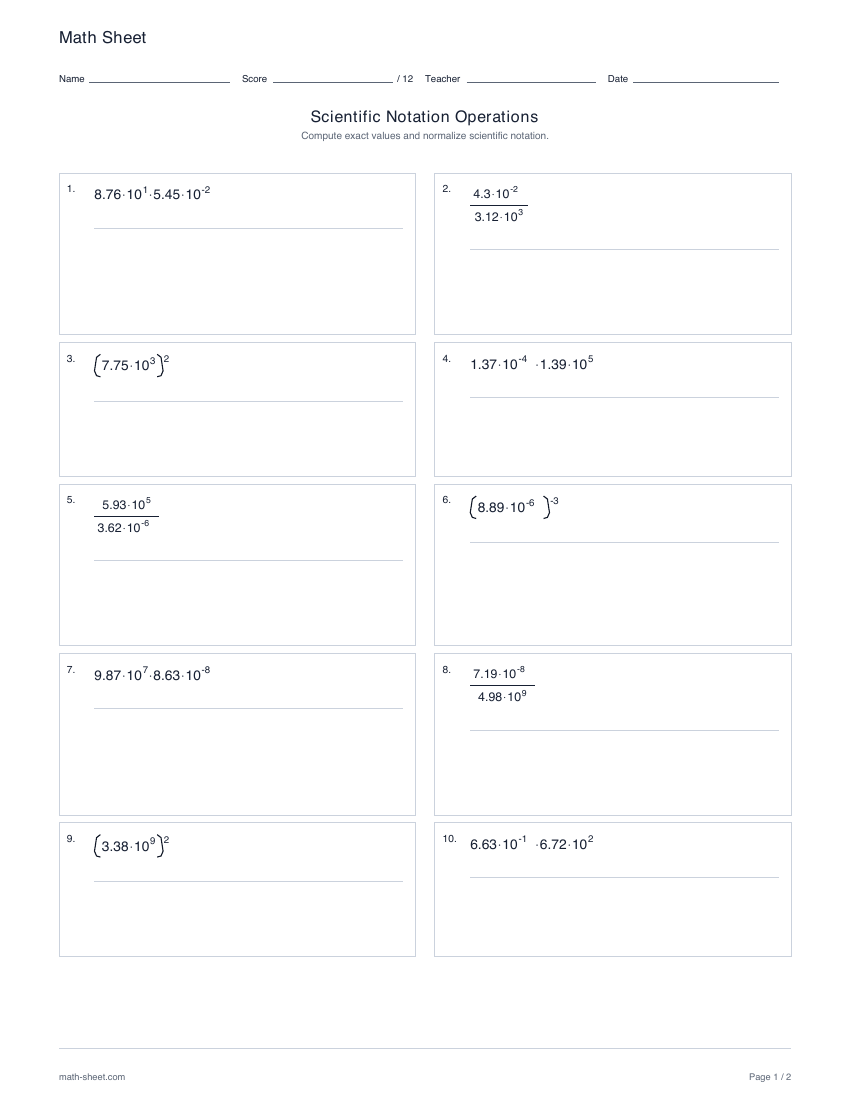
Exponents and radicals
Select multiplication, division and powers for 12 scientific notation problems. Choose exponent signs, normalize coefficients and keep exact answers or clearly marked approximations.
Preview and downloadChange one source of difficulty at a time: the base sign, exponent type, number of terms or equation structure. These starting points open the same worksheet with focused settings.
Use positive bases and familiar repeated multiplication before introducing negative exponents.
Open this starting point →Compare the reciprocal of a fraction with a reciprocal after taking an exact root.
Open this starting point →Compare products and quotients with positive exponents before mixing signs.
Open this starting point →Focus on even roots over real-variable domains and check the result with a negative substitution.
Open this starting point →Begin with radicals already in simplest form so the coefficient arithmetic is the main task.
Open this starting point →Use two-binomial radical products to connect distribution with exact root simplification.
Open this starting point →Balance numeric and positive-variable practice across addition, subtraction and multiplication without choosing operations separately.
Open this starting point →Compare one-term and two-term radical quotients while keeping the denominator restrictions visible.
Open this starting point →Practice retaining one valid solution and rejecting candidates introduced by squaring.
Open this starting point →Use familiar squares and write the complete real solution set.
Open this starting point →Multiply coefficients, add the powers of ten, then return the coefficient to the interval from 1 to 10.
Open this starting point →Evaluate a root
7
The principal square-root symbol names the nonnegative root.
Solve an equation
x = −7 or 7
Both values square to 49, so both belong to the solution set.
Simplify with a variable
|x|
Absolute value keeps the result nonnegative even when x is negative.
The product rule adds exponents when the bases match. The quotient rule subtracts exponents where the original denominator is nonzero. A power of a product acts on every factor, including the coefficient.
Radicals need their own checks. Combine like radical terms only after simplifying them. For a binomial denominator, use a conjugate and check that it does not create a zero denominator. After squaring an equation, test every candidate in the original equation.
Begin with simple powers if repeated multiplication or signed arithmetic is uncertain. Move to exponent laws after the notation is secure, then use square-root simplification before radical operations.
Yes. The integer-base and fraction-base evaluation worksheets offer separate exponent kinds. Fractional-exponent tasks use exact roots; negative bases use odd root indices so the answers stay real.
It is the base magnitude for a power, or the resulting root magnitude for a root. A range from 1 to 10 therefore includes 10³ and ∛1000. A very narrow range repeats its available facts.
Candidate roots are checked in the original equation. The final answer includes only valid real solutions. Choose a one-solution or two-solution set according to the practice needed.
The calculation keeps an exact value. Exact normalized coefficients with up to six decimal places stay exact; longer or repeating coefficients are rounded to three places and marked approximate. This differs from significant-figure measurement rules.
Logarithm worksheets are currently in English; other custom worksheets offer eight printed languages. All activities support Letter and A4. Include or omit the answer key; the two fixed reference sheets have no answer edition or random regeneration.
Review distribution, substitution and like terms before introducing radical terms.
Explore expressions →Strengthen inverse operations and exact checking with linear equations.
Explore equations →Learn when a measured result needs significant-figure rounding.
Explore significant figures →