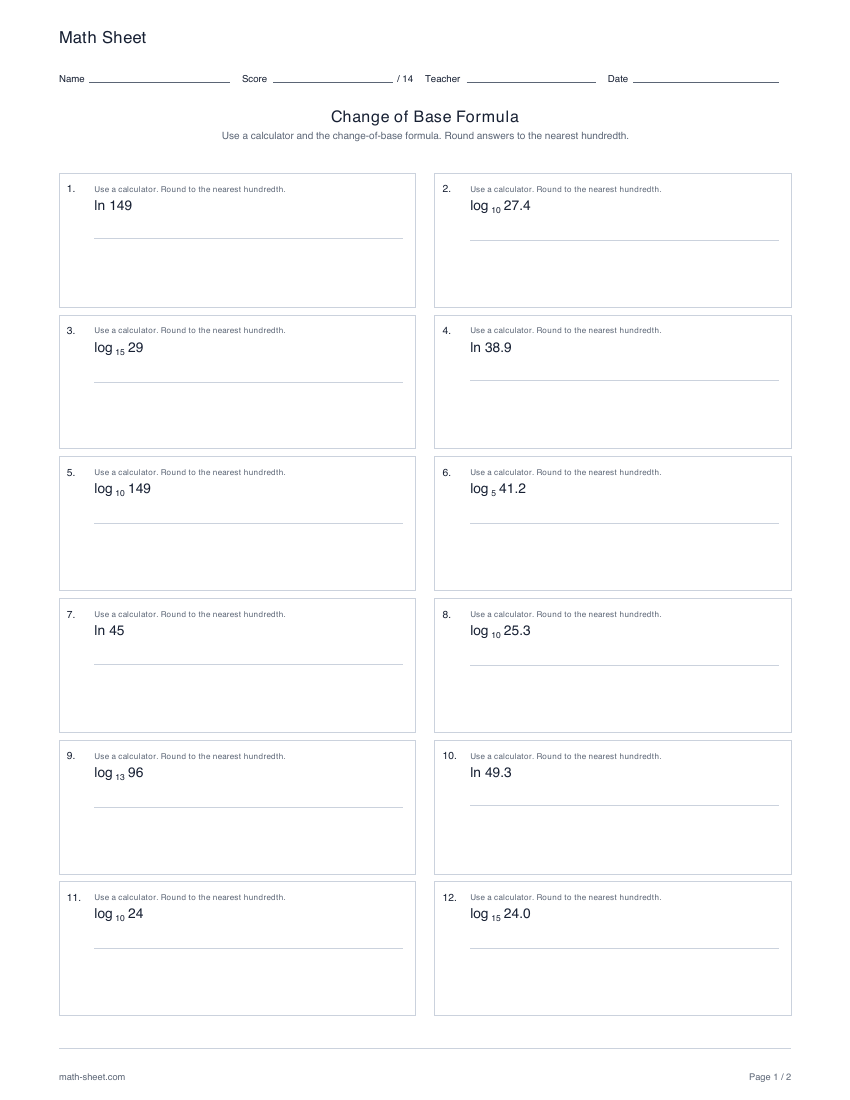
Choose 12, 14 or 16 calculator questions and answers rounded to the nearest hundredth or thousandth. The default has 14 questions rounded to hundredths. Questions mix ln, explicit base-ten logarithms and other integer bases.
For a positive argument x and a base b greater than zero and different from one, log base b of x = ln(x) / ln(b). Keep all calculator digits until the final division, then round. An approximation sign distinguishes the rounded decimal from the exact logarithm.
The preview and downloaded PDF use the same resolved questions. Answers follow on separate pages; choose the student-only edition when handing out the exercise.
Learning objective
What this activity builds
Apply the change-of-base formula and round only the final logarithm value to the requested precision.
Worked example
Approximate log base 7 of 25 to the nearest hundredth.
ln(25) / ln(7) is approximately 1.65.
Divide the logarithm of the argument by the logarithm of the base. Use the same logarithm function for both values and round only after dividing.
Teaching notes
Make the practice count
Use either ln or common log consistently in the quotient.
Keep the argument in the numerator and the base in the denominator.
Preserve trailing zeros when the requested precision needs them.
Arguments between zero and one give negative answers for these bases.
Make it yours
Customize the practice
Choose your options, update the preview, then download the exact same pages.
Choose the worksheet length and rounding precision. Calculator answers are rounded only at the final step.
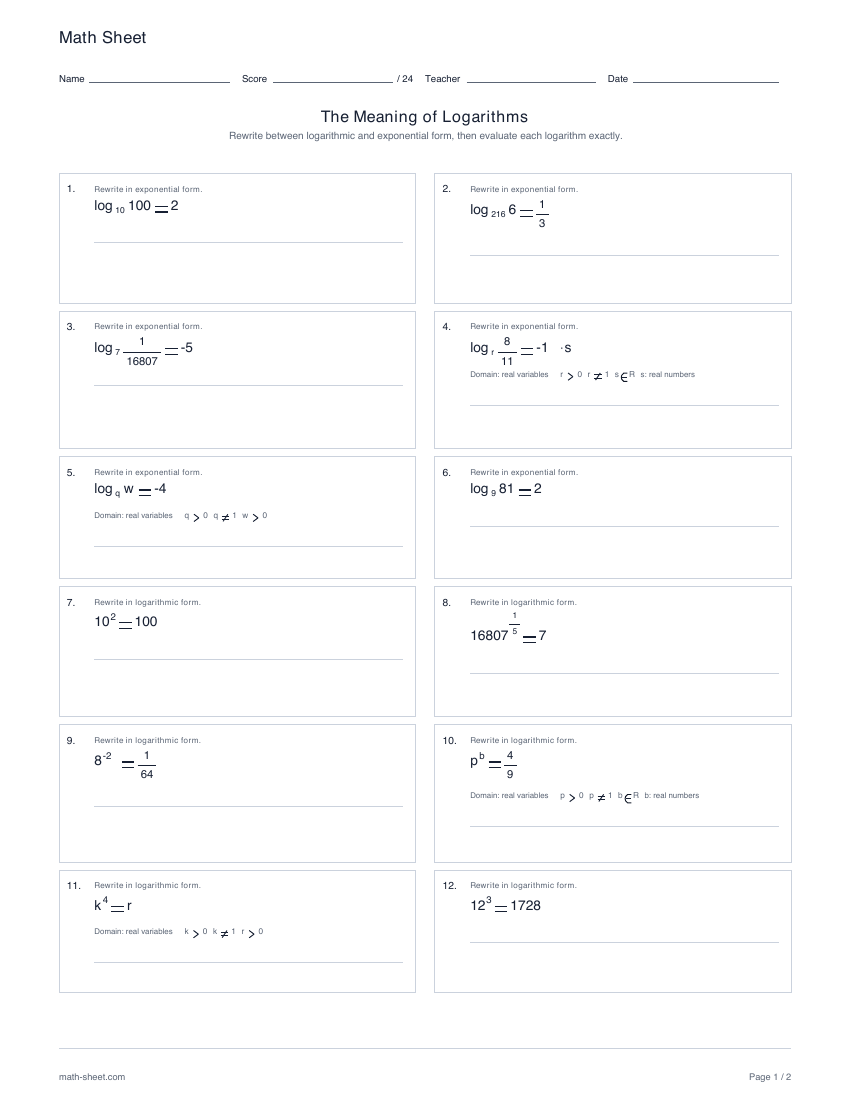
Rewrite exponential and logarithmic equations and evaluate exact logarithms. Choose numeric or symbolic forms, fractional exponents and reciprocal arguments, with separate answers.
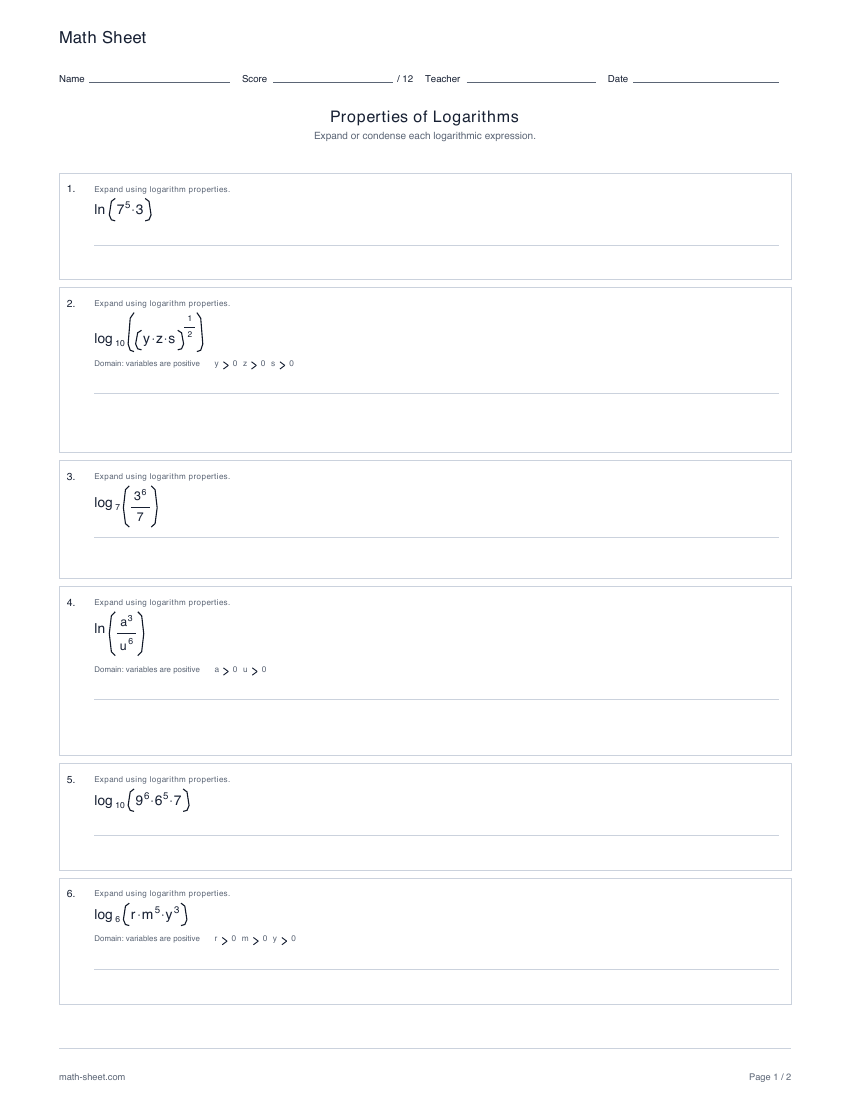
Expand and condense logarithms with 16 selectable product, quotient and power forms. Practice natural logs, base-ten logs and fractional powers with exact symbolic answers.
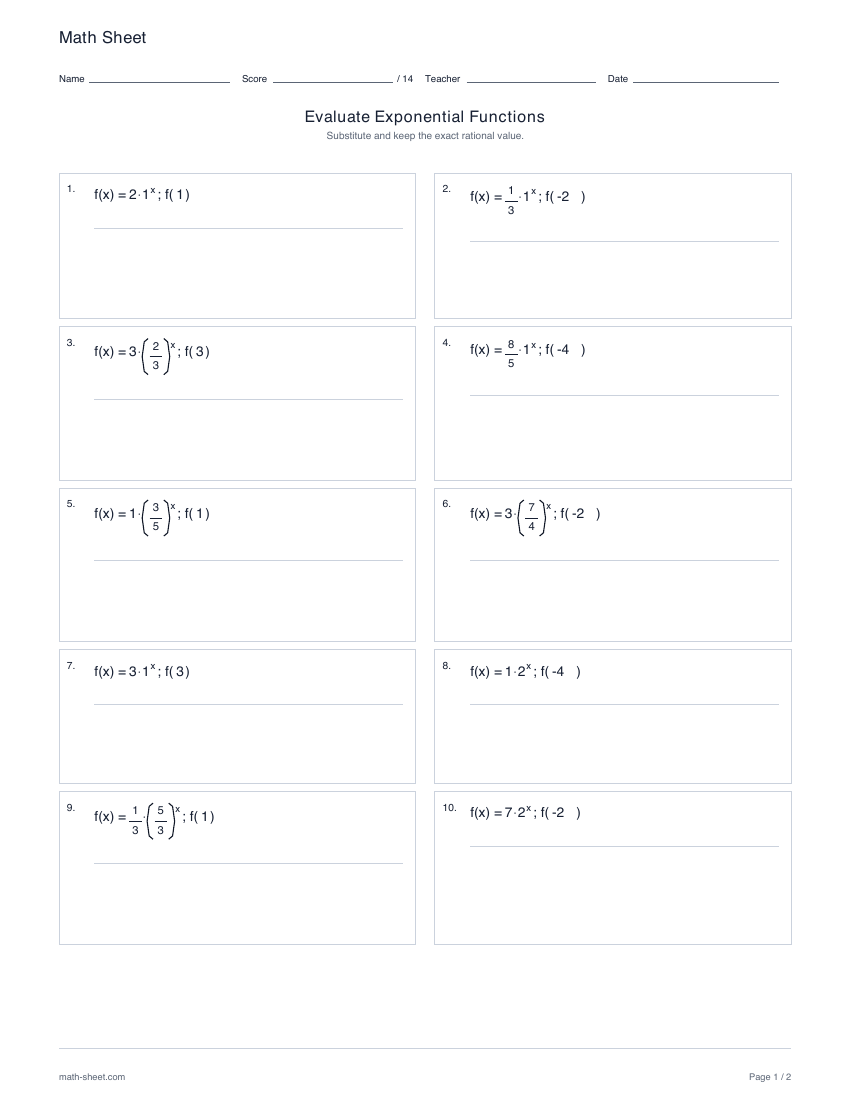
Evaluate 14 exponential functions at positive, negative or mixed integer inputs. Keep exact fraction answers and show a hundredth approximation when needed.