
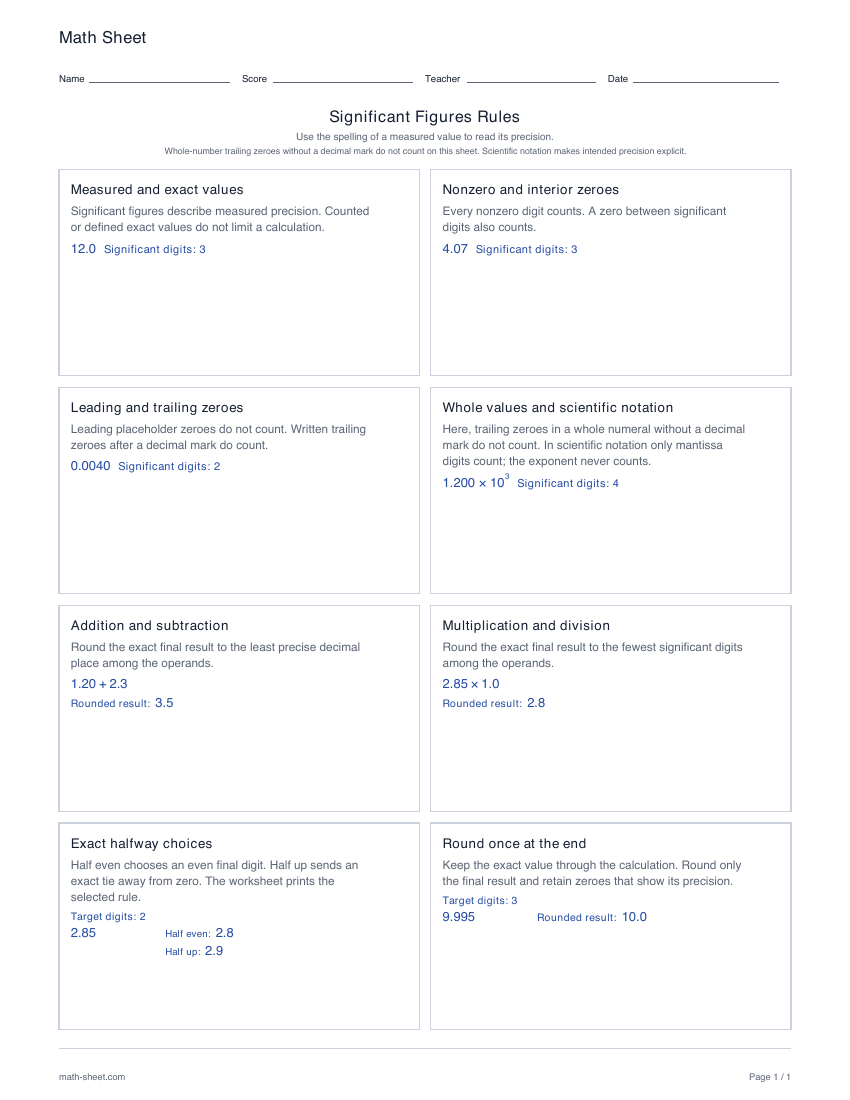
Significant figures
Significant figures rules handout
Print an original significant figures reference with zero rules, scientific notation, calculation rules and rounding examples. Choose Letter or A4 and a printed language.
Preview and downloadRead the digits. Keep the precision.
Learn what each written digit tells you. Count significant figures, calculate with measured values and round the final answer using the right rule.
Choose a worksheetEqual values. Different precision.
Precision in practice
Use the rules reference, then distinguish leading, interior and significant trailing zeroes in ordinary and scientific notation.
Significant figures
Print an original significant figures reference with zero rules, scientific notation, calculation rules and rounding examples. Choose Letter or A4 and a printed language.
Preview and download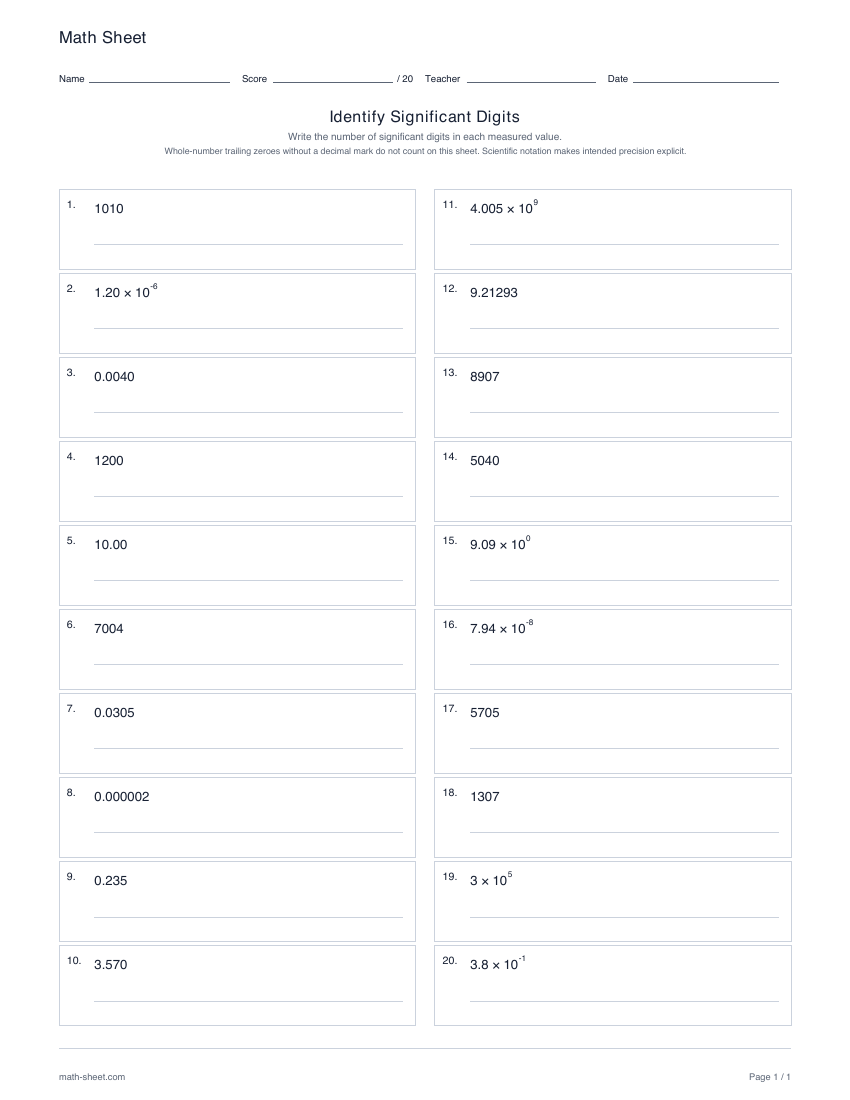
Significant figures
Count significant digits in whole numbers, decimals and scientific notation. Select any combination, generate 20 questions and print a separate answer key.
Preview and downloadPrecision in practice
Choose the rule that matches the operation. Keep all working digits until the final answer and state how exact halfway cases are rounded.
Significant figures
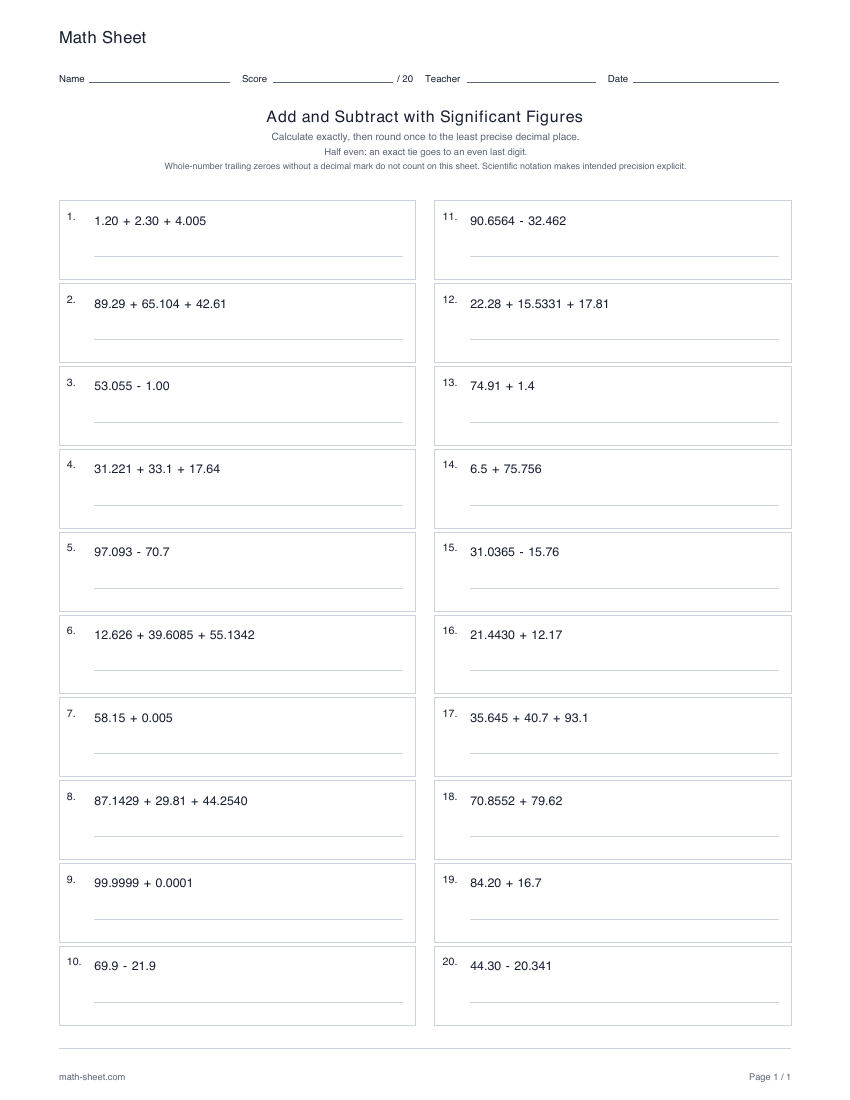
Practice two-number sums, three-number sums and subtraction with 20 questions. Round by decimal place, choose a halfway rule and print precision-preserving answers.
Preview and download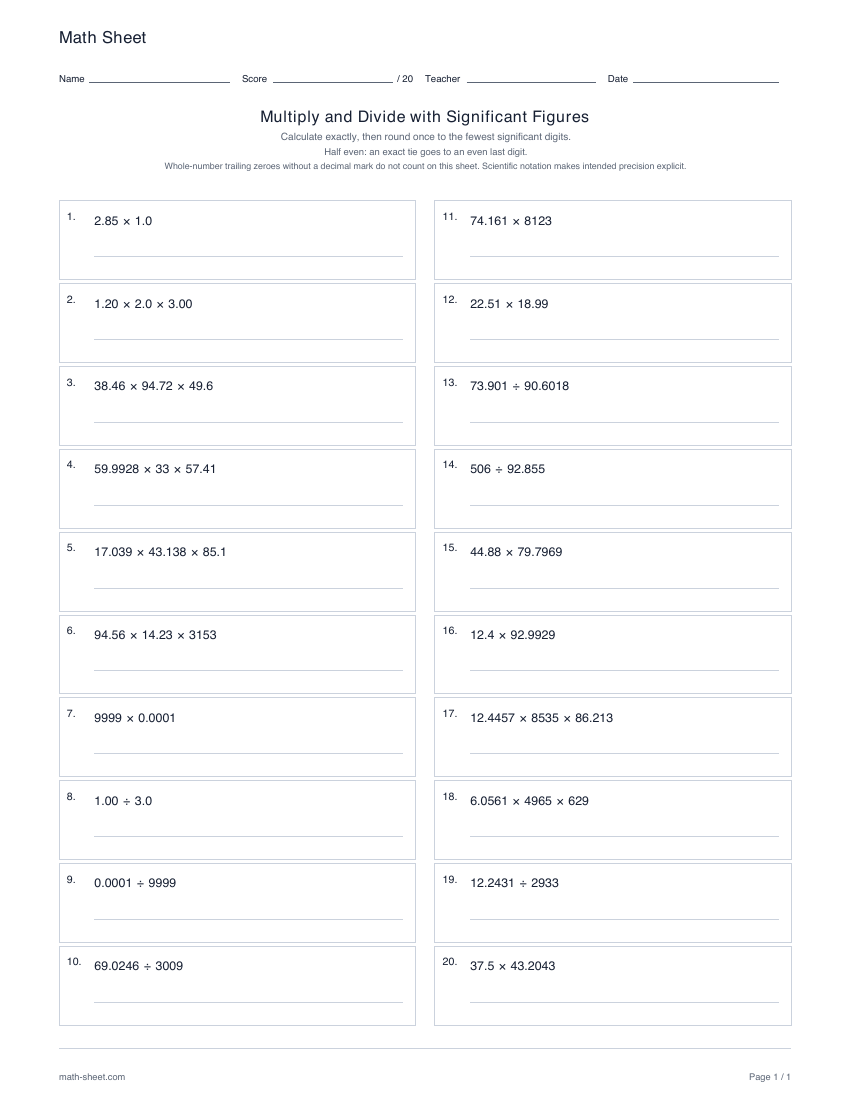
Significant figures
Generate 20 two-factor, three-factor or division problems. Round to the fewest significant digits, preserve meaningful zeroes and download the worksheet with answers.
Preview and downloadBegin with one kind of number or calculation. Combine choices when the learner can explain which digits matter and why.
Separate interior zeroes from trailing whole-number zeroes under the stated worksheet convention.
Open this starting point →Compare leading zeroes with significant zeroes at the end of a reported decimal.
Open this starting point →Practice scientific notation with positive, negative and zero exponents.
Open this starting point →Compare two-addend and three-addend sums while keeping the least precise decimal place visible.
Open this starting point →Use the least significant-digit count and avoid rounding before the final result.
Open this starting point →Practice subtraction with exact ties rounded away from zero. The selected rule is printed on the worksheet.
Open this starting point →Add or subtract
12.47 + 3.2 ≈ 15.7
The exact sum is 15.67. The tenths place in 3.2 sets the precision of the answer.
Multiply or divide
2.40 × 3.0 = 7.2
The factor 3.0 has two significant digits. Keep two in the final product, even though 2.40 has three.
Keep the full calculation until the end. Rounding an intermediate result can change the final answer.
Leading zeroes locate the decimal point. Interior zeroes count. Written trailing decimal zeroes also count: 0.0040 has two significant digits.
Whole-number trailing zeroes need a stated convention. On these worksheets, 2400 has two significant digits. To state four clearly, write 2.400 × 10³. The rules handout explains this convention before it appears in practice.
Each practice worksheet has 20 questions. Every selected kind appears, with the questions distributed as evenly as possible. The rules handout is a fixed reference.
Yes. In Identify significant digits, select scientific notation alone or combine it with whole numbers and decimals. Scientific exponents range from −9 through 9.
Exact ties round to even by default. The arithmetic worksheets also offer ties away from zero, often used in school rounding. Both rules round to the nearest value when the result is not exactly halfway.
It keeps the requested precision clear when a whole-number answer ends in zeroes, and makes very large or small results easier to read. For two significant digits, 1.0 × 10³ is more explicit than 1000.
Yes. Choose the student-only ready-made download or turn off Include answers in the settings. The rules reference has no separate answer edition.
Customized sheets support English, German, Albanian, Spanish, Italian, French, Turkish and Norwegian Bokmål. English uses a decimal dot; the other seven use a decimal comma.
Strengthen place-value understanding and written decimal arithmetic.
Decimal worksheets →Connect a rounding decision with the place being reported.
Rounding worksheets →Choose Letter or A4 and print at actual size for clear writing space.
Printing help →