
Probability
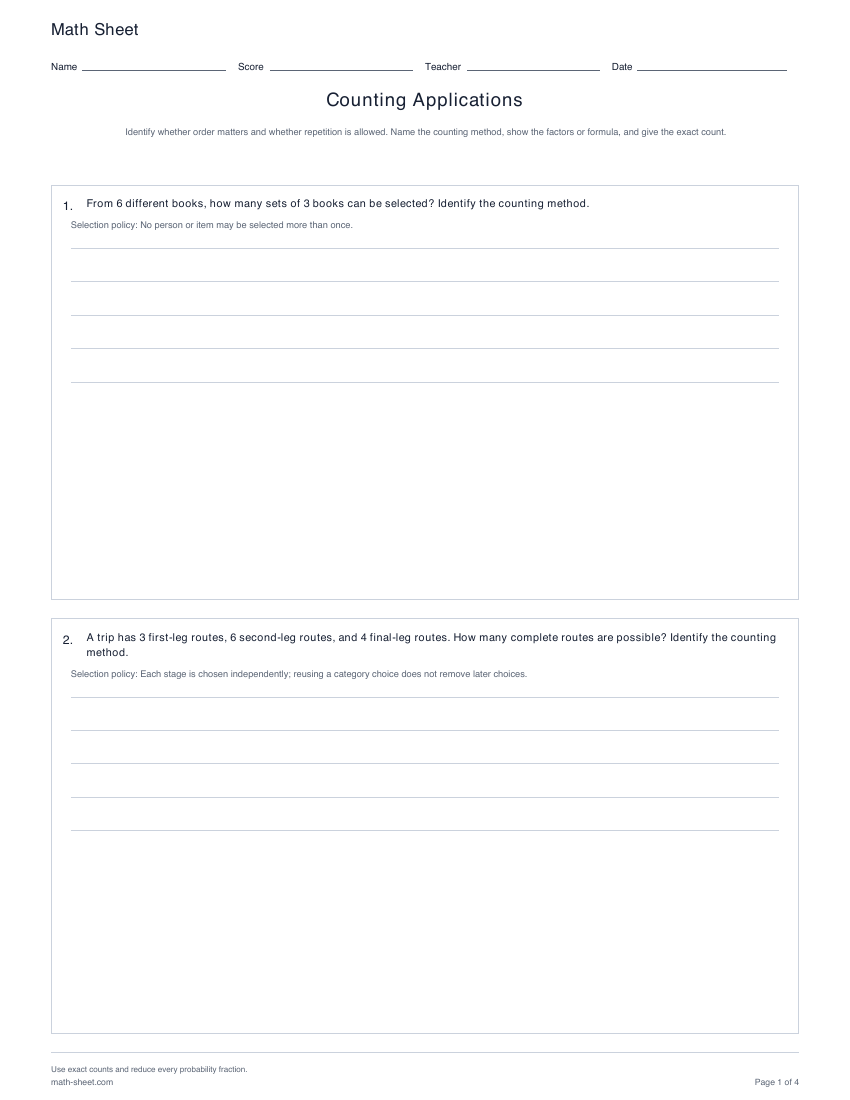
Counting Applications worksheets
Choose among the multiplication principle, ordered selections without replacement, and unordered combinations in varied finite contexts.
Preview and downloadProbability practice
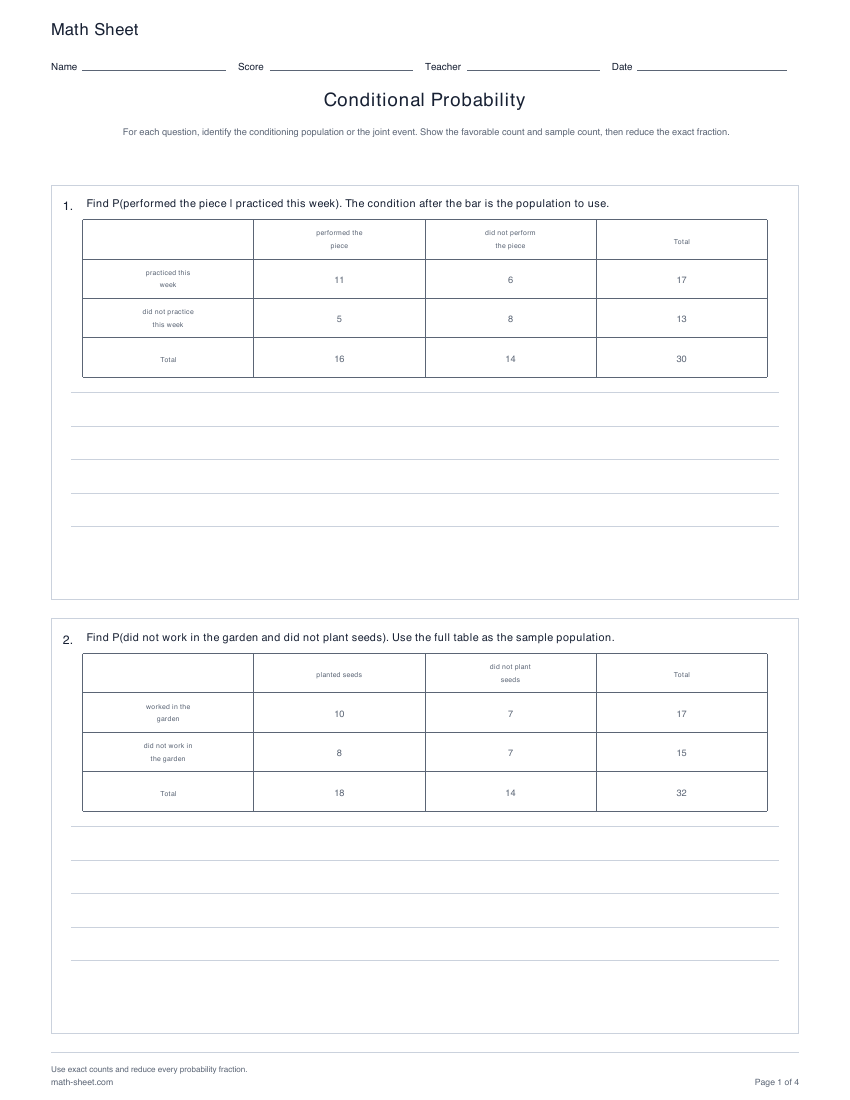
Compare conditional and joint probabilities using complete two-way count tables and two sequential draws without replacement.
Ready-made English PDF · fixed settings
Customization below makes a separate PDF.
Fixed English ready-made files. Custom settings below apply only to the configured PDF.
Ready to print
For each question, identify the conditioning population or the joint event. Show the favorable count and sample count, then reduce the exact fraction.
Download the practice pages alone, or include a separate answer key or teacher model. Longer activities may use more than one page.
Customize this worksheetCounting sheets make order and repetition policies explicit. Conditional-probability sheets keep the conditioning population visible in complete two-way tables and update both category counts and denominators after a draw without replacement.
Learning objective
Choose the correct sample population for P(B | A) or P(A and B), then express the result as an exact reduced fraction.
Worked example
The conditional probability is 3/6 = 1/2. The joint probability is (4/7)(3/6) = 2/7.
The condition tells us the first draw already was red, leaving 3 blue among 6 tokens. The joint event also requires the first red draw to happen, so multiply its probability 4/7 by the conditional second-stage probability 3/6. These answer different questions.
Teaching notes
P(B | A) asks for the chance of B within the population where A is already known. With P(A) > 0, P(B | A) = P(A and B)/P(A). In a two-way count table, use the count matching both conditions as the numerator and the conditioning row or column total as the denominator. A joint probability instead uses the complete population as its denominator.
For example, a class of 30 has 12 club members, of whom 8 study French. The probability of French given club membership is 8/12 = 2/3. The probability that a randomly chosen class member is both a club member and a French student is 8/30 = 4/15. Do not swap the condition: French membership totals would be needed to find club membership given French.
These printable tasks use complete two-way count tables and two ordered draws without replacement, with exact reduced fractions and worked answers. Teach the meaning of the bar before formulas. Start with one table, then compare conditional and joint bag events; ask learners to label the population beside each denominator. Use the separate key to mark reasoning as well as fraction reduction. Continuous conditioning and full Bayesian inference lie beyond this worksheet’s scope.
No. If the first result is given, only calculate the conditional second-stage probability. Multiply stages when the question asks for both results to occur as a joint event.
No. Independence requires P(B | A) = P(B) when P(A) > 0. In the bag example, P(second blue | first red) = 1/2, whereas the unconditional chance of blue on the second draw is 3/7.
Make it yours
Choose your options, update the preview, then download the exact same pages.
Choose table or without-replacement models, conditional or joint requests, and number of questions. Keep the seed to reproduce the same worksheet.
A useful next step
Probability
Choose among the multiplication principle, ordered selections without replacement, and unordered combinations in varied finite contexts.
Preview and download