Analyzing and solving polynomial equations worksheets
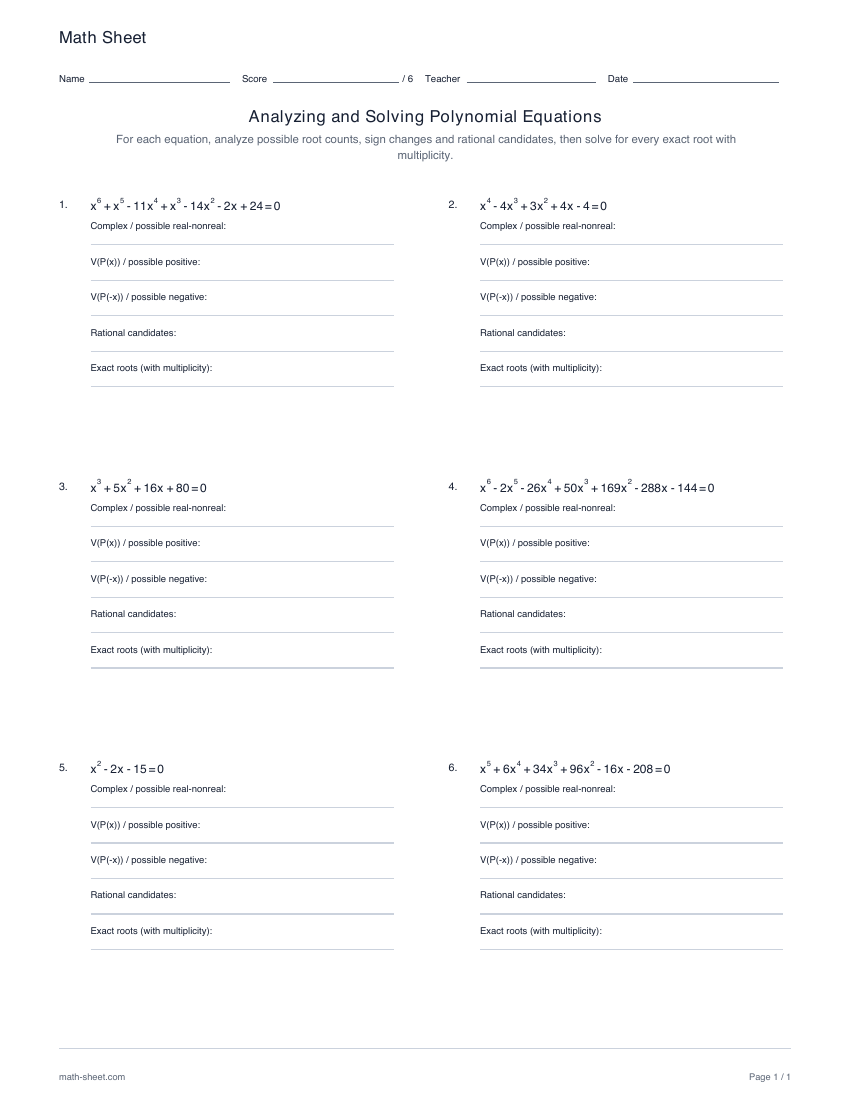
Analyze and solve six expanded monic polynomial equations of selected degrees two through six. Each exact key separates degree and Descartes possibilities from rational candidates and the complete roots with multiplicity.
Each expanded equation connects four distinct analyses: degree and conjugate pairing bound real and nonreal counts, Descartes gives possible positive and negative counts, and the Rational Root Theorem supplies candidates. Exact solving then identifies the actual roots and multiplicities.
Keep possibility lists separate from actual answers. Skip zero coefficients when counting sign changes, test rational candidates exactly, and use conjugate pairs to complete irrational and nonreal roots before rebuilding the polynomial.
Learning objective
What this activity builds
Combine degree, conjugate pairing, Descartes’ Rule of Signs and the Rational Root Theorem, then solve for every exact root.
Worked example
Analyze and solve x³ − x² + x − 1 = 0.
Complex total 3; possible real/nonreal counts (3,0) or (1,2); V(P)=3 gives 3 or 1 positive, V(P(−x))=0 gives 0 negative; rational candidates ±1; roots 1, i and −i.
The degree and sign rules give possibilities. Factoring by grouping gives (x − 1)(x² + 1), which identifies the actual roots.
Teaching notes
Make the practice count
Count roots with multiplicity; every real root is also a complex root.
Skip zero coefficients when counting sign changes in P(x) and P(−x).
Rational Root Theorem values are candidates, not guaranteed roots.
Use conjugate pairs for real irrational and nonreal roots.
Check the final root multiset by rebuilding the monic polynomial.
Make it yours
Customize the practice
Choose your options, update the preview, then download the exact same pages.
Choose any nonempty set of degrees 2 through 6. Every six-question sheet combines root-count possibilities, Descartes sign counts, rational candidates and exact solved roots.
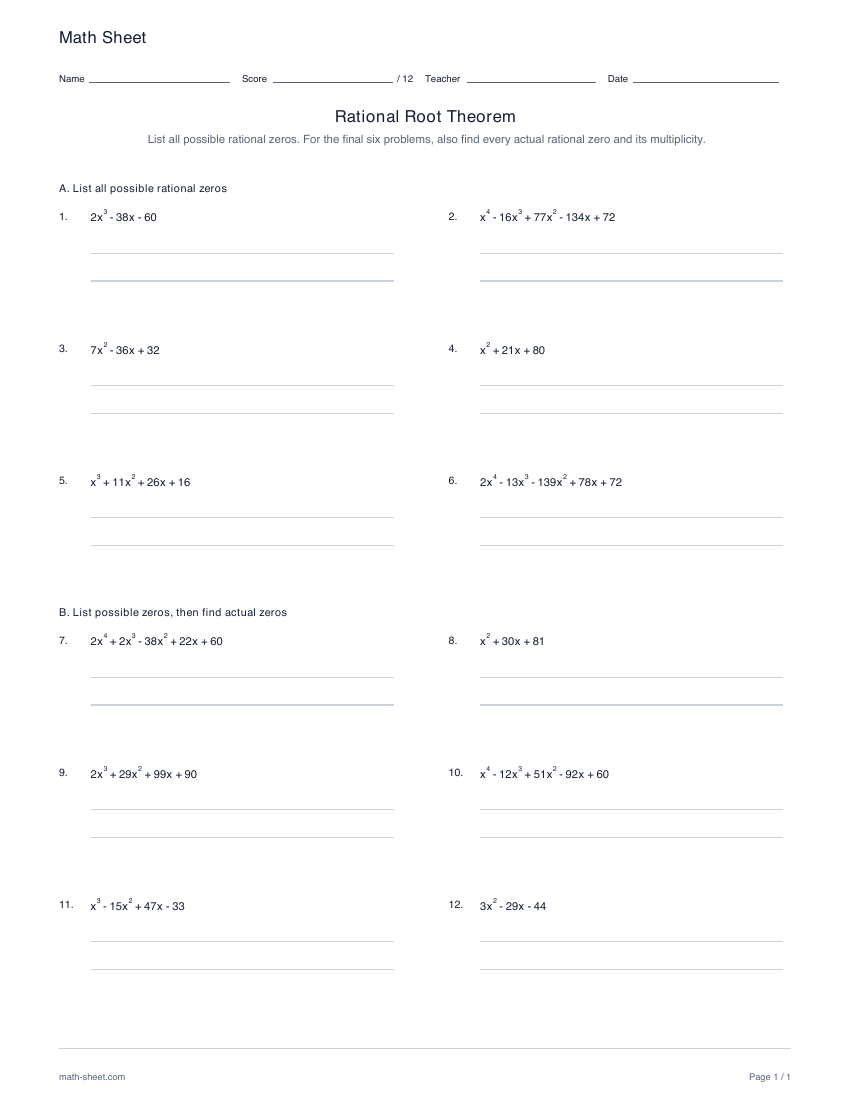
List every possible rational zero from the printed leading and constant coefficients, then find exact rational zeros and their multiplicities in twelve degree-two through degree-four problems.
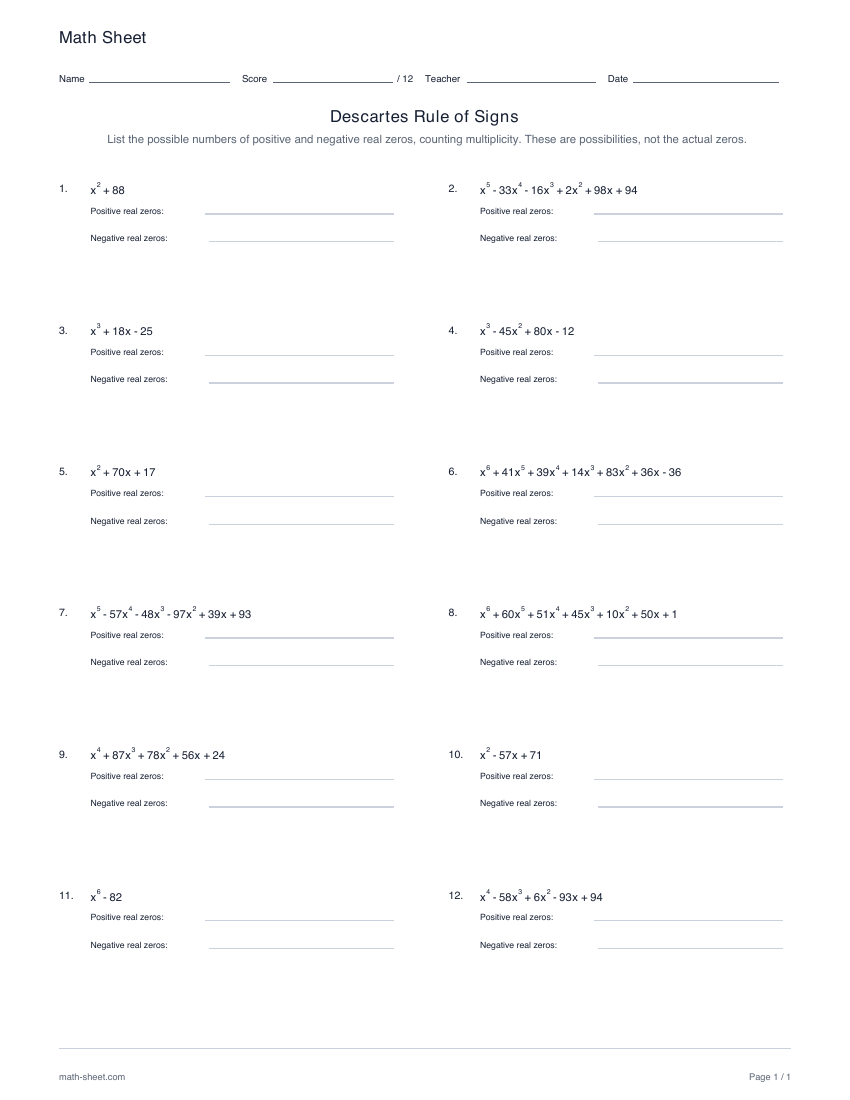
Use sign changes in P(x) and P(−x) to list every possible number of positive and negative real zeros for twelve degree-two through degree-six polynomials.
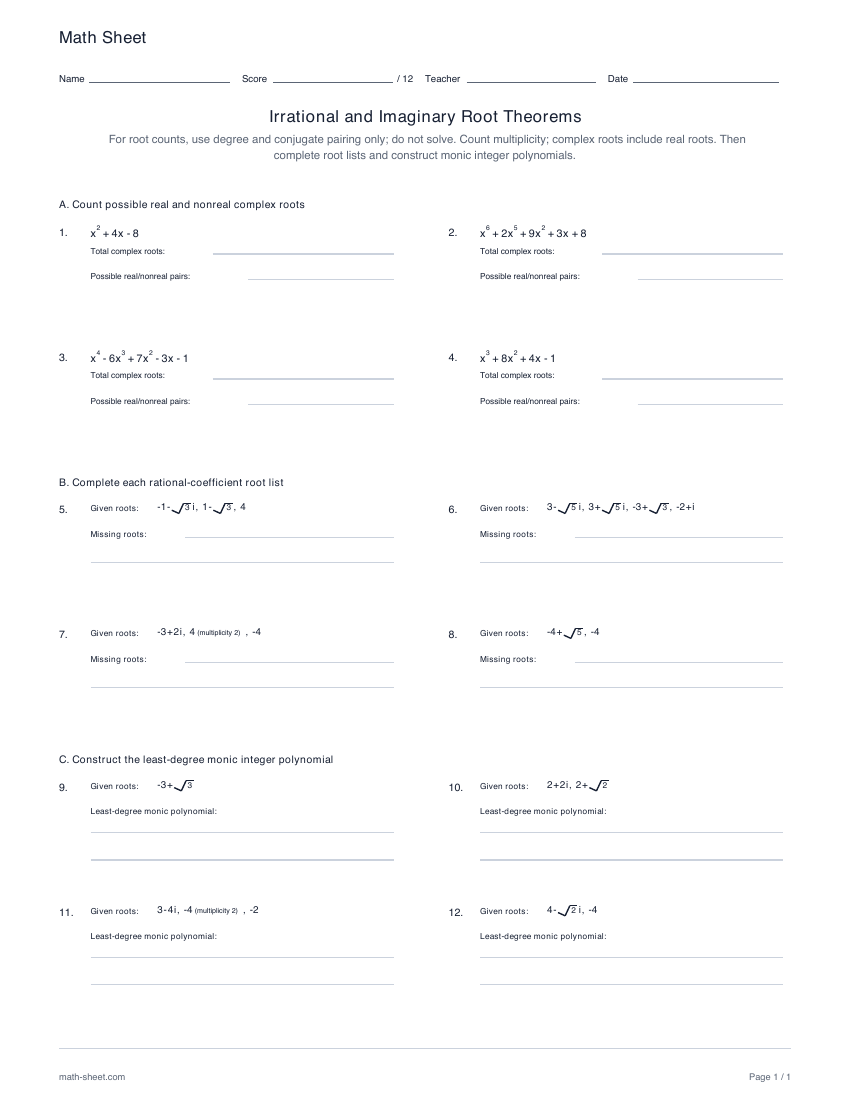
Use degree and conjugate pairing only—not polynomial solving—to list possible real and nonreal complex-root counts, counting multiplicity and including real roots in the complex total. Complete rational-coefficient root lists and construct least-degree monic integer polynomials.