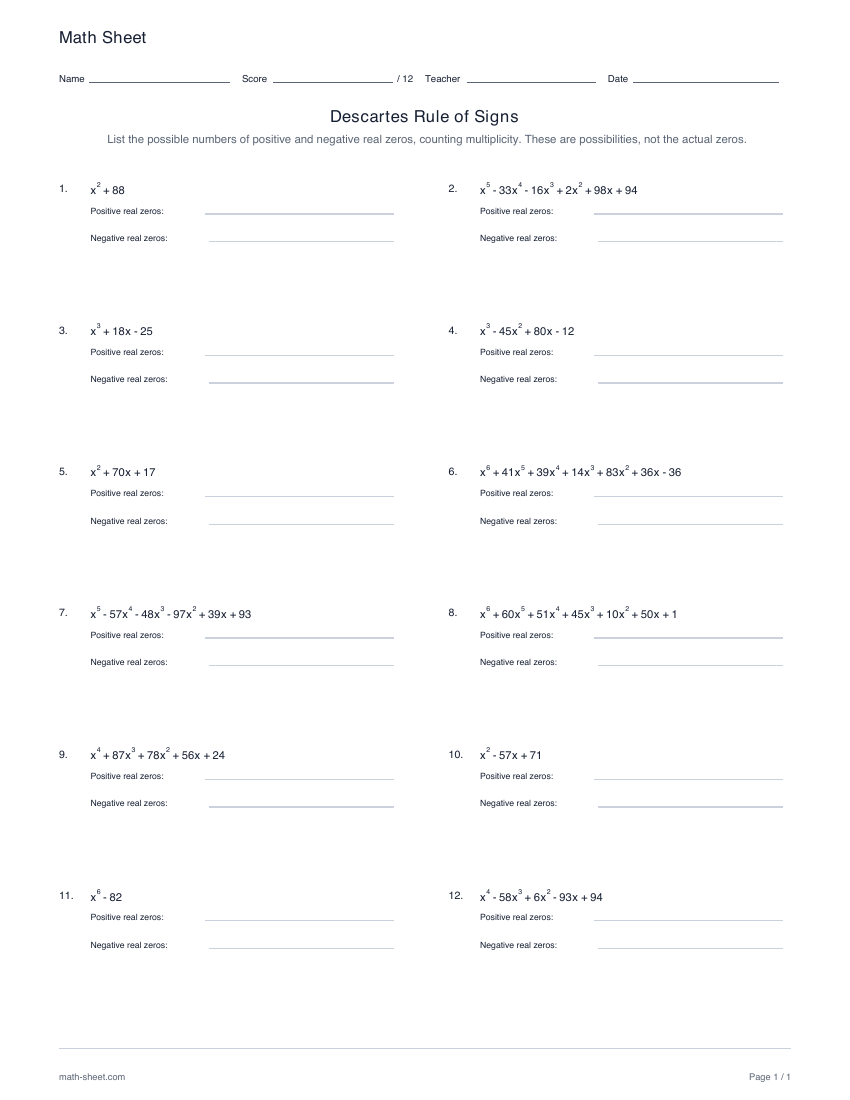
Use sign changes in P(x) and P(−x) to list every possible number of positive and negative real zeros for twelve degree-two through degree-six polynomials.
Count sign changes, then list every permitted count
Write P(x) in descending powers and count changes only between consecutive nonzero coefficients. Missing powers contribute no sign and must be skipped.
For P(−x), change the sign of every odd-power term and keep every even-power term unchanged. If V is the variation count, the permitted real-zero counts are V, V − 2, and so on to zero or one. These are possible counts including multiplicity, not the polynomial’s actual zeros.
Learning objective
What this activity builds
Count sign variations correctly through missing powers and convert each variation count into its complete descending-by-two possibility list.
Worked example
For P(x) = x⁴ − 3x³ + 2x − 5, list the possible positive and negative real-zero counts.
Positive: V(P(x)) = 3, so 3 or 1. Negative: V(P(−x)) = 1, so 1.
Ignore the missing x² term when counting. To form P(−x), change signs only on terms with odd exponents.
Teaching notes
Make the practice count
Order nonzero terms by descending exponent before counting changes.
Skip zero coefficients; they do not create or interrupt a sign change.
For P(−x), negate coefficients on odd powers and retain coefficients on even powers.
From V, list V, V − 2, and so on until reaching zero or one.
The possible counts include multiplicities and do not determine the polynomial’s actual positive or negative zeros.
Make it yours
Customize the practice
Choose your options, update the preview, then download the exact same pages.
Choose degrees 2 through 6 in any combination. Keys show V(P(x)), V(P(−x)), and every possible positive and negative real-zero count.
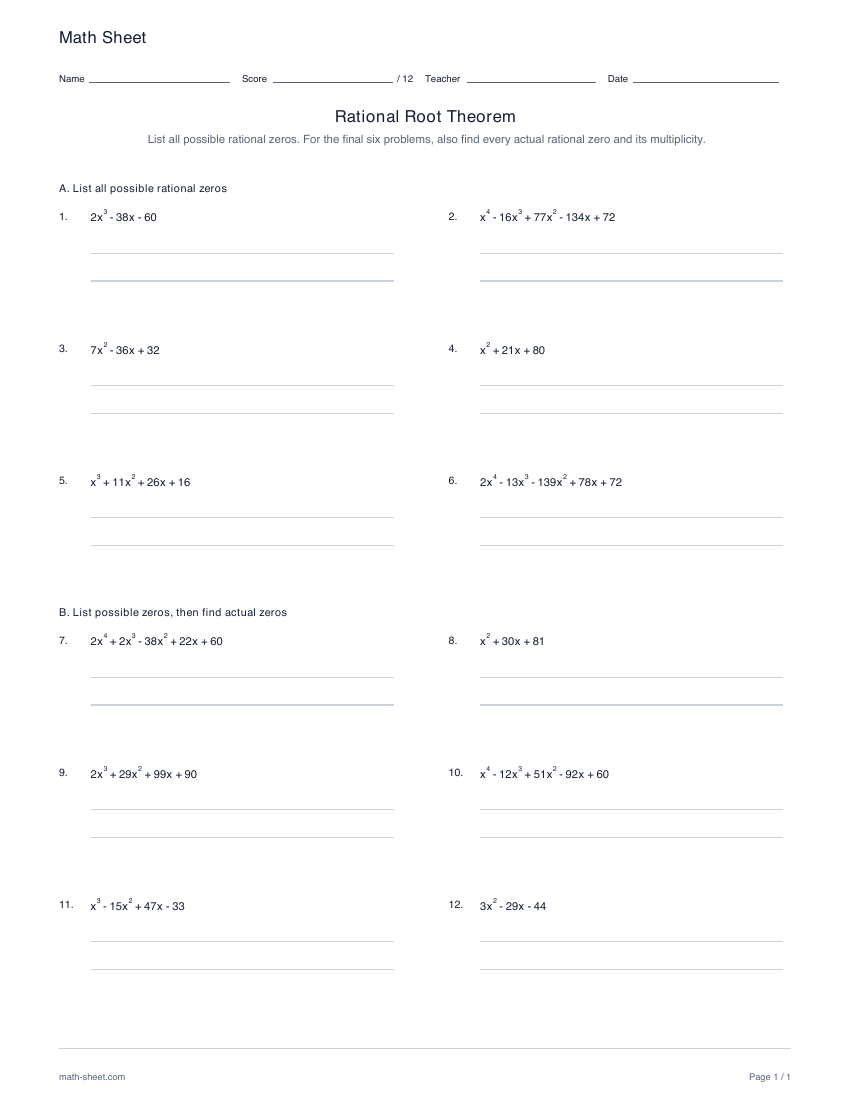
List every possible rational zero from the printed leading and constant coefficients, then find exact rational zeros and their multiplicities in twelve degree-two through degree-four problems.
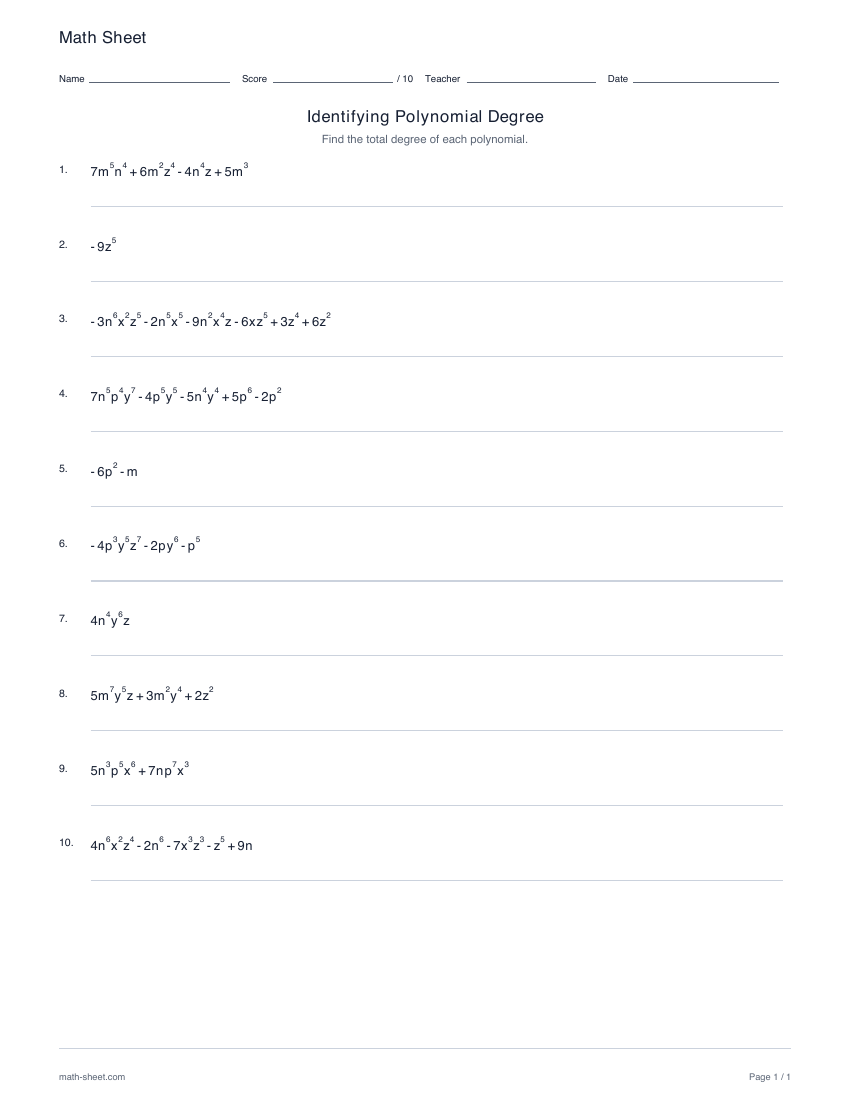
Find the degree of ten monomials and polynomials. Select one through six terms, compare term degrees and check a separate key with the exponent calculations.