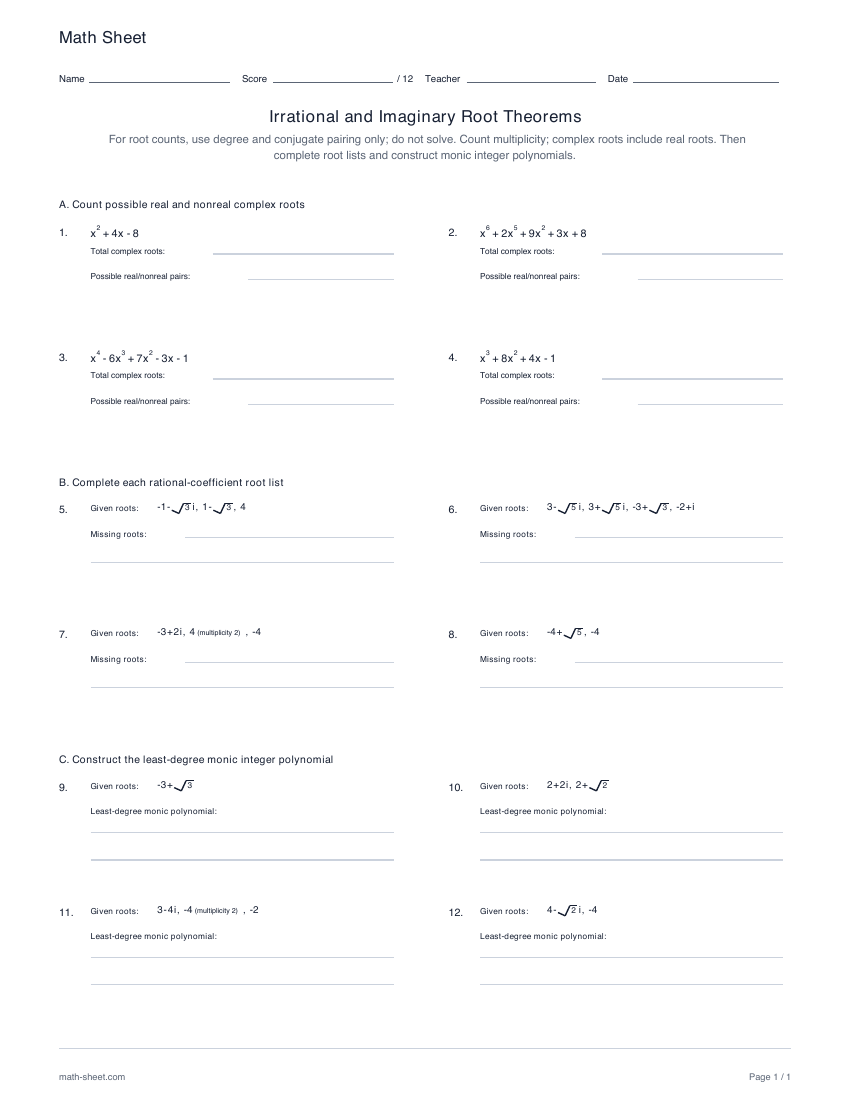
Use degree and conjugate pairing only—not polynomial solving—to list possible real and nonreal complex-root counts, counting multiplicity and including real roots in the complex total. Complete rational-coefficient root lists and construct least-degree monic integer polynomials.
Fixed English ready-made files. Custom settings below apply only to the configured PDF.
Ready to print
Start with a ready-made worksheet
For root counts, use degree and conjugate pairing only; do not solve. Count multiplicity; complex roots include real roots. Then complete root lists and construct monic integer polynomials.
Download the practice pages alone, or include a separate answer key or teacher model. Longer activities may use more than one page.
Pair every forced conjugate and preserve multiplicity
Degree counts every complex root with multiplicity, including real roots. Nonreal counts must be even, but these possibilities do not identify the displayed polynomial’s actual roots.
For rational coefficients, a + b√d forces a − b√d and a + b√d i forces a − b√d i with matching multiplicity. Construction uses the minimal closure and returns the monic integer polynomial.
Learning objective
What this activity builds
Apply real-irrational and nonreal conjugate closure with multiplicity, then build the unique least-degree monic integer polynomial.
Worked example
A rational-coefficient polynomial has root 1 − √3 with multiplicity 2. What root is forced, and what factor, including multiplicity, is required?
1 + √3 also has multiplicity 2; the factor is (x² − 2x − 2)².
Real irrational roots occur in conjugate pairs. Multiplicity carries to the conjugate, and the pair multiplies to x² − 2ax + a² − b²d.
Teaching notes
Make the practice count
A degree-n polynomial has n complex roots counting multiplicity; nonreal roots occur in pairs.
Possible real/nonreal counts use degree and pairing only and do not claim the displayed polynomial’s actual roots.
For rational coefficients, both real irrational and nonreal roots require their conjugates.
Do not add a conjugate that is already supplied, and preserve its stated multiplicity.
For construction, use one linear factor per integer root and one integer quadratic per conjugate pair.
Make it yours
Customize the practice
Choose your options, update the preview, then download the exact same pages.
Choose any nonempty set of degrees 2 through 6. Each sheet has four possible-count questions, four conjugate-completion questions, and four least-degree constructions.
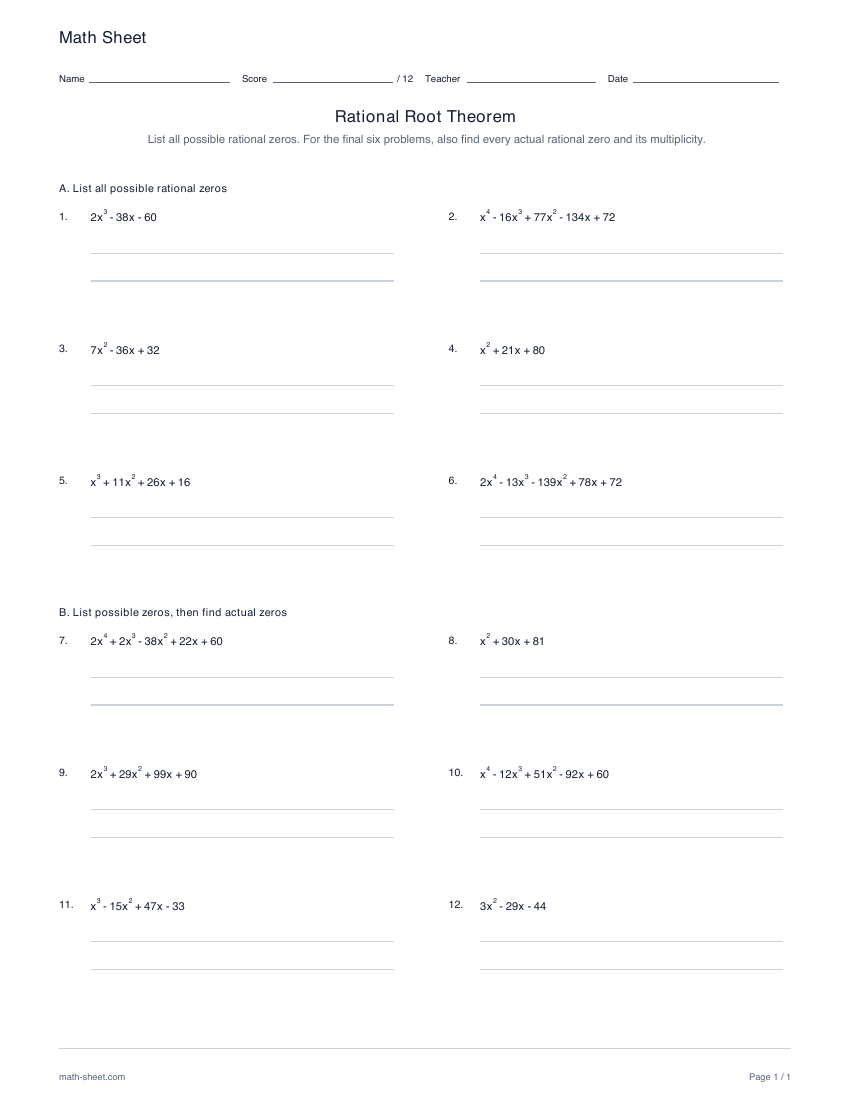
List every possible rational zero from the printed leading and constant coefficients, then find exact rational zeros and their multiplicities in twelve degree-two through degree-four problems.
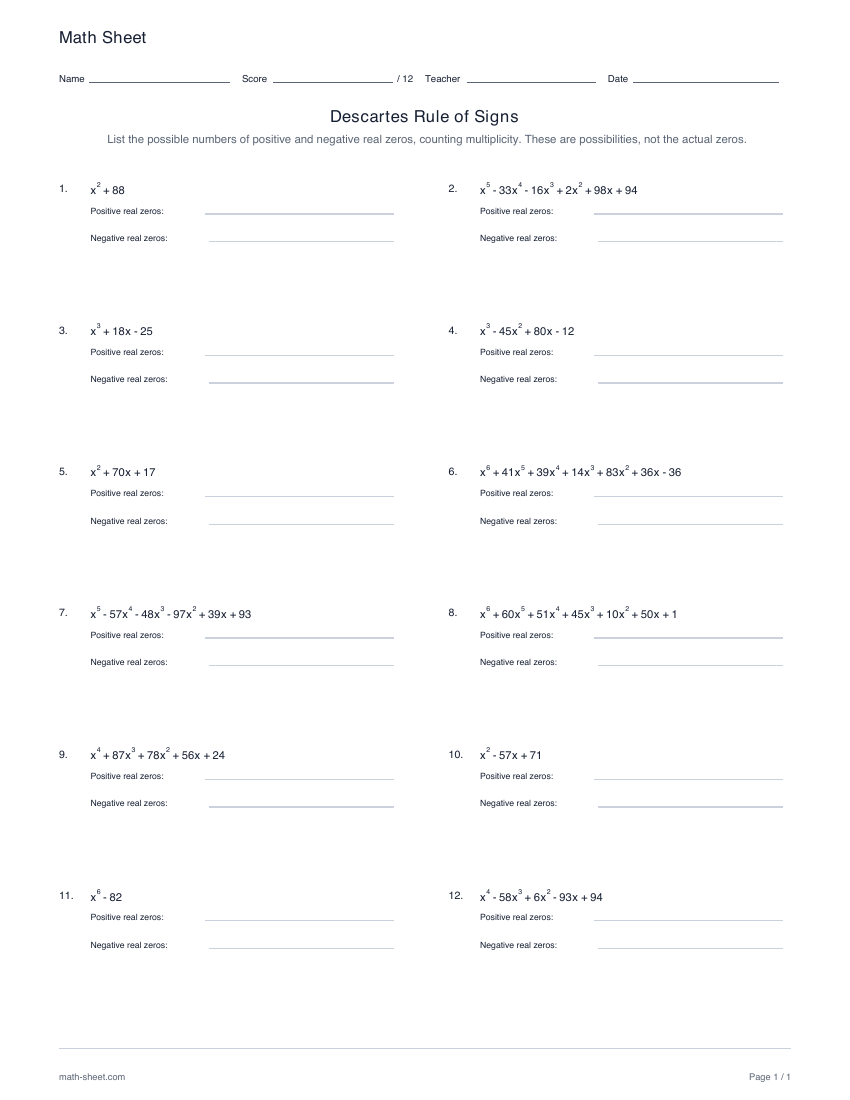
Use sign changes in P(x) and P(−x) to list every possible number of positive and negative real zeros for twelve degree-two through degree-six polynomials.