Geometry practice

Area of composite figures worksheets

Find the shaded area of nine 2D composite figures. Choose joined parts or cutouts, shape families, units and rounding; print diagrams and a separate answer key.

Ready-made English PDF · fixed settings

Customization below makes a separate PDF.

Fixed English ready-made files. Custom settings below apply only to the configured PDF.

Ready to print

Start with a ready-made worksheet

Find each shaded area by adding joined regions or subtracting cutouts. Use full calculator pi and round only the final answer to the selected precision.

Download the practice pages alone, or include a separate answer key or teacher model. Longer activities may use more than one page.

Customize this worksheet

Paper sizes and printing help · More geometry activities

Decompose the shaded region before calculating

Every sheet has nine shaded compound regions selected from four families. Joined parts have disjoint interiors; white notches and holes fit inside their outer shapes. The labels provide all measurements needed for a signed area decomposition.

Add attached rectangles, triangles or semicircles and subtract cutouts. Keep fractional products and the full calculator value of pi through the complete expression, then round the final answer to the chosen whole, tenth or hundredth precision.

Learning objective

What this activity builds

Decompose a compound region into familiar parts, assign an addition or subtraction sign to each part, and round only the final exact area.

Worked example

A 12 cm by 8 cm rectangle has a 4 cm by 3 cm rectangular corner cut out. What area remains?

84 cm².

Find the outer area, 12 × 8 = 96 cm². Subtract the removed rectangle, 4 × 3 = 12 cm². The remaining shaded area is 96 − 12 = 84 cm².

Teaching notes

Make the practice count

  • Trace the outside boundary and decide whether each familiar part is joined or removed before writing a formula.
  • Combine two matching semicircles into one circle when that makes the decomposition clearer.
  • Keep pi and exact fractional products through the whole calculation, then round the signed total once.
  • Check that the answer uses square units and is smaller than its outer shape when a hole or notch was removed.

Move from rectangle cutouts to curved composite figures

Begin with rectangle-based cutouts: find the outer rectangle and subtract the removed rectangle. These are two-dimensional shaded-area questions, with answers in square units.

For a circular example, a capsule with a 24 cm by 16 cm rectangle and two radius-8 cm semicircular ends has area 24 × 16 + pi × 8². The semicircles make one circle, so the exact total is 384 + 64pi cm², or 585.1 cm² to the nearest tenth. Keep pi until the final rounding step.

Make it yours

Customize the practice

Choose your options, update the preview, then download the exact same pages.

Worksheet settings

Shape families
Units
Page note and reproducible seed

The same settings and seed make the same questions. Shared links include your page note; leave personal information out. Notes use the selected language’s supported characters; English accepts basic Latin text.

Configured PDF · Compound shapes area · US Letter

Preview ready. Download includes these exact pages.

2 student pages
Enlarged pages scroll. PDF size stays the same.
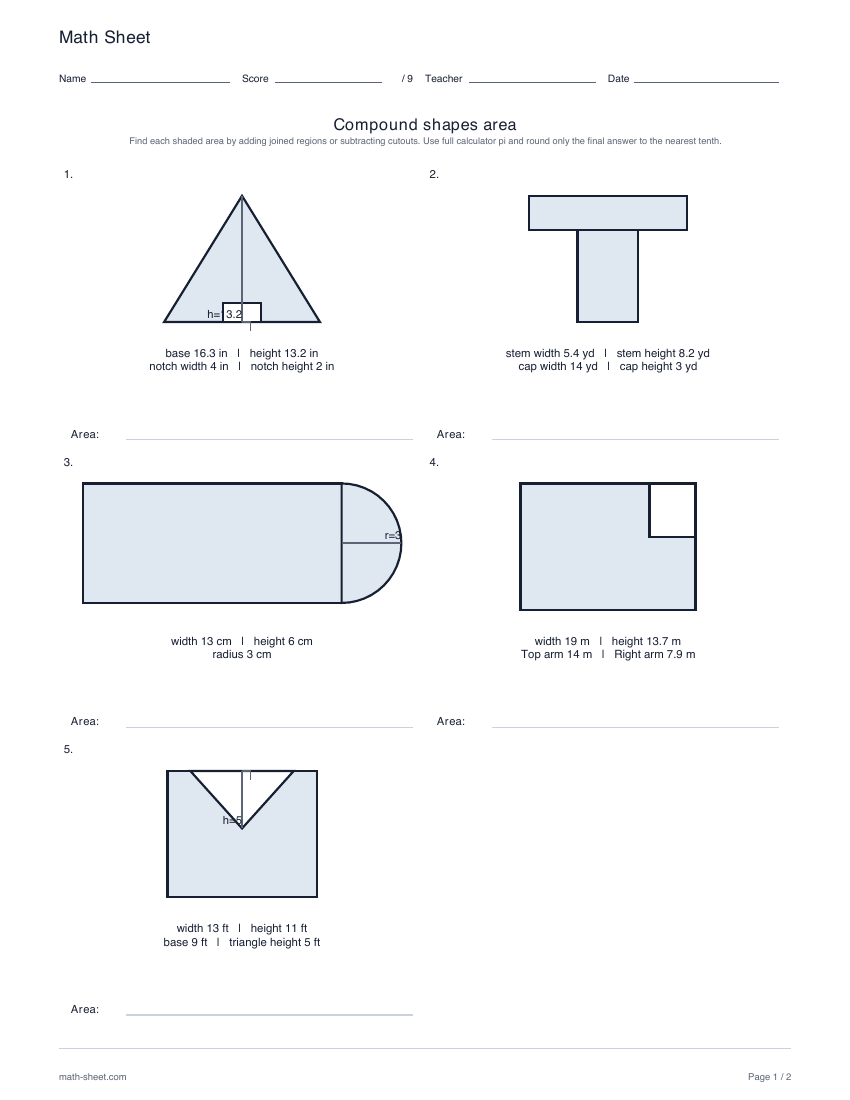
Math SheetNameScore/ 9TeacherDateCompound shapes areaFind each shaded area by adding joined regions or subtracting cutouts. Use full calculator pi and round only the final answer to the nearest tenth.1.h=13.2base 16.3 in | height 13.2 innotch width 4 in | notch height 2 inArea:2.stem width 5.4 yd | stem height 8.2 ydcap width 14 yd | cap height 3 ydArea:3.r=3width 13 cm | height 6 cmradius 3 cmArea:4.width 19 m | height 13.7 mTop arm 14 m | Right arm 7.9 mArea:5.h=5width 13 ft | height 11 ftbase 9 ft | triangle height 5 ftArea:math-sheet.comPage 1 / 2
Math SheetNameScore/ 9TeacherDateCompound shapes areaFind each shaded area by adding joined regions or subtracting cutouts. Use full calculator pi and round only the final answer to the nearest tenth.6.r=2base 19 ft | height 13 ftradius 2 ftArea:7.r=5radius 5 cm | base 5 cmtriangle height 5 cmArea:8.width 21 yd | height 13 ydinner width 8 yd | inner height 6 ydArea:9.r=3width 16 in | height 12.8 inradius 3 inArea:math-sheet.comPage 2 / 2

A useful next step

Related activities

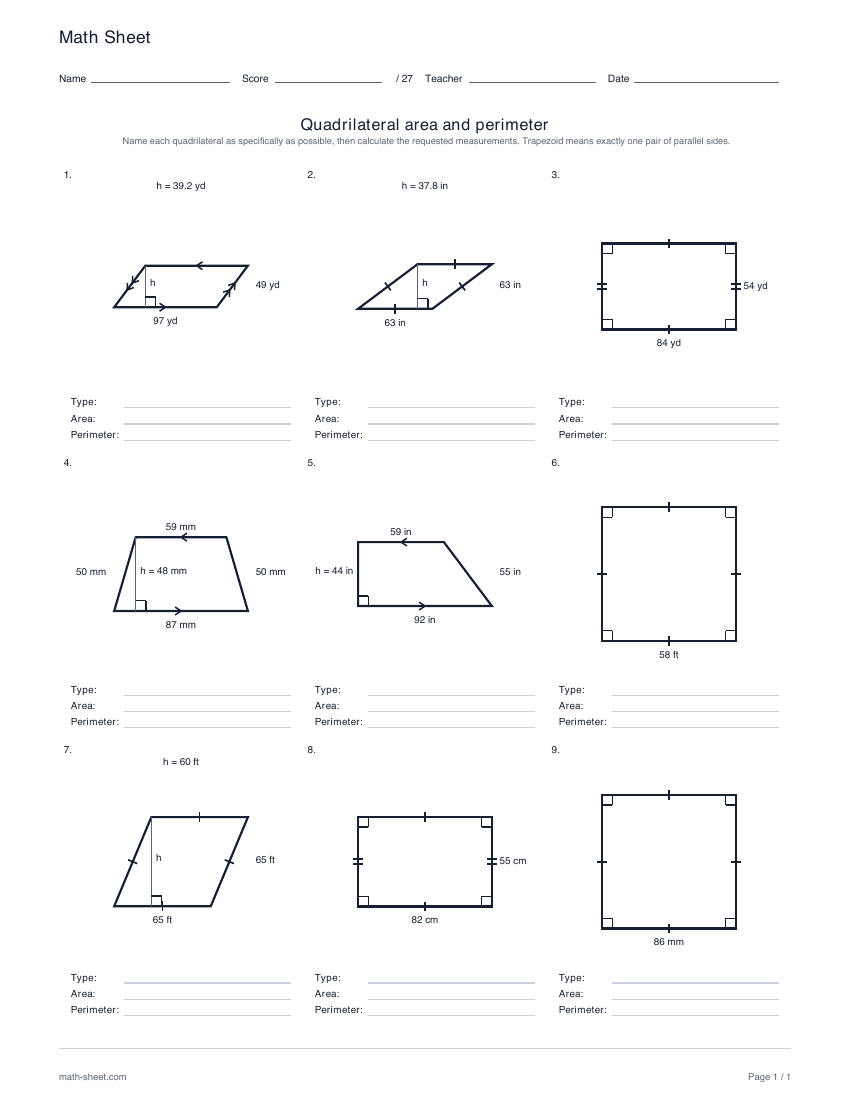
First page preview: Quadrilateral area and perimeter worksheets

Geometry

Quadrilateral area and perimeter worksheets

Name nine marked squares, rectangles, parallelograms, rhombi and trapezoids, then calculate area, perimeter or both with exact whole-number or decimal dimensions in five selectable units.

Preview and download
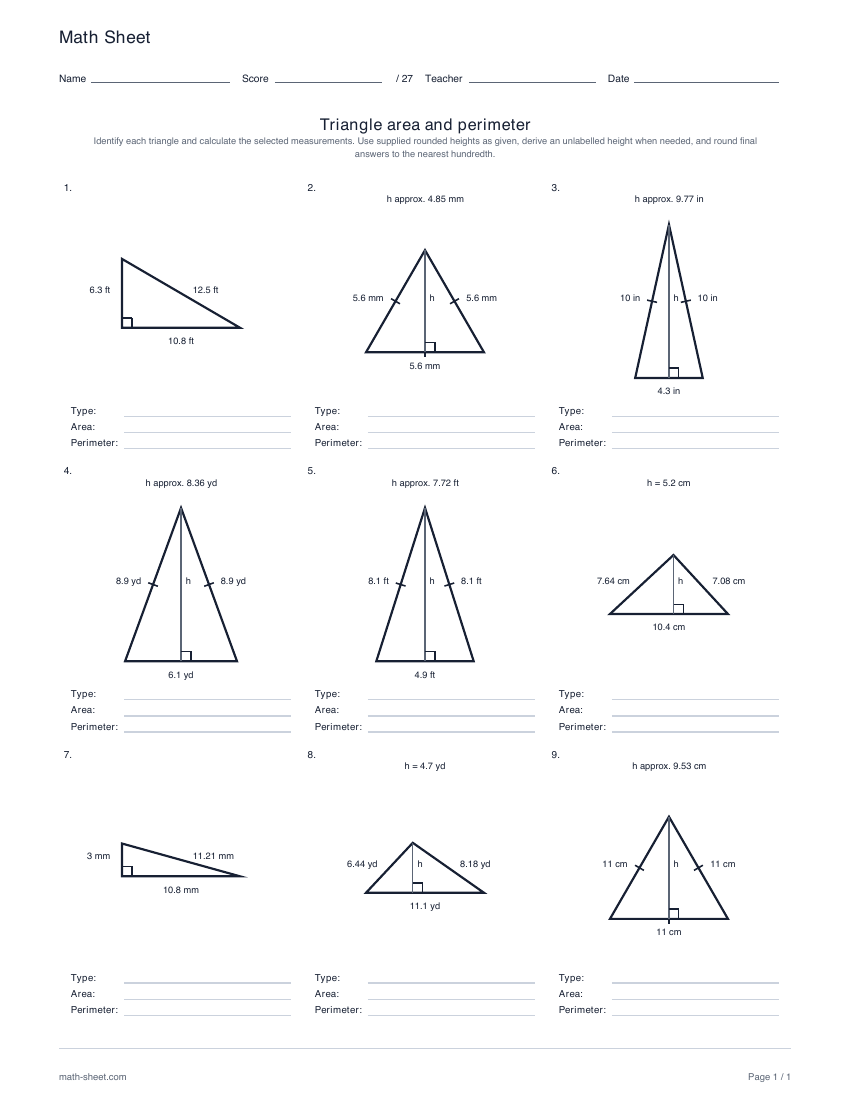
First page preview: Triangle area and perimeter worksheets

Geometry

Triangle area and perimeter worksheets

Identify nine right, common scalene, equilateral and isosceles triangles, then calculate area, perimeter or both from visible whole-number or decimal measurements in five selectable units.

Preview and download
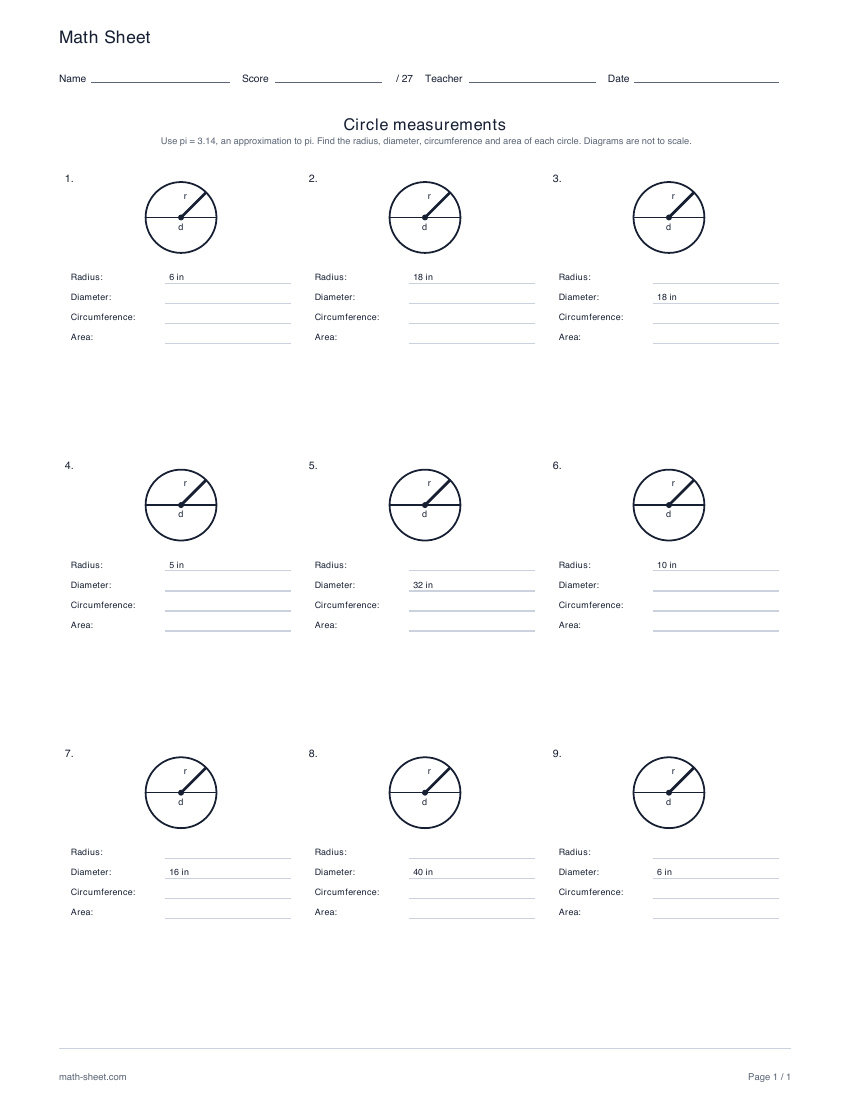
First page preview: Circle measurements worksheets

Geometry

Circle measurements worksheets

Find radius, diameter, circumference and area in nine circles from a supplied radius or diameter. Choose any of five units, use pi = 3.14, and optionally print the formulas.

Preview and download

Choose joined regions or cutouts

These are two-dimensional area worksheets. Select shape families and addition-only, subtraction-only or mixed practice. Add areas with disjoint interiors; subtract a notch or hole from its enclosing region. Keep full calculator pi until the final rounding and label the answer in square units.