Probability reference

Probability reference sheet

A printable guide to probability, independent and dependent events, replacement and probability trees. Connect definitions with worked examples and conditional branch probabilities.

Ready-made English PDF · fixed settings

Customization below makes a separate PDF.

Fixed English ready-made files. Custom settings below apply only to the configured PDF.

Ready to print

Print the reference handout

Read each definition beside its example. State the experiment, sample space and event before calculating a probability.

Download the complete reference with its explanations and worked examples. This handout does not need a separate answer key.

Choose paper and language

Paper sizes and printing help · More probability activities

From definitions to conditional probability

Read about sample spaces, the probability scale, complements and independent events. Continue to dependent draws, conditional probabilities and a tree diagram that accounts for every outcome.

This is a fixed teaching handout. Paper size, printed language and teacher note can change; there is no separate answer edition or random question set.

Learning objective

What this activity builds

Use precise probability language, count equally likely outcomes and distinguish independent trials from conditional probabilities.

Worked example

Can we always divide the number of matching labels by the number of labels?

Only when those outcomes are equally likely.

On a fair six-sided die each face has the same chance, so counting faces works. On two dice, sums have different numbers of ordered outcomes. Count the equally likely pairs, not the distinct sums.

Teaching notes

Make the practice count

  • Ask learners to describe an event in words and as a set.
  • Use 0, 1/2 and 1 as reference points on a probability scale.
  • Compare a theoretical probability with results from a short experiment.
  • Keep the sheet beside early number, dice and spinner practice.

Make it yours

Customize the reference

Choose your options, update the preview, then download the exact same pages.

This fixed five-page guide covers probability basics, independence, multiplication, conditional probability, replacement, and probability trees.

Worksheet settings

Page note

Add an optional note to the reference page. Shared links include your page note; leave personal information out. Notes use the selected language’s supported characters; English accepts basic Latin text.

Configured PDF · Probability Reference · US Letter

Preview ready. Download includes these exact pages.

5 reference pages
Enlarged pages scroll. PDF size stays the same.
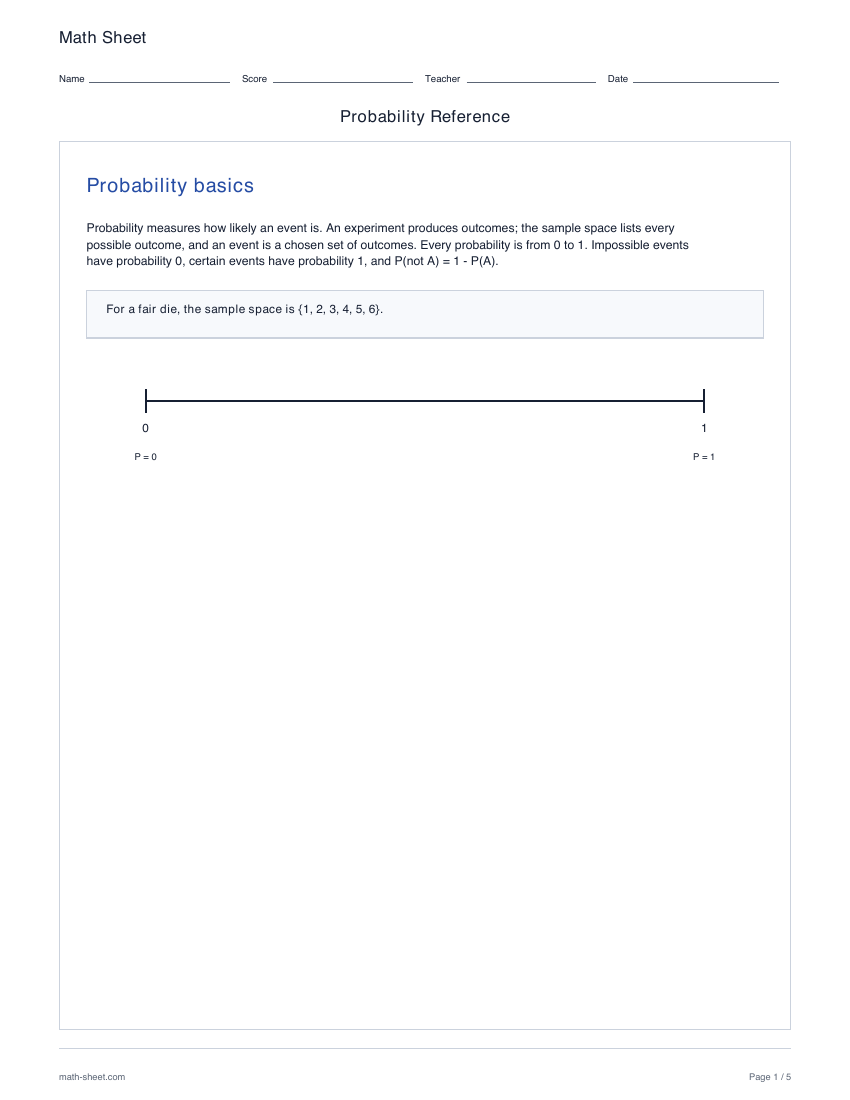
Math SheetNameScoreTeacherDateProbability ReferenceProbability basicsProbability measures how likely an event is. An experiment produces outcomes; the sample space lists everypossible outcome, and an event is a chosen set of outcomes. Every probability is from 0 to 1. Impossible eventshave probability 0, certain events have probability 1, and P(not A) = 1 - P(A).For a fair die, the sample space is {1, 2, 3, 4, 5, 6}.01P = 0P = 1math-sheet.comPage 1 / 5
Math SheetNameScoreTeacherDateProbability ReferenceEqually likely outcomesWhen all outcomes are equally likely, P(A) = favorable outcomes / total outcomes. Check this assumption beforecounting.For an even result on a fair die: 3/6 = 1/2.3 / 6 = 1/2math-sheet.comPage 2 / 5
Math SheetNameScoreTeacherDateProbability ReferenceIndependent eventsEvents are independent when one result does not change the probability of the next. Multiply probabilities along aspecified sequence.Three heads in three fair tosses: 1/2 × 1/2 × 1/2 = 1/8.1/2 × 1/2 × 1/2 = 1/8math-sheet.comPage 3 / 5
Math SheetNameScoreTeacherDateProbability ReferenceDependent eventsWithout replacement, the first draw changes the available outcomes. Use the new conditional count on the seconddraw. Replacement restores the original sample space.From a bag with 4 blue and 2 red counters, P(red then blue without replacement) = 2/6 × 4/5 = 4/15.P(A) × P(B | A)1/3 × 4/5 = 4/15math-sheet.comPage 4 / 5
Math SheetNameScoreTeacherDateProbability ReferenceProbability treesA tree shows every branch in order. Multiply along each path; mutually exclusive complete path probabilities add to1.Two draws without replacement from 4 blue and 2 red: RR=1/15, RB=4/15, BR=4/15, BB=2/5; the four paths total1.startred 1/3blue 2/3red | 1/51/15blue | 4/54/15red | 2/54/15blue | 3/52/5total = 1math-sheet.comPage 5 / 5

A useful next step

Related activities

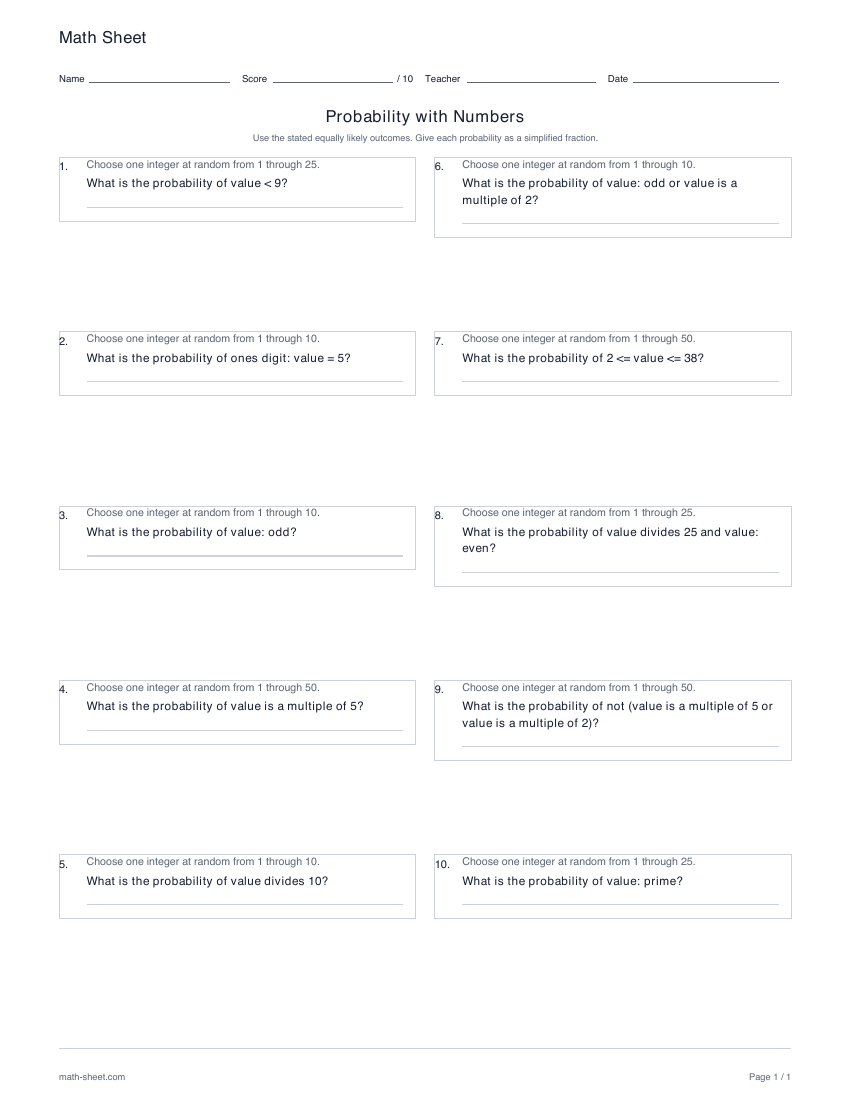
First page preview: Probability with numbers worksheets

Probability

Probability with numbers worksheets

Find the chance of selecting a number from a finite set. Practice ranges up to 10, 25 or 50, count favorable outcomes and simplify the probability with an explained answer key.

Preview and download
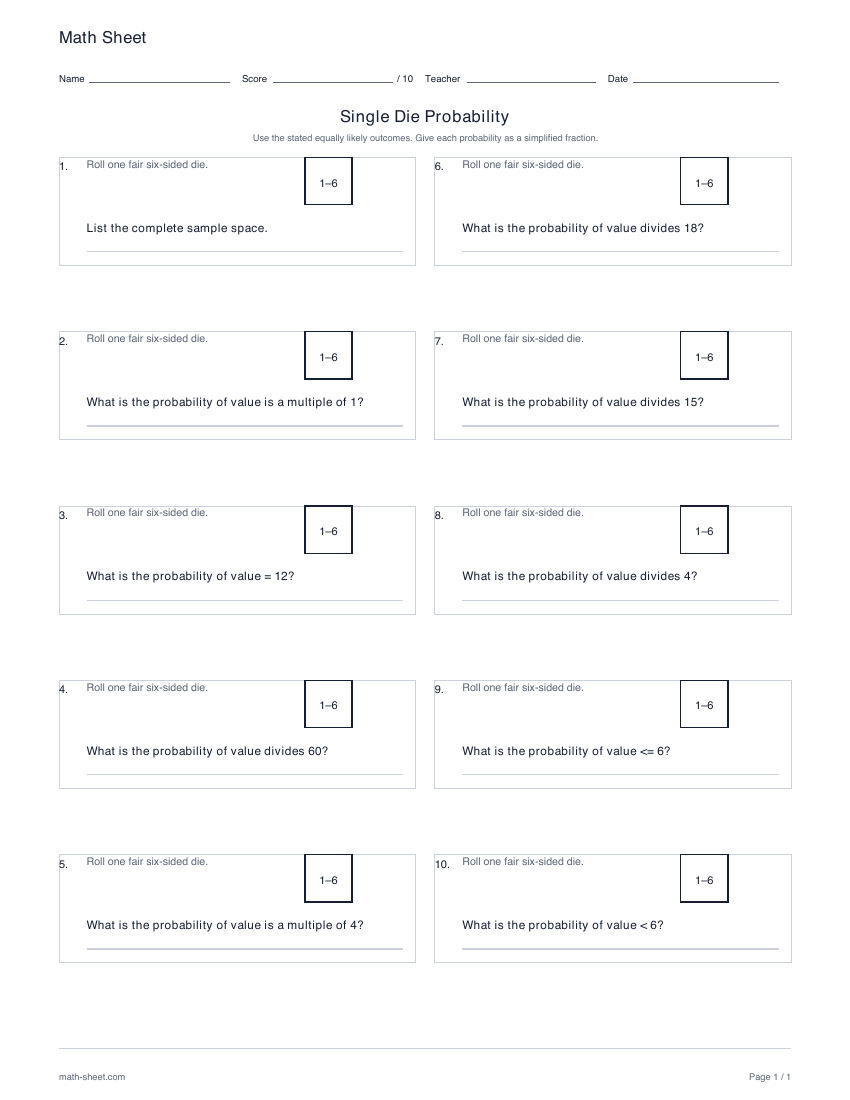
First page preview: Single die probability worksheets

Probability

Single die probability worksheets

Explore six equally likely outcomes on a fair die. Choose number, multiple-and-divisor or factor questions, then print a worksheet and a separate explained answer key.

Preview and download
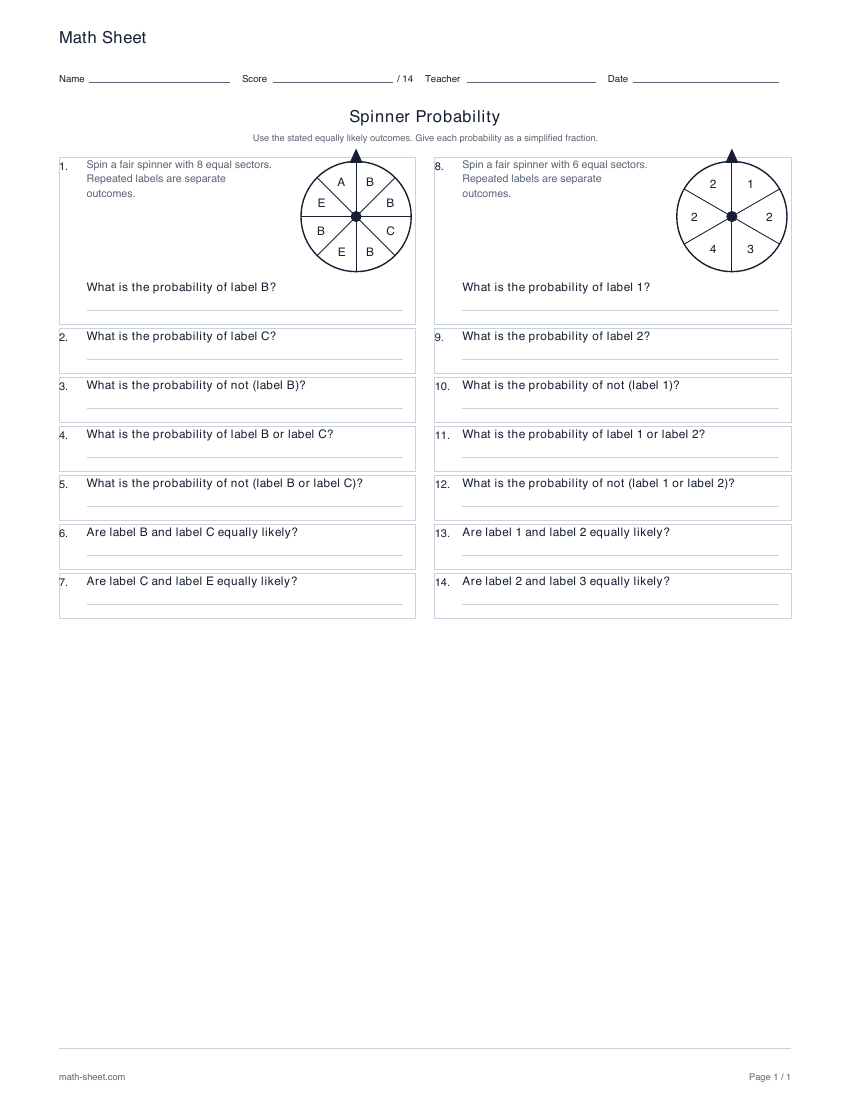
First page preview: Spinner probability worksheets

Probability

Spinner probability worksheets

Read number and letter spinners with 5 to 12 equal sectors. Count matching sectors from the printed diagram and calculate simplified probabilities with an answer key.

Preview and download