
Geometry
Drawing angles worksheets
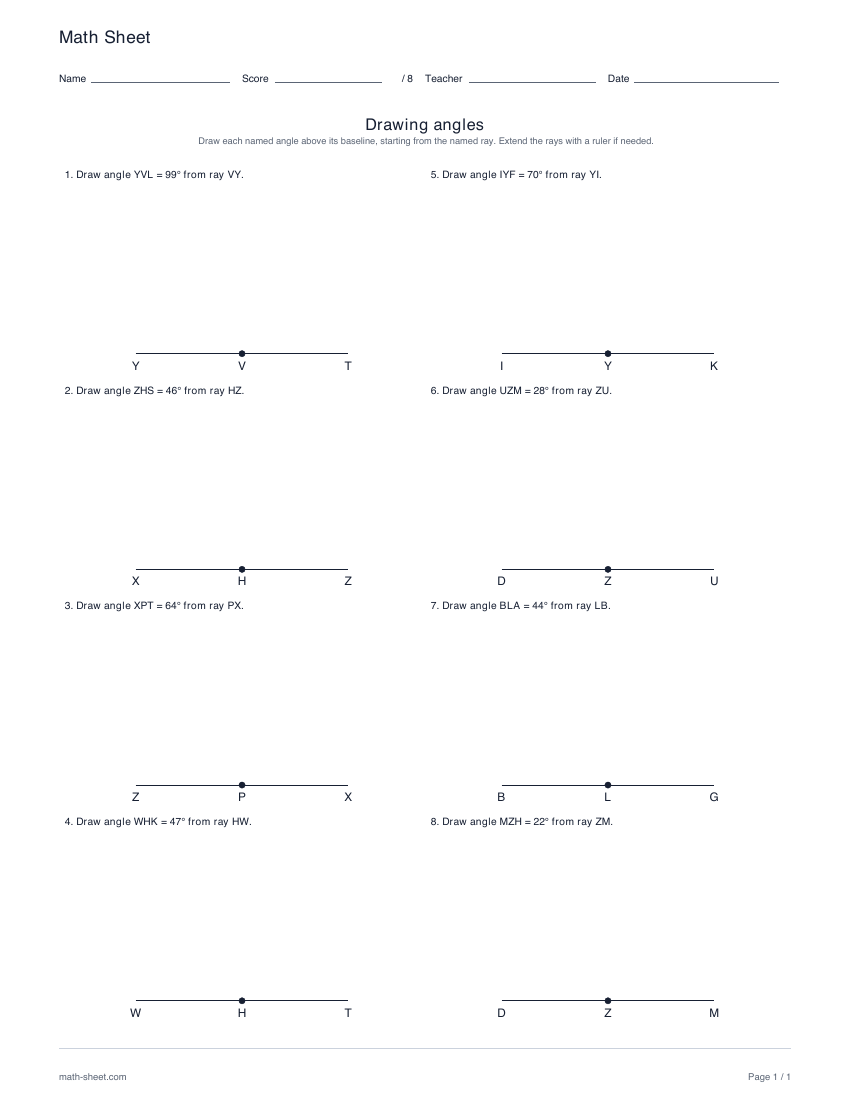
Construct eight named angles from stated whole-degree measures. Every prompt identifies the left or right starting ray; the separate key adds the correct new ray and endpoint label.
Preview and downloadGeometry practice
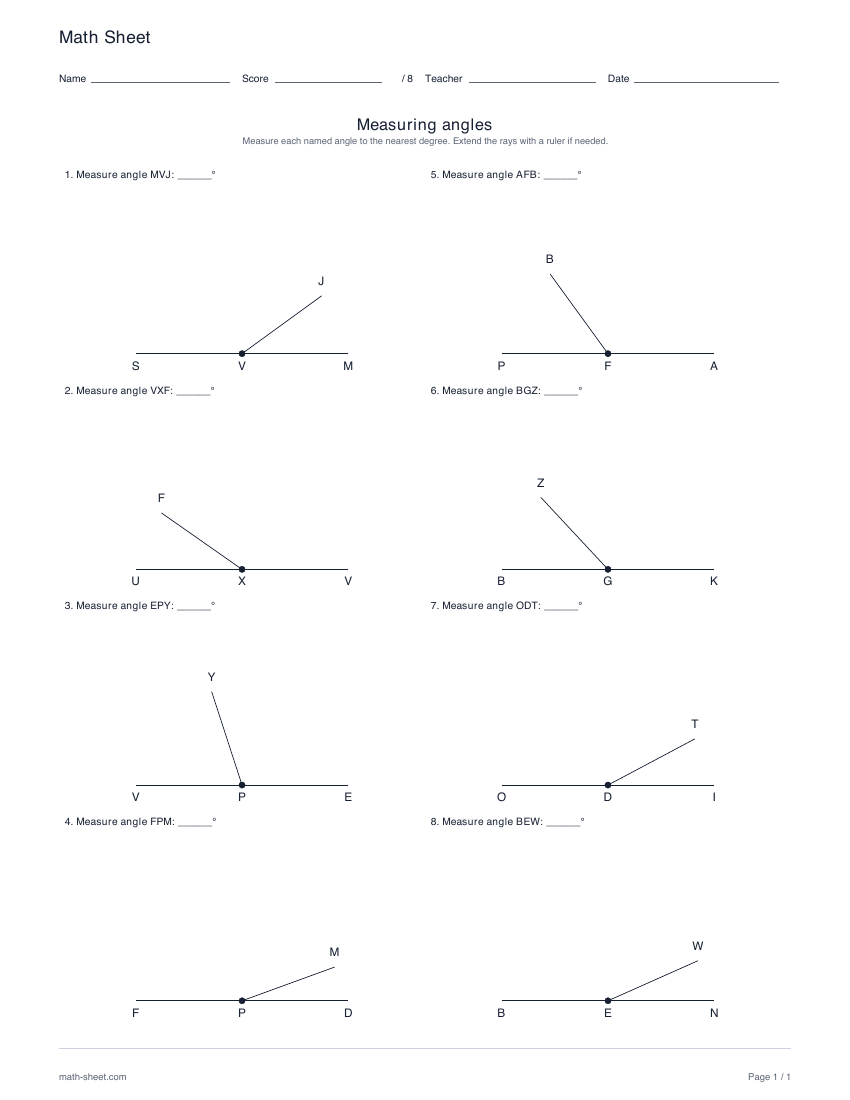
Measure eight named angles to the nearest degree. Each diagram uses a two-sided baseline, a clearly labelled vertex and one ray above the line, with a separate numeric answer key.
Ready-made English PDF · fixed settings
Customization below makes a separate PDF.
Fixed English ready-made files. Custom settings below apply only to the configured PDF.
Ready to print
Measure each named angle to the nearest degree. Use the named baseline endpoint to choose the starting ray, and extend either ray with a ruler if needed.
Download the practice pages alone, or include a separate answer key or teacher model. Longer activities may use more than one page.
Customize this worksheetEach sheet has eight labelled angles. The three-letter angle name identifies the starting baseline side: its first letter is the endpoint of the ray that begins the measured turn, and the middle letter is the vertex.
Center the protractor on the vertex, align 0 degrees with that named ray, and measure to the upper ray to the nearest degree. Extend either printed ray with a ruler when your protractor scale sits farther from the vertex.
Learning objective
Align a protractor with the named starting ray and read the scale that measures the requested turn from 1 through 179 degrees.
Worked example
Use the scale that begins at 0 degrees on ray BA.
The first endpoint in angle ABC identifies the starting ray from vertex B through A. The other baseline direction is present for alignment, but it is not part of the requested angle.
Teaching notes
Make it yours
Choose your options, update the preview, then download the exact same pages.
A useful next step
Geometry
Construct eight named angles from stated whole-degree measures. Every prompt identifies the left or right starting ray; the separate key adds the correct new ray and endpoint label.
Preview and download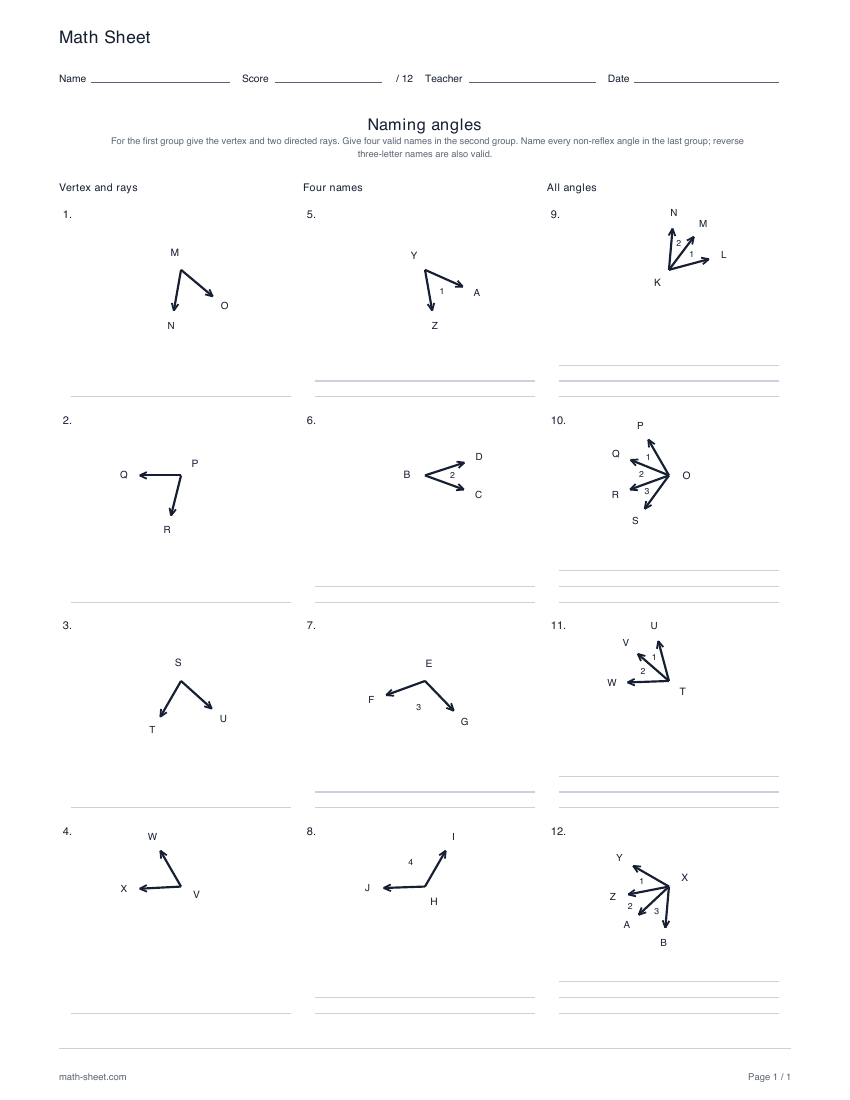
Geometry
Identify vertices and directed rays, give four valid names for a single angle, and name every angle formed by three or four rays. Twelve questions include complete answer lists.
Preview and download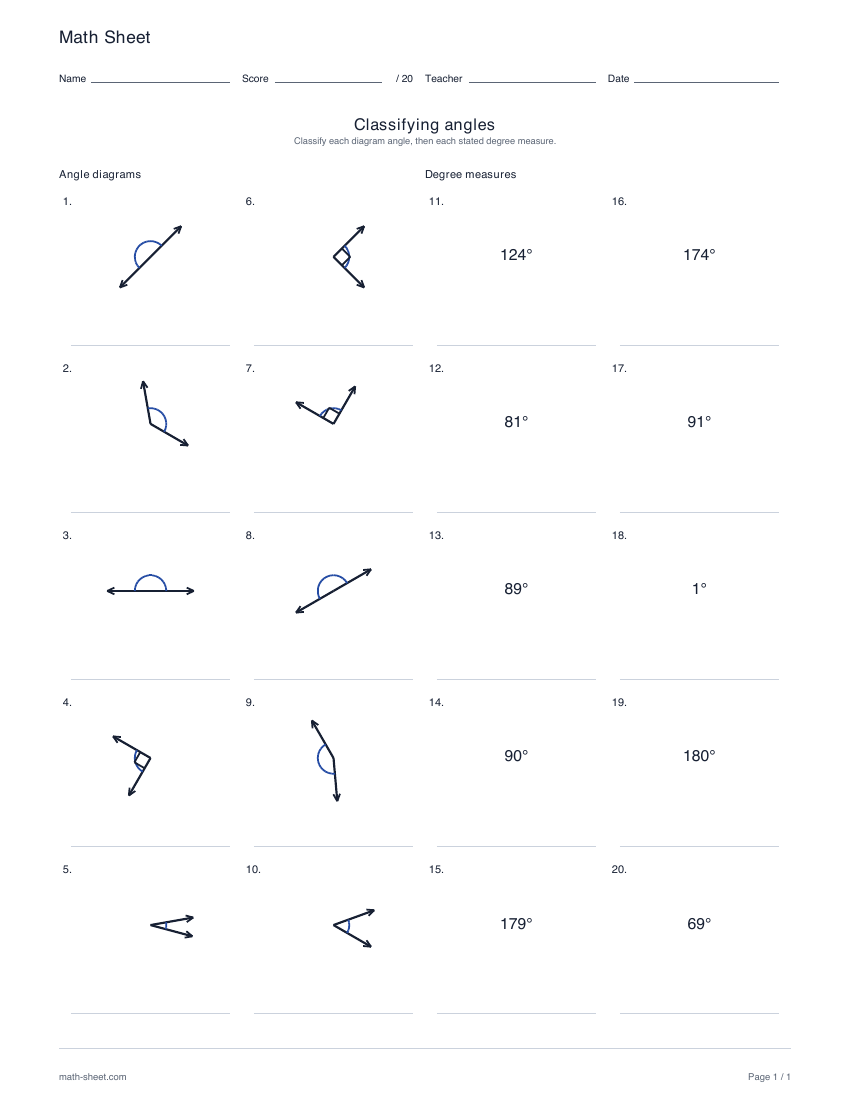
Geometry
Classify 20 angles as acute, right, obtuse or straight. Ten questions use unlabelled diagrams and ten use exact degree measures, followed by a separate answer key.
Preview and download