
Graphing
First-quadrant ordered pairs worksheets
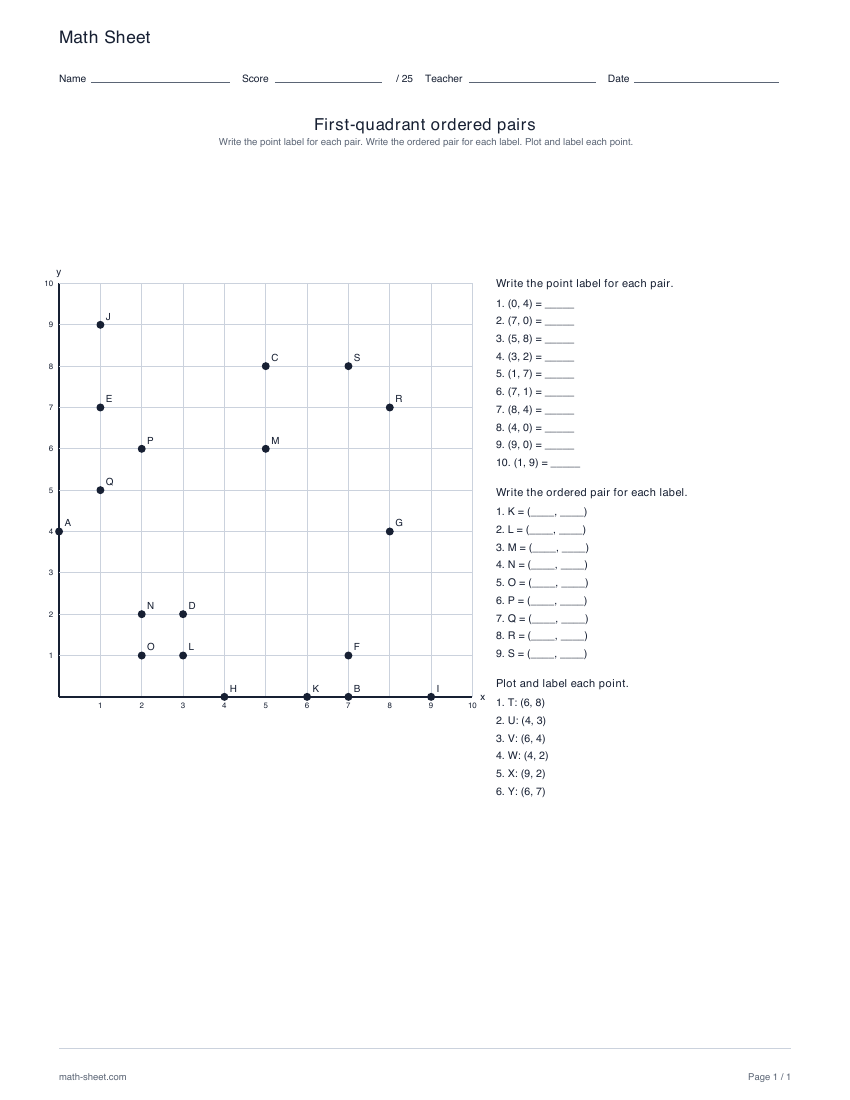
Read and plot positive ordered pairs on a coordinate grid. Each printable worksheet includes 25 questions in three groups and a separate completed answer sheet.
Preview and downloadRead a point. Draw a picture.
Practice ordered pairs, follow a coordinate puzzle or build a detailed picture one path at a time. Choose positive coordinates or all four quadrants, then print the questions and a separate answer key.
Choose a graphing taskUse reading and plotting sheets to check coordinate understanding, then add the sequencing demands of a picture. These starting points open editable studios; their downloads follow the selected settings. Ready-made files on each activity page keep their default configuration.
| Task | Teaching purpose | Starting point |
|---|---|---|
| Read and plot positive ordered pairs | Connect x then y to a location, including points on axes. | Read positive ordered pairs → |
| Read and plot in four quadrants | Use each coordinate’s sign to choose the direction. | Read and plot signed coordinates → |
| Complete a short graphing puzzle | Follow a single sequence before tackling longer paths. | Connect a short coordinate puzzle → |
| Follow a first-quadrant picture | Manage separate paths and half units using positive coordinates. | Follow a first-quadrant picture → |
For a fall coordinate graphing worksheet, open four-quadrant coordinate pictures and select Pumpkin, a Halloween design or a Thanksgiving picture. These longer fixed pictures need signed coordinates and careful path tracking.
Coordinate practice
Move between a point, its label and its coordinates. Start with positive values, then introduce signed positions and all four quadrants.
Graphing
Read and plot positive ordered pairs on a coordinate grid. Each printable worksheet includes 25 questions in three groups and a separate completed answer sheet.
Preview and download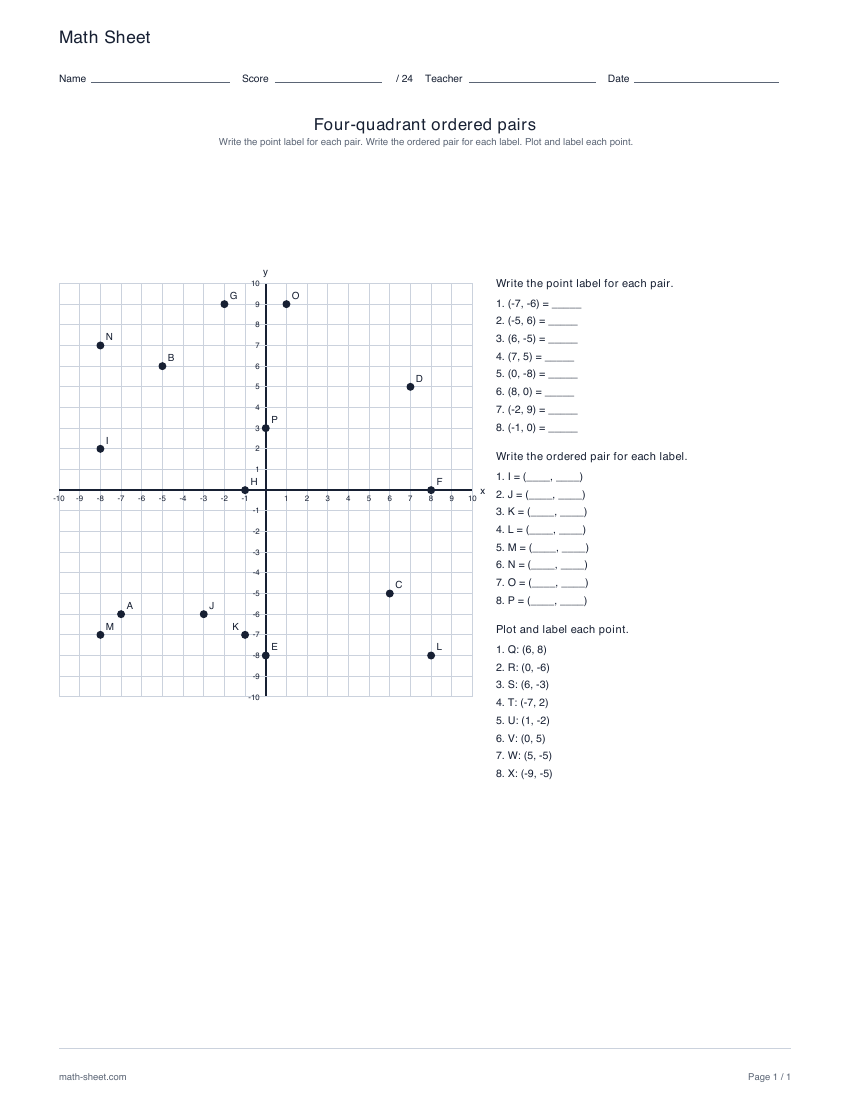
Graphing
Practice signed coordinates with 24 reading and plotting questions. Identify labeled points, write ordered pairs and add new points across the four quadrants.
Preview and downloadCoordinate practice
Follow a short puzzle or choose a detailed seasonal design. Separate paths, half coordinates and circle details make careful plotting matter.
Graphing
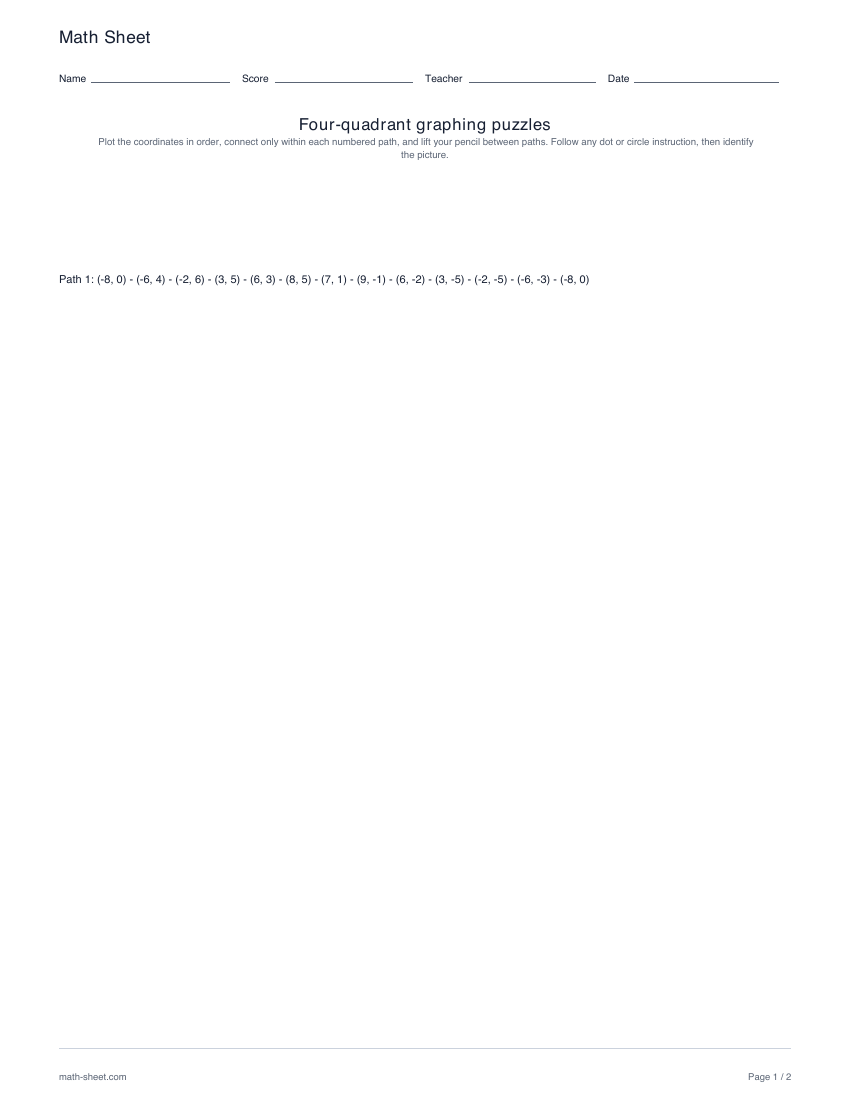
Plot ordered pairs and connect them to reveal an original picture. Choose easy, medium or hard coordinate puzzles with separate completed graphs and answers.
Preview and download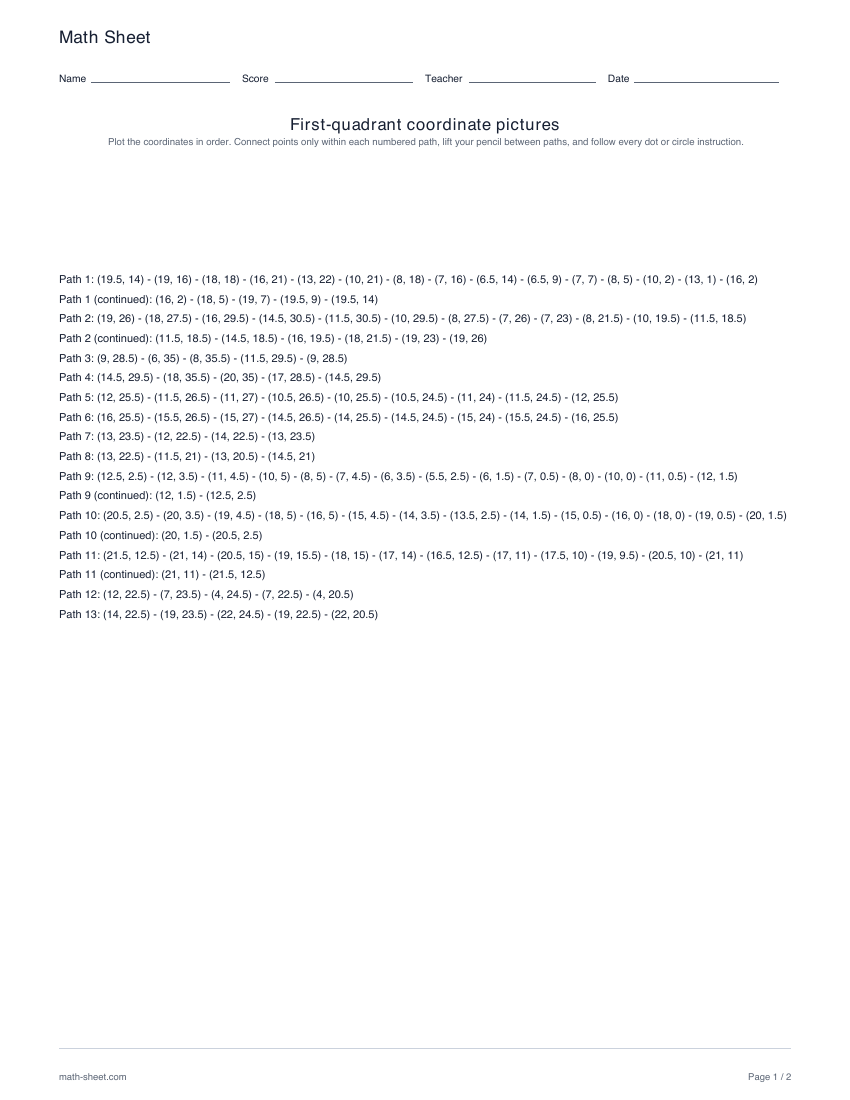
Graphing
Choose an original Easter bunny, egg or basket and plot its ordered pairs in the first quadrant. Download complete coordinate lists, a blank grid and a separate picture key.
Preview and download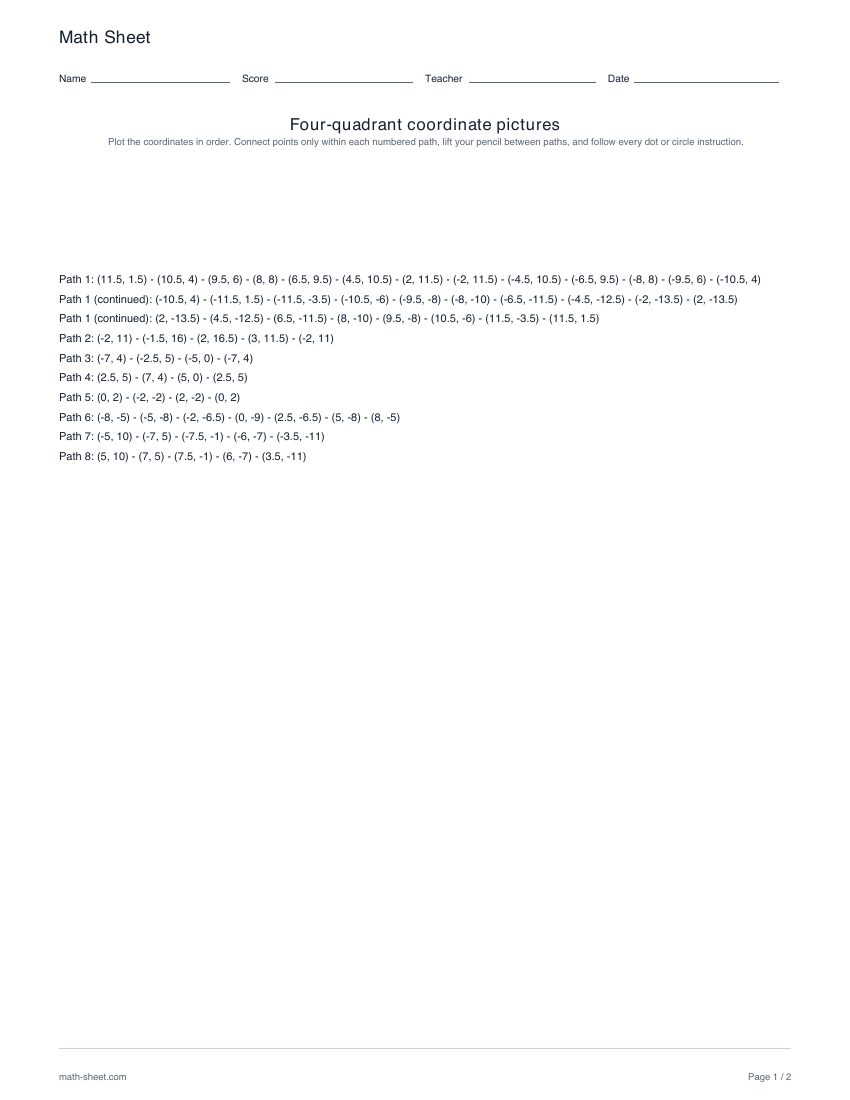
Graphing
Choose from 21 original seasonal coordinate pictures. Plot signed ordered pairs, connect separate paths and complete any dot or circle details, with full printable lists and answer graphs.
Preview and downloadChoose by readiness
Start with the coordinate skills the learner already understands. These selections use familiar grade labels for navigation; schools and countries may introduce graphing at different stages.
Connect horizontal and vertical positions with point labels before introducing negative coordinates.
Open this practice →Work through separate paths after positive coordinates and half-unit positions are familiar.
Open this practice →Use the signs of x and y to locate points, including positions on the axes.
Open this practice →Start with one sequence and check the completed shape before trying multiple paths.
Open this practice →An ordered pair gives two positions. In (−4, 2), x = −4 places the point four units left of the origin, and y = 2 places it two units up. Reversing the numbers produces a different point.
A zero coordinate places a point on an axis. The point (0, 5) is on the y-axis; (5, 0) is on the x-axis. Neither point belongs inside a quadrant.
Easy puzzles use one short sequence of 3–9 listed points. Medium puzzles use 10–19. Hard puzzles use more than 20 and introduce separate paths and half-unit positions. Each level has four original designs. New problems draws from that set, so a design can repeat.
For a fixed seasonal task, choose from 21 four-quadrant pictures: autumn and Halloween designs, Thanksgiving pictures, winter pictures and Easter bunnies, eggs and baskets. The bunny, egg and basket also have first-quadrant versions.
Choose a coordinate picture →A detailed picture may have several pages of coordinate lists followed by a blank graph. Continued paths keep their path number and repeat the last coordinate so that the next connection is clear. The answer edition adds a completed graph for checking.
Pick US Letter or A4 to match your paper. Ready-made downloads are English; the generator supports eight printed languages and an optional page note.
Read the printing guide →Set your own task
Use these existing paper generators for your own coordinates, functions or scale drawings.
Graph paper
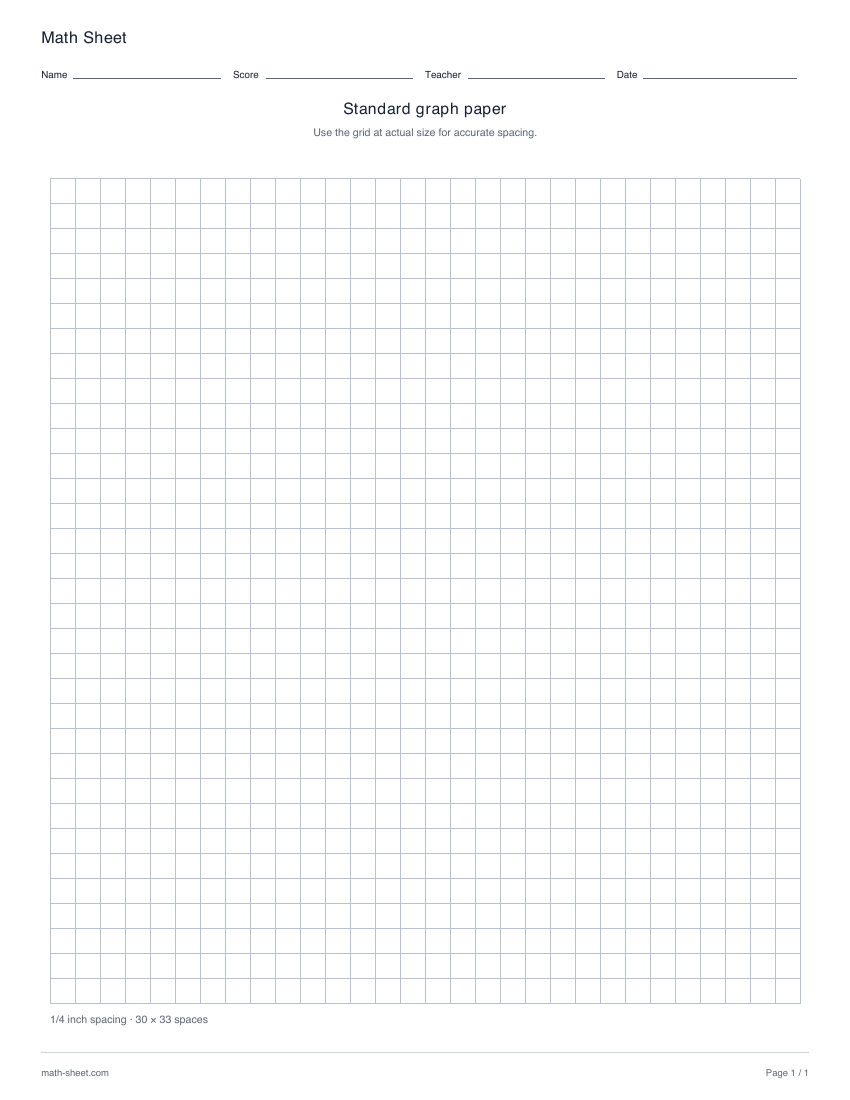
Print square graph paper with 1/10, 1/4, 3/8 or 1/2 inch spacing, or a true 1 cm grid. Choose US Letter or A4 and preview the actual number of cells.
Preview and download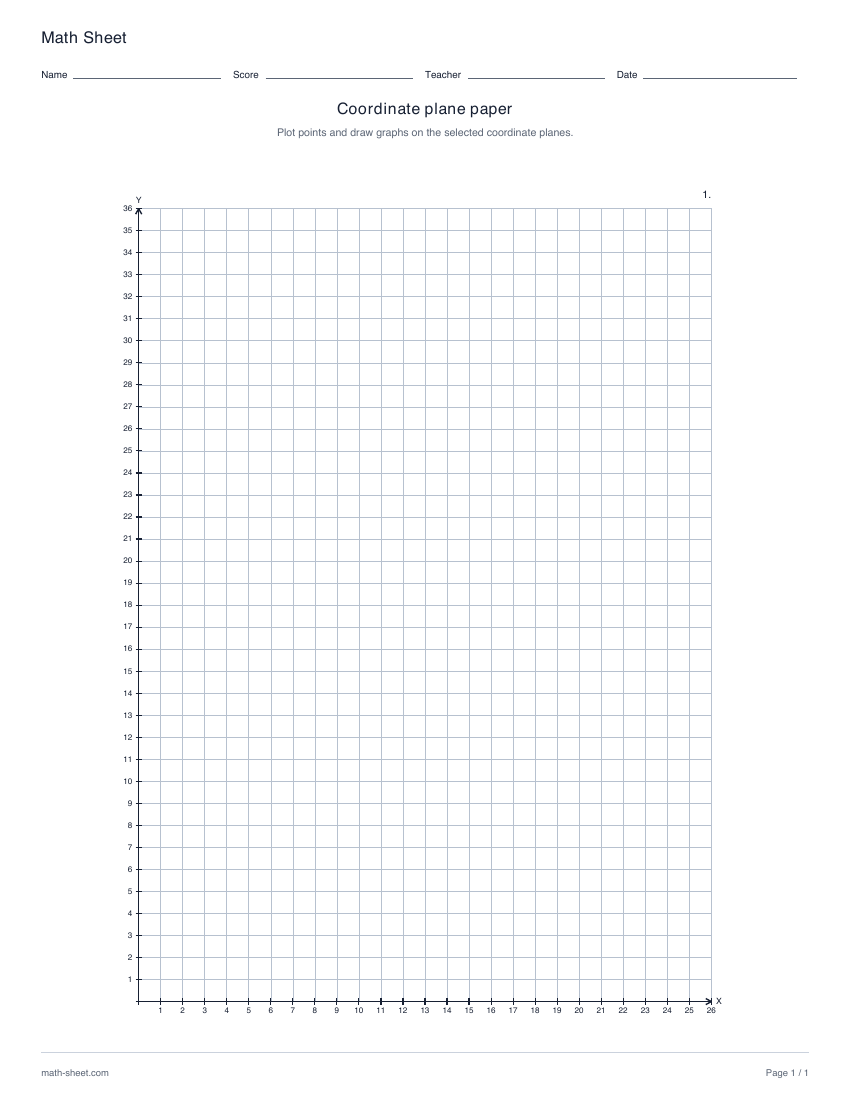
Graph paper
Print first-quadrant or four-quadrant coordinate planes in seven layouts. Choose numbered or unnumbered axes while keeping the declared coordinate ranges.
Preview and download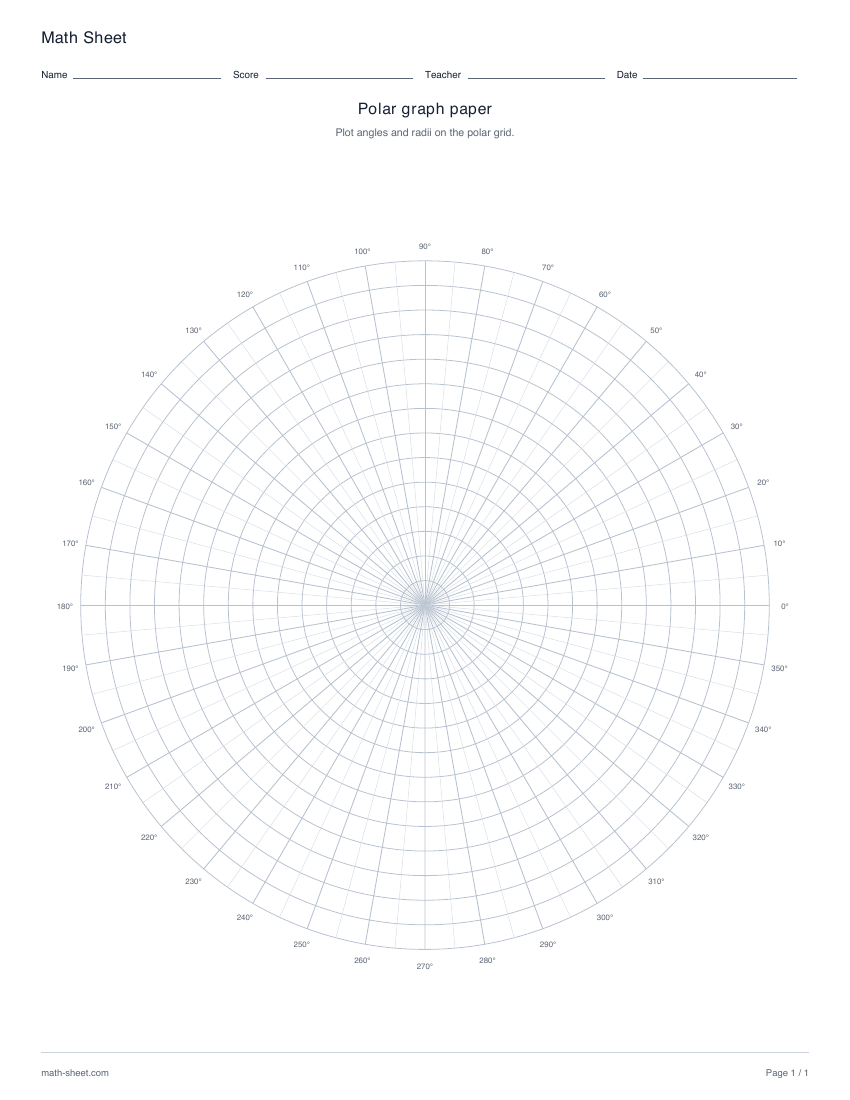
Graph paper
Print a polar grid with fourteen concentric circles and spokes every 2°, 5° or 10°. Angle labels appear every 10° around the outside.
Preview and downloadBar charts, line plots, pie charts and other displays belong in the graph worksheets collection, where learners work with datasets and interpret what a graph shows.
Explore data graph worksheets →Ordered-pair sheets ask learners to read labeled points and plot new points. Puzzles add a sequence to connect and reveal a shape. Fixed coordinate pictures add longer numbered paths and may include half-unit positions, dots and circles; choose them after plotting is secure.
Choose four-quadrant ordered pairs for reading and plotting, four-quadrant graphing puzzles for a short connected task, or four-quadrant coordinate pictures for a fixed seasonal design. First-quadrant resources use positive positions instead of practicing negative coordinates.
Print the complete student edition for every coordinate-list page and its blank grid. The separate answer edition includes the completed graph. A picture may take more than one page, so check the full preview before printing.