
Probability
Single die probability worksheets
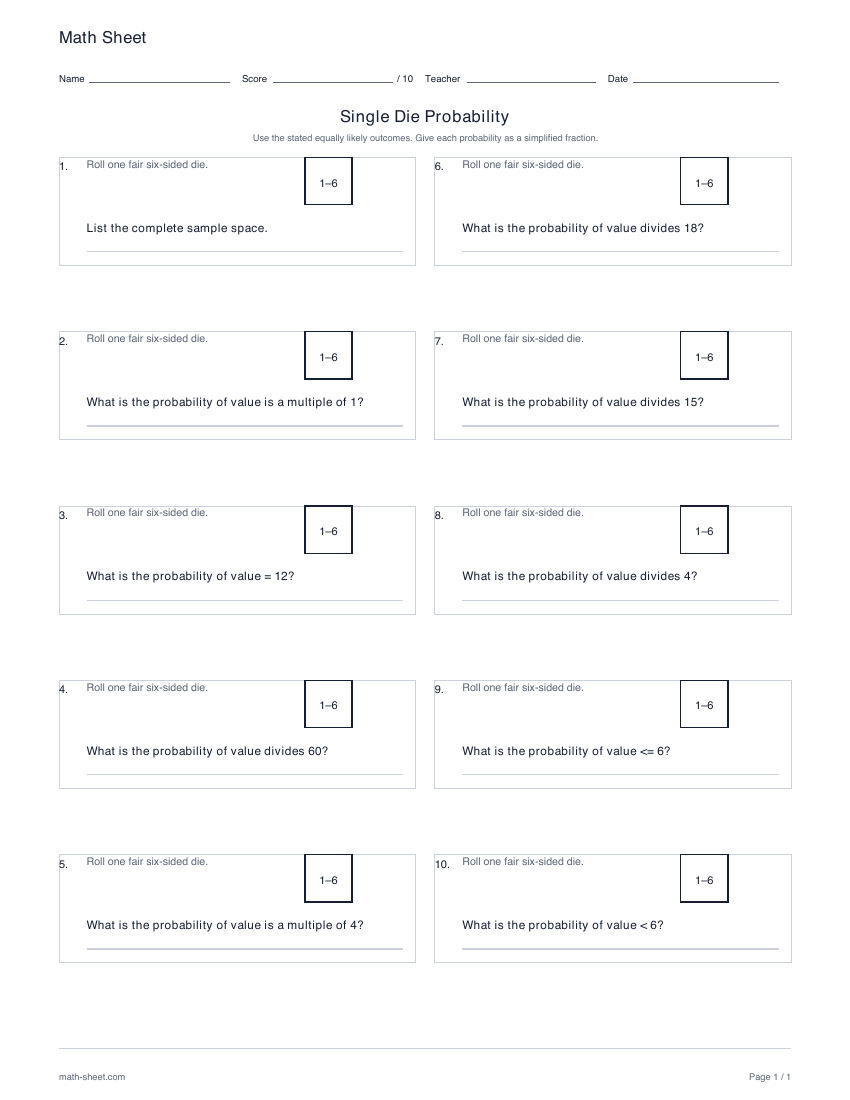
Explore six equally likely outcomes on a fair die. Choose number, multiple-and-divisor or factor questions, then print a worksheet and a separate explained answer key.
Preview and downloadProbability practice
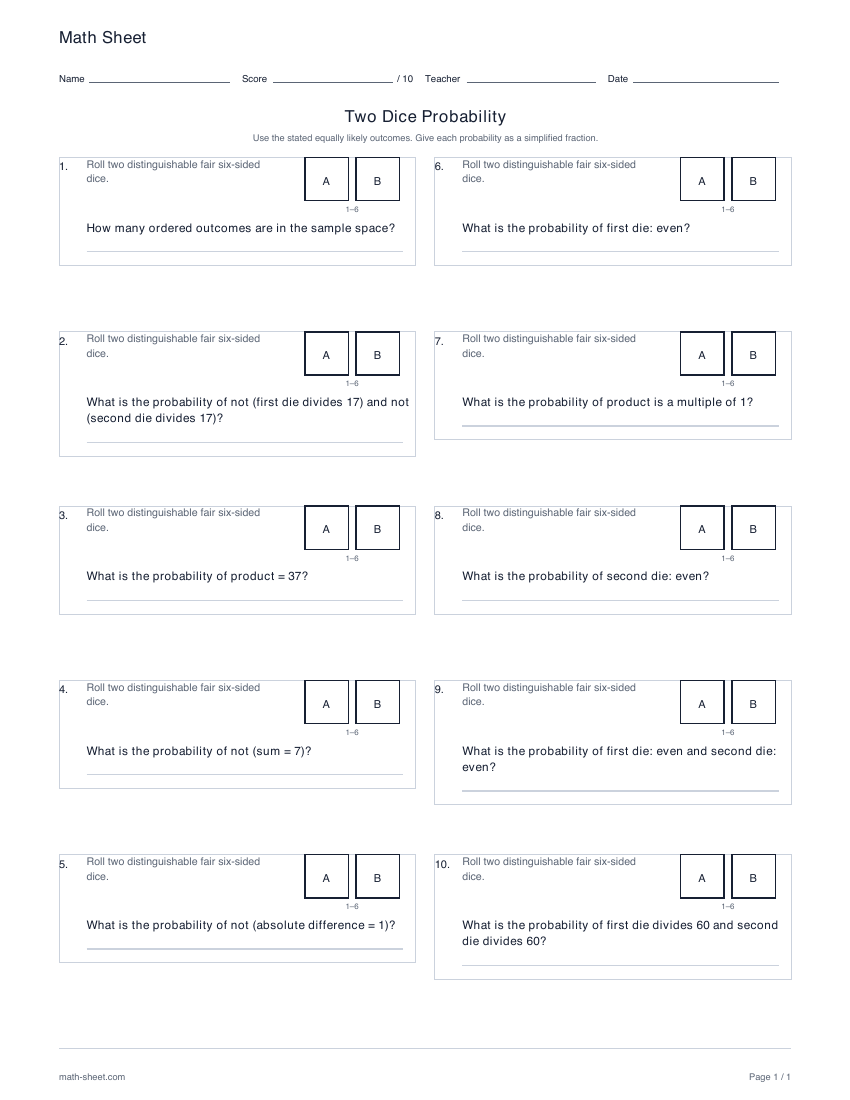
Count ordered outcomes from two fair dice. Practice number events, sums, differences, products and factor relationships with probabilities derived from all 36 possible pairs.
Ready-made English PDF · fixed settings
Customization below makes a separate PDF.
Fixed English ready-made files. Custom settings below apply only to the configured PDF.
Ready to print
Treat the first and second dice as distinguishable. Count matching ordered pairs out of the 36 equally likely outcomes, then simplify.
Download the practice pages alone, or include a separate answer key or teacher model. Longer activities may use more than one page.
Customize this worksheetEach question makes its experiment and event explicit. The answer key connects the favorable count with the whole sample space, then simplifies the fraction. Selected question families control what appears on the sheet.
A probability is a property of the stated model. When outcomes are not equally likely, a simple count of different labels is not enough. With two dice, use 36 ordered pairs rather than eleven possible sums.
Learning objective
Use ordered pairs to calculate compound-event probabilities without assuming that sums are equally likely.
Worked example
6/36 = 1/6.
The six matching pairs are (1,6), (2,5), (3,4), (4,3), (5,2) and (6,1). There are 6 × 6 = 36 equally likely ordered outcomes. A sum of 2 has only one matching pair, so the possible sums do not all have the same chance.
Teaching notes
Make it yours
Choose your options, update the preview, then download the exact same pages.
The two dice are distinguishable, so the sample space has 36 ordered outcomes. Sums are counted from those outcomes.
A useful next step
Probability
Explore six equally likely outcomes on a fair die. Choose number, multiple-and-divisor or factor questions, then print a worksheet and a separate explained answer key.
Preview and download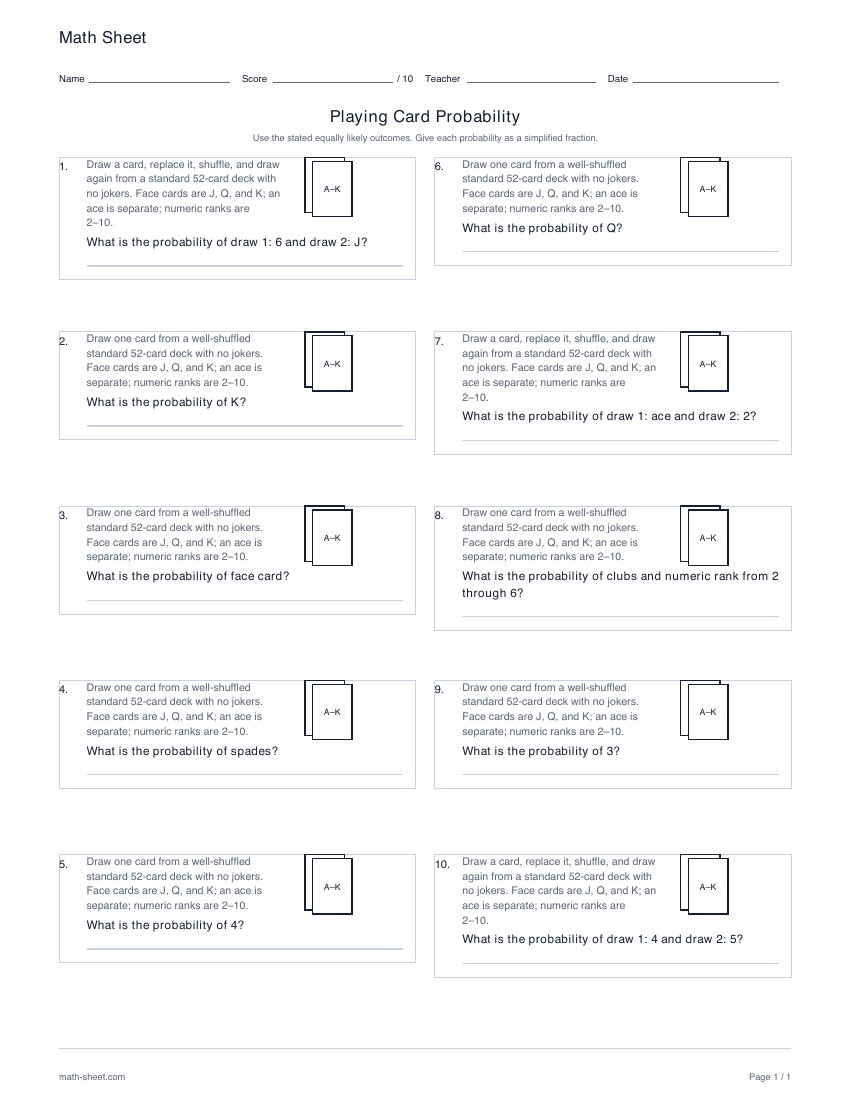
Probability
Calculate probabilities in a standard 52-card deck. Choose single draws or independent draws with replacement, with explicit card conventions and an explained answer key.
Preview and download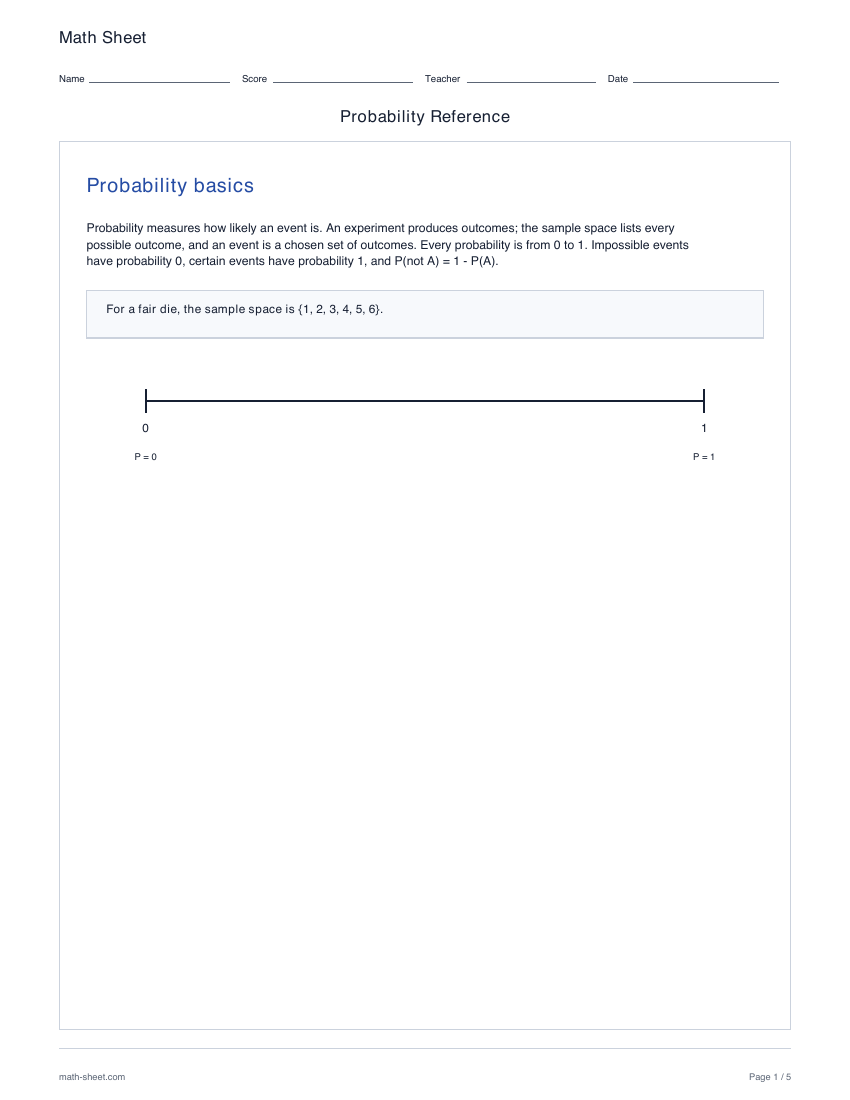
Probability
A printable guide to probability, independent and dependent events, replacement and probability trees. Connect definitions with worked examples and conditional branch probabilities.
Preview and download