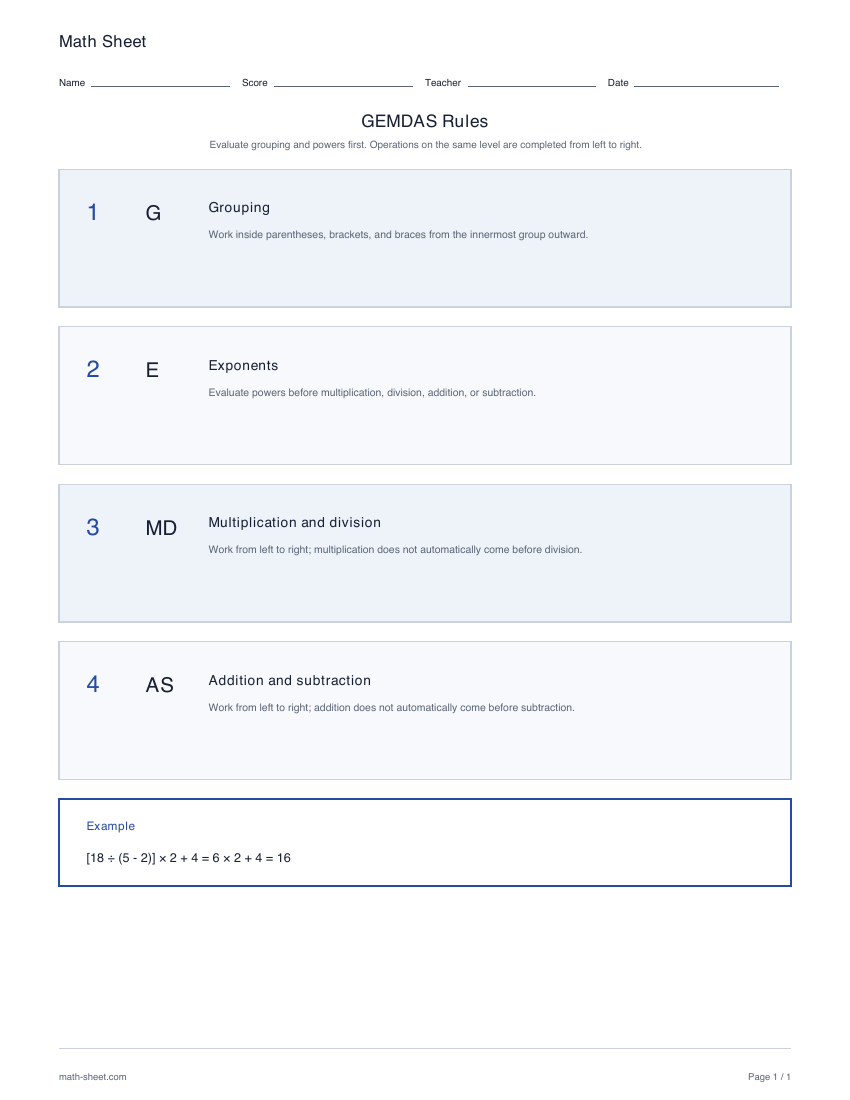
Use an order-of-operations handout that treats parentheses, brackets and braces as grouping symbols. Follow a nested example from the innermost group outward.
Fixed English ready-made files. Custom settings below apply only to the configured PDF.
Ready to print
Print the reference handout
Start with the innermost group. Continue through powers, multiplication/division and addition/subtraction, using left-to-right order within tied levels.
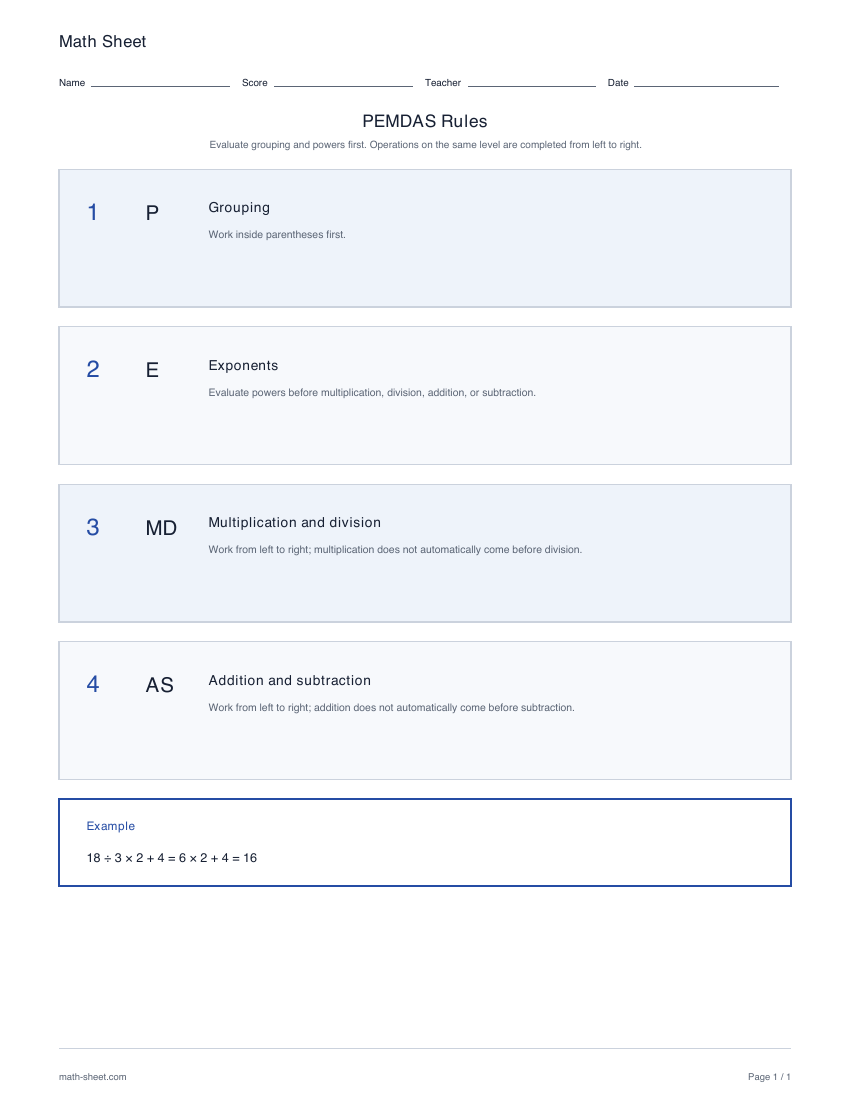
Download the complete reference with its explanations and worked examples. This handout does not need a separate answer key.
Print the English reference in Letter or A4, or choose another printed language below. The handout includes the explanation and examples together on one page.
Pair the reference with a focused worksheet. The important habit is identifying the next operation and explaining why it comes first.
Learning objective
What this activity builds
Recognize equivalent grouping symbols and evaluate nested groups before surrounding operations.
Worked example
Evaluate 2 × [3 + (8 − 5)].
2 × [3 + 3] = 2 × 6 = 12.
The parentheses are inside the brackets, so 8 − 5 is calculated first. Then finish the bracket before multiplying by 2. The shape of the grouping symbol does not create a new arithmetic priority.
Teaching notes
Make the practice count
Trace the matching opening and closing symbols before beginning.
Work from the deepest group outward, keeping the rest of the expression unchanged.
Rewrite the full expression after each step to avoid losing terms.
Show that replacing a matched pair of brackets with parentheses does not change its meaning.
Make it yours
Customize the reference
Choose your options, update the preview, then download the exact same pages.
Print a clear order-of-operations reference with grouping, powers, multiplication and division, then addition and subtraction. Worked examples explain equal precedence and left-to-right calculation.
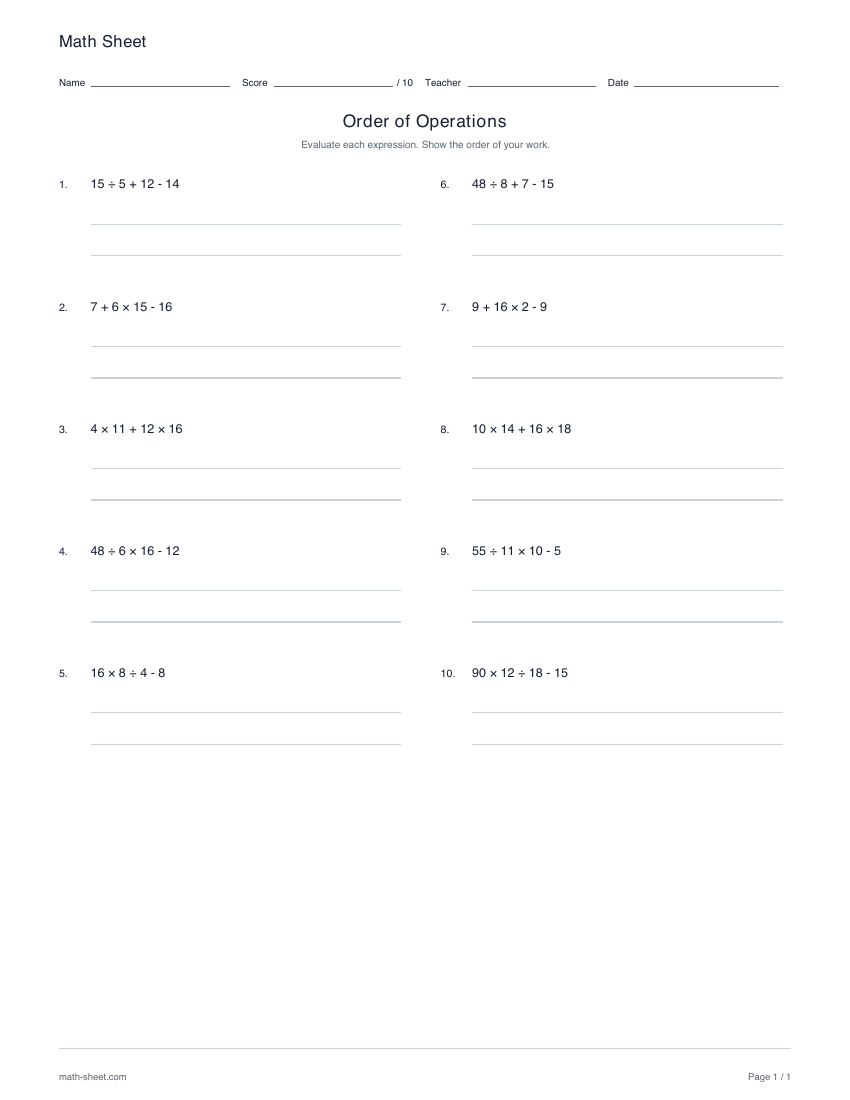
Evaluate ten expressions with all four arithmetic operations. Select easy or hard practice and five grouping/exponent formats, then print the questions and a separate worked key.
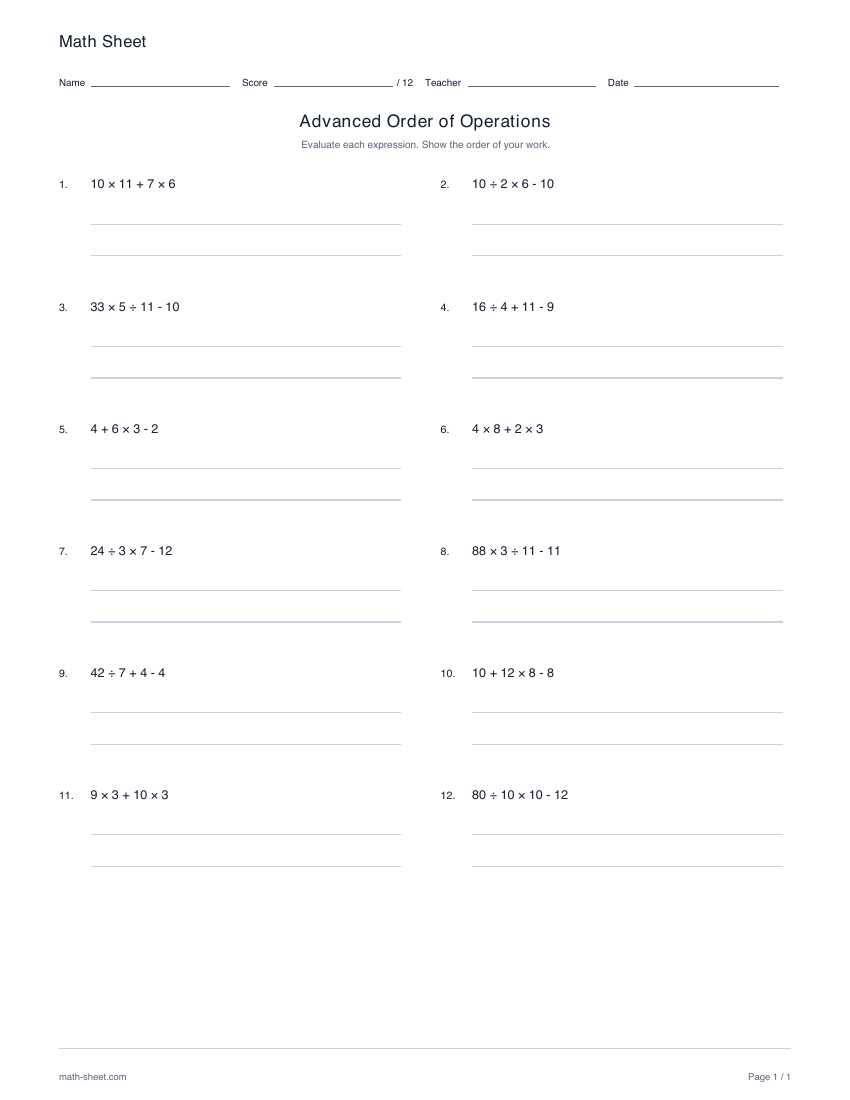
Work through twelve expressions with positive, negative or mixed inputs. Combine easy or hard practice with grouping, nested groups and exponents, and check a separate answer key.